Agreement signed for construction of new roads on six islands

A MVR 424 million (US$27.5 million) agreement for the construction of roads on six islands has been signed by the Ministry of Housing and Infrastructure and Maldives Road Development Corporation (MRDC).

The islands chosen for the road construction project are Dhidhdhoo in Haa Alif Atoll, Hanimaadhoo in Haa Dhaalu Atoll, Kudahuvadhoo in Dhaalu Atoll, Vilufushi in Thaa Atoll, Villingili in Gaaf Alif Atoll and Thinadhoo in Gaafu Dhaalu Atoll.

According to local media, nine roads are to be constructed in Vilufushi, fifteen in Villingili, 21 in Thinadhoo, 13 in Kudahuvadhoo, 21 in Hanimaadhoo and 15 in Dhidhdhoo.

Speaking at the ceremony, President Mohamed Waheed Hassan Manik expressed hope that road construction work in the six islands would be completed soon.

Likes(0)Dislikes(0)

MDP pickup seized by police

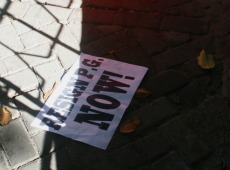
Police have seized a pickup truck used by Maldivian Democratic Party (MDP) during today’s protest, local media reported.

The pickup, which is used by the party to play pro-MDP music through a loudspeaker, was removed after it began to disturb students at a nearby school.

Police had given orders to protesters to leave the area, eventually pushing the crowd up towards the Roashanee Building on Sosun Magu, local media reported.

Resulting clashes between police and demonstrators saw multiple arrests.

Likes(0)Dislikes(0)

Indians, not MDP, should be demanding Maldives intervention: Firstpost

If India continues its nervous fence-sitting, Waheed will do a Rajapakse and China will quickly expand its toe-hold in the island(s), writes G Pramod Kumar for India’s Firstpost publication.

In fact, India had lost considerable ground by not openly backing Nasheed at the time of the coup. India could have sent his army – just as the way it sent its forces to rescue Gayyoom when he was under attack by mercenaries in the 1980s- and protected Nasheed.

His supporters in fact wanted India to prevent his ouster, but the regional super power exposed its weakness by refusing to intervene. Now, here is the second chance for it to reclaim lost ground and redeem its super-power image.

What’s wrong in protecting our strategic interests in our own backyard? The interests of a 1.2 billion people democracy and a US$ 1.8 trillion dollar economy?

In fact, it should be Indians, not the MDP, that should demand that India play a decisive role in Maldives. It’s in our interest.

It’s not Bangladesh, Bhutan or Afghanistan that we should have controlling stakes in. We should have complete control of the Indian Ocean for our people and our interests to be safe because that is where China and Pakistan is expanding.

A decade ago, the Himal magazine published from Kathmandu had found an innovative perspective for south Asia to escape the air of Indo-Pakistan strife that dominated the region – to look at it upside down where the Indian ocean and the southern parts of India dominated the map. But today, even our part of the Indian ocean seems to be going out of our grip. India is hemmed in from all sides by just two countries – China and Pakistan!

Supporting authoritarian regimes in the region – both in Maldives and Sri Lanka – will be seriously detrimental to our interest. We cannot talk foreign policy with (their) rogue alliances smirking right on our face.

Maldives is not just about Nasheed, it is also about India, its people and its history.

Read more

Likes(0)Dislikes(0)

Protesters released on condition they “not be seen in groups”

Five Maldivian Democratic Party (MDP) protesters arrested Monday (February 18) night were released on the condition they “are not seen within groups for two months,” reports local media.

The Criminal Court “remanded to arrest” 16 of the 84 people taken into police custody during protests.

The court also extended the detention period of four other protesters.

Likes(0)Dislikes(0)

PPM Youth Wing to protest against MDP demonstrations

The Progressive Party of Maldives (PPM) Youth Wing have said they intend to hold a demonstration against the recent Maldivian Democratic Party (MDP) protests.

PPM Youth Wing President Ibrahim Nazim told local media that when “the time is right” the youth wing will “pour out into the streets” to show their discontent at the recent MDP demonstrations.

“Compromising the peace and safety of the country, committing arson, attacking police and military, harassing their families, we cannot just idly sit by and watch this.

“They are even being harassed near schools. It is just not yet our time,” local media reported Nazim as saying.

The youth wing president claimed that they had remained quiet so far as they belong to a party that was part of the coalition government.

Likes(0)Dislikes(0)

Trial hearing cancelled after police report failure to produce Nasheed

Additional reporting by Neil Merrett.

Former President Mohamed Nasheed’s trial hearing scheduled for 4:00pm today (February 20) was cancelled by the Hulhumale’ Magistrate Court after police were unable to present him to judicial authorities due to his presence in the Indian High Commission.

The High Court meanwhile threw out an appeal hearing into the first warrant issued on February 13, after Nasheed failed to appear at a hearing scheduled for 1:00pm this afternoon.

On Monday (February 18), the magistrate court issued a second arrest warrant requesting police present Nasheed on charges of illegally detaining Chief Criminal Court Judge Abdulla Mohamed during his final days in office.

An official from the Judiciary Media Unit confirmed Nasheed’s hearing was cancelled after police said the former president could not be arrested while still inside the Indian High Commission.

“Police have said they won’t be able to bring Nasheed to Hulhumale’ Magistrate Court and so the hearing has been cancelled. A new hearing is yet to be scheduled by the court,” the official said.

The Maldivian Democratic Party (MDP) have said Nasheed will remain inside the High Commission until an interim government is established ahead of the presidential elections in September.

Police have cordoned off the street outside the High Commission, but have so far taken a hands off approach towards the few hundred Nasheed supporters protesting at the barricades.

Police Spokesperson Sub-Inspector Hassan Haneef was not responding to calls from Minivan News at time of press.

Stalemate

Nasheed and the MDP have maintained that the charges against him are a politically-motivated attempt to prevent the former president from contesting in presidential elections scheduled for later this year.

Nasheed’s lawyer Hassan Latheef said the former president’s team of lawyers were having to rely on the media to receive updates regarding the latest news from Hulhumale’ Magistrate Court, and were not being officially informed of any decisions it was making.

“It is very unfortunate that we are not directly informed by the court regarding the developments in this case. Instead, we are having to contact the court for information,” he said.

“We are relying on the media for updates. Now that the court hearing has been cancelled, we have no idea what will happen,” Latheef said.

Asked whether about the possibility of the trial being conducted in absentia, Latheef added: “The constitution states clearly that no trial can be held with the defendant being absent.”

“However, knowing this particular court and the knowing the magistrates on the case, as well as the police and government, I do not doubt it could happen,” Latheef said.

Earlier today, MDP Spokesperson MP Hamid Abdul Ghafoor said that the Foreign Ministry had already been in touch with the Indian High Commission to try get them to hand Nasheed over to police.

“I wouldn’t put it past the government to raid the Indian High Commission, partly because nobody expects them to do it,” Ghafoor said.

India’s Special Envoy arrives

India’s Special Envoy Harsh Vardhan Shringla visited Male’ today to try and resolve the stalemate, which has attracted widespread international media coverage, and extensive attention from the Indian media. No headway or details of meetings had been reported at time of press.

Meanwhile, a small police presence manned barricades around the the Indian High Commission building ahead of the scheduled trial.

Minivan News also observed a large UN contingent sitting in Traders Hotel opposite the High Commission. UN Special Rapporteur on the Independence of Judges and Lawyers, Gabriela Knaul, is currently in the country for a scheduled visit until February 24.

A large number of tourists were passing through the barricades and having their photos taken with police officers controlling traffic outside the high commission. A row of 30 bouquets of flowers had been placed against the wall of the commission earlier in the day by a group of female Nasheed supporters. One had a card the read: “We will always be with our President (Anni) XX”.

As the time of the hearing neared, around 200 MDP supporters gathered outside the party office on Sosun Magu before moving to the Prosecutor General (PG)’s Office demanding the PG withdraw the charges against former President Nasheed.

As the 4:00pm deadline passed, a few hundered supporters and onlookers once again gathered on Sosun Magu, where they have been holding successive daily demonstrations since Friday (February 15).

Around 20 riot officers were deployed to control the crowd, remaining a few hundred yards away from the protesters.  The atmosphere was tense as supporters continued to heckle authorities, however at time of press police had taken no action to disperse the demonstration.

However police subsequently seized a yellow-painted pick-up truck equipped with a loudspeaker that was playing the party’s protest songs, claiming that it was disturbing nearby schoolchildren.

Likes(1)Dislikes(0)

Experts lambast results of US$170,000 million National Drug Use Survey

A survey published by the United Nations Office on Drugs and Crime (UNODC) and Maldivian National Drug Agency (NDA) has claimed there are 7496 drug users in the Maldives.

According to the findings of the nationwide survey, 6.64 percent of people aged 15-64 in Malé and 2.02 percent in the atolls are currently using drugs, with the highest proportion of drug users aged between 15 and 19 years old.

The study also sought to determine drug use patterns, assess behavioral characteristics, and identify “community knowledge, attitudes and perceptions towards the drug problem”.

According to the study, being unmarried is considered a “risky behavior among drug users”.

Non-governmental organisations (NGOs), community based organisations (CBOs), and other stakeholders were also found to “heavily emphasise law enforcement and faith-based value systems,” as opposed to treatment and rehabilitation.

“A strong endorsement of Sharia’h law was apparent. In words of a key stakeholder, ‘Treatment alone will not yield results. It must be in conjunction with proper punishment’,” the report stated.

The survey findings also “confirmed that drug use in Maldives is predominantly a male phenomenon” and claimed the most common drugs are hash oil and brown-sugar (a heroin derivative) – known locally as theyo and hakaru, respectively.

However, key populations such as those in jail, women, and users of ‘party drugs’ were left out of the survey.

Controversial findings

Informed sources who participated in the survey process have expressed serious concerns about the “flawed methodology” of the data collection process, which they claimed had produced a final report that inaccurately and grossly underestimates drug use in the Maldives.

The number of drug users reported by the survey was extremely low compared to the number of actual users, the sources said, which previous studies had found ranged between 20,000 and 30,000 people.

“The methodologies used are flawed and do not work in the Maldivian context because of social stigmas surrounding drug use. There was no effort to develop a methodology that would be appropriate for this country context,” said a source.

The enumerators used to conduct interviews for the survey were “very young, inexperienced kids” while those with “extensive experience” in drug abuse prevention and with surveying were marginalised, sources claimed.

“No one in the Maldives will openly admit ‘I’m a drug user’ – it’s seen as a moral issue because of religious beliefs,” the sources stated.

“The survey team was getting zero numbers from some atolls. But they insisted they were using a scientific methodology and this would be corrected at a later date,” the sources explained.

“All these young people who just finished school who were used as supervisors, they were useless,” the sources alleged.

“Teenage interviewers would go to houses and ask elders if there were any drug users in the household, and of course they said no. Additionally, drug users are also very manipulative,” the sources said.

Production of the report involved 50 enumerators surveying 3500 households, 762 people, and 72 focus group discussions.

“The incentives used – 20 MVR for completing a questionnaire – targeted heroin users only. Additionally, 80 percent of incarcerated population uses drugs and they were not included in this survey,” informed sources stated.

“Furthermore, the differentiation between male and female addicts, and the exclusion of women from the survey, is not something normally done,” the sources added.

The sources claimed the National Drug Agency (NDA) was informed about the methodological flaws, however no action was taken to correct the problem.  Moreover the NDA did not set policy standards or engage in oversight and instead conduct implementation without any monitoring, they claimed.

“When this survey started two years ago, the government was informed about all these problems, but they did not give a damn about this. The purpose of all this manipulation is for political reasons. They want to show the public that the [drug abuse] problem is improving,” the sources alleged.

“The government should know what they are doing in this sector. They should know better than to use drug addiction as a political tool,” the sources stated.

Flawed findings

Expert sources involved in the survey process had strong negative reactions to many of the report’s findings.

“Being unmarried is not a risky behavior related to drug use. How did they come to this conclusion? It’s crazy!” said one informed source.

“NGOs, CBOs, and stakeholders are not in favor of punishment over treatment. NGOs changed the law to have drug abuse recognised as a disease,” they said.

New trends in drug use were excluded from the report’s focus as well.

“There are drugs that are not even mentioned in this survey coming in now, like meth, and most of the party drugs are available in the Maldives now, such as speed, ecstasy, and LSD.

“Older users are going for the heroin, while youth that are to use hashish oil are now also going for party drugs,” the sources explained.

More harm than good

The survey’s findings were “commendable”, said National Drug Agency Chairperson and State Minister for Health, Uza Lubna Mohammed Zahir Hussain, in the report’s foreword.

“The information provided by this survey without a doubt contributes to a better understanding of the nature and extent of the impact of drug abuse and this understanding will help decision makers to identify appropriate strategies to combat the problem of drug abuse in the Maldives,” Lubna stated.

However, the informed sources were distraught by the possible ramifications of the report’s “flawed” findings.

“Future plans, policies, and interventions will be designed based on this survey, which is not accurate. We know very clearly the results are wrong,” they said.

“Now for another 10 years there will not be enough funds for drug prevention and treatment. Donors will refer to the survey and think the Maldives doesn’t need any prevention or treatment programs, because the reported prevalence rate is so low,” said sources.

For example, expert sources explained there was only one rehabilitation center in the Maldives and that it is “inappropriate” for the Maldivian context, as well as understaffed. No experts in drug abuse treatment staffed the rehabilitation centre, the NDA or Health Ministry, they added.

“The NDA is running the rehab center, which employs a behavior-based program for heroin users. It doesn’t work for other types of addicts and there is no oversight. There are no beds and all the toilets are broken.

“There was a marijuana user sent for treatment. Every other day he tried to swim away from the rehab island and nearly drowned because he has  mental problems. The program didn’t match his needs,” sources stated.

Sources explained there were numerous such problems which will now be greatly exaggerated by the survey’s “false” findings.

“Already there are next to no prevention efforts, supply reduction policies, or harm reduction programs; nothing comprehensive.

“Customs and the Maldives Port Authority have no container scanning machines and no drug-sniffing dogs. Anyone can bring drugs into the country,” they said.

“Meanwhile, government policies are changing almost every day. Whenever the government involves themselves in this sector they do harm, not good,” the sources lamented.

Sources claim that government policies under the last three administrations have been “ad hoc” and worsened drug abuse within the Maldives. Multiple international consultants have conducted drug use assessments and their recommendations are nearly identical, yet these recommendations are never enacted as policies, the sources stated.

Minister of Health Dr Ahmed Jamsheed Mohamed also voiced concern regarding drug abuse policies. During his speech at the survey’s launch, he stated that drug abuse was the “worst enemy of development” and based on the survey’s findings, it is necessary to “take a break, take stock, and strategise”.

The National Drug Use survey was conducted between 2011 and 2012, by the UNODC, NDA, INOVA Pvt Ltd, All India Institute of Medical Sciences (AIIMS), in partnership with five civil society organisations. The European Union and Swedish government provided US$2,180,200 in funding.

Download the National Drug Use Survey

Clarification: The National Drug Agency (NDA) has responded to this article in a letter, published on Minivan News. According the NDA, the US$170,000 budget for the survey was “a small amount of the overall budget of expenditure pertaining to the NDUS research”, and therefore the reference in this article’s prvious headline to the total funding of US$2 million was misleading. Minivan News has clarified the headline to avoid confusion.

Likes(1)Dislikes(0)

Police increase security presence in Male’ and atolls

Police have increased security measures around Male’ and other Atolls in order to main peace and order, local media reported.

The announcement comes after a week of protests carried out by Maldivian Democratic Party (MDP) and supporters of former President Mohamed Nasheed.

Police said that Special Operations police, capital police and traffic police are now active during the night in Male’, and that city police have increased their vigilance, according to local media.

A number of demonstrators have been apprehended following the unrest in Male’ and police have reported that multiple officers have been injured following confrontations with protesters.

Likes(0)Dislikes(0)

Comment: Justice has little to do with the impending prosecution

This article was first published on Dhivehisitee. Republished with permission.

With former President Mohamed Nasheed taking refuge at the Indian high Commission in Male’, the international community’s strange apathy towards the ongoing fight for democracy in the Maldives has been stirred, if not entirely shaken. As Male’ waits to find out how India will respond to the Maldivian government’s request to hand Nasheed over to the police today, it is worth looking at the intricacies of small island politics where personalities loom large. What is at stake, and equally importantly, who are the players?
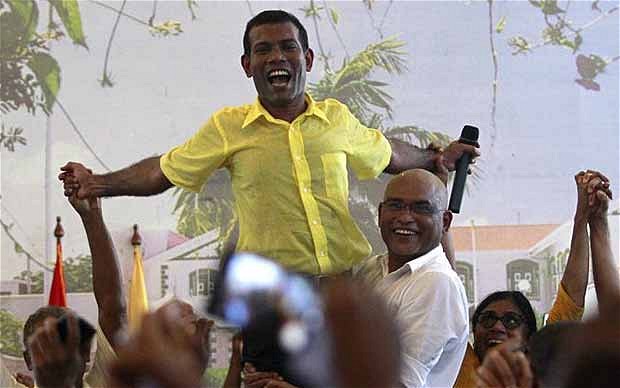
Mohamed Nasheed, the first democratically elected president of the Maldives, is holed up in the Indian High Commission in Male’. Seeking refuge in Indian diplomatic premises was a smart move by the former president, a veteran democracy activist. It not only provided him sanctuary and forced India’s involvement, it also provided India – smarting from Male’s recent insults and shabby treatment of GMR — with the opportunity to do a policy U-turn without embarrassment.

Nasheed has now been at the Indian High Commission for a week. If he leaves, his next long-term residence is most likely to be the prison island of Dhoonidhoo. The current government is prosecuting Nasheed for arresting Chief Judge of the Criminal Court, Abdulla Mohamed, in January 2012, a month before the coup. The pursuit of Nasheed through the courts began in July last year. Several summons and arrest warrants have been issued, cancelled and enforced since. In October last year, the police made a deliberately high profile arrest of Nasheed while campaigning on an island far from Male’. The last arrest warrant, issued on Monday, five days after Nasheed took refuge at the High Commission, expires at 4:00pm today.

Nasheed, an Amnesty prisoner of conscience who spent several years in jail for dissent, has said the prosecution is politically motivated. The purpose, he says, is to ensure he cannot run in the presidential elections scheduled for 7 September. Any sentence will disqualify him from the race. If Nasheed is prevented from running, there will be unrest like the country has never before seen. He is loved by many, more than he is loathed by coup-makers and their supporters. His Maldivian Democratic Party (MDP) has over 47,000 members, and they are all ardent supporters.
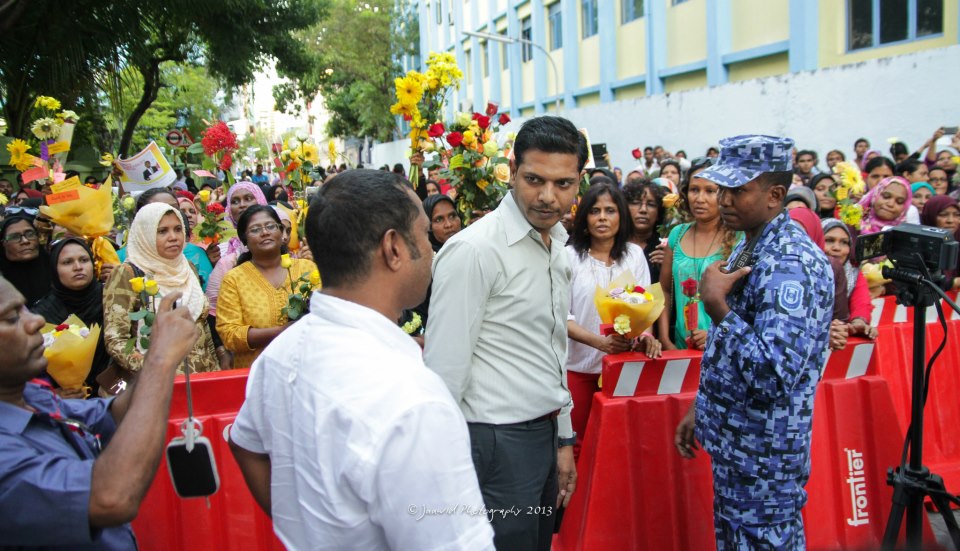
Since Nasheed sought refuge, several ‘delegations’ from various constituencies have presented him with bouquets, some wrapped in silk, almost on a daily basis. Yesterday they brought him bouquets, or at least tried to, until the police blocked their way with barricades.

Nasheed had been ‘the people’s president’, mingling with the young, the old, the rich and the poor with equal ease. When he takes to the streets, they follow him. Now, sensing he is in danger, they march on the streets of Male’ every evening, calling for his protection. Several have stated — with all seriousness — that Nasheed can only be taken into custody over their dead bodies. At an MDP press conference in Colombo, Sri Lanka, yesterday, former Foreign Minister Mohamed Naseem announced the party would boycott the elections if Nasheed is prevented from running under any pretext. That is close to 50,000 people, a large chunk of voters among the 350,000 population who would not participate in the election.

Mohamed Waheed Hassan Manik, the current president, along with a group of nameless men “all… of the same level” who now rule the country, meanwhile, are depicting Nasheed’s presence at the Indian High Commission as a ploy to avoid facing the charges against him. Waheed said he was “dismayed” Nasheed remained at the Indian High Commission, instigating “street violence”, his view of the nightly demonstrations by Nasheed’s supporters.

Waheed used to be Nasheed’s Vice President but, when offered the presidency by coup-makers in January, promptly betrayed Nasheed and hastened to take oath as President of the Maldives. A PhD graduate from Stanford University with a long career in the United Nations, he was seen by the international community as someone who would ‘stabilise’ the volatile atmosphere created by the coup.

He has since aligned himself closely with the ideologies of the Islamist Adhaalath Party, overseen curtailment of several fundamental civil and political rights, disregarded blatant human rights abuses by security forces, and partaken in the xenophobic and nationalistic campaign to oust India’s GMR. Waheed loves Twitter, has intimate personal chats in public with his family on various social media and, although seemingly composed and calm most of the time, can surprise with fist-pumping, rebel-rousing speeches when excited.

Unlike Nasheed, Waheed has very few supporters. His party has just over 3000 members with no representation in parliament. It is a common joke that his supporters consist of his wife Ilham, his children, and one loyal advisor (among two). He recently launched his presidential bid at his wife’s house, but is yet to reveal whether he will compete as an individual or form an alliance with someone else. With so few supporters, and lack of potential allies, he has very little hope of winning, especially with Nasheed in the race. Based on past and present behaviour, it is clear that he would gladly participate in any political prosecution of Nasheed.

Waheed is not the only one. All of the presidential candidates would like to see the back of Nasheed. Former President Maumoon Abdul Gayoom, who returned to the political centre-stage after the coup, has said he is “embarassed” by Nasheed’s decision to take refuge at the High Commission. He must also feel frustrated. Gayoom and his fellow authoritarians’ control over the Maldives’ judiciary is now well exposed and often discussed. If Nasheed can be brought to court, all three judges, hand-picked from among the worst on the bench, would arrive at a guilty verdict with ease. They would impose a hefty sentence.
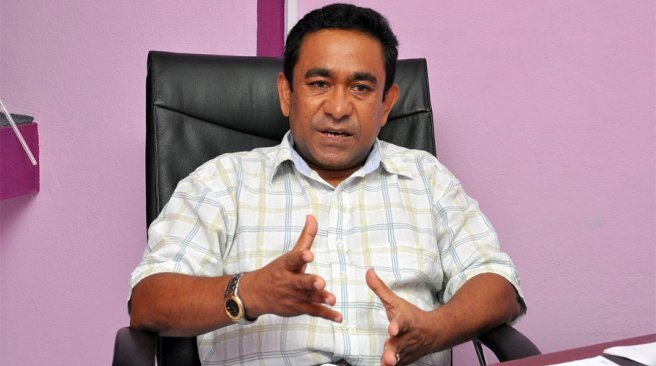
With Nasheed inside the Indian High Commission, international law has got in the way. Gayoom’s party, PPM, has not yet decided on their presidential candidate. Would it be Gayoom the septuagenarian? His politically active daughter, currently State Minister for Foreign Affairs, Dunya Maumoon? His brother Abdulla Yamin, against whom there are corruption charges amounting to US$800,000? One of Gayoom’s two sons? With Nasheed in the race, the times ahead will be tough for any member of the family. With him gone, the field is wide open.

Gasim Ibrahim and Ahmed Thasmeen Ali are also in the running. Gasim is one of the richest men in the country. He has shares in almost everything that makes money from five star hotels to the humble onion. He owns not just several resorts but a fleet of assorted vessels, an airport, and a hefty reputation for being a womaniser. Gasim never attended school (and is one of the country’s worst public speakers), but was recently awarded an honorary doctorate in entrepreneurship from the Open University of Malaysia in recognition of his mega-tycoon status.
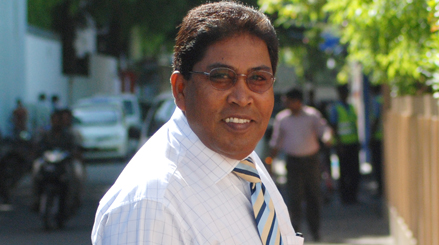
Gasim invests heavily in education, although his reasons for doing so are often far from altruistic. Attending one of his schools means towing his Jumhooree Party line – student and staff alike. He provides scholarships and loans for university education abroad for many, several of whom then enter into a life-long relationship of patronage with him. He recently described the power relations between him and the people as that of “master and servants.” Although without any training or experience in law or even a remotely related discipline, he now sits on the Judicial Service Commission (JSC), the chief overseer of the judiciary. Many of Nasheed’s supporters have asked: how can Nasheed have a fair trial when Gasim, his rival in the presidential race, sits in the JSC with its control over the judiciary?

Thasmeen’s party, the DRP, was Gayoom’s party before Gayoom split and formed PPM. While some maintain that DRP is ‘more democratic’ than PPM, with Thasmeen at the helm, the party participated in — and condoned — events of 7 February that ended democratic governance. Unlike his competitors – Nasheed, Gasim, Gayoom (or whoever Gayoom anoints from the shortlist) all of whom generate intense emotions among people – Thasmeen is mostly regarded with indifference. He rarely makes headlines, and is often discussed among rival supporters and democracy activists in relation to unpaid debts of millions owed by a family business.

DRP itself, however, still has a significant number of supporters. Last December Gayoom’s PPM overtook DRP in numbers to become the second largest party, but two days ago, DRP once again became the second largest party with 22,687 members. But, there is only a difference of 64 members between the two parties. The truth is, there is little that differentiates members of the two parties — some support PPM because it’s Gayoom’s, and others support DRP because it was Gayoom’s. Unlike Gayoom’s embarrassment and Waheed’s dismay, Thasmeen was “saddened” by Nasheed seeking refuge. Just like them, however, he sees Nasheed’s act as “unnecessary”, and a ploy to evade justice.

Apart from the candidates, there are also several petty chiefs who would like Nasheed behind bars. Several of them, frighteningly, work in law enforcement. The Defence Minister Mohamed Nazim, Police Commissioner Abdulla Riyaz, and Minister of Home Affairs Mohamed Jameel Ahmed, for example. All of them would love it if Nasheed simply disappeared.
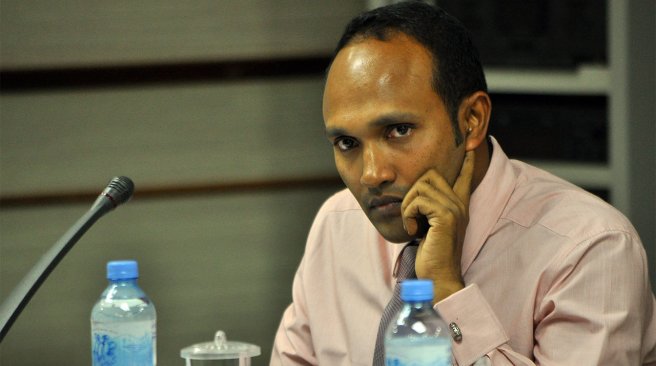
Jameel, the Home Minister (also present during the police mutiny on 7 February), is from the island of Fuammulah, an atoll unto itself, located furthest south of Male’. Jameel has a PhD in Law from London’s SOAS University, but has a shockingly tenuous grasp of the fundamentals of democracy, even rule of law. Jameel is known to have a vicious temper, having flown off the handle in public on several occasions, earning him the nickname Angry Bird. It would not be an exaggeration to say Jameel hates Nasheed.

In a pamphlet he co-authored with Hassan Saeed (with whom heads the Dhivehi Qaumee Party (DQP), another small party of little consequence) he accuses Nasheed of attempting to undermine and destroy the Islamic faith in the Maldives. Saeed is Jameel’s long-time friend (they live in the same apartment building) and he is also one of Waheed’s special advisors (the disloyal one). Nasheed had Jameel arrested for defamation after the ‘hate-pamphlet’ was published, but Criminal Court Chief Judge Abdulla Mohamed (the same judge for whose arrest Nasheed is currently being prosecuted for), released him.

For Jameel, it is payback time. Having Nasheed arrested and prosecuted before the elections is imperative, he has said. On Monday, Jameel told Times of India that “I would be the happiest person to see Nasheed contest and lose.” Jameel’s two fantasies are mutually exclusive, but will end with the same desired climax: Nasheed will not be President again.
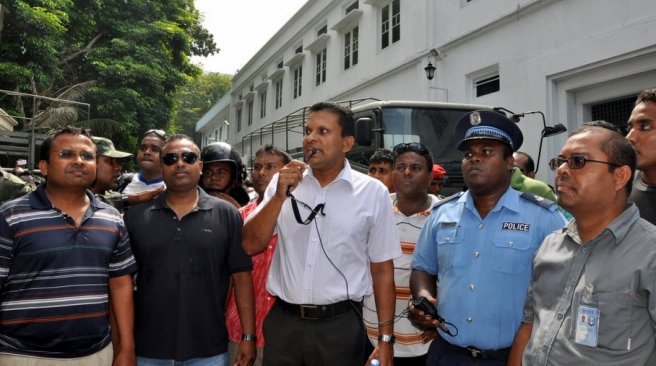
Nazim the Defence Minister and Abdulla Riyaz the Police Commissioner fear that should Nasheed be re-elected they, and not Nasheed, would be heading to Dhoonidhoo. Nasheed has called them traitors and openly declared his intention to prosecute them, if he is re-elected. They, with the current state minister for Home Affairs Mohamed Fayaz, commandeered the security forces during the police mutiny on 7 February 2012. To avoid jail time, they must imprison Nasheed. All three lost their positions during Nasheed’s government, and all bear personal grudges.

Is Nasheed’s life in danger?

Yes, says all Nasheed’s supporters. Last week, pro-MDP TV channel, Raajje TV, aired a video that was all the confirmation they needed. Nasheed, less then 24-hours after he resigned, was being brutally manhandled by a squad of about twenty policemen. They are all dressed in full riot gear. One of them has the former President, their Commander in Chief only a few hours previously, by the collar, hand across throat. In a move that supporters have likened to the movements of Neo, the protagonist in Hollywood hit movie The Matrix, Nasheed is seen sliding away from their grasp and fleeing for his life.
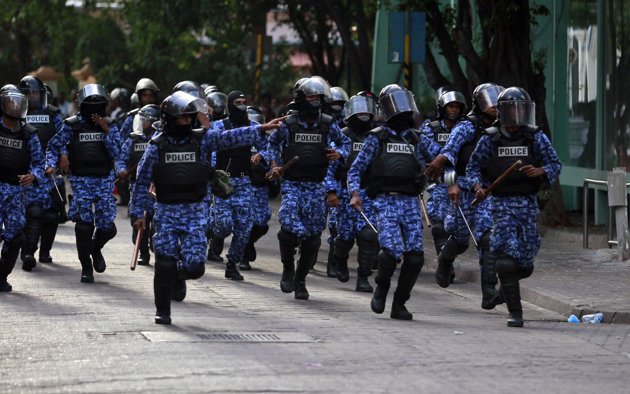
The policemen after Nasheed are members of an ‘elite’ squad named Special Operations or SOs. These are the same men who led the police mutiny on 7 February. According to the CoNI testimony of Nasheed’s police Commissioner, Ahmed Faseeh, the SOs’ origins explained their present: They were the ‘Star Force’, put together in a rush to control the uprisings in 2004 against Gayoom’s dictatorship.

To sum up his description of the squad, most SOs are men recruited into the police straight from the streets, given muscle enhancing substances (suspicions focus on steroids), made to pump iron, taken to intensive training in a foreign country, and brought back home for the sole purpose of ‘crowd control’. Then, as now, according to Fasyh, they were a tough squad to control. Back under Nazim and Riyaz, the SOs have happily reverted to form, taking up pre-democracy tactics of violence and brutality with ease and abandon. And, as seen in the video, they have no respect for Nasheed, or his life.

All things considered, is Nasheed’s prosecution politically motivated? Yes. Apart from all the reasons above, the current regime has failed to implement any steps recommended by the international community to reform the judiciary. Judge Abdulla Mohamed, whom Nasheed arrested citing national security, and against whom their are many allegations of misconduct and criminal activities, not just remains on the bench as the Chief Judge of the Criminal Court, but is also a part of the regime’s inner circle, attending government functions and officiating at various events.

Questions remain over the legality of the Hulhumale’ Court where he is to be tried, and all calls to redress Article 285 of the Constitution have been willfully ignored.

Justice appears to have very little to do with the impending prosecution.

Dr Azra Naseem has a PhD in International Relations

All comment pieces are the sole view of the author and do not reflect the editorial policy of Minivan News. If you would like to write an opinion piece, please send proposals to [email protected]

Likes(1)Dislikes(1)