The Maldives National Defece Force (MNDF) has today declined to obey a court warrant issued by the Criminal Court to summon People’s Alliance (PA) Leader and MP Abdulla Yameen, who was taken to Aarah island this morning at dawn by the Maldives National Defence Force (MNDF) reportedly “for his own protection”.
Police were compelled to used force to restrain ruling Maldivian Democratic Party (MDP) activists outside Yameen’s house last night. Shortly afterwards, both police and protesters were showered with rocks an other projectiles by people from nearby buildings, injuring many. Police used tear gas while the MNDF deployed an armoured car to contain the incident.
Yameen was taken to the Presidential Retreat ‘Aarah’ to provide assistance and protection to him upon his request, according to the MNDF.
The MP and high-profile businessman was recently summoned for questioning by police concerning charges of bribery and treason. After a series of court hearings regarding the legality of his arrest and detention, along with Jumhoree Party (JP) MP Gasim Ibrahim, the Supreme Court ruled he be released from house arrest.
However the government yesterday indicated that it was unwilling to drop the matter, and was monitoring judges for signs of corruption.
Press Secretary for the President Mohamed Zuhair said the MNDF had refused to the court warrant to summon Yamin “because the MNDF does not believe it was a lawful order issued by the court.’’
‘’He requested the MNDF provide security and protection for him,’’ said Zuhair. “He told the MNDF that he wished to leave Male’ and stay on another island.’’
Zuhair said Yameen had attempted to stay on an island in Alifu Atoll but the MNDF took him to Aarah island “because MNDF knows where they can provide him best protection.”
‘’It was the [opposition] who sparked the riot last night,” Zuhair claimed. “At first it was just a peaceful assembly, but some people tried to attack the president. A group of people ran towards him to attack him, but his bodyguards confronted them.’’
Zuhair said MDP supporters gathered outside Yameen’s house following the attack, alleging he was the person behind the attack.
‘’When MDP supported gathered near Yameen’s house, people in the nearby buildings threw pavement blocks down at them. It proves that they were ready for violence,’’ he said.
PA Secretary General Ibrahim Shareef said everyone should follow an order of the court.
‘’We will not accept this,’’ Shareef said. ‘’If everyone uses their power anyway they want, there is no use for laws and regulations.’’
Shareef claimed that the MNDF took Yameen against his will, and not by request.
‘’They took him after the riot was controlled and when everything was over,’’ Shareef claimed.
Major Abdul Raheem said he did not have detailed information regarding the case, and recommended Minivan News contact Attorney General Husnu Suood.
Suood did not respond to Minivan News at time of press.
The ruling Maldivian Democratic Party (MDP) yesterday held a mass protest against corruption and to bring justice to the country.
The protest started yesterday afternoon at 4:00pm near the social centre on the western side of the capital. More than 7000 people participated, holding banners expressing their views, wearing yellow T-shirts and waving yellow flags in the party’s colour.
Some wore T-shirts with the phrase ”I need some cash”, in reference to leaked audio tapes of Independent MP Mohamed ‘Kutti’ Nasheed requesting money from Jumhoree Party (JP) MP Gasim Ibrahim. A ‘donations’ box satirising the MP for Kulhudhuffushi was also spotted.
MDP Chairperson Maryia Didi and parliamentary group leader ‘Reeko’ Moosa Manik walked with protesters through the streets of Male’ calling to for the constitution to be upheld and corruption eliminated, and demanded the arrest of Gasim and People’s Alliance party leader MP Abdulla Yameen.
The protesters came to a halt near the tsunami monument where Moosa Manik and Mariya Didi addressed the crowd.
”We will not quit until we hit the end of this,” said Mariya. ”Even if [the culprit] is a judge, an MP or a rich merchant, we will not hesitate or step back. We will do anything we should [to stop corruption].”
Moosa Manik meanwhile warned that government might as well open a “court of people” if the judiciary failed to take action against people who involved in corruption and bribery.
”We might have to open a court of the people and summon the people faced with allegations of corruption,” he said. “If we have to do this, we will not stop before delivering a verdict on them,” said Moosa. ”I am very clearly saying that the Supreme Court ruling to release Yameen and Gasim was unconstitutional.”
After Moosa’s speech the crowed dispersed, after being invited to attend MDP’s rally at the artificial beach later that evening.
MDP rally turns riot
President Mohamed Nasheed and MP Moosa Manik addressed the gathered MDP supporters at the rally that evening. Rough estimates put the crowd numbers at 10,000.
”Anyone can buy votes in parliament by giving one million rufiya in advance, and then later two million, total three million. I also can buy roze that way,” said Nasheed, alluding to the mysterious person ‘Rose’ hinted at in the leaked tapes.
”But I will never buy votes, even if it was the last thing I had to do,” Nasheed claimed.
The President said that if parliament’s decisions were dependent on money, the laws of the land would end up in such a way as to only benefit the rich people of the nation.
President Nasheed said he would not hesitate to “step outside of the chart” to preserve democratic governance in the Maldives.
“Believe this, I will not keep from action for my own protection. I will not stay in hiding to maintain my rule. I say repeatedly I will face danger. I will not back down in the face of any harm that might befall me. My life has given me a number of experiences. I will make use of it in the right way,” he said.
Later security official whispered in Nasheed, and the President was escorted away.
Moosa Manik, in his speech to the gathering, ordered the president to take necessary actions against those who have involved themselves in corruption.
”In the constitution, it very clearly it states that the cabinet requires parliament’s consent,” he said. ”Parliament’s consent does not that MP’s should take a votes over the cabinet.”
During Moosa’s speech, a group of people passing by stopped and attacked MDP supporter. A group of around 50 MDP supporters ran towards the group, but were able to escape.
MDP activists gather near Yameen’s house
Following the attack, a group of MDP supporters headed toward Yameen’s house. The crowd ran across the main road Majeedee Magu and tried to forcibly enter the MP’s house.
As the crowd arrived at the businessman’s residence, a police squad was deploying in front of it to protect him. The crowed tried to enter Yameen’s house but police raised their batons and threatened the protesters, causing them to become angry.
Members in the crowd warned the police not to hit anybody with their weapons, and angrily demanded police make way for them to enter Yameen’s house.
When police refused, the crowd threw stones and water bottles at Yameen’s house. After a while, a second group of people positioned on nearby buildings began showering police and the MDP activists with pavement blocks, injuring many.
MDP activists spread out
After the rally came to a halt, MDP activists divided into groups and gathered at different points across the city. One group gathered near the house of PA deputy leader and MP Ahmed Nazim, who was recently charged for attempted assault on political figures, threatening independent commissions and corruption.
Another group gathered near Gasim’s house, a second near the Speaker of the Parliament’s house and opposition Dhivehi Rayyithunge Party (DRP) MP Abdulla Shahid, a third near the home of Chief Judge of the High Court Abdul Gany a fourth group near the the home of the Chief Judge of Criminal Court Abdulla Mohamed, who recently denied police an arrest warrant for Yameen and Gasim.
MDP supporters also hoisted MDP’s flag in the DRP head office located near artificial beach, and threw stones at the windows.
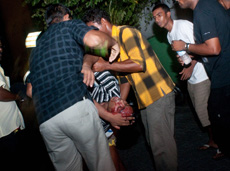
An injured protester receives assistance
MNDF and Police control the riot
After police were unable to control the more violent MDP activists, the Maldives National Defense Force (MNDF) was deployed in riot gear, with shields and long batons.
Meanwhile, groups of MDP activists came into conflict with people supporting the opposition leaders, exchanging barrages of thrown bottles, pavement blocks and stones.
In one heated encounter police ordered journalists to leave the area and Minivan News was unable to determine exactly what happened afterwards. Some reports claimed that MNDF and police beat the gathered protesters with their batons.
Aftermath
Police Sub-Inspector Ahmed Shiyam said that nine police officers were injured in the night’s violence, with one in a serious condition. Six civilians were also injured during the riot, he said.
Police used pepper spray near Yameen’s house and tear gas numerous times in different areas in an effort to disperse the crowed.
Some people living in the areas police sprayed by tear gas and pepper spray have complained to the police, claiming their children suffered breathing difficulties due to the use of the toxic chemicals.
A short statement from the MNDF reveals that the national security council decided after an “emergency meeting” last night to offer protection for MPs.
“The Honourable MP for Mulaku Abdullah Yamin Abdul Gayoom is now under MNDF protection,” it read. Minivan News understands that Yameen is being held at the Presidential Retreat on Aarah.
Opposition response
At a press conference this afternoon, DRP Leader Ahmed Thasmeen Ali laid the blame for last night’s unrest squarely on the shoulders of the government and supporters of the ruling MDP.
“We believe that this was created by supporters of the government,” he said, adding that senior officials had appeared on state media in the past week in a bid to “create unrest.”
The majority leader of parliament expressed concern that the situation has reached “the point where the army is arresting people.”
He added that citizens were in “a state of terror” as there was no rule of law in the country, warning that further escalations could lead to open conflict.
Following last night’s events, said Thasmeen, the opposition members no longer believed in the country’s safety and security.
“Things are now reaching the point where we have to mobilise our supporters for protection and security,” he said. “None of us want unrest. But if we do not believe that the rule of law exists in the country, if everyone does not get the safety and security they deserve, we have to do it even if it means mobilising our supporters.”
The MP for Kendhoo said the DRP was considering taking measures in parliament in response to the actions of the security forces, which he called “unlawful.”
Youth Minister Hassan Latheef has said that police have commenced another investigation into the activities of People’s Alliance (PA) party leader Abdulla Yameen and Jumhoory Party (JP) leader Gasim ‘Buruma’ Ibrahim.
Latheef said police had requested the criminal court issue a warrant for the arrest warrant of the pair, but this was denied.
”The criminal court declined to issue the warrant saying there were no grounds to issue an arrest warrant for the second time,’’ said Latheef. ”But this is a whole different case.’’
Latheef said that when police requested the criminal court issue the arrest warrant, the court referred to the recent case and issued a statement signed by the chief judge of the criminal court denying the police request.
”The case concerns the influence of independent commissions,’’ Latheef said. ”We do not accept the criminal court’s denial of the police request.’’
He said that attempts by police to investigate allegation of corruption and bribery were not intended to threaten and intimidate political figures.
”We are currently monitoring to see if there are any judges involved in corruption and bribery,’’ Latheef said, adding that ”we are not saying that judges have been involved in such activity.’’
He declined to reveal the names of the judges being observed and the courts they belonged to, claiming it would obstruct the observation.
”If there are fair and independent judges in courts, we will succeed in this case,’’ Latheef claimed.
Under Secretary for the President’s Office, Ibrahim Rasheed, promised the government would listen to the voice of people.
”We will investigate any act of aggression,’’ he said. ”The government will not cease its effort to eliminate corruption and bribery.”
The ruling Maldivian Democratic Party (MDP) has announced it will conduct a special protest today to eliminate corruption and bring “justice and balance” to the Maldives.
Spokesperson for the MDP, Ibrahim Haleem, said the party called on the “whole nation to take part in this protest”, but did not encourage any more people living in the islands to come over to Male’.
”A lot of people from the islands have arrived Male’ to participate in this event,” said Haleem. ”We are expecting at least 10,000 to participate in this protest.”
Haleem said the protest was to “eliminate corruption and to establish justice in the country.”
”MDP has made more than 27 pledges to the people of the Maldives. One of them is to eliminate corruption from the country and to establish justice and peace,” Haleem said. ”Today we will erase the civil unrest caused to the country due to the disgusting act of corruption and bribery for eternity.”
Jumhoree Party (JP) leader Gasim Ibrahim and People’s Alliance (PA) leader Abdulla Yameen, both high-profile businessmen, were recently taken into police custody on charges of corruption and treason. Deputy Speaker Ahmed Nazim was also taken into custody.
On Sunday the Supreme Court ruled the pair be released from custody, as evidence against them was deemed insufficient. The major opposition Dhivehi Rayyithunge Party (DRP) denounced the arrests as political at a rally held Tuesday night, where it promised to deliver a “shocking message” to the government.
Today Haleem said protesters will call on judges “to judge fairly and to be impartial.”
”Judges should remember that they also shall work according to the laws, and the protesters will call on the judges to bring justice and peace to our country,” he said. ”We do not have any personal issues against any individual judge.”
He said the protest would start in front of the social centre at 4:00pm, “and God knows when or where we will conclude.”
”Our acts will be strong and voices will be loud today,” he suggested.
The GMR-Malaysia Airports Holdings Berhad (MAHB) consortium that recently won the controversial bid to develop Male’ International Airport will spend US$373 million on the upgrade, MAHB has reported.
Speaking at the opening of the cavernous Delhi Terminal 3 last week, GMR Manager P Sripathi told Maldivian journalists that physical work would begin on the airport towards the end of this year.
“The first phase is organising the finances and transitioning the airport from a government-run enterprise to a privately-run enterprise,” he explained.
“The transition will be a new thing [for the Maldives] and we will be there to help with that. We have done such things in other places, and we know how to go about it,” he said.
“There are over 100 various items have to be agreed and signed off between the [incumbent] Maldives Airport Company Limited (MACL) board and ourselves, but we expect to see work start on the new terminal 9-10 months from now.”
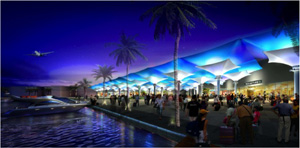
Impression of the new airport at night
Sripathi said that within six months GMR would upgrade existing facilities at Male’ International Airport “to a level that international passengers and tourists may [expect]. We will deal with the ‘pinch points’ that are there today.”
Ultimately the development will involve 45,000 square metres of new terminal, repair and expansion of the runway, parking and taxiing space, and a turning point so more flights can be landed in the space of an hour.
The infrastructure giant’s ‘brownfields’ approach – refurbishing an active airport, as opposed to a ‘greenfields’ or ‘from scratch’ project – mirrors that of its much larger airport development in Dehli. The old terminal was upgraded prior to the opening of the new one last week, which is now expected to cater to 90 percent of the airport’s passengers, with capacity of 34 million per annum upgradable to 100 million.
Sripathi acknowledged that while nothing of similar scope was going to be built in the Maldives – Male’ International Airport currently handles 800,000 passengers per annum (each way), “[Dehli] is definitely in the vein we are planning.”
Representing a company about to plow US$400 million into Hulhule, Sripathi is unsurprisingly unconcerned about rising sea levels: “Worried? Absolutely not. Land that has been there for 2500 years is not going to disappear in 25 years,” he chuckled.
Local controversy regarding privatisation and the recent political upheaval have given equally little pause to the infrastructure juggernaut – but its recent entertainment of the Maldives press pack suggest it is sensitive to domestic public opinion.
“We are not worried, because we are out of the fold. We are here to do a job,” Sripathi said.
The debate [over privatisation] has obviously been there for a long time, and is perhaps coming to an end, that we leave to [the politicians]. We are only here to do our bit.”
Accusations by opposition parties about the transparency of the bidding process were not something in which GMR saw itself involved, Sripathi said.
“Let me distinguish our role from the government’s role,” he said. “Whatever the political debate that goes on in the country, we shouldn’t be interfering – that is not our duty. That is between the executive and the [opposition]. In this particular instance, if there is opposition to privatisation then this debate has taken place over many years. Otherwise government wouldn’t have initiated this privatisation program in the first place.
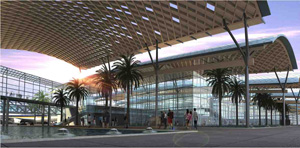
Natural lighting in the new terminal building
“The World Bank IFC has [monitored] this exercise and given a very good report, and that is where this should stop,” he said.
The government’s calculations acknowledge that the strength of GMR’s bid came from its US$78 million upfront payment (compared with US$27 million from the second-highest bidder) and in particular, its 27 percent sharing of fuel revenue.
Based on GMR’s forecast, the government anticipates that 60 percent of government revenue from the airport deal will derive from fuel – $74.25 million annually between 2015-2020, increasing to US$128.7 a year from 2025-2035. This in turn was the most significant element of the final ‘net-present-value’ calculations to determine the winning bid.
The Turkish-French consortium TAV-ADPM, who expressed dissatisfaction with the bid evaluation process to newspaper Haveeru and requested a “re-evaluation of the bids”, expressed disbelief that the GMR-MAHB consortium would be able to offer such a high percentage of the fuel trade to the government “without facing any loss.” TAV-ADPM had offered 16.5 percent, warning that pushing prices higher would drive buyers away.
Sripathi claimed 27 percent was “absolutely reasonable. We have done our homework, otherwise we would not have made the bid.”
“In Male [airport] there are two types of fuel trade going on: MACL sells directly to airlines, and in another kind of sale, parties buy from MACL and then sell to airlines,” he explained. “We looked at the margins of both lines of business, kept the same percentages, and calculated what we could offer the government if we took over all this and amalgamated it under one umbrella. The margin we can give to the government? 27 percent.”
Quizzed as to whether it was reasonable to estimate a revenue share by forecasting fuel prices over the lifespan of a 25 year agreement, Sripathi replied “everybody predicts. There are international agencies that predict the way fuel prices will go up and down.”
“I’m talking about the top line,” he said. “Bottom line, if the fuel prices go up, similarly everywhere will go up and the selling prices will also go up. We have to put a margin in there.”
At its airport in Hyderabad, GMR allows five independent fuel suppliers to compete to offer the most competitive price to the airlines.
In Male, “the volume does not support that. In India there are refineries and many fuel companies operating, and fuel companies can sell directly to the airlines,” Sripathi noted. “But in the Maldives fuel is imported, and the volumes are such that not many people come and buy fuel – the model is different.”
While its fuel figures are undoubtedly one of the major reasons behind GMR’s winning bid, a simple fuel monopoly is unlikely to recoup the consortium’s US$400 million investment.
Either GMR anticipates that global growth in the fuel trade is worth the risk, or it is taking a hit on the fuel price for the sake of offering a much lower 10 percent share of gross airport revenue, as compared to the other bids (TAV-ADPM offered almost 30 percent). The only figures available to the government in estimating this revenue (a staid US$20.43 million by 2025-2035) will have derived from the existing commercial revenue from the airport.
Compared to the glittering Gucci-lined corridors of airports in tourist cities such as Dubai, Male’ International’s 4-5 meagre departure lounge shops and dilapidated eateries look positively downtown in comparison – a striking missed opportunity, given the bulging wallet of the average visitor to the Maldives.
Sripathi indicated that the consortium is very interested in the well-heeled concourse traffic – sufficiently interested for the infrastructure giant to invest a sum equal to almost half the country’s entire GDP.
“It’s a lovely project. The type of tourists coming are from the very high-end tourism market, therefore the business opportunities are plenty,” Sripathi hinted.
“I would say the airport is naturally located to advance a lot aspects, like cargo. For example, many people would be surprised to know just how much cargo goes through the airport, because of the number of international connections and wide body aircraft using the airport. People are transiting air freight through the Maldives from places like Colombo – this means there is niche value out there.”
Some investment will be recovered through a US$25 airport development tax, set by the government for all bidders to be levied only on international travellers at time of departure and added to ticket prices.
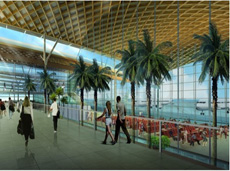
Inside the concourse
Sweetners
Many longer term “vision” projects associated with the airport seem designed to appeal to government planners. The airport will be unlocking 50 acres of land and will develop “what we envision will become the Maldives’ financial district,” Sripathi said. “That’s from our vision document. [The government] asked what can be done, and we used our expertise and experts from the US, and this is one of the things we have proposed.”
The company also runs a social responsibility foundation, GMR Varalakshmi, that funds schools and vocational training in areas where it operates. The company took the Maldivian media on a tour of its centre near Hyderabad, which included a residential technical training college running free courses for 500 young people in trades ranging from air-conditioning and electronics to IT, sewing and hotel management – often in conjunction with the group’s partners and suppliers. Guides emphasised the importance given to instilling discipline and professionalism in students, as well as technical training.
Regarding salaries and employment of existing airport staff in Male’ – a key point of contention among the opposition parties critical of the deal – Sripathi commented that the company was “not about to bring Indian standards [of employment] to Maldives – income levels and expenses are dependent on place – it is independent.”
Ground handling, currently outsourced to Island Aviation, will be taken over by the new airport company, Sripathi confirmed.
“Whether we need more than one ground handling company depends on the size of business,” he said. “If size of business allows it, then we can [involve another company], otherwise there will be single party doing it to international standard.”
For other airport staff – aside from security, immigration and air traffic control, which will continue to run by the government as per other international airports – the 1500 people currently working at the airport “will become part of the privatisation process. We are in talks MACL board members,” Sripathi said.
“We are looking at their concerns and anxieties – ultimately people think somebody is coming into the country to take over the airport. But we are here to help develop the airport’s assets and show people its full potential,” he continued.
“But what is important keep in mind is that investment in an airport is a heavy investment – US$400 million is a heavy investment. These sorts of numbers must be returned to us – and the government – otherwise we both cannot survive.”
Disclosure: Minivan News and 10 other representatives of the Maldivian media recently toured Hyderabad airport and attended the opening of Dehli Terminal 3 as guests of GMR.
Correction: A previous version of this article erroneously referred to ‘Malaysia Airlines (MAHB)’ in one instance, where it should have read ‘Malaysia Airports Holdings Berhad (MAHB)’. This has been corrected.
The executive today signaled reluctance to hand control of state media over to parliament, potentially sparking a political tug-of-war over Television Maldives (TVM) and Voice of Maldives (VOM).
The state media outlets are currently operated by the Maldives National Broadcasting Corporation (MNBC), a 100 percent government owned company established by executive decree.
However in April Parliament approved a law to establish a company called the Maldives Broadcasting Corporation (MBC) to operate the state media, with nine board members appointed and answerable to the parliament.
Today the parliament appointed nine members for the MBC board. Chairman of MNBC Mohamed “Madulu” Waheed and Managing Director Ibrahim Khaleel also proposed their names, but were dropped from the shortlist by parliament.
Out of the 29 names presented, MPs approved 18 names to be shortlisted and nine of the persons were appointed as the MBC board members.
“MNBC is a company established under a resolution by the president and all its assets and land also belong to the company under a contract,” said the President’s Political Advisor Hassan Afeef today at a press conference.
”Although the MBC has been established, the MNBC will continue operating the state broadcasters. I would like to note that TVM and VOM are both channels registered under MNBC and are assets of that company.”
President Mohamed Nasheed ratified the bill establishing the MBC in April, which was originally passed by Parliament on 6 April 2010.
The government said then that it wanted the corporation to be free from political and commercial influence, and to televise public service announcements and matters of the state (such as President Nasheed’s speeches) at no cost to the government.
However today Afeef said that if the MNBC did not wish to hand the assets to MBC, there was no way they could be transferred if the MNBC did not wish to.
“If the MBC was established for the government to operate, the government would have the power to appoint people for its board,” Afeef said. “The government did not establish MBC, it was the parliament.”
Press Secretary for the President’s Office Mohamed Zuhair in April that the formation of a new public broadcaster “will be best for the general public”, and that MNBC’s assets would be transferred to the new corporation.
DRP MP Abdulla Mausoom suggested at the time that President Mohamed Nasheed should “be very happy” with the way the bill was passed.
”Now the president can say he has no power over the media,” Mausoom said.
However government’s backtracking today suggest it may not be prepared to hand control of the state broadcasters to parliament so readily.
The Dhivehi Rayyithunge Party (DRP) has announced it will hold a “special protest” this evening together with coalition partners, to deliver “a shocking message” to the government.
Ali Solih, DRP Media Coordinator, said that the protest would be held at the Artificial Beach tonight and that the leaders of the four opposition parties will be present at the protest.
”Leader of People’s Alliance (PA) , leader of Dhivehi Qaumy Party (DQP), leader of Jumhooree Party (JP) and leader of the Dhivehi Rayyithunge Party (DRP) will address the people at tonight’s protest,” said Solih, ”and they will deliver a shocking message to the government.”
JP leader Gasim Ibrahim and PA leader Abdulla Yameen, both high-profile businessmen, were recently accused by the government of vote buying and treason. However Supreme Court has since ruled that their arrest was unconstitutional, after a panel of five judges decided that there was not enough evidence to keep them under house arrest.
Solih claimed the protest would show the government “the unity of the opposition coalition.”
”Due to the weather, not many islanders will be able to participate in this protest,” he said, ”but it will be a mass protest.”
Solih said that the party had requested the municipality council provide a ground for it to hold meetings, but that the council had not given an appropriate answer.
Deputy Leader of the DRP, Umar Naseer, said tonight’s gathering would not be a protest “but a rally where the leaders of four parties will address to the people.”
”It will start at 8:45pm,” he said. ”This rally is to let the government know that they have failed and that they should resign now.”
He said that the rally was “not scheduled to turn into a protest.”
On May 13, DRP held a protest against hiked electricity tariffs, titled ‘Red Notice’. The protest was dispersed by riot police outside the State Electricity Company (STELCO) building, and several DRP MPs, protesters and police were injured in the scuffle.
The Supreme Court of Maldives has overturned a High Court ruling to keep MPs Gasim Ibrahim and Abdulla Yameen under house arrest for 15 days, ordering the immediate release of the high-profile businessmen and minor opposition party leaders.
Yameen and Gasim were detained pending an investigation into alleged corruption, bribery and treason.
A legal team led by former Attorneys General Azima Shukoor and Dr Hassan Saeed, representing the MPs, appealed the High Court decision last week on the grounds that the arrest was unlawful as Gasim was taken to the police station “to clarify something.”
Today’s ruling invalidates both the Criminal Court order to keep the MPs under house arrest for three days and the High Court ruling to extend the period to 15 days.
Chief Justice Abdullah Saeed said there was no room to uphold the lower court rulings granting the police authority to arrest the MPs.
The panel of five judges on the interim court concurred that the evidence presented was not sufficient to keep Gasim and Yameen under house arrest or in custody.
Speaking to press after the verdict, former Justice Minister Dr Mohamed Jameel Ahmed and Dr Hassan Saeed said the ruling was “a victory for separation of powers in the Maldives.”
“Both of them were arrested in violation of the constitution and today this has been proven,” the Dhivehi Qaumee Party leader said.
Mulaku MP Yamin told reporters that the highest court of appeal in the country has ruled that police disregarded the law and the constitution in arresting the MPs.
“This is a victory for the Maldivian people, a complete victory,” said Gasim.
Crowds of PA and JP supporters gathered outside the former presidential palace Theemuge that houses the Supreme Court and High Court, to celebrate the ruling.
The leaders of the opposition People’s Alliance and Jumhoori Party (Republican Party) was arrested on 29 June in the wake of the en masse resignation of the cabinet, who claimed that opposition MPs were obstructing the government with the passage of laws intended to wrest executive power from the president.
The first hearing
At last week’s Supreme Court hearing, police requested that the court abolish provisions in the parliamentary rules of procedure that restrict the detention of MPs.
Ibrahim Riffath, Deputy Solicitor General advocating on behalf of the police in his personal capacity, argued the provisions were unconstitutional as article 88(a) of the constitution only grants authority to the People’s Majlis to formulate regulations for its administration and that MPs’ privilege could not be extended through such regulations.
According to local newspaper Haveeru, another point of contention at the hearing was interpreting article 45 of the constitution, which states everyone has the right not to be arbitrarily detained, arrested or imprisoned except as provided by law enacted by the People’s Majlis in accordance with article 16.
Article 16 restricts Majlis to enacting laws that could limit rights and freedoms to any extent only if demonstrably justified in a free and democratic society.
Grilled by the judge, Mohamed Jinah from police said the law referred to in article 45 was the Police Act, which grants police extensive powers for criminal investigation.
However, former AG Hassan Saeed said it refers to the Criminal Justice Procedures Act, which was being drafted at the same time as the constitution.
Hassan Saeed said the Police Act does not specify how arrests and detentions should be made.
Letters sent by MDP MPs to President Mohamed Nasheed containing allegations of corruption against Jumhoree Party(JP) leader MP Gasim Ibrahim have been leaked to the press.
Gasim is currently under house arrest, charged with bribery and treason.
In one of the letters, Madaveli MP Mohamed Nazim claims that Gasim offered him a 100 foot fibereglass fishing boat and Rf4 million to join the JP, adding that the offer was unlawful and could be considered attempted bribery.
In his letter Kedhikolhudhoo MP Ahmed Easa alleges that Gasim offered him Rf5 million to defect from MDP to the JP.
The letter from Mohamed Gasam, MP for Thinadhoo, claims Gasim had offered him “many rewards” to recruit him away from MDP.
In a letter signed by Hulhu-Meedhoo MP Ilyas Labeeb, the writer mentions that Gasim offered him Rf5 million to buy and construct a house in Hulhumale’.
Press Secretary for the President’s Office, Mohamed Zuhair, said that he could not confirm whether the letters were genuine, or that the letters were the same as those received by the president.
‘’Similar complaints were forwarded to president by several MPs,’’ said Zuhair. ‘’I cannot confirm whether the [leaked] letters are the actual letters.’’
Zuhair said that police were currently investigating the allegations of corruption against the opposition leaders.
Spokesperson for the MDP parliamentary group, Baarah MP Mohamed Shifaz, one of the MPs whose name was on one of the leaked letters, revealed that the leaked letter in his name was an edited version of the letter he actually wrote.
Shifaz said that the middle paragraph of the leaked document in his name was edited.
‘’I did not mention any amount of money Gasim offered me,” Shifaz said. “I wrote that he had offered me different amounts on different occasions.”
‘’I did send a letter to president last month, because of a rumor that circulating in those days that I was about to join the JP,” he said. “It dragged me into a situation where MPs almost lost confidence in me, and I thought the president might feel the same way. So I sent him a letter to make him confident that I would not leave MDP.”
MDP’s Council adopted a resolution late last month to terminate its coalition agreement with JP.
Gasim did not respond to Minivan News at time of press.
 (0)Dislikes
 (0)
(0)