Maldives President expresses sympathy after Norway terror attack kills 92

President Mohamed Nasheed has sent a message of sympathy to His Majesty King Harald V of Norway, after a bomb attack in Oslo and a shooting rampage on Utoeya Island killed 92 people on Friday.

Norwegian police have since arrested 32 year-old right-wing anti-Islam fanatic Anders Behring Breivik, as the country comes to terms with its worst attack since World War II and the single worst attack by a lone gunman.

85 of the casualties were young people attending the annual summer camp for the youth wing of Norway’s ruling Labour party.

One of the survivors told news agency Reuters that the gunman was dressed as a policeman and “would tell people to come over: ‘It’s OK, you’re safe, we’re coming to help you.’ And then I saw about 20 people come toward him and he shot them at close range.”

Another survivor told media that Breivik “seemed very focused. He took his time and picked victims out one by one. People lay on the ground, and he went over them and shot them in the back. He shot them all twice to make sure they were dead.”

Breivik had undergone compulsory military training as part of Norway’s national service and held licenses for several firearms, including automatic weapons. He surrendered to armed police who arrived at the Utoeya Island camp 40 minutes after being called by panicked attendees.

Police are investigating whether the car bomb, which exploded outside government offices in Oslo, was linked to Brevik’s purchase of six tons of fertiliser for a farm he bought 10 weeks ago.

Al-jazeera reported that under Norwegian law, Breivik faces a maximum sentence of 21 years extendable indefinitely in five year increments.

Norway has meanwhile entered a period of national mourning.

“This is beyond comprehension. It’s a nightmare,” Norwegian Prime Minister Jens Stoltenberg told press in Oslo.

In his letter to the Norwegian King, President Nasheed said he was “deeply shocked and saddened to hear about the bomb attack on government buildings in Oslo and the subsequent shooting on Utoeya Island. The Government and the people of the Maldives and I condemn this wanton act of terror in the strongest terms. At this time of distress I extend my profound sympathy and support to Your Majesty, the Government and the people of Norway.”

Likes(1)Dislikes(0)

“El Al will be a Trojan horse for Maldives”: George Galloway

The commencement of flights by Israeli national airline El Al to the country will be “a Trojan horse for the Maldives,” warns controversial British politician George Galloway.

In a video message aired at the Adhaalath party national congress that concluded last night, the former MP said that he was “deeply shocked” by the government’s decision to authorise the operation of Israeli national carrier in the Maldives on December 13.

“At a time when Arab doors are closing on Israel as a result of the Arab revolution, the idea that the Maldives, an entirely Muslim country, would open the door for El Al, the Israeli national carrier, and bring the Israeli flag into their country, and bring the Mossad and all the attendants who will come with it, is just absurd to me,” said Galloway.

He added that Israeli flights would be “a Trojan horse for the Maldives.”

“You will be bringing Israel into your country at a time when most civilised people are trying to get Israel out of their country,” he continued.

“So I very much hope the people of the Maldives will rally behind the campaign to stop this infiltration of the country by this Zionist settler state. The blood of the Palestinian people for 63 or 64 years now is on this project and nobody should want to share in this blood.”

In April this year, the religious conservative Adhaalath party threatened to terminate its coalition agreement with the ruling Maldivian Democratic Party (MDP) in protest if Israeli flights are allowed to commence flights to the country.

Transport Minister Adil Saleem however said in June that the airline would allow Maldivians to visit Masjid-al-Aqsa in Jerusalem, the third holiest site for Muslims.

Adil Saleem noted that 500 Maldivians had visited Israel this year and authorising El Al to operate flights to the country would provide a cheaper option for pilgrims.

Official figures meanwhile revealed that 433 Israeli tourists visited the Maldives in 2004, followed by 758 in 2005; 569 in 2006; 838 in 2007; 1307 in 2008; 1588 in 2009 and 1380 in 2010.

Likes(0)Dislikes(0)

Alidhoo resort staff on strike over unpaid wages

Maldivian staff working at Alidhoo Resort in Haa Alifu Atoll have declared themselves on strike claiming that the management of the resort had not paid them salary for last month.

The resort is operated by Yacht Tours, owned by local businessman and former MP Abdulla Jabir.

“It is almost the end of this month and Ramadan is coming up – we have to send money to our families back on the islands and we are really broke,” said a staff member working in the resort.

He claimed allowances of the staffs working in the resort had not been paid for the last three months, including service charge and overtime.

“Last week we spoke with the management about our salaries and they said we will be paid today, and today they said they will pay us next Monday,” he said. “Now we are not very confident with this management so we have decided to continue this strike until they pay us.”

The management first told staff that the payments were delayed because the chairman of the company was not in the Maldives, he continued.

“When he came back, they said the banks were not giving money to the resorts – how can we believe them now?” the staff member said.

He claimed that expatriates working on the island had not received their salaries for the past three months.

“They want to join us in the strike but they fear that they might be fired and sent back to their countries,” he said, adding that the expats were supporting the strike although they were not physically involved.

Vice President of Tourism Employees Association of Maldives (TEAM) Mauroof Zakir told Minivan News that TEAM was not officially involved in the strike.

“TEAM has decided not to participate in any strike that is conducted without informing TEAM prior to the commencement of the strike,” Mauroof said. “However, we have given Alidhoo staff instructions.”

Mauroof said TEAM made the decision in a recent meeting because “whenever the strike reaches an uncontrollable status, that’s when the staff see TEAM, and when it reaches that situation it is very hard for us to solve the issues.”

Chairman of Yatch Tours Abdulla Jabir told Minivan News that the delay was caused because he was not in town.

“It will be arranged sometime today,” he said. “The payments were delayed because I was not here.”

Likes(0)Dislikes(0)

Two men arrested for secretly filming a couple having sex

Police have arrested two islanders from Utheemu in Haa Alifu Atoll, after they allegedly filmed a husband and wife while they were inside their room having sex.

Police Sub-Inspector Ahmed Shiyam confirmed that the arrests was made.

“The two of them were arrested following a report received by police that they had secretly filmed and watched a husband and wife while they were inside their room having sex,” Shiyam said, adding that he could not reveal further information as the investigation was ongoing.

Councilor of Utheemu Asrar Adam told Minivan News that the men were “caught red-handed” at midnight on Monday.

“A person living in the house came out to have a cigarette and saw the two of them trying to watch the husband and wife,” Asrar said. “The next day police arrived on our island and arrested them.”

Asrar identified the men arrested as Mohamed Hassan, 26. and Ali Munaz, 21.

“Islanders of Utheemu have been suspicious that these men have been watching the toilets of houses in the island and have been secretly filming while girls are inside,” he said.

Asrar said police have not officially shared any information with the council regarding the incident, and the council was only aware of other allegations made by islanders.

“No one has officially reported it to the council,” he noted.

He added that one of the suspects, Mohamed Hassan, 26, was the vice president of Maldivian Democratic Party (MDP)’s Utheeemu Wing.

Asrar said that the detention period of the arrested pair had been extended by the court, according to information he had received.

Likes(0)Dislikes(0)

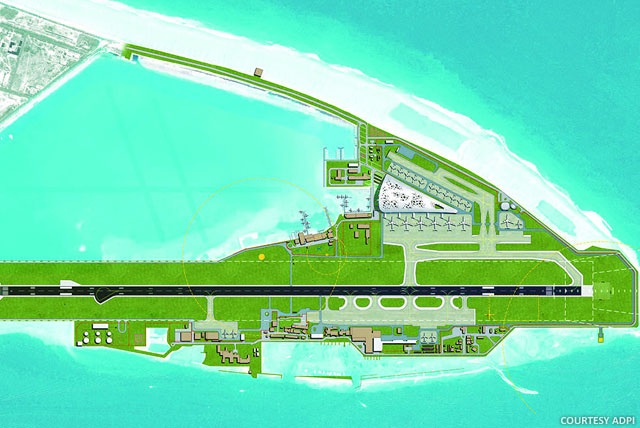
Airport architect releases further images of planned development

Airport architecture and engineering firm ADPI has unveiled new images of the design for Male’ International Airport, which is being developed by Indian infrastructure giant GMR.

The existing terminal is being upgraded before the construction of a new terminal on the opposite side of the island of Hulhule, which the developer has pledged to complete in 2014.

As well as being a visually dramatic structure on the skyline, the new airport will include various sustainability initiatives such as seawater air-conditioning.

Artist's impression of the exterior

Ultimately the development will involve 45,000 square metres of new terminal, repair and expansion of the runway, parking and taxiing space, and a turning point so more flights can be landed in the space of an hour.

The infrastructure giant’s ‘brownfields’ approach – refurbishing an active airport, as opposed to a ‘greenfields’ or ‘from scratch’ project – mirrors that of its much larger airport development in Dehli. The old terminal was upgraded prior to the opening of the new one last week, which is now expected to cater to 90 percent of the airport’s passengers, with capacity of 34 million per annum upgradable to 100 million.

At over US$400 million the project is the largest single foreign investment ever made in the Maldives and has run into political controversy, including persistent allegations from opposition parties that there was corruption in the bidding process, and several referrals to the Anti-Corruption Commission (ACC).

“There has been no formal communication [with the ACC], and we are extremely confident of standing up to any scrutiny because of the way the bid was scrutinised by the World Bank’s International Finance Corporation (IFC),” CEO Andrew Harrison told Minivan News in an interview in March, setting a target for the completion of the refurbishment in October.

The refurbishment is “essentially throw-away” considering it will have  less than a three year lifespan until the new terminal is completed in 2014, Harrison told Minivan News at the time, but will include a food court and a raised ceiling in arrivals so tourists can see the sea as they emerge from the gate.

Besides ongoing upgrade work and staff training exercises, recent developments include the signing of a US$140 million contract with the State Trading Organisation (STO) to supply fuel, switching the contract over from Dubai-based Galana Petroleum.

More recently, the government announced that the airport was to be renamed after former President Ibrahim Nasir, who ordered its construction during his rule.

A map of the redevelopment, due 2014
Likes(0)Dislikes(0)

HRCM sends report to UN Human Rights Committee

Endemic sexual violence against women and children, violent crime, abuse of migrant labourers and a persistent culture of torture in detention facilities are among a catalogue of serious issues facing the country, the Human Rights Commission of the Maldives (HRCM) has informed the UN Human Rights Committee.

The document summarises areas relevant to the International Covenant on Civil and Political Rights (ICCPR), which the Maldives acceded to in 2006. It heavily references the Maldives Journalists Association (MJA) and several news sources, including Haveeru and Minivan News, with little reference to primary research conducted by HRCM itself.

Violence against women

“One in five women between the ages of 15 and 49 years reported physical or sexual violence by a partner, and one in nine reported experiencing severe violence,” HRCM noted, referencing a 2006 study by the then Ministry of Gender and Family.

“One in six women in the capital Male’ and one in eight countrywide reported experiencing childhood sexual abuse under the age of 15 years. Of those women between the ages of 15 and 49 years who had ever been pregnant, 6 percent reported having been physically or sexually abused during pregnancy,” it cited.

“The survey further reported that many respondents’ perceived women to be subordinate to men, and that men used Islam to justify restrictions and violence against women.”

Parallel to this, HRCM observed a particularly low conviction rate for rapists and sexual assault offenders.

Reasons for this, the report claimed, included “the absence of an Evidence Act, the lack of witness protections provisions and fear of reprisals by abusers, finding witnesses (two male or equivalent women), awareness on the side of the victim regarding the condition that she should be in while reporting, such as not showering before consulting medical personnel, lack of national guidelines on medico-legal documentation, failures of existing laws and procedures leading to re‐victimisation of the victim, and intimidation of being stigmatised by the community.”

Forced labour

Abuse of migrant workers in the Maldives is occurring on an industrial scale, with at least 30,000 foreign workers (8-10 percent of the total population of the country), completely undocumented. Most of these are Bangladeshi nationals, with 2200 of those 2700 migrant workers deported in 2009 by the Department of Immigration and Emigration of Bangladeshi origin, HRCM noted.

“The State needs to enforce existing regulations relating to work place standards and regularly monitor the same,” the report noted. “In addition, the state should develop a mechanism whereby the wages to the workers are duly paid and the travel documents of migrant workers are not held in hands of employers in order to eliminate the undue influence by employers on the migrant workers to work in unfavourable conditions, including forcing them to do labour against their will.”

Documents of migrant workers such as passports were routinely confiscated by employers, the report stated.

“In the Maldives, it is a practice to take hold of the passport of the migrant worker by his/her owner for the intention of safe keeping, and this applies to both government and private sector together with the individuals,” HRCM said.

HRCM observed that the maximum fine facing labour traffickers for fines under the Employment Act was Rf 5000 (US$324). It noted that the Maldives had conceded to ratify the International Convention on Protection of Rights of All Migrant Workers and Their Families (ICPRMWF).

Violent crime

HRCM noted six crime-related deaths in 2010 and eight in 2009, and stated that this was high relative to the population.

“It is to be noted that most of the people who are involved in cases of extreme violence, and murders are repeat offenders (sometimes juveniles) providing clear evidence into the failure of the criminal justice system in the country,” HRCM stated.

Factors involved, the report noted, included “inadequate legislation pertaining the criminal justice system, such as a Penal Code does not reflect the spirit of the present Constitution, inadequate legislation pertaining to evidence and witnesses, dismissal of forensic evidence by courts, absence of a witness protection program and inadequate correctional and rehabilitation system for convicted offenders.”

Detention concerns

Visits from the National Preventive Mechanism (NPM) to Dhoonidhoo Police Custodial in March 2011 identified that five detainees had been kept in solitary confinement cells for periods ranging from several days to up to four months, without being let outside for exercise, HRCM stated,

HRCM also raised concerns about the standard of a “hastily built” jail in Addu Atoll in 2009, consisting of metal cages, to accommodate prisoners following a prison fire in Maafushi, and the confiscation of clothing as a disciplinary measure.

HRCM noted a general failure to keep arrested suspects separate from convicted criminals, and commented on the use of Maafushi prison as a police custodial.

The report also stated that “a high profile politician, Mr Abdulla Yameen, was held under protective police custody for a short period in 2010 in a place outside the formally established places for police custody” (Yameen, the leader of the opposition-aligned People’s Alliance and the former President’s half-brother, was detained in the Presidential Retreat at Aarah).

HRCM expressed concern that “in the case of Mr Yameen, he has not been compensated so far [for his detention on the Presidential Retreat].”

Read the full report

Likes(0)Dislikes(0)

Resort staff arrested in Addu for premarital sex

Police have arrested a 36 year-old Maldivian man and a 33 year-old Thai woman for premarital sex, both of them staff at Herethera Island Resort in Addu Atoll.

Police Sub-Inspector Ahmed Shiyam said the pair were arrested last Thursday following a complaint received by police.

”Both of them have been arrested and are in police custody,” Shiyam said, noting that the pair were arrested on charges of sexual misconduct.

”They were not arrested while they were on Herethera Resort, but while they were on an island in Addu Atoll.”

He said police were currently investigating the matter.

Local media reported that an islander alerted police and when police officers attended the scene the couple were involved in sexual activity.

An islander told newspaper Haveeru that the individuals were involved in a relationship and used to visit the house they were arrested inside very frequently.

Staff at Herathera declined to comment in the absence of the general manager, who was overseas at time of press.

Under the 1968 Penal Code the penalty for premarital sex is 100 lashes. A updated Penal Code has been at committee stage in parliament for more than a year.

Likes(0)Dislikes(0)

Government pursues Sri Lanka currency exchange as devaluation deadline passes

Maldivian financial authorities are reportedly in negotiations with Sri Lanka to try and establish a currency swap mechanism in an effort to stabilise the value of the rufiya against the US dollar – a move opposition MPs claim is at best, a short-term relief.

Sources linked to the country’s financial sector have told Minivan News that a deal between the Maldives Monetary Authority (MMA) and the Central Bank of Sri Lanka was “in the pipeline” in order to try and create a system for a direct exchange between the rufiya and the Sri Lankan rupee.

Mahmood Razee, the Maldives’ Economic Development Minister, did confirm that talks were taking place over a possible exchange movement with Sri Lanka, reflecting the government’s intentions to try and stabilise the local currency against high demand for the dollar.

While claiming to welcome government initiatives for economic stabilisation, a spokesperson for the opposition Dhivehi Rayithunge Party (DRP) said that although a currency exchange may provide “short-term” relief for dollar demand, the government would be required to show shrewd financial management to maintain confidence in the rufiya in the long run.

Income aims

The currency swap is the latest development in the government’s plan to boost income of foreign money that has maintained a lucrative blackmarket for the US dollar in the country. Three months ago, the government began pursuing a controversial plan to devalue the rufiya. The local currency, which was pegged at an exchange rate of 12.85 to the dollar since July 2001, was this year amended to within 20 percent of this figure to try and bridge a limited national supply of foreign money in circulation.

The devaluation stance was welcomed at the time by the International Monetary Fund (IMF), yet was domestically met with derision by opposition politicians and a week of public protests across the capital during April over fears about the resultant rises in living costs.

Despite accusing certain opposition parliamentarians of manipulating protests and media coverage for their own political gain, financial authorities requested patience for three months for the dollar demand and supply to stabilise – a deadline that passes this month.

With local news reports  claiming the local currency was trading at up to Rf16.5 to the dollar on the country’s black-market, Mahmood Razee said at the time that authorities could consider additional support measures such as currency exchanges if its stabilisation aims were not met.

While discussions are said to have been ongoing for sometime over trying to establish methods to exchange currencies with other nations, a report in the Pakistan Observer newspaper today cited Razee as claiming discussions were very much continuing between finance heads in Sri Lanka and the Maldives.

However, a source with knowledge of the discussions who wished to remain anonymous told Minivan News that “figures” at the very top level of the MMA were involved in ongoing talks with the Central Bank of Sri Lanka to provide a currency exchange system.

Talking to Minivan News today, Razee confirmed that talks were ongoing, though he said he was unsure as to what stage they had currently reached. The economic development minister claimed that although the currency exchange talks had begun before the decision to devalue the rufiya, he added that it did form part of the government’s response for trying to balance local dollar demand.

However, with the initial three-month target period to introduce economic stabilisation now passed, Razee said that he believed the finance ministry was limited at present in terms of additional support measures that could be introduced to the economy, particularly during the low-tourism season and its impact on government earnings.

“At present, I’m not so sure the Ministry of Finance will be able to undertake any urgent [new] measures to ensure stabilisation,” he said. “It would be more difficult at the moment to introduce these measures due to the low tourism season.”

Since January this year, the government had pledged to try and balance its books with a focus on generating direct revenue through the gradual introduction of taxation schemes. These schemes have included a Business Profit Tax scheduled to be launched this week for higher income enterprise and the tourism Goods and Services Tax (GST) introduced over the new year.

DRP Spokesperson Ibrahim ‘Mavota’ Shareef claimed that although the opposition party welcomed stabilisation measures from the government, it did not believe that longer-term measures had been successfully planned by authorities to bridge the dollar demand. However, Shareef said that the black market was testament to the fact that dollars did exist in the country, but that they required sufficient management to ensure they are finding their way into wider circulation.

“Any measures that encourage financial stabilisation we would welcome. This is more a national than political issue. But we do not see [stabilisation]happening yet,” he said. “If we are all spending more than we earn, especially the government, then we cannot balance the economy. These currency swaps are a short-term solution to achieve this.”

Claiming that the government had shown limited long-term measures to protect the economy, Shareef said he believed that there was a danger many local people would not want to keep savings in the form of rufiyaa as a result of “deceptive” government policy.  “When the government said that three months of the [rufiyaa float] policy would bring stabilisation people believed them,” he said.

Yet with government earnings expected to increase on the back of taxation drives, Shareef said that there were reasons to believe stabilisation was possible and that the tourism industry was a strong example of where sufficient foreign currency revenue could be generated.

“This depends though if the market is well managed. When the government first decided to manage the ruifya float [devaluing the currency against the dollar] they should have calculated the availability of foreign currency,” he said. “Dollars are clearly available on the black market and it is the duty of the government to supply them to [society].”

As such, Shareef claimed that it was therefore the government’s responsibility to have managed the devaluation “properly”, alleging that it had instead hoped for a positive outcome for finance rather than ensuring correct measures were available.

Likes(0)Dislikes(0)

Sheikh refuse to preach at MDP Religious Council

Maldivian Democratic Party (MDP) Religious Council’s Chair Al-hafiz Ahmed Zaki has said that many Maldivian religious scholars were invited last night to preach in a sermon organised by the council but the sheikhs refused to show up “because it was an MDP podium”.

“The scholars have decided not to preach to MDP members to try and let others believe that MDP members belong to another religion,” Zaki said, speaking last night. “However, MDP members are all Muslims and they do want to hear religious sermons.”

Zaki speculated that the scholars refused the invitation thinking that the series of religious sermons commenced by the MDP Religious Council was politically motivated.

“The religious sermons are not only targeted solely for MDP members but for all the Maldivians,” he said.

Zaki said the result of handing over the Islamic Ministry to another political party was that the party assigned to implement the MDP manifesto in upholding religion was not implemented.

“Despite the Maldives consisting of many religious scholars, it was a big challenge that there are many scholars that refuse to preach on MDP podiums,” he said.

He urged religious scholars to preach to everyone, from the President to normal citizens.

Former President of Adhaalath Party Sheikh Hussein Rasheed told Minivan News that the Adhaalath Party has always cooperated MDP in its religious sermons.

“I don’t have any information that anyone among us received an invitation to go preach at last night’s religious sermon,” Shaikh Hussein Rasheed said. “Last year also we went to Seenu Atoll with MDP to preach, so we have always cooperated MDP in that.”

Sheikh Rasheed said that the reason why scholars refused to preach on an MDP podium might be that scholars think it meant getting involved in politics.

“Now many of the scholars are independent and they are not involved in any political activity or political party, perhaps that’s the reason why they won’t go on sermons organised by political parties,” he said, adding that Adhaalath had “no issues” with MDP.

In November last year, former Chair of MDP Religious Council Sheikh Adam ‘B. A’ Naseem resigned claiming that he was unhappy with the party’s religious policy.

Likes(0)Dislikes(0)