Comment: Death penalty for infanticide is infantile

Among the many paths in life that lead a woman to kill her newborn baby, it is never this: one day she wakes up with an overwhelming urge to kill.

In order to satisfy that urge, she goes out and seduces/forces a hapless, innocent man to have sexual intercourse with her and to impregnate her. Still with the ultimate end-goal of killing in mind, she covertly carries the baby inside her. After nine-months of ingenious methods of hiding her ballooning figure from all eyes, she gives birth in perilous conditions without any medical attention.

Finally, she experiences the pleasure of killing which she had anticipated and meticulously planned for nine long months. And with immense gratification, she reaches out and makes sure her baby’s first breath is also its last.

Infanticide is not a new phenomenon – cases of it have been recorded from the time human records began, and research has shown a myriad of socially-generated causes behind the offence. Rates escalate in patriarchal societies where women are regarded as second-class citizens, and where crimes against women are on the rise. A recent report published by TrustLaw Women, an online organisation that offers free legal assistance to women, shows that infanticide is a common marker among countries that offer the worst environments for women to live in.

What is driving our women to such desperation? We do not know for sure, because we have invested neither time nor effort to find out. Crime statistics, however, give more than just a hint.

The thin line between perpetrator and victim

Police statistics for 2010 show over 500 sexual offence cases and 299 arrests for the same. By April this year, 58 cases of sexual offences had already been reported to the police.

In the last few months, Minivan News has reported on a whole range of random violent sexual offences against women from gang rape to rape of a 74 year-old. Added to these are less random rapes and sexual assaults occurring closer to home that run the whole gamut from decades-long sexual abuse of daughters by fathers to the attempted to rape of a mother by her son.

In the latest case, reported last month, five men are alleged to have raped an 18-year-old girl in Laamu Atoll Maabaidhoo. Her mother found her after two hours of searching, slumped under a coconut palm, her clothes in tatters and unable to walk from all the injuries the men had inflicted on her.

In March this year, a gang of 15 men abducted, drugged and raped a 20-year-old woman on the island of Hithadhu in Seenu Atoll. They recorded their vile acts on a mobile phone, for post-rape pleasure. Yet, as a coalition of NGOs highlighted recently, ‘not a single case of ‘rape’ [was] in the statistics maintained by either the PG [Prosecutor General] or the Criminal Court’.

Why? Rape is not a crime under our current Penal Code.

We live in a society where years of ‘religious’ preaching and traditions that have refused to bow to the winds of progress have taught women to accept it as their due to be beaten up by husbands for perceived marital transgressions.

Seventy percent of our women believe this to be the case. One in every seven secondary school students are sexually abused, according to an unpublished 2009 report by UNICEF, a vast majority of them girls. A Gender Ministry report in 2007 found that over 12 percent of Maldivian women between the age of 15 and 49 are sexually abused as a child.

The situation is worse for girls in Male’ than elsewhere, where more than 16 percent of girls under the age of fifteen are sexually abused. This means that of every 100 girls you walk by on the streets of Male’ and its auxiliary islands, 16 have suffered sexually at the hands of a man. How many of these offences end up in unwanted and enforced pregnancies?

Some of the girls are in a position to travel abroad for abortions – and yes, whether we like it or not, it is happening; and it will continue to happen.

Refusing to see that this behaviour is not merely a sin, but also a social issue that affects every human society, does not make it into a religious problem alone with only the harshest of religious solutions. Those who cannot have their unwanted babies surgically removed, resort to dumping them somewhere, drowning them, or subject them to worse forms of mutilation and death. These girls/women need help.

Capital punishment is not a deterrent as evidence from various countries where it is in force has shown. The fate of previous perpetrators would be the last thing on the mind of a woman about to commit such an act. If she were capable of rational thought during those desperate moments, killing a baby would be the last thing she would do.

Immaculate conceptions?

The learned men at Adhaalath see only one reason for the rise of infanticides: the “rising popularity of fornication“, and have called for the death of mothers guilty of the crime. It is not sufficient that some of the women have been jailed for life while the men, who must surely have been involved, have walked scot-free.

Without the existence of a crime defined as ‘rape’, it is easy to categorise every such brutal violation of a woman as ‘fornication’ – the type that is only ever ‘popular’ among depraved, misogynistic men who seem to view preying on vulnerable women as a popular sport. By calling for the death of the women who become victims of such men while remaining wholly silent on the men themselves, the ‘scholars’ at Adhaalath are encouraging such behaviour among the men.

And, by taking such a stance on this pressing social concern, Adhaalath is making itself not just a misnomer, but is turning a blind eye to its own slogan proudly displayed on its masthead taken from Surath An-Nisã (The Women): ‘Allah commands you […] that when you judge between people, you judge with justice’ (4:58).

Criticism of Adhaalath’s views, and that of other religious bodies in the country, do not always arise from ‘mad secularists’, as is their constant accusation. Nor is criticism of these views meant to suggest that religion has no role to play in our society. It does; and there is much Adhaalath and other such institutions can do.

Why not preach against rape in their Friday sermons when they have the ears of most of the country’s male population within their reach?

Why not speak then of the respect with which Islam says women are to be treated?

Why not drive the point home that at least 50 percent of the blame [in cases where the conception arose from consensual activity] lies with the men?

Why not repeat the message until it penetrates through the thick haze of misogyny that seem to envelop many among them that women have not been put on this earth for their depraved ‘pleasures’, sexual or otherwise?

Adhaalath, and other religious bodies, could also use their proven ability for fundraising to raise money for proper research into the rising problem of infanticide.

Or to help boost the adoption programme under Islamic teachings that the Gender Department has been trying hard to get off the ground. Or perhaps to provide funding for a shelter for abused young women or a safe place for young girls turning to juvenile delinquency. None of them have proper care; none of them have a place to go. The buruga may cover, but it does not shelter; and being covered up is not the same as being protected.

There are many different ways to help, and many ways that Islam obliges its followers to help those in need; but they can only become clear when the dogma is put aside and room for reason made.

No doubt the next ‘religious’ edict calling for the death of yet another disturbed or disadvantaged group in society would be prefixed with the customary Bismillah. If only, instead of repeating it like some meaningless chant, a moment is taken to consider its meaning: ‘In the name of Allah, the most compassionate, the most merciful…’ Wither the compassion, Adhaalath?

All comment pieces are the sole view of the author and do not reflect the editorial policy of Minivan News. If you would like to write an opinion piece, please send proposals to [email protected]

Likes(1)Dislikes(0)

Over 19,000 applications being processed under “Veshi Fahi” Male’ housing project

Some 19,900 applications for housing under the government’s flagship “Veshi Fahi” Male’ (decongestion) project are being processed as construction of 250 flats in Hulhumale’ and 500 flats in Male’ is expected to be completed “before too long.”

According to a statement by the President’s Office on the implementation of the project’s first phase, two members of the public – Aishath Hussein Manik, H. Reedhookokage, and Mohamed Afeef, Ma. Redrose – were chosen for the oversight committee on Monday.

The oversight committee will be tasked with monitoring the evaluation of the application forms while a permanent office is to be opened on Sunday (July 10).

Under phase one of the project launched in January, a total of 1,000 parties were invited to apply for the housing scheme. Over 8,000 application forms were submitted on the first day.

Also in January, the cabinet approved related projects under the “Veshi Fahi” programme, including development of a container park in Thilafushi to incentivise relocating warehouses in Male’ and construction of a multi-purpose local market with modern facilities for residents of Male’.

On April 12, the cabinet handed over land allocated for the project to the newly-elected Male’ City Council, which has nine councillors from the ruling Maldivian Democratic Party (MDP) and two councillors from the opposition Dhivehi Rayyithunge Party (DRP).

The programme was launched on November 10, 2010 with the aim of combining the development of Malé, Vilingili, Guli Falhu, Thilafushi, Hulhumalé and Malé International Airport: “The programme’s goal is to provide adequate housing for least advantaged Malé families and support decongestion of Malé.”

The capital Male’ has a land area of less than two square kilometers but is home to one-third of the country’s population or approximately 125,000 people.

Likes(1)Dislikes(0)

Comment: Dengue fever, a problem for everyone

Although the MNDF has been drafted in to help combat the problem of dengue fever that is affecting Male and several other atolls, it is important that people don’t stand back and think that this action alone will solve the problem.

Experience in many other countries has shown that a ‘top-down’ or vertical campaign against dengue fever is only part of the solution to preventing outbreaks of the virus from getting worse.

Most people know that dengue fever is spread by a mosquito that takes the blood of an infected person. The blood contains a virus that causes dengue fever and this is passed on to a new person when they are bitten in turn by the mosquito. The mosquito seems fine – but people infected by the virus may become very seriously ill and a small proportion may die.

Most action to prevent the spread of dengue fever is aimed at the mosquito itself. If the mosquitoes are stopped from breeding then the transmission of the dengue virus from person to person will be interrupted and no new cases will occur. Often the strategy against the mosquito relies on spraying chemicals and treating water storage containers. But without having fully integrated community involvement, this strategy has failed almost everywhere in the world that it has been tried. The mosquitoes will always find ways to outwit their human adversaries unless locally tailored eradication programmes are implemented.

Community involvement is key to the success of the eradication programme and every member of the community should be involved in understanding the problem of controlling the mosquitoes (vector control). Within each community the local community leaders should be involved in forming a dedicated steering committee that can create formal task forces or community working groups that will undertake environmental management. The working groups will need to know in detail exactly what they are supposed to be doing and precise training sessions need to be organised. Every locality is different so each community task force needs to identify the exact local conditions in which their mosquitoes will be breeding. Precise local knowledge is the most important resource for beating the disease. In particular waste water needs to be evacuated efficiently; water pipelines and water storage containers must be protected and communal waste collection improved.

A research programme in Cuba compared the usual ‘top down’ ways of combating dengue fever with a community activist approach as described above. They found that the community based environmental strategy was much more effective that the usual eradication programme. You can read more about this research on:

http://www.bmj.com/content/338/bmj.b1959.full

Garbage: a special problem throughout the Maldives

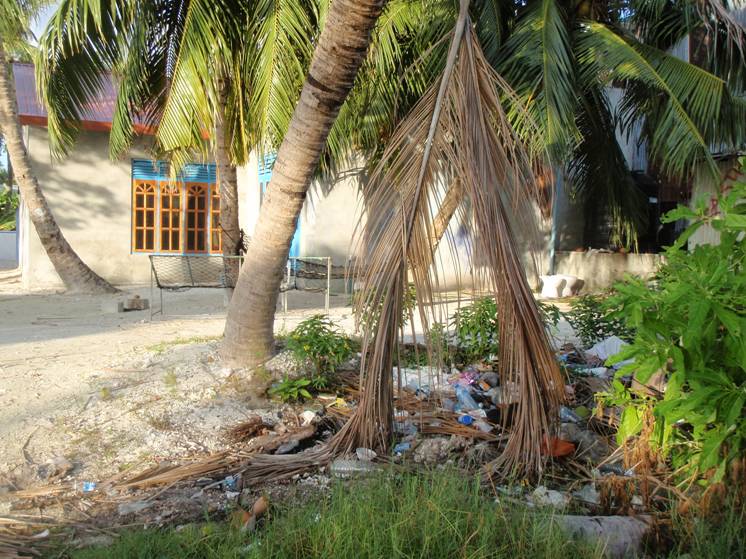
The mosquitoes love little collections of water. When I was in the Maldives as a volunteer for the Friends of Maldives health programme I noticed that outside almost every house there is a little collection of garbage. This includes plastic drink containers, tins, discarded tyres, containers and invariably a pile of half coconuts. These are ideals breeding sites for the mosquitoes that carry dengue fever. Unless each and every one of these piles is cleaned up, dengue fever will continue to be a problem throughout the Maldives in urban and rural areas.

Mosquitoes love the little collections of water that form in garbage piles.

Dr Tom Heller is a Senior Lecturer in the Open University’s Faculty of Health and Social Welfare.  He has previously visited the country as a medical volunteer for the UK-based NGO, Friends of Maldives.

All comment pieces are the sole view of the author and do not reflect the editorial policy of Minivan News. If you would like to write an opinion piece, please send proposals to [email protected]

Likes(0)Dislikes(0)

Maldives customs reveal million rufiya heroin haul

The Maldives Customs Service has said it last month foiled a “major” attempt to smuggle Rf1 million worth of heroin int0 the country after 100 packets of the drug were found to have been swallowed by a Pakistani national.

Customs representative Mohamed Ibrahim told Minivan News today that 100 packets of “high-grade” heroin,  a combined total weight of 797 grammes, were found to have been swallowed by a 23 year-old male from Pakistan when he had arrived at Male’ International Airport on June 25. Police are now said to be investigating the case, which is said to remain at an early stage.

The seizure come as the government pledges to crackdown on the sale, packing and distribution of hard drugs in the country.

In committing to this crackdown, Mohamed Ibrahim said the challenge of detecting drug packages that have been swallowed by smugglers was nothing new for customs and did not require authorities to review their screening processes in the future. The customs spokesperson claimed it had made similar “significant seizures” in the past.

However, Ibrahim added that the financial value of drugs found during the seizure was particularly significant.
“[The seizure] was worth quite a lot. Heroin like this is very expensive when you compare it to cannabis leaf or hash oil,” he said.

Just last month, the government has vowed to crackdown further upon significant players within the country’s hard drugs trade.  Police announced on June 24 that they had arrested an individual suspected of being one of the country’s most high-profile drug kingpins following months of investigation.

About 896 grammes of drugs were said to have been discovered inside the suspect’s apartment during its investigation. The apartment, which was rented in a building belonging to MP ‘Redwave’ Ahmed Saleem, contained a number of tools that could be used to pack drugs, while powdered narcotics were also found, according to police. Saleem was not himself linked to the drug operation.

Speaking following the police raid last month, President Mohamed Nasheed promised a more compassionate approach would be adopted for dealing with the country’s addict population. However, he additionally pledged to directly target any individuals profiting from the trade of substances like heroin, even if it led back to friends or family.

“We can seize the hard drugs that enter the country. We can find out how it enters, too. And as I envision it we can stop [the trafficking]. While undertaking these efforts, it is now becoming very much certain to me…for example, what happened the other day [the raid] was the sort of thing I find quite shocking,” he said. “800 packets of heroin a night were getting sealed in the house of an honourable member of parliament. 800 packets of heroin were being distributed in the ground floor of this house. True, there might be no connection between the MP and his house to the people doing [the drug dealing]. But what I know is, in my home, in my own home…the laws of the country definitely say this. That I should know what happens in my own home, under my own shelter.”

Likes(0)Dislikes(0)

Media bodies slam police questioning of reporter accuracy

The police service has come under renewed criticism from media bodies like the Maldives Journalist Association (MJA) over claims it continues to stifle free speech by questioning reporters over both the identity of sources and the accuracy of their stories.

The MJA’s concerns relate specifically to the recent decision by police to summon DhiFM News Editor Mohamed Jinah Ali for questioning to prove the accuracy of a news report from December 29, 2010.  The report itself alleged that an international standard O’ Level examination paper was leaked and found hidden in a fish container in the country.

MJA founder and President, Ahmed ‘Hiriga’ Zahir, has told Minivan News that he is “very worried” that police were operating outside of their constitutional role by questioning journalists and media outlets over the accuracy of news reports. Similar concerns have been shared by the Maldives Media Council (MMC), which has said it also holds reservations over the nature of police questioning of journalists, despite itself calling for more professionalism and training within the national media.

In addressing these criticisms, Police Sub-Inspector Ahmed Shiyam confirmed to Minivan News that authorities had spoken with the DhiFM editor in regards to the examination paper story, after it received complaints concerning the accuracy of the report and its relation to an ongoing investigation.

“Before we go ahead with any case on this matter, we needed to confirm if [DhiFM] are standing by their story,” Shiyam said. “We requested that if the story is true, then the reporter had to prove the details to us.”

The Department of Public Examinations that oversees handling of the papers has reportedly denied there is any truth to claims in the report that an international examination had been leaked.

According to police, the DhiFM report had claimed that an unidentified source within the Department of Public Examinations had revealed details of the alleged loss of the examination paper.

However, in responding to concerns from organisations like the MJA that it was for specialised authorities like the MMC and not the police to decide upon the legitimacy of a story, Shiyam said that law enforcement authorities had to respond to complaints received by members of the public, even in regards to the media.

“We don’t want to have to deal with issues like this, but there are presently many problems with the report,” he said. “Once we have confirmed whether the report is factual or not, then we will decide whether to send any case to the media council (MMC).”

However, the Police sub-inspector was unable to share the exact nature of the its concerns or the complaints made regarding the report when asked by Minivan News.

In responding to the police questioning of the DhiFM editor, MJA president Ahmed ‘Hiriga’ Zahir claimed that whether the report was true or not, the country had a specific journalism authority in the MMC that deals with potential issues of ethics and professionalism in the media. Hiriga said that he believed it therefore remained important to keep the police from overseeing media in this way.

The MJA founder gave a hypothetical example of the problems he believed police questioning posed for the media. Hiriga pointed out that if the media was confronted by a source within police detailing possible unethical practices by law enforcement officials, the media should be free to report this without possible prosecution.

“This really raises questions over freedom of expression in the country,” he said. “I don’t know if the report is true or not, but it is not the role of the police to decide this.”

Hiriga added that the country’s journalists were also protected under article 28 of the Maldives’ constitution. This article prevents reporters from having to give up the identities of their sources to police if they did not wish to do so.

The President of the Maldives Media Council (MMC) Mohamed Nazeef said that it had been made aware of the questioning issue by DhiFM, but added that no decision had been taken yet on its next course of action.

Nazeef added that he was concerned however that police had appeared to become involved in deciding upon issues of media ethics and the factual nature of an article’s content, which was the main purpose of the MMC.  The media council, which has an elected board of eight representatives from the media and seven public members, has stated aims of trying to safeguard a free national press that acts in a responsible manner, as well as reviewing complaints over coverage.

Rather than a problem that should be seen solely as an issue for police to resolve though, the MMC president said that it was important for society as a whole to break away from a long-standing culture of looking to punish the media for its reportage.

“There is a culture within society to want to punish the media through measures like giving prison sentences to journalists for their reporting. The way of thinking has changed now and we can’t penalise the media just because of something we might not like,” he claimed. “However, I think we need to see changes both within the media and the public too.  Society needs to accept that media is now free and can report on any issue, while the media has to be more professional in how it reports the news and trains journalists.”

As a wider concern, media freedom – and the industry’s responsibility in exercising it – has remained a prevalent issues for the country during the last year, both in terms of the right of police to question reporters and editorial independence.

Back in May, the International Federation of Journalists (IFJ) released a report entitled ‘Press Freedom in Peril‘ relating to the South Asia region that claimed there were a number of issues in the Maldives where “discord between journalists and the government is rife”.

In the findings, SAMSN stated that “going beyond the perception-based indexes of press freedom that have put Maldives among the most rapidly improving countries in terms of media reform, there are certain difficulties that journalists in the nation continue to face, even if these are not reflected in the broad numerical indexes, which are admittedly of limited value.”

However, the Maldivian media – including the government-owned Maldives National Broadcasting Company (MNBC) – is frequently accused of overt political bias in favouring one or other of the major political parties, viewed as a legacy of decades of autocratic governance and a state-controlled media establishment.

Several opposition-allied MPs and businessmen remain key owners of much of the country’s private media, and visiting journalism trainers have previously voiced concerns from young Maldivian journalists that senior editorial management obstruct them from reporting ethically.

Iraq Editorial Manager for the Institute of War and Peace Reporting (IWPR), Tiare Rath, observed in September 2010 following a series of journalism workshops that “one of the major issues all my students talked about is resistance among newsroom leadership – editors and publishers.”

“Even if the journalists support and understand the principles being taught, they consistently tell me they cannot apply them,” Rath said.
“This is a very, very serious problem that needs to be addressed.”

However, despite the issues of self-regulation facing the media, local press associations have continued to raise concerns about the conduct of police in questioning journalists over controversial and politically sensitive issues.

In February, the MJA spoke out along with other prominent media figures like the editor of the Haveeru newspaper to criticise police for requesting to speak with some of its journalists regarding the identity of sources on which it based a report.

The story focused on an alleged blackmail ring that reportedly obtained pornographic images of some high-profile national figures through the internet, which has been the basis of an ongoing police investigation. Haveeru said at the time that its staff declined to reveal the identities of its sources.

Likes(0)Dislikes(0)

Comment: Winning the war on Dengue

The news that dengue is hitting the Maldives hard has reached the Netherlands, along with other parts of the world from which your beautiful country attracts large numbers of tourists.

That Maldivian children are dying of dengue is distressing and of course a horrific experience for the families affected, but there will surely be broader ramifications for the country. The blame culture that followed these deaths, fuelled by emotional debates in the press is affecting your country badly. Negative press will influence the tourism sector and may have a major economic impact.

When the Indian Ocean island La Reunion was struck by an outbreak of Chikungunya virus – also transmitted by dengue mosquitoes – in 2005/6, it suffered losses of tourism income amounting to €225 million (US$325 million). The French government had to inject €76 million to keep the tourism industry alive. With 1.2 million tourists per year, surely the Maldives cannot afford to wait for such a thing to happen.

So how can the war against dengue be won and can it be done quickly? In my opinion this is possible by doing just one thing well: learning from the past.

In the absence of a vaccine and specific medicines, the sole option to contain or eliminate dengue is through controlling the mosquito that transmits it. It is this option where many countries are failing miserably. Whereas in the middle of the last century, the responsibility for mosquito control remained in strong government hands and was rigorously organised and meticulously executed, a gradual shift of responsibility to the general population in recent decades has yielded disastrous outcomes.

Community awareness and engagement in controlling potential mosquito breeding sites has at best been partially effective, but remains hopeless in most countries with endemic dengue. The result at present: 2,5 billion people at risk, and an estimated 100 million cases of infection per year. These numbers keep growing steadily.

By 1947, the same mosquito that is causing havoc in the Maldives today had invaded 11 million square kilometres of Central and South America. The Pan-American Sanitary Bureau then took the decision to eliminate it. By 1962, these efforts had succeeded in 21 countries, an area encompassing 8.5 million square kilometres. I repeat, 8.5 million square kilometres. Compare that to the size of Male’, or even the Maldives at large, and one wonders why we have forgotten past successes and not simply repeated these.

Back then, these huge successes were based on intensive campaigns to search for breeding sites and either remove or treat them with insecticides to kill mosquito larvae. Large teams of inspectors moved from house to house, and all they did was that. Clean up trash and kill mosquito larvae. These teams were well organised, well funded, well trained, motivated, and well paid.  Much of that has changed, and with the shift of responsibility away from governments, so has the capacity and know-how to deal with outbreaks waned.

Pro-activism to control dengue mosquitoes is gone. Instead, waiting for things to go wrong and then act has become the norm for policy. Why is that?

First, it’s a money issue, and the lack of willingness of governments to put money on the table when prevention is the issue. Politicians like to solve problems that are visible but shy away from spending money on something that may strike one day. Further complicating chronic underfunding are five other factors that contribute to the failure of dengue vector control programmes.

These factors are:

  • The desire to find easy solutions
  • Degradation of technical and managerial skills
  • The increasing scope of the problem
  • The shortness of human memory
  • Expectation of failure

I emphasize that the most important factor in achieving successful control of dengue mosquitoes is a programme led by a high calibre administration and staffed by well-trained, supervised and motivated personnel. Most countries suffering from dengue lack precisely these things and call upon experts from the World Health Organization (WHO) when disaster strikes. Beyond the WHO’s advisory role, which mostly emphasizes strategies based on community participation of which we know that they don’t really work, there isn’t much it can do.

When the experts fly home, you remain with the problem and responsibility to execute their well-meant advice. They will not do it for you. Setting up a high-level response team is certainly a good thing, but meetings do not control epidemics.

What is needed are highly competent control staffs that know how to systematically cover areas and reduce vector breeding; staff that go out into the country and are capable of containing transmission of the virus and to prevent further misery. Although this should be done in a military style, this is not the same as mobilising the military as is now being done in the Maldives.

We have taken a different approach to the persistent problem of dengue by building on the hugely successful campaigns of the past, and augmenting the old strategies with the latest scientific knowledge and modern tools. The successes of the past were accomplished without computers, mobile telephony, satellite imagery, modern monitoring and surveillance tools, and so on.

We have these now, and should use them to the full. Not just to control outbreaks, but solve the problem permanently, in a sustainable and green manner.

We are discussing this approach with various islands in the Caribbean at present, and consider the Maldives as another great example of where dengue mosquitoes can be eliminated for good.

Now you are facing bad press, political turmoil, and deaths. A public-private partnership holds the key towards avoiding this from happening every few years, and if given an opportunity we are ready to lend a helping hand with our team that holds some of the world’s leading mosquito and dengue experts.

Maldivians should not worry about keeping their kids from going to school. Instead, the country should be planning a dengue mosquito elimination campaign. Good for the public, good for tourism.

Prof. Dr. Bart G.J Knols of the University of Amsterdam is a medical entomologist and CEO of the private firm Soper Strategies, which aims to provide comprehensive mosquito-borne disease elimination programmes.

(http://www.soperstrategies.com)

All comment pieces are the sole view of the author and do not reflect the editorial policy of Minivan News. If you would like to write an opinion piece, please send proposals to [email protected]

Likes(0)Dislikes(0)

Task force claims dengue “epidemic” under control despite coordination concerns

The task force appointed by the government to combat a dengue fever outbreak linked to the deaths of seven people has claimed it is beginning to bring the spread of the virus under control, despite initial difficulties in coordinating with local councils.

A spokesperson for the task force, which has been put in charge of coordinating the responses of government ministries, the Maldives National Defense Force (MNDF) and NGOs like the Red Crescent, has said it has overcome initial difficulties such as dealing with local councils in trying to curb virus infection rates.

In a week where authorities have labelled the latest outbreak of dengue fever across the country as an “epidemic“, opposition parties have been critical of both the speed and nature of the government’s response to these concerns, despite welcoming efforts to try and combat the virus.

The criticisms come after newspaper Haveeru reported that a four-year old boy, who had been brought to Male’ for treatment of dengue fever, had become the seventh person in the last week to have died from the virus.

Despite fears of the virus continuing to spread, for those charged with coordinating the country’s dengue control programme, “significant progress” is claimed to have been made over the last few days in collecting data and trying to understand the full scale of the current outbreak and how to contain it.

At present, the taskforce overseeing this national response the to dengue fever has said that it expects the current outbreak to be fully under control within a week.  The claims have been backed by official figures supplied by the same coordination body that indicated that 11 suspected cases of dengue were reported today, compared to 16 cases recorded yesterday and 18 cases the day before.

Speaking to Minivan News today, the task force’s media spokesperson said that while dengue outbreaks were nothing new in the Maldives, the number of suspected cases of the virus that traditionally were expected dropped by this time of year had in fact spiked. The spokesperson added that this apparent spike in infections had created a number of coordination difficulties for a new system of local government put in place following the country’s first local council elections in February.

“Compared to last year, during these dates, figures usually go down. However, this month, there has been a spike [in numbers of dengue cases],” he said. “When the local councils took over [collecting data about the virus from the Health Ministry], the whole process was stalled, nothing was moving.”

The spokesperson said that there was insufficient research to identify the exact factors driving a suspected spike in infection numbers of late.  However, he claimed there had been “many internal and administrative problems” that when combined with the country’s wet season – resulting from the south west monsoon that runs from May to November – may have served to exacerbate the impacts of the outbreak.

According to the task force spokesperson, the decision to hand over the responsibility for detailing information on the spread of dengue from the Health Ministry to island councils had initially raised notable problems for the government; though these issues were now being resolved.

“There were some problems in getting councillors initially to work on weekends, but I think everyone has understood the severity of the outbreak,” he added.

While no “drastic” changes had been made in the methods used by authorities themselves to combat dengue fever infections, the taskforce representative said that the key focus for efforts both now and during any future “epidemics” would be in trying to ensure that the mechanisms for coordination were working efficiently.

“In the future, this task force will have helped with this, because we are getting important data and contacts,” the representative said.

With the task force currently budgeted to run for seven days, the body’s media spokesperson said that no decision had yet been made on whether similar initiatives would be used during future outbreaks, yet he was confident that important lessons could be learnt from the current system.

“I think the task force will help to administer preventative measures during outbreaks in the future. Building a fixed system out of this existing network will be very helpful,” he said. “There has been a change in how government works, so people have had difficulties in adjusting to this and awareness of requirements has been low. Councils also have to realise their responsibilities as well.”

The task force spokesperson claimed that preventative measures for dengue also needed to focus on members of the public in areas like education at schools, as well as improving hygiene in houses and carrying out inspections at construction sites to limit mosquito breeding grounds.

“I think the basic thing is to get this system in place, like in schools, things like education on personal hygiene and dealing with councils,” he said. “If these don’t work, then every time we can’t always go to the MNDF for assistance.”

“Bungled” response

Despite the task force representative’s claims, Ibrahim ‘Mavota’ Shareef, Spokesperson for the opposition Dhivehi Rayyithunge Party (DRP), saidthat he believed that the government had “bungled” their response to trying to control dengue fever. Shareef added that although the DRP welcomed and would cooperate with the government in efforts to try and limit the spread of the virus, he said that authorities had acted too slowly in trying to deal with the outbreak.

“From what we have seen the government is just not doing enough. We don’t believe they have been willfully negligent, but there has been negligence in their approach [to dengue outbreak],” he claimed. “They have not responded fast enough, which could be inexperience on their part. But I think this will be a wake-up call for them to change policy in dealing with these type of situations.”

Likes(3)Dislikes(0)

Industry seeks “grace period” for overhauling employee living conditions

Business organisations and labour rights groups have called on the government for more time to address proposed amendments to the Employment Act that will drastically shake up living standards for foreign and local workers employed within the Maldives.

The Ministry of Human Resources, Youth and Sports has today invited comments on the new proposals requiring all employers within the country to ensure that specific standards of living quarters are being provided to staff such as those living on resorts or construction sites.

The proposed amendments to the Employment Act outline new requirements for staff accommodation that include providing a clear separation of work and private space, sufficient artificial or natural light, purpose built kitchen areas and specific health and safety standards.

From the perspective of employers, Mohamed Ali Janah, President of the Maldives Association of Construction Industry (MACI), said that despite certain negative perceptions of the industry over treatment of its workers, beyond a few bad examples, there was a willingness to improve treatment of staff.

“Any improvement [to worker’s living conditions] we would welcome. Yet, with any improvements there is a cost attached to this,” he said.

Speaking to Minivan News, Janah said that he believed that the proposed amendments to workers’ living conditions would impact on the cost of construction work in the Maldives.  He said implementing such living standard changes would therefore require a grace period of around one year to allow businesses and their customers to adapt to the changes.

The MACI president claimed that in an already highly competitive marketplace,  society, rather than the construction industry alone, would have to accept some of the financial burden to offset the higher costs of accommodating workers to the standard proposed by the Human Resources Ministry.

“This will definitely have an impact on proposed costs in the industry. Right now, in what is currently a competitive market. We are just managing to get through the economic situation,” he said.

Alongside the Employment Act regulations, Janah said that he believed that additional legislation relating to occupational health and safety was needed to be addressed both in terms of private and government contracts – an issue he claimed was not always the case in negotiations for a construction project.

“The Maldives building code and health and safety requirements also need to be addressed along with these amendments,” he added.

Taking the example of what he believed were differences between the present and previous governments, the MACI president claimed that the implementation of a more structured national budget had meant that state building contracts were no longer a sure thing for building groups. These changes within the construction market were therefore seen as putting further pressure on building firms to try and cut costs while providing new residences for staff.

“[The accommodation proposals] are a good move, but there needs to be time for the industry to adapt,” Janah claimed. “There is awareness of the new requirements that needs to be created. I don’t believe penalizing companies would be the best practice and that a grace period of around a year would be a good time frame to address [the changes].”

Tourism workers

From a tourism industry perspective, worker’s organisations like the Tourism Employees Association of Maldives (TEAM) have criticised the decision to give just 15 days to provide feedback to the regulations proposed by the Human Resources Ministry.

TEAM President Ahmed Shihaam said that the association would be discussing its responses to the changes in accommodation within the next 24 hours, though had hoped the group would also have time to consult with tourism industry employers as well.

Shihaam claimed that a 15 day time-frame to respond to the regulations made it difficult to consult with important stakeholders like resort employers on the long-term implications of the proposals.

“Rather than days, we may need a month or so to address these issues properly, both with our members and the employers [the resorts themselves],” he said. “This is new to us all and the intention is not to make enemies.”

The Maldives Association of Tourism Industry (MATI), which represents a number of resort businesses operating in the country was unavailable for comment when contacted by Minivan News at the time of going to press.

In addressing the proposals for the Employment Act, Human Resources Minister Hassan Latheef said that the proposed new accommodation standards had been adapted from recommendations outlined by the International Labour Ogranisation (ILO), specifically in terms of sanitation conditions and room size.

Latheef claimed that the proposals would address many of the complaints and concerns received by the country’s Labour Relations Authority from Maldivian Workers concerning the conditions of their accomadation, particularly at resort level.
“Maldivians, rarely complain on the pursuit of [unpaid] salaries, most of the time, they complain about the conditions at work or their living conditions. Most of the complaints I should say come from resort workers,” he said. “Their complaints come from not being paid a service charge they are entitled to, to conditions of their accommodation and alleged discrimination from senior management.”

By comparison, Latheef claimed that about 95 percent of complaints received by the Labour Relations Authority from expatriate workers related to the alleged failure of an employer to pay their wages rather than living conditions.

Accommodation amendments

The proposals opened up to public consultation by the Ministry of Human Resources, Youth and Sports are scheduled to come into force four months after being published in the government gazette.

These requirements include:

  • Lodging should provide shelter from the natural elements, and be constructed using suitable materials
  • If a lodging is based at a work site, there should be a fence separating these two area at a distance of 1.5 metres
  • At entrance of lodging, a service provider’s name and contact number should be displayed along with the maximum number of people that can be accommodated
  • Lodgings should have enough daylight or artificial light as well as a means of letting air pass through
  • A single worker’s accommodation should equate to 6 square metres of living space at a height of 2.4 metres and an all round width of 1.8 metres
  • For 2 people sharing accommodation, there should 9 square metres of space that is 2.4 metres in height and 2.1 metres in width – each extra person after that should be supplied with 4.5 square metres of living space, 2.4 metres in height with a width of 2.1 metres
  • Rooms should be for separated by gender, unless workers are married
  • Lodgers should also have a means of locking away valuables
  • A toilet should be provided for every 10 people staying at a lodging
  • A sewerage system should be in place and constructed with permission from the relevant authorities
  • A kitchen should be supplied that is appropriate for the surroundings, while it’s forbidden to cook inside lodgings at construction sites
  • Employers or the service provider will be fined up to Rf5,000 for each failure of regulation that is recorded

More information on the measures can be found on the Ministry of Human Resources, Youth and Sports’ website.

Likes(0)Dislikes(0)

Police statistics raise questions over scale of Maldives sexual abuse

A man in his sixties was arrested in Fares-Maathoda last week on suspicion of sending inappropriate text messages to a 12 year old girl as police figures indicate that the number of sexual abuse cases being reported is on course to exceed last year’s total.

“The man had given a phone to the [12 year old] girl, and was sending inappropriate text messages to her, he was also trying to lure her places to meet up” said police spokesperson Ahmed Shiyam in regards to the Fares-Maathoda allegations.

Shiyam said that it was uncertain as yet if an actual meeting had taken place between the suspect and his alleged victim. “We are currently investigating that,” he added.

Police today also confirmed that on June 30 2011, a 33 year old man in Addu Atoll was arrested over the alleged abuse of a 17 year old girl. Shiyam declined to give any more information on this case saying investigations were continuing.

Increase in reported cases

Alongside providing details of these allegations, official police figures given to Minivan News have indicated that a total of 163 sexual abuse cases were reported last year. The same statistics also revealed that 108 sexual abuse cases had been reported up to the end of May 2011. According to these figures, 30 of these cases allegedly involved victims aged between 2 to 12 years.

The number of abuse cases being reported has caused concern among groups such as NGOs. Back in April, the Advocating Rights of Children (ARC) group issued a press release expressing concern at the rising number of child abuse cases in the country, calling on the relevant authorities to strengthen laws to protect children.

However, public and political opinion appears divided on whether there is an increase in the incidence of abuse cases or the number of allegations being reported.

“I believe abuse cases happen a lot in the Maldives, it is just that in the past it was not reported,” said Mariyam Leesha, a 35 year old mother of two, who has reported being a victim of abuse herself.

Leesha said that she believed society was now more open in talking about abuse meaning more people are reporting allegations to the police.

“When a victim is not believed, they will not talk about it anymore,” she said.

Leesha has said that she was abused by her uncle as a child, allegations that her family refused to believe at the time.

According to Leesha, the culture of shame and fear that previously hindered people from reporting sexual and child abuse has been broken to an extent, although more work was needed as a society.

“Even recently when a Maldivian film on child abuse was shown, there were people who said that it should not have been enacted,” she said. Leesha says that issues like sexual abuse need to be discussed more to encourage people to report abuse.

The Gender Ministry declined to comment when asked by Minivan News on the possible causes of the increased rate of sexual abuse cases being reported, saying there was an absence of study or research to make any conclusions.

The names of any victims mentioned in this article have been changed to protect their identity.

Likes(1)Dislikes(1)