The Maldives skill “gap” belying television reality

As a concept, it is a formula that has proved popular on television screens around the globe: take a high profile businesses or entrepreneur and allow people to compete in business challenges to earn a shot at the corporate big time as a fabled apprentice.

While reality shows like “The Apprentice” have proved hits with audiences in the UK and the US for the last decade, the Maldives this month concluded its first attempt at producing a business-focused reality TV – under the local guise of “The Interns”.

In a live final broadcast on Television Maldives (TVM) on July 15, a team of students from the Centre for Higher Secondary Education (CHSE) – coincidentally the show’s youngest participants – took the top prize of apprenticeships with some of the country’s largest private-sector employers.

But beyond the practical opportunities and job offers seemingly afforded through participation in reality TV contests, what real world opportunities does the Maldives’ private sector presently hold for the country’s next generation of graduates and school leavers?

Speaking to Minivan News this week, Deputy Minister for Education Anthu Ali said that for many school leavers in the country, regardless of their “academic merits”, a miss-match presently existed between the skills they were being given and those required by employers.

“When we consider the skills an employee needs in the country, say if they are applying for a secretarial role, the candidate may have the language knowledge of English and Dhivehi, but they are not taking short hand or these type of skills,” she said.

According to Anthu, the Education Ministry remained particularly concerned over the prospects available for pupils leaving school at 16, who did not going on to pursue further studies.

“A main challenge is for the 16 year-old pupils who are not going on past their O-levels,” she said. “For those students without the capacity to go into higher education or to do their A-levels, we need to be providing foundation studies.”

Anthu claimed that the government, over the last three years, had been working to try and develop a “platform” that served as a pathway for young people leaving school to help them into the job market.

“This is what we have tried during the last three years – even this year. What I mean by a pathway is not higher academic education, but vocational education,” she said.

According to Anthu, meetings have been taking place ass recently as this month with the tourism sector – as one of the country’s most significant employers – to increasingly tie the lucrative resort industry into this pathway.

She claimed that when looking at human resources nationally, there was a significant number of skilled jobs in the tourist sector being fulfilled by a mostly expatriate workforce.

Anthu said that local employees often “don’t have these skills”, adding that opportunities were required for training to open up these areas to local employees.

Social responsibility

Allied Insurance Company of the Maldives, one of the key sponsors behind “The Interns” show, said that beyond trying to boost its own Corporate Social Responsibility (CSR) initiatives, the television programme was devised from the company’s own concerns about finding suitable employees.

Company Managing Director Abdul Wahid Thowfeeq said the company had opted for a reality show format that would grant students the chance to gain experience in national marketing as well as showcasing their respective skills.

“The basic idea for the show came from the fact that Allied Insurance needed marketing personnel and we generally found there to be a lack of good candidates,” he claimed. “This is a problem faced by many companies here in the Maldives.”

Thowfeeq added that the company opted to back sponsoring a reality show as it hoped to encourage “real students” to experience marketing in a real world environment.

“We conceptualised the show so that even people at home could see there were opportunities here. There are the prospective jobs here, but the youth do not always appreciate the opportunities that are available,” he said, “They are also not aware of the expectations of their employers and the differences between education and workplace challenges.”

According to Thowfeeq, the objective of “The Interns” , at least from the company’s perspective, was fulfilled.

“Once the programme began, many of the participants featured got job offers – not just from Allied, but many other large-scale private employers in the country,” he said.

Inspiration

Discussing the inspiration for the programme, Thowfeeq said that while there were some similarities to “The Apprentice” in terms of content and design, the show was very much geared to local tastes and marketing challenges, such as having participants promoting the popular roadside beverage vendors around the capital.

He added that these challenges focused specifically on playing up the importance of key workplace skills such as customer service.

Thowfeeq contended that such challenges were of particular importance in the Maldives to provide skills in areas not presently covered in the national education curriculum for many students.

“Generally there is a gap between education and the job sector. When students complete their education, they tend to have high expectations of the job sector, but they do not have the orientation or skills to meet these needs,” he said. “A common feature of the job market is that employees do not understand about working in organisations or as part of a team.”

Thowfeeq said that besides better orientating graduates and school leavers to ensure they are prepared for work, employment should also have a positive factor in the country’s development.

“There are lots of influences on peoples lives right now, both societally and politically, we need to give a sense of hope to young people, hope that there is a promising career out there for them,” he said.

Thowfeeq contended that some of the challenges regarding training young people were n addressing that the skills required from workers in the country had drastically shifted over the last ten years.

“The skills needed for jobs in the Maldives are very different right now, especially in marketing. People need to be more specialised in their roles, more professional,” he claimed. “More training in this regard is needed for employers, but they are not getting opportunities. However, the youth themselves have to be willing to undergo this training, as well as be patient. The basic purpose of this programme was to educate the youth about prospective jobs. Such a show helps ourselves and other companies.”

Finalists

In terms of sourcing contestants for the show, the programme makers are said to have invited colleges from across the country to nominate certain students for inclusion . The eight teams chosen represented institutions including Maps College, Clique College, Cyryx College and the Maldives National University.

The eventual winners were Jayyida Badhry (19), Mariyam Hana (18), Ali Aslam (18), Mohamed Sameer (18) and Ahmed Nashiu Naeem (19), all representing the CHSE.

Speaking to Minivan News, Badhry, who before the show had been enrolled as part of a business studies course at CHSE, said ‘The Interns’ had provided a unique opportunity to develop practical skills currently not provided within the education syllabus.

“The show was a really good opportunity as we got to have many different experiences such as in understanding TV advertising,” she said.

Despite the group’s relatively young age compared to rival teams, Badhry claimed that the team’s success had been a result of team work and trusting each other to use their individual strengths.

“We are still quite young as a group and we didn’t have much experience, so we tried to make up for this through team work,” she added.

Of the five finalists, four are expected to commence a special internship with Allied Insurance after Ramazan, while one of the team will be taking a role at a prominent national marketing group.

According to Badhry, the experience on the show was proving to have an impact on her life ahead of taking up the new role – a job she was excited to begin.

“For anyone who is interested, I would recommend them looking for opportunities like this to gain practical experience of work life, It has been really great,” she claimed.

However, Badhry’s fellow team mates stressed concern that while there were opportunities out there for young people in the job market, there appeared to be some reluctance within the wider business community to entrust students with such responsibilities.

Nonetheless, back in the world of local reality television Allied MD Thowfeeq claimed that plans were already under way for a similar – though perhaps not identical – business-targeted show for next year.

“We are thinking about continuing the focus with a similar show next year, though we would like to select another professions relevant to the local community where the skills of young people need to be improved,” he claimed.

Likes(0)Dislikes(0)

Trouncing worth every minute for Maldives player: Reuters

“So how does it feel flying halfway round the world from the Maldives and losing your Badminton debut at the Olympics in straight sets?” Paul Majendie, writing for Reuters, catches up with the progress of the Maldives’ Olympians during the London 2012 games.
“The reaction from Mohamed Ajfan Rasheed was remarkably upbeat, especially as he had fulfilled a boyhood dream only hours earlier by carrying the flag for his tiny Indian Ocean island state at the spectacular opening ceremony.
‘Basically I am thrilled to be here. I take it as a positive experience,’ he told Reuters.
For the ebullient and eloquent 22-year-old, invited to the London Games as part of an International Olympic Committee scheme to encourage sport around the globe, just being there is what the Olympics is all about.
The tourist paradise of the Maldives, famed for its sun-kissed atolls that face the ever present threat of global warming and rising sea levels, has sent five athletes to London 2012. He is still pinching himself at being one of them.
‘It is difficult to explain in words. It is a great excitement for us,’ he said, still pouring with sweat after his first-round 21-9 21-6 trouncing in the humid Wembley Arena by European champion Marc Zwiebler.
The German was 14th seed. Rasheed is ranked 209 in the world.
His only moment of glory came in the first set when the scoreboard showed he was leading 7-1. Hasty electronic adjustments by the umpire returned the harsh reality to 1-7.
‘He knows how to keep the rallies going and is very experienced,’ Rasheed said. ‘It is my first time playing a European player.’
‘The Maldives is a small country. We don’t have many players. We don’t get the best coaching and I have been training in Malaysia for the past year,’ he added.
His Olympic memories, though, will be cherished for a lifetime.
‘I was flag bearer for my country. It was a big thing for me. It has been my dream since I was very small. Now that I have achieved my dream, I am very happy,’ he said.
Likes(0)Dislikes(0)

UN Human Rights Committee calls for widespread institutional reform in the Maldives

The UN Human Rights Committee (UNHRC) has urged the Maldives to guarantee citizens’ right to democracy, permit freedom of religion, reform the Judicial Services Commission (JSC), abolish flogging and the death penalty, and deal with human trafficking, among other recommendations.

The  Committee has issued concluding observations regarding the Maldives’ commitment to universal human rights, following the country’s defence of its record in Geneva on July 12-13.

The Maldivian delegation to the UNHRC was headed by Home Minister Dr Mohamed Jameel, a former Justice Minister during the 30 year rule of President Maumoon Abdul Gayoom and co-author of a pamphlet entitled ‘President Nasheed’s devious plot to destroy the Islamic faith of Maldivians’, published in January 2012.

Dr Jameel was accompanied by State Minister for Foreign Affairs, Dunya Maumoon – Gayoom’s daughter – as well as the Maldives’ Permanent Representative in Geneva, Iruthisham Adam.

Religion

A core concern of the committee involved the Maldives’ reservation to Article 18, concerning freedom of religion, the validity of which was questioned by the committee on the basis that it was “not specific, and does not make clear what obligations of human rights compliance the State party has or has not undertaken.”

Particular concerns included the tying of religion to citizenship, prompting the UNHRC to call on the country to revise its constitution, and abolish the crime of apostasy in legislation.

The committee also expressed concern about the clause in the constitution enabling the limitation of rights and freedoms “in order to protect and maintain the tenets of Islam”, challenging the broadness of the clause and warning that such a provision could be “invoked to justify the failure by the State party to fulfil its [human rights ] obligations”.

Concern was also raised about the criminalisation of homosexuality, and the “stigmatisation and marginalisation of homosexuals in [Maldivian] society”.

For its part, during its defence, the Maldives’ delegation stressed that the country was a homogeneous society and spoke one language and followed one religion, adding there was therefore no debate in Maldivian society regarding the removal of the provision relating to freedom of religion.

“This is not dogmatic government policy or preference, but rather a reflection of the deep societal belief that the Maldives always has been and always should be a 100 percent Muslim nation. Laws, like government, should be based on the will of the people,” Dunya told the panel.

Controversial transfer of power

The Committee noted in particular “the legal and political circumstances” under which the Feburary 7 transfer of power took place, and called on the government to ensure a citizen’s right to self determination – “ which lies at the core of democratic government based on the consent of the people.”

The report called on the Maldives to ensure that the Commission of National Inquiry was able to function “in conditions guaranteeing its complete independence and impartiality”, and called on the government “as a matter of urgency” to protect individuals who had provided information to the inquiry.

Torture inquiry commission

The UNHRC called for the government to establish an independent commission of inquiry to investigate “all human rights violations, including torture that took place in the State party prior to 2008 and provide compensation to the victims.”

The Committee should further investigate all allegations of torture that took place at the time of the demonstrations of February 8, 2012, in Malé and Addu, prosecute those responsible, and provide compensation and rehabilitation to the victims. The State party should implement the findings of the Commission of Inquiry set up to investigate events that took place during the political transition period.”

The committee also expressed concern at the composition of the police integrity commission, which was “hampering its independence”, and said it was concerned at the low number of cases relating to torture and ill-treatment received by the Commission as well as at the low number of police officers sanctioned.”

Legal reform

The composition and the functioning of the Judicial Services Commission (JSC) was “seriously compromised”, the UNHRC observed, a state of affairs which was affecting the independence of the judiciary “as well as its impartiality and integrity.”

“The Committee is concerned that such a situation undermines the judicial protection of human rights and fundamental freedoms in the Maldives,” the report stated, and called on the government to reform the JSC.

The UNHRC also called on the Maldives to abolish flogging and the death penalty.

Human trafficking

The committee expressed particular concern over reports relating to “trafficking in migrants from neighbouring countries for labour and sexual exploitation purposes.”

“No legislation has yet been enacted by the State party to prevent and protect against trafficking in persons. The Committee is further concerned at the lack of statistical data on the number of trafficked persons, the investigations conducted, the number of prosecutions and convictions, and the protective measures put in place, as well as the absence of a strategy to combat trafficking,” the Committee stated, calling on the government to study the root cause of the problem, provide data, punish traffickers, and provide protection to victims.

Domestic violence

Positive observations included the enactment of an Anti-Domestic Violence Act in April 2012, although the committee expressed concern at the low rate of complaints lodged for domestic violence, and at the lack of effective mechanisms of protection and rehabilitation for victims.

“The State party should take the necessary measures to implement fully the Domestic Violence Act. It should facilitate complaints from victims without fear of reprisals, intimidation or exclusion by the community; investigate, prosecute and punish those responsible with appropriate penalties; and provide compensation to victims. The State party should further establish a proper mechanism of protection, including by setting up shelters and by providing psychological rehabilitation and conduct awareness-raising campaigns on the negative impacts of domestic violence,” the report noted.

The Maldives is required to respond within one year detailing how it had implemented the Committee’s recommendations.

Likes(0)Dislikes(0)

Government has “no choice” but to hold early elections this year: MDP

The opposition Maldivian Democratic Party (MDP) has claimed that the government of President Dr Mohamed Waheed Hassan will have no choice but concede to holding early elections this year amidst what it sees as “intense” domestic and international pressure to do so.

MDP Spokesperson and MP Hamid Abdul Ghafoor made the claims amidst what he alleged was a background of “intense diplomatic activity” currently taking place in the country on the back of the ongoing protests and political deadlock that have followed February’s controversial power transfer.

The MDP has alleged that former President Mohamed Nasheed was forced to resign under “duress” on February 7 in a “coup d’etat”, leading to calls from the party for early elections this year over concerns about the present government’s legitimacy.

However, President Waheed, who contends he came to power legitimately after Nasheed’s resignation from office, has said the earliest fresh polls can be held under the constitution is July 2013.

President’s Office Media Secretary Masood Imad and spokesperson Abbas Adil Riza were not responding to calls at the time concerning the comments.

As state and private celebrations took place this weekend across the country to mark 47 years of the Maldives becoming an independent nation, President Waheed used a national address to call for citizens to maintain a “high regard” for the country’s laws and legislation.

MDP supporters have themselves continued nightly demonstrations in the capital.  Police Spokesperson Sub-Inspector Hassan Haneef has said the protests were conducted without serious incident and have resulted in no arrests over the last two days.

The MDP anticipates that thousands of its supporters took to the streets on Thursday evening during a march in the capital to call for early elections and an end to alleged arbitrary arrests of demonstrators.

International concern at “political tension”

The demonstrations, which have been held consecutively over the last month, have led to international bodies such as the Commonwealth and EU raising concerns over what they claim has been as an “escalation of political tension and violent protests” in the nation of late.

These statements were followed this week by calls from British Foreign Office Minister Alistair Burt for “high level talks” between the country’s opposing political factions. The minister said such discussions were needed to find a more peaceful political resolution to the violent clashes between protesters and police.

Burt said that while welcoming the formation of a reconstituted Commission of National Inquiry (CNI) – established initially by President Waheed to investigate the transfer of power that saw his administration inaugurated on February 7 – the UK wished for a quick and fair conclusion to the body’s work.

“I encourage all relevant actors in Maldives to refrain from any actions that could jeopardise the stable environment necessary to allow the Commission of National Inquiry to complete its work and for free and fair elections to take place,” he said.

“I call on all sides to show restraint in the interest of achieving a sustainable political solution to Maldives’ recent problems. Protests must be peaceful and the security response professional and proportionate. Violence and any cases of excessive use of force should be investigated and those responsible held to account,” the statement continued.

“Very successful” protests

MDP MP Ghafoor claimed the month’s ongoing demonstrations had been “very successful” in galvanising support for early elections to be held this year – an aim he believed that would “soon” be realised.

The protests have continued amidst allegations of protesters inciting violence against reporters and security forces, as well as counter claims of unchecked police brutality.

“Many people were there for the Independence Day protests regardless of how the current administration wants to make it appear otherwise,” Ghafoor alleged. “This coup administration is now very shaky, they are unable to run the country, of which they have made a complete mess. I cannot see how they can hold on [to power].”

The MDP spokesperson said that despite the international community prioritising ongoing violent clashes in Syria at present, concern was increasing among foreign diplomats over the rhetoric and demands of former president Maumoon Abdul Gayoom, who currently serves as leader for the government-aligned Progressive Party of Maldives (PPM).

Ghafoor added that Gayoom has, on separate occasions, called for an apology from, and the arrest of former President Nasheed over insinuations he was directly involved in organising the alleged “coup d’etat” on February 7.   The MDP meanwhile has alleged that the PPM leader was refusing to sit down to talks between the country’s various political heads.

After Nasheed appeared to offer a conditional apology to his predecessor, Ghafoor added that Gayoom’s continued refusal to engage in dialogue with opposition figures in the country threatened to make him an “irrelevant” figure in the current political process.

“When Gayoom refuses to engage in dialogue and has his tantrums, he is showing the international community that he is not a 21st century politician,” he claimed. “When these people are against dialogue they show there is no interest in moving ahead peacefully.”

PPM MP and Spokesperson Ahmed Mahlouf and the party’s Deputy Leader Umar Naseer were not responding to calls at the time of press regarding the MDP’s claims.

With the holy month of Ramazan commencing last week, the MDP contended that the mindset of its supporters had not changed in regards to its so-called “direct action” demonstrations – with the recent nightly protests expected to continue indefinitely.

Ghafoor claimed that he expected tensions could rise further with PPM-backed protests also potentially taking place in and around the capital during the next few weeks.

The party’s demonstrations have in part been linked in local media to concerns over the high-profile murder this week of policeman Lance Corporal Adam Haleem whilst he was on duty on the island of Kaashidhoo.

The officer’s death saw figures on both sides of the country’s political divide accusing their opponents of using the death to forward their own respective agendas, particularly in relation to the legality and conduct of ongoing opposition protests in the capital.

Ghafoor has alleged that in the current environment, and with opposition allegations of arbitrary arrests and violence against civilians, a growing number of police and military personnel were not wanting to be identified with the current government.

He also alleged that while a number of officers had acted in a mature manner with their approach to trying to control crowds, a number of “thugs” working within police ranks had continued to incite violence against demonstrators, while targeting specific opposition individuals and media personnel.

The Maldives Police Service has maintained that its officers have continued to exercise minimum force against protesters despite a handful of serious injuries sustained within its ranks during the sporadic eruption of violent clashes during the last month.

During the month’s protests, Minivan News has at times witnessed a general atmosphere that has verged between noisy and almost playful to sudden bouts of cat and mouse baiting of police by anti-government figures in the crowd.

The MDP has maintained that its protests are “largely peaceful” and that it was police who were responsible for instigating violence and making arbitrary arrest of senior figures. The UN Office of the High Commissioner for Human Rights has also this month expressed concern over violent protests and use of “excessive force” against demonstrators.

In this volatile climate, the Police Family Association yesterday released a statement calling for the public to consider that police officers were human beings who have “rights like others, and their persons and dignity must be held in due regard by everybody”.

According to local media, the statement also raised concerns over the death of Lance Corporal Haleem, stating that lessons should be taken from his “sacrifice” in order to motivate offcers to peacefully restore law and order.

“The Statement of PFA also said that it was ‘proud of the exemplary service rendered by the Police and for the great sacrifices by police officers without a step backward, in order to protect this nation from the challenges posed by social changes today,’” reported the Sun Online news service.

“At times of sadness, hatred and anger, everyone must accept that police officers are also human beings, and that they are also entitled to human rights just as others are, and the dignity of their lives must be respected. Especially, this Association believe that everyone must respect the rights of police officers serving this nation if we wish to strengthen and prolong democracy and human rights in this country”, the statement continued.

CNI extension

Aside from protesting, Ghafoor also pointed to the CNI’s ongoing work on the country as being another key focus for the MDP during the next month, despite raising concerns about who exactly had given permission for an extension to the body’s deadline until the end of next month.

“Who has allowed for the extended deadline to go ahead? The CNI was scheduled to conclude by July 30, but now this Judge Selvam has said there will be one more month for its work,” Ghafoor claimed. “We also see that there is a two month process involved here, yet the judge has at times taken a four-day weekend off from CNI. Similarly there is just one media briefing a fortnight. Considering this is just a two-month process, there should be at least one a week.”

Likes(0)Dislikes(0)

President calls for “unanimous” patriotism with Independence Day address

President Dr Mohamed Waheed Hassan used his Independence Day address to stress the importance for all Maldivians to “practice solemn allegiance to the principles of Islam, and observe firm adherence to fine social etiquette”.

Speaking at a special ceremony at Male’s Republic Square on Thursday (July 26) to celebrate 47 since the Maldives became an independent nation, the president was reported to have called upon Maldivian people to cooperate with the state’s “relentless peace efforts”, according to the President’s Office website.

Aside from calling for national laws and legislation to be held in high regard, the address was also said to have focused on asking Maldivians to convey unanimous national pride and patriotism through “loyalty and respect” towards the country and peoples’ rights.

According to the President’s Office, Dr Waheed also emphasized the importance of “strengthening” the country’s independence to ensure continued national development.

The president was said to have highlighted the need to safeguard the country’s religion, a consolidation of military and “unifying our people” to further ensure planned developments went ahead.

In addressing national politics, the president said that nearly a decade had been spent to establish democracy in the Maldives, which he contended had “flourished so rapidly”. However, the speech emphasized that the “poor social and political condition of today” were the result of “certain changes” to the judicial and legislative system that had been made in the past.

The speech saw the president call on parliament to move ahead with passing bills to reinforce and strengthen the country’s judicial and legislative system in a bid to reduce crime and improve safety and security.

Likes(0)Dislikes(0)

Choking Off Freedom in the Maldives: New York Times

“In February, a cabal backed by an ousted dictator and a group of extremist Islamists dealt a severe blow to nascent democracy in a country many people consider an island paradise: the Maldives,” writes Deputy Chairman of the UK Conservative Party’s Human Rights Commission Benedict Rogers in the New York Times.

“In the past few weeks, the forces behind the new rulers have driven the knife deeper into the country’s wounded democracy. Without serious international pressure, people who struggled for freedom against dictatorship for so many years — and briefly tasted liberty — will be plunged into authoritarian rule coupled with a rapidly growing extremist Islamist agenda.

Three Danish legal experts published a report this month on their independent investigation into the events surrounding the resignation five months ago of the Maldives’ first democratically elected president, Mohamed Nasheed. They concluded that, according to international law, his ouster amounted to a coup d’état. The international community needs to take this report seriously.

Nasheed was charged this month with illegally arresting a judge while he served as president. It is clear that the charges are politically motivated, designed to eliminate him from contesting any future elections — if any are held. There is no chance he can expect a fair trial. If convicted, he could serve three years in jail.

The former president is not the only opposition activist being harassed by the new regime. The leader of the youth wing of his party, the Maldivian Democratic Party, Shauna Aminath, was arrested and detained, and other people who have taken part in pro-democracy protests have been severely beaten by the police. Demonstrators were released on condition that they did not participate in another protest for 30 days, in violation of the Constitution. Exiled democracy advocates have received death threats.

The Maldives’ journey to democracy was long and arduous. For 30 years, Maumoon Abdul Gayoom ruled the archipelago with an iron fist. Opponents were jailed, torture was rampant, freedom of speech nonexistent. Toward the end of his rule, however, he developed a thirst for legitimacy and respectability, and appointed several reformist ministers in the hope that they could give him a better image in the international community.”

Read More..

Likes(0)Dislikes(0)

Comment: Burial of the truth

This article first appeared on Dhivehi Sitee. Republished with permission.

Last Sunday night Lance Corporal Adam Haleem was stabbed to death on the island of Kaashidhoo. He was en route to duty and in full uniform. He died from multiple stab wounds just after midnight. He was 26 years old, and the father of a son not yet a year old.

Before the young policeman’s body was cold, his death had become a political opportunity for many. Politicisation of life and death is not a new phenomenon in the Maldives. It was on the rise before the change of government on 7 February. But the extent to which the current ‘Unity Government’ of Dr Mohamed Waheed Hassan Manik is going, to squeeze every drop of political juice from the death of Lance Corporal Hameed, is a revolting spectacle to behold.

It was Dr Waheed himself who set the ball rolling.

What was this about hate-mongering? What did he mean? Was the policeman’s murder linked to the current political unrest? That was certainly the inference, as he reiterated shortly after:

One of the first political figures to put into words what Waheed insinuated was MP for Kaashidhoo area Abdulla Jabir. He told the Sun within an hour of the news breaking:

[I] condemn this murder in strictest words. It is sad that such incidents are increasing. The reason for this is the continued actions by MDP [Maldivian Democratic Party] to spread lies about the police and create anger against them among the people.

Sun also reported that ‘Private MP’ Ahmed Mahloof (PPM), less than two hours after the news broke, said:

What we have seen tonight is the democracy that MDP talks about. The democracy we have seen is the one which calls to attack the police. I condemn this. Nasheed and MDP must take responsibility for this.

Several others were jostling for space on the bandwagon. Home Minister Mohamed Jameel Ahmed said this:

Here are some significant others.

Human Rights Commissioner Mariyam Azra, too, appeared convinced that what the Unity Government and its supporters were saying was indeed true. Within the hour she had this to say:

Very sad that a policeman has been killed like this. Nobody should speak in ways that incite hatred against another.

Politics of death

The death of a policeman—especially when hostilities between anti-government protesters and the security forces are at an all time high—is a potent event, laden with political consequences. For the Unity Government it became the ‘evidence’ with which to prove a ‘truth’ they have been peddling from the beginning: MDP is a violent political group determined to regain power at any cost.

This strategy for criminalising dissent and constructing all supporters of MDP as ‘terrorists’ who are also the cause of all the social unrest of today, has been at the forefront of this government’s efforts to legitimise itself since day one.

The government was helped in its campaign to exploit the young policeman’s death by the police themselves. Lance Corporal Haleem died at around quarter past midnight on Sunday night. Between then and mid-afternoon Monday—despite being in possession of all facts surrounding the murder—the police did not make public any details surrounding it. The only thing said was ‘a policeman has been murdered,’ and where.

This left a long Speculation Window in which the Unity Government could air as fact its message that Lance Corporal Haleem had been murdered by an MDP thug, driven to it by calls for violence against the police by MDP leaders.

During the midnight hours, knowing that most people stay up late during Ramadan, key figures in the Unity Government saturated the media with the message. Jumhooree Party (JP) leader Gasim Ibrahim appeared on his Villa TV with Kaashidhoo MP Jabir and JP’s President Dr Didi to discuss ‘the problem of MDP’s continuous incitment of violence against the police.’

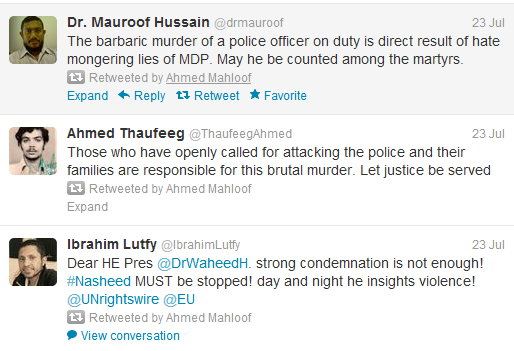
They intertwined news of the policeman’s death with the narrative of ‘MDP violence against the police’ so often and with such conviction that by the time the police finally revealed more facts, most people—except the accused—were convinced MDP was behind the policeman’s murder. Here’s a tweet that encapsulates the sentiments of government supporters the following day.

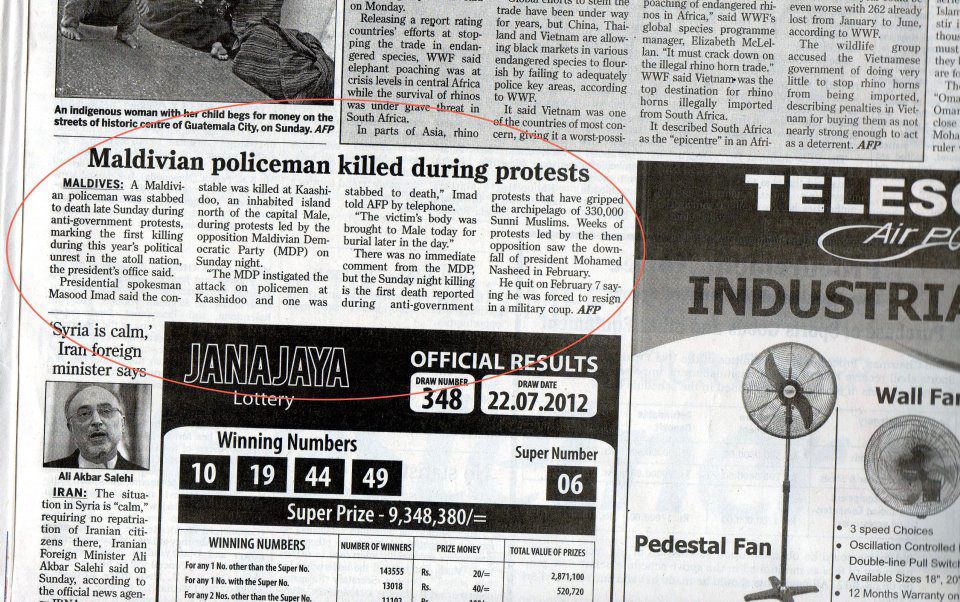
Dissemination of the message did not stop at the country’s borders. In fact, when spread to the international community, the Unity Government didn’t bother with the insinuations. It just came straight out and pointed the figure at MDP. Before Monday morning, the President’s Office Spokesperson, Masood Imad, had told the AFP in Colombo:

The MDP instigated the attack on policemen at Kaashidoo and one was stabbed to death.

Here’s how a Sri Lankan newspaper ran the story the next morning:

Whither the truth?

The truth of the matter, when details began to come out on Monday, was very different. Lance Corporal Haleem was killed by a criminal he had investigated for about a year, and was about to arrest.

The murder was straightforward, and Mohamed Samah, the 22-year-old culprit from the same island, was arrested at the scene. There was an eye-witness and several people, including the police, were on the scene within seconds.

The subsequent scramble to pinpoint the political party to which the accused belonged was ugly. And it was a malaise that affected not just the Unity Government but the general population in its majority. It was as if the violent death of a young man would only begin to matter once the murderer’s political affiliation was established.

His connections with various key figures in different political parties were discussed; his identity card number was keyed into the Elections Commissions website; his membership of one party thus established without doubt—only for that party to come out and say: “There are many MDP members who signed up to other parties by mistake.” Seriously. In a ‘functioning democracy’, as Dr Waheed describes the Maldives, the facts of Lance Corporal Haleem’s death would have required a formal retraction. And, at the very least, it would have elicited an apology to the MDP for very serious wrongful accusations made against it.

But that is not what happened, for it was not Lance Corporal Haleem’s death that was important but the concurrent narrative of MDP’s violence that it was used to construct. Under the circumstances, truth was irrelevant. Thus the political abuse of Lance Corporal Haleem’s body continued apace.

After the condemnations came the heavily publicised State funeral. Of course, the fallen must be honoured. Policemen put their lives at risk protecting society, and we should appreciate that, especially so when they die on duty.

But was the public spectacle put on by the Unity Government and Maldives Police Service really necessary? It is not part of Maldivian culture to hold ostentatious, loud, photographed and televised funerals.

We are humble and simple in our bereavement. But, pictures of Lance Corporal Haleem’s coffin being carried to Islamic Centre on the shoulders of sombre looking policeman were splashed across the media. As were pictures of various key Unity Government figures consoling the family, looking appropriately grieved, and even praying. Faith, like death, reduced to a photo opportunity.

In a slight digression: I could not help but notice Lance Corporal Haleem’s distraught mother photographed at the burial ground paying her respects. I know several mothers, wives, daughters and sisters (myself included) who have desperately wanted it to be otherwise. But it has always been maintained that a woman cannot partake in the burial. What was it about this occasion that allowed the bending of a seemingly inflexible Islamic rule?

Retaliation against the wrongfully accused

As the day passed, the rhetoric of MDP’s violence against the police was only ratcheted up, not lowered. Now the Unity Government’s efforts were on making people forget the truth.

It seems as if the fact of Lance Corporal Haleem’s death has been buried with him. What remained of concern was the accompanying narrative – MDP is deliberately inciting violence against the police and must be stopped.

Thus the Maldives Police Service began ‘retaliation’ against MDP for a crime it had nothing to do with. Chief among several actions taken to avenge Lance Corporal Haleem’s murder was the ’leaking’ of a telephone conversation between Nasheed and MDP Mariya Didi, one of his closest allies and friends. In the March 29 conversation, Mariya is heard updating Nasheed about police violence and use of pepper-spray against protesters resisting their dismantling of Usfasgan’du [MDP’s protest camp] that day. She asks for Nasheed’s advice, and he replies:

There’s not much we can do. I don’t know. What is there to do? I think [we] need to get people out to fight if we can get them. If we can get people to fight, get them out. It’s very clear to me, I think we need to fight back. If we can get people to fight. Find kids from Male to fight the police.

Mariya laughs. Not the response one would expect from a person who thinks she has just been assigned the task of recruiting a gang of thugs to take on the national security forces. Regardless, the police thought it prudent to release the audio clip. For what purpose? It was certainly not aimed at calming tensions or to make real the rhetoric of reconciliation.

Nasheed’s supporters are unlikely to accept the private conversation between him and Mariya as evidence of his alleged brutality. For them, his commitment to non-violence was proven beyond doubt when not just the MDP-affiliated Coup Report but also the so-called CONI Timeline documented Nasheed’s unequivocal refusal to use weapons against the mutinying police, or anyone else, on 7 February.

The only purposes the audio clip served was to harden government supporters’ dislike and mistrust of Nasheed, and to fortify government’s efforts to construct Nasheed as the cruel leader of the violent political organisation that is said to be MDP. To support their claim that MDP leaders are all characterised by political extremists prone to violence, they have also unearthed statements made by key MDP figures encouraging—wrongly so—retaliation against the police for their brutal violence against them during the events surrounding the transfer of government.

Whether or not their words bear any relation to the murder of the policeman, once again, is of the least consequence. What it did beautifully was fit the government narrative. What use to make of the audio clip, which the police has been in possession of since March, was decided shortly after Lance Corporal Haleem’s murder and long before facts of his killing were made public. Home Minister Jameel hinted at it on the night of the murder itself:

The ‘evidence’, with the allegation, is continuing to play across the media—mainstream and social–since then.

Before they brought foreigners and shot them dead, now getting Maldivians to stab them…Bravo to the democracy Anni is bringing.

The poster with the last Tweet from President’s Spokesperson Abbas Riza reads:

6 February Massacre

Main reasons why a massacre was desired:

—to declare a state of emergency

—to abolish the JSC and give MDP the power to appoint judges

—to arrest the leaders who stepped up to defend Islam and the Constitution

—to hand MPL (Maldives Ports Limited) to a company of which India’s GMR is a shareholder

These are not the words and actions of members of a government eager to calm the political and social turmoil afflicting Maldives today. On the contrary, they are intended to cause the opposite effect.

If the Unity Government were serious about reconciliation in the five long months gone, it would have taken due action against members of the police who mutinied. It would not have given them promotions instead.

It would not have appointed as leaders of the security forces men like Mohamed Nazim, Abdulla Riyaz and Mohamed Fayaz, men who the whole country saw playing a key role in the change of government on 7 February. The seeds of public mistrust of the police were planted on that day, and on 8 February. And they grow and mushroom with every day that passes without this government’s acknowledgement of the these facts.

There can be no reconciliation without the truth.

All comment pieces are the sole view of the author and do not reflect the editorial policy of Minivan News. If you would like to write an opinion piece, please send proposals to [email protected]

Likes(1)Dislikes(0)

Government demands GMR “temporarily halt” construction of new terminal

The Maldives government has called for a cessation of work on the new airport terminal by Indian infrastructure group GMR, over allegations the company has “violated rules and regulations” regarding the construction.

President’s Office Spokesperson Abbas Adil Riza confirmed to Minivan News that the cabinet, acting on information provided by the Transport Ministry, had requested that building work on the new terminal at Ibrahim Nasir International Airport (INIA) be halted.

“When the government decides that a project be stopped, we will make sure this happens,” he said. “GMR have not discussed the construction with relevant authorities.”

Abbas did not clarify if the alleged violation of rules and regulations by the company was related to previous reports that construction on the project commenced last month without obtaining  construction permits from the country’s Civil Aviation Authority.

Transport and Communications Minister Dr Ahmed Shamheed was not responding to calls at the time of press.

A GMR spokesperson said today that the company itself had received no letter or communications calling for a halt to work.

However, local media has reported that the cabinet opted on Tuesday (July 24) to call for a “temporarily halt” on work on the terminal, over claims GMR had not acquired necessary authorisation and permit approval from the country’s Civil Aviation Authority.

GMR told Haveeru earlier earlier this month that terminal construction had been approved in an existing master-plan agreed with the government. The company has pledged that it will open by July 2014, “irrespective” of outside issues.

Addressing the matter of GMR’s construction work earlier this month, the government at the time claimed that the permit was “not a huge issue” and was believed to have resulted from an error by contractors presently working on the airport’s construction.

Development plans

The development of the airport – expected by the company to total US$511m in costs – is the largest foreign investment project undertaken in the Maldives’ history and includes commitments to renovate INIA’s existing terminal by September both in terms of operational efficiency and customer services, according to GMR.

With contractors already having begun work on the new structure in June, the administration of President Dr Mohamed Waheed has previously stressed that it would not seek to interfere or “disturb” the project that officially commenced back in November 2010 under the administration of former President Mohamed Nasheed.

However, President’s Office Spokesperson Abbas previously claimed that the long-term prospects of the construction ultimately depended on GMR validating the legality of their contract – a document that was overseen by the International Finance Corporation (IFC). The IFC is a member of the World Bank group and the largest global institution focused on private sector in developing countries.

Abbas added that should the (now government party controlled) parliament also decide on nationalising the airport in line with the wishes of certain pro-government parties to take back the project from GMR, then the present administration would have to comply with such a decision.

The government of President Dr Mohamed Waheed Hassan comprises a coalition of former opposition parties that represent the majority of elected representatives. The now-opposition Maldivian Democratic Party (MDP) presently has 29 MPs in the Majlis, the largest number of MPs belonging to a single party.

Nationalisation calls

Several pro-government parties – including the Dhivehi Rayithunge Party (DRP), Dhivehi Qaumee Party (DQP), People’s Alliance (PA) and Jumhoree Party (JP) – advised President Waheed last month that they continued to endorse an agreement signed in June 2010 calling for the airport to be taken back from GMR and nationalised.

The agreement endorsed six main points which included taking legal action to prevent the government’s decision to award the contract to GMR.

Likes(0)Dislikes(0)

Nine people to face charges over ‘honeytrap’ nude photo blackmailing scam

The Maldives Police Service (MPS) have sent a case involving nine people to the Prosecutor General (PG), alleging the group was involved in blackmailing people after acquiring nude pictures and videos of them through Facebook.

Last year in February, police arrested 14 persons including a minor for alleged involvement in the blackmailing ring, after the group used a fraudulent Facebook account to acquire videos of politicians, businessman and other members of the public and used the material to blackmail them for money.

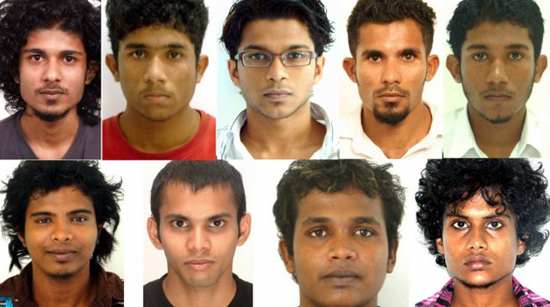
In a press briefing held yesterday, police revealed to media the details of the nine persons facing charges, all of them from Hithadhoo in Addu City: Mohamed Mumin (26), Hussain Shah (24), Ahmed Mohamed (26), Mohamed Minsar (24), Azmeen Ishaag (23), Mohamed Ishaag (27), Ibrahim Ishaag (20), Ali Ishaag (26) and Ahmed Athif (21).

Police stated that during the investigation process they retrieved videos of about 60 to 70 people who were blackmailed.

They also said that they have sent cases involving 10 persons to the PG, concerning the content of videos obtained. Police did not reveal the details of those charged.

Speaking at the press briefing, Superintendent of Police Mohamed Riyaz said that police did not reveal the details because the case concerned a lot of people and there remained “certain things” that still needed to be checked before revealing their identities.

Police earlier told Minivan News that they would be revealing the details of those in the videos as the investigation progressed.

Superintendent Riyaz stated that the blackmailers used two Facebook accounts to blackmail the victims and had acquired large sums of money in the process, transferred it using a shop in Male to a shop in Addu City.

Two Facebook profiles identified at the time as being involved in the ring where those belonging to ‘Lyshiaa Limanom’ and ‘Angelic Sharrown’. Both of these profiles show the same picture of a young blonde woman wearing sunglasses, and each profile had between 1200-1300 Facebook ‘friends’ – most of them Maldivian.

Riyaz also said that the blackmailers had also collected money by personally contacting the victims.

“[Before taking money] they first checked the financial capacity of the person. They took large sums of money from some people while collected money from others on a monthly basis for a very long period,” he said.

Riyaz did not reveal the details of exactly how much money that was laundered.

During the investigation, police questioned several officials from the former government including officials of state minister level.

Local newspaper Haveeru reported that the investigation was halted following pressure from the former government, and the investigations resumed following the controversial transfer of power which toppled the government of then President Mohamed Nasheed on February 7, 2012.

Following the arrests made on February last year, police in a statement said they had begun investigations after the issue came to light two months back.

“Police conducted a special operation from February 13-20, 2011 in an effort to stop this crime and present the criminals before the court,” read the statement.

Police at the time said 10 of the 14 alleged perpetrators were arrested in Addu City while four of them, including a 17 year old minor, were caught in Male’. According to police all persons arrested in Addu City were between the ages of 21-26.

Police stated that they discovered “hundreds of nude pictures and videos of Maldivians” in the laptops and external hard drives of those arrested.

“While some of the pictures were taken of people while drunk, other pictures were taken without the consent of the person,” police said.

Police also stated that they had noticed that some people in the videos were performing explicit acts in the presence of minors, and warned that this “could affect the future and discipline of the minors”.

Police questioning Haveeru journalists

During the investigations, police questioned two journalists from local newspaper Haveeru following an article they published on the blackmailing ring.

Haveeru in the article interviewed a person who claimed to have seen some of the material, who said that MPs belonging to both the opposition and the ruling party had fallen for the scam, as well as prominent businessmen and “national figures”.

Haveeru journalists Ahmed Hamdhoon and Ismail Naseer volunteered to take part in police questioning about an article published by Haveeru on February 22 concerning the content of images acquired through Facebook. The paper maintained that it did not have any of the files that were in question.

Haveeru Editor Moosa Latheef told Minivan News at the time that although police had acted politely and without aggression in requesting the identity of the sources said to have viewed the indecent images – a request he said was denied just as politely – the case could have serious ramifications for the national media in the future.

Latheef stressed particular concern that should police repeat their conduct of looking to question journalists about their sources or stories.

“We are very much enjoying the press freedom in the Maldives right now. But I’m afraid that if the police or other institutions try to interfere with our [press] freedom then they will create an atmosphere where we are unable to fulfill our responsibilities,” he said. “If this repeats then we could have journalists who are afraid to write about issues. No one wants to go to the courts to defend himself or herself [over stories].”

Latheef said that in general, it could become very easy to begin such a case by accusing a journalist – or anyone – of having illegal content such as pornographic images on their computer. Yet on a wider level, the editor was wary about police being able to gain access to the computer files of the country’s journalists and their contents that could include confidential sources vital to break stories.

While the paper’s editor accepted that there were situations such as national security issues that could warrant a court to request the identity of a journalist’s source against commonly held industry ethics, he claimed such requests should remain very rare cases.

Latheef said that the Facebook bribery allegations were a story not about an issue of national security, but one concerning prominent members of the government, parliament and the judiciary, which paled in consequence to some of the stories he said Haveeru has previously published.

Police at the time also obtained a court order to search the computers of some Haveeru staff.

However, police officials later said they ultimately opted not to conduct a search on Haveeru’s premises, but that the questioning of the journalists involved was important to an ongoing investigation.

“Attack on free media”

Following the questioning, Maldives Journalist Association (MJA) condemned the police actions describing the actions as a step to suppress free media in the country.

MJA President Ahmed ‘Hiriga’ Zahir said at the time that the action taken by police in questioning Haveeru’s Ahmed Hamdhoon and Ismail Naseer was unprecedented under the current constitution.

A media officer for the Maldives Police Service following the events said at the time that they were unable to confirm what sort of questions the journalists were asked and if they may be called in for further questioning at a later date.

However, Zahir at the MJA questioned why the police needed to summon the journalists about a story and images already thought to be in the public domain.

“I don’t think this was simply a case of police asking journalists to help them with an enquiry,” he said. “I personally believe it is an attempt to censor and suppress the Maldives media, which has been free.”

The case became a subject of intense political debate and conspiracy against the former government of President Mohamed Nasheed where then opposition figures accused his government of trying to cover up the blunders of his party, Maldivian Democratic Party (MDP) activists who were unfit for top government posts.

Dhivehi Qaumee Party (DQP), an opposition party at the time sent a letter to the President’s Office, calling the President Nasheed to remove government officials involved in the case from their posts “or if you do not remove them from their posts it will be taken as meaning that you are supporting such activities.”

The DQP called on the government to take action against those involved “as soon as possible.”

However, former Press Secretary for the President Mohamed Zuhair brushed off the allegations stating that none of the events reportedly depict “would have taken place inside the President’s office.”

“We don’t have Facebook, MSN or any other social networks on any computer of the President’s Office,” Zuhair said. “It is nothing to do with the government or the president,” he responded.

Several blogs at the time speculated on the names of those caught up in the scandal, but police did not confirm the identities of those compromised.

Likes(0)Dislikes(0)