June arrivals show 6.1 percent increase despite fall in traditional markets

The Maldives has recorded a 6.1 percent overall increase in tourist arrivals for June 2012 compared to the same period last year, according to figures from the Maldives Marketing and Public Relations Corporation (MMPRC).

The increase came despite continued drops in key markets across Europe, including the emerging Eastern European market.

The German market, which was one of the few large market segments to show a double figure increase over the last few months, declined 9.4 percent in June 2012, compared to the same period last year.

The decline in the longstanding staple UK market – the country’s largest prior to the sudden influx of Chinese visitors in 2010 – slowed slightly, recording a drop of 3 percent to 6146.

Russia, a lucrative and generally consistent emerging market for the Maldives, fell 12.3 percent in June 2012 compared to the previous year.

Italian arrivals continued to plummet, falling 32.8 percent.

Chinese arrivals continued to show strong growth in terms of volume, increasing to 17,809 in June 2012 – growth of 15.6 percent, on the back of strong charter performance. The MMPRC’s figures suggest that in terms of volume, Chinese arrivals are three times greater than the country’s second largest market.

The Middle East region continued to show strong growth, with arrivals increasing almost 110 percent to 2533. The vast majority of arrivals were from Saudi Arabia, which recorded a 152 percent increase in June 2012 on the same period last year.

Total arrivals for the first half of 2012 are up 2.3 percent on the same period in 2011 to 458,068, implying that the country still has a chance at breaking its target of one million visitors despite the ongoing political and economic turmoil.

Head of the MMPRC Mohamed Maleeh Jamal was not responding at time of press.

Likes(0)Dislikes(0)

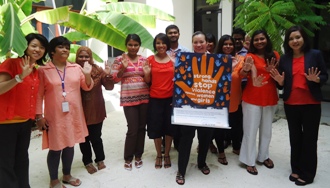
The spirit of Orange Day

Orange has always known to be a powerful color: it stimulates enthusiasm, creativity and symbolises vitality with endurance. It is also said be one of the healing colors.

So what other better color than Orange to show peoples’ solidarity in the fight to end all forms of violence, abuse and discrimination inflicted on millions of women and young girls worldwide in pandemic proportions.

Available country data reveals that up to 70 per cent of women experience physical or sexual violence from men in their lifetime – the majority by husbands, intimate partners or someone they know.

Among women aged between 15 and 44, acts of violence cause more death and disability than cancer, malaria, traffic accidents and war combined.  It is one the most pervasive human rights violation that is devastating millions  lives, fractures communities, and stalls development.
The violence takes many forms and occurs in almost all places – domestic violence at  home, sexual abuse of girls in schools, sexual harassment at work, rape by husbands or strangers, in refugee camps or as a tactic of war.

The Global Unite Youth Network, a group of over 40 young activists from around the world working to end gender inequality and violence against women and girls, launched its first action on Wednesday, 25 July: UNiTE Orange Day, under the UN Secretary-General’s campaign UNiTE to End Violence against Women.

The young activists, including myself, decided to raise awareness about the issue of violence against women and girls and bring this pandemic to people’s atention, not only once a year on 25 November (International Day for the Elimination of Violence against Women), but every month.

The goal was simple: Generate interest and conversations about the issue, and encourage people to start thinking and talking about how to end violence against women and girls.

On the same day, the UNiTE campaign also launched the new UNiTE Ribbon as symbol for preventing and ending violence against women and girls. The mission is to make this symbol universal.

Therefore, through social media campaigns,the Global Unite Youth Network members, including myself, asked men, women, boys and girls, young and old in our countries to wear something orange on 25 July and wear the orange ribbon, together creating a historical global movement.

Orange Warriors from across the world

Following just almost a week of campaigning, on Wednesday, we witnessed the rise of several hundreds of “Orange Warriors” from beyond borders, nationalities and cultures, ready to stand up to violence committed against women and girls.

From Bosnia to Bangladesh, France to Sri Lanka, Thailand to Phillipines, US to Russia, Georgia to India – both young and old alike – joined the campaign, uploading their pictures shining with multiple shades of orange to social networks such as Twitter and Facebook.

From the Maldives a small butspirited group of individuals also joined the campaign, including my family and close friends, colleagues at Minivan News and staff of UN agencies.

The island nation of 350,000 people gripped by widespread gender-based violence including domestic abuse, harassment and discrimination with every 1 in 3 woman reported to be victim of violence.

UN Staff marks Orange Day

UN Women Representative in Maldives Michiyo Yamada said violence affects not only women and girls themselves but everyone in a community and society. We all need to understand the gravity of the issue and show a commitment individually.

“It is very encouraging to see young people taking a lead to advocate to end violence against women and girls, as they are a key agent of change.” Yamada noted.

She added: “We hope everyone will join this campaign and say NO every day to emphasise zero tolerance to VAWG.”

Next Orange Day is scheduled for August 25th. Will you wear orange and Say No?

Likes(0)Dislikes(0)

The many promises of Mohamed Nasheed: Dr Hassan Saeed

“I have said in the past that many people find it hard to trust Nasheed and recent revelations about his relationship with President Waheed put this into perspective,” writes Dr Hassan Saeed, Special Advisor to President Waheed, in Haveeru.

“At this time of reflection, I want to put on record my own experience.

Shortly after my resignation from President Gayyoom’s cabinet in 2007, I visited London accompanied by two close friends. Through a series interviews with the BBC and the Independent, I and my team launched our 2008 presidential election campaign. We were then known as the New Maldives movement.

Whilst in London we also held a number of meetings. This included some with members of the then opposition UK Conservative Party. One such meeting was with a senior Conservative MP who had been closely working the MDP.  During the meeting in his office, he remarked that the MDP leadership lacked experience and competency and that he would ask the MDP leadership to back the New Maldives team in the 2008 presidential election.

Perhaps he did?

Shortly after we returned from London the MDP held primaries to pick its presidential candidate. A number of senior MDP officials from Addu and elsewhere met me conveying a message from Nasheed. That message was very clear; Nasheed would contest the MDP primaries, but he did not intend to contest the Presidential election. If he were to win the MDP primaries, he would back me.

This was not just local MDP officials making rash promises; Nasheed himself came to visit and told me that I commanded substantial support within the MDP. He asked for my support to win those primaries. He even told me further that his own mother supported me. Almost immediately after our meeting an older woman called me. She said she was Nasheed’s mother and how big a fan of me she was and that she would get fully involved in my election campaign.

Many in Nasheed’s door-to-door campaign teams would call and tell me that he was making it crystal clear to MDP voters that if he won in the primaries he would back me.

Nasheed did win. Initially, I did not hear from him for several days. My colleagues contacted him. A meeting was arranged. Nasheed’s team consisted of Ibrahim Mohamed Salih, Ameen Faisal and Nasheed himself. From our side Dr Jameel, Dr Shaheed and myself attended.

Nasheed agreed to be my running mate with the MDP to get 75 percent of cabinet posts. However if elected President on this ticket I would have had the authority to veto incompetent and corrupt nominations from the MDP.  In view of what seemed a good arrangement for all sides, we agreed this. We even shook hands on it before we finished the meeting.

Nasheed called an MDP Qawumee Majlis (Nations Council) meeting. He then contacted his close aides to mobilize their support for our agreement. The MDP member for the Constitutional Assembly Mr. Adnan Haleem floated the proposal to the MDP National Council. The Council unanimously endorsed the arrangement for Nasheed to be my running mate.

A meeting of senior officials from both sides was arranged to discuss joint campaign funding.

All seemed to be arranged. We would have change in the Maldives and it would have comprised an alliance that the subsequent first round Presidential election results shows could have secured up to 41.58 percent – ahead of Gayyoom’s 40.34 percent.

However what seemed to be solid turned out to be thin air. To my surprise immediately after the meeting a senior official from Adalat Party called me and said that Nasheed had asked MDP backing for his presidential campaign!”

Read More..

Likes(0)Dislikes(0)

President to mark 47th Independence Day with Republic Square address

President Dr Mohamed Waheed Hassan will deliver an address this evening from Republic Square in Male’ to commemorate 47 years since the country became an independent nation.

According to the President’s Office, Dr Waheed will host a special Independence Day function, organised by the Ministry of Home Affairs, that will include a ceremonial hoisting of the national flag at the square.

Maldivian Independence Day commemorates the nation obtaining the right to self determination on July 26, 1965. The country had previously been a British protectorate since the late 19th century.

As part of Independence Day festivities held in the country this week, President Waheed and First Lady Ilham Hussain also hosted an official reception yesterday evening at the National Museum.

Foreign dignitaries, former presidents, Parliamentary Speaker Abdulla Shahid and serving MPs and cabinet members were said to be among invitees to the function, according to the President’s Office website.

Likes(1)Dislikes(0)

President Waheed’s brother protests outside London Ruder Finn office

A small group of protesters gathered outside PR firm Ruder Finn’s London offices to mark Maldives Independence Day, reports PR Week, including President Mohamed Waheed’s brother, Naushad Waheed Hassan.

Naushad previously stepped down the post of Deputy High Commissioner to the UK as of now “because I cannot serve a regime that has brought down the democratically elected government of my country in a coup d’état.”

The protest saw placards bearing slogans ‘Islamophobes and dictators’, ‘Ruder Finn: no client too toxic’ and ‘Gold medallists of spin: Ruder Finn’, reported PR Week.

“The criticism came after Ruder Finn was blasted by British-based pro-democracy group Friends of Maldives for accepting a brief to promote a tourism drive by the Maldives government. This followed claims that president Mohamed Nasheed was removed in a coup d’etat in February.

“Agency boss Nick Leonard had not faced protesters himself as he was on holiday. But he defended the agency’s actions, saying: ‘I believe in freedom of speech and they have the right to voice their opinion.’”

Read more

Likes(0)Dislikes(0)

Civil Court dismisses ruling of own watchdog body against Chief Judge Abdulla Mohamed

The Civil Court today dismissed a decision by its own watchdog body, the Judicial Service Commission (JSC), to take action against Chief Judge of the Criminal Court Abdullah Mohamed for violating the Judge’s Code of Conduct.

An investigation into a complaint of ethical misconduct against Judge Abdulla was completed by a JSC special committee which recommended in the final report to the commission that action be taken against the Judge for violating the Judge’s Code of Conduct – specifically, by making a politically biased statement in an interview with DhiTV.

However, during the period given to Judge Abdulla to respond to the report, he instead obtained a Civil Court injunction against his further investigation by the judicial watchdog.

The JSC appealed the injunction on January 24 of this year, claiming that the Civil Court had disregarded the commission’s constitutional mandate which allowed it to take action against judges, and argued that the court did not have the jurisdiction to overrule a decision of its own watchdog body.

But the appeal was rejected, concluding that the commission had not provided the court “any substantial reason to terminate the injunction and that the High court cannot make a decision on the case while the case is pending at a lower court.

As the final verdict on the case came out today, the Civil Court overruled the the decision stating that Judge Abdulla was not given an opportunity to respond to the allegations during the investigation.

According to the decision, providing a chance to submit any complaints after the investigation is completed cannot be deemed as an opportunity for the Judge to present his defence.

Like all other state institutions the JSC must also be held accountable in front of the law, the court noted, addding that party who believes to have suffered damages due to a decision by the commission have the right to litigate  matter to protect his rights.

Furthermore the Civil Court concluded that action cannot be taken against the Abdullah under the Judge’s Code of Conduct, because the said violation predates the regulation.

Charges against the Judge

Apart from the ethical misconduct complaint, the JSC revealed that a total of 11 complaints have been submitted to the commission against Judge Abdulla Mohamed, among which are serious allegations of corruption and abuse of authority.

The first complaints against Abdulla Mohamed were filed in July 2005 by then Attorney General Dr Hassan Saeed – now Dr Waheed’s political advisor – and included allegations of misogyny, sexual deviancy, and throwing out an assault case despite the confession of the accused.

Among the allegations in Dr Saeed’s letter was one that Judge Abdulla had requested an underage victim of sexual abuse reenact her abuse for the court, in the presence of the perpetrator.

In 2009, those documents were sent to the JSC, which was requested to launch an investigation into the outstanding complaints as well as alleged obstruction of “high-profile corruption investigations”.

The JSC decided not to proceed with the investigation on July 30, 2009.

Former President’s member on the JSC and whistleblower Aishath Velezinee for several years contended that Abdulla Mohamed was a central, controlling “father figure” in the lower courts, answerable to former President Maumoon Abdul Gayoom and a key figure responsible for scuttling the independence of the judiciary under the new constitution.

Central figure in Nasheed’s downfall

Abdulla Mohamed was also a central figure in the downfall of former President Mohamed Nasheed, following the military’s detention of the judge after the government accused him of political bias, obstructing police, stalling cases, links with organised crime and “taking the entire criminal justice system in his fist” to protect key figures of the former dictatorship from human rights violations and corruption cases.

Judge Abdulla’s arrest sparked three weeks of anti-government protests starting in January, while the government appealed for assistance from the Commonwealth and UN to reform the judiciary.

As protests escalated, elements of the police and military mutinied on February 7, alleging Nasheed’s orders to arrest the judge were unlawful. A Commonwealth legal delegation had landed in the capital only days earlier.

Nasheed publicly resigned the same day, but later said he was forced to do so “under duress” in a coup d’état. Nasheed’s Maldivian Democratic Party (MDP) has taken to the streets in recent months calling for an early election.

Judge Abdulla was released on the evening of February 7, and the Criminal Court swiftly issued a warrant for Nasheed’s arrest. Police did not act on the warrant, after international concern quickly mounted.

Likes(1)Dislikes(0)

Lance Corporal Haleem killed by “MDP loyalist”, government tells foreign media

The government has claimed that murdered policeman Lance Corporal Adam Haleem was stabbed to death by a “Maldivian Democratic Party (MDP) loyalist”, in a text circulated to foreign media outlets.

President’s Office Spokesperson Masood Imad was reported as stating in a story published by AFP that “MDP instigated the attack on policemen at Kaashidoo and one was stabbed to death” during protests.

Police meanwhile held a press conference today during which they claimed that the murdered policeman was attempting to arrest his alleged killer, 22 year-old Mohamed Samah, at the time of his death.

Police stated that Haleem had observed Samah wandering the street despite being under house arrest, and asked him to accompany him to Kaashidhoo police station. Samah had reportedly been released to house detention on Sunday following a two day arrest over an assault case.

According to local media, police stated that Haleem had asked Samah to get ready to go to the station with him, and had waited outside his house. Samah allegedly came out of the property with a knife, which he used to stab Haleem while the officer was on the phone to the police station.

Police further alleged that Samah was intoxicated at the time of the incident, and stated that he had tested positive for cannabis following his arrest.

Speaking to Minivan News, Imad said “I can assure you that he was an MDP loyalist, and an active member of the Donbileih Kaashidhoo campaign. The attack took place moments after calls to engage in violence against police, in an MDP rally.”

MDP Spokespersons Hamid Abdul Ghafoor and Imthiyaz Fahmy were not responding at time of press.

Haleem suffered serious stab wounds in the attack, including a nine-inch deep stab wound to the chest. He was alive but in critical condition when brought to the hospital, but died soon afterwards while undergoing treatment.

The death has been swiftly politicised amid spiraling political tensions in the country.

The government condemned former President Mohamed Nasheed and his Maldivian Democratic Party (MDP) for the murder, claiming that MDP’s ongoing protests against the police in the capital Male’ provoked the attack on Kaashidhoo island.

Home Minister Dr Mohamed Jameel Ahmed tweeted that the “murder of police officer came after continuous attack on police force by MDP, calling [the] entire police force traitors.”

In another tweet, Jameel also said that “evidence available to police [which] exposes MDP top leadership calling for violence against the police force.”

Police subsequently released a recording of a phone call between Nasheed and MDP MP Mariya Didi, in which Nasheed expresses frustration with the police dismantling of the party’s protest site at Usfasgandu: “I think we need to fight back. If we can get people to fight. Find kids from Male to fight the police. That is what I think. I don’t know if we can get people to fight. I want to fight against them,” the former President is heard to say.

The MDP retaliated by publishing a screenshot of the Elections Commission party registry indicating that Samah was a member of the government-aligned Progressive Party of the Maldives (PPM).

The party further alleged that the suspect was a key supporter of Jumhoree Party (JP) MP Abdullah Jabir, who won the Kaashidoo constituency in the recent by-election with official endorsement from PPM.

Jabir has denied the claim and alleged the suspect had actually been working with MDP candidates at local elections, and was mentioned in a police report at the time for attacking a member of the JP’s campaign personnel.

PPM’s Council Member Ahmed Saleem yesterday stated during a press conference that “Party is not important. What’s important is the crime committed by the criminal.”

“We have also heard people say that he is from PPM. But we have not checked if it’s true. The reality is that MDP members have been registered under other parties by mistake,” Saleem claimed.

Likes(0)Dislikes(0)

Hulhumale’ court has jurisdiction to hear Nasheed case: Deputy Prosecutor General

Deputy Prosecutor General (PG) Hussein Shameem has said that Hulhumale’ Magistrate Court does have the jurisdiction to hear the case of former President Mohamed Nasheed over his role in the detention of a Criminal Court Chief Judge.

Shameem contended that should the court maintain its decision against hearing the case, there were few other judicial alternatives in trying to ensure a “fair trial”.

The comments were made as the PG’s office called on the Hulhumale’-based court to review its decision to send back the case to authorities on the grounds that it did not have the jurisdiction to hear the former president’s trial as written under the Judicature Act.

Nasheed, along with three Maldives National Defence Force (MNDF) officers, face charges over the controversial detention of Criminal Court Chef Judge Abdullah Mohamed – a decision the former president claimed was taken over national security concerns.

Chief Judge abdulla was detained by the military, after he had opened the court outside normal hours to order the immediate release of former Justice Minister and current Home Minister and Deputy Leader of the Dhivehi Quamee Party (DQP), Dr Mohamed Jameel.

The opposition Maldivian Democratic Party (MDP), of which Nasheed is the presidential candidate, has claimed it expects the trial – whether in Hulhumale’ or another court – to go ahead regardless of legality.  The party has alleged the case serves solely as a means to convict the former president and potentially prevent him from contesting in the next general election.

However, Shameem claimed today the PG’s office had opted to hold the case against the former president in Hulhumale’ as it believed a fair trial could not be held at the country’s Criminal Court, an institution Judge Abdulla continues to oversee.

“We believe the Hulhumale’-based court does have the jurisdiction to hear this case under provisions outlined in the Judicature Act. We do not believe a fair trial could be held at the Criminal Court in this particular case,” he said.

Alternatives

Shameem claimed that there was a seemingly limited number of alternatives for hearing the case should Hulhumale’ Magistrate Court maintain it does not have the mandate to host such a trial.

“We would not be sending the case [to the Criminal Court],” he said. “So if the Hulhumale’ magistrate feels uncomfortable with the case or maintains it does not have the jurisdiction, we would have to appeal at the High Court about this.”

A statement sent to local media yesterday by the PG’s office claimed that despite Hulhumale’ Magistrate Court’s initial reservations, it could hold the case as the island was under the same judicial constituent as nearby Male’ and Villimale.

The statement also contended that judicial regulations did not prevent a magistrate court from investigating allegations of the “deliberate arrest of an innocent individual”.

Addressing the issue of court jurisdiction, President’s Office Media Secretary Masood Imad said that the government remained committed to not interfering with the country’s judiciary. Masood said he would not therefore comment on the case against the former president, who has alleged his successor Dr Mohamed Waheed Hassan came to power in a “coup d’etat” on February 7.

“We would not want to touch the issue with a ten-foot pole,” Masood added, referring any questions on the case to Attorney General (AG) Azima Shakoor.

AG Shakoor was not responding to calls at time of press.

Former President to justify judge’s detention

Former President Nasheed has previously that he is “prepared” to justify the reasons for the arrest of Judge Abdulla, and said he was ready to appear in court and prove his actions were valid.

MDP MP and Spokesperson Hamid Abdul Ghafoor claimed that that despite the present uncertainty over the exact legal body that would be hearing the trial, he believed authorities would be going ahead with the trial.

“Nobody, can stop them from doing it,” he claimed. “They have no choice to go ahead with such a thing. It is the only way to avoid talk of an early election by arresting Nasheed and trying to dismantle the MDP. The dictatorship is back.”

Ghafoor alleged that the MDP did not presently take the potential trial of the former President Nasheed “seriously”, owing to what he claimed was institutionalised bias and political influence in the country’s judiciary.

“Today for example, a lower court was able to overrule the JSC [the country’s judicial watchdog] to take action against Chief Judge Abdullah over concerns of his conduct,” he said.

Ghafoor claimed that the judiciary’s reputation and conduct reflected a wider societal attitude that the Maldives did “not have a culture of law” for citizens to rely on.

“The courts and judiciary are not up too much here. During the thirty years of dictatorship we had, the media published propganda about these institutions and people thought they were quite capable,” he said. “Yet in the democracy we have had, you have to prove yourselves”

Ghafoor claimed that as the issue of Nasheed’s trial continued to wear on, more members of the public were becoming are “that the trials are a sham”.

In late 2011, Judge Abdulla was himself under investigation by the JSC, the country’s judicial watchdog, for allegedly politically biased comments made to private broadcaster DhiTV. The Judicial Services Commission (JSC) was due to release a report into Judge Abdulla’s alleged ethical misconduct, however the judge approached the Civil Court and successfully filed an injunction against his further investigation by the judicial watchdog.

Judge Abdulla’s arrest sparked international criticism of the Nasheed administration as well three weeks of anti-government protests in January, leading the former government to appeal for international assistance from the Commonwealth and UN to reform the judiciary.

Likes(0)Dislikes(0)

Maldives protesters hit Ruder Finn offices: PRWeek

A 15-strong group gathered outside the London offices of Ruder Finn on Tuesday to protest about the agency’s work for the Maldives government,” reports Matt Cartmell for PRWeek.

“The protest, which coincided with Maldivian Independence Day, saw placards bearing slogans ‘Islamophobes and dictators’, ‘Ruder Finn: no client too toxic’ and ‘Gold medallists of spin: Ruder Finn’.

The criticism came after Ruder Finn was blasted by British-based pro-democracy group Friends of Maldives for accepting a brief to promote a tourism drive by the Maldives government. This followed claims that president Mohamed Nasheed was removed in a coup d’etat in February.

Agency boss Nick Leonard had not faced protesters himself as he was on holiday.

But he defended the agency’s actions, saying: ‘I believe in freedom of speech and they have the right to voice their opinion.’”

Read more..

Likes(0)Dislikes(0)