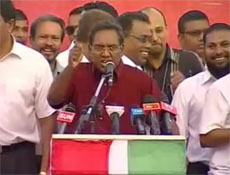
Prospect of “radicalised, authoritarian” Maldives threatens all nations: former president Nasheed

Former President Mohamed Nasheed has spoken of the close relationship between climate change, human rights, and democracy during separate addresses to the Danish parliament and the University of Copenhagen this week.

Discussing concerns over political instability in the Maldives that have been raised by NGOs such as Amnesty Intentional since President Dr Mohamed Waheed came to power last year, Nasheed accused the current government of reversing “hard won freedoms” and awarding “Islamic extremists” with cabinet positions.

He also claimed that the prospect of the Maldives becoming a “radicalised, authoritarian stronghold” would have negative connotations well beyond the country’s borders.

“In many ways, [extremists] set the tone of Government communications and they are busy trying to indoctrinate the people with a misguided version of Islam,” Nasheed said.

The office of President Waheed – who entered into office through a controversial transfer of power on February 7, 2012 – today dismissed Nasheed allegations that Islamic extremists were serving in the government.

“I urge Mr Nasheed to stop spreading lies to promote his political agenda.  I call on him to engage professionally,” President’s Office Media Secretary Masood Imad said via SMS today.

Senior government figures have earlier this year criticised some of the recent findings published about the Maldives by Amnesty International, accusing the group of publishing reports without conducting research.

During his visit to the Danish capital, Nasheed also met with current and former Danish Ministers, high-level officials, supporters, as well as gave an interview to local tv news show DR2 Dagen.

Nasheed, who is a globally recognised high-profile advocate for climate justice, expounded on how he believed environmental issues, human rights, and political stability are increasingly intertwined.

“The fight against climate change is a human rights issue and the way we respond to it will shape not just our environment, but also geopolitical reality – for generations to come,” he stated while speaking at the University of Copenhagen yesterday (April 16).

“Bad energy policy is not just polluting our planet, it is polluting our politics, warping international relations.”

“New balance of power”

Nasheed gave a lecture to the University of Copenhagen highlighting the “corrupting influence of fossil fuels” on energy politics and how this has clashed with the newly-founded Maldivian democracy.

“The politics of energy is polluting international relations, just as it pollutes the air, casting a shadow over much of the world and holding back clean energy,” he stated.

“It is the invisible force holding nations in thrall to dictators, causing conflicts and repressing human rights, a suffocating inertia that holds back democracy and development.”

Nasheed addressed how “the fight for fossil fuel resources has shaped the world” for over a century, but now “the time has come for a reformation in energy politics; one that values human rights above mineral rights.”

While fossil fuels have “driven companies to corruption, governments to repression, and nations to war, the new resources – solar, wind, waves – are much more widely distributed…there are no ‘resource fields’ to fight over.”

Clean energy is about a significant shift in the established geopolitical order, a shuffling of the deck in the great game, not just about rewiring the world economy, Nasheed explained.

“Carbon emissions”

“If we turn our backs on corrupting influence of fossil fuels, if we reject the polluting in pursuit of the beautiful, we can protect the world around us. We can deliver sustainable economic growth. And we can do so whilst putting development and democracy first,” he stated.

“For the first time since the Industrial Revolution, it is now technologically, economically and politically feasible for people to get their energy sustainably.

Nasheed said it was important that climate change not be underplayed as “some abstract risk,” claiming that the lives and freedoms of people all over the world were threatened if no action was taken to address environmental concerns meaningfully.

“I know it is possible, because we had a plan to do it in the Maldives. A fully costed plan, approved by the World Bank, to go carbon neutral. The only reason we didn’t was because we were rudely interrupted by a coup!” Nasheed exclaimed.

“Radicalised, authoritarian stronghold”

Nasheed also gave a speech to the Danish Parliament that reiterated similar environmental themes, but with an emphasis on the Maldives’ 2008 democratic transition.

A year prior to the Copenhagen Accords – the first time that big emitters from the developed and the developing world all agreed to cut carbon emissions – the Maldives had transitioned from former President Maumoon Abdul Gayoom’s 30-year authoritarian rule to democracy, Nasheed explained.

“Positive changes such as ‘Basic freedoms’ – freedoms which been repressed for generations – began to take hold,” said Nasheed.

“The Maldives was being hailed by NGOs as a model of liberal, Islamic democracy,” he added.

Nasheed provided the Danish parliament with a brief narrative account of the police and military mutiny on February 7, 2012, which he alleged was controlled by “Gayoom, and his allies, alongside Islamic extremists keen to re-establish the old order.”

“[Gayoom’s] former dictatorship organised the coup because they could see the edifice of their economic and political power crumbling,” he explained. “It was crumbling because Maldivians had rejected authoritarianism, rejected feudalism and largely rejected Islamic extremism.”

Nasheed also added that the prospect of the Maldives becoming a “radicalised, authoritarian stronghold” was a threat for many people.

“It is a threat to the hundreds of thousands of Europeans who holiday there every year. It is a threat to neighbouring democracies, such as India.  And it is a threat to the stability of the wider Indian Ocean, through which 40% of world trade passes,” he said.

“A democratic Maldives is not only your friend; it is also the best guarantor of your interests,” he emphasised.

Free and fair elections

Domestically, Nasheed is presently being tried in the Hulhumale’ Magistrate Court over the controversial detention of Chief Judge of the Criminal Court Abdulla Mohamed in January 2012.

However, Nasheed has maintained that the trial, presently on hold pending a High Court decision on the legitimacy of judges appointed to hear the former president’s case, is politically motivated to try and prevent free and fair elections from occurring this September.

He highlighted recent conclusions of both local and international experts into the present status of the country’s judiciary to support his claims.

“The United Nations Special Rapporteur says the court is bias and politicised. This view is shared by Amnesty International and the UN Human Rights Committee,” he said.

Likes(2)Dislikes(1)

Finance Minister confident MPs will back wider revenue measures

Finance Minister Abdulla Jihad has expressed confidence that MPs will approve a raft of measures to raise state revenue, even after they narrowly rejected government proposals to increase an airport service charge yesterday (April 16).

Hiking the airport service charge from US$18 to US$30 for international passengers was among a raft of measures proposed by the Finance Ministry within the estimated 2013 budget in order to raise MVR 1.8 billion (US$116 million) in new income.

The finance minister told MPs in December 2012 that additional revenue was needed to finance the fiscal deficit and rein in soaring public debt, which was projected to reach MVR 31 billion (US$2 billion) or 82 percent of GDP by the end of 2013.

After yesterday’s rejection of the service charge increase, Jihad told Minivan News that he was of the belief parliamentarians would back other proposed measures that he has previously claimed will be vital in balancing the state budget.

These measures include hiking Tourism Goods and Services Tax (T-GST) to 15 percent, introducing GST for telecom services, and “selectively” reversing import duty reductions.

Despite expressing optimism that these reforms would be passed, Jihad stressed that he had personally received no feedback from MPs or political representatives regarding the exact level of support for such measures at time of press.

During the parliamentary debate on increasing the airport service charge this week, MPs of the opposition Maldivian Democratic Party (MDP) and government-aligned Progressive Party of Maldives (PPM) both opposed the proposed hike.

MPs of both the majority and minority parties alleged that President Dr Mohamed Waheed planned to use an expected MVR185 million (US$12 million) from raising the departure tax to finance his presidential campaign before the increase was rejected.

“Significant” impact

Jihad today expressed concern that the Majlis’ rejection of hiking the airport service charge would significantly impact state revenues.

Speaking to newspaper Haveeru, Jihad said that budget forecasts has been designed with the increased airport charge in mind, with yesterday’s vote meaning a “significant amount” of funds would be lost from state revenue.

“If the amendments for the import duty are not passed, we will find it extremely difficult to manage the budgets of institutions. So it’s critical that the parliament expedites work on the bills and support them,” he was quoted as telling local newspaper Haveeru.

Jihad later told Minivan News that longer-term tax measures were already being considered as an alternative to cover any shortfall as a result of the airport charge not being increased.

He also did not rule out the possibility of resubmitting a proposal to increase the airport service charge at a later date – although no such decision had been made as yet.

The Parliamentary Group leaders of the country’s largest two parties could not be reached for comment today on the finance minister’s claims.

Maldivian Democratic Party (MDP) Parliament Group Leader Ibrahim Mohamed Solih (Ibu Solih) had his phone switched when contacted by Minivan News.  Solih’s PPM counterpart, presidential candidate Abdulla Yameen, was not responding to calls at time of press.

MDP MP and Spokesperson Hamid Abdul Ghafoor claimed the party would look to review all measures proposed in parliament to try and increase revenue on a “case-by-case” basis.

However, he claimed that the opposition party remained “skeptical” about any financial measures being proposed by the administration of President Waheed, accusing the government of pushing the country towards bankruptcy.

Fiscal responsibility

Despite rejecting an increased airport service charge, legislation on fiscal responsibility submitted in 2011 by the previous government was passed with 42 votes in favour and 10 against at a sitting of parliament on Monday (April 15).

If the bill is ratified, the government would be prohibited by law from obtaining loans after January 1, 2016 to finance recurrent expenditure or loan repayment.

The bill also sets limits on government spending and public debt based on proportion of GDP, mandating the government to not allow public debt to exceed 60 percent of GDP.

Borrowing from the central bank or Maldives Monetary Authority (MMA) should not exceed seven percent of the projected revenue for the year, while such loans would have to be paid back in a six-month period.

Moreover, a statement outlining the government’s mid-term fiscal policy must be submitted annually to parliament at the end of the financial year in July.

Likes(0)Dislikes(0)

President Waheed “most patient, just and capable” among candidates: Dr Hassan Saeed

Dhivehi Qaumee Party (DQP) Leader Dr Hassan Saeed has said he believes President Mohamed Waheed is the only presidential candidate who has the required “patience and drive” to work alongside people with differing views.

The recent comments by Saeed – who currently serves as Special Advisor to President Waheed – were made the same month the DQP formally entered into a coalition with the President’s own Gaumee Iththihaadh Party (GIP) ahead of elections scheduled for September 7 this year.

Both the DQP and GIP are small political parties currently facing potential dissolution for lacking the minimum requirement of 10,000 members as stipulated in the recently passed Political Parties Act.

Speaking to local newspaper Haveeru on Sunday (April 14), Saeed said that President Waheed was the most “academically qualified” candidate.

“He stands even far taller when you compare his international experience  and experience in government than any of the candidates. So if you look at it in any angle, this man is far more capable than all of the remaining candidates,” he said.

Despite the remarks, in February 2012, in a leaked audio clip, Saeed was heard describing President Waheed as “politically the weakest person in the Maldives” .

In the audio clip, he also went onto mock the size of the GIP’s support base, claiming at the time that the party’s only members were “Dr Waheed and the wife, that Ahmed ‘Topy’ Thaufeeg, [Secretary General of the GIP] and Waheed’s secretary at the President’s Office”.

Dr Saeed was not responding to calls at time of press when contacted by Minivan News.

Saeed – who was himself a presidential candidate in 2008 and ended the race at third position with 16 percent of the popular vote – claimed that there was a high possibility that many other government-aligned parties would follow the DQP in joining President Waheed’s coalition.

Saeed said these parties could include the government-aligned Jumhoree Party (JP) of business tycoon MP Gasim Ibrahim, Dhivehi Rayyithunge Party (DRP) and the Maldivian Development Alliance (MDA), led by tourism magnate MP Ahmed ‘Sun Travel’ Shiyam.

Gasim and DRP Leader Ahmed Thasmeen Ali are both presidential candidates for their respective parties.

The religious conservative Adhaalath Party has also publicly pledged its support to President Waheed, last month announcing plans to form a coalition with the GIP.

Saeed claimed that all political parties, except the opposition Maldivian Democratic Party (MDP), were welcome to join the coalition.

He claimed that should such an alliance find an agreement on a common ideology, then it could possibly “change the face of Maldivian politics”.

Giving his reasons why the door was closed for the MDP – the largest political party in the country – Saeed claimed that party’s presidential candidate, Mohamed Nasheed, was not a person who had the capacity to work in a coalition government since he always had problems in “digesting opposing views”.

“Chasing and slowing down”

Saeed claimed that the former president’s “impatience” would not allow him to work in a coalition government, adding that the “science of making a coalition government work” required patience and tolerance.

“One cannot simply run at the pace he wants to,” he said. “A coalition partner would always chase the president and slow him down, should he take such a pace. There should always be an environment for dialogue. [In a coalition,] one cannot simply take a wrong way and jump into the sea. Likewise, you cannot go in the right direction as fast as you want. But in general, a coalition government would always be heading in the right direction. Nasheed cannot be like that,”

The MDP previously said that it would not look to form a coalition ahead of elections this year.  However, Saeed claimed by contract, that there was no political party interested in forming an alliance with the main opposition party of the country.

“[The MDP] are only getting the opportunity to work in a coalition within the parliament. Therefore, MDP is seen to work in collaboration with other parties in parliament. They don’t have a problem working as a coalition in parliament. But outside the parliament, they keep saying that they do not want a coalition. This is because, they really don’t have anyone to form a coalition with,” he said.

Speaking during a recent party gathering, former President Nasheed stated that leaders of various political parties had learned “bitter lessons” over the difficulties of running a government by sharing cabinet positions among different political parties over the last four years.

“A cabinet in which one minister belongs to this party and another belongs to that party, cannot run a government,” he said. “I want the people of this country to remember that, when there is word of coalition, it means of forming a weak government.”

Meanwhile, Chairperson of the MDP, MP Moosa ‘Reeko’ Manik echoed similar sentiments claiming that the MDP could not work with political parties demanding political positions as a pre-condition of any alliance.

“There is no place in the MDP for those who come to us and demand a package of four cabinet positions, 12 judges, three warehouses and the Maldives Monetary Authority (MMA). But it doesn’t mean all doors are closed for those parties interested in working under a common political ideology,” Manik said at the rally.

Political weight

Saeed this month also criticised former President Gayoom’s Progressive Party of Maldives (PPM).  The PPM is fielding Gayoom’s half brother MP Abdulla Yameen as its presidential candidate.  Saeed claimed that even Yameen should be backing President Waheed instead of the other way round.

Dr Saeed alleged that Yameen was a candidate who was too “hard to sell” to the public, claiming there remain a number of unpleasant “characteristics” that came to the minds of voters about him.

“Yameen will face the anger of anyone who hated Gayoom’s 30 years [in power]. Yameen will get the hatred of every person who was tortured during Gayoom’s time. He would not get the support of anyone who wished to leave the past. Even the person who wishes to support Yameen would hate him because Gayoom is right beside him,” he told Haveeru.

“There are a lot of people who hate dynastic rule.  A lot of businessmen also suffered during Yameen’s tenure as the trade minister. So they would have a hard time to back him.”

Saeed’s remarks in local media were met with harsh criticism from PPM MP Shifag Mufeed, who described the DQP leader as someone that lacked any political weight.

“The Maldives has two political ideologies. It is that of former President Gayoom’s ideology and that of former President Nasheed’s. Though he says that no one would join those two ideologies, Dr Hassan Saeed himself must know that he does not even have the weight of a wheat grain in Maldivian politics,” Mufeed said in parliament yesterday (April 15).

Shifag also slammed the government of President Waheed, claiming that a bill proposed to parliament on increasing an existing Airport Service Charge was an attempt by the government to recklessly increase its income so that it could be utilized in “fooling people” to vote for him.

The PPM and DQP are both members of President Waheed’s national unity government.

Saeed’s election history

After facing defeat in the first round of the 2008 presidential elections, Saeed publicly announced unconditional support to the MDP candidate Mohamed Nasheed during the subsequent run-off election.

Once Nasheed was elected president, the MDP alleged that Saeed took a U-turn on his own unconditional backing and had demanded several cabinet portfolios for his supporters.

Saeed was later appointed as the special advisor to the president – a cabinet minister level position – in the new government.  Meanwhile, Saeed’s running mate, Dr Ahmed Shaheed, was appointed as the Foreign Minister and current Home Minister Mohamed Jameel Ahmed was given the cabinet portfolio of Communication and Civil Aviation.

However, following a falling off with Nasheed, Saeed left the government claiming that his “diligent” advice was not considered by the former president.  Later, Jameel was sacked from the government and Shaheed joined forces the MDP.

Leaving the government, Saeed and his fellow party colleague Jameel quickly turned against former President Nasheed and became outspoken critics of his administration.

‘Hate-pamphlet’ scandal

In January 2012, just a few days before the controversial fall of Nasheed, DQP released a 30-page pamphlet accusing Nasheed’s government of working under the influence of “Jews” and “Christian priests” to weaken Islam in the Maldives.

“When the Nasheed administration established diplomatic relations with the biggest enemy of Islam [Israel], the government agreed to change the school curriculum and teach our small children about the goodness of Jews,” read the pamphlet. “The Jew’s plan and way of thinking is to divide Islamic countries.”

The Nasheed administration denied the allegations and claimed that the pamphlet was filled with “extremist, bigoted and hate-filled rhetoric” intended to incite hatred among public towards the government.

Following President Waheed’s controversial ascension to power on February 7, 2012, Saeed was reappointed as the Special Advisor for the President while his colleague Jameel was given the position of Home Minister.

Likes(0)Dislikes(0)

Hiking airport service charge to US$30 narrowly rejected at parliament

Legislation proposed by the government to raise the airport service charge from departing international passengers to MVR460 (US$30) was narrowly rejected by parliament today.

The amendment bill submitted by government-aligned MP Riyaz Rasheed was rejected with 28 votes against, 27 in favour and two abstentions.

At the parliamentary debate on the bill yesterday (April 15), MPs of the opposition Maldivian Democratic Party (MDP) and government-aligned Progressive Party of Maldives (PPM) opposed the proposed hike.

MPs of both the majority and minority parties alleged that President Dr Mohamed Waheed planned to use an expected MVR185 million (US$12 million) from raising the departure tax to finance his presidential campaign.

The 1978 law imposing the airport service charge on departing passengers was first amended under the previous administration and raised to US$18.5 for foreigners.

The imposition of a similar Airport Development Charge (ADC) of US$25 by Indian infrastructure group GMR was previously a major point of contention for the Waheed administration, which terminated the concession agreement with the GMR-led consortium to modernise the airport in December 2012.

Hiking the airport service charge from US$18 to US$30 was among a raft of measures proposed by the Finance Ministry within the estimated 2013 budget to raise MVR 1.8 billion (US$116 million) in new income.

Finance Minister Abdulla Jihad told MPs in December 2012 that additional revenue was needed to finance the fiscal deficit and rein in soaring public debt, which was projected to reach MVR 31 billion (US$2 billion) or 82 percent of GDP by the end of 2013.

On January 29 this year, the cabinet decided to impose austerity measures to manage the budget following revenue shortfalls.

“Members of the cabinet noted that, by late this year, the country might have to face enormous challenges unless strict budgetary control measures were not implemented,” the President’s Office said at the time.

During the budget debate in December 2012, Majority Leader MP Ibrahim Mohamed Solih warned that the additional revenue projected in the budget was unlikely to materialise.

The MDP parliamentary group leader noted that most of the proposed measures – such as hiking the Tourism Goods and Services Tax (T-GST) to 15 percent, introducing GST for telecom services, and “selectively” reversing import duty reductions – required parliamentary approval.

Acting Finance Minister Ahmed Mohamed was unavailable for comment today on the impact to government finances from the loss of projected revenue.

Fiscal responsibility

Meanwhile, legislation on fiscal responsibility submitted in 2011 by the previous government was passed with 42 votes in favour and 10 against at a sitting of parliament on Monday (April 15).

If the bill is ratified, the government would be prohibited by law from obtaining loans after January 1, 2016 to finance recurrent expenditure or loan repayment.

The bill also sets limits on government spending and public debt based on proportion of GDP, mandating the government to not allow public debt to exceed 60 percent of GDP.

Borrowing from the central bank or Maldives Monetary Authority (MMA) should not exceed seven percent of the projected revenue for the year, while such loans would have to be paid back in a six-month period.

Moreover, a statement outlining the government’s mid-term fiscal policy must be submitted annually to parliament at the end of the financial year in July.

Likes(0)Dislikes(0)

MNDF hosting Pakistani Naval vessel ahead of diplomatic meetings

The Maldivian National Defence Force (MNDF) has said it continues to promote “good relations” with its neighbours as this week it plays host to a Pakistani naval ship visiting the Maldives.

The vessel – known as the PNS Saif – arrived in the Male’ yesterday (April 15), where it presently remains docked.  The ship’s arrival follows the visit last week of two Indian naval vessels.

MNDF Spokesperson Colonel Abdul Raheem told Minivan News today (April 16) that there was no significance behind the recent back-to-back visits of the Pakistani and Indian Naval forces.

“The Maldives has good relations with all neighbouring countries, including India, Pakistan, Sri Lanka and Bangladesh,” he said.  “Neighbouring countries’ ships visit often, it is normal.”

The Pakistani High Commissioner to the Maldives, Pakistani citizens living in the Maldives, as well as senior officials from the military and Maldives Police Service are scheduled to visit the naval ship today, according to the MNDF.

The PNF Saif’s commanding officer will then host a “special dinner” on the ship this evening.

A series of other diplomatic meetings and events are scheduled during the ship’s visit, including a special event hosted by the MNDF for Pakistani naval officers tomorrow (April 17).  This is scheduled to be followed by a luncheon hosted by the Pakistani High Commissioner.

Senior PNS Saif officers are also scheduled to meet Minister of State for Defence and National Security Mohamed Muizzu Adnan, Chief of Defence Force Major General Ahmed Shiyam, as well as Commandant Coast Guard Brigadier General Ahmed Shahid.

The ship will remain in the Maldives until April 18.

Indian defence collaboration

Meanwhile, India has assured the Maldives of its commitment to “further enhance defense cooperation and security partnership,” following talks between Defence Minister Mohamed Nazim and his Indian counterpart A K Antony on Monday (April 15), the Times of India has reported.

Enhanced defence cooperation between the two nations is expected to include training exercises, capacity building and infrastructure-strengthening, according to media reports.

The Maldives hosted two Indian Naval Ships – the ICGS Varuna and INS Sujata – representing the First Training Squadron last week.

During the “goodwill visit”, a dinner function was held aboard the ships, where new Indian High Commissioner to the Maldives, Rajeev Shahare, made his first public appearance after assuming the post.

The dinner event was attended by the Maldivian Defence Minister Colonel (Rtd) Mohamed Nazim, other government ministers, diplomats, and high ranking officers from the Maldives military. The Indian government gave the Maldivian government a “contribution”, spare helicopter parts, and gym equipment, reported local media.

Shahare also used the event to praise Maldivian authorities for their “magnanimity” in allowing him to meet senior government officials at this event prior to presenting his credentials to the president, while speaking with local media April 10.

MNDF anniversary

The MNDF has said it is also currently preparing celebrations for its 121st anniversary on April 21 with a “big ceremony” that will include two different events held in the nation’s capital Male’, Colonel Raheem told Minivan News.

A parade is scheduled to take place at 4pm near the tsunami monument in the Henveiru neighborhood of Male’, said Raheem.

An “official gathering, which normally includes all high level delegations” in the Maldives is also being planned for April 25.

As practice for the parade, a military band and MNDF soldiers carrying assorted firearms have been performing early morning marches in formation through Henveiru this week.

Likes(0)Dislikes(0)

“Vast majority” of PPM members will remain loyal to former President Gayoom: MP Nihan

Progressive Party of Maldives (PPM) MP Ahmed Nihan has claimed the “vast majority” of supporters will remain loyal to the party despite uncertainty over the future allegiance of senior figures like Umar Naseer and Deputy Leader Ilham Ahmed.

MP Nihan told Minivan News today that should either Naseer or MP Ilham leave the PPM, most members would still remain loyal due to their support for former President Maumoon Abdul Gayoom and the principles under which he founded the government-aligned party.

The comments were made as the PPM’s internal disciplinary council yesterday concluded a hearing against Umar Naseer, who recently lost out on standing as the party’s presidential candidate during its primary.

He later alleged that his sole opponent in the contest, MP Abdulla Yameen; was backed by the Gayoom family and PPM parliamentary group, controlled all of the party’s organs, including the council and election committee, and had “rigged” the primary in his favour by ballot stuffing, falsifying the count and “pouring black money” to buy votes.

He further alleged that criminal gangs, convicts and drug smuggling “networks” were part of Yameen’s campaign team.

Yameen, who is also half brother of former President Gayoom, denied the accusations, while the PPM later asked Umar to apologise for his remarks or face disciplinary action.

Umar’s case was yesterday (April 14) sent to the PPM Council’s for a decision on whether he should face expulsion from the party after refusing to apologise to Yameen or defend himself at the subsequent disciplinary hearing.

Nihan added that the next council meeting concerning Umar’s position in the PPM was “expected shortly”, although no decision had yet been taken over whether he would be allowed to remain with the party.

Despite the party’s rhetoric, Umar was quoted in local media today as claiming he would reveal his future political plans at a rally scheduled for Friday (April 19).

“I will let my supporters know the path I have chosen,” he was quoted as telling Haveeru.

Meanwhile, Ilham Ahmed today announced his decision to resign his vice presidency role within the PPM, refusing to provide further details to local media at the time.

Loyalty

MP Nihan claimed that the resignation was not thought to be related to Umar Naseer’s disciplinary hearing yesterday.

He went on to state that Ilham had in the past been a strong supporter of Gayoom dating back to before the PPM was founded after a number of its MPs broke away from the Dhivehi Rayyithunge Party (DRP).

“He was elected with the blessing of Maumoon. Ilham has always played the political game well,” said Nihan.

Taking the example of other previous Gayoom supporters such as MP Ali Waheed – who eventually joined the opposition Maldivian Democratic Party (MDP) – Nihan alleged that some in the party believed Ilham had strong business links with presidential candidate and MP for the fellow government-aligned Jumhoree Party (JP), Gasim Ibrahim.

“We heard Ilham’s been connected with Gasim for sometime now,” he added.

Nihan said that both Ilham and Umar currently remained with the party and could play a significant role ahead of presidential elections scheduled for September.

However, Nihan said that should they both defect to other political parties, he did not expect more than several hundred PPM members to leave with them.

He added that even in the case of a possible defection from the two senior party members, both would also be limited in terms of viable political parties they could side with. Nihan also questioned the stability of forming political coalitions in the Maldives.

“The Maldives will not be stable under a coalition,” he said. “We also have to consider the international community in all this, such as the UK, and our neighbours in India and Sri Lanka, there is a big struggle at present.”

MP Ahmed was not responding to calls at time of press, while a spokesperson for Umar Naseer claimed he “did not give interviews to Minivan News.”

When contacted earlier today, the PPM office in Male’ said it did not “know anything” regarding Umar Naseer’s hearing.

“Unprecedented move”

Addressing developments within the PPM today, MDP MP and Spokesperson Hamid Abdul Ghafoor claimed that the government-aligned party had used the People’s Majlis to attack President Dr Mohamed Waheed in what he claimed was an “unprecedented” move.

Hamid argued that amidst speculation over the respective futures of Umar Naseer and Ilham Ahmed, the PPM was finding itself “alone” politically, while the president was by contrast expanding a coalition of parties ahead of September’s elections.

“Political entities – aside from MDP – are all remnants of the past. They are products of the past dictatorship, and they are now splintering. It’s a classic example of a dictatorship breaking up, fragmenting,” he claimed.

“It’s a [Gayoom] family thing being played out politically. His family is split in two between backing Waheed or the PPM and Gayoom is keeping both sides afloat, so he can play the game to the end and win.”

Parliamentary criticism

Meanwhile, Two PPM MPs publicly criticised President Waheed at today’s sitting of parliament, with MP Ali Arif slamming the country’s leader for “harassing” the legislature. He also accused President Waheed of discontinuing public services and development projects, while using state funds to finance his election campaign, according to local media.

PPM MP Shifag ‘Histo’ Mufeed, formerly of the MDP, alleged that the president was planning to use an expected MVR185 million (US$12 million) from raising the airport departure tax to US$30 for his presidential campaign.

“I think this is the biggest atrocity after the Nexbis atrocity,” Shifag said, referring to ongoing legal wrangling over an agreement to use a border control system provided by a Malaysia-based IT firm that was approved by the government.

The implementation of a similar Airport Development Charge (ADC) by Indian infrastructure group GMR was previously a major point of contention for senior figures in the Waheed administration, eventually paving the way for the US$511 million foreign investment project to be declared void by the government last year.

Likes(0)Dislikes(0)

Former President Nasheed reaches Copenhagen climate talks despite alleged obstruction

Former President Mohamed Nasheed was temporarily obstructed from traveling overseas yesterday (April 14) despite having High Court approval, the opposition Maldivian Democratic Party (MDP) has alleged.  Nasheed’s office has said this is the fourth time over the last 12 months that he has faced restrictions on his travel.

The High Court had granted Nasheed permission to travel abroad yesterday, while Maldivian authorities were informed of his planned departure to Copenhagen, Denmark, at 7:30pm in the evening, MDP MP and Spokesperson Hamid Abdul Ghafoor claimed today.

However, an hour before Nasheed’s scheduled departure – after he had arrived at Ibrahim Nasir International Airport (INIA) in Male’ –  his office said they were informed Nasheed could not leave the country.

The Department of Immigration and Emigration were then accused of preventing Nasheed from leaving the Maldives, claiming the High Court had not granted him permission to travel overseas before April 15.

After Nasheed’s flight departed, the Immigration Department then granted their official permission, Ghafoor said.

Nasheed then rescheduled his flight and departed the Maldives for Copenhagen at 11:40pm on April 14.

Ghafoor added that this was the fourth instance where Nasheed has been obstructed from traveling abroad on a scheduled international visit under the present government.

He explained that “everything was scheduled properly and there was no controversy from the High Court,” instead the issue lies with the Immigration Department.

“The Immigration Department will not stop trying to find any little administrative mistakes – and when they can’t, they invent something. They will most likely quote an administrative error on the part of Nasheed’s staff,” said Ghafoor.

“President Nasheed has not been shown the courtesy a former head of state deserves,” he added.

Nasheed’s spokesperson, Mariya Didi echoed these sentiments stating: “As a former President, it deeply concerning that the Maldivian authorities continue to withhold the constitutionally stipulated privileges accorded to President Nasheed.”

When asked about Nasheed’s travel arrangements, Immigration Controller Dr Mohamed Ali told Minivan News today to “ask the MDP about it,” adding he would not comment on any instance of the former president being obstructed from traveling overseas.

Climate change, economics, and democracy

While in Denmark, Nasheed has been invited to speak at the University of Copenhagen on the economics of climate change.

His office has said he will speak on outlining the dangers posed to the Maldives by climate change, and explain how the world can build a carbon neutral global economy by focusing on the opportunities provided by clean technology.

The investments for producing sustainable energy in the Maldives are now viable, Nasheed told local media prior to his departure yesterday.

Ghafoor said that Nasheed plans to speak at the Danish Parliament and meet with ministers during this “rushed but comprehensive trip”.

“He’s not a green man per se, but rather supports economics of the green movement,” he added.

Nasheed told local media that his parliamentary speech will highlight how the Maldives has deviated from democratic principles and the efforts necessary to put the country “back on track to democratic governance”.

Nasheed is scheduled to return April 18.

Previous travel bans

Earlier this year,the Hulhumale’ Magistrate Court denied former Nasheed’s request to travel abroad for a family wedding from March 27 to March 31.

Meanwhile, Nasheed’s request to travel overseas between February 27 to March 5 was denied by the Hulhumale’ Magistrate Court because “he had not cooperated with the court on previous instances”. The trip had been scheduled after Nasheed received an invitation from the Commonwealth Secretary General Kamalesh Sharma, and to Denmark under an invitation from the state.

Nasheed was also prevented from leaving the country December 21, 2012 to visit his ill father in Bangkok, Thailand due to a “technical problem,” the Department of Immigration and Emigration has claimed.

Earlier in 2012, the Hulhumale’ Magistrate Court imposed an internal travel ban “confining Nasheed Male’,” which he said will hinder his political campaigning and wider party work.

Copenhagen climate justice advocacy

Nasheed galvanised thousands of environmentalists at a 350.org rally in Copenhagen December 2009, vowing to persevere until a politically binding climate change treaty was attained.

The Danish Prime Minister called Nasheed “the real hero of Copenhagen” following a marathon 30 hour negotiation session to reach an agreement during the 2009 UN Framework Convention on Climate Change (UNFCCC) talks.

The agreed-upon accord recognises that global temperatures should rise no higher than two degrees Celcius above pre-industrial levels, but does not commit developed countries to legally-binding emission reduction targets.

Current carbon-neutral commitments

The current government of President Mohamed Waheed Hassan Manik has said it is committed to pursuing carbon neutral ambitions, despite last year’s political tensions reportedly affecting investment potential for such schemes.

Environment Minister Dr Mariyam Shakeela said last year that some of the programs presently being undertaken by her ministry had started seven years previously – before Former President Mohamed Nasheed came to power – and were being adhered to on the grounds they would benefit the nation.

“We are continuing with the carbon neutrality program,” she said at the time. “ We are giving it our best shot.”

Since early 2012, the Maldivian government has overseen the initial stages of a few new renewable energy projects to achieve this goal.

The Maldives’ State Electric Company Limited (STELCO) announced in March 2013 plans to implement a 50 megawatt floating solar panel project to power the country’s capital Male’ and provide renewable energy for 28 islands with rooftop installations.

The Ministry of Environment in conjunction with the Ministry of Finance issued a prequalification application in January 2013 for the “Solar Maldives Programme.” The project aims to “design, build, finance, own, operate and transfer grid-tied solar photovoltaic systems for integration with diesel generators on 15 islands” in the south, north, and upper north provinces.

The government has also received bids to install a 300 kW grid connected solar PV system on Thinadhoo Island, the regional capital of Gaaf Dhaal (Huvadhoo) Atoll. This is part of the “Clean Energy for Climate Mitigation (CECM) Project” financed by the Climate Change Trust Fund (CCTF) – a collaboration between the Maldivian government, World Bank, European Union (EU) and the Australian Agency for International Development (AusAID).

“The system is expected to meet 30 percent of the peak day time demand of electricity and will offset approximately 300 tons of carbon dioxide annually,” the Ministry of Environment previously claimed.

The Waheed administration has also announced its intention to move ahead with plans to transform the Maldives into a biosphere reserve through the designation of zones across the country that would earmark land use for specific purposes such as tourism development or conservation.

Likes(0)Dislikes(0)

Speaker Shahid resigns from DRP, “one can read between the lines,” claims MDP

Speaker of Parliament Abdulla Shahid has today confirmed his resignation from the government-aligned Dhivehi Rayyithunge Party (DRP) amid rumours of his defection to the opposition Maldivian Democratic Party (MDP).

“As of today I have resigned from DRP. I shall continue to avail every opportunity to serve our nation and its people,” Shahid tweeted today.

However, Shahid declined to comment on speculation that he would be defecting to the MDP.

“I have left DRP as I’ve announced via Twitter.  Other than that, I have no comment today,” he said via SMS.

DRP Spokesperson Zeena Zahir confirmed to local media today that Shahid’s resignation letter was submitted to the party’s office.

Speaking at a rally in Addu City last night, MDP MP Ali Waheed claimed that Shahid would move to the former ruling party.

Meanwhile, MDP Spokesperson MP Hamid Abdul Gafoor told Minivan News that, “Shahid resigned from DRP and he has not denied a possible switch to MDP, but he has not announced such a switch officially either.”

“It is speculated and he has assisted us [the MDP] a lot, but I can’t say for sure because we are very hands off. It is his decision to make,” Hamid added.

“A meeting between Shahid and MDP may occur April 19 but it’s not confirmed,” he said. “Although everyone is being very coy, one can read between the lines.”

Local media reported recently that three other DRP MPs – MP Mohamed ‘Colonel’ Nasheed, MP Ali Azim and MP Hassan Adil – were also preparing to join the opposition.

The supposed reason for their defection, as reported in local media, was a clash among the party’s MPs.

Media reports also speculated that Shahid’s resignation and the possible defections of MPs resulted from the fallout of  a clash within the DRP parliamentary group over its wavering stand on no-confidence motions against Home Minister Dr Mohamed Jameel Ahmed.

A source in the MDP alleged to Minivan News that DRP Leader MP Ahmed Thasmeen Ali brokered a “last minute deal” with the government in exchange for DRP MPs abstaining in the no-confidence votes.

Newspaper Haveeru meanwhile reported today that Shahid signed for MDP yesterday (April 14) and that an official announcement would be made at a rally planned for the weekend.

Likes(0)Dislikes(0)

MDP withdraws no-confidence motions against ministers

The opposition Maldivian Democratic Party (MDP) has withdrawn no-confidence motions in parliament against Home Minister Dr Mohamed Jameel Ahmed and Defence Minister Colonel (Retired) Mohamed Nazim as well as a motion to remove MP Gasim Ibrahim from the Judicial Service Commission (JSC).

The parliament secretariat released a statement yesterday (April 14) confirming the move, explaining that MPs had the discretion under parliamentary rules to remove no-confidence motions before they are put to a vote.

Speaking to press before departing for Denmark last night, former President Mohamed Nasheed said the MDP parliamentary group made the decision in the interest of averting political turmoil and ensuring calm and order in parliament ahead of the presidential election on September 7.

The MDP presidential candidate added that the party would “always consider public interest”.

MP Ibrahim Mohamed Solih, parliamentary group leader of MDP, told local media that the decision was made to avoid strife caused by the dispute among MPs over secret voting.

Voting on the no-confidence motions tabled for the parliament sitting on April 8 was postponed after MDP MPs insisted on conducting voting through secret ballot.

With 29 MPs out of the 77 in parliament, the formerly ruling MDP needed the support of at least 10 MPs to pass the no-confidence motions.

At last week’s sitting, MDP MPs claimed that the government-aligned Dhivehi Rayyithunge Party (DRP) agreed to vote in favour of the motions before reversing the decision at the eleventh hour.

MPs of the government-aligned Jumhooree Party (JP) and DRP had voted in favour of secret ballot for no-confidence votes in December 2012.

However, on March 16, the Supreme Court struck down as unconstitutional the amendment to parliamentary rules stipulating that no-confidence motions must be conducted through secret ballot.

In its judgment (Dhivehi) on the constitutionality of secret ballots for no-confidence votes, the Supreme Court majority opinion contended that the rule contravened article 85 of the constitution as well as parliamentary principles and norms of free and democratic societies.

The Supreme Court also ruled in March that parliament’s removal of Civil Service Commission (CSC) Chair Mohamed Fahmy Hassan was unconstitutional.

Both rulings were criticised at the time by opposition, government-aligned and independent MPs as an unconstitutional “challenge to the separation of powers.”

On March 19, parliament’s Independent Institutions Committee voted to seek a replacement for Fahmy at the CSC despite the Supreme Court judgment reversing his dismissal.

“The committee decided today that he [Fahmy] should go and we should continue looking for another person. Effectively we are ignoring the Supreme Court’s decision. The MDP will continue to raise this issue in parliament, it is a policy and it is legally non-negotiable. We cannot compromise on that,” MDP MP Hamid Abdul Gafoor told Minivan News at the time.

The committee’s decision has since been approved at the parliament floor, passing with 42 votes in favour during last Wednesday’s (April 10) sitting.

Supremacy

On the following day, the Supreme Court released a press statement declaring that judgments, orders and rulings of the apex court with their attendent legal ramifications must be accepted “without further debate or interpretation.”

The Supreme Court called on all persons and institutions subject to the Maldivian constitution to comply with and respect its decisions.

The statement referred to article 145(c) of the constitution, which states, “the Supreme Court shall be the final authority on the interpretation of the Constitution, the law, or any other matter dealt with by a court of law.”

The press release also noted that article 141(b) establishes the Supreme Court as “the highest authority for the administration of justice in the Maldives.”

Likes(0)Dislikes(0)