“If I keep silent, I have become a traitor”: Velezinee vows to continue campaign against “silent coup”

The President’s Member on the Judicial Services Commission (JSC) and outspoken whistleblower Aishath Velezinee has vowed to continue pushing for a public inquiry into the activities of the JSC, despite what she has described as an “assassination attempt” on Monday January 3.

Velezinee was hospitalised after she was stabbed three times in the back, in broad daylight on the main tourist street of Male’, “right outside the Home Minister’s door.”

Many international organisations, including Transparency International and the International Commission of Jurists (ICJ), have expressed “grave concern that the attack may be politically motivated.”

Velezinee turned whistle-blower on the JSC in August 2010, after parliament failed to issue an injunction she had requested on the reappointment of judges before the conclusion of the constitutional interim period. Velezinee contends the reappointment of unsuitable judges – many largely uneducated and some with criminal convictions – was rushed through in collaboration with senior members of parliament.

Since then she has campaigned against what she alleges is a “silent coup”, an “alliance between parliament and the judiciary to subvert the rule of law, derail constitutional democracy and use the courts to bring down the executive.”

“I didn’t stop complaining. I realised this was a bigger thing, a conspiracy, and mentioned names. They were not interested in change – they are using all their powers, their status and the respect people have for them to subvert the rule of law.”

The public, she claims, is poorly informed on the matter as “there is a huge information gap because the JSC meetings are closed. If the JSC sittings were open to the media, the public would be able to put together what has happened.”

“I sit in the JSC and I see the Speaker of Parliament (Abdulla Shahid) and DRP MP (Dr Afrasheem Ali), also members of the Commission, do whatever they will. What is done in the JSC is done by parliament.”

For example, she explained on the last day of the final parliament session for 2010, the opposition-majority Majlis amended the Judges’ Act (13/2010) to award a Rf 53,250 (US$4140) monthly retirement package to former JSC Vice Chair and Interim-Supreme Court Justice Mujthaz Fahmy, despite a conviction for embezzling state funds in 1996.

“It was not an honourable discharge, he was not fit to be a judge. But they made an amendment to the judges bill solely for one man – only Mujthaz it applies to, and only Mujthaz it will apply to,” Velezinee explained.

MP Afrasheem observed at the time that judges are awarded high salaries and benefits to ensure their ethical and disciplinary standards, and that it is essential for them to continue to be able to uphold their dignity and impeccable ethical standards even after they leave office.

“If a retired Justice were forced to wheel a cart on the street after leaving the bench, it will not give them the respect and the love that they received in office, and still deserve,” Afrasheem said.

The entire amendment, Velezinee alleges, was “to pay Mujthaz his dues for his role as an instrument in the silent coup.”

Meanwhile the public, she stated, “ is misinformed as to the reality of the judiciary they have. We have high state officials using their status and their authority to confuse the public, and legitimise that which is unconstitutional.

“The public are helpless when it is the state that has dissented. We Maldivians have been taught to obey. Obedience is the priority – our religion is about obedience. It is a completely different culture for us to stand up for ourselves and demand things of our leaders.”
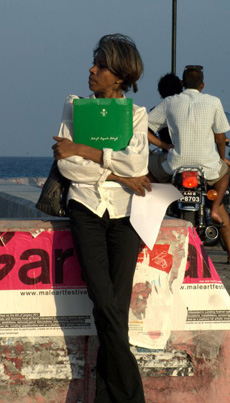
JSC member and whistle-blower Aishath Velezinee

Lead-up

Days prior to being stabbed in the street, Velezinee had been trying to get the Majlis to distribute a 34-page letter to members of the JSC’s parliamentary oversight committee, without apparent success. On January 2, she delivered 250 posters to citizens around Male’, calling for a public inquiry into the JSC.

“The Constitution grants everyone a free and fair trial, but JSC’s treason has deprived the people of not only a right to a free and fair trial but thereby compromised all other fundamental rights,” she wrote on her website, the day before her stabbing. “The State can neither protect fundamental rights of the people, nor further human rights and practice democratic government without the institutionalisation of an Independent judiciary.”

The attack

At 10am on the morning of January 3, Velezinee was walking along the main tourist street of Chandhanee Magu near Islanker school, “when I felt this knock on my back.”

“I thought I had been bumped, I didn’t realise I had been stabbed,” she said. “When I looked back I made eye contact with a guy as he was turning around. So I kept walking and then he turned back and stabbed me a second and third time.”

Her assailant, whom she described as “a young kid, a teenager”, jumped on the back of a waiting motorbike driven by another and rode off.

“At that point I put my hand up and it was completely soaked in blood, and I realised I had been stabbed. If I had fallen I would have been dead, the second two stabs would have finished me off, as would the first if their aim had been correct. But I’m light and my bag got in the way. I think it was meant to be assassination attempt or else hit my spine and make me a vegetable for the rest of my life.”

While still upright she was, however, “bleeding everywhere. I was soaked through.”

“My fear was that I would easily I bleed to death. But I took a deep breath and realised I was alive. As soon as I realised this, the only thing I wanted to do was go and get the blood stopped and get to the Commission because this was the day of the High Court appointments, and I know they wanted me out of the way. I didn’t realise how serious the wounds were, I didn’t see them until two days later when I went for a dressing change.”

“I tried calling 119, it took four attempts to get through, I told them I was stabbed. Nobody stopped to help me, so I saw a neighbour from my childhood and didn’t give him a chance to say no and jumped on the back of his motorbike and said ‘take me to IGMH (Indira Gandhi Memorial Hospital), I’ve been stabbed.”

“He took me round the corner to his home, where he could get a vehicle. At that point another man stopped and said “no, you can’t wait if you’re bleeding like that, get on my bike.”

“I got on the bike without thinking and then wondered, ‘who are you?’ He was really good, screaming at traffic to get out of the way, but I was bleeding very heavily. I had to hold on and he was afraid I would faint – it was dangerous on a motorbike.

“He came to Majeedhee Magu. He tried to get a taxi to respond, but I saw a police car and they took me to hospital.”

On the agenda at 2:30pm that day at the JSC was the decision over which applicants would qualify for appointment as High Court judges.

“It was very suspicious the way the Commission acted [after the stabbing],” Velezinee said.

“Not a single Commission member called or came to the hospital or made any effort to see how I was. Instead they hurried to organise an extraordinary meeting to discuss the assault, and then decided to hold a press conference – all of this without checking on me – and as I understand it, it was suggested by the Speaker of Parliament that the Chair of the Commission, who’ve I’ve previously alleged is suffering from a psychiatric disorder, be nominated to give a press conference.

“At the press conference they made very strange statements. They said that ‘Nobody should be attacked for having different opinions, or the way they express their different opinions’.

“The commission did not show me any respect, because after that press conference they organised a meeting on Tuesday to decide on the High Court judges. The Commission had previously agreed not to meet on Tuesdays because Tuesday is cabinet day.

“So I requested Commission members talk with the chair and make him postpone the meeting. The Speaker was leaving the country that night – I asked the Secretary General to speak with the Chair and delay the meeting until Wednesday, but the response I got was that they could not delay the meeting because it was ‘the right of the people to have the High Court’.

“I put out a rude statement accusing the Commission of trying to expedite things while I was incapacitated, and that persuaded them to cancel the meeting. But they did not say they were doing so out of concern for my wellbeing – instead they told the media that the meeting was postponed “because some members are busy.”

Still busy

Velezinee says she does not believe last week’s attempt on her life will be the last.

“I don’t believe the State can actually protect me. Because it is the state that wants me silenced – the parliament and the judiciary. If you look at what happened in the days before the attack, there was a flurry of attacks in the media – including by the parliamentary oversight committee – criticising me, my character and my performance in the JSC. This has been a very organised effort to discredit me, and some people speak in different voices.

“There are honourable men in this country who are owned by others, and they may be put in a position where they believe they have to take my life. I knew there was a chance that I was risking murder, and I wasn’t wrong. It was only because of God’s grace that I survived.”

The police, she said, had been “very effective” in their investigation so far. However police spokesperson Sub-Inspector Ahmed Shiyam said that it was “very difficult” for police to release an update on the case, as it was “complicated”.

Police were, he said, collecting evidence and would release an update to the media “as soon as it is available.”

As to whether the attacks would dissuade her from continuing to campaign against the “derailment of democracy” by parliament and the judiciary, “if I close my eyes, I will have betrayed my country and people,” Velezinee said.

“I will have betrayed them by failing to inform people and give them a chance to change this. When the State fails it is up to the citizens to hold the State accountable. The state has failed here, and as a state official it is my responsibility to inform the public and give them the chance to make an informed decision.

“I know for a fact that rule of law has been subverted. I know for a fact that there is corruption at the highest level in parliament. And I know that if I join the majority in keeping silent, I have become a traitor.”

Likes(1)Dislikes(0)

President declares Addu Atoll a city again, after Civil Court overturns decision on technicality

President Mohamed Nasheed has declared Addu a city – for the second time – after the Civil Court ruled yesterday in favour of the Dhivehi Quamee Party (DQP) that the President had no authority to do so.

The Civil Court of the Maldives ruled that the President did not have the authority to declare islands as a city before the Local Government Authority had established a criteria to determine cities, as the law stated that “all cities should meet the criteria established by the Local Government Authority.”

The President’s Office said this afternoon that the Local Government Authority had now established the criteria and published it in the government’s gazette, and stated that a city council had been formed for Addu in accordance with Decree number 2010/15, and Annex 2 of the Decentralisation Act.

The President also sent a letter to the Elections Commission, informing them of his decision to declare Addu a city. In the letter, he requested the Elections Commission to hold elections for the Addu city council as scheduled and in accordance with law.

The Local Government Authority’s criteria for establishing a city include that it have a minimum population of 25,000 people, and have a GDP of no less than RF 1 billion.

Statistics from the Department of National Planning show the GDP of Addu in 2010 as more than Rf 2 billion, while the population is almost 30,000.

Likes(0)Dislikes(0)

Journalist claims arrest was arbitrary

Musharaf Hassan, a journalist working for registered online news organisation ‘MVYouth’, has alleged that he was arbitrarily arrested, threatened and tortured by police in Hulhumale’ on Saturday night.

”I was waiting near my flat with two other journalists who work with me and a friend, and the police vehicle stopped by and started searching our bodies one by one,” he told Minivan News. ”After checking our body the police ordered us inside our house, and we waited on the ground floor of my flat where I live because one of us have not returned yet.”

Musharaf said that while they were waiting, the police team returned and shouted at them, saying they would be arrested. All of them ran inside their apartment, he said.

”They followed us into our apartment and so I locked myself inside my room,” said Musharaf. ”They knocked on the doors of the rooms and warned that they would force the door open, so I opened it.”

Police officers pulled Musharaf’s hair and pushed him inside the police vehicle, he said.

”They tortured me inside the police vehicle and one of them said to the other that I was a journalist from MVYouth, and said that the next day this story would be all over the news,” he said. ”And then they threatened me that if this story was in the news, it would be harder for me the next time they caught me.”

Musharaf said he was released after about an hour, and that on the police slip they gave him it said he was arrested to search his body.

”But they did not search my body after arresting me,” he said. ”I think it was a deliberate attack on MVyouth, we have been under a lot of pressure from the police after we published some videos of police torture and another video showing police violently attacking a person near BG [a well-known club in Maafannu].”

He also claimed that police media had refused to co-operate with the news organisation.

Police Sub-Inspector Ahmed Shiyam said that the police had no information that police officers attacked a journalist or any one specifically.

”Police always share information to all the media equally, and everyone is invited to police media briefings,” he said.

Police recently launched a three year strategic plan giving high priority to curb rising gang violence in the Maldives. Police recently said that they would be conducting special operations to reduce crime and would take any necessary measures to bring criminals to justice.

Likes(0)Dislikes(0)

Protesters call for DQP to be abolished, after Civil Court overturns Addu City Council ruling

A group of protesters last night gathered outside the residence of Dhivehi Qaumee Party (DQP) leader Dr Hassan Saeed, demonstrating against the party’s support of a Civil Court ruling preventing Addu Atoll being granted status as a city.

Saeed himself is a prominent Adduan, however the case in the Civil Court was filed by the DQP’s Deputy Leader of DQP Imad Solih. The party argued that President Mohamed Nasheed did not have the authority to declare Addu a city council.

With over 30,000 inhabitants, Addu Atoll is the second largest population centre in the country. However, as much as 60 percent of some islands currently reside in the capital Male’.

Most of the protesters claimed to be from Addu, however Minivan News also observed many Maldivian Democratic Party (MDP) supporters at the protest, including MPs Alhan Fahmy, Ilyas Labeeb and Mohamed ‘Colonel’ Nasheed.

Protesters burned an effigy of DQP Deputy leader Imad Solih, and called for the party to be abolished.

Riot police attended the area and blocked the road, however, confrontations between riot police and protesters occurred when protesters attempted to breakthrough police lines.

Police arrested some of the protesters and protesters shouted at the police accusing them of torturing peaceful protesters.

The local media have reported that similar protests were held at Addu, in Hithadhoo near the island office, led by people who supported the City Council idea of the government.

Hassan Saeed had not responded to Minivan News at time of press.

Attorney General Dr Ahmed Ali Sawad has said he will appeal the ruling.

Likes(0)Dislikes(0)

Italian paparazzi took Ronaldo and Irina photos, says resort management

Widely-circulated photographs of Real Madrid player Cristiano Ronaldo and his bikini-clad girlfriend, Russian supermodel Irina Shayk, on the beach of the ‘Rania Experience’ resort were reportedly taken by Italian paparazzi on a chartered yacht anchored nearby.

Director of the resort’s management Platinum Capital Holdings, Hassan Shiyam, said a yacht registered in the Maldives as ‘Unmeed 5’ anchored next to the island, citing engine trouble.

“Later we discovered that two European paparazzi were operating in the yacht with huge cameras. The yacht also had maps of Rania,” he said. “We are sure that the pictures were taken by the paparazzi on the yacht.”

British comedian Russell Brand and pop star wife Katy Perry were also tailed by paparazzi during their honeymoon in the Maldives in October.

Minivan News understands the couple first transferred to Four Seasons Kuda Hura in North Male’ Atoll, before surreptitiously transferring to Four Seasons Landagiraavaru after supposed media intrusion before travelling to yet another resort.

Likes(0)Dislikes(0)

Second Radisson resort to open in Maldives

Hospitality and travel company Carlson, which owns the famous US restaurant chain TGI Fridays and the Radisson hotel chain, has announced the signing of a US$91 million 281-villa resort to open in the third quarter of 2012.

The Radisson Plaza Resort Maldives, owned by Three K International, will be situated on the island of Naagoshi in Haa Dhaalu Atoll and will include 182 land and 99 water villas.

Executive vice president and chief development officer of Carlson Hotels in Asia Pacific, Xerxes Meher-Homji, said the resort would cater to both couples and families

“This spectacular resort is being created as a unique holiday sanctuary retreat for couples and families, through distinct facilities and design features catering to both markets,” he said.

Multidisciplinary firm Hassell has been appointed architectural, interior and landscape design consultants for the resort.

Carlson also has a second hotel presently under construction in the Maldives, the 250-room Radisson Hotel Maldives Hulhumale scheduled to open in the first quarter of 2013.

Likes(0)Dislikes(0)

Divide or unify: Gayoom’s return to politics raises election stakes

The return to politics of former President Maumoon Abdul Gayoom following his retirement in February last year could unify the opposition or deepen the growing factional split between the two parties, observers have suggested.

The former President returned to the Maldives to campaign on behalf of the opposition Dhivehi Rayithunge Party (DRP), of which he remains the ‘Honorary Leader’.

In a speech on Thursday evening at Kalaafaanu School in Male’, Gayoom did not show overt support of either the faction led by dismissed Deputy Leader Umar Naseer, or that of current party leader Ahmed Thasmeen Ali whom he endorsed on his retirement.

Conflict between the two factions came to a head in mid-December when a party rally descended into a factional brawl after supporters of the dismissed Naseer gatecrashed the venue.

In his speech Gayoom urged unity, quoting from the Quran and emphasing that “we should work to reduce the disputes among us.”

“I am saying this in my capacity as the Supreme Leader of DRP, as a father of all you members and as an elderly person,” local newspaper Haveeru reported the former President as saying.

He expressed concern that rival parties would exploit the opportunity to divide the opposition ahead of the elections, and said the DRP needed to win in order to protect both the country’s Arab-Islamic heritage and national assets – a clear criticism of the government’s decision to allow Indian infrastructure giant GMR to take over the management and development of Male’ International Airport.

“We should utilise the resources bestowed on us by God Almighty. The rich natural resources we have are for our children, the future generations and for us. That should not be given to foreigners,” Haveeru reported Gayoom as saying.

Despite the call for unity and his prior public endorsement of Thasmeen, Gayoom appears to be hitting the campaign trail with dismissed Deputy Leader Umar Naseer – whom the Elections Commission last week maintained had been formally removed from the party’s membership list despite the party’s “internal dispute”.

”The DRP office requested the commission remove his name from the party’s membership, saying that they have dismissed him,” said Elections Commissioner Fuad Thaufeeq. ”So we removed his name accordingly in respect to the party’s wishes.”

DRP MP Ahmed Mahlouf, himself a supporter of Naseer, told Minivan News today that while Gayoom “had invited everyone in the party to join his [campaign] trip, the others [Thasmeen’s faction] are travelling separately.”

“The target is the same – to win the local council elections,” Mahlouf said. “He definitely helped during the parliamentary campaign when he travelled to the islands, and he also campaigned for me. He is starting his first trip on Janurary 10, and islanders and candidates are looking forward to his visits.”

Political impact

The former President remains an enigmatic figure in Maldivian politics. The true extent of his popularity since the DRP’s win in the parliamentary elections over two years ago is unclear, given the absence of independent and impartial political polling in the country. The MDP contends that its infrastructure and development projects have won over many islanders, but many Maldivians – and certainly Thasmeen – still live in the shadow of their ‘Honorary Leader’ of 30 years, and responsibility for the many teething problems of the new democracy have landed at the MDP’s feet.

Certainly, news of Gayoom’s return to Male’ prompted thousands of supporters to appear at the jetty on December 31 holding posters of the former president.

The ruling Maldivian Democratic Party (MDP), Mahlouf suggested, was scared of Gayoom and the loyalty he inspired in the party faithful.

“Gayoom is the only person with popular support, and that was clearly seen in the parliamentary election. [The MDP] are scared he will run in 2013, but that will be the decision of other people. He is the right person for an election in 2011, if it were held,” Mahlouf said.

Gayoom had not said whether he would run for 2013, Mahlouf added, and had only said he would talk about the 2011 local council elections.

“But if he fit enough to run, he is the right person to change things again, and stabilise the economy,” Mahlouf suggested. “Maybe not the full five year term, maybe 2-3 years and then hand the leadership to his Vice-President. This is just my speculation, nothing has been decided – I think it should be decided at a DRP primary.”

He acknowledged that while Gayoom had publicly endorsed Thasmeen as leader in February, “I’m not sure whether he supports him anymore, or feels that [Thasmeen] is the right candidate for 2013.”

The split has put the party’s coalition agreement with the People’s Alliance (PA) under strain, with growing tension between Thasmeen’s faction and PA leader Abdulla Yameen potentially threatening the opposition’s parliamentary majority.

Mahlouf acknowledged that “the fighting is getting hot”, but said the party had resolved not to discuss internal politics with the media before the conclusion of the local council elections.

“I know Yameen is also very concerned about what the government is doing, and will only tolerate things to a certain point. There are things that need to be corrected on both sides, and we need to sit down and resolve them.”

MDP Chairperson Mariya Ahmed Didi said the former President’s return to politics “gels us together – those who believed and came out against his dictatorial regime.”

Furthermore, she suggested, it had allowed “aspiring leaders in DRP and those affiliated to DRP to see Gayoom for what he really is – concerned only about his self interest and trying to set up a dynasty.”

Thasmeen and DRP party spokesman Ibrahim Shareef had not responded to Minivan News at time of press.

Motivation

Concern over the former President’s impact on Maldivian politics reached right to the top: in the final days of 2010, President Mohamed Nasheed publicly warned Gayoom that returning to the campaign trail would not be wise and raised concerns over his safety.

“Sometimes when former presidents leave the country and then return to the Maldives, a very regrettable fate has occurred,” Nasheed said. ”I am concerned that something very regrettable is about to happen in Male’.”

”If Gayoom is returning to politics then he is messing with the feelings of the citizens that could cause them to confront and return to their history, and it is very possible that a regrettable consequence may occur,” Nasheed said. ”Do not mess with the feelings of the citizens of the Maldives, because when they are shaken, not even I can curb the pressure.”

Rumours of a previous back-room truce between the two leaders over the pursuit of corruption and human rights allegations against the former President in return for his retirement from public life appeared to be on shaky ground following Nasheed’s high profile support of elderly historian Ahmed Shafeeq during the launch of Shafeeq’s book in October 2010.

In his book, Shafeeq alleged that 111 people died in custody under the former administration and that he himself had been arrested and his diaries destroyed. Nasheed promised that police would investigate and revealed that human bones discovered in the former Gaamaadhoo prison matched the age and estimated period of death of Abdulla Anees, Vaavu Keyodhoo Bashigasdhosuge, an inmate officially declared missing in the 1980s.

Nasheed’s public support of the book prompted Gayoom to write to the British Prime Minister David Cameron, appealing for pressure to be placed on President Mohamed Nasheed following “the escalation of attempts to harass and intimidate me and my family.”

The matter, he told the British PM, involved “unsubstantiated allegations by an elderly man by the name of Ahmed Shafeeq that I had, during my tenure as President, ordered the murder of 111 dissidents.”

“In a book authored by this Shafeeq, which was ceremoniously released [on October 10] by Mohamed Nasheed himself, it is accused that I also ordered the man’s arrest and supposed torture in prison. In a country of just over 300,000, it is safe to assume that even one ‘missing person’ would not go unnoticed, let alone 111.”

Nasheed’s government had “escalated its attempts to harass me” in the run up to the local council elections, Gayoom wrote, despite his retirement from politics.

“After the government’s defeat in last year’s parliamentary elections, the popularity ratings of the ruling MDP have fallen further in recent months as a result of the government’s failure to deliver on its campaign promises, and its lack of respect for the law.”

“On the other hand,” Gayoom told the British PM, “I continue to enjoy the strong support, love and affection of the people, and have been voted by the public as ‘Personality of the Year’ in both years since stepping down from the presidency.”

Likes(1)Dislikes(0)