MPs debate legislation on health professionals

MPs yesterday debated legislation on health professionals submitted by the government to create oversight councils seeking to maintain standards, ensure qualifications, investigate complaints, and take disciplinary measures.

Presenting the bill (Dhivehi) on behalf of the government, Progressive Party of Maldives (PPM) MP Ahmed Shiyam explained that “the bill very clearly defines health professionals, medical practitioners, dental practitioners, nurses and midwives.”

The bill proposes the creation of “a medical and dental council, nursing and midwifery council, and the allied health council,” he said.

The MP for Lhaviyani Naifaru added that the bill also specifies the responsibilities and tasks of the councils as well as criteria and procedures for appointing members.

Shiyam said the bill was “long overdue” and contended that the absence of such legislation was the “main reason” for the deterioration of the health sector.

In the ensuing debate, opposition Maldivian Democratic Party (MDP) MP Rozaina Adam agreed that the bill was overdue but suggested that shortcomings needed to be addressed at the committee stage.

An insurance mechanism for doctors was not included in the bill, she said, noting that the practice in other countries was for compensation for medical negligence to be paid out of an insurance scheme.

“It is not possible for doctors to pay for that out of their own pockets,” she said, adding that she hoped provisions would be added to provide “liability insurance” for doctors.

Rozaina also accused the government of plotting to remove former Health Minister Dr Mariyam Shakeela by modifying her initial portfolio on July 1 and transferring the gender department to the new Ministry of Law and Gender to be headed by Attorney General Mohamed Anil.

Shakeela was reappointed as Minister of Health and nominated for parliamentary approval. Shakeela was dismissed yesterday after she failed to secure parliamentary consent when pro-government MPs voted against confirming her appointment on Monday (August 11).

Rozaina argued that it was unconstitutional for the attorney general to head a ministry as his mandate was clearly defined.

If the ruling party’s MPs did not have confidence in Shakeela, Rozaina said President Abdulla Yameen could have not reappointed her instead of subjecting her to “public humiliation”.

While pro-government MPs spoke in favour of the health professionals bill, other MDP MPs contended that the health sector would not be improved by passing the bill.

MP Abdul Ghafoor Moosa suggested that the number of employees in the health sector was excessive and redundant and questioned the “competency” of the government to improve the quality of healthcare.

Adhaalath Party MP Anara Naeem meanwhile said all Maldivian citizens agreed that the health sector was in dire need of improvements and stressed the importance of a law to ensure standards for health professionals.

“Outreach programmes of Israeli Zionists”

Introducing the legislation, MP Shiyam praised former President Maumoon Abdul Gayoom for the “positive revolution” brought to the health sector during the PPM leader’s “golden” 30-year reign.

However, the progress achieved under Gayoom “came to a halt when certain people destroyed the health sector in the name of democracy,” Shiyam claimed, and as a consequence of former President Mohamed Nasheed allegedly replacing health professionals with political appointees.

The health sector deteriorated “as a result of conducting outreach programmes of Israeli Zionists and efforts to instil a culture of spreading the Jewish religion in the name of healthcare,” he said, which was “tragic and dangerous”.

Shiyam was interrupted by MDP MP Ibrahim Shareef raising a point of order and objecting to pro-government MPs “turning the Majlis into a political podium” with rhetoric that was irrelevant to the bill up for debate.

After Speaker Abdulla Maseeh Mohamed dismissed the point of order, Shiyam said he was “highlighting the causes of the health sector being in the state it is in today”.

“I condemn efforts by the previous government to spread secularism by bringing Zionists here,” he said.

In November 2010, the Islamic Foundation of Maldives called on the government to “shun all medical aid from the Zionist regime” while a team of seven Israeli eye doctors was due to arrive the next month, claiming that Isreali doctors and surgeons “have become notorious for illegally harvesting organs from non-Jews around the world.”

However, despite protests and flag burning, the Disaster Management Centre revealed in December 2010 that in addition to screening of some 215 people in the capital, 16 patients underwent surgery with the Eye from Zion doctors, 104 received consultations, and 137 people were treated in Gaaf Dhaal Thinadhoo by the Israeli NGO.

Likes(1)Dislikes(0)

New passport verification system set up at immigration counters

A new e-passport verification system donated by the International Organisation for Migration (IOM) has been set up at immigration counters at the Ibrahim Nasir International Airport (INIA) and the foreign labour section at the immigration department, reports local media.

Speaking at a function at Hulhulé Island Hotel yesterday, IOM Programme Manager Alia Hijree explained that the system could be used if an immigration officer feels suspicious about a passport or visa, adding that the process would only take 19 seconds.

“In this short time we verify the details about a suspicious person, to match those details stored on the electronic chip of the e-passport. The system will find how much the details match. In addition to this, the system will be able to check the type of ink used in the passport along with several other details,” she was quoted as saying by Haveeru.

Defence Minister Colonel (Retired) Mohamed Nazim meanwhile said the Maldives was targeted by smugglers while the threat of terrorism was a major concern in the region.

“Today criminals are more organized, technologically more capable, and increasingly operate across the borders. The threat of terrorism is a major concern in this region,” he was quoted as saying by Sun Online.

Counter-terrorism measures are being implemented to strengthen border control, he added.

“To strengthen our border security and minimise the threat of terrorism and trans-national crime, we are working hard to implement robust border security measures and also counter terrorism measures as well.”

Likes(1)Dislikes(0)

Approximately MVR10 million spent on mosque renovation, says Islamic minister

The government spent about MVR10 million (US$648,508) on renovating mosques across the country ahead of Ramadan this year, Islamic Minister Dr Mohamed Shaheem Ali Saeed informed parliament yesterday.

Responding to a question tabled by Addu Meedhoo MP Rozaina Adam concerning developments in her constituency, Shaheem said MVR1 million (US$64,850) was allocated in July for the renovation of 65 mosques in the southernmost atoll.

Plans for the construction of a large “modern” mosque in the Hithadhoo ward has been discussed with the Addu City Council, he revealed.

As the people of Addu City, however, requested the construction of an Islamic Centre with classrooms and a library, Shaheem continued, the project has been revised “in line with the people’s wishes.”

Funds have been allocated in this year’s budget to commence the project, he added.

The council was also informed earlier this year of plans to construct a waqf building to raise funds for Islamic affairs, he continued, noting that proceeds from leasing the building would be spent under the council’s supervision.

The funds would be used for mosque renovation and Quran classes, he explained, adding that the ministry was seeking finances from the Islamic Development Bank in Jeddah.

Likes(1)Dislikes(0)

India-Maldives friendship association to conduct seminar on expatriate workers

The Friendship Association of India and Maldives (FAIM) will conduct its second ‘Let’s talk’ seminar this Friday, this time covering the topic of expatriates in the Maldives.

The seminar will take place at 8:30pm this Friday (August 15) at the CHSE hall in Malé. Officials from the high commissions of India and Sri Lanka, and the consulate of the Philippines will participate in the panel discussion.

Questions tackled during the discussion will include: do we need to employ expatriates in the Maldives, does expatriate skill and labour contribute to the wellbeing of the Maldives, and does the presence of expatriates enrich the society of the Maldives?

Government estimates of the Maldives’ expatriate work report around 88,175, growing from less than 30,000 in the year 2000.

Local NGO Transparency Maldives, however, has suggested that overall figure may be closer to 200,000 and has called for greater awareness of the abuses and poor conditions many workers are facing.

The FAIM invites members of the public to attend and join the debate.

Likes(0)Dislikes(0)

“Police did not beat them enough,” says Majlis majority leader Ahmed Nihan

Ruling Progressive Party Maldives’ (PPM) parliamentary group leader Ahmed Nihan has defended police brutality during a People’s Majlis debate today, accusing opposition MPs of putting up an act using tomato sauce to pretend police beat them up.

“Honorable Speaker, police did not beat them enough. Those who say they were brutalised, came to Majlis the next day in good health with makeup on. Their health is better than before. How can anyone who was brutalised get up on their two feet and speak on this Majlis floor [the next day]?” he said.

“They say they were brutalised, bloodied, and put on a drama on hospital beds, smear themselves with tomato sauce, and take photos and the next day they speak perfectly well at this Majlis and go off.”

Nihan appeared to be referring to police officers brutalizing several opposition MPs during a demonstration following the controversial ouster of former President Mohamed Nasheed.

On February 8, MPs including MPs Mariya Ahmed Didi, Reeko ‘Moosa’ Manik, Eva Abdulla and former MP Mohamed ‘Bonda’ Rasheed were severely beaten.

Nihan’s comments came during a debate on revising clauses in the 2008 Police Act that state the police must forward criminal cases to the Attorney General (AG) for prosecution.

The amendments – accepted by the Majlis today – propose placing prosecutor general (PG) instead of AG in clauses relating to prosecution, as the Constitution of 2008 states only the PG can press charges on behalf of the state.

Nihan said opposition MPs had politicised the issue by digressing from the debate and focusing on police brutality.

Death of officers

Nihan also suggested the deaths of police officers, Adam Haleem on Kaafu Atoll Kaashidhoo Island in 2012 and Misbah Abdulla in Malé in 2013 were linked to opposition’s defaming of the Maldives Police Service.

Referring to Haleem’s murder, Nihan said: “This is the result of a specific people protesting and calling for attacks on Maldivian police and soldiers during that week and weeks before that.”

Haleem was stabbed to death in July 2012 and several government officials including current Vice President Dr Mohamed Jameel Ahmed blamed the MDP for the death. The MDP said the government was politicising the death for political gain.

Abdulla was killed in an accident after a speeding motorcycle hit him while he was manning a vehicle checkpoint.

“In every event, in every discussion, [they say police] are brutal, arresting – were you arrested when you were prostrating [in prayer]?” Nihan said.

“Harassing police is harassing us, playing with our arteries, our blood,” he continued.

Police Brutality

On August 6, AG Mohamed Anil told parliament five February 8 brutality cases involving four police officers are ongoing at the Criminal Court.

At minister’s question time, MP Eva Abdulla asked how far investigations into police brutality – as recommended by the 2012 Commission of National Inquiry’s (CoNI) – had progressed.

“With respect to the administration of justice, in particular concerning allegations of police brutality and acts of intimidation, there is an urgent need for investigations to proceed and to be brought to public knowledge with perpetrators held to account and appropriately sanctioned,” read the second recommendation of the report.

While it concluded that the transfer of presidential power was constitutional, CoNI had found that “there were acts of police brutality on 6, 7 and 8 February 2012 that must be investigated and pursued further by the relevant authorities.”

Anil explained that the Police Integrity Commission (PIC) had investigated 45 cases of alleged police brutality and made a recommendation to the home ministry to dismiss six police officers. However, only one officer was sacked, Anil said.

February 8

Thousands of MDP supporters took to the streets of Malé on February 8, 2012, in a protest march after former President Nasheed declared his resignation the previous day had come “under duress” in a “coup d’etat” instigated by mutinying police officers of the Special Operations (SO).

Following an investigation, the Human Rights Commission of Maldives (HRCM) concluded that the heavy-handed police crackdown on the MDP walk was “brutal” and “without warning.”

The HRCM recommended the PIC investigate the “disproportionate” use of force that left dozens of demonstrators injured and hospitalised.

In May 2013, the PG’s Office pressed charges against two police officers accused of assaulting MDP MPs ‘Reeko’ Moosa Manik and Mariya Ahmed Didi during the violent crackdown.

Amnesty International meanwhile warned that failure to prosecute police officers accused of human rights abuses and “serious failings in the justice system entrenched impunity”.

In June 2013, former PIC member Hala Hameed told parliament’s government oversight committee that the cases involving the six police officers were “not disciplinary issues, but crimes,” expressing concern with the home minister’s refusal to suspend the officers.

Moreover, former PIC Chair Shahinda Ismail told Minivan News in September 2012 that a staff sergeant caught on tape kicking a fallen demonstrator “was promoted after this incident.”

In February this year, Shahinda told Minivan News that detainees arrested in Addu City on February 9 were “forced to walk on smoldering coals”.

According to the HRCM report, 32 people filed complaints concerning varying degrees of injuries sustained in the crackdown, while 20 people submitted medical documents of their treatment of injuries.

Two fingers on the left hand of one demonstrator were crushed, the report noted.

Al Jazeera filmed parts of the crackdown, reporting that “police and military charged, beating demonstrators as they ran – women, the elderly, [with] dozens left nursing their wounds”. The BBC meanwhile reported “a baton charge by police on crowds gathered outside one of the main hospitals.”

In a report in May 2013, the UN Special Rapporteur for Independence of Judges and Lawyers Gabriela Knaul warned that there could be more instability and unrest unless serious human rights violations of Maldives’ authoritarian past are addressed.

Likes(1)Dislikes(0)

Case of Russian smuggling cocaine halted due to language barriers

The case of Prutova Angelina, a young Russian charged with smuggling 2kg of cocaine into the Maldives has been halted due to language barriers.

Angelina – a 25-year-old Russian national – was arrested on January 27 of this year, when she arrived in the Maldives from Sao Paulo, Brazil.

Judge Abdullah Nasheed said that the next hearing will be held only after finding a translator who spoke Russian, according t Haveeru.

According to reports, during the first hearing of her case, with the aid of a translator, the state read aloud all of the charges against her at court. Angelina then demanded for a translator who knows Russian.

“I know English only a little bit”, Angelina replied when the judge questioned her about her English, reported Haveeru.

Angelina demanded for a translator who knew Russian for a second time when the charge sheet was read out to her.

She also said that she wished to arrange a lawyer for herself.

According to reports, Angelina failed to answer when she was asked how long it would take to arrange a lawyer, and the judge then instructed her to arrange a lawyer for the second hearing of her case.

Despite being sent to the Prosecutor General’s Office in April, the case had already been delayed due to a dispute between the Criminal Court and the PG’s office over the provision of a translator.

The Law on Narcotic Drugs and Psychotropic Substances stipulates that a foreign national charged with importing over 1 gram of narcotics will be sentenced to life imprisonment. There is also a possibility of received a minimum fine of MVR10,000 (US$651).

Likes(1)Dislikes(0)

Foreign investments pose no threat to Islam or sovereignty, insists President Yameen

Foreign investments pose no threat to either Islam or Maldivian independence and sovereignty, President Abdulla Yameen said last night, assuring that the creation of special economic zones (SEZs) was no cause for concern.

“It does not mean casinos will be operated in the Maldives, and it does not mean the president would have more power than he should,” Yameen said in a speech at a function held by the Maldives Inland Revenue Authority (MIRA) to celebrate its fourth anniversary.

Yameen insisted that foreign investments would be fully subject to Maldivian law while sovereignty would extend to the SEZs.

The government’s flagship SEZ legislation – which envisions free trade zones with relaxed regulations and tax incentives – has come under fire from the opposition with former President Mohamed Nasheed contending that the zones would be used for criminal enterprises, “irreligious” activities such as gambling, and money laundering.

The opposition leader had dubbed the legislation the ‘Artur Brothers bill’, referring to an infamous pair of Armenians linked with money laundering and drug trafficking who made headlines last year after they were photographed with cabinet ministers.

Nasheed had also argued that the government would have less authority in the SEZs than the authority it exercised in Addu Atoll Gan Island during British occupation.

Corruption

Yameen and GasimBriefing MPs on parliament’s economic affairs committee yesterday – which is reviewing the SEZ bill – MP Mohamed ‘Kutti’ Nasheed reportedly sought to allay fears that SEZs would facilitate corruption.

The ruling Progressive Party of Maldives MP – who was involved in drafting the legislation – explained that the bill includes mechanisms to prevent corruption and take legal action in accordance with the UN  International Convention against Corruption.

Provisions were included for terminating agreements with investors if an act of corruption is proved, he added.

Nasheed also suggested that other issues such as a ceiling for investments and extending incentives to developers in addition to investors could be addressed at the committee stage.

Speaking at the committee, Jumhooree Party Leader Gasim Ibrahim expressed concern with the legislation conferring excessive authority to the president, which he warned could be used to favour or “destroy” businesses.

The absence of a ceiling limit for investments was a threat to existing enterprises, Gasim argued, as the president could “take some dollars and create economic zones to enrich three or four people.”

The business tycoon, however, said he supports passing the bill with revisions.

MP Ahmed Siyam Mohamed – owner of the ‘Sun Siyam Resorts’ and leader of the government-aligned Maldives Development Alliance – urged expediting the passage of the bill as an SEZ law would allow “stalled investments” to resume.

Foreign banks were not lending for investments in the country at present, Siyam said, but development banks would be established along with the SEZs.

The economic committee’s chair said last week that he expects the review process to be completed before the end of the month, after which the bill would be sent to the Majlis floor for a vote. 

New frontiers

Yameen meanwhile said last night that the Maldives should emerge from its “small crab hole” into the wider world.

The government’s efforts to generate income to create job opportunities and provide education and healthcare was “not a big ask,” he said.

The country should have the courage and capacity to forge ahead, he added, and “face new things.”

The government’s efforts were geared towards “economic transformation” through diversification and fostering a “business-friendly environment” for both domestic and foreign entrepreneurs.

While increasing tourist arrivals was “natural economic growth,” Yameen explained that the objective was to “transform” the economy from the present “production frontier” to a higher level.

The “main beneficiary” from economic diversification and ‘mega projects’ would be the state, Yameen added, as tax revenue would increase and job opportunities would be created.

The Ibrahim Nasir International Airport currently caters for about 1.5 million passengers, he continued, but the government’s target was developing the airport to serve “five to seven million passengers.”

Implementation of the mega projects – such as the ‘iHavan’ transhipment port – would “transform the economic landscape,” Yameen suggested.

The government was also reviewing framework agreements for “avoidance of double taxation” to ensure that “corporate leaders” from neighbouring countries with investments in the Maldives are not taxed twice, Yameen revealed.

While the government’s focus was on the economy instead of partisan politics, Yameen stressed that political stability and a low crime rate were among the “basic ingredients” for economic transformation.

Reiterating the government’s focus on youth development, Yameen said the Maldives needed to move away from a culture of “criminalisation” of trivial offences to encouraging youth and “giving them conviction” and employment opportunities.

The younger generation was “the energy of the economy,” he added.

In a speech earlier this month, Yameen point to the country’s “motivated”, “highly intelligent” and “easily trainable” youth as a key resource for economic growth.

Likes(5)Dislikes(0)

Harbour construction on-going in 48 islands, says housing minister

Harbour construction is on-going in 48 islands while work is expected to begin in a further 10 islands during the year, Minister of Housing and Infrastructure Dr Mohamed Muiz informed parliament yesterday.

Appearing for minister’s question time, Muiz said projects for six islands have been sent to the tender board last week.

“Our hope is to solve the problem in the next year or so for all islands facing embarking and disembarking difficulties. God willing, we will achieve this,” he said.

Opposition Maldivian Democratic Party (MDP) MP Mariya Ahmed Didi had asked Muiz how many harbours have been constructed since the current administration took office in November.

The former MDP chairperson said 58 harbours were constructed during the three years of former President Mohamed Nasheed’s administration.

Kuribee and Nellaidhoo harbours

Muiz was summoned to respond to a question tabled by MDP MP for Vaikaradhoo, Mohamed Nazim, concerning harbour construction on two islands in his constituency.

Nazim noted that President Abdulla Yameen had pledged to expand the Kuribee harbour and that work had stalled on the Nellaidhoo harbour.

Muiz explained that construction began in Kuribee in 2011 for a 300-feet long and 150-feet wide harbour while the harbour in Nellaidhoo was to be 400-feet long and 150-feet wide.

Both projects were awarded to the Works Corporation Ltd (WCL) under contractor finance rules with the government-owned corporation providing equipment and material, he said, which then subcontracted Heavy Force Pvt Ltd for MVR21.5million (US$1.3 million).

However, construction stalled over difficulties faced by WCL in providing reinforcement boulders and the subcontractor stopped work on July 2012 after dredging and quay wall construction.

Of the 34 projects awarded to WCL in 2010 and 2011, an audit found that the government canceled 24 after the corporation failed to commence work. WCL had completed only one infrastructure project.

In late 2012, former President Dr Mohamed Waheed dissolved WCL and formed an office called public works under the Ministry of Housing and Infrastructure.

The public works division subcontracted Heavy Force to carry out the remaining work, Muiz continued, and agreed to provide equipment and material through the State Trading Organisation (STO).

“However, STO also faced difficulties providing reinforcement boulders and the work stalled for about 14 months with Heavy Force unable to continue,” he said.

Project changes

The present administration subsequently changed the project to a normal material and labour contract – “as is done in other islands” – and subcontracted Heavy Force for a cost of MVR36.3 million (US$2.3 million) in February this year, he revealed.

Muiz stressed that the decision was made based on the “counsel and advice” from elders and councillors from both islands.

As Kuribee islanders had requested widening the harbour to 200-feet and President Yameen had pledged to do so during a campaign trip, Muiz said the old quay wall had to be rebuilt with an additional 50-feet dug into the island.

Muiz said further “variations” would be undesirable as the project has been costly.

Public finance regulations stipulate a 10 percent limit for variations to projects, he explained, adding that the tender board only allowed exceptions on rare occasions.

On the stalled project in Nellaidhoo, Muiz said the both the contractor and supervising staff from the ministry had said that construction was proving difficult due to strong ocean currents.

The ministry and the contractor decided to build the outer seawall first, Muiz revealed, which is expected to begin in a month.

“Our target is to finish the harbours on both islands during this year,” he said.

In a follow-up question, however, MP Nazim said Kuribee islanders wanted the length of the harbour increased as well.

In response, Muiz said additional changes could be made in another phase after completing the project and “seeing how it is being used.”

Muiz also offered updates to a number of other MPs about harbour construction for islands in their constituencies. While harbour construction usually takes 12 months, he explained that delays were often caused by shortage of material.

Likes(1)Dislikes(0)

President presents MIRA’s “Ran Laari” awards

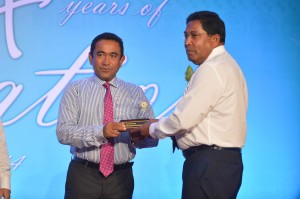
President Abdulla Yameen presented the Maldives Inland Revenue Authority’s (MIRA) “Ran Laari” (golden laari) awards at a ceremony last night to 11 taxpayers that paid the highest amount of tax last year.

According to MIRA, taxes paid by the 11 recipients accounted for 17 percent of the MVR9.8 billion (US$636 million) collected as tax revenue in 2013.

The five private companies that paid the highest amount in taxes were Villa Shipping and Trading Company, Trans-Maldivian Airways, Crown Company, Kurehdhoo Holding, and Sunland Hotels.

Among government-owned companies, the award was presented to the Maldives Airports Company while the daughter of former Vice President Mohamed Waheed Deen, Aminath Sheznee, the late Hussain Shakir, BHM owner Hussain Moosa, and Helegili resort operator Annie Mary Emmy were given the award in the individual category.

Speaking at the ceremony in Dharubaaruge, President Yameen said MIRA’s efforts were “credit worthy” and praised the authority’s employees.

The “litmus test” for MIRA’s success and efficiency should be how much the cost of administration declines every year, he added.

Yameen suggested that the authority’s target should be spending 10 laari for every MVR199 (US$13) collected as tax revenue.

MIRA’s work would have to be “amplified” in the future in conjunction with the government’s efforts to diversify the economy and broaden the tax base, he said.

The tax base, structure, terminology, and methodology would be very different from the current “simplistic corporate taxation” once new industries are introduced, Yameen explained, referring to a possible petroleum tax as an example.

A custom duty levied at the border for imported goods for the easiest tax to collect as opposed to value added taxes such as sales taxes, he noted, which involves a much higher cost of administration.

In the future, he added, all sales transactions should “ultimately” be viewable on a MIRA main frame as it would significantly lower administrative costs.

Taxation in any country inevitably involves “tax fraud,” Yameen continued, which involves tax evasion and deliberate fraud.

While the current administration did not wish to criminalise and prosecute businesses, Yameen said cases of tax evasion could not be disregarded.

Likes(1)Dislikes(1)