MDP Chair’s company ordered to pay MVR1.3million

The Civil Court has ordered Heavy Load Maldives Pvt Ltd to pay MVR1.3million (US$84,41500) for the failed payment of several speedboats, reports local media.

Heavy Load – owned by the family of Maldivian Democratic Party Chairperson ‘Reeko’ Moosa Manik – was ordered to reimburse Maldives Finance Leasing Company Pvt Ltd after the court found it had failed to meet the previously agreed payment schedule.

The unpaid amount – for which Moosa was reported to have been guarantor – is to be paid to the court within three months.

Likes(0)Dislikes(0)

‘CSI turtle’ launches investigation into ghost fishing nets found in the Maldives: The Guardian

“Call it CSI Turtle. In the Maldives, at the heart of the Indian Ocean, scores of turtles are being found with gashed or ripped-off flippers and deep scars in their shells. The cause is clear: the turtles are becoming ensnared in “ghost” fishing nets that have either have been lost or dumped,” reports Damian Carrington for the UK-based Guardian newspaper.

“The turtles that don’t drown are then attacked mercilessly by accomplices. The stumps of the turtles’ flippers show clear signs of being ripped off by sharks, while the shell damage points to a sharp implement: the beaks of birds and the claws of crabs. The nets themselves cut through the turtle’s flesh like cheesewire, leaving deep wounds.

But what the investigation has not yet established are the culprits behind the crime and the motive.

‘It’s OK to keep finding these turtles and keep stitching them up, but it’s just going to keep happening. So we need to try to find out why the nets are being lost,’ says Dr Jill Hudgins, a scientist from the Seamarc consultancy and employed by the Four Seasons resort on Landaa Giraavaru island.

The turtles are the Olive Ridley variety, which live in the open ocean, not the atolls and lagoons of the Maldives, and Maldivian fishermen don’t use nets, pointing the investigation abroad.

Hudgins’ team has now compiled a database of more than 40 net types, detailing the mesh size and the twine diameter, as well as the types of floats attached and other data like the labels on debris trapped in the net such as plastic bottles.

The evidence all points to trawler nets floating in from India and Sri Lanka, and a recent breakthrough was finding a net manufacturer’s label: Garware, an Indian company. Hudgins has now sent images of the nets and severely injured turtles to the company and awaits their reply.

‘We want to scare them a bit,’ she says, and then get their help in finding solutions.”

Read more

Likes(0)Dislikes(0)

Four additional cases sent to state prosecutors over Afrasheem murder

Police have forwarded cases of four additional individuals to the Prosecutor General’s Office (PGO) for their alleged involvement in the murder of MP Dr Afrasheem Ali last year – taking the total number of suspects facing charges over the attack to seven.

Police today confirmed that cases had been filed with the PGO on September 23 against Azleef Rauf, Shaahin Mohamed, Adam Salaah and Abdulla ‘Jaa’ Javid – son-in-law of opposition Maldivian Democratic Party (MDP) Chair ‘Reeko’ Moosa Manik.

Progressive Party of Maldives (PPM) MP Dr Afrasheem Ali was stabbed to death on the night of October 1, 2012, on the staircase of his home.

State prosecutors have previously accused Hussain Humam of going to the residence of Dr Afrasheem and murdering him with a machete and a bayonet knife.

Along with Humam, Ali Shan faces the same charges. A minor identified as ‘Nangi’ meanwhile stands accused of aiding and abetting the murder, after police claimed he had accompanied Humam and Shan to the residence of Dr Afrasheem before the attack.

Previous hearings

In August this year, two police officers testified at the Criminal Court against key suspect Hussein Humam, claiming they had discovered incriminating text messages on his phone during a random search on the night of the murder. The message was said by the police witnesses to discuss a failure to receive a payment the suspect he had been promised.

The police officer did not identify the recipient of the text message during the hearing, alleging that Humam – who they had stopped many times previously – was under the influence of an illegal substance and acting out of character.

Humam had initially denied charges against him in court.  He later confessed to the crime at a hearing held in May, according to a statement read out by prosecutors in the court/ State prosecutors read out the statement in court, which was said to have been given by Humam at one of the initial hearings.

The statement claimed that son-in-law of ‘Reeko’ Moosa Manik, Abdulla ‘Jaa’ Javid, had offered to pay him MVR 4 million for the murder of MP Afrasheem. However at a subsequent hearing in June, Humam retracted his confession claiming that he had been coerced by police.

Humam’s father has also written to the Criminal Court and the Human Rights Commission of the Maldives accusing police of conducting psychological abuse against the suspect, and exerting coercion to make him confess to a crime he did not commit.

Political calls

To mark one year since the attack that killed the MP yesterday (October 1), the PPM called on the country’s courts to expedite trials of all those involved in the case in order to “enforce due justice” on the attackers, according to local media.

The Maldivian Democratic Party (MDP) last month meanwhile condemned alleged insinuations by religious NGO Jamiyyathul Salaf preacher Sheikh Adam Shameem Ibrahim suggesting that the party was behind Dr Afrasheem’s murder.

Following the first round of voting in which the MDP took 45.45 percent of the popular vote and secured its place as front runner in a run-off vote that remains indefinitely suspended by the country’s Supreme Court, the party slammed what it alleged was an “incitement of hatred” by the NGO.

Police investigation

The Maldives Police Services (MPS) announced in October 2012 that the FBI were extending assistance in the investigation of the MPs murder.

Commissioner of Police Abdulla Riyaz later stated during a press conference held in December 2012 that the murder of Afrasheem had been carried out with a political motive, and that the culprits were to be paid MVR 4 million (US$ 260,000).

Riyaz had at the time dismissed claims that the murder was linked to religious fundamentalists, stating “no evidence has been gathered which suggests this murder had a religious motive.”

Soon after the murder police arrested two MDP activists – Mariyam Naifa and Ali Hashim ‘Smith’ – in connection with the attack. Both suspects were later released without charge.

The MDP later accused the government of attempting to frame the party with “politically-motivated arrests” of its members. In November 2012, former President Mohamed Nasheed accused the government of negligence in its efforts to bring the perpetrators to justice.

Last appearance

On the night of his murder, Dr Afrasheem had made his last public appearance on a live talk show on state broadcaster Television Maldives (TVM) titled “Islamee Dhiriulhun” (Islamic Living).

In the program, Dr Afrasheem said he was deeply saddened and asked for forgiveness from citizens if he had created a misconception in their minds due to his inability to express himself in the right manner.

Minister of Islamic Affairs Sheikh Shaheem Ali Saeed was meanwhile quoted in local media as saying that the Islamic Ministry had not forced Dr Afrasheem to offer a public apology for anything in his last television appearance.

Dr Afrasheem’s moderate positions on subjects such as listening to music had drawn stringent criticism from more conservative religious elements, who dubbed him “Dr Ibilees” (“Dr Satan”).

In 2008, the scholar was kicked and chased outside a mosque after Friday prayers, while more recently in May 2012, the religious Adhaalath Party released a statement condemning Afrasheem for allegedly “mocking the Sunnah”.

In a three-page press release (Dhivehi) released on July 10, 2008, NGO Salaf listed Dr Afrasheem’s alleged transgressions and advised the moderate religious scholar to “fear Allah, stop talking any way you please of things you do not know of in the name of religion and [stop] twisting [Islamic] judgements to suit your personal wishes”.

Likes(3)Dislikes(0)

Police to appeal against MC Hameed’s reinstatement

The Maldives Police Service has announced its decision to appeal the Civil Court ruling to reinstate former Chief Superintendent Mohamed ‘MC’ Hameed who was dismissed by the institution’s Disciplinary Committee in August 2012.

A spokesperson told local media that no officers would be reinstated until the appeals process had been exhausted in the country’s apex courts.

The Police Disciplinary Board decided to relieve Hameed and Superintendent Ibrahim Adhnan of duty and to demote Superintendent ‘Lady’ Ibrahim Manik to Chief Inspector of Police, and to remove the disciplinary badge on his uniform.

Newspaper Haveeru at the time claimed that the decision was made by the Disciplinary Board on allegations that the three officers had “worked for the political benefit of a certain party” using their police roles.

The decision to reinstate was based on the precedent set by the ruling on former Civil Service Commission (CSC) Chair Fahmy Hassan, whose dismissal by parliament was recently reversed by the Supreme Court.

The Supreme Court ruling stated that if Fahmy Hassan was dismissed from the position without being investigated and proven guilty, as per the criminal justice procedure, then his dismissal was to be considered as double jeopardy.

Likes(0)Dislikes(0)

Defense Ministry blasts media outlets for “sowing discord in the military”

The Ministry of Defense and National Security has blasted certain media outlets in a statement released Tuesday (October 1) for “sowing discord and disorder in the military.”

Several media outlets carried reports this week on a “letter of concern” sent to Chief of Defence Force Major-General Ahmed Shiyam, in which the top brass of the military expressed concern over political turmoil in the country following the failure of the country to hold scheduled elections on Saturday (September 28).

“Some TV channels and media outlets are repeatedly attempting to sow discord and disorder in the military, against the constitution and laws of the Maldives,” read the statement from the Defence Ministry.

The Defence Ministry called the media reports “irresponsible” and “politically motivated.” The Ministry furthermore said it will file complaints with relevant authorities to halt such reports and said it believed the Maldives Broadcasting Commission and Maldives Media Council must take action.

The MNDF’s letter to Major-General Shiyam was initially signed by four senior officers, but 16 officers across the top brass subsequently added their names to it. The letter came after police forcibly brought runoff preparations to a halt following a Supreme Court order.

The Supreme Court had opened at midnight on Friday to order security forces to physically obstruct the election in line with its earlier suspension, invoking article 237 of the Constitution, concerning the authority of the security services to “protect the nation’s sovereignty, maintain its territorial integrity, defend the constitution and democratic institutions, maintain and enforce law and order, and render assistance in emergencies.”

One signing officer told Minivan News on condition of anonymity: “This is not a petition. It is a letter of concern over the Supreme Court’s order to delay elections, the failure of state institutions, and the possible politicisation of the military, and asking that unconstitutional orders not be issued.”

The officer said the letter had been signed by ranks including Generals, Colonels, Lieutenant Colonels, Captains, First Lieutenants, Sergeant Majors and Warrant Officers.

MNDF Spokesperson Colonel Abdul Raheem, himself a signatory, confirmed the letter’s existence to Minivan News.

“It was to inform the leadership of our concerns about political turbulence in the country right now and how the military should plan and prepare for it,” Colonel Raheem said, and implied that it was not unusual for senior officers to brief the Chief of Defence on such matters.

The 3000-strong MNDF is responsible not just for defence, but also the Coastguard and civil services such as firefighting and rescue operations.

The letter seems to have prompted an internal shuffle in the organisation, including a marine commander being switched to another unit. One resignation letter obtained by Minivan News, of First Lieutenant Mohamed Haleem, was addressed to Defence Minister Retired Colonel Mohamed Nazim.

“I do not believe the security services are currently adhering to the constitutional provisions stated in articles 237 and 238. Also, while the spirit of article 246 of the constitution is, to refrain from political affiliations and to treat equally among the people and different groups, respecting the principles of Islam and human dignity, I do not see this currently happening [within the security services],” First Lieutenant Haleem stated.

“For the last 23 years [of my military service]; I have served this country under a solemn oath taken in the name of Allah, I do not see any way that I can carry out my duties as prescribed in the constitution and the military act, while in this position, therefore I request you to relieve me from my duties,” he concluded.

Former Brigadier General Ibrahim Mohamed Didi, who as a junior soldier was instrumental in defending the Maldives from the coup attempt of 1988 which saw 80 mercenaries from the Tamil militant group the People’s Liberation Organisation of Tamil Eelam (PLOTE) launch a frontal assault on the Maldives’ military headquarters, issued a letter today over social media.

“My advice to the military officers is: ‘Do not give the opportunity to anyone who plans to rule this country by taking the laws to their own hands and override the constitution and undermine the constitutional framework of this country’,” wrote Didi, who was the Male’ Area Commander during the 7 February 2012 controversial power transfer before resigning “prematurely” from his 32 year career on July 16, 2012.

Likes(0)Dislikes(0)

Police and military officers reinstated based on precedents set in CSC Fahmy case

Civil Court Judge Maryam Nihayath yesterday (30 September) ordered the reinstatement of a police officer and a Maldives National Defence Force (MNDF) officer, previously dismissed on criminal charges.

The decision was based on the precedent set by the ruling on former Civil Service Commission (CSC) Chair Fahmy Hassan, whose dismissal by parliament was recently reversed by the Supreme Court.

Former Intelligence Chief Mohamed ‘MC’ Hameed has also been reinstated this week based on the Supreme Court ruling 2012/SC-C/35.

MC Hameed was dismissed from the police after the controversial transfer of power on allegations that he had abused his authority as the chief of police intelligence for the benefit of a certain political party and that he had leaked secret information obtained by the police.

The Supreme Court ruling stated that if Fahmy Hassan was dismissed from the position without being investigated and proven guilty, as per the criminal justice procedure, then his dismissal was to be considered as double jeopardy.

Regardless of the ruling, subsequent disagreements between the court and the Majlis resulted in Fahmy’s replacement.

Judge Maryam Nihayath’s ruling stated that the Supreme Court (ruling 2012/SC-C/35) had brought into existence important procedures to follow when dealing with such cases.

The judge also stated that MNDF officer Ahmed Althaf was dismissed from the force on allegations that he lost a compressor valve and asked a lower rank officer to replace it with an older one.

Nihayath’s ruling stated that the court had found he was dismissed without completing the criminal justice procedure, which the Supreme Court ruling had argued violated articles 42, 50 and 51 of the constitution.

Yesterday’s ruling stated that the legal precedent had determined that a person was dismissed from his job in a criminal offence without having completed the criminal justice procedure could not be charged with the same case offence in a court of law without constituting double jeopardy.

In a separate case yesterday, where a police officer was dismissed from his position on allegations that he stole MVR 241,215 (US$15,640) from a safe in the police tow yard, the same Supreme Court ruling was cited.

Judge Nihayath noted that the police officer was not dismissed after completing the criminal justice procedure, and that even if he were, the precedent set in the Fahmy case would still not allow him to be charged and sentenced by a court of law.

In November last year parliament voted 38 – 32 in favour of removing the CSC chair after the Independent Institutions Committee investigated the complaint of sexual harassment lodged by a female CSC employee.

On 14 March 2013 the Supreme Court ruled that parliament’s decision to remove Fahmy from his position was not based on reasonable grounds and invalidated the decision.

In spite of this, the parliament appointed a new member to the Civil Service Commission to replace Mohamed Fahmy Hassan – 51 out of 54 MPs present in the parliament voted in favor of appointing Fathimath Reenee Abdulsathar.

On August 15, the Supreme Court issued an injunction to halt parliament’s appointment just as the President’s Office prepared to give credentials to Reenee.

Likes(0)Dislikes(0)

Indian authorities report hundreds of workers forced from Maldives without wages

The Indian High Commission in Male’ has said it is aware of hundreds of cases over the last three months where its nationals have gone unpaid, before facing deportation or being forced to return home without their earnings.

State institutions and bodies including the country’s Labour Relations Authority (LRA), police, immigration officials and the foreign ministry have all been accused by the high commission of failing to fulfil their duties, and – in some cases – “deliberately encouraging” the mistreatment of foreign workers.

The concerns have been raised by Indian authorities after the Bangladesh government last week temporarily halted migration of its own nationals to work in the Maldives – unless accredited by the state – over fears they were becoming victims of a “section of unscrupulous recruiting agencies”.

In June, the Maldives was placed on the US State Department’s Tier Two Watch List for Human Trafficking for a fourth consecutive year – with the US State Department noting conditions of “fraudulent recruitment, confiscation of identity and travel documents, withholding or nonpayment of wages, and debt bondage”.

Indian High Commission sources – citing the example of the Bangladesh Government – said that its own authorities should now consider similar intervention after increasing instances of workers being denied salaries and basic human rights.

“No employer can take a foreign national’s passport, yet this is happening. Some semi-literate workers who are here cannot draft letters or seek justice. Without pay they cannot go to the Civil Court,” said a commission source.

“So they are having to leave the country either with no salary, or instead compromising and getting just some of the money they are owed. Ultimately their employers just contact agents and then bring new workers to the country.”

Minivan News was last week shown several files containing correspondence by the Indian High Commission detailing its communications with Maldivian private employers who have not provided expatriates their wages, despite accepting that payments are owed to former Indian staff.

The majority of promises for financial reimbursement remain unfulfilled at time of press, with the employees in question having been forced to return home or turn to the high commission for food and support, Indian authorities have said.

Commission support

Indian nationals Santosh Kumar Ram and Harendra Kumar are the latest expatriates forced to leave the Maldives, after unsuccessfully pursuing months of unpaid wages that left them without food or income, and forced to beg their own government for financial support.

An official for the Indian High Commission said that the two men, who had both been in the Maldives since last year, had communicated their concerns on July 22, 2013, alleging they had not been paid by their employer for the final six months of their employment.

Despite the intervention of the high commission, both men – who had been staying in shelter provided by their employer – had been declared absconders by the state, resulting in them leaving the country this week as deportees. Their former employer, who denied responsibility for the two men, did provide return flights for the two Indian nationals, but declined to pay them the earnings claimed to be outstanding.

“This is completely unacceptable,” said a diplomatic source with knowledge of the case.

While provided shelter by their employer – who has denied ever employing Santosh Kumar Ram and Harendra Kumar – the two men have not been given food, relying instead on the commission to ensure they were fed.

The two men had previously sought support at the Department of Immigration and Emigration’s shelter for undocumented workers in Male’, opened this year as part of attempts to offer a more “humane” means of tackling the issue of unregistered foreign workers in the country.

However, the high commission said both expatriates were denied assistance at the shelter as their then-employer, despite not providing food, had given them accommodation.

In a similar case earlier this year, the Indian High Commission said another six of its nationals had been forced to leave the country without four months of salaries they were owed by their employer. The commission argued that they could not afford to remain in the country for ongoing legal action to claim their money.

In a letter seen by Minivan News, one employer said that delayed payments to the six workers was related to the “financial crises”, but promised the Indian High Commission the debt would be settled.

The six affected workers, since returned to India, are still waiting for their earnings at time of press.

High commission sources said that they had also been made aware of semi-literate foreign nationals being sent to other islands by their employers for non-existent work.  Once on another island, they were then being reported as having fled the company with whom they are registered for their visa.

Department of Immigration Chief Executive Officer (CEO) Abdullah Munaaz and Chief Superintendent of Immigration Zubair Muhammad were not responding to calls from Minivan News at time of press.

Minivan News was also awaiting a response from the Foreign Ministry at time of press over the high commission’s concerns.

“Systematic abuse”

Immigration Controller Dr Mohamed Ali has previously told Minivan News that while almost all foreign workers coming to the Maldives arrive under registered companies, some were finding themselves “illegally used” by employers due to “systematic abuse” of the visa system.

Foreign low-wage workers are often lured to the country by agents after paying a ‘recruitment’ fee or entering into debt – sometimes as high as several thousand dollars – that is shared between local agents and recruiters in the country of origin, most significantly Bangladesh.

In many cases the workers are then brought into the country ‘legitimately’ by a specially-created paper company, created using the ID of a complicit or unwitting Maldivian national, for the stated purpose of working on a ‘construction project’ of dubious existence.

The exact scale of the Maldives’ unregistered foreign workforce remains unknown, with estimates ranging from between around 40,000 people to potentially double that amount.

In April, Immigration Controller Dr Mohamed Ali confirmed that authorities had targeted the return of 10,000 unregistered workers by the end of the 2013.

The pledge to return a pre-determined number of expatriates was criticised at the time by the Human Rights Commission of Maldives (HRCM), which raised concerns that some workers were potentially being punished for the actions of employers or agents acting outside the law.

Likes(3)Dislikes(0)

MDP MP Ilyas Labeeb appeals to police to refuse “unconstitutional” orders, as protests continue

MDP member of parliament and parliamentary whip Ilyas Labeeb appealed to police to protect the constitution, refuse to follow unconstitutional orders, and to learn from the action of the senior MNDF officers who recently sent a “letter of concern” to Chief of Defence Force about the matter.

Ilyas Labeeb delivered his speech from the campaign truck kept on Fareedhee Magu in the middle of the crowd, facing the police standing behind barricades.

Just as Labeeb began addressing the crowd, police lit up floodlights to spotlight the MP.

“Shining that light in our faces, or implying we are marked for arrest, does not intimidate me. Violently taking MP Ali Azim into your custody does not intimidate me. Even if you come and take me away now, that still won’t scare me. I will come back here and speak out as soon as I am freed again. We are asking for elections, for our constitutional right,” Labeeb said.

“Aren’t you ashamed to be bowing down to unconstitutional orders? Nineteen MNDF officers have sent a letter against the following of constitutional orders, against the politicisation of the security forces. The MNDF is more senior than the police force. Listen to them, learn from them. Give it up now. Your stand on February 7 was that you were demonstrating against unconstitutional orders. What are you doing today?”

“We are standing up for the constitutional rights we are entitled to, for our sake, for the sake of our families, yes, but equally for the future of you and your families. Start protecting the constitution, police, that is in the best interests of the nation.”

Ilyas Labeeb ended his speech by leading the crowd in chanting “Where’s my vote? You stole my vote”, “Election now” and “Forward, forward, swiftly forward”.

By this time, just over a dozen regular police officers formed a line of obstruction behind the barricades, facing the protesters.
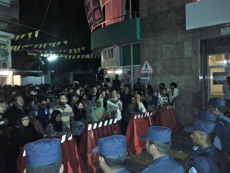
Labeeb moved to the frontline of the protest and appealed to the police again, this time speaking directly to them without the aid of a microphone or making it a public speech.

“You boys must think deeply. Why are you following unconstitutional orders? Neither the Police Act nor the Constitution mandates you to do so, in fact it is clearly stated that you must not follow an unconstitutional order,” he said.

“Don’t you realise what they are doing? They send you out here against hundreds and thousands of citizens, you come with your name tags and in simple regular uniform, and you face scorn from the people. Yet it isn’t you, but the Special Operations who hide behind their masks and helmets who run into crowds and brutalise citizens. They are using you young boys as a shield to hide behind. You don’t have to be slaves to the SO officers or the Commissioner of Police,” Labeeb continued.

“Look at [Commissioner of Police] Abdulla Riyaz. He’s hiding in his rooms after sending you all here. He has secured an apartment abroad, planning to run away as soon as the government changes. All the leading people who were part of the coup have. They won’t think of you then. What will happen to you boys if you continue following unconstitutional orders?”

“Remember all that talk about housing flats for the police? Do you know who took the first flat? Abdulla Riyaz. It was meant for regular officers like you, but he took one for himself first. Is this how you want things to be? Are you still going to stay back quietly and let things proceed like this?”

“I know that as you are all listening to this speech of mine now, your seniors will take you in for a chat later tonight. But they are not the ones you should be believing, nor should you believe me. Instead, read for yourselves what is in the Police Act and the constitution. If you need assistance, we can arrange lawyers for you; not lawyers affiliated with MDP but other experienced lawyers.”

“Regardless of how long it takes to get back our right to vote, we will continue demanding it. And when the elections are on, we will beat them with votes. We will win the elections.”

MP went back into the crowds after concluding his monologue to the line of officers.

Monday – the fourth consecutive day of protests – saw protesters grow from a few hundred to just over a thousand by around 10:00pm.

Crowds later thinned out once the SO officers came to the area after protesters moved, and later hid the police barricades at the protest site.
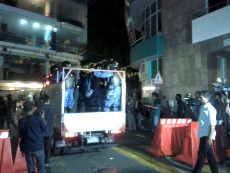
Minivan News observed teams of SO officers run into the crowds twice and make two arrests – one of whom was a man who had previously crossed the police line set out by the regular police officers, referred to as ‘Blues’.

The SO later drove six times to and fro through the protest area in one of their trucks after crowds had thinned out, locating a barricade hidden in a construction site on Fareedhee Magu and sending regular officers to retrieve it.

“Targeting MDP MPs as an intimidation tactic”: MP Alhan Fahmy
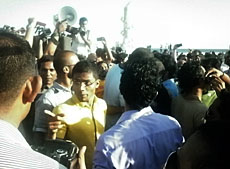
Meanwhile, police have been arresting and summoning MDP parliamentary group members in relation to various cases in the past few days after the party started direct action asking for immediate elections.

MP Alhan Fahmy, who was summoned to police headquarters for questioning at 2:00pm on Tuesday described the events as “intimidation tactics being used by the police. They [the government] are using multiple state institutions in their actions of undermining the constitution and its powers”.

Fahmy said that the police had accused him of threatening Supreme Court judges and their families at a protest held on September 26.

“I told them I have done no such thing, that I never called for attacks or threatened any of these judges they speak of or their families. That all I said at the rally was my perspective on the current judges sitting on the SC bench. I told them that I had spoken of a video clip showing indecent behaviour that police has said Ali Hameed has been seen in, and that if so I believe Ali Hameed should no longer be sitting on the bench,” Fahmy told Minivan News today.

MDP International Spokesperson and MP Hamid Abdul Ghafoor was also taken into police custody on Monday afternoon, allegedly for not accepting court summons. He has been transferred to house arrest today after the first hearing of the case.

Ghafoor’s lawyer, Fareesha Abdulla O’Shea, however claims that due process was not followed when delivering the court summons.

She said that the case is being presided over by Criminal Court Chief Judge Abdulla Mohamed.

“The case is about Hamid’s refusal to give a urine sample and he is being charged under section 123 of the Drug Act. I advised not to enter a plea as we haven’t received any of the related documents or information from the court yet,” O’Shea said.

“Today, after the hearing, Hamid was issued another summons relating to charges levied for possession of alcohol,” she stated.
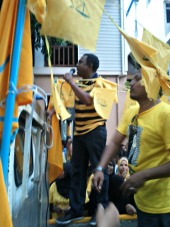
MP Ali Azim was arrested from the protests on Sunday night, with SO officers pulling him off the campaign truck, throwing him onto the ground and dragging him away into custody. He was brought to a court hearing on Monday, where the courts added a seven day extension to his detention on account of him being “a threat to national security”.

Azim attended a meeting of the Parliament’s Privileges Committee after his hearing yesterday, where he alleged that he had been ill-treated even after arrest.

“The SO officer on my right side tried very hard to break my finger, I have photos to prove this. Upon being pushed into the van, one of the officers grabbed hold of my groin area very hard,” Azim told the committee.

“They also asked me to provide a urine sample, but I didn’t because my lawyer advised me against it as the charges levied against me did not allow police to make such a request. I was also handcuffed on the trip from Dhoonidhoo to the court in Male’, and on the way to this parliamentary meeting,” he added.

DRP MP ‘Colonel’ Mohamed Nasheed was also arrested at protests and later released, while MP Ibrahim Rasheed is being investigated for allegedly assaulting police.

MP Eva Abdulla has also been arrested at protests on Tuesday.

Likes(0)Dislikes(0)

MDP Spokesperson charged for refusing to give urine sample to police

The Prosecutor General’s Office (PGO) has charged Maldivian Democratic Party (MDP) Spokesperson MP Hamid Abdul Ghafoor for refusing to give a urine sample to police in a case last year in which a group of MDP politicians were arrested on an uninhabited island and charged with alcohol and drug possession.

The PGO’s lawyers told the Criminal Court that Ghafoor was arrested on November 16 last year in connection with a drugs case, and said he had refused to give a urine sample and had therefore violated the Drug Act.

Ghafoor’s lawyer told the court that she could only respond to the charges on behalf of her client after receiving the relevant documents. The presiding judge, Chief Judge of the Criminal Court Abdulla Mohamed, told her these would be provided and scheduled the next hearing for October 9.

Ghafoor was arrested yesterday (September 30) in the afternoon ahead of his court hearing. He was released following the hearing.

Ghafoor is also accused in another case before the court concerning possession and consumption of alcohol and cannabis.

A total of 10 people were taken into police custody on 16 November 2012 after police raided and searched Hondaidhoo with a court warrant. Officers alleged they found large amounts of suspected drugs and alcohol upon searching the island.

On 22 August 2013, criminal court media official Ahmed Mohamed Manik confirmed the PG had charged MDP MP Abdulla Jabir, Ghafoor, and Jadhulla Jameel with smuggling alcohol into the country and consuming it, as well as possession of cannabis and objecting to urine testing.

Former President Mohamed Nasheed’s Press Secretary Mohamed Zuhair and his wife Mariyam Faiza were also charged for objecting to take urine tests, said Manik.

Two Sri Lankan nationals named Raj Mohan and Anoor Bandaranayk, as well as a Bangladeshi named Suhail Rana, were also taken into custody following the island raid. Their cases have not been filed at the Prosecutor General’s (PG) Office.

According to the Drug Act, Sections 123(a), 161(a), and 161(b), any person arrested on suspicion of having abused alcohol or narcotics has an obligation to comply with police requests for routine urine examination by promptly providing urine samples, and failure to comply is a criminal offence punishable by a one year jail sentence.

Additionally, the son of Nasheed’s former special envoy, Mohamed Hamdhoon Zaki,  has been charged for trafficking illegal drugs into the country – the penalty for which is 25 years and a fine of up to MVR 10 million (US$650,000).

Likes(0)Dislikes(0)