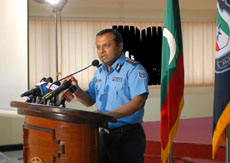
Six hundred flats awarded to police and military

Government authorities have awarded 600 apartments to Maldives Police Service (MPS) and Maldives National Defence Force (MNDF) personnel this week, including to Police Commissioner Abdulla Riyaz and senior police officers.

The housing development projects – providing 300 apartments for MPS, and 300 for MNDF officers – are being jointly managed by the government-owned Housing Development Corporation (HDC) in conjunction with the Police Cooperative Society (POLCO) and the MNDF co-operative SIFCO.

The opposition Maldivian Democratic Party (MDP) has described the awards as a continuation of the patronage policies that prevailed under the 30 year autocracy of Maumoon Abdul Gayoom.

Under the MPS’s MVR580 million (US$37.6 million) ‘Blue’s Housing Project’ 210 three-bedroom and 90 two-bedroom apartments will be built.

The housing scheme was described as being important for the maintenance of the police force’s welfare by Commissioner Riyaz during the project’s foundation laying ceremony in March. Acting Home Minister Ahmed Shafeeu presented recipients with the official documents yesterday (September 2).

Apartments were awarded to officers with at least 20 years of service and based on a points system used in other housing schemes, Chief Superintendent of Police Abdulla Nawaz told local media.

The awarding of flats marks the beginning of the POLCO project, which is seeking private investment for a further 150 apartments, said Commissioner Riyaz during Monday’s ceremony.

Last month, 50 apartments on Hulhumale’ were handed over to police officers by President Dr Mohamed Waheed, who expressed hope that more housing would be made available exclusively for police and military officers.

Since the controversial transfer of presidential power involving elements of the police force, 1000 officers have been promoted and 110 new officers were hired. More recruits have been sought for a “special constabulary” reserve force, a loan scheme has been established for officers, and arrangements have been made for officers and their families to receive cheap accommodations and medical treatment in Sri Lanka.

The Maldives Police Service had not responded to Minivan News’ enquiries at time of press.

MNDF flats

Meanwhile, the government has re-started construction of 300 housing units on Hulhumale’, specifically for MNDF officers.

President Waheed, Defence Minister Mohamed Nazim, and senior MNDF officials laid the foundation stone for the apartment complex during a ceremony held on Hulhumale’ yesterday.

The apartments will be given to female officers who had not been previously awarded housing units, as well as to retired officers, the MNDF told local media.

Once constructed, the housing units would provide MNDF personnel and their families “adequate accommodation” as many are currently “living under a degree of hardship, having to rent their living spaces,” Waheed said during yesterday’s ceremony. Nazim added that the project would provide facilities such as playgrounds, a swimming pool, and a gym for residents.

President Waheed also awarded 50 apartments to MNDF personnel and their families last month, although seven of these flats had yet to be assigned.

Waheed noted during yesterday’s ceremony that the provision of shelter for military personnel was not an act of kindness, but rather a government obligation.

“The development and welfare of personnel should be improved in accordance with financial capability of the government, and the flats awarded today provides evidence of that fact,” Defence Minister Nazim stated at the time.

In April 2012, MNDF officers were given two years of allowances in a lump sum, which amounted to MVR 150 million (US$10 million) for the institution.

The Maldives National Defence Force was also not responding to enquiries at time of press.

“Patronage” continues: MDP

The Maldivian Democratic Party (MDP) believes the award of 600 housing units to MNDF and MPS officers is a continuation of the patronage system established during former President Maumoon Gayoom’s 30-year autocratic rule.

“In the light of extensive exposes, such ‘patronage’ is familiar to voters from the single party dictatorship of Gayoom and I believe they will simply say to each other ‘I told you so’,” MDP MP and Spokesperson Hamid Abdul Ghafoor told Minivan News today (September 3).

The MDP previously raised concerns about whether the already constructed flats – which it contends forms part of the “Veshi Fahi” Male’ (decongestion) project launched under the previous government in 2011 – were being given to the “needy” and most deserving.

Ghafoor said it was “very concerning” that police should be given flats exclusively, to the detriment of teachers, doctors and other civilians. He also questioned how officers themselves had been selected for the process.

While some of the officers may have deserved the housing, there was concern that some officers involved in last year’s mutiny had been rewarded with flats, claimed Ghafoor.

Last month, President Waheed requested parliament approval to obtain a US$29.4 million loan from the Bank of Ceylon to finance the government’s budget and manage cash flow.

The Ministry of Finance and Treasury was seeking to secure the loan as a way to “enforce” the 2013 budget approved by parliament, stated a letter from the President’s Office read during a parliament session held on August 13.

Likes(0)Dislikes(1)

Parties to leaked “coup agreement” dismiss document’s authenticity

Read an English translation of the document

Download the original document in Dhivehi

Vice President of the Civil Alliance coalition of NGOs, Abdulla Mohamed, has claimed that a leaked document allegedly signed by all then-opposition political parties to commit to toppling former President Mohamed Nasheed’s government is not authentic, and that the signatures of party representatives are forged.

The document, apparently signed and sealed by the parties and the Civil Alliance, purports to be  blueprint of a plot to overthrow the government, forcing former President Nasheed to resign, and have the Supreme Court order him to remain away from politics for the rest of his life.

The document is dated December 29, 2011 and features the signatures and seals resembling those of the then-opposition parties Progressive Party of Maldives (PPM), religious conservative Adhaalath Party (AP), Dhivehi Qaumee Party (DQP), Jumhoree Party (JP), Dhivehi Rayythunge Party (DRP), People’s Alliance (PA) and the Civil Alliance.

The unauthenticated signatures appear to include those of PPM Vice President Umar Naseer, Islamic Minister Sheikh Shaheem Ali Saeed (on behalf of the AP), Leader of the DQP Dr Hassan Saeed, Leader of the JP Gasim Ibrahim, DRP Leader Ahmed Thasmeen Ali, and Deputy Speaker of Parliament Ahmed Nazim on behalf of the PA.

“This agreement, is an agreement agreed by friendly political groups, after having come to the belief that current President Mohamed Nasheed of Galolhu Kenereege should no longer be allowed to remain as the president of this country, to completely bar Nasheed from politics and to eradicate the existence of the Maldivian Democratic Party (MDP) who are being influenced by Christianity for the sake of the country’s future, for reasons that include: dishonoring the religion Islam and the laws of this country, openly promoting anti-Islamic mottos, refusing to enforce Islamic Sharia’, indulging in anti-Islamic activities, arbitrarily arresting political opponents, acting contempt of the courts of the law,” states the document’s introduction.

Abdulla Mohamed dismissed the document: “I swear by Allah, that I have never signed an agreement with any political parties both in my personal capacity and in my capacity as the Vice President of the Civil Alliance. Any agreement, had we made one, would have been live on television. I even have the minutes of meetings held with political parties and I will reveal them soon.”

Ahmed Thasmeen Ali, Gasim Ibrahim, Sheik Shaheem and Deputy Speaker Ahmed Nazim have all denied the validity of the document to local media.

“I helped Waheed out of the mess”: Ahmed Faiz

Former Deputy CEO of Maldives Ports Limited Ahmed Faiz – who recently defected to the MDP following his arrest for allegedly attempting to blackmail Supreme Court Justice Ali Hameed in a sex-tape scandal – told Minivan News that it would have been “really odd” for the parties to enter into such an agreement without his being a party to it.

Faiz did not dismiss the authenticity of the document, but suggested that GIP may have been deliberately sidelined from the agreement.

“When I looked into the document, one party was missing. President Mohamed Waheed Hassan’s party Gaumee Ithithaadh Party (GIP) is missing in the document. I was the one representing the party at those meetings aimed at toppling Nasheed,” said Faiz.

Faiz said he presumed that omitting the GIP from the agreement was possibly due to tensions between Waheed – who was then Vice President – and the group of opposition political parties.

“Their spirit was quite odd. They were talking during the meetings too. Firstly, they planned to oust both Nasheed and Waheed. They had grudges against Waheed after he gave a press conference as Vice President calling for the suspension of Chief Judge of the Criminal Court Abdulla Mohamed. However I talked to the opposition parties and persuaded them to exclude Waheed from the plan,” Faiz explained.

Faiz also implied that Waheed had little role during the initial stages of ousting of Nasheed’s government, and contended that a televised press conference and early morning meeting between Waheed and opposition parties a week prior to Nasheed’s ousting had just been “showing off”.

During the press conference, DRP Vice President Ibrahim Shareef “asked the Vice President to save this nation. I would like to call upon the security forces [to accept that] since the Vice President is a person elected by Maldivians, and should the President be incapacitated to perform his legal duties, the Vice President must assume the duties of the President.”

Waheed was not present at the press conference. Faiz told Minivan News, “When the idea of ousting Waheed and Nasheed began floating, I went onto VTV and invited Waheed to join the anti-government protest that had been going on against Nasheed. He got really upset and we both even had a falling out.”

‘Plot’ to oust Nasheed

According to the document, the plot to topple Nasheed’s government was to start on February 24, 2012 – 17 days earlier than the day Nasheed was toppled – following a nation-wide Islamic symposium.

It proposed that Nasheed’s presidency be ended within 24 hours from commencement of the symposium, after giving the president a five hour ultimatum to resign unconditionally.

In late January 2012, 22 days of continuous anti-government protests led by then opposition figures and religious scholars following the controversial detention of Chief Judge of the Criminal Court Abdulla Mohamed escalated into a mutiny by certain elements within the police and the military.

By midday of February 7, 2012, then-President Nasheed had exhausted all his options to establish a chain of command within the ranks of police and military, and was left trapped inside the Maldives National Defence Force (MNDF) barracks surrounded by rebelling police and military forces along with an angry mob of demonstrators, who had been armed by the rebelling security services.

Within a short span of time, the current Defence Minister Mohamed Nazim – who had been a civilian at the time – entered the military barracks and gave Nasheed an ultimatum to “resign or face the dire repercussions”. At the same time another group of demonstrators and rebelling security forces stormed and took control of the state broadcaster. Nasheed’s subsequent resignation at the President’s Office was aired on the swiftly re-branded Television Maldives.

Vice President Mohamed Waheed then ascended to power.

Mutiny and Vice President’s endorsement

The symposium, the document claimed, would escalate into a violent demonstration on the outskirts of Republic Square with three groups stationed at different locations.

Religious sheikhs affiliated with the movement would address the police barricading the area, and were to convince them that it was haram under Islam to obey the orders of President Nasheed in a bid to appeal for their support. Following the speeches of the religious sheikhs, politicians would take over the stage and then PPM Vice President Umar Naseer was to give the final speech.

By the end of his speech, a lieutenant colonel and a brigadier general from the MNDF would step aside from their duties and would appeal to the remaining military officers to disobey the orders of the president.

By this time, a platoon of Police’s Special Operations (SO) department would rebel against the police leadership and begin protests within Republic Square, creating a distraction that would allow more demonstrators to enter Republic Square and join the rebel police.

According to the document, by this time then Nasheed’s Defense Minister Tholhath Ibrahim Kaleyfaanu – who according to the document had pledged supported to the movement – would go on to order the MNDF to arrest the protesting police live on state broadcaster MNBC One.

Using this opportunity, the organizers of the movement, by using opposition-aligned TV station DhiTV, would propagate rumors across the country that MNDF had begun brutalising the protesting police and appeal the other police officers to join the protests to help their colleagues.

The document claimed that Nasheed’s Vice President Mohamed Waheed Hassan – the current president – had pledged his support for the movement and would take over the presidency as soon as the Supreme Court ruled that Nasheed had been incapacitated.

It also claimed that Waheed had agreed to form a national unity government with “friendly political groups”, and had agreed not to seek re-election at the conclusion of the presidential term.

Arrest of Nasheed and declaration of incapacity

By the time the demonstrations had escalated into a violent mob backed by police and military, the Special Protection Group (SPG) of the MNDF – tasked with protecting the president – would escort Nasheed to the presidential retreat of Aarah, in the name of giving him protection and security.

Shortly after Nasheed had been escorted to the island, an emergency court case would be filed at the Supreme Court requesting it to rule that Nasheed was incapable of remaining as the President, due to fear of violence and loss of the social harmony of the state as police and military were reluctant to follow his orders.

Then Vice President Mohamed Waheed Hassan would immediately take oath as the President as soon as the ruling was issued.  In an another ruling after Waheed assumed power, the Supreme Court would order the imprisonment of Nasheed and bar him from involvement in politics for the rest of his life.

According to the document, leader of the DQP and running mate of resort tycoon and JP Leader Gasim Ibrahim, Dr Hassan Saeed, and Deputy Speaker of Parliament Ahmed Nazim were lobbying the Supreme Court bench to get its support.

The document also alleged that the PPM has had agreed to have current Attorney General Aishath Azima Shukoor try to convince Chief Justice Ahmed Faiz Hussain to support the petition.

After intense negotiations, the document claimed, a green signal had been given to the movement that the Supreme Court would issue the orders as requested by them.

New government

The document claimed that shortly after Waheed Hassan assumed power, the cabinet of President Nasheed would immediately be dismissed and a new cabinet would consisting of 10 members would be appointed including PPM Vice President Umar Naseer as the Home Minister and Tholhath Ibrahim Kaleyfaanu reappointed as the Defense Minister.

Similarly, retired Colonel Mohamed Nazim was to be appointed as the Chief of Defence Force and Abdulla Riyaz appointed as the Commissioner of Police.

However, when the government of President Mohamed Waheed Hassan assumed power in February 7, 2012, the position of Home Minister was given to Dr Mohamed Jameel Ahmed and the Defense Minister position was given to retired Colonel Nazim. Brigadier General Ahmed Shiyam was appointed Chief of Defence Force while Abdulla Riyaz was appointed as the Commissioner of Police.

Dismantling and factionalising MDP

Following the change of government, the document claimed that it was highly important to divide, dismantle and factionalise the ruling Maldivian Democratic Party (MDP), in a bid to weaken opposition to government.

“It has been agreed among all friendly political groups, that it is very important to influence and overtake the control of the Maldivian Democratic Party (MDP) and the following actions have been commonly agreed to be carried out in order to dismantle the MDP’s leadership,” read the document.

The schemes to divide the MDP included backing then President of the Party, Dr Ibrahim Didi – whom the document described was politically weak and easily manipulated – while also supporting current Chairperson of MDP MP ‘Reeko’ Moosa Manik, whom the document described as susceptible to blackmailed and threats against his business interests.

The document noted that Vice President of MDP MP Alhan Fahmy was the second biggest threat in the MDP as he had the potential to reorganise it in the absence of Nasheed.

The document claimed that the movement would work on promoting Dr Didi as party’s official presidential candidate, financed by JP Leader Gasim Ibrahim.

In a bid to verify the authenticity of the document Minivan News tried contacting all parties mentioned in the document, but with the exception of Abdulla Mohamed from the Civil Alliance, no others were responding to calls at time of press.

Read an English translation of the document

Download the original document in Dhivehi

Likes(1)Dislikes(0)

Thimarafushi airport opens in Thaa atoll

Thaa Atoll’s Thimarafushi airport was officially opened this morning by President Dr Mohamed Waheed Hassan. The airport was developed by state-run Maldives Transport and Contracting Company (MTCC).

The airport was developed to provide an efficient means of transport to the people, Haveeru reports, although as the airport does not have a control tower flights will only land during the day.

Addressing a crowd at the inauguration ceremony, President Waheed emphasized that the airport would facilitate faster development within the atoll, in part by improving tourist accessibility.

The President noted that certain infrastructural development requirements must be fulfilled for the airport to be considered fully complete, reports Haveeru.

The airport development project was originally awarded to Maldives Airports Company Limited (MACL) in April 2012. MACL subcontracted the project to MTCC for MVR32 million ($2.8 million) the following month. Delays, allegedly due to financial constraints, fueled political tensions earlier this year.

The airport will be operated by Island Aviation, which runs the Maldives national airline Maldivian Air.

Likes(1)Dislikes(0)

Cabinet’s convention centre re-zoning “for political gain”: Addu City Mayor

The Cabinet has advised President Mohamed Waheed Hassan to overturn the previous government’s decision to make the Addu Equatorial Convention Center (ECC) zone an ‘uninhabited area’, potentially allowing the sale of prohibited commodities such as liquor, as practiced for resorts.

The area was designated ‘uninhabited’ on November 19, 2011 by former president and current presidential candidate Mohamed Nasheed.

Yesterday’s recommendation originated in the Finance Ministry, which submitted a paper on the subject during Monday’s cabinet meeting, the president’s office reports.

Spokespersons at the President’s Office said they could not provide details on the recommendation; Addu City Mayor Abdullah Sodig reports that the council was not consulted on or informed of the Cabinet’s recommendation, and claims that it was made for political gain in the face of this Saturday’s presidential elections.

“The Cabinet recommendation opposes Nasheed’s [tourism development] policy, and they want to show the public that they are trying to give land to people who need it. But it’s really just political gain,” Sodig said. “Three days before elections, I don’t think it’s about giving people land.”

Zoning laws in the Maldives determine which islands and areas may be developed for tourism and therefore exempted from national laws prohibiting the sale of alcohol and pork and enforcing compliance with cultural dress codes. Maldives’ southern atolls, including Addu and nearby Gnaviyani atoll, have historically benefited the least from the country’s tourism economy.

President Nasheed decreed the ECC zone uninhabited prior to the 2011 SAARC summit in Addu, effectively laying a foundation for resort, guest house and other tourism-oriented development activities.

Nearly two years since this decree the mood has shifted dramatically. Bids to develop the convention center and surrounding area were interrupted by the February 7, 2012 transfer of power, after which the new administration retained the building as a “national asset”.

Formerly enthusiastic about Addu’s growth potential, Sodig today expressed deep frustration with the government’s inaction.

“[The Convention Center] is never dusted, the toilets are never cleaned, the floors never polished,” he said, adding that the facility has only been used for a few wedding parties and political rallies since it opened in November 2011.

Sodig claimed that his repeated requests for maintenance funds and development activity had received minimal response from President Waheed’s government.

“I took the State Minister of Housing to the building and asked him to look into maintenance. I even met with the Attorney General, Azima Shukoor, for the same purpose in Male,” said Sodig. “She said she would think about it. But until now they have done nothing.”

Sodig reports that without tourism development the ECC, which as of January was mired in MVR 4 million ($260,078) of unpaid electricity bills, “would end up as a liability”. As of June, the Maldivian government owed State Electricity Company (STELCO) MVR 543 million ($35.2) in unpaid electricity bills.

The Cabinet’s sudden action this week suggests that the ECC zone is now being treated as a pawn in the housing debate for the presidential elections. Addu Atoll is home to a significant percentage of the population, and has historically supported President Nasheed’s Maldivian Democratic Party (MDP).

In 2002, 700 ECC-zone land plots were allocated to Adouin families. According to the mayor, only 150 plots have been officially registered as ‘in use’. In an atoll where the average household income is MVR 60,000 ($3,900) per year, the approximate cost of building a two-bedroom home is MVR300,000 ($19,500).

While Adduans who received land in the ECC zone objected to President Nasheed’s zoning decree in 2011, they were content with the island council’s compensatory proposal, Sodig said. He added that he was not aware of any recent complaints that might have triggered the Cabinet to recommend zoning reversal.

The ministries of Finance and Housing had not responded to calls at time of press.

Likes(1)Dislikes(0)

Maldives scores 10 in record-breaking victory

The Maldives national football team yesterday began its South Asian Football Federation Championship (SAFF) by putting 10 goals past two Sri Lankan goalkeepers in record breaking style.

The high scoring game represents the biggest win in the tournament’s twenty-year history, with six goals by the Maldives’ ‘man of steel’ Ali Ashfaq making him the competition’s highest goalscorer.

“I feel happy about the result. I was excited that lots of goals were scored,” coach Istvan Urbanyi told the press after the game.

Commenting on Ashfaq’s six goals, Urbanyi hailed an “extra ordinary performance” but maintained that the win was a team effort.

It was Assadhulla Abdulla who opened the scoring for the Maldives after just five minutes from an Ahmed Rasheed cross. Sri Lanka kept their opponents at bay before Ashfaq began to take over, proving too quick for keeper Mohamed Imran who upended the Maldives’ captain when through on goal in the 19th minute.

Imran’s subsequent red card prompted the flood gates to creak, with Ashfaq converting the spot kick before adding another prior to the break. They had finally broken 15 minutes into the second half by which time Ashfaq had added another three to his tally, with his apparent hypnotism of Imran’s replacement in the 51st minute the pick of the bunch.

Sri Lanka appeared in disarray by the time Hassan Adhuham made it six on 76 minutes. The Maldives went on to put another three past the Lankan Lions, with Ashfaq claiming his sixth in the 87th minute and making the his team the first to score 10 goals in a SAFF championship game.

After the match, Sri Lankan coach Claudio Roberto declined to discuss individual players, but accepted blame for his side’s humiliation.

“Everything went wrong I will take the full responsibility of the match,” he told the media.

Post-match congratulations soon appeared across social media, with perhaps the most notable praise coming from former President Maumoon Abdul Gayoom who praised Ashfaq as “the best player in our region”.

Politicians from all parties took to Twitter to congratulate their side’s historic result. Both presidential and vice-presidential contenders for Saturday’s election took time away from campaigning to send their regards to Urbanyi’s team.

Maldives chief opponent in Group B, Afghanistan, had started their own campaign with a 3-0 win against Bhutan earlier in the afternoon.

The Maldives will take on Bhutan – the lowest ranked team in the tournament – tomorrow, before taking on Afghanistan on Friday.

Likes(0)Dislikes(0)

Perils of fundamentalism in the Maldives: International Security Observer

In recent months several newspapers, blogs and academic outlets have highlighted the tumultuous domestic skirmish between Nasheed and Waheed in the Maldives as well as the strategic balancing act of the archipelago state between India and China, writes Djan Sauerborn for the International Security Observer (ISO).

Surprisingly however the troubling rise of religious fundamentalism within the Maldives has not fully moved into the limelight of international media and organisations. This is especially astonishing, because the battle between moderate and extremist forces within the country not only has a strong impact on the upcoming elections in September but also on civil society as a whole.

Islam, which only decades ago did not play a major role within the public sociopolitical sphere, has turned into a divisive “game changer”. Moderate, peaceful and inclusive forms of religious expression are being violently pushed aside by adherents of fundamentalism.

Read more

Likes(0)Dislikes(0)

Comment: A Jumhoree Maldives?

This article was first published on DhivehiSitee.com. Republished with permission.

I went with a friend to the Jumhoree Maalan on Majeedhee Magu last night to get a copy of the Jumhoree Party manifesto.

The Maalan is a vast space of two floors, on a piece of land well over 2000 square feet. Part of it, towards the back, is cordoned off with a big red banner saying ‘Voting Booth’. Two men sat at a table to the side – they looked the closest thing to receptionists we could find. We asked them for a manifesto.

For some reason, the request surprised them. They called over a harried looking man, ‘Ahammadhey’. He agreed to give us a copy and walked over to a room at the back with a big bunch of keys. JP manifesto is kept under lock and key, like a tightly guarded trade secret. He brought us each a little leaflet, a six page summary of the People’s Manifesto: Development Certain.

The frontpage is an illustration of JP’s vision for Maldives. There’s a small island to the far right, connected to an ‘Islamic city’ rising from the sea. The entire shoreline is dominated by a mosque which itself dominates a university standing adjacent, to the left. There’s one or two trees, a crane busily constructing more buildings in a concrete jungle.

A father and son are at the forefront of the picture, walking into the mosque together. They are the nucleus, the centre of the universe as imagined by JP. A woman is somewhere in the distant background, attending to a little household chore, as women do. The only other person is a figure of non-distinctive gender, standing on a bridge. S/he looks about to jump off it. A Maldivian flag is the tallest of all things, rising above everything except the minaret. Not one but two suns shine down on this JP idyll.

There’s quite a few things—eighty three to be exact— that JP promises will happen to make this vision a reality. It begins with the promise to build an Islamic university, followed by the promise to include Nationalism as a separate subject in the national curriculum. Four regional institutes for ‘Arab Islamic learning’ will be established across the country. Next to religion is crime and punishment. Better forensics, more surveillance, better trained police with its own ‘world class’ Police Academy and an all powerful Anti-Drug Agency that will ‘completely stop’ Male’s thriving drug trade.

We asked Ahammadhey if he could talk us through some of the pledges. ‘I am a masakkathu meeha [handyman],’ he said. ‘I don’t know what’s in it.’Ahammmadhay went to fetch us a man more familiar with what JP wants to do for us people. The resident expert turned out to be Umar Bey [Mohamed Hameed], who used to teach in Majeediyya School and is a familiar figure to thousands, like us, of Male’ voters.

‘Can you tell us a little bit more about the pledges here?’

‘It’s pretty straightforward, is it not?’

‘Can we have a copy of the full manifesto?’

‘I don’t have it. To be honest, I haven’t seen it yet.’

‘It does exist? You have one?’

‘Yes, there’s a big manifesto, it’s printed and everything.’

‘So where is it?’

‘I don’t have access to it.’

‘Who does?’

Umar Bey summoned another person who confirmed there is a manifesto the party can give us, but ‘not right now.’ He asked us to come back another time.

We continued our conversation with Umar Bey.

‘There’s a manifesto published on Scribd by Hassan Saeed, promoted on his FB page. What’s that about?’

‘Haha. That’s not a JP manifesto. That’s Hassan Saeed’s.’

‘Oh? Hassan Saeed has a different manifesto?’

‘He must do. I haven’t seen it.’

We had. A few days ago it appeared on running mate Hassan Saeed’s Face Book page.

The summary we got last night is a summary of Hassan Saeed’s manifesto on Scribd: build an Islamic state where religion, together with nationalism — taught as a subject in the national curriculum — will inform all socio-political and juridical decisions and conduct of society and individuals. It also speaks of ‘maintaining’ this traditional Islamic state, as if this is not an imagined place yet to be created but the way we have always lived.

I wonder how many people intending to vote for Gasim Ibrahim know the Maldives they are voting for.

All comment pieces are the sole view of the author and do not reflect the editorial policy of Minivan News. If you would like to write an opinion piece, please send proposals to [email protected]

Likes(2)Dislikes(0)

Supreme Court demands “free and fair” polls, while EC states no changes to voter registry

Download an English translation of the Supreme Court verdict

The Elections Commission (EC) has said no changes will be made to the voter registry for this month’s presidential election, following a Supreme Court order issued yesterday (September 2) demanding all institutions ensure free and fair polls.

Despite some political parties standing in the election having raised  several concerns over about the EC’s ability to oversee free and fair polls, the commission today stressed that its registry and schedule for Saturday’s voting was going forward as planned with international and local monitors poised to monitor proceedings.

The Supreme Court yesterday ordered all relevant authorities ensure a free and fair presidential election on Saturday (September 7), with the EC remaining duty bound to address any possible errors regarding details on the voter registry.

The order was made in response to a case filed by a senior Progressive Party of Maldives (PPM) member Ahmed Zaneen Adam questioning the EC’s capabilities to oversee a free vote.

Zaneen was today quoted in Sun Online as claiming that an additional 10,000 eligible voters would now be able added to the final electoral register without having to re-register with the EC as a result of the Supreme Court order.

PPM Mp Ahmed Nihan and vice presidential candidate Dr Mohamed Jameel Ahmed were not responding to requests for information at time of press.

No amendments

EC President Fuwad Thowfeek told Minivan News that in line with the Supreme Court’s ruling, the commission was committed to following electoral regulations but stressed that no amendments would be made to the final registry.

Thowfeek added that he had no knowledge of the additional 10,000 people wishing to vote in the upcoming poll, as referred to by Zaneen in local media.

“We have not been asked to make any changes to the [voter registry] and I believe the 10,000 people he mentioned are [Zaneen’s] own opinion. The voter list has now been finalised,” he said. “The Supreme Court has asked us to follow the laws on holding an election and this is what we are doing.”

Thowfeek added that the election was moving ahead as scheduled with ballot boxes and other necessary equipment including emergency lights, ink and paper all being taken to polling booths across the country in preparation for voting.

Alongside to the voter registry, the EC said it would also be working to keep pens provided at polling booth’s “safe” after the PPM and Jumhoree Party (JP) expressed concern this week over the possible use of ‘disappearing-ink pens’ to adversely alter the outcome of the election.

Thowfeek reiterated that while the EC would be providing voters with standard ballpoint pens at polling booths, voters concerned over the use of invisible ink could bring their own stationery to vote.

“Actually, it was a PPM member who showed one of these [invisible ink] pens to the media. This is the only one we have seen,” he said.

Thowfeek added that although pens inside poll booths will be monitored in order to try and prevent any tampering, he added that the public were requested not to accept any pens from people outside the polling booths.

“We have said that it may be best for voters to bring their own pen,” he added.

Thowfeek said that with hundreds of international and local observers overseeing Saturday’s vote representing NGOs, political parties and other institutions, the EC would be requesting that only one representative per group be allowed into the polling area at a time.

He stressed that all observers would be forbidden from touching ballot boxes or papers.

However, Thowfeek said that registered observers would be able to request that election officials address any concerns about vote counting once polls had closed on Saturday.

“They can for instance request to slow down the count if it is being done too quickly,” he said.

Download an English translation of the Supreme Court verdict

Likes(1)Dislikes(0)

Government seeking “longer-term” finance to plug revenue shortfall as 2013 sales of T-bills double

The government has said it hopes to secure longer-term financing to plug a shortfall in annual revenue that has seen the number of 28-day Treasury Bills (T-bills) sold by the state almost double in July 2013, compared to the same period last year.

According to the Maldives Monetary Authority (MMA) monthly review for August 2013, sales of T-bills for July 2013 has risen by 95 percent year on year.

The MMA stated that there had been a 163 percent in 28 day T-bills by July 2013 compared to the same time last year, despite sales of T-bills with a maximum maturation period of three month and six months declining by 63 percent and 83 percent respectively. Sales of T-bills were up 35 percent for July 2013 over the previous month, according to the MMA’s figures.

T-bills are sold by governments all over the world as a short-term debt obligation backed by sovereign states. In the Maldives, they have a maximum maturity of six months, in which time they must be repaid.

Budget issues

Finance Minister Abdulla Jihad told Minivan News this week that the state’s increased reliance on T-bills between July 2012 and July 2013 reflected the current difficulties faced by the government in trying to raise budgeted revenue during the period.

He added that with only “a few people” in the private sector were interested in purchasing the short-term debt obligation, T-bills has been sold as part of wider investments made by the state through the country’s pension fund.

Jihad stressed that although there had not been an increase in state expenditure over the last twelve months, the increased reliance on T-bills by the state arose partly from having to repay US$100 million in treasury bonds to the Indian government by February 2013.

He also raised concerns over a lack of parliamentary approval for numerous revenue raising measures.

Parliament in April rejected government-sponsored legislation to raise the airport service charge to US$30, which was among a raft of measures proposed by the Finance Ministry in the estimated 2013 budget to raise MVR 1.8 billion (US$116 million) in new income.

Other proposed measures include hiking Tourism Goods and Services Tax (T-GST) to 15 percent from July 2013 onward, leasing 14 islands for resort development, introducing GST for telecom services as well as oil, and “selectively” reversing import duty reductions.

Without such measures introduced, Jihad said that the Maldives had relied on 28 day T-bills, which were being sold as a means to “roll over” debt one month at a time.

“We are trying to have banks get longer-term finance such as T-bills at present,” he said.

According to the MMA, the Maldives fiscal deficit for 2013 was estimated to have fallen from MVR 4.3 billion or 13 percent of national GDP in 2012 to MVR1.3 billion in 2013 – four percent of current GDP.

A total of 62 percent of the current deficit – which reflects the total amount of government expenditure that exceeds its earnings – is expected to be covered through foreign financing. The remaining 38 percent will be covered through T-bills and “other means,” added the financial report.

The findings have been met with criticism from the opposition Maldivian Democratic Party (MDP), which has questioned why there had been an increased reliance on short-term financing through T-bills considering total state revenue rose 16 percent over the last 12 months based on MMA findings.

Mahmoud Razee, former Economic Development Minister under the previous government, claimed that it was important to understand that T-bills should only be used by the state to help cover its operational expenses, rather than serve as a long-term means of financing.

“With income tax revenue having increased according to the Maldives Inland Revenue Authority (MIRA), why have [T-bill sales] gone up? Under the MDP government we were using T-bills to meet our cash flow,” he said. “This had nothing to do with the fiscal deficit.”

Razee argued that while the former government had itself sought foreign loans to balance the financial deficit while in power, the administration of former President Mohamed Nasheed had worked to avoid relying on T-bills for longer-term financial concerns like balancing the national fiscal deficit.

“The moment T-bills are increased, this directly affects loans that banks are able to give to the private sector, leading to the cost of borrowing increasing,” he said.

Razee claimed that the MDP government had attempted to try and extend income tax reforms introduced during its time in office to further boost revenues – a plan he said was cut short by the controversial transfer of power on February 7, 2012.

“Beyond appropriate” spending

The Finance Ministry last month said it has managed to reduce state spending over the last twelve months, despite the MMA raising fears over the current “beyond appropriate” levels of government expenditure had led to a vicious cycle of borrowing.

Finance Minister Jihad at the time told Minivan News that efforts had been successful over the last twelve months to curb recurrent government expenditure, while its borrowing had at the same time remained consistent.

In April, the government announced it was suspending state-financed development projects to curb outgoings.

The suspension of development projects was taken after the state was found to have exhausted its annual budget for recurrent expenditure (including salaries, allowances and administration costs) in the first quarter of 2013.

The decision was made the same month that currency reserves in the Maldives were found to have “dwindled to critical levels”, according to the World Bank’s bi-annual South Asia Economic Focus report.

The government has since requested parliament approve a US$29.4 million loan from the Bank of Ceylon to finance the 2013 budget approved by parliament.

In July, the President’s Office also confirmed that discussions had been held with Saudi Arabia to secure a long-term, low interest credit facility of US$300 million to help overcome the “fiscal problems” facing the nation.

Parliamentary approval will be needed to obtain either of the loans, the Finance Ministry has previously confirmed.

Likes(1)Dislikes(0)