Police summon Supreme Court Justice Ali Hameed for questioning over sex tape scandal

Police have summoned Supreme Court Justice Ali Hameed for questioning over his alleged appearance in a leaked sex tape.

According newspaper Haveeru, Justice Hameed was summoned to police headquarters in Male about 8:00pm in the evening and left at around 1:30am after spending more than five hours in the building.

Police however did not confirm the summoning but said only that the case is currently being investigated.

Last Thursday police formally notified the Judicial Service Commission (JSC), the Prosecutor General and President Mohamed Waheed Hassan regarding their investigation into the case.

The existence of a video footage allegedly involving Justice Hameed indulging in adultery came into media limelight following the arrest of Ahmed Faiz – a senior Council Member of President Waheed’s Gaumee Ihthihaad Party (GIP) and former Project Advisor at the Housing Ministry.

Following the arrest, Faiz was dismissed from his government position and the Spokesperson of President’s Office Masood Imad – who is also a GIP council member – denounced any links with the government regarding the video.

Still images from the sex tape, allegedly showing the judge committing adultery with an unidentified foreign woman, are meanwhile circulating on social media networks.

A police media official told Minivan News that individuals believed to be involved in the scandal had been either summoned to the police for questioning or had been arrested with a court warrant.

“We are currently investigating two cases concerning the video. One is the case of those who had been using the video to blackmail the people in it, and the other concerns the content of the video,” the spokesperson said at the time.

The video also prompted the JSC to establish a five-member committee to look into the matter upon receiving a letter from police. Local media reported that the committee included commission members Latheefa Gasim, Ahmed Rasheed and Abdulla Didi, and two external lawyers: Hussain Siraj and Mohamed Anil.

A second video also surfaced on social media networks apparently depicting Hameed and a local businessman discussing political influence in the judiciary. Local media identified the businessman as Mohamed Saeed, the director of local business firm ‘Golden Lane’.

Justice Hameed in the video also goes on to reveal his political ‘hook-up’ with Abdulla Yameen Abdul Gayoom – the current Progressive Party of Maldives (PPM) presidential candidate – claiming that he was one of Yameen’s “back-ups” and that his stand was “to do things the way Yameen wants”.

Following Sunday evening’s police questioning, local media reported that Hameed had avoided the usual exit doors at the police headquarters in order to avoid the media.

“Senior figures of the state such as Ali Hameed often use the police main entrance, however Hameed knowing that media was present at that entrance, ran to the exit doors located in Boduthakurufaanu Magu. Hameed had also rushed to get into a white car waiting for him at the door after media followed him,” reported Haveeru.

Local media reports claimed that this was the second time Hameed was summoned to the police for questioning. However, a source close to Hameed denied the reports claiming that police had not summoned Hameed at the time.

Police have also searched the house of Mohamed Saeed on the same night at around 7:45pm. The police claimed that they searched the house after obtaining a search warrant.

The raid was allegedly carried out to find if Saeed had been withholding any material related to the sex tape.

The police have previously summoned Saeed twice for investigation but details of the case or the topic of questioning have yet to be revealed.

Saeed’s lawyer Noorban Fahmy told media earlier that Saeed opted to remain silent in the later session after he was first questioned without the presence of a lawyer.

Likes(0)Dislikes(0)

Adhaalath Party brings 34 hafiz for Ramazan prayers

The Adhaalath Party (AP) has arranged for 38 hafiz, individuals who can recite the Quran from memory, to lead tarawih (night prayer) throughout the atolls during Ramazan, reports local media.

The hafiz will be sent to islands by the first day of Ramazan (July 9) and AP is currently coordinating with island councils and associations to determine which islands they will be assigned, said Adhaalath.

This is the fifth year the AP has brought hafiz under its social responsibility program, with 34 arriving from India and four from Sri Lanka.

Likes(0)Dislikes(0)

President opens Maldives’ first Burger King

President Mohamed Waheed has opened the Maldives’ first Burger King, one of four international restaurant chains in Ibrahim Nasir International Airport (INIA)’s new food court.

Besides Burger King’s there are two restaurants on either side of the departure gates.  The new restaurants include ‘casual’ Thai eatery Thai Express, a Australian cafe chain selling mixed drinks and snacks called Coffee Club, and Swensen’s ice creamery, which has already been operating in the airport for several months.

The chains were introduced by the Minor Food Group, a Thai-based subsidiary of the Minor International hospitality and restaurant brands conglomerate that also operates six resort properties in the Maldives, including Anantara, Naladhu and the Per Aquum brands.

The new food court was originally planned as part of the temporary refurbishment of INIA during the construction of a new terminal by Indian infrastructure giant GMR, prior to the government’s controversial eviction of the firm in December 2012. The company recently claimed it is seeking compensation in a Singapore court of US$1.4 billion, an amount four times the size of the Maldives’ state reserves.

The official opening of Burger King and the other restaurants began this morning with the recitation of the Holy Quran, followed by speeches, ribbon cutting, and the serving of food to the many assembled government dignitaries and school students brought across from Male’ for the event.

A company spokesperson told Minivan News that the reception and performance of the burger chain in its first two days of operation had surpassed expectation, perhaps unsurprising given the anecdotal practice by some Male’ families of bringing McDonalds and KFC takeaway back with them on weekend flights from Colombo. Certainly Burger King was extremely popular with the assembled school students, who steadily worked their way through mountains of whopper burgers.

Minor International Chairman and CEO William Heinecke meanwhile noted that the food court improved the quality of the airport by providing a variety of international food demanded by tourists.

“President Waheed told me earlier that this airport is very special to him because as a student he helped carry the stones to make the runway,” Heinecke said.

President Waheed expressed confidence that food court was a sign the airport was developing into a “world class facility”, “and all this under the leadership of our Maldivian colleagues”.

“This is the first big project since the new management took over the airport,” the president said. “Inshallah soon we shall see major investment such as a new runway, which we are currently seeking financing for.”

The manager of one outlet meanwhile identified “consistency of supply” as a key operational challenge in the Maldives for strict branded outlets, noting that chains such as Burger King in particular had extremely high standards of brand consistency.

Employment culture

Several speakers predicted that the introduction of the Maldives’ first major multinational fast food chain could usher in the concept of part-time employment to the Maldives, particularly for students, and help combat widespread youth unemployment.

Of the food court’s initial 53 employees eight were Maldivians who had been sent to Thailand for training, Heinecke said, stating that one of the company’s goals would be to increase the extent of Maldivian employment, particularly part-time students.

Minor Food Group CEO Paul Kenny observed that the firm had success introducing the concept 20 years ago in Thailand. Part-time work, he said, could contribute greatly to an individual’s development.

President Waheed urged young Maldivians to seek work in the fast food outlets, noting that during his tenure as a student he had worked as a tutor “as my parents could not afford to pay me an allowance.”

He also expressed hope that an outlet would open in Male’, and that the price of burgers would eventually come down (regular value meals were around the US$10-12 mark at time of press).

Likes(0)Dislikes(0)

Comment: Egypt, the Maldives and the democracy experiment

As in the Maldives the Egyptian people lived under a 30 year dictatorship which favored the few against the wishes of the majority.

This dictatorship nurtured and helped build a military industrial complex which in turn helped the dictatorship to remain unchallenged. until the internet revolution that brought President Nasheed and the voice of the majority to power through the ballot box.

In Egypt President Morsi was ousted and arrested by the military, the Muslim Brotherhood targeted, its media outlets closed; policemen with Kalashinkovs dancing on the street.

In the Maldives, the ‘deep state’ nurtured by Gayyoom bought key figures in the military. A 30 million dollar cheque signed by the magnate Gasim Ibrahim was supposedly the key that unlocked whatever inhibitions the military or anyone else may have had against the popular policies of the then democratically-elected government of President Nasheed.

Nasheed was forced to resign but managed to keep himself from getting arrested. However, his party supporters and activists were getting picked up by the police on various charges as happened with Egypt’s Muslim brotherhood.

The future of the democracy experiment is yet to unfold. In Egypt it seems to be heading towards violent confrontations. In the Maldives, some may think a peaceful transition back to a democratically elected government is possible but these very same people should ask themselves the question: would those who would be charged with treason which carries the death penalty in Islamic Shariah be willing to face the consequences for their crimes?

The top brass of the military and the police are peopled by pro-dictatorship Gayyoom forces and the only guns in town belong to them. The only way to ensure that the military do not revert to the use of force on some trumped up terrorism charge – the fact Defence Minister Nazim recently alluded that terrorist elements trained in different war zones are in the country should be taken as a hint of what these renegades plan to do – is to ensure a timely visit by a naval presence by a country friendly to the Maldivian peoples’ will. Then – and only then, can the outcome of the ballot box be fully realised.

The Egyptian democracy experiment is unlikely to favor the Muslim brotherhood anytime soon despite the fact they reflect the will of the majority. The armed forces are far too organised and well entrenched and unless a massive bloodbath ensues the present status quo is unlikely to change.

Unlike the Egyptian military, the Maldives military is not strong enough to circumvent the will of the people should they be prepared to make the sacrifices that the challenges will bring. Only a few die-hard figures from the Gayoom era does not carry the necessary moral weight – especially since the fact that they were paid off have come to the fore – to push the armed forces to align with their thinking.

The biggest miscalculation by the ousted President Nasheed was his failure to cleanse the system of the Gayoom era viruses. The same corrupt forces of the ‘deep state’ put in place by Gayoom. He did get the opportunity but he failed to act until too late. President Morsi too made the same miscalculation.To build up a loyal following one needs to catch them while young and then groom them and place them in key positions.

All comment pieces are the sole view of the author and do not reflect the editorial policy of Minivan News. If you would like to write an opinion piece, please send proposals to [email protected]

Likes(0)Dislikes(0)

Police charge Sun Media Group CEO for giving women jobs in return for sex

Police have issued a statement declaring that CEO of the Sun Media Group, Sinan Ali, is to be charged with criminal offences after he allegedly brought girls into his office and had sex with them after offering them job opportunities.

According to the statement, a 25 year-old woman identified by the police as Murishidha Shafeeq is to be charged in the same case along with Sinan.

Local newspaper Haveeru reported that the paper understands the woman is to be charged for having sex with Sinan and assisting Sinan in having sex with other girls.

Under Maldivian law, the punishment for fornication (sex outside marriage) is 100 lashes and a period of house arrest.

Editor of Sun Media Group and head of the Maldives Journalists Association (MJA), Ahmed ‘Hiriga’ Zahir, told Minivan News the issue was a personal matter for Sinan and said he would not like to comment on the matter.

Sinan meanwhile told Minivan News he had no knowledge of the case.

‘’I don’t know anything about this,’’ he said. “Two years ago I was summoned to the police headquarters and they queried about a video. I said I didn’t know anything.’’

Local newspapers reported that Sinan Ali was accused of having sex with six girls after offering them job opportunities while he was the head of Job Market Maldives.

Likes(0)Dislikes(0)

US government pledges US$9.7 million for Maldives climate change adaptation, election preparations

The United States government has pledged US$9.7 million (MVR 149 million) to the Maldives as technical assistance for climate change adaptation and election preparations.

The memorandum of understanding (MoU) between the two nations was signed yesterday afternoon (July 7) by the Maldives Ministry of Foreign Affairs Ambassador-at-large Abdul Azeez Yoosuf and U.S. Agency for International Development (USAID) Acting Mission Director Todd Sorenson.

The United States Ambassador to Sri Lanka and the Maldives Michele J Sison highlighted the importance of the agreement during the American Embassy’s Independence Day reception held last night (July 7) in Male’.

“The MoU will allow us to expand and enhance our bilateral cooperation, it is a truly special day… [it is my] sincere hope that the many ties that bind our two nations will grow ever stronger,” Sison stated.

Under the MoU, USAID will provide US$7.2 million for a global climate change adaptation project, and US$2.5 million as technical assistance for election preparations.

The Ambassador highlighted the importance of consolidating democracy and promoting the integrity of the electoral process prior to the September 7 presidential elections as the impetus for the US working with Maldivian partners to prepare for elections. One of the new programs covered under the MOU, through USAID, was launched by the U.S.-based International Foundation for Electoral Systems (IFES).

“These efforts will promote the integrity of the electoral process in Maldives in advance of the September 2013 presidential elections, but also support efforts aimed at the local council and parliamentary elections which are to follow [in 2014],” said Sison.

“The US has urged all parties all actors here to work together to chart a positive way forward that respects the Maldivian constitution, Maldivian democratic institutions, human rights and the will of the Maldivian people,” she continued.

“As such, we’ve called on all sides here to work closely together to ensure the elections in Maldives are free, fair, transparent, credible and inclusive and that the results are accepted by all stakeholders,” she added.

The US government in partnership with the UN is also “actively supporting” a small grants program for Maldivian civil society.

“Democracy – good governance – is not just about elections it’s about the process of governance and the interaction between the government and the people,” noted Sison. “Which is why… we are looking to support projects to enhance the democratic space and to effectively engage civil society organisations in promoting good governance.”

“The US is proud to be supporting Maldivian efforts to strengthen civil society and consolidate the democratic transition,” she added.

The Ambassador also reflected on the founding of the United States, the evolution of democracy within the country over the last 237 years, and the democratisation process in the Maldives. She noted the personal responsibility of citizens to strive toward a more perfect union by pushing forward, speaking out when there is injustice, and advocating for those who cannot advocate for themselves, as President Barack Obama noted in a 2008 presidential campaign speech.

“I thought of those words – both of our founding fathers and of President Obama – as I thought about the Maldives, because in the coming weeks and months ahead, reflecting the vibrancy of Maldivian institutions, the Maldivian people will once again make their voices heard in a democratic process,” said Sison.

The American Embassy’s other current initiatives include “robust USAID projects” aimed at increasing Maldivian capacity to cope with the impact of climate change and improving water security. USAID is also working with the Maldivian government to identify additional areas of cooperation related to climate change adaptation.

The US is also becoming “increasingly active” in the Maldivian economic and commercial sector.

“I’m happy to report that a number of other US companies are looking to expand their operations here, their presence and investment in the Maldivian economy,” noted Sison.

Furthermore, US initiatives have also been extend to the education sector with the “Access English Language” teaching program – with programs in Male’, Addu City, and Kulhudhuffushi in Haa Dhaal Atoll – and “Access Microscholarship”.

“The goal of these english language enrichment microschoarlips is to enable Maldivian secondary school students to pursue higher education and to increase their employment opportunities – we hope – in the job market,” Sison explained.

She also noted that US is “very proud” that the cooperation, joint exercises, and training endeavours conducted with the Maldives National Defence Force (MNDF) and the Maldives Police Service remain “very strong and robust”.

“The US knows that all of you are as committed as we are to the prosperity of Maldives, to the democracy of Maldives, and to the well being of Maldives. We hope to work together with you in a way that will inspire and benefit future generations of young Maldivians,” the ambassador concluded.

Maldives’ Minister of Defence Mohamed Nazim assured the attendees of the US Embassy’s independence day event – who included the Indian High Commissioner Rajeev Shahare, various UN agency officials, and Maldivian government ministers – that the government of Maldives was committed to ensuring elections were “free, fair and competitive”.

“Exactly two months from today maldives will vote in a historic election to elect a president,” said Nazim.

“Free and fair elections are the strongest and most visible manifestations of a country’s democratic development. The Maldives remains committed to moving forward to consolidating democracy,” he stated. “We are continuing to further strengthen our democratic institutions.”

“We are grateful to the United States for the Maldives election program 2013-14 which will contribute profoundly to strengthen the capacity of state institutions and civil society organisations in preparing for the presidential elections,” he added.

Nazim also highlighted other “key global issues of mutual concern” both governments and working closely on, particularly in the areas of national defence, promoting democracy and the respect of fundamental human rights, as well as climate change adaptation.

“The Maldives-US defence cooperation which has been vital in enhancing our national defence capabilities,” he noted.

“Climate change is an existential threat to the Maldives. As a low-lying state, no country is more vulnerable and none is more committed to increasing investments in renewable energy,” said Nazim. “I salute President Obama for his recent initiative aimed at finding a global solution to the question of climate change.”

“Climate change is too critical an issue to be left unaddressed. We need to find solutions and be ready to make hard decisions and hard choices,” he added.

“The relationship is based on a solid foundation of friendship, shared beliefs, and mutual respect. The US continues to be a close partner of Maldives through diverse spheres and greatly contributes toward the socio-economic development of the country,” Nazim concluded.

Likes(3)Dislikes(0)

Deadline for voter re-registration to expire August 7

Voters registered for this year’s presidential election have one month left to notify the Election’s Commission (EC) of any change to their permanent residence on the official registry, or else face having to travel to that address to cast their ballot.

The deadline for eligible voters to re-register their current permanent residence on the registry will expire at 16:00pm on August 7 – a month to the day before polling is scheduled to take place.

Local NGO Transparency Maldives told Minivan News today that the process for re-registration was “pretty straightforward”, but vital to ensure that any voter expected to be in a different country or island on polling day would not have to travel potentially significant distances to cast their ballot.

Members of the public wishing to re-register are required to fill a form that can be downloaded here.

Once completed and signed, the form must be submitted at a specially designated area at several locations across the country.

These locations are:

  • Addu City – Addu City Council office
  • Male’ – EC office
  • Hulhumale’ – Gazee school common room
  • Vilimale’ – Fishermen Training Centre

For all other islands in the country, re-registration forms must be submitted to the local island council office.

According to Transparency Maldives, the completed re-registration form must be signed and submitted along with a copy of either a valid national ID card, a passport or license card with a photo. The original form of ID must also be shown when submitting the form, according to EC requirements.

For anyone wishing to re-register for another person, the EC requires the signed form to be submitted with both the voter’s own valid ID, as well as a copy of the ID of the individual submitting the form on their behalf.

Re-registration process

Transparency Maldives told Minivan News in May that the issue of voters wishing to re-register their permanent place of residence with the EC had been a key concern in the build up to September’s election.

Taking the case of a Maldives national living abroad in Malaysia or Sri Lanka, the NGO previously said that unless a voter re-registered their details with the EC to use a ballot box in that country, they would need to return to their place of permanent residence on polling day.

Transparency Maldives has said that the EC had since been travelling to islands across the country to try and raise awareness over the issue, which reflected what it claimed were “progressive improvements” in the commission’s work to keep voters informed.

Transparency Project Director Aiman Rasheed today said that re-registration had been a “huge issue” during the 2008 presidential election – the first multi-party democratic poll ever held in the Maldives at the time.

However, Rasheed expressed optimism that the EC had this year been given much more time to clean up and amend errors and out of date information in the present voter registry.

“After the constitution was passed in August 2008, there was a truncated period of time before voting was able to take place,” he said, referring to voting that took place just two months later in October of the same year.

Rasheed added that having since held several democratic elections, including voting on local councils back in February 2011, the EC had since had a lot of experience in updating the voter registry.

Likes(0)Dislikes(0)

Rising religious fundamentalism, conservative thinking impacting women: Department of National Planning

Progress toward achieving gender equality has not kept pace with other development achievements in the Maldives, as reflected by the 12 percent of women who have suffered sexual abuse before the age of 15 while one in three have been the victim of violence, a Department of National Planning study has found.

The study examined how much human development progress has been achieved in the Maldives in terms of population and development, reproductive health and rights, gender equity, equality and empowerment of women as well as education during the period 1994 – 2012.

The “Maldives Operational Review for the ICPD Beyond 2014” study was conducted under the supervision of the Department of National Planning (DNP), in collaboration with the United Nations Population Fund (UNFPA), to determine whether the Maldives has met the 1994 Cairo International Conference on Population and Development (ICPD) thematic Programme of Action (PoA) goals.

The study found that “Despite impressive advancements in all development areas, the progress towards achieving gender equality and equity and the empowerment of women have not been the same.”

“Even though, the Maldivian Constitution guarantees equal rights and freedom for all Maldivians without any discrimination, prevailing traditions and socio-cultural norms have limited women’s participation in the workforce and in the community,” the study determined.

“The increasing level of religious fundamentalism and conservative thinking has worsened the situation,” it added.

Although the Domestic Violence Act 3/2012 was “a historical milestone for women in the country,” domestic violence and violence against women remains a “major concern” in the Maldives.

“One out of three females aged between 15-49 years has experienced some form of violence within their lifetime. Further, 12 percent of women reported having experienced sexual abuse before their 15th birthday,” the report stated. “Most of the time, the perpetrators are a close family member or intimate partner and the incidence goes unreported and undocumented.”

Victims to not receive appropriate and timely support, since domestic and sexual violence are perceived as a private matter and often go unreported, the study found.

Additionally, “Women continue to be stereotyped and underrepresented at professional decision making levels,” noted the report.

The low level of women being represented in senior level positions is partly due to the “high domestic burden on females,” with women heading 47 percent of households in the Maldives, one of the highest rates in the world, the study determined.

Although women are represented in the workforce, they are “mostly represented in stereotypical roles” such as education (72 percent), health (68 percent), manufacturing (65 percent) and agriculture (64 percent), said the report.

Meanwhile, 40 percent of young women remain unemployed, with 10.5 of the overall youth population being neither employed nor seeking to further their studies, the report added. Employment opportunities for many have been obstructed primarily due to inadequate employment opportunities as well as the mismatch between skills and job requirements.

The report also found that the number of women continuing their studies beyond secondary education is low compared to men. This disparity is the result of “limited access to educational institutions at the island level, domestic responsibilities and hesitance to allow females to study on another island.”
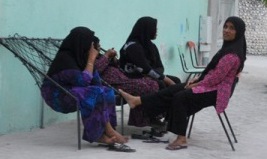
“Special affirmative actions are needed to create more employment and livelihood opportunities for women and to increase the number of women in public and political life,” stated the report.

Despite the Maldives achieving the Millennium Development Goal target to eradicate extreme poverty and hunger, malnutrition and anemia are still limiting women’s equality, equity and empowerment, noted the study.

“Poor nutritional status and anemia are significantly high among pregnant women and women of reproductive age, [which] puts them in high risk for maternal mortality,” the report found. “Malnutrition among women puts them in high risk during pregnancy and hinders their full participation in education, employment and social activities.”

Women – and young women’s – health is also at risk due to the lack of access to quality services, particularly in regard to sexual and reproductive health.

“With regard to reproductive rights, men often control decisions regarding women’s reproductive health, often based on religious and cultural grounds,” the report noted.

“[Furthermore,] the sudden growth of religious fundamentalism and conservative thinking is an emerging challenge, particularly for women and young girls,” the study stated. “There have been increase towards certain trends such as preference for home schooling and refusing vaccination and other medical services for women based on religious beliefs.”

Violence against women

Despite the extensive provisions in the Domestic Violence act, it has done little to curb the abuse of women, minors and other vulnerable people; the police, the judiciary and wider Maldivian society have made minimal progress addressing domestic violence and abuse, former Gender Minister and Chairperson the Hope for Women NGO, Aneesa Ahmed, recently told Minivan News.

Meanwhile, support for women’s equality has experienced a “significant drop” despite overall progress in improving the human rights situation nationally, a Human Rights Commission of the Maldives (HRCM) second baseline survey recently concluded.

“Despite the freedoms that the constitution has provided for women, attitudes towards women’s empowerment show a negative trend,” stated Andrew Cox, the former UN Resident Coordinator and UNDP representative in the Maldives.

“Alarmingly, the study also suggests that there has been a regression in people’s sensitivity towards domestic violence and gender based violence,” he added.

Male attitudes have become “more conservative” regarding women’s rights issues, whereas female views have become more supportive of rights in some areas, the report stated.

In a reversal from the 2005 human rights study, more women than men now consider it inappropriate for men to hit their wives. However, significant numbers of respondents stated where there was a “substantive justification” – as opposed to something trivial – “violence against wives was justified,” the report determined.

Both genders in the Maldives were also found to believe that in the husband/wife relationship, women should play a “subordinate role”.

In spite of this culturally conservative shift regarding women’s rights, an “overwhelming” 92 percent ofMaldivians believe that laws and systems to protect women from sexual assault should be reformed, according to the results of a survey conducted by Asia Research Partners and social activism website Avaaz.org.
Of those polled, 62 percent supported an outright moratorium on the practice of flogging, while 73 percent declared existing punishments for sexual crimes were unfair to women.

The international community has echoed this sentiment, particularly in regard to the recent
case in which a 15 year-old rape victim was sentenced to 100 lashes and eight months’ house arrest for a separate offence of fornication garnered substantial international attention and condemnation.

In March, an Avaaz petition calling for the repeal of the sentence and a moratorium on flogging in the Maldives collected more than two million signatures – a figure more than double the number of tourists who visit the country annually.

Currently, British couples are being asked to avoid the Maldives as a honeymoon destination to force the country’s government to overturn the conviction of the girl, who was given the draconian sentence after being raped by her stepfather, while UK Prime Minister David Cameron has been asked to intervene in the case, writes Jane Merrick for the UK’s Independent newspaper.

Maldivian Democratic Party (MDP) MP Eva Abdulla explained the current context of women’s rights in the Maldives to the publication.

“Consider the statistics on flogging: that 90 per cent of the cases are women. Consider the statistics on rape charges: 0 per cent success rate of prosecution, with the latest being the release of four men accused of raping a 16-year-old, on the grounds that there wasn’t enough evidence,” said Abdulla.

“The increasing religious fundamentalism followed by the attempts to subjugate women, both politically and otherwise, should be cause for alarm. This is a country of traditionally very strong women.

“However, increasingly, the Adhaalath Party, a self-claimed religious party which is in alliance with the current government, uses the religious card to scare off women. We women MPs are often threatened whenever we speak against the party,” she added.

Likes(3)Dislikes(0)

Two suspects charged with defrauding MVR18 million from Sheesha Brothers’ account deny charges

Three of the seven suspects charged in a case involving the fraudulent transfer of MVR 18 million from a State Bank of India account owned by the owners of Sheesha Motor Company, have denied charges against them.

Maldives National Defence Force (MNDF) Retired Colonel Shakath Ibrahim, Ali Ashraf of Rasmaadhoo in Raa Atoll and Mohamed Musthafa of Lhaimagu in Lhaviyani Atoll denied charges in court today, while the other hearings have yet to be held.

According to local media, the court was unable to hand over summons two persons charged with the case as they were not in the country.

On November 24, 2011, the Sheesha owners discovered that several unauthorised transfers had been made from their joint personal savings account to an unidentified recipient.

Following the Sheesha brothers’ – Ahmed Hassan Manik, Hussain Husham and Ibrahim Husham – discovery, they told local media the SBI transfer had been made to a Bank of Maldives account with a forged document faxed to SBI with Manik’s name and signature. The brothers said they would sue SBI and requested the bank take full responsibility for the theft.

In November 2011, Hussain Husham told local media that the total amount of MVR 18 million was taken in two transactions.

The first transaction was made on November 9, 2011, with the amount of MVR 8.5 million (US$551,000) withdrawn. On December 20, the culprits withdrew an additional MVR 9.5 million (US$616,000) from the Sheesha brothers’ account.

Likes(0)Dislikes(0)