MDP launches youth policy: ‘Entertainment without fear’

The Maldivian Democratic Party (MDP) on Friday launched its youth, sports and entertainment policy, dubbed ‘Majaa Kurun Birakaa Nula’: ‘entertainment without fear’.

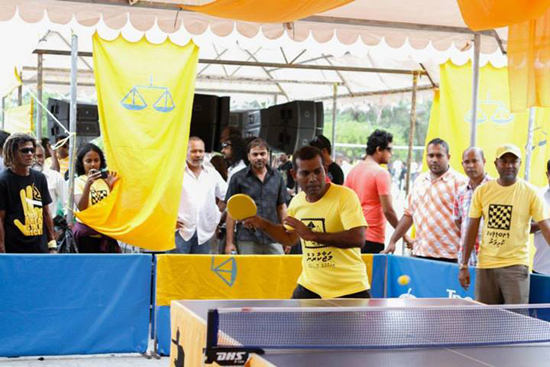
Despite the wet weather, the party’s presidential candidate Mohamed Nasheed along with senior party members and hundreds of supporters gathered at the Raalhugandu area Male in yellow athletic attire.

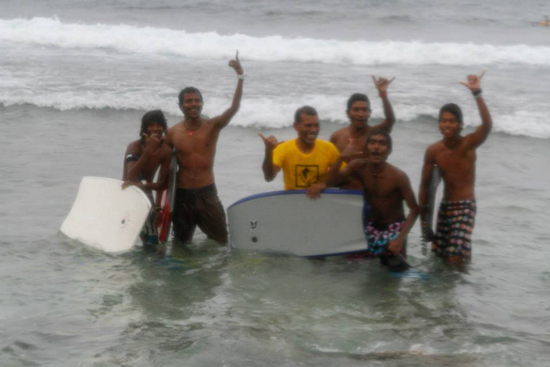
Senior party members followed Nasheed’s lead in taking part in several sport activities organised in the area, including futsal, volleyball, table tennis, baton racing and bodyboarding.

Speaking at the function to inaugurate the policy, the former President promised more sports facilities and technical assistance for athletes in a future MDP-led government, while also promising that during his five year term the government would facilitate more public participation in sports.

According to Nasheed, the policy also includes the renovation and maintenance of football grounds in the Maldives.

Young people represent a potential election-swinging demographic in the September 7 Presidential Election. With 65 percent of the population were already aged under 30 at the time of the 2006 census, the number of eligible voters have 15 percent since 2008’s presidential election. The MDP has traditionally enjoyed strong support from young people, although prior to its February 7 ousting was challenged by rising political apathy among younger voters.
“We need to put our efforts into empowering the young people of this country. If we isolate them and let them fall apart, there is no way we can bring about much needed development of the country,” Nasheed said at the policy launch, promising “renewed-hope” for the young generation: “This is not simply a sports policy, it is also an entertainment policy.”

The MDP’s entertainment election promises include developing 40 turf stadiums throughout the country, development of high standard stadiums with modern-day training facilities, netball courts and courts for ‘Bashi’ – a traditional sport played by many women – across 60 islands.

“We will also develop the current national sports building as an ‘associations’ house’. In this Associations House, local sports associations will be given space to set up their administrative offices, while accommodation and boarding facilities will also be developed for international athletes and teams who visit the country,” he said.

Nasheed – who heads the country’s single largest political party both in terms of membership and parliamentary representation – also announced the development of a ‘sports resort’ – a sports-themed holiday resort specially designed to host famous international football clubs and other sports personalities who wish spend their off-season vacation in the country.

The said resort, Nasheed promised, would have quality in-house training facilities, practice grounds and gymnasiums for such teams.

Other plans include investment in youth development and skills development under the guidance of a National Sports Institute, and the establishment of a sports school.

“We will open the opportunity to develop a sports school through public-private partnership (PPP). We would also establish a special pension scheme for athletes who represent the country abroad as part of their retirement support,” Nasheed promised.

Responding to sarcastic remarks over the policy from his political opponents, Nasheed assured young people that the Special Operations (SO) officers of the police – known for their rough handling of MDP protests – would not be allowed to barge in and “ruin the fun”.

“Young people will decide what songs they wish to dance to,” Nasheed told the ecstatic young crowd.
Nasheed “a monster”, MDP “promoting homosexuality”: rival parties

The announcement of the MDP’s youth policy fueled harsh criticism from Nasheed’s opponents. Government-aligned parties currently backing the government of President Mohamed Waheed Hassan were quick to launch attacks on the policy.

While addressing a small campaign rally, the business tycoon and presidential hopeful Gasim Ibrahim – who also heads the Jumhoree Party (JP) – described Nasheed as a “monster” who had gone “crazy” with his “crazy talks to fool the people”.

Dismissing the MDP’s youth policy, Gasim challenged Nasheed’s academic qualifications and described him a ‘Jaahil’ (ignorant) who could not read the cover of the constitution.

“He doesn’t understand what the law says, so a crazy person like him may say that he would give the opportunity for people to limitlessly entertain themselves. Look, it is not something Allah has given us human beings,” Gasim said.

The business tycoon – who finished the last presidential election in fourth place – claimed Nasheed had done every “despicable act ever to be found in the world”.

“He thinks we, the people, are fools to believe such rubbish. Actually, he seriously may think that we are fools. He has now got the mindset of a monster,” said the resort owner.

Former Spokesperson for President Waheed and current spokesperson for his Gaumee Ithihaad Party (GIP), Abbas Adil Riza, joined Gasim in denouncing the policy but had a different interpretation.

Speaking on the government-aligned television station DhiTV, Riza alleged the MDP was trying to “promote illicit activities such as homosexuality and sodomy” under the façade of its youth policy.

The current state minister of finance – who formally worked with the MDP but left after failing to win a party ticket to contest in 2009 parliamentary elections – said Maldivians had long been having “fun without fear” and claimed MDP re-emphasising the concept could be interpreted as pledging to “facilitate such devious acts”.

Meanwhile, the Progressive Party of Maldives (PPM) – headed by Maldives’ former autocratic ruler Maumoon Abdul Gayoom – claimed the youth policy was a tactic by the MDP to “win the votes of 15,000 or so drug addicts”.

PPM Spokesperson MP Ahmed Mahloof told local media authorities should take serious concern over what Nasheed was planning to do should he come to power.

“Our society is facing huge problems due to narcotic abuse, and then Nasheed comes out and says that in his government the young people can ‘enjoy without fear’,” Mahloof said.

He also said that policies such as ‘entertainment without fear’ gave the impression the party was trying to promote drugs and substance abuse.

“That is why we need to seriously think what type of entertainment or enjoyment they are allowing in the country,” he said.

Mahloof promised that his party would provide “better solutions” for youth.

Enjoy responsibly

Responding to the criticism, former Minister of Youth and Sports during Nasheed’s presidency, Hassan Latheef, told Minivan News that MDP’s policy did not promote breaking laws and anti-Islamic behavior.

“Maybe for Abbas Adil Riza having fun is simply a group of men getting together for a dance wearing excessively thin white sarongs. We are saying that entertainment can be carried out within the boundaries of the law and Islam. We are not promoting drug abuse or homosexuality at all,” Latheef said.

He explained that a seven year old who goes to play with others among their age and interacts with society produces better results at school than a boy who is not allowed to go out but is given video games at home.

Latheef said young people were subjected to derogatory treatment by police simply because of their appearance, and that the MDP was trying to remove the fear that had been cast upon youth during the 30 year reign of Gayoom.

“Like the President said, we will not let the police ruin the fun for young people. We will not let the young people be discriminated against like that. What we are saying is that the government should facilitate development and entertainment for young people,” he added. “This is a solution to a lot of problems we now face in the society.”

“Entertainment without fear does not mean letting our kids smoke or allow them to take drugs. It is simply freeing them from fear, and that doesn’t mean we are giving them the chance to break the law,” he added.

Despite the criticism, the policy has received strong support across social media networks such as Twitter and Facebook, with the hash tags #BirakaNula and #Majakurun associated with the title of the policy quickly gaining popularity among the Maldivian twitter community.

Likes(0)Dislikes(0)

MP Abdulla Abdul Raheem quits Jumhoree Party

Government-aligned Jumhoree Party (JP) MP Abdulla Abdul Raheem has announced that he has left the party after having a falling out with the party’s leader and presidential candidate, Gasim Ibrahim.

The Maafannu-West MP, who switched parties twice last year, left the Dhivehi Rayyithunge Party (DRP) to join JP in June 2012.

Raheem at the time claimed that he had been restricted from speaking in the parliament floor after going against the party’s official whip line.

Raheem was originally elected to parliament in 2009 under the ticket of DRP, but later left the party in May 2011 to join then ruling Maldivian Democratic Party (MDP), following the footsteps of former DRP MPs Ali Waheed and Alhan Fahmy.

However, he left the MDP to rejoin the DRP again shortly after the fall of former President Mohamed Nasheed’s government claiming that his views did not match those of the MDP leadership.  He again switched parties a month later and joined the JP.

Explaining his reasons to quit the party led by business tycoon Gasim, Raheem said that he was forced to leave the party because Gasim “did not know how to talk politics” and that he was attempting to “defame other political leaders”.

Referring to the speech given by Gasim during campaign rally at Vaavu Atoll last Friday evening, Raheem said that such hate speeches would only lower the support that Gasim had among the public.

Gasim during the rally described Nasheed as a “monster” who had gone “crazy” with his “crazy talks to fool the people” while dismissing the MDP’s new youth policy.

The Jumhoree Party (JP) leader went onto challenge Nasheed’s academic qualifications and described him a ‘Jaahil’ (ignorant) who could not read the cover of the constitution.

“He doesn’t understand what the law says, so a crazy person like him may say that he would give the opportunity for people to limitlessly entertain themselves. Look, it is not something Allah has given us human beings,” Gasim said.

The business tycoon – who finished the last presidential election in fourth place – claimed Nasheed had done every “despicable act ever to be found in the world”.

“He thinks we, the people, are fools to believe such rubbish. Actually, he seriously may think that we are fools. He has now got the mindset of a monster,” said the resort owner.

Speaking to local newspaper Haveeru, Raheem said that making “irresponsible statements while being emotionally charged would not be accepted by the people”.

Raheem added that he had sent letters to both the Elections Commission and the JP office informing his decision to quit the party. He also said that he would join a party after all the presidential candidates announce their running mates.

Likes(0)Dislikes(0)

Court sentences chief suspect in Afrasheem murder case to three years for drug offence

The Criminal Court has sentenced Hussain Humam, the chief suspect charged with the murder of MP Dr Afrasheem Ali, to three years in prison after finding him guilty of a drug offence.

The Criminal Court ruling stated that on July 14, 2012, police arrested Humam while he was under the influence of an illegal substance and tested his urine which showed that he had used cannabis.

Moreover, during the trial Humam confessed that he was under the influence of an illegal substance, the ruling stated.

Including this ruling, Humam will now have a total of 10 years in prison while the Afrasheem murder trial continues.

In March this year the Criminal Court sentenced Humam to six years in another drug related case and also gave him an additional year after finding him guilty of objection to order, as he refused to give urine sample during police investigations into the drug case.

Humam has previously confessed in court that he murdered Dr Afrasheem, but later had changed his testimony and denied all charges claiming that he had confessed only after police threatened him to do so while in custody.

In Humam’s alleged statement produced by police during the Afrasheem hearing he claimed the idea of killing Dr Afrasheem was given to him by Maldives National Defence Force (MNDF) officer Azleef Rauf, whom he met at a baibalaa tournament held in 2012.

The pair later met in person again at a coffee, according to the statement, along with two other individuals the statement identified as Abdulla ‘Jaa’ Javid (son-in-law of opposition Maldivian Democratic Party (MDP) Chairperson ‘Reeko’ Moosa Manik) and his brother ‘Jana’.

According to the prosecutor’s statement, Humam was promised a sum of MVR 4 million (US$260,000) for murdering the religious scholar. The statement said Humam later asked Azleef Rauf why Afrasheem was to be murdered, and was told that one of the reasons were Afrasheem’s remarks during the day former President Mohamed Nasheed controversially resigned.

State prosecutors accused Humam, along with Ali Shan – who is also facing the same charges – and a minor identified as ‘Nangi’, of going to the residence of Dr Afrasheem and murdering him with a machete and a bayonet knife.

Dr Afrasheem was a well-known religious scholar and the MP for Ungoofaaru constituency. He was stabbed to death on the night of October 1, on the staircase of his home.

Likes(0)Dislikes(0)

‘Real’ Maldives “tarnished by gang violence, drug addiction, unemployment, political corruption, religious extremism”: The National

Ahmed fears for the life of the Maldives’ first democratically elected president and well-known environmental campaigner, who is now fighting for re-election a year after a violent uprising forced him from power. And Ahmed should know – he says he was once offered the contract to carry out his assassination, writes Eric Randolph for the UAE’s publication The National.

Picture the Maldives, and you’re probably imagining crystalline waters and perfectly groomed white beaches. Yet outside the five-star resorts, real life is very different and the image of an idyllic paradise has been tarnished by the growing problems of gang violence, drug addiction, unemployment, political corruption and religious extremism.

Having been one of the most notorious members of one of the country’s most feared gangs, Ahmed (not his real name) knows this side of the Maldives all too well. We meet in the cramped one-bedroom “apartment” he shares with his parents and two siblings. Apartment is a stretch – it’s a small room down a dingy ground-floor corridor, walls painted a lurid green, with an extended bunk bed that somehow accommodates all five of them and takes up most of the space.

In 2006, a leading politician allegedly offered Ahmed a contract to kill “or severely injure” Mohamed Nasheed, the man who was trying to bring down the 30-year authoritarian rule of Maumoon Gayoom. Local politicians and elites had been using the gangs to run their drug and alcohol operations on the streets for several years by this point. Street fights over territory and girls were leading to nine or 10 deaths a year.

Ahmed won’t talk about the violence in his past, though at one stage he draws me a picture of the knives he used to carry at all times (guns, mercifully, have yet to make it to Maldives). “This is my favourite,” he says, pointing at a serrated blade that looks like a Christmas tree in his sketch.

Read more

Likes(2)Dislikes(0)

“Appalling state of women’s rights” threatens Maldives’ reputation as honeymoon destination: Independent

[UK Prime Minister] David Cameron faces calls to intervene in the case of a 15-year-old female rape victim sentenced to 100 lashes in the Maldives as new figures showed the appalling state of women’s rights in the Commonwealth country, writes Jane Merrick for the UK’s Independent newspaper.

British couples are being asked to avoid the Maldives as a honeymoon destination to force the country’s government to overturn the conviction of the girl, who was given the draconian sentence after being raped by her stepfather.

Many of the 500,000 tourists who holiday on the “paradise” islands every year are unaware of the country’s appalling record on women’s rights, with not one single conviction for rape in the past three years.

The Maldivian government’s own figures show that 90 per cent of people sentenced to flogging are female, while one in three women between the ages of 15 and 49 have suffered physical or sexual abuse over the past five years.

A new poll of Maldivians for the global campaign group Avaaz reveals that 92 per cent of people think laws to protect girls and women from sexual assault should be reformed, while 79 per cent think current systems are not adequate or fair. The Asia Research partners poll also reveals that 73 per cent think punishments for sexual crimes are unfair to women, while 62 per cent want a reintroduction of the moratorium on flogging.

Read more

Likes(0)Dislikes(0)

Sea House restaurant to host free jazz concert on July 8

The Sea House restaurant in Male’ is set to host a free jazz concert tomorrow ( July 8 ) in collaboration with Alliance Française Maldives (AFM).

The concert, which begins at 9:00pm, will feature classic jazz saxophonist Jean-Pierre Baraglioli and tabla player Peshala Manoj.

AFM, an NGO providing French language courses and other cultural events in the Maldives since 2009, last month hosted an evening of free musical performances by Maldivian and French artists at Male’ City Hall as part of its annual Fête de la Musique celebrations.

Likes(0)Dislikes(0)

President’s Office announces Ramadan working hours

The President’s Office has announced that its official working hours during Ramadan will be between 9:00am to 1:30pm.

The reduced working hours, which will come into effect for the Islamic holy month, are the same as those adopted in previous years, according to the President’s Office website.

Likes(2)Dislikes(0)

PPM pledges harsher punishments for assaulting police, ‘obstructing police duty’

Punishments for obstructing police duty and assaulting police officers will be made harsher under a Progressive Party of Maldives (PPM) administration, according to PPM vice presidential candidate and former Home Minister Mohamed Jameel Ahmed, reports local media.

Jameel noted that punishments for those who call for attacking police will be made harsher by amending the Penal Code as part of PPM’s policy for maintaining peace and security.

He pledged that a PPM government would try and ‘wrap up’ all criminal investigations and send them for prosecution within a month, as well as make “major changes” to investigative mechanisms.

“At the end of the party’s first five-year period, mechanisms will be set up to facilitate for prosecution to proceed within 24 hours,” said Jameel.

Surveillance mechanisms will be installed “across the whole Maldives” as well as “state-of-the-art forensic facilities”, he added.

Likes(2)Dislikes(1)

Maldives being used as a transit point by illegal recruiters: Philippines

The Philippines’ Bureau of Immigration has declared it is tightening monitoring of Filipino nationals traveling to the Maldives, over fears the country is being used as a transit point for labour trafficking of its citizens.

The government of the Philippines, which depends heavily on remitted income from its massive expatriate workforce, restricts its nationals from working in countries with a record of poor treatment of low-wage foreign workers, such as Lebanon and Jordan.

However the Bureau’s Immigration Minister Ricardo David Jr issued a statement revealing traffickers were circumventing this restriction by obtaining ‘legitimate’ employment papers for workers in Dubai and the Maldives, and routing workers to restricted countries through these destinations.

David revealed 17 Filipino workers were victimised in such a fashion by illegal recruitment agencies in June, noting that none of the workers had employment contracts and had instead only been ‘promised’ salaries of US$300-$1500 a month once they reach their destination.

The Maldives is recognised as a destination country for labour trafficking, and to a lesser extent, sex trafficking. Various reports into the practice have identified key appeals to traffickers in the form of poor oversight and monitoring of work permit requests, and a near-total lack of enforcement or investigation of traffickers in favour of swiftly deporting victims – many of whom go into substantial debt paying bogus ‘recruitment fees’ of up to US$4000.

However the statement from the Philippines suggests the country’s lack of oversight of foreign worker employment is also being exploited by traffickers to transit victims.

Domestically, “Recruitment agents in source countries collude with employers and agents in Maldives to facilitate fraudulent recruitment and forced labor of migrant workers”, read a recent report from the US State Department’s human trafficking monitoring office.

Despite widespread acknowledgement of the practice and the government’s submission of a draft anti-trafficking bill to parliament in December 2012, the Maldives still has no specific laws prohibiting human trafficking and “the government of the Maldives made minimal anti-trafficking enforcement efforts during the year.”

While forced labour was prohibited under the 2009 Employment Act, it was not penalised, the report noted.

“The government reported investigating four and prosecuting two sex trafficking cases in 2012, compared to no prosecutions recorded in 2011,” the report stated.

However “the government did not report any prosecutions of government employees for alleged complicity in trafficking-related offenses [and] the absence of government translators prevented foreign trafficking victims from pursuing recourse through the Maldivian legal system.”

The Maldives was placed on the US State Department’s Tier Two Watch List for Human Trafficking for the fourth consecutive year, and faces mandatory downgrading to Tier 3 next year along with Afghanistan, Barbados, Chad, Malaysia, Thailand unless it addresses the problem.

Tier 3 countries are defined by the State Department as those which “neither satisfy the minimum standards for the elimination of trafficking nor demonstrate a significant effort to do so”, and are open to non-humanitarian and non-trade international sanctions.

Likes(0)Dislikes(0)