Interschool theatre festival demonstrates youth awareness of human rights issues

No additional reporting by missing journalist Ahmed Rilwan

The Interschool Human Rights Theatre Festival exhibits the high level of awareness amongst primary and secondary school pupils on different human rights issues.

The three day festival organised by the Human Rights Commission of the Maldives (HRCM) ran from September 25-27 and saw creative and extensive theatre pieces from seven schools alongside six short but thought-provoking skits by a group of volunteers from the HRCM.

Of the seven schools participating, four schools were from the capital Malé and the remaining three schools from the atolls.

All seven theatre pieces by the schools – two of which were recordings from two schools from the atolls – showed creativity in presenting different human rights issues, with different schools opting for different forms of theatre.

The winning entry featured children from Jalaaluhdheen School – in Haa Dhaalu Kulhudhuhfushi – using a traditional and effective form of theatre in which all of the scenes were presented at the same time to show human rights violations towards migrant workers.

Well laid out scenes brought to life the many situations in which migrant worker rights are violated. Unsafe working conditions, disrespectful customers at a restaurant, and a classroom scenario where the students verbally abused the foreign teacher convinced the judges to select the Jalaaluhdheen piece as the outstanding entry.

Pieces from the other schools focused on disabled people’s rights, with the runner-up entry from the Galolhu Madharsaa exhibiting a well-coordinated piece with excellent visuals, audio, before concluding with a beautiful message.

Skits by the volunteers were based on elderly people’s rights, women’s rights, and children’s rights.

While speaking to Minivan News, HRCM Vice President Ahmed Tholal said that the aim of the festival was for the students to gain a deeper understanding of human rights by actively taking part in the theatre pieces.

“We want to encourage a more creative approach to human rights compared to learning about human rights only through reading or listening material”.

The winning piece suggested the festival had been a success, with excellent awareness shown by the students of the rights of migrant workers, who are believed to amount to more than a hundred and fifty thousand individuals. It also illustrated that violations do not only occur at labor level jobs but also in blue collar posts.

The festival is also noteworthy in its high level of participation of students with special education needs such as participation from Jamaaluhdheen’ class for hearing impaired children (CHIC) and Thulhaadhoo’s Special Educational Needs class, from Baa Atoll.

The children performed on the same platform, and were judged against the same criteria, as the other schools.

The festival which was the first of its kind organised by HRCM was funded by UNICEF with collaboration with Ministry of Education. Additional sponsorship was received from Bandos Island Resort and Muni home care.

Tholal also highlighted other awareness projects which are aimed at school children such as the creation of human rights clubs within the schools and the the recent human rights defender training held at Girifushi to enable youth to facilitate sessions in collaboration with these clubs.

Likes(2)Dislikes(0)

Maldives backtracking on democracy, warns MP Imthiyaz Fahmy

No additional reporting by missing journalist Ahmed Rilwan

The Maldives is facing an authoritarian reversal with a corrupt judiciary, impunity for human rights abuses, and growing religious extremism, opposition Maldivian Democratic Party (MDP) MP Imthiyaz Fahmy has warned.

In a lecture titled ‘The Maldives backtracking on democracy: human rights violations, impunity, and increasing religious extremism’ delivered last Friday (September 26) at the University of Western Australia in Perth – organised by the Centre for Muslim States and Societies – Imthiyaz stressed that the country’s problems “have nothing to do with Islam.”

“But our fear is that authorities are using few extremist individuals for their short-term political gain. This gives these few extremists a voice and influence in politics that they don’t deserve,” he explained.

“Our fear is that the lack of actions by the authorities against these few individuals could increase their influence in the society. This can be one of the biggest long-term challenges to our hopes for democracy.”

While “pundits and some ill-informed Western policy makers conclude that Islamic civilisation is in a clash with Western civilisation,” Imthiyaz argued that the “actions of a few extremists” did not warrant concluding that Islam was not compatible with democracy.

“Extremism of these individuals is not only incompatible with democracy, but most importantly for Muslims like Maldivians, Islam is not compatible with extremism,” he said.

Referring to reports of Maldivian jihadists fighting in Syria, Imthiyaz stressed that the vast majority of Maldivians were peaceful and remained “committed to the moderate values of Islam.”

Transitional justice and impunity

The turning point for the Maldives journey to democracy was the custodial death of Evan Naseem in Maafushi jail and subsequent prison shootings in September 2003, Imthiyaz observed.

Prior to the first multi-party democratic election in October 2008 following the adoption of a revised liberal constitution, Imthiyaz said the country was “ruled with an iron fist” by former President Maumoon Abdul Gayoom, whose 30-year reign was characterised by oppression, censorship, and torture.

The judiciary used to be the instrument which endorsed all those human rights violations and injustices that took place in the country,” he contended.

The Maldives became a forerunner to the Arab Spring, Imthiyaz continued, with the defeat of the “Egyptian-like dictatorship” in the October 2008 presidential election.

The challenges faced by the first democratically-elected government included the absence of a “transitional justice mechanism” to address human rights violations of the past, an unreformed judiciary, and incompatibility of coalitions with a presidential system, he explained.

Consequently, the MDP government was toppled in a “coup d’etat” on February 7, 2012 when former President Mohamed Nasheed was “forced to resign by mutinying police and army generals backed by politicians associated with the former dictatorship.”

Imthiyaz noted the police brutality in the aftermath of the transfer of power, particularly the heavy-handed crackdown on an MDP protest march on February 8, 2012.

He also referred to Amnesty International warning that “any attempt at political reconciliation in the Maldives would be meaningless” without accountability for human rights abuses.

Imthiyaz added that hundreds of MDP members as well as leaders were facing “selective prosecution” by the state.

Despite numerous calls by the Inter Parliamentary Union (IPU) for the government to investigate arbitrary arrests, attacks and harassment of MDP MPs, Imthiyaz said “the perpetrators have been enjoying complete impunity.”

He also observed that the Supreme Court’s repeated interference in last year’s presidential polls was criticised by the UN, the European Union, and the Commonwealth.

While the apex court dismissed the chair and deputy chair of the Elections Commission less than two weeks before the parliamentary elections in March, Imthiyaz noted that the court is currently conducting suo moto proceedings against members of the Human Rights Commission of Maldives.

Referring to the UN Special Rapporteur on the Independence of Judges and Lawyers questioning the court’s independence and impartiality, Imthiyaz said the Supreme Court was widely perceived as “as an instrument of partisan revenge than as a forum for impartial justice.”

Threats to MPs

The “growing threat” to MPs was another challenge for democracy, Imthiyaz continued, referring to the brutal murder of MP Afrasheem Ali – which police investigated in a “politicised” manner – and the stabbing of former MDP MP Alhan Fahmy.

Death threat messages have been pouring on MDP MPs mobile phones. Yet the authorities do not seem to care at all,” he said.

The IPU has said that the government’s reaction would be “a test of the country’s democratic credentials.”

Imthiyaz noted that the Maldives dropped to 108th place in the RSF Press Freedom Index for 2014.

While the perpetrators behind the arson attack on Raajje TV last year have not been prosecuted, Imthiyaz said police have not conducted “a proper investigation” into the disappearance of Minivan News journalist Ahmed Rilwan and were “unable to establish whether they are now investigating a missing person case, or an abduction case or a murder case.”

Likes(1)Dislikes(0)

Government uses gangs for its ends, alleges former President Nashed

The government is unable to stop gang activities because it employs gangs for its purposes, former President Mohamed Nasheed has alleged.

Speaking to reporters yesterday prior to departing for the UK to attend the Conservative Party conference, the opposition Maldivian Democratic Party (MDP) leader said the government had the power and resources to clamp down on gangs, but was unable to do so because senior officials have used gangs.

“I am not necessarily saying that senior government ministers used gangs to make [missing Minivan News journalist Ahmed] Rilwan disappear or torch the MDP [office] or sent [death threats via] texts,” Nasheed explained.

“But senior government officials are using gangs for many other things.”

Nasheed’s remarks came after the main opposition party’s office was set on fire Thursday night (September 25) following two consecutive nights of vandalism and numerous death threats sent to the party’s MPs as well as journalists.

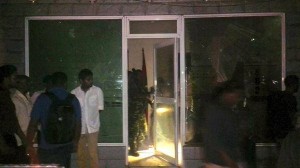
Earlier on Thursday, a machete knife was buried in the door of the Minivan News building after a known gangster – clearly identifiable on CCTV footage – removed the security camera.

Several journalist were also sent a text message warning them not to cover “the incidents happening in Malé now.”

“This is a war between the laadheenee [secular or irreligious] MDP mob and religious people. We advise the media not to come in the middle of this. We won’t hesitate to kill you,” read the threat.

Radicalised gangs

Nasheed meanwhile suggested that radicalised gangs were behind the recent “atrocities” in the capital, noting that extremist religious indoctrination of youth was a relatively recent phenomenon in the Maldives.

“In my view, one of the most important reasons the government has to think deeply about this is because certain people are instilling their interpretation of Islam in the hearts of the boys in these gangs,” he contended.

The opposition leader claimed that many young men from criminal gangs were seen in a protest march held in Malé on September 5 with participants bearing the militant organisation Islamic State (IS) flag and calling for the implementation of Islamic Sharia.

Of the approximately 150 participants, Nasheed claimed most were “active in gangs.”

“So youth in gangs are turning to ISIS [Islamic State of Iraq and Syria] ideology. That activities of ISIS are happening in the Maldives is becoming very clear to us. And while this is happening, the government is unable to stop gang activities,” he said.

The government’s inaction posed a serious danger to the security of the country, he added.

A Facebook page called Islamic State in Maldives promoting IS in the country was discovered last month, which shared photos of protests calling for a ban on Israeli tourists where protesters carried the IS flag.

Moreover, a new site called Haqqu and Twitter account sprang up recently featuring IS-related news and publications in Dhivehi as well as translations of a sermon by self-proclaimed Caliph Abu Bakr al-Baghdadi.

The site was most recently updated this morning with the news of a Saudi Arabian pilot who allegedly refused to participate in military operations against IS.

Extremism in police and military

Nasheed also reiterated his claim that there were IS supporters or sympathisers in the police and military.

Earlier this month, Nasheed told the Independent newspaper in the UK that the vast majority of Maldivians fighting in Syria and Iraq were ex-military.

“Radical Islam is getting very, very strong in the Maldives. Their strength in the military and in the police is very significant. They have people in strategic positions within both,” he alleged.

Following the MDP’s claim in May that extremist ideologies were prevalent in the security services, the defence ministry dismissed the allegations as both “baseless and untrue” and intended to “discredit and disparage” the military.

The Maldives Police Service (MPS) meanwhile issued a press release on September 18 condemning Nasheed’s allegations.

While police estimated that about 24 persons with links to militant jihadist organisations might be active in the Maldives, MPS insisted that none of them were police officers.

“And the police leadership has always been working to ensure that such people are not formed within the police,” the statement read.

Meanwhile, asked about the party’s response to attacks on its office, Nasheed said ensuring safety and security of all Maldivian citizens was the responsibility of the state.

“The MDP could form its own militia or paramilitary, but that’s not the path we want for the Maldives. If we are forced to protect and defend ourselves, we have reached a very tragic state,” he said.

Likes(0)Dislikes(0)

Foreign ministry, US embassy, international organisations condemn attack on Minivan News

The Ministry of Foreign Affairs, the US embassy in Colombo, and international press freedom organisations have issued statements condemning the attack on the Minivan News office.

A machete knife was buried in the door of the Minivan News building on Thursday afternoon (September 25) after a known gangster removed the CCTV security camera outside the premises.

Expressing “deep concern” with the increasing intimidation and threats faced by journalists, Foreign Minister Dunya Maumoon “noted that the government remains strongly committed to create an environment that gives protection to media personnel to exercise their duties freely and responsibly.”

“Media freedom and freedom expression are fundamental human rights guaranteed under the Constitution of the Maldives and the human rights instruments that the Maldives is party to,” read the foreign ministry statement.

“At the ongoing Human Rights Council Session in Geneva the Maldives co-sponsored the resolution calling for the safety of journalist.”

The US embassy also expressed concern “about the recent attacks on media and political offices in Malé as well as continuing threats to media personnel.”

“Peaceful freedom of expression is a fundamental democratic right, and we strongly condemn these acts. The embassy notes the prompt Maldivian Police Service action to launch an investigation, urges the authorities to bring to justice the perpetrators, and calls for an end to all intimidation and violence,” the US embassy stated.

Press freedom

Reporters Without Borders (RSF) meanwhile noted that the attack came after an investigative report – commissioned by the Maldivian Democracy Network – on the disappearance of Minivan News journalist Ahmed Rilwan was made public.

“The fact that [Thursday’s] attack on Minivan came three days after the report’s publication is not seen as a coincidence,” RSF stated.

Citing the abduction of several young men in June by a vigilante group in a push to identify online activists advocating secularism or professing atheism, the investigation report found gang activity in Rilwan’s abduction to be a strong possibility.

“Reporters Without Borders condemns this latest attack and calls on the authorities to provide Minivan’s journalists with protection, especially as this is not the first time the website and its staff have been targeted,” the statement read.

Rilwan remains missing after 50 days and is believed to have been abducted.

The International Federation of Journalists (IFJ) also called on the government to conduct a thorough investigation and expressed concern with declining safety for journalists in the Maldives.

“This attack is clearly intended to intimidate an independent news organisation for its editorial line,” said IFJ Asia Pacific Deputy Director Jane Worthington.

“It’s a lame and condemnable attempt that the Maldives government should investigate thoroughly to ensure the perpetrators are punished as soon as possible.”

The IFJs local affiliate, Maldives Journalist Association (MJA), also put out a press release condemning the attack.

“Minivan News is an established and active news organisation, and this attack is a clear attempt to threaten and intimidate journalists in the Maldives. MJA calls upon the authorities to investigate this incident with utmost urgency,” MJA said.

The MJA noted that institutions and mechanisms were in place to investigate complaints regarding the media, noting that “differences [of opinion] with regard to content published by news organisations do not warrant vandalism and intimidation.”

“While establishing an environment where journalists could work freely is a responsibility for all, we call on the relevant authorities of the state to do everything necessary to ensure [press freedom],” the MJA said.

After rising to 51st in 2009, the Maldives dropped to 108th place to pre-2008 levels in the RSF Press Freedom Index for 2014, marking a decline in press freedom for the third consecutive year.

In February 2013, opposition-aligned private broadcaster Raajje TV reporter Ibrahim ‘Asward’ Waheed was nearly beaten to death, while the station’s offices and equipment were destroyed in an arson attack in October.

In June 2012, two men slashed the throat of freelance journalist and blogger Ismail Hilath Rasheed with a box cutter.

Likes(0)Dislikes(0)

MDP office set on fire amid escalating tension

The Maldivian Democratic Party (MDP) office on Sosun Magu in Malé was set on fire around 12:45am last night amid escalating tension in the capital.

The arson attack follows vandalism of the main opposition party’s office for two consecutive nights and numerous death threats sent from unlisted numbers to MDP MPs, senior members and dozens of journalists.

Eyewitnesses told local media that petrol was poured into the ground floor of the office through the smashed up windows before a lit molotov cocktail was hurled inside. A second lit molotov cocktail fell outside the door.

A team from the fire and rescue service of the Maldives National Defence Force (MNDF) arrived shortly after the incident and extinguished the flames. The damage caused by the fire was reported to be minor.

According to the party, the attack came about 15 minutes after staff left the office in Henveiru Sharaasha.

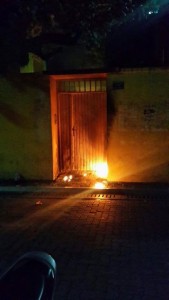
Meanwhile, around 2:15am, the door of former MDP MP Hamid Abdul Ghafoor’s residence was set ablaze. Half an hour later, Hamid received a text warning that he would be stabbed and killed.

The fire was swiftly put out before it could spread. An eyewitness saw a lit molotov cocktail or ‘petrol bomb’ hit the door.

The previous night (September 24), crude oil was thrown on the house of former President Mohamed Nasheed while the opposition leader was at an MDP national council meeting at the nearby Malé City Hall.

The windshield of MDP Chairperson Ali Waheed’s car was smashed with a large rock later the same evening.

Hamid told Minivan News yesterday that attacks against the party’s office and members have been frequent during the past eight years.

“Since 2005, MDP office has been vandalised countless times and each time we get a forensics team doing some investigation but there seems to be no end to these investigations,” the party’s international spokesperson said.

Hamid suggested that the recent spate of attacks might be motivated by Nasheed accusing Adhaalath Party leaders of radicalising and indoctrinating youth to carry out vigilante actions in the name of Islam.

“Don’t do this to our youth. Don’t make them do vile deeds after picking them out individually and leading them astray,” Nasheed appealed at an MDP rally held on Monday night (September 22).

Death threats

In a tweet posted yesterday, Nasheed expressed concern with the evident lack of concern from PPM in response to the repeated vandalism of the MDP office as well as the death threats sent to MPs and senior members.

MDP MP Imthiyaz Fahmy told Minivan News last week that death threats have become too commonplace to publicise each incident.

Following last week’s rally, MDP MP Eva Abdulla received a text message threatening a suicide attack at the next MDP gathering. The message also threatened to “kill off” MDP members and vowed to “fight to the last drop of blood.”

Eva revealed on social media last night that she had received a text threatening to kill the children of MDP members.

“Don’t bring out your children on the streets these days. Stabbing season is about to begin. [We] will kill you,” the message read.

Eva noted that the same message was sent to many MDP members while the “govt looks on”.

Several journalist were also sent a text message warning them not to cover “the incidents happening in Malé now”, which yesterday included an attack on the Minivan News office and SMS threats to a staff member.

“This is a war between the laadheenee [secular or irreligious] MDP mob and religious people. We advise the media not to come in the middle of this. We won’t hesitate to kill you,” read the threat.

The text message was sent to journalists from opposition-aligned private broadcaster Raajje TV, Vaguthu.mv and state broadcaster Television Maldives as well as other news outlets.

Following the vandalism of the party’s office for a second consecutive night, the MDP put out a press statement yesterday criticising the police’s failure to properly investigate the attacks and apprehend the perpetrators.

The statement noted that Wednesday’s nights attacks came after protection was sought from the police.

“This party believes that the attacks against the MDP leadership, administrative staff, and property are an uncivilised atrocity committed to eradicate opposition political ideology,” the party stated.

The party further contended that statements from government ministers and institutions were encouraging the “atrocities” and increase of serious crimes, condemning the government’s inaction and silence in the wake of the attacks.

“The party assures all Maldivian citizens that despite the attacks on the residences and property of the MDP’s senior leaders, the party’s leadership will not back down a single inch and swiftly carry on with our efforts to establish justice and equality in the Maldives, ensure human rights, and strengthen democracy,” the statement read.

Likes(1)Dislikes(0)

President Yameen pledges 24-hours electricity to all inhabited islands during 2015

Reliable electricity for 24 hours will be provided to all inhabited islands during 2015, President Abdulla Yameen pledged at a ceremony held last night to inaugurate the distribution of 77 generators by government utility company Fenaka to the atolls.

In addition to the 77 generators, President Yameen said the Fenaka Corporation has procured 60 generators.

“God willing, all these engines will be commissioned next year and all the equipment needed for the engines and the distribution network has now been brought,” Yameen said.

When distribution of the power generators is complete around mid-2015, President Yameen said electricity for 24 hours would be assured for the entire country “for the first time in Maldivian history”.

Aside from the 170 islands covered by Fenaka, Yameen noted that the State Electricity Company (STELCO) was already providing electricity to other inhabited islands with larger populations.

Assuring electricity service across the country was “not a small accomplishment,” he added, expressing gratitude to the Fenaka management team and CEO Mohamed Nimal.

Fenaka was established in June 2012 by former President Dr Mohamed Waheed after dissolving seven provincial utility companies formed by his predecessor.

The 77 new generators were procured for US$5.9 million from China’s FuJian Yanan Power, including 40 generators of 160 -200 kilowatts, 24 generators of 250-300 kilowatts and 13 of 500 -1000 kilowatts.

Cables required for the project were purchased from Sri Lanka’s Kelani Cables Company for US$33.9 million

A contract for the distributional boxes for the project was awarded to local Power Engineering company for approximately US$ 16.9 million in July.

In July, opposition Maldivian Democratic Party MPs objected to frequent power cuts in their constituencies, including Addu City, Noonu Velidhoo and Laamu Gan.

Yameen meanwhile said efforts were underway to provide electricity services at an affordable price, which includes making arrangements for purchasing oil and generating electricity from renewable sources.

Following a visit by Indian Foreign Minister Salman Kurshid in February, the Indian government pledged to supply petroleum products “on favourable terms.”

Yameen also said state-owned enterprises (SOEs) should be “integrated with the government’s mainframe policy,” which would ensure that government-owned companies cooperate, work towards common goals and implement the Progressive Party of Maldives’ (PPM) manifesto.

The new administration sought to identify “inherent problems” with the government companies and improve interfacing and networking.

While the boardroom would have autonomy to manage the company, Yameen revealed that a group of ministers have been tasked with coordinating among the companies.

Likes(0)Dislikes(0)

Rilwan’s family call on police to follow up on issues highlighted by private investigation

The mother of missing Minivan News journalist Ahmed Rilwan has responded to a private investigation into her son’s disappearance by calling upon police to pursue all lines of inquiry.

“Since the report publicized on September 22, 2014 is independent without the family or any others’ involvement, I call on the Maldives Police Services to investigate the issues highlighted on the report without delay,” said Aminath Easa on behalf of her family.

“I urge the police to ascertain if the individuals named in the report are involved in Rilwan’s disappearance and clear their names. If they are not involved, I urge the police to find those responsible and take immediate action,” read a statement released by the family today.

The report – commissioned by the Maldivian Democracy Network (MDN) – speculated on multiple theories behind the disappearance 47 days ago, concluding a “gang related” abduction to be a “strong possibility”.

Evidence of possible “hostile surveillance” by two known affiliates of Malé based Kuda Henveiru gang was noted in the report, compiled by UK-based private security firm Athena Intelligence and Security.

Police have since condemned the report as “irresponsible” and “politically motivated”, suggesting that the safety and security of individuals named in the report has been compromised .

Police media officials has reported a number of complaints from those implicated in the report since its release, while the MDN’s Shahindha Ismail and the lawyer Mushfique Mohamed have also been subject to online intimidation.

Shahindha defended the report earlier today, noting that the information contained was already in the public domain.

“We have simply acknowledged the elephant in the room. It is questionable now whether the police are too afraid to address it themselves,” said Shahindha.

Rilwan’s mother today expressed gratitude for all organisation and members of the public who have offered assistance in helping find Rilwan.

Easa – aged 67 – has been at the forefront of efforts to publicise the disappearance of her 28-year-old son, leading a march around the capital last Friday (September 19) aimed at publicising a number of questions left outstanding by the police’s investigation

Similar questions were previously raised earlier this month in a petition to the People’s Majlis signed by around 5000 people. The family has yet to receive a response from the Majlis in relation to the petition.

Likes(1)Dislikes(0)

UPR report shared with judiciary before submission, says HRCM at Supreme Court trial

The Human Rights Commission of Maldives (HRCM) shared its Universal Period Review (UPR) report with the Department of Judicial Administration (DJA) and sought feedback ahead of submission to the UN Human Rights Council, the commission’s lawyer told the Supreme Court today.

The DJA – which functions under the direct supervision of the Supreme Court – did not respond to the request for commentary on the report or object to its content, the lawyer noted at the first hearing of the trial.

All five HRCM members are on trial after the apex court initiated suo moto proceedings in relation to the UPR report, which suggested that the Supreme Court’s control over the judiciary was undermining powers of lower courts.

At the beginning of the hearing, Chief Justice Ahmed Faiz Hussain reportedly said that the HRCM’s report contained false and misleading information concerning procedural matters of the judiciary.

The suo moto proceedings – which allows the court to act as both prosecution and judge – were initiated to hold the commission’s members accountable under Article 141 of the Constitution, Article 9 of the Judicature Act, and Supreme Court regulations, the chief justice said.

Article 141(b) states, “The Supreme Court shall be the highest authority for the administration of justice in the Maldives.”

Article 141(c) states, “No officials performing public functions, or any other persons, shall interfere with and influence the functions of the courts,” while section (d) states, “Persons or bodies performing public functions, through legislative and other measures, must assist and protect the courts to ensure the independence, eminence, dignity, impartiality, accessibility and effectiveness of the courts.”

The commission’s attorney Maumoon Hameed explained that each UN member state was required to submit a report for the UPR.

The UPR is a state-driven process that reviews the human rights records of all 193 UN member states every four years, based on submissions by the government, the UN, NGOs and human rights commissions. The Maldives’ review is scheduled to take place in April or May 2015.

In a press release today, the HRCM said it submitted as evidence information regarding the UPR process as well as commentary received from various state institutions.

“At today’s hearing, the commission requested an opportunity to submit further information and evidence,” the press release stated.

“The Supreme Court adjourned today’s hearing. The commission has not yet been informed of a date for the next hearing.”

The next hearing has since been scheduled for 1:30pm on Sunday, September 28.

Noting that Supreme Court decisions could not be challenged as it was the highest court of appeal, Hameed had, however, asked for five working days to prepare a defence.

Control of judiciary

Less than two weeks before the parliamentary polls in March, the Supreme Court had charged Elections Commission Chair Fuwad Thowfeek and Deputy Chair Ahmed Fayaz with contempt of court and dismissed the pair under unprecedented suo moto proceedings.

Subsequent changes to contempt of court regulations made in June authorised courts to penalise individuals for any expression, action, gesture, or piece of writing “inside or outside a courtroom” that could be considered contempt of court.

Meanwhile, in a press statement yesterday, the opposition Maldivian Democratic Party noted that under Article 27 of the HRCM Act a case could only be filed against the commission regarding published reports following an inquiry which proves components of the report to have been false.

In its UPR report, the HRCM stated that the Supreme Court’s control of the judiciary was weakening judicial powers vested in lower courts.

“Supreme Court issued a circular ordering all state institutions not to communicate to individual courts regarding any information relating to the judiciary except through the Supreme Court. HRCM is facing difficulties in gathering information related to judiciary due to lack of cooperation,” the report stated.

Moreover, the report noted that “due to shortfalls in judicial system, functioning of the judiciary is often questionable on various grounds including independence, transparency, interference, influence, competency, consistency, and accessibility.”

Through a raft of regulations enacted in recent months, the Supreme Court has sought to consolidate control over administrative affairs of the judiciary.

In a comprehensive report on the Maldivian judiciary released in May 2013, United Nations Special Rapporteur for the Independence of Judges and Lawyers, Gabriela Knaul, wrote that centralising administrative decisions in the hands of the Supreme Court “has undoubtedly contributed to the strong impression that lower courts are excluded from the administration of justice and decision-making processes.”

The Maldives representative to the UNHRC subsequently accused the special rapporteur of undermining the sovereignty of the country.

Criticism of the Supreme Court’s role in the electoral process by United Nations High Commissioner for Human Rights Navi Pillay last October was meanwhile described as “ill-informed” and “irresponsible” by former President Dr Mohamed Waheed.

Likes(0)Dislikes(0)

Police label MDN investigation “politically motivated”, MDN defends report

The Maldives Police Service has labelled the recently commissioned private investigation into the disappearance of Minivan News journalist Ahmed Rilwan as “irresponsible” and “politically motivated”.

The findings of a Maldivian Democracy Network (MDN) commissioned report by private investigators from the UK were intended to deceive the public, read a police statement yesterday evening.

“That the report publicized profiles of individuals violates their human rights, undermines their dignity, incites hatred against them and poses risks to their security,” said police. “We will investigate the process by which the report was compiled and take action against those involved.”

Responding to the police statement today, the MDN has defended the report and denied it had breached the rights of any individuals or organisations.

“The information in the report  contains what is already in the public domain. We have simply acknowledged the elephant in the room. It is questionable now whether the police are too afraid to address it themselves,” said MDN’s Shahindha Ismail.

Police have argued that the report was “based on baseless information” intended to lead people into thinking Rilwan was abducted.

Rilwan was last seen 46 days ago on the 1am ferry to Hulhumalé shortly before neighbours reported seeing a man forced into a car outside his apartment.

The report concluded that the disappearance is likely to have been an abduction involving local gangs. It named a number of individuals, some of whom have since submitted complaints with police.

Police said today that those named in the report – conducted by UK security firm Athena Intelligence and Security – have reported intimidation since its release. Threats to “disappear” Shahindha and Rilwan’s family’s lawyer Mushfiq Mohamed have also been posted online in the past 24 hours.

Shahindha told Minivan News today that MDN had previously contacted police, offering to bring in outside experts to assist, without receiving any response. She noted that the work commissioned was “in no way a criminal investigation” and was intended to assist rather than obstruct police.

She did, however, question the police’s awareness of the fundamental rights, protected under Article 16 of the Constitution.

“MDN is of the opinion that MPS need further awareness on fundamental rights, constitution and especially the Article 16 of it. MDN is a longstanding organisation which has worked to promote and protect human rights, regardless of whether they are of offenders, and we are well aware of the fact that we have not infringed a fundamental right of an individual or organisation.”

“We are extremely concerned that the MPS is focusing on defending people who have been  alleged been involved in criminal behaviour such as stalking and threatening, rather than looking into these allegations. These are crimes under the Gang Act (17 and 18 / 2010),” she said.

Despite repeated urges from family, friends, and international groups to expedite the investigations, police have yet to offer conclusive theories or evidence explaining the disappearance.

Last week they police noted that no “concrete evidence” could be found between Rilwan and the  reported abduction outside his apartment shortly after his last sighting.

Rilwan’s family – which has been at the forefront to hold authorities accountable for the apparently stalled investigation – is described by police as having been used by certain groups to obtain information regarding its investigation.

“We do not believe such information should be publicized” said Tuesday’s statement, suggesting that its release is avoided by police as it jeopardises peace and order

Police concluded the statement by noting that it’s officers are trained throughout the world – including the US, the UK and Australia – and are capable of investigating the smallest of incident up to larger crimes such as terrorism.

Likes(0)Dislikes(0)