Five police brutality cases from February 2012 ongoing at court, AG tells Majlis

Five cases involving four police officers accused of committing acts of brutality in February 2012 are ongoing at the Criminal Court, Attorney General Mohamed Anil informed parliament today.

At minister’s question time, opposition Maldivian Democratic Party (MDP) MP Eva Abdulla asked how far investigations into police brutality – as recommended by the 2012 Commission of National Inquiry’s (CoNI) – had progressed.

With respect to the administration of justice, in particular concerning allegations of police brutality and acts of intimidation, there is an urgent need for investigations to proceed and to be brought to public knowledge with perpetrators held to account and appropriately sanctioned,” read the second recommendation of the report.

While it concluded that the transfer of presidential power was constitutional, CoNI had found that “there were acts of police brutality on 6, 7 and 8 February 2012 that must be investigated and pursued further by the relevant authorities.”

Anil explained that the Police Integrity Commission (PIC) had investigated 45 cases of alleged police brutality and made a recommendation to the home ministry to dismiss six police officers.

After the ministry instructed police to take disciplinary action against the officers, the police disciplinary board investigated the cases and sacked one officer.

However, the disciplinary board decided there was insufficient evidence to prove wrongdoing by the other five officers and decided not to dismiss them pending the outcome of a trial.

Four of the accused officers were nonetheless removed from “front line” duty and transferred to different departments, noted the attorney general.

The PIC had also submitted cases involving six police officers to the Prosecutor General’s (PG) Office to press assault charges, he continued.

Of the cases filed at the Criminal Court by the PG’s Office, Anil said one case had been concluded and has since been appealed at the High Court.

Moreover, he added, cases involving three other officers were sent back to the PIC due to incomplete information with instructions for resubmission.

The PG’s Office also decided not to prosecute three police officers accused of obeying “unlawful orders,” Anil noted.

Of the 45 cases investigated by the PIC, the attorney general explained that the commission decided there was no evidence concerning 14 complaints, while there was insufficient evidence to identify the officers responsible for 11 acts of brutality.

The remaining cases involved procedural violations, he added, concerning which the PIC recommended strengthening institutional mechanisms.

Following the recommendation to the home ministry, Anil said efforts were undertaken to familiarise police officers with laws and regulations as well as to strengthen ethical training, while further courses were formulated and conducted.

Police brutality
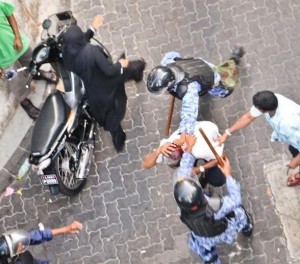
On February 8, 2012, thousands of MDP supporters took to the streets of Malé in a protest march after former President Mohamed Nasheed declared his resignation the previous day had come “under duress” in a “coup d’etat” instigated by mutinying police officers of the Special Operations (SO).

Following an investigation, the Human Rights Commission of Maldives (HRCM) concluded that the heavy-handed police crackdown on the MDP walk was “brutal” and “without warning.”

The HRCM recommended investigations by the PIC into the “disproportionate” use of force that left dozens of demonstrators injured and hospitalised.

In May 2013, the PG’s Office pressed charges against two police officers accused of assaulting MDP MPs ‘Reeko’ Moosa Manik and Mariya Ahmed Didi during the violent crackdown.

Amnesty International meanwhile warned that failure to prosecute police officers accused of human rights abuses and “serious failings in the justice system entrenched impunity”.

In June 2013, former PIC member Hala Hameed told parliament’s government oversight committee that the cases involving the six police officers were “not disciplinary issues, but crimes,” expressing concern with the home minister’s refusal to suspend the officers.

Moreover, former PIC Chair Shahinda Ismail told Minivan News in September 2012 that a staff sergeant caught on tape kicking a fallen demonstrator “was promoted after this incident.”

In February this year, Shahinda told Minivan News that detainees arrested in Addu City on February 9 were “forced to walk on smoldering coals”.

According to the HRCM report, 32 people filed complaints concerning varying degrees of injuries sustained in the crackdown, while 20 people submitted medical documents of their treatment of injuries.

Two fingers on the left hand of one demonstrator were crushed, the report noted.

Al Jazeera filmed parts of the crackdown, reporting that “police and military charged, beating demonstrators as they ran – women, the elderly, [with] dozens left nursing their wounds”. The BBC meanwhile reported “a baton charge by police on crowds gathered outside one of the main hospitals.”

In a report in May 2013, the UN Special Rapporteur for Independence of Judges and Lawyers Gabriela Knaul warned that there could be more instability and unrest unless serious human rights violations of Maldives’ authoritarian past are addressed.

Likes(1)Dislikes(0)

Evacuation of Israelis demonstrates radical’s threat to guesthouse tourism

On July 28, an Israeli surfer on Thulusdhoo Island vandalised a protest placard featuring a swastika alongside an Israeli flag.

Within hours, an estimated 30 protesters from Malé travelled to the island to call for the expulsion of all Israeli tourists. The new arrivals were temporarily detained while the police evacuated 30 Israelis along with 4 tourists of other nationalities.

The incident has left several guest houses on Thulusdhoo empty and caused the cancellation of bookings, while nearby resorts have called off excursions.

Thulusdhoo, only 40 minutes away from Malé, is home to one of the country’s top surf breaks and – although Israeli arrivals amount to a small fraction (3,253) of the 1 million-plus tourist arrivals in Maldives each year –  Thulusdhoo’s nine guest houses rely heavily on Israeli surf tourism.

“Business will be down for the next three months. If incidents like this occur in the future, guest house tourism will suffer a lot of damage,” said Mohamed Hashim, who runs Batuta Maldives Surf View on Thulusdhoo.

Anti Israeli sentiment has been growing in the Maldives since the onset of the Israeli offensive in Gaza. The Maldives has announced plans to boycott Israeli imports, thousands have marched in solidarity with Palestine, and over MVR5 million has been donated to a humanitarian fund for Gaza.

Maldives luxury resorts – with one hotel on one island – are shielded from the local citizenry and society but they have offered islanders little benefit from its multi-billion dollar profits. Local tourism, on the other hand – while it offers hope of greater wealth distribution – is particularly vulnerable to unrest within the community.

Vigilante action of the sort seen on Thulusdhoo could pose serious risks for this emerging sector.

Real danger?

Interviews with protesters reveal that they had demanded police escort guests off the island through the protesting crowd in order to show tourists “they cannot provoke us”.

One man claimed the Israeli tourists were soldiers and described their actions as condescending. He further claimed the tourists had told locals, “We are Israelis. You cannot do anything to us.”

Condemning the police’s detention of the protesters while guests were evacuated, he said the police had treated the locals “worse than the Jews.” Israeli tourists must face the protesting locals, he argued, claiming even US President Barack Obama had gone to places where shoes had been thrown at him.

“This is a slap to Maldivian Muslim faces. After harming Muslims in that country, they come here, to a Muslim country, stay in a Muslim community and slap us in the face.”

“They have given Maldivians a warning. Just as they are killing children there, tomorrow they will kill your children,” he continued.

Another man said, “They cannot come to the Maldives on that passport. This is a 100 percent Muslim nation. Jew, Christian dogs cannot come into this country.”

No confrontation

Thulusdhoo Island Council President Ahmed Anees has denied the claim of confrontations between protesters and guests, saying that the community had in fact resolved the issue before those journeying from Malé arrived.

Batuta manager Hashim said that, though he did not believe that any of the protesters would have physically harmed guests, guest house owners could not agree to demands for guests to be escorted through the irate crowd.

“Escorting guests off through a crowd opens up opportunity for danger, for example someone in the crowd throwing a stone. We didn’t allow them the opportunity,” he said.

Rumors on social media and irresponsible media coverage had caused the situation to escalate, he said.

“Just as insults to our Prophet Mohamed riles us up, the swastika riles them up. It represents the Holocaust in which millions of Jews died. The guest shouldn’t have vandalised the placard. I do not support their actions. The boards were taken down. The issue was resolved,” he continued.

Protesters have gone on to hold a series of nightly demonstrations in Malé, calling for a ban on tourists from Israel. The Israeli and American flags were burned in front on Relax Inn and Mookai Hotel in Malé on Thursday.

Hashim said he did not see how banning Israeli tourists could have an economic impact on Israel.

“A ban on imports from Israel can cause an economic impact, but banning Israeli tourism is not that important. It affects our economy, not theirs,” he said.

Evacuation “heartbreaking”

Israeli citizen and tour operator Tom Niv – present on Thulusdhoo during the incident – described the evacuation as “heartbreaking.”

“I am fully against ugly behavior. When ugly behavior occurs, whether it’s from Israelis or locals, the police should get involved. As a travel agent, I am not accepting any kind of unwelcome behavior. We are guests in this country and we should respect rules.”

Thulusdhoo is “no longer safe for us,” Niv continued. “That a few extremists can impact a whole nation is crazy.”

Both Niv and Hashim maintained that Thulusdhoo was tourist friendly up until the evacuation.

“The guests mixed with the locals, frequented local businesses such as souvenir shops and went fishing on local boats,” Hashim said.

“There was a really good vibe, even clients posted on social media, look these are Muslims, we are Jews, see how good friends we are and see how much fun we have together,” Niv said.

“Almost everyone who came to Thulusdhoo got really connected with the locals. They weren’t like in resorts, like servants. It was not about money or tips. They really became good friends.”

Anees said residents continue to welcome tourists of any nationality, though he admitted he was now apprehensive of having Israeli tourists on Thulusdhoo.

Repercussions

Hashim fears businesses might now be wary of investing in Thulusdhoo in the future.

“Any act that may harm tourism worries us. Tourism is a very vulnerable industry. Burning flags in front of hotels in Malé and calling for tourism bans will scare off tourists,” he added.

Deputy Minister of Tourism Hussein Lirar said the safety of tourists is the government’s first priority, and that it is holding discussions on preventing similar incidents in the future.

Meanwhile, the Ministry of Tourism and Ministry of Home Affairs are in the process of establishing Tourist Police to deal specifically with tourist affairs.

“This is quite important as the number of tourists coming to Malé is also increasing,” he said.

For Niv, the evacuation will have far-reaching consequences for guest house tourism in the Maldives.

“Israelis are not the only one who went away, Australians, French – not too many – but they will tell their friends that local islands are not safe anymore.”

“Now it is against Israel. But tomorrow it could be against Europeans or against Americans. It shows what can happen in certain conditions. This will definitely damage tourism in local islands and tourism in general,” said Niv.

Demands for a ban on tourists from any country should be directed at the government, while disagreements with any state’s actions ought not to translate into direct threats against tourists.

The incidents on Thulusdhoo reveal the risks radicals could have on guest house tourism. Local disputes over the actions of an Israeli – or a tourist of any nationality – should be taken up with police and local government.

Failure to do so could cause irreparable harm to the guest house sector.

Likes(1)Dislikes(0)

Government’s reaction to death threats is a test of democracy: IPU

The Inter-Parliamentary Union (IPU) has called on the Maldives to make a speedy investigation into the death threats against opposition MPs and to offer them full protection.

The statement follows a series of death threats made against seven Maldivian Democratic Party (MDP) MPs on Saturday night (August 2).

“IPU is deeply concerned by these acts of intimidation against MPs in a country where many parliamentarians have been victims of attacks, harassment and arbitrary arrests in recent years,” said the IPU.

Secretary General Martin Chungong said “the authorities’ response to the threats and their capacity to promote, with the help of the opposition, real inclusiveness and political dialogue will be a litmus test for the democratic process in the Maldives.”

“The authorities must act with the necessary resolve to bring the culprits to justice,” continues the statement.

MP Eva Abdulla – a recipient of the threats, and the first Maldivian member of the IPU – told Minivan News that she had received no update from the authorities regarding any investigation or protection after reporting the incident three days ago.

“I am alarmed the parliament has not said anything,” she said.

“The MNDF should take some action, the Majlis have not said anything, and the Inter-Parliamentary Union is speaking before the parliament,” Eva added.

Meanwhile, police claimed that an investigation had been launched on the day the threats were received, with a spokesman describing the investigation as “going very fast”.

When asked about the level of security offered to MPs, the spokesperson stated that it was the responsibility of the Maldives National Defence Force (MNDF) to provide a bodyguard.

Both the police and the MNDF were unwilling to comment on the level of protection currently offered to MPs.

The Sergeant-at-Arms – the head of the Majlis’ independent security team – told Minivan News that he had been informed of the threats, adding that the usual procedure was to inform MNDF and the police.

He suggested  that authorities have no capacity to track who sends these threats, a point previously contested by the opposition who have suggested those culpable are being protected from prosecution.

Threats

In the death threat sent to MPs on Saturday, the perpetrators referred to the murder of Ungoofaaru constituency MP and Islamic scholar in October 2012.

“It is not a sin to kill those who challenge Allah’s words and call for freedom of religion. Afrasheem Ali was an example,” read the message.

While the murder of Dr Afrasheem was the most shocking attack on an elected representative in the country’s history, former MDP MP Alhan Fahmy was left unable to walk for months after being stabbed in the back in February this year.

The safety and rights of MPs have previously been a concern of the IPU, who in November 2013 arranged an emergency visit to the Maldives.

The organisation’s request for an urgent visit was prompted by the growing list of cases involving Maldivian MPs – 24 in total – filed with the IPU’s Committee on the Human Rights of Parliamentarians.

Death threats made against those in the public eye have become a norm in Maldivian cyberspace. Politicians, bloggers, and social media users have reported receiving threats for a range of reasons, from their support of a particular political party to their advocacy of freedom of religion.

Earlier this week, 15 journalists from different media outlets received SMS threats in relation to the coverage of gang violence in the capital Malé.

The Human Rights Commission of the Maldives (HRCM) has previously expressed concern over the prevalence of cyber threats, and urged victims to report threats made via Facebook, Twitter, or comments on blog posts to the police.

“In light of recent events, at a time of high levels of intolerance, and increase in gang related violence, do not treat any form of cyber threat as an idle threat,” said HRCM Vice President Ahmed Tholal.

Likes(1)Dislikes(0)

MPs debate allowing civil servants to campaign for public office

The government has proposed revisions to the Civil Service Act that would allow civil servants to campaign for public office without resigning from their jobs.

“If these amendments are passed, our civil service employees would be able to campaign for elected posts while remaining in their jobs and have the opportunity contest elections,” explained Progressive Party of Maldives (PPM) MP Mohamed Ameeth Ahmed Manik at today’s sitting of the People’s Majlis.

Presenting the legislation (Dhivehi) on behalf of the government, the MP for Raa Madduvari explained that the amendments to the 2007 law were part of a raft of bills proposed by the government to bring outdated laws in line with the new constitution adopted in August 2008.

Opposition MPs have expressed concern that the changes may lead to the politicisation of the civil service, which currently employs just under 25,000 Maldivians – over 7 percent of the population.

Ameeth meanwhile noted that the Supreme Court had ruled Article 53 of the act was unconstitutional.

In September 2011, the Supreme Court backed a ruling against the prevention of civil servants’ participation in political activities.

The courts referred to Article 30(a) of the Constitution, which states, “Every citizen has the right to establish and to participate in the activities of political parties.”

The case was filed at High Court in late 2008 by Mohamed Hanim, who was demoted from his post as director general at the Ministry of Youth and Sports after he spoke at a campaign rally of the then-opposition Dhivehi Rayyithunge Party.

Ameeth noted today, however, that the revisions would establish boundaries for civil servants who wish to be active in politics.

The amendments would prohibit civil servants from using powers to directly or indirectly influence political activities as well as participating in political activity either during official working hours or in a way that casts doubt on impartiality in the performance of duties.

Additionally, civil servants would be prohibited from filling any post in a political party or submitting a form to register a political party.

The restrictions were necessary to ensure that the civil service was free of political bias and undue influence, Ameeth said.

The amendments also stipulate that political appointees, judges, employees at state-owned enterprises, soldiers, and staff at the judiciary and parliament would not be considered civil servants.

Article 77(d) of the Civil Service Act – which prohibits campaigning for public office – would meanwhile be abolished.

Despite Ameeth’s claims, however, the bill does not propose abolishing Article 51 of the act, which stipulates that civil servants must resign six months ahead of contesting an election.

Conceding that the draft legislation could have shortcomings, Ameeth appealed for MPs to offer “constructive” criticism and noted that stakeholders could be consulted at the committee stage to address concerns of civil servants.

Debate

In the ensuing debate, opposition Maldivian Democratic Party (MDP) MP Ali Azim alleged that the main purpose of the bill was to “force all civil servants to join PPM.”

He further claimed that employees hired for government-owned corporations were forced to sign PPM membership forms.

MDP MP Abdulla Shahid – former speaker of parliament – contended that the amendments would return civil servants to the “enslavement” of the years before 2007, warning that it could be used to dismiss large numbers of civil servants.

Civil servants could be fired if they refuse to attend “certain rallies” or put up campaign posters, he claimed.

MDP MP ‘Reeko’ Moosa Manik meanwhile called on the government to set a minimum wage of MVR4,500 (US$292) a month for civil servants.

Statistics published by the Civil Service Commission in June showed an estimated 40 percent of civil servants are paid less than MVR4,999 (US$324) per month.

MDP MP Mariya Ahmed Didi noted that current President Abdulla Yameen – who resigned from the government and formed the People’s Alliance party in 2008 – had backed the legislation in the 16th parliament (2003-2008).

The prohibitions in the law were intended to establish a “professional civil service” and ensure “institutional memory,” she said.

Civil servants would have an undue advantage over other candidates since they could misuse their authority, she suggested.

Majority Leader Ahmed Nihan, however, insisted that former President Maumoon Abdul Gayoom deserved “full credit” for creating an independent civil service.

The present administration also deserved gratitude and praise from civil servants for ensuring the right to participate in political activity, he added.

MP Ahmed Amir of the Maldives Development Alliance (MDA) – coalition partner of the ruling PPM – meanwhile suggested seeking advice from the Supreme Court when the legislation is reviewed by committee.

While the amendments prohibit civil servants from being a signatory to a request to form a political party, Amir noted that the constitution guarantees the right to form political parties to all citizens.

PPM MP Abdulla Rifau said it was “regrettable” that parliament had not amended the law in light of the Supreme Court ruling.

The PPM government would ensure that civil servants receive a pay rise when the economy improves, he added.

Rifau went on to accuse employees in the health sector of “pestering” the government with politically motivated acts of sabotage.

Likes(2)Dislikes(0)

Malé City to improve bus service based on new survey

Malé City Council has conducted a bus service survey to identify potential improvements to the capital’s public transport.

“From this survey, we found that many people are using the bus service, and many want to improve the service. Necessary improvements must be brought about as a top priority,” said Male’ Mayor Mohamed Shihab.

The survey was conducted after the council received a number of complaints regarding buses. It consisted of thirty questions posed to a randomly selected sample of 180 people.

The results showed that women make up the majority of passengers (52 percent) using the service which was introduced in 2011.

The percentage of people travelling by bus is low during weekends, particularly on Fridays, the survey revealed. It also indicated that most people (40 percent) use the bus in the morning compared to the afternoons (20 percent) and evenings (16 percent).

While only 31 percent reported being unhappy with the overall bus service in Malé, respondents reported several concerns.

Approximately half of respondents said they were unhappy with the bus fare – currently MVR5 per journey, while 58 percent said were unhappy with the hours of service. The bus currently runs from 6am until 1am.

Over a third of respondents did not approve of the current seating arrangements on the bus while another 32 percent complained about the condition of the vehicles. Twenty one percent said they were unhappy with behavior of bus conductors, while a similar number of people said they were bothered by the behavior of other passengers.

Respondents complained over punctuality of buses, with only 24 percent stating that buses arrived on time.

Even though buses are supposed to arrive at each stop every 15 minutes, 30 percent of respondents said they had to wait for over 20 minutes. Those who expressed discontentment with the bus stops (35 percent) said their main concerns was the lack of a shelter or a place to sit down.

A majority of respondents (61 percent) wanted more bus routes to be introduced.

Shihab said that, while the results of the survey indicated the sentiments of those who utilise the service, there would be many who were not taking the bus due to certain other issues.

He said that providing a bus service in Malé is very challenging due to the conditions of the city, including heavy traffic and construction work, but also due to failures of the service provider.

The service is provided by MVK Maldives Pvt Ltd, who are also facing criticism over failures in providing public ferry services.

The mayor noted that any reforms would be made in accordance with the agreement between MVK and the council.

Likes(1)Dislikes(0)

Government will not hesitate to implement death penalty: Home Ministry

The Maldives Government will not hesitate to implement the death penalty, the Ministry of Home Affairs has assured.

The statement follows a wave of attacks within the past 7 days, including fatal stabbings in Malé and Thulusdhoo.

The Home Ministry said that the government “will not hesitate to implement the death penalty placed by the courts upon persons who stab and murder with the willful intent to kill,” according to local media Sun Online.

The ministry also said that the Maldives Police Service is conducting a number of special operations to prevent further attacks, assuring that the government is taking every possible measure to bring an end to the outbreak of violence in the capital.

Measures to re-introduce the death penalty were finalised in April, while local media reported last month that the Maldives Correctional Services (MCS) had completed a facility in which to administer the lethal injection.

Minivan News has been unable to obtain comment from either the Home Ministry or the MCS regarding these preparations.

Prior to this policy change, the Maldives had maintained an unofficial moratorium on the death penalty since 1953, when Hakim Didi was executed by firing squad for the crime of practising black magic.

Several people have been sentenced to death during the moratorium, although they have traditionally had their sentences commuted to life imprisonment by presidential decree.

Despite widespread concerns over the state of the Maldivian justice system, Minister of Home Affairs Umar Naseer said the chances of killing an innocent person after completing all the procedures in the regulation was “far-fetched” and “almost impossible”.

Although the death penalty has proven to be a contentious issue, Naseer assured the international community that the Madlives has a firm reason to continue with the ruling.

Conversely, Amnesty International have pointed out that the decision to resume the death sentence is in contradiction with the International Covenant on Civil and Political Rights – a treaty to which the Maldives became a party in 2006.

Similarly, The Maldivian Democracy Network (MDN) has condemned the Maldivian government’s decision to implement the death penalty.

“Given the state of the Maldivian judiciary, which is also perceived to be highly politicised and corrupt, it is most concerning that as grave a matter as life and death of humans is to be decided by it,” the MDN stated.

“In addition to this, research shows that capital punishment does not deter murder any greater than the threat and application of lesser punishments,” the statement concluded.

The practice of the death penalty, and the use of lethal injections, has recently grabbed international headlines again after  aconvicted murderer in Arizona appeared to take two hours to die.

Joseph Wood’s death is the third such instance in the US this year, and has prompted a suspension of executions while the state undertakes a review of its procedures.

Likes(1)Dislikes(0)

Policing not affected by reduction of ministerial powers, insists Umar Naseer

The restriction of the home minister’s prerogative to order individual police officers has not affected police effort’s to combat gang violence, Home Minister Umar Naseer insisted in parliament today.

Appearing for minister’s question time, Naseer explained that the home minister could no longer issue direct orders to police officers due to “changes” made to his mandate by President Abdulla Yameen, who exercised “his discretion under the law”.

“However, there has been no change to the role of police in this country. Police are fulfilling their responsibilities and will continue to do so,” Naseer insisted, adding that “special measures” were being taken to ensure security in the capital Malé.

The opposition Maldivian Democratic Party (MDP) alleged yesterday that “the present climate of fear in Malé and several islands began to escalate following [Naseer’s] constitutional powers as the minister in charge of police being reduced”.

Local daily Haveeru reported last week that President Yameen’s decision to reduce the home minister’s powers came after Naseer ordered police officers to investigate Tourism Minister Ahmed Adeeb – deputy leader of the ruling Progressive Party of Maldives (PPM) – for alleged unlawful activities.

Contrary to Naseer’s remarks today, President’s Office Spokesperson Ibrahim Muaz Ali had denied any changes to the home minister’s mandate.

Crime wave

Naseer meanwhile told MPs today that a “special police operation” was ongoing to curb gang violence in the capital following a spate of violent assaults during the past six days.

Naseer suggested that the problem was exacerbated by insufficient police resources, revisions required for “some laws”, and drug trafficking.

Crime in the Maldives stemmed from drug use, Naseer said, adding that efforts to combat drug trafficking have increased “manifold” under the current administration.

Efforts were currently underway to renovate and upgrade the rehabilitation centre in Himmafushi, he noted.

The government would continue “supply reduction” and “harm reduction” efforts, he added, reiterating that a period of 15 years would be needed with a “sustained effort” by successive administrations to address the country’s drug problem.

Asked by PPM MP Ahmed Nihan if there was any intelligence information suggesting that opposition politicians were behind the gang violence in a “deliberate attempt to incite unrest”, Naseer said he could not share confidential information at “an open forum”.

“But I would say that it is likely that scheming by some people might be involved in what’s going on now,” he said.

“Pestering”

Naseer was summoned to the People’s Majlis today after a question was tabled by MDP MP Eva Abdulla concerning his allegations made in the wake of losing the PPM presidential primary to Yameen in March 2013.

Naseer had contended that the election was “rigged” and alleged that criminal gangs, convicts and drug smuggling “networks” were part of Yameen’s campaign team.

The PPM subsequently expelled Naseer from the party after he refused to apologise.

Asked how far any investigation of the president’s links to gangs and drug trafficking had progressed, Naseer said he was not legally obliged to answer the question as the remarks preceded his appointment as home minister and was not related to his present duties.

Naseer had previously retracted the allegations and categorically asserted that there were no links between Yameen and criminal enterprises.

In an interview with Minivan News in January, Naseer had dismissed the allegation as “political rhetoric” borrowed from the MDP.

Moreover, in April, Naseer told state broadcaster Television Maldives that he was “not a political threat” to Yameen.

At today’s sitting, Naseer repeatedly alleged that former President Mohamed Nasheed encouraged drug use and had resigned in “a state of intoxication”.

Nasheed would test positive for drug use “even if his urine is tested right now,” Naseer said.

Moreover, Nasheed was responsible for attacks against police officers and their families following the transfer of power in February 2012, he claimed.

In followup questions, MDP MPs suggested that Naseer could not answer truthfully for fear of losing his job.

Naseer responded by saying that he would not hesitate to order investigations of senior government officials “if a case reaches me.”

MDP MP Imthiyaz Fahmy meanwhile argued that Naseer by his own admission must have been lying either in parliament or when he made the allegations against Yameen last year and asked whether he had apologised either to the president or the public.

Naseer said he had “nothing to apologise for” and suggested that MDP leaders should apologise for causing MVR200 million worth of damage by allegedly setting fire to police stations, vehicles and courts on February 8, 2012.

Asked by an irate MP ‘Reeko’ Moosa Manik – former MDP chairperson – if provoking the main opposition party was part of his mandate, Naseer said he was “responding in kind” to MDP MPs’ “pestering” questions.

The deputy speaker advised Naseer to show more respect to a party with the support of over 105,000 people.

Likes(2)Dislikes(0)

Transparency Maldives concerned over “stagnation of democratic consolidation”

An assessment of the effectiveness of Maldivian institutions in preventing and fighting corruption points to a “stagnation in democratic consolidation and a reversal in democratic gains,” anti-corruption NGO Transparency Maldives (TM) has said.

Institutions of the National Integrity System (NIS) – consisting of the three branches of the state, public sector agencies, and non-government actors – were evaluated on their resources and independence, mechanisms to ensure transparency, accountability and integrity, and extent to which each institution fulfilled their assigned role in preventing corruption.

The Elections Commission (EC), the Anti- Corruption Commission (ACC) and the Auditor General’s Office were ranked the strongest pillars, while political parties and civil society received the lowest scores.

“The findings show that most institutions do not fully adhere to the legal framework, meaning there is a gap between practices and mandates afforded by the law, and that oversight mechanisms are not working as intended,” TM’s Advocacy and Communications Manager Aiman Rasheed said.

Noting the erosion of the separation of powers and the judicial attempts to undermine the independence of the EC and the ACC, Aiman said he was concerned over the lack of public outcry in instances where the powers of key democratic institutions are undermined.

“What is most worrying is the culture of impunity in the Maldives. There is no outcry from civil society, meaning those who undermine democratic consolidation can get away with almost anything,” he said.

A strong and functioning NIS serves as a bulwark against corruption and as a guarantor of accountability, while a weak system harbors systemic corruption and produces a myriad of governance failures, the report said.

Politicisation

Although the 2008 constitution established a mechanism for separation of powers, the period between 2008 and 2013 saw the legislature and judiciary curbing the powers of the executive and independent institutions, the report noted.

It specifically cited an amendment to the Public Finance Act in 2010, which curtailed the powers of the executive with regard to public finance management and state assets. The revision allows an opposition-dominated parliament to prevent the exercise of governmental policy.

A Supreme Court in September 2012 also limited the ACC’s powers to halt projects or issue binding orders and injunctions, it noted.

‘The verdict has made the commission toothless. We believe the ACC must at the very least have the power to suspend actions perceived as corrupt,” Aiman said.

He also said the 16-point guideline imposed by the Supreme Court on the EC in October is a blow to the commission’s independence.

“There are questions on how much authority the commission has in making decisions on electoral processes and the conduct of elections. The events of the past cycle of elections had had a tremendous negative impact on the Election Commission’s independence,” he said.

Systemic failure

Political parties associated with powerful individuals dominate the People’s Majlis, and their self-serving political practices have constrained the legislature’s ability to function with independence, the report noted.

Although there are provisions to hold the executive in check through budget review, appointment of cabinet, and questioning ministers on policies, in practice, the extent to which the executive was held accountable depended on the level of support the president’s political party enjoyed in the Majlis.

Meanwhile, allegations of political influence within the judiciary, and concerns over the qualifications and suitability of serving judges have raised questions over the independence of the judiciary, the report said.

But key oversight institutions, such as civil society organisations and the media, lack adequate resources and the professionalism necessary to effectively influence government policy for the betterment of society, the report continued.

Systemic weakness in upholding democratic institutionalism was demonstrated by the controversial transfer of power in February 2012, the report said, arguing that former President Mohamed Nasheed’s resignation under questionable circumstances created doubts over the political system’s ability to guarantee democratic governance.

“Although the Constitution of 2008 created a democratic Constitutional Government, the traditionally transmitted undemocratic political practices are also embedded in the new politico-institutional framework, thus weakening the overall institutional framework, and leaving room for misgovernance and political malpractices,” a press statement accompanying the report said.

Recommendations

The report recommended the enforcement of a comprehensive code of conduct for MPs, political appointees, and judges, with penalties for non-compliance.

MPs and political appointees must declare their assets and business interests, and legislation that limits party cross-over in the Majlis must be established, it said.

The executive must be granted more independence in determining public spending, albeit with strong measures to ensure integrity and transparency in decision-making.

Qualification and experience requirements of judges stipulated in legislation need to be enforced and the Supreme Court must exercise greater judicial restraint in interpreting its powers, it said.

The report also called on greater powers to be granted the ACC, Police Integrity Commission, and said that financial and human resources must be provided for the efficient functioning of all political, economic and social institutions.

Read the report here

Likes(1)Dislikes(0)

MDP condemns death threats received by Majlis members

The Maldivian Democratic Party (MDP) have condemned death threats received by six MDP MPs last night (August 2), and called on  the Progressive Party of the Maldives (PPM) to desist in sheltering radical suspects.

“[T]he PPM government continues to shelter radical suspects and is yet to name or arrest a single suspect accused of having issued such threats in previous cases lodged by the MDP,” read an MDP statement.

The MDP confirmed that MPs Mariya Didi, Rozaina Adam, Eva Abdulla, Ali Azim, Parliamentary Group Leader Ibrahim Mohamed Solih and former Speaker Abdulla Shahid all received death threats.

Two threats were sent to each MP via text message. The first message read, “[We] will kill you if you behave inappropriately.” The party suggested that the police had the technical capability to identify unlisted numbers.

The second read, “It is not a sin to kill those who challenge Allah’s words and call for freedom of religion. Afrasheem Ali was an example.”

In June the party requested that police investigate a series of threats made via Twitter against its members, including former President Mohamed Nasheed.

The MDP statement went on to note the recent spate of murders taking place around the capital, as the number of violent attacks reported rises to nine.

“The Maldivian Democratic Party notes with concern that the present climate of fear in Male’ and several islands began to escalate following Home Minister Umar Naseer’s constitutional powers as the Minister in charge of Police being reduced on 24 July 2014 by his former political rival President Yaameen Abdul Gayoom.”

Writing on her Twitter account, Eva Abdulla challenged the Maldives Police Service to investigate the matter. “You have the means to investigate, if you have the will,” Eva stated.

“[The] police have the means to look this up, if they have the will to do so. If they do not (as they did not with any of the complaints I lodged past two years) well at least I will know this is govt-approved. [sic]” Eva added on social media.

Police have confirmed with Minivan News that they are investigating the matter, but declined to give any more information on the details of the case.

Dr Afrasheem Ali’s murder in October 2012 was the most high profile attack on a member of parliament in the country’s history.

In the second death threat sent to MPs yesterday, the perpetrators referred to the attack on the former Ungoofaaru constituency MP and Islamic scholar.

The ensuing investigation found the crime to have been premeditated and politically motivated. On January 16 2014, the Criminal Court sentenced the prime suspect in the murder, Hussain Humam, to death.

Meanwhile, former MDP MP Alhan Fahmy was unable to walk for months after he was stabbed in the back in February.

The safety and rights of MPs have previously been a concern of organisations such as the Inter-Parliamentary Union (IPU), who in November 2013 called for an emergency visit to the Maldives.

The organisation’s request for an urgent visit was prompted by the growing list of cases – 24 in total – involving Maldivian MPs filed with the IPU’s Committee on the Human Rights of Parliamentarians.

Likes(2)Dislikes(0)