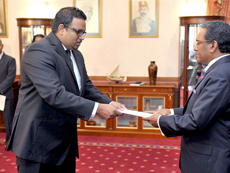
President’s Office budget exceeded by MVR 7 million in 2010: audit report

President’s Office spent in spent MVR 7,415,960 (US$480,931) over the parliament approved budget for the office in 2010, according to the auditor general’s office.

The audit report, released on Thursday, focused on the expenses of the President’s Office and the residences of the President and the Vice President.

The report spells out explicitly 12 instances in which the Auditor General believes the President’s Office acted in breach of laws and regulations.

In addition to the excess expenditure of MVR 7 million, the report also highlights then-President Mohamed Nasheed’s chartering of an Island Aviation flight from Colombo to Male’ on November 19, 2010. This had cost MVR 146,490 (US$9500) for the charter itself, together with the ground handling fee of MVR 3,097 (US$ 201) paid to Sri Lankan Airlines, and fuel charges of MVR 11,925 (US$773) paid to Ceylon Petroleum Corporation.

The audit report states that while all these were paid from state funds, no records were available to prove that Nasheed booked this flight for official purposes. It stated that the trip was there considered to have been made for personal reasons and that Nasheed has not yet paid back this amount to the state.

The report also points out that the state had used the special budget of the Ministry of Finance and Treasury to settle payments worth MVR 21.9 million (US$1.4 million) to two foreign companies who were assisting an investigation which was being conducted by the Presidential Commission, understood to be an investigation of the former government’s sale of oil to the Burmese military junta.

Another transaction considered unlawful by the Auditor General’s report was the settling of pending bills dated between 2005 and 2008 submitted by a Malaysian company for the purchase of items for the presidential palace during former President Maumoon Abdul Gayoom’s administration.

Other incidents stated in the report include failure to submit reports on official trips made abroad or documents to highlight achievements made in these trips, hiring consultants outside of recruitment procedure and without specifying their duties, payment of fines levied due to failure to process bill payments by deadlines and incurring additional spending due to lack of timely organising of trips to local atolls.

The report details the amounts spend in the year 2010 on the annual paid vacation of 30 days with their respective families by the President and the Vice President.

Former President Nasheed is said to have spent MVR 446,578 (US$28,961) on a trip to Singapore with family, while  President Mohamed Waheed Hassan, then Vice President, had spent MVR 764,121 (US$49,554) on a trip to Malaysia and America with his own family.

The report calls on the state to put in place policies to govern limits of the amounts that can be spent by the President and Vice President on their annual vacation.

It also points out the lack of documentation to prove that trips made by families of the President or Vice President citing medical purposes were indeed made for those reasons.

The report emphasises that the amounts spent on the President’s official residence had significantly decreased, offering a comparison of the amounts spent since 2007. According to the report, the President’s official residence spent MVR 68.8 million in 2007, MVR 79.7 million in 2008, MVR 42.04 million in 2009 and MVR 27.13 million in 2010.

It cites staff cuts from 313 to 154 personnel, and lower spending on official trips among other reasons for the decreased spending.

Chief of Staff during Nasheed’s administration and current Deputy Chair, Finance, of MDP Ahmed Mausoom was not responding to calls at the time of press. Minivan News was also unable to reach President’s Office Spokesperson Masood Imad.

Read the full report (Dhivehi) here.

Likes(0)Dislikes(0)

PPM council elected at party’s first ever congress

Key positions within the Progressive Party of Maldives (PPM) were filled this weekend during elections at the party’s first ever congress.

Twelve out of the fourteen seats of PPM’s council were won by party members aligned with MP Abdulla Yameen, who is competing for the party’s presidential primary against interim Vice President of PPM, Umar Nasser.

Yameen’s half brother, former President of the Maldives Maumoon Abdul Gayoom, was appointed PPM President after being the only candidate nominated for the post.

Yameen was also appointed Parliamentary Group Leader. Both Yameen and Gayoom were appointed to their respective positions without a vote, as no one else contested against them.

Gayoom’s daughter, Dhunya Maumoon was selected as PPM’s Women Branch President and Abdul Raheem Abdullah was appointed Deputy Leader of PPM Parliamentary Group Leader, also without contest.

Gayoom’s son, Faris Maumoon secured the highest number of votes by a single candidate at 419, while his other son, Ghassan Maumoon received 416 votes.

PPM Vice Presidency

Tourism Minister Ahmed Adheeb and PPM Parliamentary Group Deputy Leader Ilham Ahmed were elected as the first vice presidents of PPM.

Local media reported the temporary results of the secret votes taken at PPM congress show that Adheeb received 361 out of 400 votes.

Ilham received 301 votes while Raheem – who was later appointed as Deputy Leader of PPM Parliamentary Group Leader – received 268 votes.

The temporary results have not yet been officially announced at the congress, which is taking place at Darubaaruge, Malé.

PPM Council Member and lead activist of Umar Naseer’s presidential primary campaign team, Ibrahim Nazim was elected as President of PPM’s youth group.

Aminath Nadhaa was elected as vice president of the party’s youth group with 40 votes in favour.

PPM formed due to actions of Nasheed: Gayoom

Former autocratic ruler Gayoom, who presided over the Maldives for thirty years, said that PPM was formed due to the actions of former President Mohamed Nasheed’s government, local media reported.

Speaking during the PPM congress, the Gayoom claimed that government accountability was largely reduced during Nasheed’s presidency and assaults had become “commonplace”, Sun Online reported.

Gayoom added that PPM took part in the demonstrations held between 2011 and 2012 and that they are now part of the multi-party coalition that was formed following Nasheed’s controversial removal from power in February 2012, local media stated.

Under the ‘multi-party coalition’ that has since taken control of the country, a new bill enforcing limitations on such demonstrations and protests was recently ratified by President Mohamed Waheed Hassan Manik.

In a joint statement from local NGOs Transparency Maldives (TM) and Maldivian Democracy Network (MDN) this month (January 2), it warned that the bill posed “serious challenges to the whole democratic system”.

The statement claimed that the bill could restrict the constitutional right to freedom of assembly (article 32), freedom of expression (article 27) and press freedom (article 28).

Speaking at the congress on Friday, Gayoom urged candidates who lost out, not to feel disheartened as the ‘opportunity to serve the nation was still available’, local media reported.

“Don’t think of it as an obstacle. The future is in your hands. The chance to serve the party and nation will become available,” the former President was quoted as saying in local newspaper Haveeru.

Likes(0)Dislikes(0)

Brigadier General Nilam suspended following testimony to Government Oversight Committee

Former head of military intelligence, Brigadier General Ahmed Nilam, has been relieved of his duties at the Maldives National Defence Force (MNDF), by Defence Minister Colonel (Retired) Mohamed Nazim.

According to a statement by the Defence Ministry yesterday, General Nilam was suspended because a case involving the former head of military intelligence was under investigation.

The statement did not provide further details or specify the nature of the investigation and alleged offence.

The move follows the Brigadier General’s testimony (Dhivehi) to parliament’s Government Oversight Committee on January 9, which was made public on Wednesday after MPs on the committee voted to publicise minutes of the closed session.

During the past two weeks, the oversight committee has summoned high-ranking officers of the security services for its review of the Commission of National Inquiry’s (CNI’s) report into the transfer of presidential power on February 7, 2012.

In his testimony to the committee, Brigadier General Nilam said he was asked by Defence Minister Nazim if he believed that the transfer of power amounted to a coup or a revolution.

Nilam said he replied that, “looking at it academically, this has all the characteristics of a coup.”

“I have even looked into this and studied this along principles that academicians would consider. So I told [Nazim] that this has all the characteristics. He didn’t say anything else,” Nilam said.

Asked by pro-government Progressive Party of Maldives (PPM) MP Ahmed Nihan if he believed there was a coup d’etat, Nilam said based on his experience in military intelligence, “this has roots that go much deeper.”

Brigadier General Nilam was seen in leaked video from inside the MNDF headquarters showing a frenzied former President Nasheed ordering officers to go out and confront the mutinying police on the morning of February 7.

Responding to questions by committee members, Nilam explained that the president, defence minister and chief of defence forces were issuing orders because “the [military] lines weren’t working.”

“I was really saddened. This was not something I ever saw inside the military. There has been insubordination. There are former officers here [among MPs on the committee]. There is insubordination. But things have never happened like this in such an operation,” Nilam said at the committee.

Nilam added that he saw a president in a “very helpless” state, which was “a sad moment.”

“We are entrusted with the duty and responsibility of protecting the country’s independence and sovereignty. It is truly disturbing to see something like from [the military],” he said.

The brigadier general said he was present when current Defence Minister Nazim relayed the message for the president’s “unconditional” resignation.

He also noted that military officers banged the president’s car with their boots while he was taken to the President’s Office from the military headquarters and that current Chief of Defence Forces General Ahmed Shiyam took over as acting chief before President Nasheed officially resigned.

“There are lot of questions here. I believe that this should be investigated thoroughly and looked into. These are very serious matters,” he said.

Under Maldivian law, Brigadier General Nilam continued, a “coup d’etat” could not be carried out without the military’s involvement as the offence is specified and prohibited in the Defence Forces Act of 2008.

Asked by the committee’s chair, MP Ali Waheed, if there was a threat to the life of President Nasheed had he not resigned, Nilam said weapons were stored because there was fear of live armour being used and that the mutinying police were armed with riot gear.

Nilam also revealed that the military did not have “any control of [presidential residence] Muleeage after 7:00am or 7:30am in the morning.”

Police and ex-servicemen entered Muleeage after 7:15am on February 7, 2012, he added.

First Lady Laila Ali and the president’s daughters were reportedly taken to a safe location in the morning.

Continuing his testimony, Brigadier General Nilam said he overheard President refuse assistance from two foreign nations before he decided to resign.

“[The President] said this is an internal matter. He answered both calls in much the same way,” he said.

Nilam added that there was possibility of bloodshed “if it dragged on” and that the president’s life was in danger.

Meanwhile, former Chief Superintendent of Police Mohamed Jinah was also relieved of his duties last week following his testimony to the oversight committee.

Likes(0)Dislikes(0)

Nasheed’s ousting result of “planning, propaganda and a lot of work”: Umar Naseer

The resignation of former President Mohamed Nasheed on February 7, 2012 was the result of “planning, propaganda and a lot of work”, interim deputy leader of the government-aligned Progressive Party of Maldives (PPM) Umar Naseer has claimed.

Introducing candidates from “Team Umar” at a rally last week ahead of the PPM’s first congress this weekend, Naseer urged supporters to vote for members of his team as they had “produced results” through street activism against the formerly ruling Maldivian Democratic Party (MDP) administration.

“A lot of people told us that Mohamed Nasheed’s government cannot be toppled from the street. I said while contesting for DRP’s [Dhivehi Rayyithunge Party’s] deputy leader that I was coming to this post to topple Mohamed Nasheed’s government from the street. We have proven and shown that,” he said.

“You should not think that February 7 happened automatically,” he continued. “It did not happen like that. It was the result of planning, propaganda and a lot of work by some people. It did not happen automatically.”

While former President Nasheed insists that he was forced to resign “under duress” following a police mutiny and loss of command and control over the military, a Commonwealth-backed Commission of National Inquiry (CNI) found that the transfer of power to then-Vice President Dr Mohamed Waheed Hassan Manik was constitutional.

Speaking at last week’s rally, Umar Naseer said members of his team led protests for 22 consecutive nights and played an important role in backing up mutinying police officers in the early hours of February 7.

In an interview with Australian journalist Mark Davis for the SBS Dateline television programme in February 2012, Naseer claimed he was at a “command center” on the night of February 6 directing protests by the then-opposition.

“On the protesters’ side, we were informing and educating the police and army through our speeches and television programs,” Naseer said.

Asked by Davis if the opposition had made any other inducements, such as promises that they and their families would be “looked after” if they switched sides, Naseer said “there were.”

He added that the former president could have been beaten by a mob if he had emerged from the military headquarters without agreeing to resign.

At the first PPM rally following the controversial transfer of presidential power, Umar Naseer said he told former President Nasheed to resign “or else you might lose your life.”

Naseer claimed that the former president’s choices were to either resign peacefully or “resign after bloodshed.”

“While the operation [protest] was going on that night, I was at the commanding center. I was talking to Nasheed’s close aides. I told them to surrender; otherwise [he] might lose life. I told them that repeatedly. But, firstly, they responded arrogantly saying they do not have to surrender [because] such a circumstance has arrived,” Umar claimed.

But around 8:30am the next morning, Umar claimed that Nasheed called him saying that he wanted to resign. Nasheed said that he would not participate in any political activities hereafter, Umar added.

“Nasheed called and said that he is prepared to resign. He requested arrangements to be made for him and his family to leave for somewhere else. I told him that it will be arranged and to prepare for resignation,” Umar claimed.

Following media coverage of those remarks, Umar however released a statement claiming he did not imply that President Nasheed’s life was threatened by police and Maldives National Defence Force (MNDF).

During the unrest, Umar said that he spoke to Former Defence Minister Tholhath Ibrahim Kaleyfaanu and told him that their lives were in danger because of the large number of protesters in Republic Square.

“I said his life could be in danger because of the large number of people gathered there [Republican Square] and it seemed that police, MNDF did not have the capacity to control the crowd – not even us,” Umar said.

“We feared from our hearts that if the civilians [protesters] had entered the MNDF headquarters by using any means, Nashed, Tholhath and MNDF and police inside the building [at the time] would have been at danger.”

Likes(0)Dislikes(0)

Comment: Maldives competitive, combative, yet cooperative, too

With Maldivian President Mohamed Waheed Hassan Manik returning two [the “political parties” and the “privileges” bills] of the three crucial bills passed by parliament, the stage is now set for a possible, limited confrontation between the executive and the legislature, all over again.

For the third “public assemblies” bill, the president has given his assent, but the opposition Maldivian Democratic Party (MDP) says it would defy the law if it came to that.

The president has rejected the bill that mandates 10,000-strong membership – up from the existing 3,000 – for political parties to be registered by and with the Election Commission (EC).

As the Maldivian budget allocates 0.1 percent of the GDP for the state funding of political parties, which in turn is based on registered membership, the law has serious consequences for smaller parties. Included in the list are the Gaumee Ithihaad Party (GIP) of President Waheed and the Dhivehi Qaumee Party (DQP) of his Special Advisor Dr Hassan Saeed. The DQP was the second runner-up in the first round of presidential polls in 2008.

The Maldives is a nation where democratic education and elections are a costly affair. Given the vast seas that have to be traversed for a campaign – even in individual parliamentary constituencies. as well as the small number of electorate covered in comparison to other countries – few political parties can sustain themselves without state funding.

With other political parties neck-deep in campaigning for the presidential polls due later this year, any last-minute changes in the law could have consequences for them all.

The “political parties” bill regarding privileges of parliament and MPs, which has also been returned to parliament by the president, has limited application. However, the bill assumes greater significance in the context of some government ministers and other political party leaders in the government ridiculing parliamentarians, and threatening [to remove] them from public platforms.

In the case of the religion-centric Adhaalath Party (AP) for instance, together the two bills could stall its recent efforts to project itself as the self-appointed defender of Islam among Maldivian political parties, protecting Maldivian people’s rights via their elected representatives. Needless to point out, the AP does not have any elected member in the People’s Majlis (parliament).

President Waheed aims at regulating public assemblies and rallies through the third bill. It is a reaction to the MDP rallies following the February 7 transfer-of-power, some of which turned violent. Protests and counter-protests had a tendency to multiply, and the security forces had little power or even the scope to regulate them; especially considering the distance between rival groups’ rallies.

Armed with the 2008 constitutional guarantee protecting the citizens’ rights in the matter, an air of permissiveness was threatening tranquility in the tourism-driven country.

Consensus and cohabitation

Parliament is in recess at present, and is not expected to meet again until March. It is almost a foregone conclusion that the house will vote the two bills be returned to the President, enabling a mandatory assent for both, within 14 days of such passage.

The opposition MDP as the single largest party cannot protest in the interim considering party leader and former President Mohamed Nasheed similarly returned a bill amending the Finance Act, only to grant his assent at the last-minute after the Majlis passed it a second time.

However, what is interesting is the combination of votes that each of these bills polled. Though moved by MDP members in the Parliament, the ‘political parties’ bill and the ‘privileges’ bill had the support of the Progressive Party of Maldives (PPM) and the Dhivehi Rayyithunge Party (DRP), the top two parties in President Waheed’s government.

The MDP opposed the bill regulating public assemblies, but other political parties in the government mustered their strength to have it passed.

The combination can pose an embarrassment, though not a challenge, to the government in general and President Waheed in particular, when parliament votes on the two returned bills. The MDP can then actively consider moving the no-confidence motion against President Waheed, which it has been talking about for a long time.

The government parties can be expected to rally around their President – whose term expires later this year – to deny the mandatory two-thirds vote for the impeachment of the head of state.

For the MDP, it could still serve a limited purpose – that is if they are capable of putting together a winning alliance.

Indications are that every party in the government now wants to put up a candidate for the presidential polls, and could rally round the top one in the second, run-off round. Some parties in the coalition may also develop other ideas during the second-round polls, where MDP’s Nasheed may be considered.

What needs noting at such a stage is the emergence of ‘consensus politics’ in present-day Maldives, both inside and outside Parliament, at a time when the nation is otherwise burdened by political divisions and personality clashes.

Independent of the issues involved, it could also set the tone for ‘cohabitation politics’, where the executive and the legislature would be seen as learning to live with each other. The Maldives would then have matured into a democracy capable of voting on issues, inside parliament and outside, moving away from personalities even while retaining the party-tag, to a limited extent at the very least.

Jarring notes, still?

What may send out a jarring note against this background is the MDP’s declaration that the bill regulating public assemblies could not stop the party from launching its promised ‘revolution’. Considering that the ‘revolution’ call was given by at meeting of the MDP’s National Council that had discussed the pending criminal case against President Nasheed, the two may be inter-linked. Thereby hangs a tale, as any conviction of President Nasheed on the charge of ordering the ‘illegal detention’ of Criminal Court Chief Judge Abdulla Mohamed while he was in power could disqualify him from contesting the elections.

Apart from the ‘Nasheed case’, the Supreme Court is already seized with litigation pertaining to the powers of the legislature vis-a-vie the judiciary; particularly in the summoning of sitting judges trying President Nasheed before a house committee.

Interestingly, the majority decision of the parliament, endorsed also by Speaker Abdulla Shahid, favours the sovereignty of the people under the constitutional scheme, represented by the supremacy of Parliament over the powers and independence of the judiciary. A judicial interpretation in context would have consequences that the infant democracy has to learn in the interim.

Of equal importance in the Nasheed case, in terms of the immediacy of the circumstances involved, would be any case proceeding from the second passage of the “political parties” bill, with mandatory assent from the President. The Adhaalath Party has already declared its intention to fight it out legally, but such a course would now have to wait until after the bill becomes law.

The question is if the judiciary has adequate time to adjudicate on the issue between the time the bill becomes law and the notification for fresh elections to the presidency. If not, would the status quo be maintained in the matter? If in the process, would any judicial stay of the new law pending final disposal be challenged by the legislature, but not the executive as it exists now?

Revisiting CoNI report

Even as these complicated questions beg acceptable and adaptable answers, the MDP has gone ahead with revisiting the report of the Commission of National Inquiry (CoNI), which upheld the power-transfer of February 7 last year. The MDP-controlled Parliament Committee on Government Oversight has opened investigations on the CoNI Report, which has been endorsed by the incumbent Government and the international community alike.

Under powers purportedly entrusted to it, the committee has decided to summon President Waheed and President Nasheed to appear before it. The committee has also decided to get two external experts (obviously of its choice) to comment on the CoNI report. As if tit-for-tat, a temporary committee of parliament, where the government has a majority, has decided to investigate the commissions and omissions of the Nasheed presidency with renewed vigour.

More recently, the MDP members of the committee, meeting in the absence of other party members, have directed the nation’s Prosecutor General (PG) to proceed legally against incumbent Defence Minister Mohammed Nazim and Police Commissioner Abdullah Riaz on charges of violating Article 99 of the Constitution, by their refusal to honour the panel’s summons, for their interrogation on the CoNI Report. However, the committee has spared Ahmed Shiyam, chief of the Maldivian National Defence Forces (MNDF).

The committee’s views are opposed to those of Attorney General Azima Shakoor, who had earlier written to Speaker Abdullah Shahid that the proceedings were at variance with the Majlis’ Rules of Procedure, and has failed to protect the rights and privileges of individuals summoned before it. If taken forward, this has the potential for a clash between constitutional institutions, though ultimately if approached the Supreme Court could clarify the position.

Apart from the legislative business and judicial pronouncements, such initiatives too have consequences that would cancel out each other at one level, but complicate matters otherwise.

What the political parties need to understand and accept is the fact that neither in constitutional terms, nor in political terms, are such measures expected to give them an additional advantage, either in domestic elections or with the international community.

For that to happen, they have to be seen as winning the presidential polls first and the parliamentary polls next year. The rest of it would be dismissed as fencing by their domestic constituencies and wagering by the international community.

In the process, they would have dissipated their own energies and also frustrated their constituencies, at home and afar. For they are all still working on more problems that the nation can ill-afford and is even more ill-equipped to handle, not on solutions to the existing problems, which are also of their own making.

The writer is a Senior Fellow at Observer Research Foundation

All comment pieces are the sole view of the author and do not reflect the editorial policy of Minivan News. If you would like to write an opinion piece, please send proposals to [email protected]

Likes(0)Dislikes(0)

Former military, police intelligence chiefs claim Nasheed had no choice but to resign

The former Maldives National Defence Force (MNDF) chiefs have claimed that former President Mohamed Nasheed had no choice but to resign on February 7, 2012, following a police and military mutiny.

The allegations were made public after meeting minutes of Parliament’s Executive Oversight committee were published in the parliament’s website.

The committee is currently conducting an inquiry into the controversial transfer of power that took place. It has so far interviewed senior military officers, police officers and senior officials of both the current and former government.

Among the interviewees were  former Chief of Defence Force (retired) Major General Moosa Ali Jaleel, former Commissioner of Police Ahmed Faseeh, and former MNDF Male’ Area Commander (retired) Brigadier General Ibrahim Mohamed Didi.

Others interviewed included former intelligence heads of the MNDF and police: Brigadier General Ahmed Nilam and Superintendent Mohamed ‘MC’ Hameed.

On February 7 2012, a continuous 22 day protest led by then opposition politicians, religious scholars and later joined by mutinying military and police officers, led to the sudden resignation of President Nasheed. The protests were fueled following Nasheed’s controversial detention of Chief Judge of Criminal Court Abdulla Mohamed.

The ousted President subsequently alleged he was forced out of office in a coup d’état.  However, this claim was challenged in report by the Commonwealth-backed Commission of National Inquiry (CNI), which found the transfer of power legitimate and constitutional.

“No other way for Nasheed” – former Chief of Defence Force Moosa Ali Jaleel

Chief of Defense Force Moosa Ali Jaleel told the committee that the circumstances leading up to the resignation of former President gave rise to the fact that resignation was obtained by “illegal coercion”.

“I fully believe that President [Nasheed] resigned under duress,” he said.

Jaleel refused to describe the transfer of power as coup, stating that this should be decided by the court. However, he claimed that the transfer of power only took place because it involved assistance from the military.

“What I am saying is that the military was there when about 15,000 protesters gathered during protests of August 12-13 2004, but the government did not topple. There was a armed attack by the Tamil Tigers on November 3, 1988, and the government did not topple. But on February 7, 2012, during a protest of 2500, the government was toppled. I am referring to the statistics,” he said.

He added that the circumstances and the violent environment around the MNDF headquarters meant that “there was no other way for President Nasheed [than to resign].”

“The control of the MNDF Headquarters was not with the president, but it was exactly the way the Defense Minister wanted,” he alleged.

Jaleel added that no president could be sure of his safety when those officers who were supposed to look after his security began to call for his resignation. He would know his power no longer exists and his command no longer followed, added Jaleel.

“It is a coup” – former military intelligence head Ahmed Nilam

Former MNDF intelligence chief Brigadier General Ahmed Nilam echoed Jaleel’s remarks. Asked whether the toppling of Nasheed was a coup or a revolution, he claimed it was a coup.

“Academically speaking, the events on February 7 fulfilled all the essentials of a coup. It involved all the features of a coup that are widely accepted around the world. Some of the elements take place before the toppling of a president. Others take place spontaneously,” he said.

Nilam said he studied the events after the incident took place, which fitted an academic’s definition of a coup. However, Nilam also highlighted that it was up to a court to legally determine whether it had been a coup or not.

Asked if he had given the same details to the CNI, Nilam said he did given the same statement to the commission but it had not been reflected in its result.

He also reiterated that had not for the military assistance in the toppling of the government, there would have been no coup and Nasheed would not have been forced to resign.

“Police officers disobeyed their orders” – former Commissioner of Police

In his statement to the committee, Commissioner of Police Ahmed Faseeh alleged that police officers who gathered in Republican Square on February 7 had disobeyed orders and their actions were grossly inconsistent with the Police Act, as well as professional standards established within the police.

Recalling the events, Faseeh said that he had done everything he could to control the situation but said there came a point where the officers had openly mutinied and disobeyed his orders.

“The actions of the police officers that night were unlawful. I am not a lawyer, so I can’t go into the details. But a lot of unlawful activities were carried out by the police,” he claimed.

However, Faseeh said that he did not know whether Nasheed had resigned under duress because he had not been present with him in  the MNDF headquarters.

Likes(0)Dislikes(0)

MVR 312,928 on phone expenses “not unreasonable”: former Environment Minister

Former Minister of Housing and Environment Mohamed Aslam has claimed the MVR 312,928 (US$ 20,254) spent from the Ministry’s budget on his mobile phone expenses between June 2009 and August 2011 was not “unreasonable”.

The findings, part of an audit report on the Housing and Environment Ministry for 2011, also show that MVR 25,200 was spent by the ministry on a staff breakfast function held during Ramadan in 2010, local media reported.

Aslan’s phone expenses, as revealed by the audit report, equate to MVR 12,035 (US$ 779) per month for the 26 months between June 2009 and August 2011.

The former Minister told Minivan News today (January 17) that his phone bills were so high due to his position requiring him to “frequently” leave the country.

“I happened to be the minister who travelled most frequently and there have been times where I have been out of the country for weeks at a time.

“On those occasions I had to take calls from overseas, I had to answer them and roaming is very expensive. In that regard, the total cost was not unreasonable,” Aslan claimed.

The former minister alleged that the foreign minister, who was the person who travelled “almost” as much, would have similar phone bills.

Aslan claimed that ministry staff had “told” him to change his billing address and kept on paying the phone bills.

“It was never brought to anyone’s attention that it was illegal. When the bill is to be paid the ministry sends a voucher to the Ministry of Finance and they pay it.

“There is a budget for phone expenses. When it came to my attention [that the phone bills were high] I tried to reduce the amount of calls I would take,” Aslan said.

When asked whether he used a different phone for personal calls, the former minister stated: “I only ever carried one phone.”

Audit report

The audit report of the housing and environment ministry for 2011 further states that the amount of MVR 25,200 (US$1364) was spent on a staff break-fast function held during Ramadan of 2010, local media reported.

The money spent on the function came from budgets allocated to ministry meetings and seminars, the audit report noted.

“We advise that no expense be made in contradiction to the State Financial Regulation. We also advise that that authorisation from the Ministry of Finance be sought, as stated in the State Financial Regulation point 4.06 (c), prior to making an expense that will directly benefit the staff,” the report stated according to local media.

The audit report further highlights that the ministry had spent a total of MVR 501 million (US$32.4 million) in loans for projects not included in the parliament-approved budget.

The auditor general said that expenses not stated in the parliament-approved budget is a violation of the constitution, public finance act and the state financial regulation, recommending that action should be taken against parties responsible for the violations, local media reported.

Likes(0)Dislikes(0)

Comment: Mistakes cannot be rectified after an execution

This article first appeared on the website of the UK High Commission. Republished with permission.

Like many I was saddened by the execution of the Sri Lankan housemaid Rizana Nafeek in Saudia Arabia last week.

The UK has been actively supporting calls for clemency, not least because there is evidence to suggest that Rizana was a minor at the time of the alleged murder she committed (UK statement on execution).

The UK and fellow EU Member States are strong advocates for abolition of the death penalty (which is no longer permitted in the EU). Last autumn we tried to encourage both Sri Lanka and Maldives to join us in supporting the UN moratorium on the Death Penalty. Despite supporting the previous UN motion in 2010, this time both countries chose to abstain.

Although both Sri Lanka and the Maldives have legislative provision for imposing the death penalty, neither country has carried out judicial executions for some time (since 1976 in Sri Lanka and 1953 in Maldives).

But in both countries there have been recent calls for the reintroduction of the death penalty to help combat some of the more serious crimes. As someone who has worked with very serious offenders in previous jobs, I personally doubt the efficacy of capital punishment as a means of deterring crime and the research I have seen bears this out.

Of course for some people and cultures retribution is an important part of the argument.

It’s natural to feel anger and to desire revenge when we have been wronged. But part of the role of an impartial justice system is to remove emotion from the consideration in order to arrive at an objective assessment of the facts.

This is not to say that the victim’s wishes or feelings should be ignored, but a more dispassionate approach reduces the prospects of a miscarriage of justice. And after an execution, mistakes can, of course, never be rectified.

For others, forgiveness is a stronger impulse.

I was humbled to read the recent comments of Mrs Nimalaraja, a Sri Lankan whose husband was killed by a 14 year old boy in the UK last summer. Following the sentencing of her husband’s assailant last week she said: “I am not angry any more. Before, I was angry because I lost my husband, but I am not angry now. The boy is a child and he didn’t mean to kill Nimal – it was an accident.”

For Mrs Nimalaraja – who attended every court sitting – understanding what had happened and seeing justice done was more important than heaping heavy punishment on the perpetrator.

Robbie Bulloch is the UK Deputy High Commissioner to Sri Lanka and the Maldives

All comment pieces are the sole view of the author and do not reflect the editorial policy of Minivan News. If you would like to write an opinion piece, please send proposals to [email protected]

Likes(0)Dislikes(0)

Party switching adding to lack of public confidence in parliament: Transparency Maldives

Political figures and civil society organisations have expressed concern at a perceived accountability failure within the Maldives’ democratic system, which they allege allows MPs to switch freely between rival parties for personal gain.

Local NGO Transparency Maldives claimed the lack of mechanisms for investigating the alleged use of incentives to encourage MPs to transfer to other parties had done very little to “allay fears” among the general public of parliament being a corrupt institution.

Ibrahim Shareef, Deputy Leader of the government-aligned Dhivehi Rayyithunge Party (DRP), claimed while MPs were not necessarily having their allegiance bought by rival parties, there was “always a temptation” for elected officials to transfer to a party expected to come to power. He claimed such activities were likely a factor in growing public disillusionment with democracy.

The issue arose after Progressive Party of Maldives (PPM) MP Ilham Ahmed was reported in local media as stating this his allegiance was “not for sale”, despite his “love and admiration” for Jumhooree Party (JP) Leader Gasim Ibrahim.

“Gasim is someone whom I love very much. He is a very good friend of mine since Television Maldives and through my teenage years. But loving or being close to someone is not reason to change parties,” Haveeru reported Ilham as saing.

While aware of MP Ilham’s comments, JP Spokesperson Moosa Rameez maintained it was against the values of the party to offer incentives to encourage MPs to join up.

“We have our doors always open for people who believe in our policies to join us. There have been no attempts made to bring Ilham to JP ,” he told Minivan News.

The JP is a coalition partner of the PPM within the government of President Dr Mohamed Waheed Hassan Manik.

Corruption fears

Transparency Maldives Project Director Aiman Rasheed maintained that a lack of investigative mechanisms and regulations within the Majlis to outline rules for MPs wishing to switch political parties had helped to further erode public trust in elected officials.

Rasheed pointed to a report published by Transparency International last year concluding that 90 percent of a surveyed group of Maldivians believed that the People’s Majlis was the most corrupt of the country’s institutions.

The “Daily Lives and Corruption: Public Opinion in Maldives” report surveyed 1001 people in the Maldives between April 23 and April 29 of 2011 to capture public perception of corruption in the country.

Rasheed maintained that reports and allegations of MPs switching to other political parties for incentives was one of a number of factors that had led to dwindling trust in the country’s parliament.

“The problem is that all these claims [of MPs switching parties or being bought] remain allegations. No one is doing any investigation into these claims and these is no interest in doing so,” he claimed.

“What this serves to do is erode trust in parliament, which our Public Opinion in Maldives report found to be seen as the most corrupt national institution. Parliament is not doing anything to allay these fears and it is really hard to verify such allegations.”

Rasheed claimed that Transparency Maldives was concerned that parliament was failing to do its duty by providing details of MPs’ interests and finances to the public.

He stressed that although efforts were taken to try and make an MPs assets and interests publicly available, parliamentarians themselves failed to agree on procedure for doing this.

Party switch

Ahead of presidential elections scheduled for later this year, Shareef warned there was a “real danger” MPs would switch to rival parties to protect their political careers, regardless of ideology or political allegiance.

“The Maldives is in a transition state to a democracy, however the situation has been very volatile in the past five to six years,“ he claimed.

Shareef claimed a lack of understanding within the country about the workings of a democratic system had also led to difficulties following a switch from autocracy after general elections were held in 2008.

“Democracy is a word we all talk about.  But the Maldives is a mostly youthful nation that chose to believe that democracy would bring solutions to all our problems. However, over the last few year that had been growing disillusionment with [former President] Mohamed Nasheed,” he claimed.

Shareef alleged that politicians on both sides of the country’s political divide sought to be in power by making unrealistic promises spread through what he believed was mostly privately-owned, politically biased media services.

“The media is being controlled and used as a tool to mislead [island] communities about MPs. There is always a temptation for MPs to go where the wind blows strongest,” he claimed.

“If it looks like a party might be coming to power, many MPs without a strong ideology might choose to switch to them to ensure they can keep their well-paid political positions.”

Shareef claimed that rather than earning condemnation from constituents for switching their political allegiance, MPs would at times decide to swing towards parties that would provide them with the greatest benefit in line with voter preference in their communities.

“Royalist stance”

As well as criticising the ideology of the opposition MDP, Shareef also hit out at coalition partner the PPM, which he accused of favouring a “royalist stance” towards leadership in the country.

The PPM was formed back in 2011 after a split between supporters of current DRP leader Ahmed Thasmeen Ali and those of his predecessor and former President Maumoon Abdul Gayoom.

Gayoom had previously been the autocratic ruler of the country for 30 years from 1978 to 2008, when he was defeated in the country’s first democratic elections by former President Mohamed Nasheed.

Shareef accused the PPM of holding a deeply conservative ideology in favour of what he labelled a constitutional monarchy. He claimed such an ideology was focused on maintaining the former President’s legacy through his immediate heirs.

“They represent a very deeply conservative ideology of invoking a golden age of 30 years [of autocratic rule],” he said. “If you carefully observe, the top ladder of the PPM represent a legacy of Gayoom that will be maintained though his children.”

Shareef contended that traditionally, the president of the Maldives seemed as far away and distant to the everyday lives of the Maldivian people as the president of the US.

“Until recently, people saw the president as someone with divine authority to rule the country from Male’,” he said. Shareef claimed that efforts to change would be difficult.

When contacted by Minivan News today, PPM MP and Parliamentary Group Leader Abdulla Yameen said the party was busy with its congress and internal elections to decide on its key positions ahead of presidential elections later this year. He declined to comment on the issue.

Likes(0)Dislikes(0)