Supreme Court overrules Parliament’s decision to invalidate Hulhumale Magistrate Court

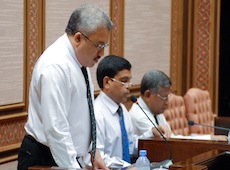
The Supreme Court has issued an order invalidating the decision of Parliament’s Independent Institutions Oversight Committee to not recognise the legitimacy of the Hulhumale’ Magistrate Court.

Former President Mohamed Nasheed is currently facing charges in the Hulhumale Court for the detention of Chief Judge Abdulla Mohamed during the final days of his administration.

The oversight committee this week declared the court illegitimate, claiming it lacked “constitutional and legal grounds” to support its legitimacy.

In an order, (No. 2012/SC-SJ/05) issued on November 28, the Supreme Court declared that no institution should meddle with the business of the courts, claiming that it held parental authority over “constitutional and legal affairs” and would not allow such “interference” to take place.

“Any action or a decision taken by an institution of the state that may impact the outcome of a matter that is being heard in a court of law, and prior to a decision by the courts on that matter, shall be deemed invalid, and [the Supreme Court] hereby orders that these acts must not be carried out,” the order read.

Though the order did not specifically mention the decision by the parliamentary oversight committee, it was issued shortly after the committee’s decision regarding the Hulhumale’ court.

Last Tuesday, the Independent Institutions Oversight Committee,following an issue presented by three sitting MPs, declared there were no “legal grounds” to accept the setting up and functioning of Hulhumale’ Magistrate Court based on the powers vested to the Judicial Service Commission (JSC) under article 159 of the constitution and article 21 of the Judicial Service Commission Act, and based on the articles 53 and 63 of Judicature Act.

The members of the committee claimed there was a lack of any legal reasoning to recommence the works of the concerned court after its work had been suspended for five months after the Judicature Act came to force.

Article 63 of the Judicature Act states: “A Magistrate Court shall be established in all inhabited islands with the exception of Male’ where there are the four superior courts created in accordance with Article 53(b) of this Act and in an island where 4 divisions of these four superior courts are established in accordance with Article 53 (c) of this Act.”

However, the Independent Institutions Oversight Committee in its explanation of the decision stated that the exception of Male’ in the stated article included Hulhumale’, which for administrative purposes is considered a ward of the capital.  The committee argued Hulhumale’ could not be deemed as a separate island to establish a magistrate court.

No one should meddle with the courts: Supreme Court

In quashing the parliamentary committee’s decision, the Supreme Court stated that while the Maldivian constitutional system broadly entertained the principle of separation of powers, no one power of the state can go beyond the limits set out in the constitution.

“According to articles 5, 6 and 7 of the constitution that came to force on 7 August 2008, the Maldivian constitutional system has explicitly set out that the executive power, legislative power and the judicial power is independent from one another and the boundaries of each power being clearly set out, it is unconstitutional for one power of the state to go beyond its constitutional boundaries as stated in article 8 of the constitution,” read the order.

The Supreme Court also in its order maintained that as per the constitution, the judicial power of the state was the sole constitutional authority in settling legal disputes between the institutions of the state or private parties.

“The judiciary established under the constitution is an independent and impartial institution and that all public institutions shall protect and uphold this independence and impartiality and therefore no institution shall interfere or influence the functioning of the courts,” it added.

Not meddling with business of courts – Deputy Chair of Independent Institutions Oversight Committee

Speaking to Minivan News, Deputy Chair of Independent Institutions Oversight Committee MP Ahmed Sameer said the committee was not meddling with the business of the courts, but addressing a constitutional violation carried out by the JSC in establishing an illegitimate court.

Sameer – who is also the deputy leader of Maldivian Democratic Party (MDP) parliamentary group – stated that it was a responsibility of the parliament to hold independent institutions and other bodies of the state accountable, and that his committee was mandated with the scrutiny of actions of independent institutions.

“Initially, when we summoned the JSC to the committee, they refused to talk to us or provide any information to the committee. However, from the documents that the committee received later, we found out that the Hulhumale’ Magistrate Court was formed by the JSC which is a violation of the constitution and the laws,” he said.

Sameer argued that the constitution explicitly states that courts can only be formed by legislation and not “through a vote in the JSC”.

“The committee’s decision was made based on the findings of the inquiry. We have all the documents including the agendas of the meeting and the meeting minutes. It is clear that the JSC had formed and an act that is beyond the powers vested to the commission in the constitution and the JSC Act,” he added.

Sameer claimed that the decision by the committee was binding and no authority can overrule the decision.

“With the committee’s decision, we do not plan to give the budget to the court and works are underway to in drafting an amendment that would specifically state the courts that would be formed under the law,” he said.

Sameer added that the parliament will not tolerate any decision that undermines its constitutional powers and responsibilities.

Arrest of Judge Abdulla

The issue concerning Hulhumale Magistrate Court’s legitimacy came to limelight following the Prosecutor General (PG) filing criminal charges against former President Mohamed Nasheed for the detention of Chief Judge of Criminal Court Abdulla Mohamed in January  2012.

Criminal Court Chief Judge Abdulla Mohamed was arrested by the Maldives National Defence Force (MNDF) on the evening of Monday, January 16, in compliance with a police request.

The judge’s whereabouts were not revealed until January 18, and the MNDF acknowledged receipt but did not reply to Supreme Court orders to release the judge.

Then Home Minister Hassan Afeef subsequently accused the judge of “taking the entire criminal justice system in his fist”, listing 14 cases of obstruction of police duty including withholding warrants for up to four days, ordering police to conduct unlawful investigations and disregarding decisions by higher courts.

Afeef accused the judge of “deliberately” holding up cases involving opposition figures, barring media from corruption trials, ordering the release of suspects detained for serious crimes “without a single hearing”, and maintaining “suspicious ties” with family members of convicts sentenced for dangerous crimes.

The judge also released a murder suspect “in the name of holding ministers accountable”, who went on to kill another victim.

Nasheed’s government subsequently requested assistance from the international community to reform the judiciary. Observing that judicial reform “really should come from the JSC”, Foreign Minister at the time, Ahmed Naseemm said that the JSC’s shortcomings “are now an issue of national security.”

The judicial crisis triggered 22 days of continuous protests led by senior opposition figures and those loyal to former President Maumoon Abdul Gayyoom, which eventually led to the controversial toppling of Nasheed’s administration on February 7.

The PG’s Office filed charges based on the investigations by Human Rights Commission of Maldives (HRCM) on the arrest, which concluded that Nasheed was the “highest authority liable” for the military-led detention of Criminal Court Chief Judge Abdulla Mohamed.

Along with Nasheed, the report concluded that the former president’s Defence Minister, Tholhath Ibrahim Kaleyfaanu, was a second key figure responsible with others including Chief of Defence Force Moosa Ali Jaleel, Brigadier Ibrahim Mohamed Didi and Colonel Mohamed Ziyad.

Charges were also filed against all of those which the HRCM investigation report identified as responsible for the arrest in Hulhumale’ Magistrate Court.

Hulhumale Magistrate Court and legitimacy

During the first hearing of the trial, ex-president Nasheed’s lawyers took procedural points challenging the legitimacy of the court, but were rejected without justification. Nasheed’s legal team’s appeal challenging the legitimacy was initially rejected by the High Court claiming that it cannot look into a matter that was already being heard in Supreme Court.

However, the High Court later granted Nasheed an injunction temporarily suspending the trial of the former president at the contested Hulhumale’ Magistrate Court.  The injunction is pending a ruling on procedural points raised by the former President’s legal team.

Following the injunction, Hulhumale’ Magistrate Court has announced that it had suspended all ongoing cases.

In its announcement, the Hulhumale’ Magistrate Court said it has suspended proceedings on cases involving marriage, divorce, guardianship, family matters, property lawsuits, civil cases, criminal cases involving extension of detention periods as well as other matters that could be affected by the questions raised over its legal status.

Following the High Court’s injunction granted to Nasheed, the JSC filed a case in Supreme Court asking it to look into the legitimacy of the court. The Supreme Court then instructed the High Court to halt its hearings on the appeal.

Supreme Court had previously ordered the Civil Court to send over all files and documents on a case submitted by a lawyer, Ismail Visham, over a year ago challenging the legitimacy of the Hulhumale’ Magistrate Court.

The Supreme Court on November 19, held the first hearing of the case concerning the legitimacy of Hulhumale’ Magistrate Court and Ismail Visham was decided as the respondent of the case.

Nasheed’s legal team also intervened in the court case. Nasheed’s lawyers stated that the case involved the interests of the former president as his case regarding the detention of the Chief Judge of Criminal Court Abdulla Mohamed is heard by Hulhumale’ Magistrate Court.

Meanwhile, several prominent figures have raised doubts over the legitimacy of Hulhumale Magistrate Court.

Former Chairman of the Constitutional Drafting Committee of the Special Majlis, Ibrahim ‘Ibra’ Ismail, in an article in his personal blog stated – “The [Hulhumale’ court] was created by the Judicial Services Commission (JSC) without authority derived from law. Therefore the validity of any order or judgement issued by this court is questionable, and the constitution says no one has to obey any unlawful orders, i.e, orders which are not derived from law. Therefore, President Nasheed’s decision to ignore the summons has more than reasonable legal grounds.”

Ismail further writes that no court has the power, under any law, to issue a travel ban on a person without ever summoning them to court.

He also stated that there was ample to room to believe that the courts were acting with a bias against Nasheed, owing to a number of other politicians and business tycoons who were repeatedly defying court orders and summons.

Prominent lawyer and Independent MP Mohamed ‘Kutti’ Nasheed – who is also the chair of Parliament’s Independent Oversight Committee – in his personal blog also echoed similar remarks explaining that a magistrate court could not legally be established at Hulhumale’.

However following the Supreme Court’s order, Nasheed told Minivan News said that he “wished to give a considered view soon” but refused to reveal a specific date by which he would respond.

Likes(0)Dislikes(0)

Deputy Minister paid salary with no record of attendance, Tourism Ministry audit report reveals

A Deputy Minister at the Ministry of Tourism, Arts and Culture was paid salary and allowances from April 2011 to January 2012 with no official records of attendance, the ministry’s audit report for 2011 has revealed.

The audit report (Dhivehi) made public on Tuesday stated that a total of MVR 343,351 (US$22,267) was paid to the senior official for 10 months while there was no documentation to show that he “ever attended either the ministry or any office functioning under the ministry.”

The Auditor General recommended recovering the funds and taking action against the responsible staff at the ministry.

While there was no specific regulation governing attendance of political appointees at the time, the Auditor General contended that paying salaries without attendance records was against “the spirit of the public finance regulations.”

In addition, the audit discovered that the ministry gave a temporary license or authorisation to a private company to operate a tourist hotel at the Laamu atoll Kadhdhoo airport in violation of the Tourism Act.

The audit found that the permission was given despite an inspection report finding that the facility did not meet the criteria for a tourist guesthouse in terms of quality of service.

A tourist hotel is ranked higher than a guesthouse, the audit report noted.

Under articles 4, 18 and 19 of the tourism law, the report explained, a tourist hotel could not be operated on the plot at the regional airport.

The hotel was however operated from May 24, 2011 to December 25, 2011 before official permission or a permanent license was sought, the audit report noted.

Local media reported yesterday (November 28) that the guesthouse or hotel was operated by Heavy Load Maldives, a family business of MP ‘Reeko’ Moosa Manik, chairperson of the formerly ruling Maldivian Democratic Party (MDP).

The Auditor General recommended submitting the case to the Anti-Corruption Commission (ACC) for further investigation.

Minivan News is seeking comment from former Tourism Minister Dr Mariyam Zulfa.

The audit report also noted that temporary authorisation or licenses for operating guesthouses were renewed “some times for over a year” while the facilities did not meet the requisite criteria.

Moreover, registration and licenses were provided to some dive centres and guesthouses without collecting registration and licensing fees.

In other cases highlighted in the report, the audit noted that documentation was not properly maintained for equipment such as camera and mobile phones purchased in 2010.

As a result, equipment provided for use by staff was not recovered when the employees left the office.

In addition, the Tourism Ministry did not maintain a detailed income registry with reference numbers and dates as required by the public finance regulations. The regulations require that the registry must be routinely shared with the Finance Ministry.

“However, inquiries for the Ministry of Tourism’s 2011 audit revealed that such a record [of income] was not prepared and maintained,” the audit report stated. “As a result, we note that it could not be confirmed whether the incomes due to the ministry was received in full.”

Offices and departments under the Tourism Ministry

The audit report noted that the Tourism Ministry’s audit for 2011 was conducted without any documentations or financial records from the Department of Information (DOI) operating under the ministry.

Repeated requests for documents from the department went unheeded, the report stated, adding that the financial statement of the DOI was not provided for the 2010 audit either.

On Monday (November 26), the President’s Office announced that the DOI has been abolished as new institutions formed by the 2008 constitutions carries out the functions previously performed by the department.

“Following this change, registration of media; formulating policies and facilitating the development of local media; creating the official Maldives’ calendar; maintaining the registry of journalists and writers; and, representing the Maldives internationally in the press field will be carried out by the Ministry of Tourism, Arts and Culture. Information to international media on local events will be given by the Ministry of Foreign Affairs,” the President’s Office stated.

Meanwhile, concerning the other offices operating under the ministry, the audit found that employees of the Maldives Tourism Promotion Board (MTPB) were paid overtime salaries in violation of the civil service regulations for calculating overtime.

The audit also noted that clothing allowance was paid to all employees in January 2011 in anticipation of overseas trips to attend tourism fairs. However, the allowance was not recovered from two staff at MTPB who did not travel abroad during the year.

An audit of the National Centre for the Arts (NCA) meanwhile revealed that MVR 24,735 (US$1,604) was spent out of the budget on tickets for a lecturer and his family for a “one-day creative writing workshop” on November 19, 2011.

However, an official agreement was not signed between the lecturer and the NCA and there was no documentation at the centre regarding the workshop.

The NCA also spent MVR 33,000 (US$2,140) during a ten-day period on food for 20 staff working on a “Male’ Art Festival” in excess of the approved rate in the public finance regulations. Catering was also arranged without a public announcement after seeking quotations from only two parties, the audit found.

A total of MVR 19,750 (US$1,280) was spent on catering for seven events organised by the NCA in 2010 without seeking quotations from more than one party.

The catering contract was awarded to a particular party at a rate of MVR 50 per person while the public finance regulations specify a rate of MVR 40 per person.

Aside from a note from NCA and catering bills, the audit report noted that no other documentation for the transactions could be found at the NCA.

Likes(0)Dislikes(0)

Jumhoory Party MPs Jabir and Alhan to vote against President in no-confidence motion

MPs Abdulla Jabir and Alhan Fahmy of the Jumhoory Party (JP) – part of the current coalition government – today publicly announced that they will vote against President Dr Mohamed Waheed Hassan in an upcoming no-confidence motion.

During a press conference, held at the People’s Majlis along with opposition Maldivian Democratic Party (MDP) MPs Ibrahim Rasheed and Imthiyaz Fahmy, Jabir and Alhan told local press that they did not have confidence in the current president.  The two MPs claimed they were ready to stand against him, even if the vote was to be taken tomorrow.

Jabir was among a number of MPs and senior MDP figures arrested earlier this month on suspicion of the possession of drugs and alcohol following a raid by police on the island of Hodaidhoo in Haa Dhaal Atoll.

Jabir, his wife Dhiyana Saeed – the former Minister for Gender and Human Rights under the current government – and the MDP have all alleged the arrests were politically motivated.  The charges have been vehemently denied by the President’s Office, which has told media that it had no knowledge of the operation until it had been carried out by police officers.

The arrests have nonetheless been labelled as “very worrying” by a delegation from the Inter-Parliamentary Union (IPU), which late last week claimed it was “difficult” to believe the police raid had not been politically motivated.

Speaking at today’s press conference, MP Alhan alleged that Dr Waheed was threatening MPs because his attempts to make MPs act as his puppets had not worked. He said Waheed had also threatened MPs during public speeches he had given of late.

Local newspapers meanwhile quoted MP Jabir as saying that Dr Waheed should not be kept in his position, reiterating that he did not come to power through an election.

Jabir also revealed plans to forward a no-confidence motion against Home Minister Dr Ahmed Jameel and said that he had already signed the motion.

Earlier in October MDP, filed a no-confidence motion against Home Minister but was withdrawn on November 12 without mentioning a clear reason.

At the same time, a no-confidence motion against Dr Waheed was also submitted to the parliament.

The MDP claimed that the no-confidence motion was submitted to the parliament in response to what it alleged were orders from President Waheed to attack citizens and MDP MPs, and to carry out acts of “inhumanity” on February 8.

The MDP also accused President Waheed of trying to “destroy” the sensitive economy of the nation, claiming that his handling of the economy had destroyed foreign investor confidence in the Maldives.

The motion was filed with the signatures of 26 MPs of Maldivian Democratic Party (MDP) on October 10.

According to article 100 (e) of the constitution, a no confidence vote against the President can be passed with votes from two-thirds of the total numbers of MPs in parliament, which amounts to 52 votes.

Likes(0)Dislikes(0)

Government “cynically used xenophobia, nationalism and religious extremism” to attack foreign investor: former President

Additional reporting by Neil Merrett and Mohamed Naahii

The Waheed government’s decision to void the GMR contract and issue the developer a seven day ultimatum will “put off potential investors for decades,” former President Mohamed Nasheed has said.

“Waheed’s government has cynically used xenophobia, nationalism and religious extremism to attack GMR, the country’s largest foreign investor. Waheed is leading the Maldives down the path to economic ruin,” Nasheed said, following Attorney General Azima Shukoor’s issuing of the ultimatum on Tuesday (November 27) evening.  The ultimatum was made while arbitration proceedings are pending in the Singapore courts.

The government’s party to the 25 year concession agreement – the 100 percent state-owned Maldives Airports Company Limited (MACL) – issued a statement on Wednesday declaring that the company was “now working with stakeholders to take over the operations of Ibrahim Nasir International Airport (INIA) on or before the expiry of the seven days period provided to [GMR] to handover possession of the INIA pursuant to the notice issued by the government of the Maldives and MACL.”

GMR meanwhile yesterday denounced the move as “unilateral and completely irrational”.

“We have no plans to go. We have 23 more years here,” GMR’s Head of Corporate Communications Arun Bhaghat told Minivan News.

CEO of INIA, Andrew Harrison, told Minivan News that the airport’s 1700 staff were “quite concerned” and “not exactly jumping for joy”.

The company had held several meetings with staff following the announcement and called on them to ensure continued smooth operation of the airport while the legal team was working to resolve the issue.

“People who have seen their businesses improve since GMR took over have been calling me up expressing support,” Harrison noted.

The company had received no communication from the government apart from the notice issued yesterday, he added.

The Indian government was quick to back GMR yesterday following the announcement by its Maldivian counterpart, noting that the company was awarded the deal “through a global tender conducted by the International Finance Corporation (IFC), a member of the World Bank.”

“The IFC has stated that it has complied with Maldivian laws and regulations and followed international best practices at each step of the bidding process to ensure the highest degree of competitiveness, transparency and credibility of the process,” said the Ministry of External Affairs.

The Indian government added that it was prepared to take “all necessary measures to ensure the safety and security of its interests and its nationals in the Maldives.”

Surprisingly, GMR’s stock showed an upward trend following the government’s announcement.

Traders on one broker’s website predicted that stock was reacting positively due to the Indian government’s quick defence of the company and the prospect of significant compensation for the infrastructure developer following arbitration proceedings.

“Stock will definitely react in a positive manner as it has now become a matter of national prestige,” predicted one trader on Indian finance portal, Moneycontrol.

The Maldives’ decision was widely derided in the Indian media. Forbes India suggested that “the decision to send the Indian consortium packing has brought into focus the risk of doing business in emerging markets with rapidly changing political landscapes.”

“India Inc has had its share of relatively minor `law and order’ problems in its journey into Africa and a few brushes with shifting goalposts in places like Indonesia and Russia. But being thrown out after signing a 25-year, supposedly iron-clad international contract, is a first,” Forbes observed.

Locally, the Progressive Party of the Maldives (PPM) of 30 year autocrat Maumoon Abdul Gayoom praised the government’s move as “important for protecting the rights of Maldivian citizens”.

“It is PPM’s hope that the government’s decision to terminate the agreement with GMR will not affect the historic friendship between the governments and people of the Maldives and India,” the PPM said in statement.

The largest party in the ruling coalition, the Dhivehi Rayyithunge Party (DRP), was more reserved.

“The government should act responsibly and according to the legal contract,” said DRP MP Dr Abdulla Mausoom. “The consequences of government decisions should not adversely affect the lives of the Maldivians.”

The 2191-member Dhivehi Qaumee Party (DQP), which during the Nasheed administration filed the Civil Court case outlawing the airport development charge (ADC) stipulated in GMR’s concession agreement which deprived MACL of airport revenues and cost the government several million dollars, praised President Waheed as a national hero.

“[The] decision will be noteworthy in the history of this country,” DQP Leader and President Waheed’s Special Advisor, Dr Hassan Saeed, was reported as saying in local media.

“No one would expect such a decision to be made by a country that heavily relies on India. But Waheed has decided what is best for his country,” said Saeed. “President Waheed will be remembered in the years to come.”

Saeed earlier wrote to Indian Prime Minister Manmohan Singh urging him to terminate the Maldives’ airport development contract with GMR, warning of rising fundamentalism and anti-Indian sentiment should he fail to do so.

“I want to warn you now that there is a real danger that the current situation could create the opportunity for these extremist politicians to be elected to prominent positions, including the Presidency and Parliament on an anti-GMR and anti-India platform,” Saeed informed Singh.

“That would not be in the interests of either the Maldives or India. You are well aware of the growing religious extremism in our country,” Saeed warned the PM.

Seven day stand-off

GMR has shown no interest in complying with cabinet’s direction and has expressed confidence in the professionalism of the Maldives National Defence Force (MNDF) and its assignment to protect the airport, raising speculation as to how far the government would be willing to go to enforce its decision to void the concession agreement and reclaim INIA.

President’s Office Media Secretary Masood Imad told Minivan News on Wednesday that the government’s role had “solely been to advise MACL to take control of the site.”

“We are not engineering any handover [of the airport],” he said. “What we have done is just given our opinion after being advised that [terminating the contract] was the proper thing to do.”

GMR has responded that it did not recognise a legal basis for the government’s decision while the arbitration is still ongoing in the Singaporean courts, stating that it would continue to manage and oversee development at the airport for the remaining 23 years of its tender agreement.

Masood claimed that any decision to retake the airport would be “the responsibility” of MACL.

“Well I suppose if MACL decide to terminate the agreement and the company hasn’t moved, procedures are in place for the MACL to address these issues,” he said, forwarding further inquiries to MACL Managing Director Mohamed Ibrahim.

Ibrahim however told Minivan News he was “not willing to disclose anything at this moment.”

Likes(1)Dislikes(0)

Tourism growth slowed to less than one percent in 2012: Finance Ministry

The government’s forecast for economic growth in 2013 is 4.3 percent, following a slowdown to a projected 3.4 percent in 2012, according to an economic and fiscal outlook by the Finance Ministry introducing the state budget (Dhivehi) proposed for next year.

Tourism was especially hard hit in 2012, with growth falling from 15.8 percent in 2010 and 9.1 percent in 2011, to an expected 0.7 percent in 2012.

The original forecast for economic growth in 2012 was 5.5 percent.

An International Monetary Fund (IMF) mission said in a statement earlier this month that economic growth slowed to three and a half percent this year on the back of “depressed tourist arrivals earlier in the year and weak global conditions,” which have been “only partially offset by strong performance in construction and fisheries-related manufacturing.”

The IMF mission forecast “a modest recovery” for 2013 and beyond.

The Finance Ministry’s statement on the economic outlook for the next three years meanwhile explained that the Maldivian economy dipped into recession in 2009 following the global financial crisis in the previous year.

However, the economy rebounded with 7.1 percent growth in 2010 and 7 percent in 2011.

“While [real GDP] was projected to increase in 2012, the main cause of the economic slowdown compared to 2011 was the weakening of the tourism sector during the year,” the Finance Ministry stated.

While the tourism industry grew by 15.8 percent in 2010 and 9.1 percent in 2011, the industry’s growth in 2012 was expected to be 0.7 percent.

The two main reasons cited by the Finance Ministry for the anaemic growth were “the political turmoil the country faced in February” and a decline in the average number of nights tourists spend in the country “as a result of a decline in the average number of days a tourist spent in the Maldives.”

On average, tourism accounted for 28 percent of GDP during the past 10 years.

The main drivers of growth in 2012 were a booming construction industry and growth in manufacturing and fisheries.

Fisheries, manufacturing and construction

The volume of fish catch has been steadily declining for the past seven years. While approximately 185,000 tonnes of fish were caught in 2006, the number dropped to about 70,000 tonnes in 2011.

During the past five years, the value of the fisheries industry declined from MVR 489 million (US$31.7 million) to MVR 321 million (US$20.8 million) with a corresponding fall of 3.3 percent of the economy to 1.1 percent in 2012.

As a result of opening up the country’s Exclusive Economic Zone (EEZ), the industry’s productivity was expected to rise by 9.7 percent in 2012.

However, as fishing in the Indian Ocean was not expected to improve in coming years, the Finance Ministry has forecast the real GDP of the fisheries sector to decline by 1.3 percent in 2013.

Estimated real GDP for the manufacturing industry – fisheries products, foodstuff, furniture and cement – was meanwhile MVR 998 million (US$64.7 million) in 2012, up from MVR 850 million (US$55.1 million) the previous year.

Fisheries-related products accounted for the largest share of the manufacturing industry.

Following 19 percent growth in 2011, the construction industry was expected to have grown by 16 percent in 2012.

“The main reason for the large growth of the sector in 2011 and 2012 was the development of new resorts in 2011,” the Finance Ministry observed, adding that resort development accounted for 50 percent of construction in the Maldives.

Meanwhile, in the retail and import business sector, customs statistics for the first eight months of 2012 showed that the value of goods imported (adjusted for inflation) was 22 percent higher than the same period in 2011.

The real GDP of the business sector in 2012 was an estimated MVR 875 million (US$56.7 million).

Deficit and debt

The Finance Ministry also revealed that nominal GDP in 2011 was MVR31,447 million (US$2 billion) while the estimate for 2012 was MVR34,148 million (US$2.2 billion).

Real GDP in 2011 was MVR20,461 million (US$1.3 billion). Nominal GDP per capita in 2012 was estimated to be MVR 80,260 (US$5,206) per annum.

Real GDP measures the value of all goods and services produced in a country expressed in the prices of a base year – 2003 in the Maldives.

According to the Finance Ministry, the medium term target of the government was meanwhile reducing the fiscal deficit “to pave the way to conduct social and economic programmes” and regain the confidence of international financial institutions.

While a budget deficit of 9.7 percent was forecast 2012, the Finance Ministry said the figure was expected to reach 12.6 percent of GDP by the end of the year.

“The projected deficit in the estimated budget proposed for 2013 is 6.1 percent of GDP,” the Finance Ministry stated. “In the medium term, the budget deficit can be lowered to 1.9 percent of GDP in 2015.”

The Finance Ministry proposed MVR 1.1 billion (US$71.3 million) as foreign loans and MVR 1.1 billion (US$71.3 million) as domestic finance to plug the budget deficit in 2013.

While tax revenue from T-GST, GST and import duties collected in 2012 was lower than forecast, the Finance Ministry revealed that income from Business Profit Tax (BPT) was 80 percent higher than expected.

At the end of 2012, the government would have received MVR 1.3 billion (US$84 million) as BPT while the forecast was MVR763.6 million (US$49.5 million).

Presenting the 2013 budget to parliament on Monday, Finance Minister Abdulla Jihad said revenue forecast for 2013 was MVR 12.9 billion (US$836 million), including MVR 1.8 billion (US$116 million) expected as a result of implementing proposed revenue raising measures.

However, most of the proposed measures – such as hiking T-GST and introducing GST for telecom services – would have to be approved by parliament through amendments to the relevant laws.

More than MVR 200 million (US$12.9 million) was estimated as GST receipts from telecom services in 2013.

The Finance Ministry also revealed that the ‘total external public and public guaranteed debt’ was estimated to reach MVR 13.7 billion (US$888 million) in 2012.

Of the MVR 4.1 billion (US$330 million) of the loan assistance spent in 2012, more than 50 percent was from multilateral financial institutions and 28 percent from bilateral donors.

A total of MVR 1.9 billion (US$123 million) from loan assistance has been spent for various projects in 2012 while the rest was spent for budget support.

As of September 2012, MVR 561 million (US$36.4 million) has been received as budget support – US$16 million from the Asian Development Bank and US$20 million from a standby credit facility extended by the Indian government.

Moreover, the government spent more than MVR 1 billion (US$64.8 million) in 2011 and MVR 1.1 billion (US$71.3 million) in 2012 to service foreign debts as interest and repayments.

The figure was expected to remain the same in 2013.

In addition, the government spent MVR 660.5 million (US$42.8 million) in 2011 and MVR 2 billion (US$129.7 million) in 2012 to service domestic debts.

The figure for domestic debt was expected to decline to MVR 1.1 billion (US$71.3 million) in 2013 as payment for US$ 100 million of government bonds sold to the State Bank of India in Male’ – amounting to MVR 771 million (US$50 million) as repayment for a second tranche – has been pushed back to 2014.

Similarly, repayment of three ways and means treasury bonds to the Maldives Monetary Authority (MMA) or central bank amounting to MVR 951 million (US$61.6 million) has also been pushed back.

Government spending on loan repayment and interest payments was expected to reach MVR 3.1 billion (US$201 million) in 2012.

Including an estimated MVR 13 billion (US$843 million) in domestic debt, the total public debt is expected to reach MVR 27 billion (US$1.7 billion) in 2012 and MVR 31 billion (US$2 billion) in 2013 – 82 percent of GDP.

Likes(0)Dislikes(0)

Comment: And the killer is…

This article first appeared on DhivehiSitee. Republished with permission.

The government knows who killed MP Afrasheem Ali.

The Minister of Home Affairs Mohamed Jameel Ahmed has appeared in the media twice in the last week to repeat the claim. Both times he stopped short of sharing the knowledge with the public.

The first time was on 24 November, when Haveeru reported Jameel as saying “MP Afrasheem’s murderer has been found”. The only thing he shared with reporters, however, was his incredulity that the murder had been premeditated in great detail. He observed gravely:

This is a matter of serious concern.

In another Haveeru piece, on the same subject the same day, Jameel also implied that the murder involved  politicians with money and violent gangs of disaffected youth, all with the potential to be hired hit men. Again, he chose not to reveal who was involved in the suggested assassination.

Although Jameel said the killer has been found but, according to Police Commissioner Abdulla Riyaz, the investigation is ongoing. He was on-message with Jameel, though, when it came to government policy for sharing information with the public:

…details will be revealed as soon as it is time to reveal them.

From the very beginning, the murder of MP Afrasheem has been more than about the murder of MP Afrasheem. Within hours, he was being eulogised as ‘one of the greatest scholars we have ever seen’. His funeral was a State sponsored spectacle, aired live on ‘TVM’. Afrasheem’s family was invited to the Majlis so he could be honoured and his beneficiaries financially compensated.

When investigations began, the FBI was reported to be helping. Until now, however, the only visible sign of FBI’s involvement has been a typical ‘information leading to the arrest’ reward worth MVR50,000.

This is not to say the FBI has not been of any use to the government. President Waheed is holding up FBI involvement as the reason people should believe in the impartiality of the investigation.

“When agencies like these are involved, you can be sure it’s all very professional,” he said recently. Good for Waheed that not many Maldivian government supporters have heard of General Petraeus, or of the FBI  and the Patriot Act.

With or without FBI help, the police took into custody six people in connection with the murder. Several were MDP activists. None of them have been charged, but their detention period continues to be extended every 15 days. Only one person arrested after the murder, Mariyam Naifa, was released. The police never gave a reason for her arrest, and imposed extra-legal conditions on several personal liberties before freeing her.

Then followed a period of almost complete silence about the murder. It was ‘broken’ in late October, with this  news briefing which revealed:

…200 items are being investigated in the forensic lab and more than 300 hours of CCTV footage have been collected as evidence.

Apart from this, the only things police could confirm with certainty were that Afrasheem had been murdered, and that the body was really Afrasheem’s.

The police also used the news conference to announce a change of approach to their investigations. Whereas previous cases had emphasised speed—as in lawyer Najeeb’s case—now the emphasis would be on caution. This was an emphatic sign that police were going to take their own sweet time telling the public what happened.

Then, on 11 November, former President Mohamed Nasheed very publicly criticised the investigation. MDP followed Nasheed’s speech with a request for a parliamentary review of the investigation. It was as if a sleeping dog had been kicked in the balls. Jameel quickly deviated from the official line of ‘this can take forever’ to declare ‘the killer has been found.’

This also when his press conferences began to sound like a promotional gig for a Hitchcock movie. He has since appeared several times to tell the public he knew, but was not telling, who killed Afrasheem.

This morning, Haveeru  ran a new update of the non-story. Jameel is very ‘disconcerted’ by former President Nasheed’s remarks that he thinks police are biding their time in order to pin the murder on an MDP member. Nasheed also said he suspects that ‘the right time’ will be as close to the by-election on 1 December to elect Afrasheem’s replacement as possible.

Jameel dismisses Nasheed’s accusations as dangerous impediments to justice. Here is in the words of Haveeru, what Jameel said next:

Jameel further added that the people of Ungoofaaru must secure Afrasheem’s seat in Parliament to a member of his party and described it as a duty of the Ungoofaaru constituency people.

Did he really say that it was ‘the duty’ of the people of Afrasheem’s constituency, his home island, to make sure PPM retained its seat? Straight after dismissing Nasheed’s allegations that he is attempting to influence the election?

As always, Haveeru lent support to the government line with an opinion piece asking people to see MDP’s accusation of bias in the investigation in the same light as their accusations of bias against CoNI. That is to say ‘baseless’.

This is part of the government’s plan all along to pre-empt any criticism of the results when they are finally rolled out. Waheed had begun preparing for just such an eventuality by referring to the FBI presence as ‘proof of integrity’. Any criticism of the investigation from now on could and would be labelled as ‘the unreasonableness of MDP.’

Whatever about the motive of Afrasheem’s killer, it has been clear from the beginning that it is politics dictating the official response to his killing.

All comment pieces are the sole view of the author and do not reflect the editorial policy of Minivan News. If you would like to write an opinion piece, please send proposals to [email protected]

Likes(1)Dislikes(0)

Cabinet voids US$511 million GMR contract, gives airport developer seven day ultimatum to leave

Additional reporting by Neil Merrett and Mohamed Naahii.

The Maldivian cabinet has declared the agreement with Indian infrastructure giant GMR to develop Ibrahim Nasir International Airport (INIA) void, and has given the company a seven day ultimatum to leave the country.

“The government has given a seven day notice to GMR to leave the airport. The agreement states that GMR should be given a 30 day notice but the government believes that since the contract is void, it need not be followed,” said Attorney General (AG) Azima Shukoor.

During a press conference on Tuesday evening, Shukoor stated that the government reached the decision after considering “technical, financial and economic” issues surrounding the agreement.

The attorney general claimed the government had obtained legal advice from “lawyers in both the UK and Singapore as well as prominent local lawyers – all who are in favour of the government’s legal grounds to terminate the contract.”

“We also got advice from both local and international lawyers in the Maldives Airports Company Limited (MACL),” she added.

Shukoor said the government had two legal grounds to terminate the contract: one in which the government believed the contract was ‘void ab initio’ – meaning to be treated as invalid from the outset; and the second being ‘frustration’, an English contract law doctrine which acts as a device to set aside contracts where an unforeseen event either renders contractual obligations impossible, or radically changes the party’s principal purpose for entering into the contract.

“The contract is governed by the English contract law. The government believes that the agreement is void ab initio meaning the contract was void from the beginning or the contract is frustrated,” she said.

She added the termination of the agreement was a “purely legal decision” and did not have any connection with the recent series of anti-GMR protests headed by the religious Adhaalath Party (AP).

The decision was, Shukoor insisted, made “professionally” and after “thorough research”.

Shukoor also claimed the government was going to initiate the arbitration process in Singaporean Courts and had already informed its decision to both GMR and MACL.

Asked how the government planned fund the estimated US$700 million in compensation for terminating the contract, Shukoor declined to speak of the sum of money but expressed “full confidence” in winning a court battle.

“We were advised by very professional lawyers including Queen’s Counsels (QC). We have full confidence in winning the case,” she said.

“We do not intend to share all our legal arguments in this press conference. Please do respect that decision,” she added.

“Completely irrational”: GMR

GMR has slammed cabinet’s decision as “unilateral and completely irrational”.

“This unlawful and premature notice on the pretext that the concession agreement is ‘void’ is completely devoid of any locus standi and is therefore being challenged by the company before the competent forums. The company disputes that the concession agreement is ‘void’,” GMR said in a statement.

“The company would further like to state that it has taken all measures to continue operations at the Ibrahim Nasir International Airport thereby ensuring that this vital gateway to Maldives is kept open.

“We would also like to inform all that this action by the government of the Maldives is in complete disregard of and has been done during the pendency of arbitration proceedings in the designated tribunal in Singapore. We are therefore taking all measures to ensure the safety of our employees and safeguard our assets. We are confident that the stand of the company will be vindicated in every way.”

Speaking to Minivan News, GMR Executive Vice President & Group Head of Corporate Communications, Arun Bhaghat, said the only reason for the decision as stated in the government’s letter was that the airport development charge had been ruled unleviable by the Civil Court, and therefore the entire contract was void.

In late 2011 the then-opposition Dhivehi Qaumee Party (DQP) filed a successful Civil Court case blocking GMR from charging an Airport Development Charge (ADC) – a US$25 charge for outgoing passengers stipulated in the concession agreement – on the grounds that it was a tax not authorised by parliament.

Nasheed’s administration chose to honour the original contract, and instructed GMR to deduct the ADC revenues from the concession fees due the government, while it sought to appeal the Civil Court ruling.

However, the Nasheed government fell a month later and the opposition inherited the result of its court victory, receiving a succession of bills from the airport developer throughout 2012, despite the government’s insistence that the January 5 letter from MACL outlining the arrangement was no longer valid.

In the first quarter of 2012 the government received US$525,355 of an expected US$8.7 million, after the deduction of the ADC. That was followed by a US$1.5 million bill for the second quarter, after the ADC payable eclipsed the revenue due the government.

Combined with the third quarter payment due, the government now owes the airport developer US$3.7 million.

“The net result of this is that the Maldivian government now has to pay GMR for running the airport. On this basis it is likely that the Maldivian government will end up paying about MVR 8 billion (US$519 million) to GMR for the duration of the contract,” wrote Dr Hassan Saeed, DQP Leader and President Mohamed Waheed’s Special Advisor, in a recent appeal to Indian Prime Minister Manmohan Singh calling on him to cancel the Maldives’ agreement with GMR and warning the Indian PM of “rising extremism” as a result of the GMR deal and anti-Indian sentiment.

GMR attempted to compromise by offering to exempt Maldivian nationals from the ADC, with GMR Chairman G M Rao personally mailing Waheed with the offer, but claimed to have received no response from the government.

“This is by far the single largest foreign investment in the Maldives at US$511 million – in today’s figures, 40-50 percent of the Maldives’ GDP,” observed Bhaghat, adding that the company was supremely confident of defending its legal position.

“We have no plans to go. We have 23 more years here,” he said, vowing that the cabinet’s decision would have “no effect” on the operation of the airport.

“The defence force in this wonderful country is well geared to ensure smooth operation of the airport,” Bhaghat told Minivan News.

India backs GMR: “All necessary measures”

The government of India “proposes to monitor the situation in Maldives closely and is prepared to take all necessary measures to ensure the safety and security of its interests and its nationals in the Maldives,” India’s Ministry of External Affairs has meanwhile said in a statement.

“We have noted the decision by the Government of Maldives to terminate the agreement with the GMR Group to manage the Male International Airport. It would be recalled that the consortium consisting of GMR and MAHB (Malaysian Airport Authority) had been awarded the contract to manage the Male’ International Airport concession through a global tender conducted by the International Finance Corporation (IFC), Washington, a member of the World Bank.

“As the Advisor to the Government of Maldives, the IFC has stated that it has complied with Maldivian laws and regulations and followed international best practices at each step of the bidding process to ensure the highest degree of competitiveness, transparency and credibility of the process,” the statement read.

“The investment by GMR represents the single largest foreign direct investment in the history of Maldives. The decision to terminate the contract with GMR without due consultation with the company or efforts at arbitration provided for under the agreement sends a very negative signal to foreign investors and the international community. The Government of India would continue to remain engaged with the Government of Maldives on this issue, and would expect that the Government of Maldives would fulfil all legal processes and requirements in accordance with the relevant contracts and agreement it has concluded with GMR in this regard.”

“Destabilising the country”: MDP

The Maldivian Democratic Party (MDP) has meanwhile accused cabinet of destabilising the country by attacking foreign investment and supporting “extremist” rhetoric.

“This decision is bad for tourism, bad for the economy and bad for the Maldivian people,” said former President Mohamed Nasheed.

“Waheed’s government has cynically used xenophobia, nationalism and religious extremism to attack GMR, the country’s largest foreign investor. This will put off potential investors for decades. Waheed is leading the Maldives down the path to economic ruin,” he stated.

MDP MP and Spokesperson Hamid Abdul Ghafoor told Minivan News that disputed contracts could be unravelled through a legal process, but said the executive’s decision to void the contract and evict the country’s single largest foreign investor was not backed by any law.

“If cabinet has now decided to revoke the contract, who is going to execute the order? The contract is bound under international law. The case is still being heard by a court of arbitration in Singapore,” Ghafoor said.

“Will police be executing this order to reclaim the airport, or will it be Islamist elements? This is an executive decision that is being taken without any legal or political backing.”

Maldives National Defence Force (MNDF) Spokesperson Colonel Abdul Raheem said the military was “not involved” in the airport issue: “We will however, continue to take care of security [at the site] and look after it,” he said.

Police Spokesperson Sub-Inspector Hassan Haneef told Minivan News that any decision to enforce the decision would have to be directed by the President’s Office.

Decision prompted by “extremists”

Ghafoor claimed that threats of direct attacks on foreign investors reflected what he was the growing role of extremist Islamic thinking within the most senior decision making of the present government.

Raising concerns over the legality of voiding the GMR contract, Ghafoor pointed to recent comments in local media by the government-aligned religious Adaalath party, whose president Sheikh Imran Abdulla was yesterday quoted as threatening to “invade the runway” should the government not renege on the airport agreement.

“The deal was done very transparently, and [the government] have never been able to prove any wrongdoing,” Ghafoor claimed. “Yet, what is most worrying is that we have the cabinet of what we believe is an illegitimate government that is being influenced by extremist influences.”

Ghafoor alleged that the government’s decision over the GMR issue was being driven by former President Maumoon Abdul Gayoom’s Progressive Party of Maldives (PPM), Adhalaath Party President Sheikh Imran and fellow party member and Minister of Islamic Affairs, Sheikh Mohamed Shaheem Ali Saeed.

“We are now seeing the government partnering with and backing the rhetoric of a movement led by an Islamist group, it is very apparent what is going on here,” he said.

MP Ghafoor further claimed that parliament had, as of this evening, received no information on the decision to renege on the GMR agreement, adding that several no-confidence motions against senior government figures including President Waheed were scheduled.

“What is going on right now is a shift in parliament,” he said.

Ghafoor also claimed that beyond the potential legal and economic ramifications of reneging on the sovereign agreement with GMR, rumours of a Chinese intermediary stepping in to cover possible financial consequences could significantly affect the Maldives internationally.

“In terms of geopolitics, we are hearing about a Chinese connection to the [airport issue] that does not put the country in a comfortable position,” Ghafoor claimed. “Ideologically and culturally we have much closer ties to India than China.”

Returning from a visit to China back in September, President Dr Mohamed Waheed Hassan told reporters that Chinese aid to the Maldives would not be limited to a US$500million (MVR7.7billion) loan finalised earlier this year.

Waheed revealed at the time that the Chinese government had pledged to make all necessary aid available to the Maldives, including assistance with road and shipping development, local media reported at the time.

Regarding China’s view on Maldivian politics, Waheed noted that the Chinese were amongst the first nations to recognise his unity government.

“The Chinese Prime Minister personally told me that he had full confidence and support for the Maldivian government,” Waheed was reported as saying.

However, the Maldives government this evening dismissed suggestions that China would be taking a role in any future airport development.

“On this matter, China is as far away from the airport development as is physically possible,” said Presidents Office Media Secretary Masood Imad.

Troubled airport agreement

The agreement with the GMR-Malaysia Airports Holdings Berhad consortium was signed on June 28, 2010 with the Nasheed administration, following a bidding process conducted by the World Bank’s International Finance Corporation (IFC).

The GMR-MAHB consortium narrowly beat Turkish-French consortium TAV Holdings-Aéroports de Paris Management (ADPM), scoring a final Net Present Value (NPV) score of 495.18 to the runner up’s 454.04 at conclusion of the bid.

GMR’s win was based on playing to the government’s highest-scoring factors – fuel share revenue and upfront payment – at the expense of non-fuel related airport revenue.

As part of its successful bid, GMR paid the government US$78 million and 1 percent of non-fuel revenue and 15 percent of fuel revenue for 2011-2014, increased to 10 percent and 27 percent respectively for 2015-2025. The developer at the time anticipated that additional services and duty free development for the country’s well-heeled clientele, as well as the Maldives’ tourism growth potential, would offset the risks of the higher fuel share.

Opposition parties at the time the agreement was signed – and are now in government following February 7’s controversial transfer of power – first opposed GMR’s development of the airport on nationalistic grounds, and then levelled numerous allegations against the company ranging from corruption to concerns that the deal would allow Israeli bombers to refuel en route to bombing Arab countries.

Further protests occurred in December 2011 after GMR ceased renewing lease agreements of several existing airport duty free operators, notably duty-free liquor store Alpha-MVKB.

The High Court upheld at the time that since GMR had given notice on March 1, 2011 and, as per the agreement, the contract had been terminated on March 31. The court concluded that MVK had no right to remain at the airport without approval from GMR, and began packing up the store’s contents on December 4. Following the eviction, MVK CEO Ibrahim Shafeeq accused GMR of breaking into his shop and stealing his stock, and then launched a ‘Go Home GMR’ protest.

As tension with the developer increased, President Waheed’s cabinet attacked the IFC as “irresponsible” and “negligent” in conducting the bidding process.

The IFC denied the accusations, stating that its advice was geared towards achieving the “objective of upgrading the airport and ensuring compliance with applicable international regulations” and providing the Maldives government “with the maximum possible revenue”.

The stand-off escalated in early August 2012 following a stop work order on the new terminal development, after the government alleged certain planning permissions had not been obtained from the Civil Aviation Authority.

Likes(0)Dislikes(0)

JP MP Abdulla Jabir “confident” as secret voting for no-confidence motions passed again by Committee

Jumhoree Party (JP) MP Abdulla Jabir has revealed he is “confident” that the vote on secret balloting for no-confidence motions against the President will pass in parliament.

The Kaashidhoo MP’s comments follow Parliament’s General Committee’s decision to pass the proposed amendments to establish secret voting.

The same amendment was voted on just over a week ago in parliament, but was defeated by a narrow margin of 34 to 39 votes.

The proposed amendment to Article 167 of the Standing Orders states that secret ballots should be taken at the parliament and parliament committees for removing the President, Vice President and members of independent institutions from office.

General Committee Chairman Abdullah Abdul Raheem said that the bill was passed today with four votes in favour, out of the nine MPs present at the meeting. The remaining MPs did not participate in the vote.

The amendment was filed by Maldivian Democratic Party’s (MDP) Maanfannu-dhekunu MP Ibrahim Rasheed, who stated there is an importance to establish an independent and secure environment for members of parliament during voting.

JP MP Jabir further iterated the need for protection of MPs when voting, alleging that President Mohamed Waheed Hassan Manik is “unlawfully” operating the country and that the secret vote will protect MPs from abuse.

“I am confident [the vote] will pass, especially with all the developments that have taken place since the last vote. This brutal executive of the government that Waheed is operating is a military government now, and he is why this vote is being made,” Jabir told Minivan News.

MDP International Spokesman and MP for Henveiru South Hamed Adbul Ghafoor believes that the proposed amendment will obtain the full 39 votes, alleging that “cracks” are appearing in the Dhivehi Rayyithunge Party (DRP).

“The Progressive Party of Maldives (PPM) also voted to make the ballot secret at committee stage, and the parties who were involved in the coup are now becoming unstuck, we will get out 39 votes this time,” Ghafoor claimed.

“Politically motivated attempt to disrupt parliament  ahead of the vote”: MDP

A number of MPs were arrested prior to the previous vote on secret balloting, in what opposition parties alleged was an attempt to disrupt parliament ahead of the vote.

In a police raid on the island of Hondaidhoo in Haa Dhaal Atoll, both Jabir and Ghafoor were detained along with several opposition figures including former SAARC Secretary General and Special Envoy to the former President, Ibrahim Hussain Zaki, former Press Secretary Mohamed Zuhair and his wife Mariyam Faiz, for the alleged possession of alcohol.

Police claimed to have found large amounts of “suspected” drugs and alcohol upon searching the island.

The arrests were made “based on information received by police intelligence,” police said. Sub-Inspector Hassan Haneef told Haveeru that the suspects were arrested with alcohol and “hash oil”.

Following the arrests made around midnight, the suspects were taken to Kulhudhufushi in Haa Dhaal Atoll, and Zaki was hospitalised.

Despite a police attempt to extend the detention periods, both Jabir and Ghafoor were released by the Kulhudhufushi Magistrate Court.

In an investigation into allegations of police brutality towards MPs, a delegation from the Inter-Parliamentary Union (IPU) revealed that they found it “difficult” to believe the arrested MPs were not targeted for political reasons.

Philippine Senator Francis Pangilinan from IPU’s Committee on Human Rights of Parliamentarians, said: “The circumstances of the arrest are very worrying. An impressive team of unidentified police and an army of officers allegedly carried out the arrests, reportedly without a warrant and ill-treated the MPs.

“We are well aware that the consumption of alcohol and drugs is forbidden in the Maldives, but we find it difficult to believe in light of the circumstances and timing of the arrests that the parliamentarians were not targeted for political reasons.”

Days prior to the secret voting motion, DRP MPs Mohamed Nashiz and Ali Azim were ordered to appear in court over Funaddoo Tuna Products’s failure to repay loans worth MVR 117 million (US$7.5 million) to the Bank of Maldives.

Allegations made by DRP MP Ali Azim claim that the president and other senior members of the executive had approached him, offering to cancel the court summons if he agreed to vote for the secret balloting in a way they preferred.

Azim alleged that in addition to Waheed, his Political Advisor Ahmed Thaufeeq and Spokesperson Abbas Adil Riza had called him and made similar statements.

The court order was later cancelled, on the grounds that the judge presiding over the case was out of the country.

Likes(0)Dislikes(0)

State budget of MVR 16.9 billion for 2013 presented to parliament

Finance Minister Abdulla Jihad submitted an annual state budget of MVR 16.9 billion (US$1 billion) for 2013 (Dhivehi) to parliament today, proposing a raft of measures to raise revenue and reduce spending.

Of the proposed MVR 16.9 billion of government spending, more than 70 percent was recurrent expenditure, Jihad noted in his budget speech (Dhivehi).

“As in other years, the highest portion of recurrent expenditure is expenditure on [salaries and allowances for government] employees,” Jihad explained. “That is 48 percent of total recurrent expenditure.”

As total expenditure would outstrip projected revenues of MVR 12.9 billion (US$836 million), Jihad said the resulting deficit would be plugged with MVR 971 million (US$62 million) as budget support and MVR 1.3 billion (US$84 million) from Treasury bill (T-bill) sales.

Of the MVR 971 million in budget support, MVR 671 million (US$43 million) was expected as foreign loan assistance, Jihad explained, with the rest to be made up from “domestic finance.”

New measures proposed to raise revenue is expected to account for MVR 1.8 billion (US$116 million) in income, Jihad said.

Jihad further claimed that the budget deficit at the end of 2013 would be MVR 2.3 billion (US$149 million), half the deficit in the current year.

On revenue forecasts, Jihad revealed that income from taxation would account for MVR 9.1 billion (US$590 million) while MVR 3 billion (US$194 million) was expected from other sources, such as resort lease rents, dividends from government companies and profits from the Maldives Monetary Authority (MMA).

On social and economic programmes, Jihad said MVR 2.5 billion (US$162 million) was allocated to the education sector, MVR 1.7 billion (US$110 million) for strengthening the judiciary, MVR 1.5 billion (US$97 million) for improving health services, MVR 2 billion (US$129 million) for social security and welfare and MVR 5.5 billion (US$356 million) for infrastructure projects in the atolls.

A public sector investment programme (PSIP) was formulated with MVR 3.1 billion (US$201 million), Jihad said, with MVR 1.5 billion (US$97 million) from the state budget, MVR 21 million (US$1.3 million) from domestic loans, MVR 1.2 billion (US$77 million) as foreign loans and MVR347.6 million (US$22.5 million) as free aid.

The PSIP projects include construction and repairs of harbours in 14 islands, establishing sewerage systems in 11 islands, water systems in three islands, 1,500 housing units in eight islands, 21 new mosques and upgrading the regional hospitals in Kulhudhufushi and Addu City to tertiary level.

Meanwhile, according to the latest figures from the Finance Ministry, government spending as of November 22 stands at MVR 10.9 billion (US$706 million), while revenues of MVR 8.5 billion (US$551 million) have been collected so far this year.

Jihad said in parliament today that total spending in 2012 is expected to be MVR 16.5 billion (US$1 billion) while revenues would be MVR9.4 billion (US$609 million).

The revenue forecast in the 2012 budget was however MVR 11 billion (US$713 million).

“At the end of 2012, the state’s budget deficit is estimated to be at MVR 4.3 billion (US$278 million). That is 12.6 percent of GDP,” Jihad revealed.

Revenue raising and cost-cutting measures

A recent mission from the International Monetary Fund (IMF) urged the government to implement a raft of measures to raise revenues, advising that strengthening government finances was “the most pressing macroeconomic priority for the Maldives.”

Finance Minister JihadEchoing the IMF concerns, Jihad told MPs that rising public debt was “a major challenge to the country’s economy,” revealing that the state’s debt would increase to MVR 31 billion (US$2 billion) by the end of 2013 – 82 percent of GDP.

If the deficit spending trend continues, Jihad warned that the Maldives would face severe difficulties in securing development loans and financial assistance.

Taking the IMF recommendations on board in formulating the budget, Jihad proposed a number of revenue raising and cost-cutting measures,

  • Review government subsidies to target assistance to the needy
  • Freeze hiring “as much as possible”
  • Reforming the universal health insurance programme ‘Aasandha’
  • Reducing the number of councillors and board members of government companies
  • Reducing expenditure for trips from government offices to the atolls
  • Reduce government expenditure on rent for government offices
  • Reduce overseas trips by government employees
  • Amending the Pension Act to abolish “double pension”
  • Reversing import duty reductions
  • Hiking T-GST (Tourism Good and Services Tax) to 15 percent from July 2013
  • Introducing GST for telecom services (currently exempt from the tax)
  • Introducing GST for oil
  • Increasing airport service charge for foreigners from $18 to $30
  • Amending the law on revenue stamps
  • Abolishing 22 loss-making government companies

Jihad appealed to MPs to approve the measures and warned of “bitter consequences for the whole nation” should deficit spending continue in the future.

The Finance Minister urged MPs to “put aside political differences and prioritise national interest” in recognising that the country could not “indefinitely” spend beyond its means.

“We have to accept that these measures will affect all of us to some extent,” he said. “However, if we do not begin taking these measures, we might have to face more severe difficulties as a result of steps we would be forced to take.”

Monetary policy

According to projections by the MMA, said Jihad, the current account deficit is expected be higher than 2012 by 15 percent.

The current account deficit is projected to widen to 28 percent of GDP in 2013, Jihad said.

Collaborative efforts from different sector would be needed to “solve the balance of payments problem facing the country,” Jihad added, as the imbalance in the foreign exchange market has been building for many years, resulting in a parallel or “black market” for dollars.

Policies have been proposed to increase exports and expand small businesses, Jihad said.

Following the submission of the budget today, a joint committee of the parliament’s Finance Committee and Economic Committee would convene to review the proposed budget before it is put for a vote.

The budget debate has meanwhile been scheduled for December 4, 5 and 6, Speaker Abdulla Shahid said today.

Likes(0)Dislikes(0)