Majlis standoff stalls roadmap talks; Commonwealth, UN call for dialogue to continue

Former President Maumoon Abdul Gayoom’s Progresive Party of the Maldives (PPM) has joined the Dhivehi Rayithunge Party (DRP) in withdrawing from the roadmap talks, after Maldivian Democratic Party (MDP) MPs blocked President Mohamed Waheed Hassan from addressing parliament on Thursday.

The session was eventually cancelled, after Speaker Abdulla Shahid – a DRP MP – was repeatedly blocked from entering the chamber.

While a seven point agenda had been agreed during the Indian-sanctioned cross-party roadmap talks last week – including early elections as a discussion point – the parties had been unable to agree on an order of preference.

Local media had reported that the meeting was “heated” due to the participation of Indian Foreign Secretary Ranjan Mathai, with representatives of some parties expressing their “dismay” at the Indian government “interfering in the domestic affairs of the country and trying to rush towards an early election.”

The MDP meanwhile issued a statement reiterating its support for the roadmap and a peaceful solution to the crisis, but placed an early election date as a precondition to continued progress – both in the talks, and parliament, which it contends Dr Waheed has no right to address as an “illegitimate” president.

“In-line with the Inter-Parliamentary Union and others, we understand the importance of dialogue, especially in the Majlis, as a means of resolving the political deadlock in the country,” said the party’s spokesperson, Hamid Abdul Ghafoor.

“However, we also believe that in order to have a focused dialogue inside and outside parliament there must be a clear commitment by Dr. Waheed to elections by a certain date during 2012. When that date is announced, all parties can and must work together to ensure the conditions are set for the conduct of those elections. MDP will certainly play its part in that regard.”

Ghafoor also expressed regret over “isolated incidents of violence both by and against protesters and at any injuries caused. MDP again calls on all those participating in protests to do so peacefully and within the law and to show maximum restraint.”

International community responds

United Nations Secretary General Ban Ki-Moon issued a statement, expressing “concern about the continued political tensions in the Maldives, which were manifested today in actions that impeded the opening of the Maldives’ parliament.”

“The Secretary-General urges all parties concerned to resume immediately their political dialogue, both in and outside parliament, in order to find a mutually agreeable way forward on the basis of the Constitution and without jeopardizing the democratic gains achieved thus far in the Maldives,” the UN said in a statement.

Commonwealth Secretary-General Kamalesh Sharma also issued a statement expressing concern over disruption of parliament, urging for a “swift and dignified State Opening of the Majlis so that pressing national needs can be debated and advanced.”

While freedom of assembly and freedom of expression are core Commonwealth values, so too is constitutional democracy, including respect for the dignity of office-bearers appointed under the constitution and enabling those office-holders to perform their responsibilities fully and freely.

“Parliament is the heart of a democracy. The Commonwealth finds it unacceptable that the State Opening of the Majlis of Maldives has been disrupted, and the offices of the President and Speaker have been seriously disrespected,” the Commonwealth said in a statement.

“While freedom of assembly and freedom of expression are core Commonwealth values, so too is constitutional democracy, including respect for the dignity of office-bearers appointed under the constitution and enabling those office-holders to perform their responsibilities fully and freely.”

The Commonwealth has meanwhile appointed Sir Donald McKinnon as Special Envoy to Maldives, following consultations with political leaders in the country.

“These are very serious times for Maldives. Cooperation and a shared sense of national interest are required, as well as restraint. Our Commonwealth Ministerial Action Group is understandably deeply concerned, and is committed to working with Maldives in a constructive and positive way. The Commonwealth at large is fully committed to assisting Maldives,” said Secretary-General Sharma.

“Maldives has committed itself to the Commonwealth’s values and principles, which include constitutional democracy, the rule of law and separation of powers, and human rights. Our principles include consensus and common action, mutual respect, legitimacy, transparency and accountability. These are the foundations on which an enduring, prosperous and peaceful future for Maldives can be built.”

“I am delighted that Sir Donald has agreed to serve as my Special Envoy. He will visit Maldives to promote the consolidation of democratic culture and institutions, and Commonwealth values and principles; to encourage inclusive agreement among political leaders on a way forward from the current political situation; and, to oversee further Commonwealth support for Maldives, including a new technical assistance programme aimed principally at strengthening the judiciary.”

Sir Donald McKinnon is a former Commonwealth Secretary-General from 2000-2008, and former Deputy Prime Minister and Minister of Foreign Affairs of New Zealand.

During his tenure as Secretary-General, he led the Commonwealth’s support for Maldives’ transition to multiparty democracy. He previously brokered a peace accord in Bougainville, Papua New Guinea, for which he was nominated for the Nobel Peace Prize.

He was also decorated with the highest award in New Zealand (Order of New Zealand), and awarded the Knight Grand Cross of the Royal Victorian Order by Queen Elizabeth II.

Political stasis threatens tourism

Ongoing political instability threatens the tourism industry, the Maldives Association for Travel Agents and Tour Operators (MATATO) has said, issuing a statement expressing concern that tourists “will have apprehensions about visiting the Maldives if the ongoing political unrest and demonstrations turn violent.”

“A democracy will have protests, tourists know that too, and the resorts in Maldives are situated separately and far from the capital Male and other inhabited islands, so protesting wouldn’t harm the tourists,” said Secretary General of MATATO Mohamed Maleeh Jamal.

However ongoing political strife had smeared the peaceful image of the holiday destination, he said, and emphasised furthe efforts to promote the industry.

“Even now tourists who come to Male are seeing the protests, some refuse to visit Male’ and souvenir shops and guest houses located in Male have suffered because of it,” Jamal said.

Widespread media coverage of the country’s political unrest could cost the tourism industry as much as US$100 million in the next six months, the Maldives Association of Tourism Industry (MATI) has warned.

“Various allegations such as the installation of an Islamic regime, possible enactment of full Sharia law and Anti Semitic remarks made by politicians at public gatherings have also caught the attention of the international press,” MATI stated.

While the resorts are largely segregated from the rest of the Maldives, the crisis – prompted by a change in government on February 7 in what the MDP contends was a police and military-backed coup d’état – has already impacted investor confidence and foreign aid, and is threatening sensitive markets such as China.

Likes(0)Dislikes(0)

Criminal Court extends detention of 61 arrested protesters

The criminal court has extended the detention period of 61 protesters arrested on Thursday, in opposition to President Mohamed Waheed Hassan giving the presidential address to open the first session of parliament.

Police had arrested 67 protesters on the day, but released six of them later. Minivan News understands that those detained include former President Mohamed Nasheed’s brother, Nazim Sattar.

The Maldivian Democratic Party (MDP) called on police to immediately release of the detainees last night. MDP in a press statement stated: “The families of the detained are extremely concerned and some of the families have suffered psychologically following the arrests of the detainees.”

MDP also called on the courts to make their judgements freely and impartially to ensure the people’s trust in the judiciary was not tarnished any further.

“The detention extension issued by the courts regarding the protesters who had been arrested was against legal principles,” said member of MDP’s legal team and Chairman of the MDP Legal Affairs Committee, Ahmed Abdullah Afeef, in a press conference held by MDP on Friday night.

Afeef also stated that the detention extension had been carried out “unfairly”, and alleged that the whole process had been “pre-planned” before the protesters were even taken into the court.

“Police had no evidence to prove to the court that there was a legitimate reason to extended the detention periods. The actions of the criminal court imply more of a personal vendetta rather than an impartial decision,” said Afeef.

Afeef observed that during protests that took place during December 2011 under Nasheed’s government, police had sought the detention of several protesters, providing photo and video evidence proving attacks on police, but the criminal court had rejected it and released those detained.

Afeef said that the party would appeal the decisions of the Criminal Court and said the case would be filed in High Court today. Afeef also added that High Court has said that they will hold a hearing today.

Speaking to Minivan News today at the High Court building, Afeef said: “What we are trying to say is that there maybe people amongst the protesters who should be arrested, but it has to be done based on evidence.”

“As a principle, the judge would not know what happened at the protests. Decisions from a judge should come based on evidence. Here in this case, the police could not provide any evidence, but yet still the judge issued the detention extensions,” he said.

Sub-Inspector Ahmed Shiyam told Minivan News today that 61 people arrested during the protests are in police custody, “all of them had arrested attempting to break through police lines, or attacking police officers. We have evidence and the investigation process is going on currently. We will submit that evidence to the authorities as well,” Shiyam said.

Fourteen police officers were injured on Thursday in skirmishes with demonstrators, some of whom threw rocks at officers. Four were seriously injured, and one officer was flown to Sri Lanka for further treatment.

Minivan News also observed police in riot gear cracking down protesters near the Reefside Shop in Chaandhanee Magu, without advance notice. Three protesters were taken into custody at the scene.

Questioned about the incident, Shiyam said that the people who are currently arrested were those who had “attacked the police officers”, that the others had been released.

The High Court was yet to announce the appeal hearings at the time of press.

Likes(0)Dislikes(0)

Q&A: Al Jazeera interviews President Dr Mohamed Waheed Hassan

Al Jazeera’s 101 East program has conducted an in-depth interview with new President of the Maldives, Dr Mohamed Waheed Hassan. The original interview can be seen on Al Jazeera’s website. The transcript below was provided by Al Jazeera.

Fauziah Ibrahim: Let’s start with the events on Feb 7 when President Nasheed resigned. He says that it was under duress. Was it a coup?

Dr Mohamed Waheed: It wasn’t a coup. It’s been portrayed in the Western media as a coup d’etat. But the president resigned voluntarily. We have pictures of him having a Cabinet meeting following which he writes his own letter of resignation. And in front of the television camera, he announced he was resigning with his Cabinet standing behind him. He could have indicated even indirectly even if he was under duress. He didn’t. It took 24 hours before he changed his mind. I am convinced that he resigned voluntarily.

FI: Doesn’t it disturb you though that your presidency is being challenged and being undermined by these accusations?

DMW: Of course these are unfair accusations. We were totally unprepared, it took us by surprise. And therefore, we could not get our message across to the rest of the world, to tell them about our understanding, to tell what actually happened. He had the machinery already in place because all these people were appointed by him from his party only. And therefore all shifted with him to his house and began the media campaign to show to the rest of the world it was a coup d’etat. It wasn’t a coup d’etat, if you think it was do you think he would be out here talking to you and everybody else? You know there’s no restriction on his freedom and he is moving around. We have a democracy and we are respecting it. We welcome an independent investigation to find out exactly what happened. We will not be in the way of finding out the truth.

FI: We have seen footage of security forces out on the streets; we have seen people demanding for the resignation of the then president Nasheed. Mainly these people have been the security officers. That’s what we are seeing from the video. Also, we have video footage of your current defense minister entering the barracks and then coming out of the barracks demanding the President’s resignation. We see him also in the President’s office just before and just after the resignation. Now, at that point he was just a civilian. Why was a civilian given so much privilege access?

DMW: I have no idea because I was not part of what happened that day.

FI: Did you know this was going to happen?

DMW: No, absolutely not.

FI: But you met with opposition parties before this happened.

DMW: The opposition call for his resignation has been going on for a very long time. For almost three weeks we had serial demonstrations every night in Male, calling for the President’s resignation for various reasons. And when this thing happened, nobody expected this to happen. My understanding of the issue was that the president was issuing unlawful orders to the security forces and at some point, they decided that enough was enough and they were not going to listen to him. And that’s when he decides that he was going to submit his resignation. But he changed his mind afterwards.

FI: Why do you think he changed his mind? Why do you think he is now saying it was a coup?

DMW: I think he just lost it. He lost it and realised what a blunder he had made. Maybe this was a trick he was playing on the people; I don’t know. But he resigned voluntarily and in front of the camera. He could have said under the circumstances, I am being forced to resign, but he didn’t. He didn’t give any indication, any clue. He could have called me and said “Waheed, I am being forced to resign.”

FI: What would you have done?

DMW: I would not have taken the oath of office if he had said that. He should have called me, he didn’t. He called some of the ambassadors in this country asking for help, he called some of his party members, and he called the rest of the Cabinet in his office but he didn’t talk to me.

FI: Why do you think he didn’t call you, is because he didn’t trust you?

DMW: We haven’t been talking for a while except in the….

FI: Is it because he thought you were not part of his plans in the Maldives?

DMW: We all fought for democracy in the country. It was not a reversal. I was part of the democracy movement as well.

FI: It does seem like a reversal though now that you have appointed this particular civilian, a retired colonel as the defense minister, you have appointed Mohamed Jameel Ahmed Home Minister both of whom are known as supporters of ex-President Gayoom. You have also appointed Dunya Maumoon who is Gayoom’s daughter as the state minister of foreign affairs. Are we about to see Maldives slide back into dictatorship here?

DMW: I have also appointed to the Cabinet people from seven other parties. I am trying to form a national unity government. I want everyone to participate.

FI: But everyone is looking at the security forces and they are saying the people who head this security forces are Gayoom’s supporters.

DMW: That is not true. The Home Minister is not from Gayoom’s party. In fact, the current Home Minister was in Nasheed’s government. President Nasheed came to power in a coalition. He was unable to win by himself. We brought in other parties and we won the election. But soon after the elections, he decided to go back on his words. And get everybody out of the government. The Home minister was one of them and what we saw progressively after that was a gradual reversal of democracy. The head of state began doing things that were unconstitutional like locking up the supreme court, arbitrarily arresting political leaders and detaining them without charge, and finally we have this very bizarre situation where the president orders the military to arrest a serving judge.

FI: During these events, you served as vice-president. Did you object to his actions?

DMW: Yes, I objected and advised the president that it was not the way to go about it.

FI: Did he take your advice?

DMW: He does not take anyone’s advice. He is not somebody who takes people’s advice.

FI: Why didn’t you as vice-president then resign?

DMW: I spoke out; I said this is not the way to do things. I don’t particularly like these people or the judge, I don’t know him. This is not the way to go about it. There are constitutional ways where these things have to be done.

FI: Do you trust the judiciary in the Maldives?

DMW: I trust the judiciary but it has its problems.

FI: What sort of problems?

DMW: There are problems in the sense that it has to be strengthened like in the use of modern evidence; I would like to see that the judiciary becomes more independent; that they have more resources.

FI: It has been said that the judiciary in the Maldives cannot be trusted and it is corrupt and basically supports the Gayoom regime?

DMW: No, no, no. This is not rue. The Supreme Court was appointed by the president himself. He was the one who nominated the Supreme Court judges.

FI: When you took office, several high profile officials overseas resigned. Among them are the Maldivian ambassador to the UN who went live on Aljazeera, the High Commissioner to the UK also resigned, the Deputy High Commissioner who happens to be your own brother also resigned. He said he did not know why you were favouring Gayoom. He warned you not to join the people of the autocratic ruler Gayoom. How do you feel when you are being connected to the former dictatorial regime?

DMW: The High Commissioner and the deputy high commissioner who happens to be my brother were all appointed by Nasheed. Their loyalty is clearly with the former president. Most of the educated people in this country were educated in the last 30 to 35 years. And out of that, former President Gayoom ruled this country for about 30 years. So it is very difficult to find people here who have not served with President Gayoom or who have not been with this government. If you look at the closest people to former President Nasheed you will find that there were a lot of people with him were also with former President Gayoom and his government. So it is an unfair accusation that I am taking particularly side with Gayoom. That’s not true; of course I want all political parties to be involved in a political process. Therefore, it is also proper that we must bring people from his party in.

FI: Do you not think that the specter of Gayoom looms large over Maldives and this is why you have this political turmoil now?

DMW: Not entirely. Of course Gayoom is a factor because he got 40 percent of the votes in the last election. You know, he still has some support. The man has got to be given a little bit of respect.

FI: Do you want him to be here?

DMW: If he wants to that is his right. But there are other political leaders in the country now. There are other political parties here now. They all want to be part of the political process, not to be alienated. We need to have an inclusive process in which more political parties must be involved. We simply cannot swipe all the other parties off. This is the problem.

FI: It’s certainly very honorable that you want a unity government, that you want all the parties together in order to progress the Maldivian democracy. However it’s also been said there are larger powers than you who are the machinations behind what is happening in the Maldives. You are merely a puppet. Now what do you say to that.

DMW: No, this is not true. Because I have said, I have my terms on my coalition partners who are now coming into the government. What I am saying is that you guys nominate the people and I will put them into the Cabinet. It’s my choice where I put these people. And I also don’t want them to talk to me about the vice-president’s post because that has to be somebody who I choose and somebody who I think is not involved in politics and so on. I believe that is very important this time to build confidence in the government, in the political process. The best I can do at the moment is to facilitate the process that brings people together and create some healing. There are some deep rifts in politics in the Maldives at the moment and the way to go forward is not violence, or not coming out on to the streets. The only violence that has happened here is because of former President Nasheed. There is no other violence here.

FI: Much of the current political turmoil started in September last year (2011) when the Islamist group Adhaalath left Nasheed’s coalition saying that he was not doing enough to strengthen Islam in the Maldives. Do you think Islam needs to be strengthened in this country?

DMW: This is a Muslim country. Of course there will be some political parties that will promote Islamic values. This is also true in other countries. Even in Western countries there are political parties which espouse religious values. So as a Muslim country, you shouldn’t be surprised that there are one or two parties that will talk about this. You must understand in the Islamic world there is a whole range of views on what an Islamic society should look like. And in this country and in my Cabinet, we have a range of views. Most of the people in this country are educated. We have a 96 percent literacy rate and most of our young people have gone abroad and studied in Western universities. We have emulated liberal democratic values in our country.

FI: And yet there is a rising growing Islamic fundamentalist movement in this country as well. Do you think Shariah law will work in the Maldives as some are calling for?

DMW: You see, even now our legal system is based on the Shariah and the civil law.

FI: Do you think full shariah law should be or can be implemented in the country?

DMW: Well, it is for our parliament to decide. That’s what a democracy is all about.

FI: I put it to you that perhaps democracy does not work in the Maldives. We have seen Gayoom’s dictatorship end after 30 years. Then we have seen Nasheed come in and try o implement democracy. You are alleging that he was dictatorial in some of his ways. Perhaps democracy does not work in the Maldives because this is a country that bases itself on personalities rather than policies. Is this right?

DMW: This is what we are trying to change. We started a journey of a democracy and we want this to be on the path. These are some of the challenges that we face. But we are increasingly moving towards a society where first of all we uphold our constitution, we respect the rule of law and then we don’t have people who practice dictatorial methods. We have independent institutions, we have the human rights commission, the anti-corruption commission and an independent auditor general and so on. They have to be empowered to make sure there are enough checks and balances so that people don’t go in on autocratic directions.

This is a struggle, and this struggle did not start only in 2008. It started a long time ago and we all have suffered in the process and therefore we have a stake in succeeding in democracy. And democracy will continue, there is no doubt about it. I have no doubt that democracy is for all of us. It is not only a Western concept. We have grown up with these values and we want to live with these values. We want to live ion a democratic free society and I think it can be done in Maldives. But people have to give in a little bit, you every time you don’t like something that happens you can’t go out on the streets and start pledging and burning places. This is a more advanced country; we have more educated people here. It’s a peaceful place and we cannot give this kind of shock to the people in this country. It’s not fair.

FI: Mr President, thank you for speaking with us.

DMW: Thank you.

Likes(0)Dislikes(0)

Richard Branson calls for early elections “as soon as feasibly possible”

Founder of the Virgin empire, multi-billionaire Sir Richard Branson, has again delved into Maldivian politics with a third blog post on the subject, declaring his support for early elections “as soon as feasibly possible”.

Branson first wrote an open letter calling on “interim” President Dr Mohamed Waheed Hassan to “do the right thing” and hold free and fair elections before the end of the year, describing it as “completely astounding that you have been part of an overthrow of a democratically elected government that has effectively let the old regime back into power.”

Several days later he had a phone call with Dr Waheed, and subsequently said he believed the new president was “determined to be an honest broker” who “had nothing to do with [the coup]. He watched the situation unfolding on television.”

Branson’s third and most recent post came after “a lengthy conversation with former President Mohamed Nasheed”, who “wanted to be sure that it was completely clear what had happened in the Maldives.”

“Mr Nasheed said that he had been overthrown by a coup. He said that the confusion about what happened in the first two days came about because he was forced to remain in the Presidential Palace in order to keep him away from the press, was therefore incommunicado, and only managed to escape after a couple of days,” Branson wrote.

“He said that he was very concerned the Maldives could become another Afghanistan. He believes that the way to resolve this is for interim President Waheed to step down and for The Speaker to hold court for two months.
He said he sees no reason why there shouldn’t be early elections during this calendar year, preferably within two-to-three months. The people of this country, he said, need to be asked as soon as possible who they want to rule them. The Maldives and the Maldivians urgently need to get back on track.

“He believed that there was is Islamic element of the military and mentioned that some of them chanted on the street “God is great”. He said that the new government had thrown out all human rights cases and corruption cases, which he felt was wrong. He said that some of his MPs had been removed, others had court cases brought against them.

“He ended by saying: ‘Governments should only be changed through the ballot box and not by any other means. No military in the world should be allowed to take over a Government and hold on to it.’

“We now have both sides of the story,” Branson declared.

“Having listened to both sides, it does seem wise for an election to take place as soon as is feasibly possible so that the people of the Maldives can begin to put this ugly chapter behind them.”

Branson attended the Slow Life Symposium at the upmarket Soneva Fushi resort in October 2011, a highly eco-conscious resort owned by Sonu and Eva Shivdesani.

Other attendees at the resort included actress Daryl Hannah, star of films including ‘Blade Runner’, ‘Kill Bill’ and ‘Splash’; Ed Norton, star of films including ‘Fight Club’ and ‘American History X’; Tim Smit, founder of the Eden Project; Maldives President Mohamed Nasheed; and an array of climate experts and scientists including Mark Lynas and Mike Mason.

Likes(0)Dislikes(0)

“Dark day in constitutional and parliamentary history”: Dr Jameel

The government has responded to the Maldivian Democratic Party (MDP) MPs’ preventing President Mohamed Waheed Hassan from giving the annual presidential address on March 1, in a press conference on Thursday.

Special Advisor to the President Dr Hassan Saeed, Home Minister Dr Mohamed Jameel and Attorney General Azima Shukoor, criticised the acts of the MPs, labeling them “uncivilised” and “unethical”.

“President Waheed went to the Majlis at 10:00am and had waited until 6:30pm to execute his constitutional duty,” said Dr Saeed. “He faced enormous challenges and obstruction [from MDP MPs] during this time but tried his best to resolve the situation peacefully until the last minute.”

Dr Saeed said that although he could not deliver his speech in the parliament, he had shared a written copy of his speech with the speaker and members of parliament would have received a copy of it by now.

“After requests from MDP MPs, the President met with them and they did make some proposals. The President, as the head of the state, even acknowledged those proposals but it all went astray at the end of the day,” Dr Saeed said.

“One proposal the MPs made was that instead of political parties negotiating on early elections, they wanted parliament to decide on the matter,” he added.

“The events that happened [in the Majlis] were uncivilised and unethical given the developed era we live in today.”

Home Minister Dr Jameel described Thursday as a “dark day in constitutional and parliamentary history” of the Maldives and acknowledged the patience and determination of the security forces in handling the situation.

“Security forces [police and MNDF] handled the situation with great patience and determination. Many officers sustained various degrees of injuries while controlling the protesters,” Dr Jameel said.

“14 officers sustained injuries, four of which were serious. One officer is still in a critical condition and is being prepared to be flown to Sri Lanka for additional care,” he continued.

He emphasised that the government would take action within the boundaries of the law against everybody who had obstructed the duties of the police, including those currently in police custody.

Dr Jameel noted that after investigation of those arrested, police had found that some of the suspects had tested positive for drugs after urine tests.

“We are now getting evidence that there are unlawful activities going on in the demonstrations held by the MDP,” he claimed.

Attorney General Azima Shukoor stated that she did not believe Dr Waheed had failed in executing his constitutional duties since as per the article 84 of the constitution, the first session of the parliament had not convened.

“According to the article 84 of the constitution, as long as the first session of the parliament has not convened, I do not believe that the president has failed in executing his constitutional duty,” she said.

Article 84 states: “At the beginning of the first session of each year at the first sitting, the President shall address the People’s Majlis [Parliament] on the state of the country, and may present proposals for improving the state of the country to the People’s Majlis.”

Shukoor offered assurances that President Waheed would remain determined to execute his constitutional duties and that he remained willing go to parliament and deliver the presidential address if the speaker and the parliament invited him to do so.

Asked how the government could proceed in passing bills and approving the appointment of ministers, if MDP MPs continued to challenge the government’s legitimacy and obstruct government proposals, Dr Saeed responded that “No one should try to take advantage of the President’s approach of negotiating for a peaceful solution, and no one will succeed. The President will do whatever he can in his capacity to deliver peace and order in the country.

“Those who obstructed the President from delivering the speech were not the majority of the parliament. There were 44 other MPs whose rights were deprived by them,” continued Dr Saeed.

“Whether [the MDP] believe it or not, this government is legitimate. It came to power constitutionally.

“Even if there are questions of legitimacy, this is not the way things have to be done. The international community, including the Commonwealth, have recognised the Commission that the government formed to investigate questions regarding that arose regarding recent events,” continued Saeed.

Dr Jameel said: “The actual answer to the question [you] asked is, we are seeing the behavioral differences between two political groups of the country. That is, since the beginning if anything that goes the way the MDP does not want, they always blame the institutions and the heads of those institutions.

“For instance, look at the example when the court issues a verdict in the case of MP Ismail Abdul Hameed or MP Musthafa, [two MPs who lost the seats recently]. [They claimed] the courts were at fault and they did not recognise the courts. MP Reeko Moosa Manik created his own court and issued verdicts. Where in the world does that happen? I am surprised because journalists don’t notice that,” Jameel said.

Jameel went on to state that “They [former government] arrested people the way they want and did not get their custodial period extended, for example the way they arrested me, I think they made a world record by summoning a politician six times in one week to the police station and keeping me very brutally in isolation at Dhoonidhoo island on three occasions just because of an opinion I expressed.”

Jameel continued “Minivan news is a newpaper which advocates freedom of expression as I heard, but even in Minivan News I highlight with regret that I don’t think they had reported this case, also I heard there was a group who advocated for detainees rights but they chose to remain silent when we were arrested, also they went to the court and said that we got orders from above to arrest Jameel. This is what the court said. Because it failed the courts were at fault [for MDP]”

Jameel also said that the Anti Corruption Commission (ACC), Civil Service Commission (CSC) and Attorney General’s office had all been portrayed as at fault because they had issued statements that were against what MDP had wanted.

The police and the Maldives National Defence force had been painted as at fault by the MDP, Dr Jameel claimed, “because they had only asked then government not to issue unlawful orders. So [the MDP portrayed] them as the worst people that ever created. These are examples that can be seen.”

Jameel reiterated that when DRP was in opposition they had “never had hijacked the parliament when the President arrived to deliver the speech.”

Minivan News asked whether the government would continue to seek to negotiate a political solution for the situation, to which Dr Saeed responded: “This government is not a government that will declare war against parliament. If a bill or a policy that the government proposes is rejected by the parliament, we will not arrest MPs for charges of acting against the state. We will not keep MPs on Aarah for 10 days.”

“I assure that even if the most important policy of President Waheed does not pass, he will not take any action against the parliament. Cabinet Ministers won’t resign. He won’t protest in front of the parliament building. We assure you that from President Waheed.”

Dr Saeed also said that the policies Dr Waheed would propose would not be his own policies, or those of the coalition he represents, but would rather be in the best interest of the people. He also stated that Waheed’s policies would “not contradict the oath of the MPs as well.”

Shukoor responding, stating that “In the question of legitimacy, the opposition during Nasheed’s presidency questioned his legitimacy as well. But during that term, the legitimacy was not a problem because the constitution states that for any reason if the president resigns, the vice president would take his place. That’s what is in the constitution.”

“We are speaking of an early election not because we have a legal issue here, nor there is a question of legitimacy of the current government, but to find a political solution. We are calling to amend the constitution for an early election because there are no stipulations that allow an early election to be called.”

“It is very clear. The vice president can remain till the end of the term [after assuming presidency]. It is stated in the constitution so there are no issues of legitimacy here,” she claimed.

“The current president who is in power is the person people voted for in case the serving president was unable to continue his term in any circumstance, so even looking at the political purpose here, there is no question of legitimacy here.”

“When you say a sizable amount of MPs are questioning the president’s legitimacy, I believe the national flag was torn off [in the parliament chamber] not because there was a question of legitimacy of the president, thiswas is very clear. That the speaker was unable to get into the parliament chamber was not an issue concerning the legitimacy of the president.”

Shukoor said that even if the legitimacy question was there, no one should dishonor the national flag as the national flag was legitimate.

During the scuffles in parliament, Minivan News observed from the press gallery that the national flag was knocked over while MDP MPs sought to remove the Speaker’s chair, but was quickly returned to its original position.

Likes(0)Dislikes(0)

Comment: Consensus the only way forward

The Maldivian Democratic Party (MDP) has not served its cause for early polls nor has it covered its democratic credentials with glory when it stalled Male and stopped President Mohammed Waheed Hassan from delivering the customary annual address to Parliament on Friday, March 1.

For their part, the government parties, while commendable as their conduct was in not allowing themselves to be provoked both inside and outside parliament on the occasion, seem to have backtracked on the spirit of the India-facilitated roadmap consensus document on restoration by being vague on early polls to the presidency than when due in November 2013.

The alternative to consensus is utter chaos that Maldives now or ever could ill-afford. That was also the spirit of pragmatism that attended on the Indian concerns for encouraging the roadmap document and subsequent roadmap discussions. Political stability being the touchstone for progress of democracy in any community or country — and Maldives is a combination of both than in most – the roadmap provided for this and more. Or, else, the rest of the world with their vast democratic experience would not have endorsed the Indian initiative to recognise the alternate government of President Waheed after President Nasheed had announced a vacancy through a much-televised resignation, as provided for in the nation’s constitution. Both the US and China were in the list though the latter cannot be called democratic by any stretch of imagination.

Having encouraged defections in a 77-member parliament where it did not have the numbers after the 2009 elections, the MDP cannot complain about democracy-deficiency in the rest of the polity – greater or lesser be its concerns. Having taken to the streets and encouraging individual policemen and MNDF soldiers to join forces for demanding President Nasheed’s exit as numbers would not help his impeachment through a two-thirds vote in Parliament, the present ruling combine cannot blame the MDP for adopting similar tactics to drive home its demand. The consequent deadlock cannot be allowed to hold the nation to eternal ransom, which it will be if parliament does not meet in cooler climes to address irritants and issues which in fact had facilitated democracy-deficit in the first place.

Singing a different tune

The solution lies in between. The ruling parties of the day need to acknowledge that functional democracy is not possible without a parliamentary majority even with an Executive President at the head. The MDP in turn has to acknowledge that with only 34 memb4ers, up from the post-poll 27 but excluding the one disqualified by the Supreme Court after President Nasheed’s exit, it is still short of an absolute majority. At the bottom of the MDP’s problems, both parliamentary and political, while President Nasheed was in office was its failed strategy for the parliamentary elections. The party compromised healthy parliamentary precedents that it should have set, and encouraged questionable prosperity in individual members, which did cause eyebrows to rise when they decided to support the Nasheed Government in the past.

President Waheed’s government cannot continue with the perceived pitfalls from his predecessor’s time and expect to give a government different from that of President Nasheed, and hope to win over the masses (read: voters) ahead of the presidential polls. Having argued that all economic and fiscal measures of the Government would require a parliamentary approval when the MDP Government was in a minority, the anti-MDP group that now backs President Waheed cannot sing a different tune if and when they want to change what they call the ‘faulty economic policies’ of the predecessor, even if only to win over the masses.

The less said about the complexities attending on early elections the better. Having faulted constitutional institutions other than that of the Executive, represented exclusively by President Nasheed and his Cabinet, which in turn was tied down to parliamentary endorsement based on majorities, the MDP now cannot rush the nation into elections, and then complain all over again, if candidate Nasheed were to return to power once more. The alternative to working with the existing institutions at the time would be outright autocracy. The party says it shuns autocracy, and is not tired of referring to Nasheed’s predecessor, President Maumoon Abdul Gayoom, as one – even while the reference otherwise are to people who had once served the latter and have since found a place in President Waheed’s team.

Burden, not a boon?

The MDP needs to cool tempers — not just of its leadership and cadres, who feel indignant and frustrated at what they claim to be the forced exit of President Nasheed. They need time even more for cooling the tensions that had built up between the party, the government of President Nasheed and various institutions and arms thereof. The MNDF and the police force are main components of such a scheme, and without addressing the issues triggered by the ‘mutiny charge’ and frequent changes at the top with them, an MDP President could be a burden to the nation than a boon. The latter, not the former, should be the case, post-poll.

The MDP needs to give the nation and parliament time to rework the institutional framework as they exist, though not time enough for imbibing in them a new sense of purpose and direction expected of them in a democratic scheme. The latter would take a lot more of time, and Rome, after all was not built in day. Putting the cart before the horse will also be a lop-sided approach which could only upset the MDP apple-cart, and the larger cause even more in a fledgling democracy with its inherent and institutional problems that have already shown up for what they are worth — or, not worth.

The inherent problem to post-Gayoom democracy in Maldives owes to the kind of constitution that they all produced in haste in 2008, with the sole aim of getting the incumbent out of their way, and of the nation’s way, as they had thought. That many political parties that are now against the MDP and are thus in the Waheed dispensation, had worked with the MDP to have their way when Gayoom was the sole power-centre. Just because they have fallen out even before the ink on the constitutional document had dried up, they, together with the MDP, cannot expect the inherent institutional inadequacies, to drop out, too.

Today, the MDP still wants to keep the political ghost of Gayoom alive, to try and win another election. It refuses to understand that after three years in office, and wide publicity that a thinly spread-out nation had not seen before, the voter would be judging the MDP by President Nasheed’s tenure, and not by that of his predecessor, per se. The near-dignified conduct of the government parties to the MDP’s street protests and parliamentary behaviour is a silent message that the MDP should be reading, instead. This coupled with the cost of living and dollar-rate are among the issues agitating the voters, and would be more so than democracy issues, as flagged by the MDP, if only after a time from now.

Electoral agenda

At the end of the day, both the MDP and its opponents in government are working on narrow political, rather electoral agendas, and are not on a national manifesto that the constitution still enshrines. The MDP would want to strike the electoral iron when people’s memory is still hot on the democracy and injustice issues that it now flags. The party does not seem to have the confidence to go back to the voters, based on its claims to be a better government than its predecessor. The government parties are also aware of the MDP strategy, and seem to be working with the sole aim of denying the MDP the pleasure of early elections.

The government parties also have the problem of having to decide early on about their own strategy for fresh presidential elections, and would want that date pushed as far back as possible. It would have been a different ball-game had presidential polls come in their natural course. The focus would then have been on President Nasheed and his completed five-year term. The question now is whether they would want to contest the first round of presidential polls independently or collectively, or in different combinations – and re-work their strategies for the second, run-off round, if they are confident of a second round in the first place. The last time round, all anti-Gayoom parties contested alone in the first round, but pooled their votes in favour of Nasheed, the first runner-up to give the latter his first electoral entry into the nation’s politics.

If the parties decide to go it alone now again, political morals dictate that their representatives on an otherwise apolitical Cabinet pull out before the presidential polls. One alternative to the possibility is to talk the MDP into joining what truly should be a ‘national unity government’, as propagated by President Waheed on assuming office, but not necessarily afterward. The other and worse alternative would be for the incumbent President to reconstitute his Cabinet, and yet hope that Parliament would clear the names.

It is a pre-requisite of the times that Parliament clear President Waheed’s team, as the Government parties had insisted upon when President Nasheed was in office. With Independents still holding key to a parliamentary majority, it could mean a lot in terms of compromises, if not corruption charges for purchasing their loyalties, which could at best be issue-based, and for obvious reasons. This is not the kind of democracy that Maldives and Maldivians deserve.

The ruling parties now have to record with appreciation the successive climb-downs that the anguished and aggressive MDP has made since President Nasheed’s exit. The peaceful conduct of successive rallies after the first one 24 hours after the exit had turned violent, should be a case in point. Maldives cannot even afford the police force clashing with the MDP cadres, and contributing to the continuance of peace in political rallies has become a condition-precedent for the Maldivian State to maintain a semblance of order and structure than at any time in the past decades. The alternative could be outright anarchy, and the dividing line is too thin for the nation to strain.

Likewise, the MDP has also begun participating in the roadmap talks, for which it had earlier laid pre-conditions. It may be true that the party has used the talks only to drive home its demand for early polls, and nothing more, it would soon (have to) realise how it needs the rest as they may need the party. Again, it can settle for a continued deadlock the kind of which that started the nation at the face under President Nasheed in 2010. This time round, however, such a deadlock could mean that the presidential polls may not become due until November 2013 — which is against the party’s demands and expectations.

There is a consensus that a new President should have a full five-year term, and not the residual term for which President Nasheed was elected in 2008 and a part of which President Waheed is now entitled under the Constitution. The MDP needs to acknowledge that it needs the rest of them all to have the constitution amended with a two-thirds vote, to facilitate an early election that they want. Not having compromised on issues in Parliament in the past, and having deflected the nation’s focus from one issue to another, the party may now find it difficult to take firm positions on the Roadmap even if in terms of reaching where it wants to reach.

Parliament, and not Male’s street, is the venue, and nothing is going to change inside the Chamber beyond a point by pressures from outside. If that were so, it would have happened even when President Nasheed was in office. Hoping to play the old game and paint President Waheed’s team as a revival of President Gayoom’s ‘autocracy’ has not convinced anyone who mattered elsewhere. It would remain so even more. The MDP, more than the rest, has to learn to work with other elements in a democracy and the government in a democracy. Possibly because they have to live down their ‘autocratic past’, the rest of them all seem to be less judgmental or unit-directional than the MDP.

Learning from others mistakes

It is unfortunate that mischievous sections tended to attribute motives to Indian Foreign Secretary Ranjan Mathai’s reported reference to the Roadmap propositions at the all-party meeting that he was invited to attend by President Waheed, during his second and more recent visit to Maldives after the political crisis blew up in the first week of February. As Indian officials have already clarified and explained, Secretary Mathai was only referring to the roadmap that all of them had agreed upon during his previous visit, and which the all-party conference chair too had circulated for fixing priority. That was the crux of the matter, and not the Indian position, of which there was none.

Coming from the world’s largest and equally complex of democracies, Foreign Secretary Mathai’s prescriptions, if any, would have been the quintessence of the Indian experience and exposure to a scheme that was alien to the shared sub-continental pride and traditions. Maldives can learn from other people’s mistakes. Alternatively, it could learn the lessons by going through the birth-pangs of democracy itself, which the nation anyway cannot avoid after a point, despite external prescriptions to induce pain at appropriate times and extinguish the same on other occasions. It is for Maldives and Maldivians to decide which, what and when they want them -and how, and how much of each. The rest of it all would follow, as if they were a natural course.

The writer is a Senior Fellow at Observer Research Foundation.

All comment pieces are the sole view of the author and do not reflect the editorial policy of Minivan News. If you would like to write an opinion piece, please send proposals to [email protected]

Likes(1)Dislikes(0)

Parliament cancelled after demonstrations by MDP MPs, protesters

Parliament was cancelled after Maldivian Democratic Party (MDP) MPs blocked Speaker Abdulla Shahid from entering the chamber, in protest against an address that was to be given by President Dr Mohamed Hassan Waheed.

At a press conference on Wednesday evening, Shahid said he was unable enter the chamber despite several attempts, and on one occasion had fallen and injured himself. Given the current political tensions, Shahid said he was unable to guarantee the safety of members and had decided to proceed through negotiation, rather than force.

Shahid further condemned MDP’s disruption and said it was unhealthy given the current political climate.

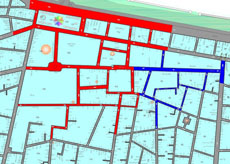
With the exception of the streets around parliament, which were locked down by police and military officers, the streets of Male’ were eerily quiet this morning.

In the narrow alleys around parliament, protesters gathered and put pressure on police lines. The largest demonstration gathered around a group of women, some wearing face masks and goggles, who sat down in front of police at an intersection on Sosun Magu. The small group of police blocking the street to parliament appeared anxious but tolerant, and the mood was peaceful.

Roads blocked by police

Earlier this morning, police reported that four officers were hospitalised with serious injuries after protesters attempted to break through police lines near the Wood Apple and threw stones and poles. A further 10 officers suffered minor injuries before the area was reinforced by the military.

“44 people have been arrested and police have the area controlled,” said Sub-Inspector Ahmed Shiyam. A subsequent SMS from police suggested that some of those arrested were to be tested for possible intoxication.

As of 1:00pm there had been no reports of protesters injured, and Minivan News observed police showing restraint in holding back largely peaceful crowds.

MDP MP sitting on the Speaker's table

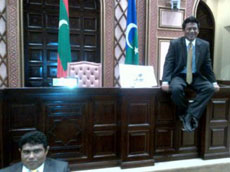
Inside parliament, MDP MPs – who make up 34 of the 77 member chamber, after the Supreme Court disqualified MP Mohamed Mustafa last week – were blocking the Speaker of Parliament, Abdulla Shahid from entering. Images being tweeted by MPs inside showed MDP MPs sitting on the Speaker’s table at the front of the chamber. MPs barricaded the doors and removed the chairs intended for the Speaker and Dr Waheed.

Shahid and a member of the Inter Parliamentary Union (IPU)  reportedly spoke with MPs to try and resolve the stand-off, while Haveeru reported that Indian High Commissioner D M Mulay was seen leaving the parliamentary office.

Telephone and internet connections inside parliament were reported to have been cut.

MDP made the decision to obstruct Dr Waheed’s address after the India-sanctioned ‘roadmap’ talks failed to produce an election date. A week of talks had established a seven point agenda, which included setting an election date and discussing necessary constitutional reforms, but no order of preference was agreed in yesterday’s meetings.

Rhetoric from key government figures, including Dr Waheed, has meanwhile suggested that they favour elections as normal in 2013. The MDP maintains that Mohamed Nasheed was ousted in a bloodless coup on February 7, and that Dr Waheed’s government is illegitimate.

Updates:

1:21: President Waheed’s Press Secretary Masood Imad said Dr Waheed remaining inside parliament waiting for the opportunity to give his address, but said MDP MPs had occupied the chamber and were obstructing the chamber.

2:20: Crowds in the streets outside parliament heated but non-violent. Chief of Defence Force Major General Ahmed Shiyam and Police Commissioner Abdulla Riyaz are reportedly conducting a meeting inside parliament, along with some members of Dr Waheed’s new cabinet.

2:55: The United States Embassy in Colombo has issued a statement expressing concern at the “disorderly protests in Malé and disruption of the opening session of the Majlis.”

“The US attaches great importance to our friendly relations with Maldives. We have welcomed the efforts of all sides to participate in a dialogue on a democratization process that could create the conditions for early elections. As the Majlis session opens, the United States encourages all parties to continue to work collaboratively and peacefully toward a solution as agreed with the Roadmap document, and not allow violence to further complicate the situation. The United States will continue to support Maldives in this process, and we stand ready to provide technical assistance on elections. In the interests of all Maldivians, we urge the parties to work together in a constructive and cooperative manner to reach agreement.”

5:30: A press conference has been called in parliament.

5:50: Spokesperson for India’s Ministry of External Affairs, Syed Akbaruddin,  said at a press conference that India’s “Foreign Secretary was [in the Maldives] to facilitate among Maldivian parties the next steps in trying to resolve this issue. The issue that remains contentious and that is the only issue left on the table is the date of elections. There were some that wanted the date to be announced prior to the Majlis and some wanted it to be dicussed inside the Majlis. As far as India is concerned, we are okay if there is discussion inside the Majlis or any other forum that they find suitable.”

6:00: Reports of MDP MPs being warned they would be removed by the military if they continued to disrupt the session.

6:30: MDP MPs Ibrahim Rasheed and Mohamed Shifaz have reportedly been removed from the parliament chamber by the military.

6:45: Rasheed was let back into the chamber after MDP Parlimentary Group Leader Ibu Solih negotiated with the Sergeant-at-arms.

7:00: A press conference that was earlier cancelled is back on.

7:30: Speaker Abdulla Shahid has announced the cancellation of the parliament session, after MDP MPs refused to let him into the chamber. On the last attempt Shahid said he fell and hurt himself slightly. The next session is scheduled for Monday.

8:00: President Waheed, Dr Mohamed Jameel and Azima Shukoor holding a press conference imminently.

Likes(0)Dislikes(0)

Presidential Commission to investigate corruption and human rights abuses abolished

The new government of President Dr Mohamed Waheed Hassan has abolished the Presidential Commission, created by former President Nasheed to investigate corruption and human rights abuses under Maumoon Abdul Gayoom.

On February 1, a week before Nasheed’s government was toppled by opposition demonstrators and mutinous police, the Presidential Commission had forwarded a case for prosecution against Gayoom’s half brother MP Abdulla Yameen, for his alleged involvement in an illegal oil trade of up to US$800 million with the Burmese military junta, during his time as chairman of the State Trading Organisation (STO).

Yameen has publicly dismissed the allegations on several occasions, distancing himself from the Singapore branch of the STO where the trade to Burma took place, as well as disputing any illegality in the trade.

Grilled by parliament’s National Security Committee over the matter in November 2011, he denied any involvement in “micro-management” of STO subsidiary companies during his time as chairman until 2005.

The allegations first appeared in February 2011 in India’s The Week magazine, which described Yameen as “the kingpin” of a scheme to buy subsidised oil through STO’s branch in Singapore and sell it through a joint venture called ‘Mocom Trading’ to the Burmese military junta, at a black market premium price.

The article draws heavily on an investigation report by international accountancy firm Grant Thorton, commissioned by the Maldives government in March 2010, which obtained three hard drives containing financial information detailing transactions from 2002 to 2008. No digital data was available before 2002, and the paper trail “was hazy”.

As well as the four shareholders, former Managing Director of STO Singapore Ahmed Muneez served as director. The Week reported that Muneez informed investigators that Mocom Corportation was one of four companies with a tender to sell oil to the Burmese junta, alongside Daewoo, Petrocom Energy and Hyandai.

Investigators learned that Mocom Trading was set up in February 2004 as a joint venture and had four shareholders: Kamal Bin Rashid, a Burmese national, Maldivians Fathimath Ashan and Sana Mansoor, and a Malaysian man named Raja Abdul Rashid Bin Raja Badiozaman. Badiozaman was the Chief of Intelligence for the Malaysian armed forces for seven years and a 34 year veteran of the military, prior to his retirement in 1995 at the rank of Lieutenant General.

Under the contract, wrote The Week, “STO Singapore was to supply Mocom Trading with diesel. But since Mocom Corporation held the original contact, the company was entitled to commission of nearly 40 percent of the profits.”

That commission was to be deposited in a United Overseas Bank account in Singapore, “a US dollar account held solely by Rashid. So, the books would show that the commission was being paid to Mocom, but Rashid would pocket it.”

Yameen has previously described the allegations as “absolute rubbish”, and denied being under investigation by the Singaporean police saying that he had friends in Singapore who would have informed him if that were the case.

The article, he said, was part of a smear campaign orchestrated by Nasheed, a freelance writer and the dismissed Auditor General “now in London”, who he claimed had hired the audit team – “they spent two weeks in the STO in Singapore conducting an investigation.”

Gayoom also lashed out at comments made by the Presidential Commission, that top-level officials from the former administration were involved in blackmarket oil deals with the Burmese military junta.

Today President Waheed’s Press Secretary, Masood Imad, confirmed the Presidential Commission had been abolished but said he was unsure of the reasons why.

Likes(1)Dislikes(0)

Amnesty condemns violent MNDF attack on a group of “peaceful women protesters” in Addu

Amnesty International has condemned attacks on a group of women in Addu Atoll by the Maldives National Defence Force (MNDF), after obtaining testimonies from victims of a crackdown on demonstrators at a rally during the recent visit to the MDP stronghold by new President Dr Mohamed Waheed Hassan.

“The 20 women were ahead of a crowd of about 70 when the police stopped them, saying they had been ordered not to allow Maldivian Democratic Party (MDP) supporters in. The women wore the yellow headbands usually donned by MDP members,” Amnesty reported,  in a statement published on Tuesday.

“The demonstrators halted their march and began to chant slogans against President Waheed, who was making his speech a couple of hundred metres away.

“They were then attacked by an army contingent which has been deployed alongside police in recent weeks.

“Army personnel arrived from a side alley behind the women, who were then caught between them and the police line.

“Separated from the rest of the demonstrators, the 20 were charged by soldiers who wielded batons and used pepper spray, pushed them around, and kicked them on their legs and ribs.

“Detailed testimonies from the [group of 20 women] revealed no evidence of the [female] protesters being involved in any act of violence.”

A woman with a sprained arm

“As the rest of the protesters ran away, army and police personnel chased them, allegedly beating anyone they caught.”

Security forces clashed with other demonstrators during the chase and a policeman was reportedly injured by a thrown stone, Amnesty noted.

Security personnel reportedly then entered the MDP office in Hitadhoo, where more than a dozen other women protesters had run for shelter.

“They chased the women into the storage room of the building and began to beat them,” Amnesty reported.

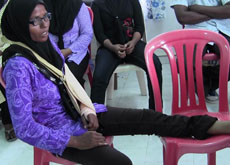
“Amnesty International learned that one woman had her arm twisted and sprained when MNDF soldiers grabbed her. They then took her glasses off, forced her to open her eye and sprayed it with pepper spray. She said they pressed her against the wall and kicked her with their boots.

“Another woman said that they began to beat her on her breast, repeatedly shouting they would see to it that she does not breast feed again.

“A third woman showed her badly bruised arm where she said that soldiers had severely and repeatedly beaten her.”

Amnesty noted that both sides had blamed each other for promoting violence, and that human rights in the Maldives “have become heavily politicised.”

“During clashes between the MDP supporters and security forces on 8 February, up to 10 buildings, including police headquarters and a court building, were burnt down in Addu city, an MDP stronghold,” Amnesty observed.

“The government has blamed MDP supporters for the destruction. Scores of people were detained in Addu following the 8 February clashes and were tortured or otherwise ill-treated in custody.”

“Police have continued to deny torturing the detainees or using excessive force against MDP protesters.”

In a press statement following the attacks, police dismissed the allegations as “lies” and said that the police only stopped the demonstrators who attempted to break into the area blocked by the security forces.

Likes(0)Dislikes(0)