STO signs agreement to supply equipment to construct Maafushi Prison wall

The State Trading Organisation (STO) has signed a contract with the Department of Correctional Services to supply equipment needed in order to construct a security wall encircling the Maafushi Prison.

Haveeru reported that Managing Director of the STO Adam Azim provided assurance that the company would provide all the necessary equipment as per schedule, and would cooperate fully with the correctional services.

The wall, which is to be built using the paid labour of the prisoners is estimated to cost MVR7 million (US$460,000), with more than half of the total being spent on equipment.

The government’s decision to build the wall came after the escape of two prisoners – both serving life sentences – through some ventilation shafts in their cells.

The Maldives Police Service had previously stated that it would assist correctional services in looking after the security of the prison by permanently stationing a police team on the island.

Likes(1)Dislikes(0)

Can decentralisation take root in the Maldives?

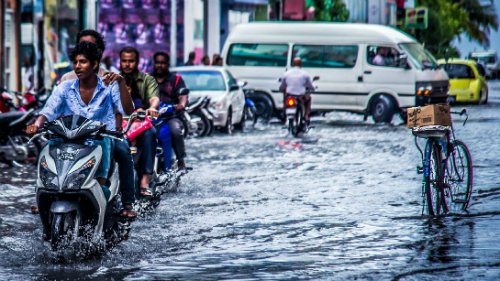
The uprooted trees and flooded streets of Malé in recent days seem to have laid bare the continuing tensions between local and central government in the Maldives.

After the central authorities last week removed the city council’s jurisdiction over the roads of the capital, senior figures from both the government and opposition have made the legal case for and against the decision.

Friction between the Maldivian Democratic Party (MDP) dominated Malé City Council and successive governments has left the local authority with just 5 of the 22 public areas granted to it after its establishment in 2010.

Attempts to replace the trees – allegedly cut down by off-duty police officers – were thwarted by the state-owned Malé Road Development Corporation last Wednesday, who police allowed to continue despite councillors’ calls to uphold the Decentralisation Act.

While the former Speaker Abdulla Shahid has suggested the cabinet has violated the law in taking over maintenance of the capital’s roads, Attorney General Mohamed Anil suggested that the move was compliant with both the Decentralisation Act and the Land Act.

The President’s Office have said the council had failed to deal with the recent floods, although the council continues to point out that it has received less than half the funds allocated to it from the 2014 budget.

“We don’t even have an account in which to put money,” explained Deputy Mayor Shifa Mohamed.

After his ministry gave orders to tear down the areca palms planted along Malé’s main thoroughfare last week, the housing minister added to the confusion today by suggesting the council would be irresponsible to challenge efforts to make the capital greener.

Others suggest that the real roots of the issue lie with a government unwilling to cede power to local authorities, resulting in what some have described as decentralisation in name only.
Policy

“They don’t believe in the concept,” suggested Shifa. “Instead of facilitating decentralisation, they are trying to show that it can’t function.”

Defending the government’s action, President’s Office Spokesman Ibrahim Muaz has said that the decision regarding street maintenance was consistent with its policy of utilising state land for social purposes.

Authority over the city’s mosques will soon revert to the Ministry of Islamic Affairs, leaving the council with control over only Malé’s burial grounds – completing the steady removal of land since the fall of the MDP government in 2012.

While the current administration has previously called on local authorities to cooperate in order to bring development to the people of the country, the provisions of the flagship Special Economic Zones Act appears to make such acquiescence redundant.

The yet-to-be-specified SEZs – designed to attract foreign investors with deregulated territory – will render local authorities powerless

“There will be consultations with the local councils, but the decision making power will be here because we want to take decisions very fast and we want development as soon as possible,” tourism minister and Chairman of the SEZ investment board Ahmed Adeeb has previously explained.

In the same interview, Adeeb made clear that his government does not feel decentralised authorities are currently suited to aid the country’s development.

“Land, labour, and capital – the central government and the regional governments are fighting for it as we don’t have enough resources even for the existing government to cover the budget deficits,” he explained.

“I believe when there’s enough economic activity we can give more powers to the councils.”

The ‘begging system’

The MDP’s claims that its political opponents are attempting to sabotage the decentralisation project in favour of maintaining a Malé-centric ‘begging system’ began before the ink had dried on the 2010 Decentralisation Act.

Following its failure to win a majority in the 2008 parliamentary elections, the MDP government had to accept a version of its decentralisation bill without the structural and fiscal provisions it had originally planned for.

The rejection of over 300 proposed amendments by the opposition-controlled house – including attempts to restore the provincial model on which the scheme was based – prompted MDP MPs to walk out of the Majlis prior to the bill’s passage in April 2010.

Subsequent amendments increasing the number of councillors were described by the party as “economic sabotage”, leaving the country with a system the UNDP has described as a “major barrier to fiscal consolidation”.

Since assuming power, the same political groups have moved to reduce the recurrent costs of a system that had grown to an estimated US$64 million per three year term.

Meanwhile, the 2014 UNDP Human Development Report pointed out that harmonising laws – a problem typified by the legal wrangling in/over the streets of Malé – remains a key challenge facing the decentralisation transition.

[T]he Decentralization Act identified land management as a core responsibility of the councils. However, this contradicts the Land Act, which provides that the Ministry of Housing and Infrastructure manage land distribution. Similarly, the Decentralization Act and the Constitution make provision for fiscal decentralization, revenue generation and management of own revenues by councils. This contradicts the Finance Act, which mandates all revenues collected from any Government body be deposited in the Government’s central public account.

Maldives Human Development Report 2014
Empowerment

Among the objectives envisioned in the Decentralisation Act are the empowerment of people and the creation of an environment conducive for peace and prosperity.

However, a report into the process by UNICEF in 2013 suggested that the political wranglings at the center of Maldivian government have left the islands worse off than before decentralisation was introduced.

“Local Councils are now less empowered than they were in 2008 which was when they officially had even less functions and revenue raising powers,” concluded the UNICEF report.

“More importantly the above arrangements mean that Council finances are micro-managed from the centre. So Councils have almost no autonomy to prioritise and manage their resources. There is, thus, basically no fiscal decentralisation.”

Decentralisation advocate Salma Fikry argues that the central government has little interest in genuine devolution of powers, preferring ‘deconcentration’ which allows for dispersed administrative powers without real financial autonomy.

“I do agree that Island Development Committees were doing better work, but the underlying truth was that the government could choose who to support and who not to support,” said Salma.

She suggested that the desire for decentralised government stemmed from the realisation in the atolls of disparities in regional service provision – another issue highlighted recently by the UNDP.

The central government will not allow for revenue raising measures at the local level as this would reduce political leverage, she explained.

The UNICEF report further noted that political partisanship and overstaffed local authorities had resulted in “political bickering” between council members, “stalemates”, and “no decision making”.

Malé Deputy Mayor Shifa also suggested that the problems with the current government stemmed from political rather than practical reasoning.

“Just because it is done by the MDP, they will destroy it.”

UNICEF concluded that the decentralisation process in the Maldives had been “rushed”, noting that such far-reaching changes can take decades to implement successfully.

During the time it took to compile the 2013 report  a new level of provincial government was introduced and subsequently abolished within two years, with UNICEF noting the subsequent “confusion at all levels of government”.

Observing recent events in the capital, it appears that the Maldives decentralisation experiment will continue to struggle to take root and may well be washed away in the next political downpour.

Likes(3)Dislikes(0)

Imam of unauthorised independent prayer congregation sentenced to jail

Self-appointed Imam, Hussain Thowfiq, arrested last month (September 30) for leading unauthorised prayers at Dharmuvantha Mosque, has been sentenced to jail for two years by the Criminal Court.

The 34-year-old was found guilty of disobeying religious unity regulations by delivering unauthorised sermons at the mosque, leading Friday prayers at a mosque not designated for the prayer, and of attempting to incite religious strife and discord read the criminal court sentence.

Meanwhile, Islamic Minister Dr Mohamed Shaheem Ali Saeed said yesterday (November 8 ) that such independent congregations are “unacceptable” and threatened legal action if members of such groups refuse to accept advice from scholars.

The government would not allow practices outside the bounds of the law and religious strictures, declared Shaheem.

The Dharumavantha congregation had previously been described as inciting extremist ideology by the Islamic minister. The sermons had called for the destruction of the current government, prompting a temporary shutdown on February this year.

Likes(0)Dislikes(0)

MP Nazim returns to Maldives, passport confiscated by immigration

The department of immigration has confirmed that the passport of former Deputy Speaker Ahmed Nazim has been confiscated following the MP’s return to the Maldives yesterday (November 8).

Despite the Criminal Court ordered travel restrictions be placed on the Dhiggaru MP late last month, Nazim was able to leave the country the same day.

While abroad, the Progressive Party of Maldives (PPM) member has been at the centre of controversy regarding his alleged attempts to smear party deputy leader and Minister of Tourism Ahmed Adeeb.

Nazim’s passport will be held until November 21, in accordance with the court order. Police have not revealed the nature of the charges facing the MP.

After a recent audit report implicated Adeeb in a US$6 million corruption scandal, the minister revealed that he had been threatened by Nazim as a result of his failure to support him for re-election as deputy speaker in May.

“But I didn’t believe the threats because the auditor general is someone I respected,” Adeeb told media after the report’s release.

“I believed up until the report was released yesterday that he would not compromised. Nazim threatened me very recently as well before he left for Malaysia.”

Adeeb expressed dismay at reports that his party colleague had attempted to link him with the disappearance of Minivan News journalist Ahmed Rilwan.

“I am saddened that former Majlis Deputy Speaker asked different journalists to write, implicating me in the case to divert focus, as the case was being investigated by police,” said the deputy leader of the Progressive Party of Maldives (PPM) yesterday.

He told journalists that Dhiggaru MP Nazim had suggested to the media that Rilwan was abducted in relation to his work on the Dhaalu Maagau case – also featured in the recent audit report.

Rumours of Nazim’s attempts to have Adeeb linked with the disappearance of Rilwan on August 8 first appeared in an independent report commissioned by the Maldivian Democracy Network in September.

Likes(1)Dislikes(0)

Independent prayer congregations “unacceptable,” says Islamic minister

Independent or unauthorised prayer congregations are “unacceptable” and legal action will be taken against its members if they refuse to accept advice from scholars, Islamic Minister Dr Mohamed Shaheem Ali Saeed has said.

Speaking at a press conference yesterday about the ministry’s achievements during the first year of President Abdulla Yameen’s administration, Shaheem stressed that it was not the government’s policy to violate the sanctity of mosques by entering with force and stopping the congregation.

“The Islamic ministry met the people who were praying in an independent congregation and advised them over a long period and instructed them to stop,” Shaheem said, referring to a separatist congregation at the Dharumavantha mosque in Malé.

The ministry’s scholars later advised members of the congregation for one month in the presence of police officers, he said.

“However, they refused to stop. So legal action has to be taken against them,” Shaheem said, adding that there was no Islamic state in the world where such congregations were allowed.

The government would not allow practices outside the bounds of the law and religious strictures, he declared.

On September 30, police arrested a 34-year-old man for leading prayers and delivering Friday prayer sermons at the Dharumavantha mosque. The suspect was arrested on charges of “attempting to incite religious strife and discord,” said police.

Independent congregation in Madduvari

In recent days, Shaheem continued, the ministry was informed of an independent prayer congregation on the island of Madduvari in Raa atoll.

“Our scholars visited that island as well with officers of the Maldives Police Service. But when we requested to meet with those senior among them, they didn’t come to the meeting,” he revealed.

Prayers were being conducted in Maldivian mosques in accordance with Islamic principles and the Prophet’s (pbuh) Sunnah.

Independent prayer congregations were not supported by learned religious scholars either in the Maldives or elsewhere.

The people involved in the congregation in Madduvari were not academically qualified or well-versed in religious matters, he claimed.

“So making independent congregations, marrying outside of court – such things are prohibited in religion,” he said.

Last week, Sri Lankan police detained three Maldivians who were allegedly preparing to travel to Syria through Turkey.

The three – two men aged 23 and 25 and a woman aged 18 – were from Madduvari and have since been released from custody upon being brought back to the Maldives, Home Minister Umar Naseer told the press on Thursday (November 6).

Meanwhile, asked if there were religious extremists in the Maldives, Shaheem said the definition of religious extremism in the Maldives was “very different” from its meaning internationally.

In the international community, he explained, religious extremism referred to “killing people, blowing places up and attacking civilians.”

Extremism in the Maldives has not reached that level, Shaheem said.

However, he added, there were religious ideologies in the country that needed to be corrected and moderated, which required religious scholars to provide counsel and advice.

Shaheem said the problem of extremism in the Maldives was not as bad as some reports suggested.

Jihad

Shaheem referred to the ministry’s public stand earlier this year on the issue of Maldivians traveling to Syria for ‘jihad’ in the ongoing civil war.

“The Islamic ministry does not support Maldivians leaving to fight in foreign wars, especially sectarian conflicts,” he said.

A large number of  Muslims were being harmed in conflicts between Sunnis and Shias, he said, including “innocent children, the elderly, and women”.

The ministry has been appealing to youth across the country against travelling abroad to fight, he added, saying that Muslims in other countries should pray for their well-being and offer humanitarian assistance.

According to a jihadist media group, a fifth Maldivian man recently died in Syria.

Achievements

The minister revealed that projects to build 20 new mosques across the country would commence in 2015, including ten projects to be financed by US$1.2 million donated by Saudi Arabian Crown Prince Salman bin Abdul Aziz al Saud.

Among the ministry’s achievements during the past year, Shaheem referred to Dhivehi translations of works of Islamic fiqh, 500 pilgrims taken to Mecca by the government-owned Hajj Corporation, and the construction and renovation of mosques.

Additionally, Singapore approved the ministry’s halal certification, strengthening the waqf system, and numerous Quran courses were conducted in the atolls, he added.

Religious unity has been established during President Yameen’s first year in office, Shaheem insisted, while closer ties have been maintained with Islamic nations.

Likes(1)Dislikes(0)

MDP slams foreign minister for giving false information regarding Chinese silk route

The Maldivian Democratic Party (MDP) has criticised the foreign minister for providing false information while responding to questions put forward in the Majlis regarding the Maldives’ participation in China’s Maritime Silk Road initiative.

“The party severely condemns foreign minister Dunya Maumoon for intentionally providing false information about Maldives and its diplomatic relations with other countries,” read an MDP press statement released yesterday (November 8).

President of the People’s Republic of China Xi Jingping has called on the Maldives “to get actively involved” in the creation of a maritime trade route linking China to the east coast of Africa and the Mediterranean.

The Ministry of Foreign Affairs has today released a statement seeking to clarify any confusion caused by these remarks, saying that Dunya had “noted her concern if her choice of words had led to any confusion”.

When asked about the potential impact of the scheme on India-Maldives relations, Dunya told the parliament last week that India had also discussed participating during the recent state visit of Chinese President Xi Jinpeng.

However, Indian Diplomats in Malé promptly refuted the claim, releasing a statement containing comments from the Indian External Affairs Ministry which denied such talks having taken place.

“[T]his matter was neither raised, nor discussed, nor is it reflected in any of the outcomes of the visit of President Xi Jinping to India,” the ministry official told Indian media on Thursday (November 6).

The Maldives foreign ministry today said that Dunya had mentioned various discussions having taken place between India and China “on a wide range of issues” as an example of the excellent relations between the two nations.

The MDP also noted that it was “shameful” that the Indian Government had to re-clarify the public after “lies” from the foreign minister, and warned the government that such actions will weaken Maldives’ relations with other countries.

Fears have been expressed by the opposition regarding the potential for the government’s willingness to participate in the scheme to damage relations with regional neighbours.

The party also called for the resignation of Dunya, stating that intentionally providing false information to the parliament was a crime under the Maldivian Constitution.

The Chinese president travelled to India after having visited the Maldives where numerous MoUs were signed between the two governments – most notably agreements promoting the Malé-Hulhulé bridge and the redevelopment of Ibrahim Nasir International Airport (INIA).

The new INIA agreement comes while previous developer, India’s GMR, waits to hear how much they are to receive in damages after a Singapore arbitration court ruled their prematurely terminated contract with the Government of Maldives to have been “valid and binding”.

As Chinese companies pledge assistance with major infrastructure projects, Indian companies continue to fall foul of the Maldives’ changing political currents.

Meanwhile, China’s rising economic presence in the Indian Ocean region has stoked concerns in New Delhi that China is creating a “string of pearls” encircling India, including Chinese investments in ports and other key projects in Sri Lanka and Pakistan.

*This article was amended shortly after publication to include an additional statement from the Ministry of Foreign Affairs

Likes(2)Dislikes(1)

MDP reconstitutes 19 ‘shadow’ committees

The opposition Maldivian Democratic Party (MDP) has reconstituted 19 ‘shadow’ committees to hold the government accountable.

MDP Chairperson Ali Waheed told the press on Thursday (November 6) that chairpersons and vice chairpersons have been newly elected to head the oversight committees.

The former MP said the leadership would have regular meetings with the shadow committees in the future.

They include committees dealing with international relations, transport, housing, rights, research and policies, elections, organisation, economic affairs, fund raising, fisheries and agriculture, media, membership and campaigns, legal affairs, security, health, education, and employment and social affairs.

Likes(1)Dislikes(0)

Maldivian jihadist fighter dies in Syria

A Maldivian jihadist fighter has died in Syria, Bilad al Sham Media (BASM) has revealed on social media, in what would be the fifth Maldivian casualty in the ongoing civil war.

“Another great Maldivian brother martyred. May Allah accept him. Ameen,” Bilad al Sham tweeted last night.

The jihadist media group – which describes itself as “Maldivians in Syria” – identified the deceased as Abu Fulan Rahimullah, which was his assumed name or alias.

“He was a great companion and a pious brother who feared Allah, who made hijrah for the sake of Allah and strove hard in the cause of Allah, trying his utmost to be among the martyrs, especially after the martyrdom of his close companions Abu Turab, Abu Nuh, Abu Dujanah, and Abu Ibrahim,” reads a message posted by the media group.

BASM revealed the death of Abu Dujanah and Abu Ibrahim in September while Abu Nuh and Abu Turab were killed in May.

Local media identified Abu Dujana as Yameen Naeem of Georgia in the Maafannu ward of the capital Malé, who reportedly travelled to Syria after studying in Egypt.

Abu Fulan was “one of the students of Abu Dujanah,” BASM said.

“Amazingly he was seen in the most intense hours of the battle by hearting [sic] the lessons of the usoolul thalaatha,” the post continued.

“His wife had seen a dream before his martyrdom and he was among the slaves who are close to Allah. And she had narrated that she smelled an extraordinary beautiful smell after his martyrdom while she was in sujood praying Fajr Salah.”

The post concluded by stating that “cowardice was not his way and he could not accept defeat as an exchange for death.”

Last week, Sri Lankan police detained three Maldivians who were allegedly preparing to travel to Syria through Turkey.

The three – two men aged 23 and 25 and a woman aged 18 – were from the island of Madduvari in Raa atoll and have since been released from custody upon being brought back to the Maldives.

The incident follows reports of a couple from Fuvahmulah and a family of four from Meedhoo in Raa atoll traveling to militant organisation Islamic State-held (IS) territories to join the fighting in Syria and Iraq.

A UN report obtained by the UK’s Guardian newspaper earlier this month observed that foreign jihadists were now travelling to Syria and Iraq on “an unprecedented scale”.

The report mentioned the Maldives as one of the “unlikely” places from which IS supporters have emerged.

Islamic State

Meanwhile, a protest march took place in the capital, Malé, in September, with around 200 participants bearing the IS flag and calling for the implementation of Islamic Shariah in the Maldives.

In late August, Foreign Minister Dunya Maumoon issued a press statement condemning “the crimes committed against innocent civilians by the organisation which identifies itself as the Islamic State of Iraq and the Levant or the Islamic State of Iraq and Syria.”

Dunya’s remarks followed Minister of Islamic Affairs Dr Mohamed Shaheem Ali Saeed’s declaration that the ISIS would not be allowed to operate in the Maldives.

“ISIS is an extremist group. No space will be given for their ideology and activities in the Maldives,” Shaheem tweeted on August 24.

Shaheem had also appealed for Maldivians to refrain from participating in foreign wars.

The Maldivian Democratic Party (MDP), however, promptly put out a statement questioning Shaheem’s sincerity, suggesting that the words had not been backed up with concrete action by the government.

Former President Mohamed Nasheed has claimed that up to 200 Maldivians are on jihad, alleging that a vast majority of them are ex-military – a claim vehemently denied by the security services.

“Radical Islam is getting very very strong in the Maldives, their strength in the military and in the police is very significant. They have people in strategic positions within both,” Nasheed said in an interview with UK’s Independent newspaper.

The opposition leader suggested that President Abdulla Yameen wanted to consolidate power before dealing with the threat of religious extremism.

“He has the Islamists with him and he can’t do away with them. He would deny that but I don’t see the government taking any measures against the Isis flag being displayed on the street and all the indoctrination going on.”

Likes(1)Dislikes(0)

India denies having discussed New Silk Road initiative with China

The Indian government has moved to correct suggestions made in the Maldives’ parliament last week that it had discussed joining China’s New Silk Road initiative.

When asked about the potential impact of the scheme on India-Maldives relations, foreign minister Dunya Maumoon had told MPs that India had also discussed participating during the recent state visit of Chinese President Xi Jinpeng.

In order to clarify the issue, Indian diplomats in Malé have released a statement in which India’s External Affairs Ministry denies such talks having taken place.

“[T]his matter was neither raised, nor discussed, nor is it reflected in any of the outcomes of the visit of President Xi Jinping to India,” the ministry official told Indian media on Thursday (November 6).

“I hope that clarifies that this was neither raised, nor discussed, nor is it reflected in any of the outcome documents available publicly on the visit of President Xi Jinping to India.”

President of the People’s Republic of China Xi Jingpeng has received positive responses from President Abdulla Yameen to his calls for the Maldives “to get actively involved” in the creation of a maritime trade route linking China to the east coast of Africa and the Mediterranean.

China’s rising economic presence in the Indian Ocean region has stoked concerns in New Delhi that China is creating a “string of pearls” to encircle India, including Chinese investments in ports and other key projects in Sri Lanka and Pakistan.

In response to opposition fears over the impact on neighbouring countries, Dunya told the Majlis that the government always remained mindful of regional security.

“His Excellency Xi Jinping visited India. India very much welcomed his visit and they discussed participating in various initiatives of China and participating in the Silk Route,” said Dunya.

However, the minister made clear that the Maldives, as a sovereign nation, was not compelled to consult with others on foreign policy decisions.

The government decided to participate in the Silk Route initiative as it would promote national interest and benefit the Maldivian people through trade and commerce, she said.

The rise in Sino-Maldivian links over the past three years appears to have coincided with a relative cooling of relations between the Maldives’ and its traditional ally, India.

While Chinese tourists make up around one-third of the one million-plus tourists visiting the Maldives each year, developmental aid is increasingly becoming a key feature of the relationship.

As Chinese companies pledge assistance with major infrastructure projects, Indian companies continue to fall foul of the Maldives’ changing political currents.

President Xi Jinpeng became the first Chinese head of state to visit the Maldives in September, as part of a regional tour which also took in Tajikistan, Sri Lanka, and India. A number of agreements, including a preliminary deal to redevelop Ibrahim Nasir International Airport (INIA), were signed during the stop in Malé.

The new INIA agreement comes as the previous developers, India’s GMR, wait to hear how much they are to receive in damages after a Singapore arbitration court ruled their prematurely terminated contract with the Government of Maldives to have been “valid and binding”.

Likes(1)Dislikes(0)