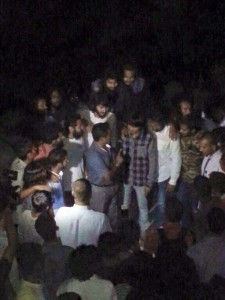
State witnesses offered political posts for testimony, says MP Nazim

Ruling Progressive Party of the Maldives (PPM) MP Ahmed Nazim has alleged state witnesses were offered jobs in exchange for testifying against him in a corruption trial.

The former Deputy Speaker of Majlis was charged with four counts of corruption in late 2009 for allegedly conspiring to defraud the former Ministry of Atolls Development.

In February 2014, the High Court upheld the Criminal Court’s dismissal of all four counts of corruption.

The appellate court upheld the Criminal Court’s refusal to accept testimony by Nazim’s former employees, referring to a Supreme Court precedent which established that accomplices to a crime could not testify for or against an alleged partner to the crime.

Prosecutor General (PG) Muhthaz Muhsin appealed the High Court’s decision with the Supreme Court in July 2014, months after the 90-day appeal period expired.

“The two main state witnesses were bribed with political posts within the government. These charges are politically motivated,” Nazim told the Supreme Court today.

The atolls ministry scam – first flagged in a 2009 audit report – involved paper companies allegedly set up by Nazim to win bids for projects worth over US$400,000, including the fraudulent purchase of harbour lights, national flags, and mosque sound systems.

At the time, police alleged Nazim ordered his staff at Namira Engineering to set up paper companies to bid for public tenders, and channeled the money to Nazim through Namira and other unregistered companies

When Justice Adam Mohamed today asked state prosecutors why Nazim must be held responsible for fraud committed by Namira, state prosecutor Abdulla Rabiu pointed out the MP was the Managing Director of the company at the time and oversaw its daily activities.

All the money from the scam had gone to Namira’s accounts, he added.

Nazim’s employees had also testified they submitted bogus bids on the MP’s orders, in the name of nonexistent companies or in the name of other companies, without their knowledge, Rabiu said.

In response, Nazim’s lawyer Husnu Suood said an audit was necessary to prove the money was deposited into Namira’s accounts and claimed Nazim could not be held responsible for corrupt transactions carried out by the company.

Chief Justice Abdulla Saeed concluded today’s hearing stating the apex court would issue a verdict at the next hearing.

Nazim who was a close associate of President Abdulla Yameen appears to have fallen out of favour with the government, with the police withholding his passport on charges of blackmail in October.

Tourism Minister Ahmed Adeeb at the time blamed Nazim for a damning report implicating the minister in a US$6million corruption scandal. Adeeb accused Nazim of attempting to defame him due to his refusal to support Nazim’s bid for the Majlis Speakership.

At the Supreme Court’s first appeal hearing, Nazim told the court his former lawyers Adam Asif and Ahmed “Reynis” Saleem had said the current political environment was “too dangerous” to represent him.


Related to this story

Lawyers “afraid” to represent MP Nazim in Supreme Court corruption appeal

Adeeb “saddened” at PPM colleague’s attempts to link him with missing journalist

High Court upholds dismissal of corruption charges against deputy speaker of parliament

MP Nazim returns to Maldives, passport confiscated by immigration

Judge frees Nazim from all corruption charges: “acts not enough to criminalise”

Likes(2)Dislikes(0)

Comment: Get up, stand up

This article first appeared on DhivehiSitee.com. Republished with permission

It is an extremely tense day in the Maldives as tens of thousands of people wait on tenterhooks for what seems to be the inevitable: the imprisonment of opposition leader, former president and icon of democracy, Mohamed Nasheed.

The outcome of the ‘trial’ which Nasheed has been subjected to is certain, the verdict written long before he was charged with ‘terrorism’ and remanded in custody on the island of Dhoonidhoo on 22 February.

Everything that followed since that Sunday, over two weeks ago now, has been a sham and a travesty against justice. The barbarity was put on full display to the world, when Nasheed was brought to ‘court’ for the first hearing. Policemen, belonging to the notorious Special Operations, pushed and shoved Nasheed to the ground.

Pictures and videos of the event shocked the country, and the world.
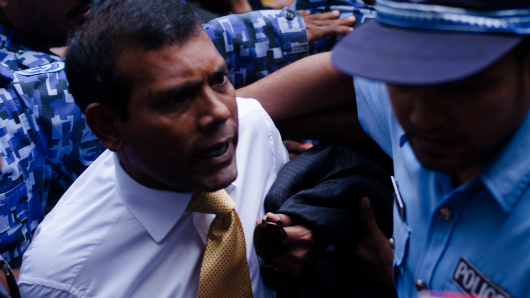
The current rulers, led by Yameen Abdul Gayoom, shrugged off the outcry with nonchalance. Locally, the police claimed Nasheed had pulled a stunt, fallen to the ground voluntarily like a footballer faking an injury looking for to be rewarded with a penalty. It did not matter that video and pictorial evidence told a different story.

Internationally, foreign minister Dunya Maumoon was recalcitrant, insisting that Nasheed’s trial is a ‘domestic issue’ that no foreigners have a say in. The government remained impervious to all outside criticism. Even the cancellation of a planned trip by India’s Prime Minister Narendra Modi, a diplomatic slap of substantial magnitude, did not make any impact on its determination to pursue with their chosen path of leading Nasheed to jail. In fact, as time passed, the government grew more belligerent.

Yameen Abdul Gayoom said on March 9 that people in distant foreign lands should butt out of Maldivian affairs. Brushed aside were the many international treaties which the Maldives is signatory to, which gives the international community the right to particular actions during certain circumstances — such as in times of the destruction of rule of law.

‘Trial’

And what a destruction it has been. Every hearing in the court, itself unconstitutional, has dealt a deathblow to the concept of rule of law. The Prosecutor General’s appointment now appears to have been engineered for the very purpose of this prosecution, as are the panel of three ‘judges’. None of them have adequate legal qualifications, and all of them are in each other’s pockets. All of them have close ties to the man at the centre of these ‘terrorism’ charges—Ablow Ghaazee, himself accused of misconduct and corruption—who Nasheed allegedly ‘kidnapped’.

The three man bench has obstructed justice at every opportunity, refusing to give Nasheed’s lawyers enough time to study evidence; giving them evidence on CDs that do not open or have been damaged; refusing Nasheed the opportunity to appoint new lawyers when the current ones objected to their unlawful treatment; and incredibly, refusing to allow Nasheed to present witnesses with the judgement that no witness can disprove the prosecution case.

Every hearing has been held after sundown, and Nasheed brought to court in darkened vehicles under heavy police escort. The lengths to which prosecutors have gone to separate Nasheed and his supporters, and to prevent media from taking pictures of him, have been ludicrous at times.

On 8 March, about an hour before Nasheed was brought to court, the powers that be spread a blue banner across the entrance to the building, placed strategically to cover the camera angle from which Raajje TV usually shoots Nasheed’s court arrival. The banner read ‘Welcome, International Women’s Day.’ A blatant mockery not of justice alone, but also of women.

There has been much anguish among Nasheed’s supporters. On February 27 tens of thousand came out to protest against the court’s decision to remand Nasheed in custody throughout the trial. It was the biggest political gathering the capital island of Male’ had ever seen. People flooded the main street of Majeedhee Magu almost covering it from end to end.

Since then there have been protests every night and every day in various different locations across the country. But the government is refusing to listen to them no matter how many there are; it seeks to shut them down instead.

Every protest is manned by hundreds of Special Operations police, sometimes with reinforcements from the army. Almost every other protest ends in brutality and/or arrests. Scores have been arrested, taken to prison, then released with the unconstitutional condition that they don’t protest for periods of time as set by the court-–sometimes days, sometimes months.

Leaders of the MDP are handpicked for the arrests, making sure that less and less of them will be able to join protests against Nasheed’s arrest. One person—MP Fayyaz Ismail—refused to sign the court’s unlawful protest ban. He was given an extra 15 days in custody. There is no legal basis for such an order.

An increasing number of locations are being declared ‘no-protest zones’ for various reasons: for residents’ peace; for local business interests; for law and order, etc. etc. Freedom of assembly is being rolled back swiftly, and without hesitation. Other associated freedoms are under similar attack. Journalists are being barred from covering the trial without legal reason. Reporters are being banned from videoing places they are legally allowed to. Police are forcing them to delete footage already recorded without legal authority to do so. The state broadcaster is continuing to ignore the biggest ‘trial’ in the country’s recent history, completely ignoring its duty to keep citizens informed.

Thumbs down

Meanwhile, Yameen and members of his ruling cabal are relishing the distress and helplessness of supporters of democracy and Nasheed. Decorum and statesmanship are nowhere to be seen. When MDP MPs protested against Yameen’s inaugural speech in parliament, he gave into his indignation, getting up and waving his thumbs up and down, then up again, like a crazed Caligula in Roman times.
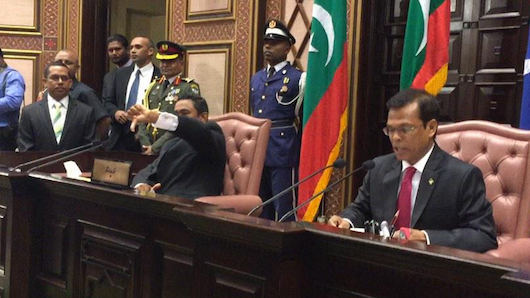
Yameen’s trusted sidekick, Tourism Minister Ahmed Adeeb, who has shrugged off corruption charges amounting to millions of US dollars and engineered the unconstitutional removal of the auditor general who dared bring up the charges, led a motorbike procession on the streets of Malé this weekend, calling to expedite Nasheed’s conviction.

Among the rats led by this pied piper on a bike with a Rolex watch on his wrist and a sapphire ring on his finger, was the current defence minister, ex-military General Moosa Jaleel. Jaleel in his eagerness to belong to Yameen’s cabal, and thus enjoy automatic immunity, forgot that he is himself on trial for the same charges he was calling Nasheed to be convicted for.

To further increase the public disgust level [or degree of impressiveness, if the onlooker is a supporter of Bro Adeeb], Adeeb has led a ‘movement’ that mimics Yameen’s thumbs-down gestures as if it is something to be celebrated and not shamed by. He has posed with his thumbs down with cabinet ministers and parliament members—as well as with his usual string of young, disaffected men on the fringes, and in the heart of, Maldives’ violent gang culture. Everyone in the Motorcade of The Shamelessness wore t-shirts emblazoned with a thumbs-down signal.

This hatred of Nasheed as a person cultivated with relish by Yameen and Adeeb has been embraced by thousands of their supporters. It has blinded them to the fact that what is being destroyed in this sham is not just Nasheed’s personal freedoms but also every single Maldivian’s many civil and political rights and their right to equal justice for all.

The fundamental problem with the Maldives’ transition to democracy was that it was unable, and oftentimes unwilling, to reform the judiciary. Few had the foresight to see where the democratic transition would end without an independent judiciary based on the principles of rule of law. Now, even on hindsight – with the results on full display – many are still too blinded by personal vendettas, grudges and hate to see that this ‘trial’ of Nasheed is the last nail in the coffin for a democratic future for the Maldives.

Years of anti-Nasheed propaganda have closed people’s eyes to the fact that whatever wrong he may have done, if they want themselves to be treated fairly and equally and live in a just society, they must protest against the injustice he is being subjected to.

Today it is the moral obligation for every Maldivian to stand up against injustice. The subject of concern is not a particular individual, be it Nasheed, Nazim, the common man jailed for six years for stealing a jar of fish-paste; or the murderer who is allowed to walk free because he is in the inner cabal. It is justice itself.

Last time the people should have stood up en masse for justice and did not, the Maldives was robbed of a free and fair election. The result is in office, orchestrating injustice, via the courts that engineered his election. This time if the people fail to stand up, it will shut all doors to another election in the foreseeable future; along with the doors to equal justice for all, quite likely for generations to come.

Dr Azra Naseem has a PhD in International Relations

All comment pieces are the sole view of the author and do not reflect the editorial policy of Minivan News. If you would like to write an opinion piece, please send proposals to [email protected]


Related to this story

“I was not afforded the rights of the accused,” says Judge Abdulla

Nasheed’s lawyers quit

State prosecutors influencing witnesses, claim Nasheed’s lawyers

Nasheed contests credibility of police and military witnesses in terrorism trial

Judges Didi and Yoosuf refuse to step down from Nasheed’s terrorism trial

Former President Nasheed arrives in court with arm in makeshift sling

Nasheed denied right to appoint lawyer and appeal “arbitrary” arrest warrant, contend lawyers

Likes(5)Dislikes(0)

“I was not afforded the rights of the accused,” says Judge Abdulla

Criminal Court Chief Judge Abdulla Mohamed testified in a terrorism trial against former President Mohamed Nasheed tonight, stating the former Commander in Chief must bear responsibility for his “unlawful arrest” in January 2012.

“I was not afforded the rights of the accused. My basic human rights were violated. I had no access to a lawyer,” Judge Abdulla told the court.

He claimed he is still unclear as to why he was kept detained from January 16 to February 7.

Nasheed is accused of abducting Judge Abdulla and is standing trial for terrorism. He has denied charges. If convicted, he faces a jail term or banishment between ten and 15 years.

The opposition leader once again reiterated a request for legal counsel and adequate time to mount a defence, pointing out that he had difficulty in appointing a lawyer while detained in Dhoonidhoo.

All four of Nasheed’s lawyers quit yesterday over the Criminal Court’s alleged failure to provide sufficient time to examine the prosecution’s evidence and prepare to defend the former president against new terror charges pressed two weeks ago on February 22.

Nasheed has previously called the Criminal Court’s rushed trial an “injustice” and “the biggest circus the Maldives has seen in constitutional history.”

But presiding Judge Abdulla Didi insisted there was no obstruction to Nasheed appointing a lawyer, and said the former president had been given ample opportunity to obtain legal counsel.

Judge Didi adjourned the hearing after scheduling the next hearing for Friday night (March 13), where the defence and prosecution are to present concluding statements.

Judges could issue a verdict at their discretion afterwards.

“This is what the President wants…”

Recounting his arrest, Judge Abdulla said he had gone home from work late on January 16, and was having dinner with his wife when masked men in military uniform entered his home without a court warrant and “dragged me off to Girifushi.”

In the process, his arm was hurt, he said. Since he had been arrested at 12am, he did not know where he was being taken, and only found out he was in Girifushi much later, Judge Abdulla said.

Senior government officials including former Defence Minister Tholhath Ibrahim Kaleyfaanu, then-Minister of Youth Hassan Latheef and former Presidential Envoy Ibrahim Hussein Zaki visited Judge Abdulla in Girifushi, he said.

Judge Abdulla said the meetings with government officials made it clear to him they did not have authority to make a decision on his detention.

Their use of phrases such as “this is what the President wants,” made it clear the then-Commander In Chief was responsible for his detention on Girifushi, Judge Abdulla said.

Government officials offered him four options, to step down as the Criminal Court Chief Judge, to transfer to another job, to leave Malé or leave the country, he continued.

Judge Abdulla was summoned to court tonight by presiding Judges Abdulla Didi, Abdul Bari Yoosuf and Sujau Usman. He was not listed among the prosecution’s witnesses and neither the state prosecutors nor Nasheed posed any questioned to the judge tonight.

Mount a defence

Nasheed requested ten additional days to appoint new lawyers stating: “You have to give a detainee the opportunity. You know very well the laws and rules you have to follow.”

But Judge Didi said the Criminal Court would not give the former president special access or privileges and said he could appoint new lawyers whenever he wishes.

Nasheed’s legal team had been given access to Dhoonidhoo Island even today, Judge Didi noted.

However, the opposition leader argued the four lawyers had dropped the case due to the Criminal Court’s denial of due process and adequate time to prepare defence, and said he required time to appoint a new lawyer of his choosing.

“Lawyers don’t grow on trees,” he said.

The office of the former President Mohamed Nasheed issued a statement tonight, pointing out defendants in other high profile cases had been given over a month to find legal representation, and the court proceedings last more than a year.

The statement also expressed concern over the Criminal Court’s decision not to hear the witnesses Nashed had submitted in his defence.

The judges said they did not believe the witnesses would negate the testimony of witnesses produced by the state, and were therefore unnecessary.


Related to this story

“This is not a court of law. This is injustice,” Nasheed tells the Criminal Court

Nasheed’s lawyers quit

Nasheed’s lawyers stage no-show citing insufficient time for preparation

State prosecutors influencing witnesses, claim Nasheed’s lawyers

Chief of Defense Forces testifies in Nasheed, Tholhath terrorism trials

Nasheed contests credibility of police and military witnesses in terrorism trial

Judges Didi and Yoosuf refuse to step down from Nasheed’s terrorism trial

Nasheed denies ordering Judge Abdulla arrest, granted three days to answer charges

Former President Nasheed arrives in court with arm in makeshift sling

Nasheed denied right to appoint lawyer and appeal “arbitrary” arrest warrant, contend lawyers

Likes(3)Dislikes(0)

Criminal Court barring Raajje TV from trials “unacceptable,” says media council

The Criminal Court’s decision to bar opposition-aligned Raajje TV from observing trials is “unacceptable,” the Maldives Media Council (MMC) has said.

The court had accused the station of “spreading lies about judges, meddling in judges personal affairs and engaging in actions that may harm judges” after a Raajje TV journalist and cameraman videotaped an alleged meeting between Judge Abdul Bari Yousuf and Prosecutor General Muhthaz Muhsin at Café Layaali in Malé on Sunday night.

At a press conference today, MMC President Mohamed Asif ‘Mondhu’ said the court could have barred the journalist involved in the incident instead of barring all journalists from the station.

Mondhu also noted that the cameraman was forced to delete the footage.

A Raajje TV staff told Minivan News that a group of young men led by Progressive Party of the Maldives MP Ahmed Assad forced the cameramen to delete it.

While taking video footage inside a public restaurant was not illegal, Mondhu said Café Layaali’s owner would have been within his rights to either obstruct filming or ask them to leave if patrons complained.

“However, if the footage is not connected to the owner, [they] can’t order it to be deleted,” he said.

Mondhu also criticised police for not stopping the group from forcing the Raajje TV cameramen to delete the footage, characterising the incident as police’s failure to provide security to media personnel.

MMC member Ahmed Hamdhoon meanwhile said the council would investigate the case to identify the culprits.

Judge Bari is currently presiding over the trials of both former President Mohamed Nasheed and former Defence Minister Mohamed Nazim.

The alleged meeting took place hours after the seventh hearing of Nasheed’s terrorism trial.

PG Muhsin told Minivan News that the judge was already at the café when he went there for a meal with family members.

“The crew were right next to me. But I don’t even think they recognised me. Because they didn’t videotape me, they were taping Bari who was sitting at another table. I don’t know why they would accuse me of such a thing. Anyone there would clearly see that I was sitting with a separate group of people and Judge Bari was sitting at another table,” he said.

However, Raajje TV insists the pair were sitting at the same table smoking shisha and that Muhsin walked away when the journalist started asking questions.

MP Assad and the group arrived shortly thereafter and forced the cameramen to delete the footage, after which Specialist Operations (SO) officers escorted the Raajje TV staff to the police station.

The police conducted body searches and took statements from the crew. They were released afterwards.

A police spokesperson said Raajje TV crew members had not been arrested, but detained briefly for videotaping in Café Layaali without the owner’s permission.


Related to this story

Raajje TV barred from Criminal Court, accused of threatening judge

Judges Didi and Yoosuf refuse to step down from Nasheed’s terrorism trial

JSC clears Criminal Court Judge Abdul Bari Yousuf of ethical misconduct

Likes(1)Dislikes(0)

Foreigners cannot meddle in domestic affairs, declares President Yameen

Foreigners will not be allowed to meddle in domestic affairs of the Maldives, President Abdulla Yameen has declared, slamming opposition politicians for seeking foreign interference.

Addressing youth supporters Sunday night at a private function in Citron Restaurant – reportedly organised by First Lady Fathmath Ibrahim – President Yameen said foreigners could not come to the country to “settle our affairs” as the Maldives was a member of the UN family with the same rights and independence as any other nation.

“We wouldn’t want foreigners from different countries coming here to criticise what we do and telling us what to do. So that is not something we will give any room for,” Yameen is heard saying in a recording obtained by Minivan News.

“So in the work we’re doing in the Maldives we will try to do things in accordance with our laws and Islamic principles. And if the consequence of that is people from distant nations finding it unacceptable, that is their problem. That is their problem. But we are not going to give up an inch of our country’s sovereignty to foreign parties.”

Photo from social media

Yameen’s remarks come amidst a political crisis and anti-government demonstrations sparked by the arrest and prosecution of both former President Mohamed Nasheed and former Defence Minister Mohamed Nazim on terrorism charges.

Last month, Foreign Minister Dunya Maumoon hit back at statements issued by the UN, EU, India, Canada, and the Commonwealth expressing concern with the arrest and trial of the opposition leader.

“The Government of President Abdulla Yameen Abdul Gayoom will not take instructions from a foreign government on any issue in governing the country,” she said in a statement.

Yameen meanwhile said protesting on the streets was not a right reserved to the opposition and warned them not to consider the government’s “compassion and patience” as weakness.

“Do not believe at all that it is our weakness when we don’t act or take up problems seriously. It is because we love the Maldivian people. We were patient to prioritise [national] interest, peace and security here. But when it reaches the point where our patience is challenged, then we will say that we will also welcome taking things down the determined path,” he said.

While his administration welcomes protests and free expression within legal bounds, Yameen said opposition politicians inviting foreign governments to take action against the Maldives was unacceptable.

He argued that causing harm to society and imperilling national security could not be justified in the “context of individual liberty.”

Yameen asked youth to consider if it was acceptable to call for tourism boycotts and invite other countries to “meddle in the Maldives’ sovereignty and independence.”

People who cause damage to the country should be given just punishment, Yameen insisted.

Referring to the opposition Maldivian Democratic Party-Jumhooree Party (MDP-JP) alliance’s demands to release “political prisoners,” Yameen said the new constitution separated the three powers of state and the president could not interfere in judicial proceedings.

He also accused the opposition of not attempting to save youth incarcerated for arson and other offences during anti-government protests after allegedly encouraging the crimes.

“But when they feel something is about to happen to a politician over a crime he committed, it is as if the Maldivian sky is falling on our heads,” he said.

“So this is the double standard among us.”

While ordinary Maldivians faced harsh sentences on a daily basis, Yameen said the opposition politicians and lawyers briefing foreign diplomats about the “inadequate system” were unconcerned.

“But when just one case of a politician is filed at court, the entire justice system of the Maldives becomes a corrupt system,” he said.

The Maldives’ judiciary deserves the respect of foreign nations, he said.

He went on to say that former allies the JP and Adhaalath Party who protested against Nashed’s administration now calling for his release was “a riddle.”

All citizens were equal before the law, he continued, and all citizens have a constitutional right to defend themselves in a court of law.

Opposition protests against Nasheed’s administration in 2012 were prompted by the government “destroying the justice system” and arresting Criminal Court Chief Judge Abdulla Mohamed, Yameen said.

The public “came out in defence of the constitution” when Nasheed defied the Supreme Court’s orders to release the chief judge, he said, adding that the protests were about “a substantial and serious problem” whilst the current protests were “without any substance or basis.”

On the opposition alliance’s demands to release Nasheed, Yameen insisted that the government has not “arrested any politicians” and argued that enforcing the law without bias was in the best interest of the nation.

“Those facing punishment for their crimes happening to be politicians does not mean [we are] taking action against politicians,” he said.

If the president interfered and sought to settle such cases out of court, Yameen asked both the youth and opposition parties to consider if the president should overrule the judiciary once a death penalty verdict has been passed.

“Should President Yameen enforce the judgment differently for different people based on their colour, their faces, and their social standing?” he asked.

“If President Yameen acts differently in the present cases, why wouldn’t he act so in [death penalty cases]?”


Related to this story:

EU, UN join international chorus of concern over Nasheed’s arrest, terrorism trial

Foreign Minister Dunya slams Canada, Commonwealth statements on Nasheed prosecution

Former President Nasheed arrives in court with arm in makeshift sling

Likes(3)Dislikes(0)

Opposition MPs continue Majlis protests

The opposition Maldivian Democratic Party (MDP) MPs have continued protests at the People’s Majlis, disrupting proceedings for the fifth consecutive parliamentary sitting since the Majlis opened on March 2.

However, ruling Progressive Party of the Maldives (PPM) accepted an amendment to the Prisons and Parole Act amidst opposition protests. The amendment, submitted by Gemanafushi MP Jameel Usman, bars individuals serving prison sentences from holding a leadership position within political parties or other associations.

MDP MPs have been protesting over the arrest and terrorism charges against opposition leader and former President Mohamed Nasheed. If convicted, he faces a jail term or banishment between ten and 15 years.

If the amendment is passed and if Nasheed is convicted, it could effectively strip Nasheed of his presidency with the MDP and his membership.

When Majlis began at 9am, MDP MPs gathered at the secretariat’s desk calling for the the immediate release of President Nasheed and other political prisoners including former Defence Minister Mohamed Nazim.

Some MPs were blowing stadium horns while MDP MP Ali Azim was calling for Nasheed’s release through a megaphone.

Crossing the line

Speaking to Minivan News, PPM parliamentary group leader Ahmed Nihan said that he understands the opposition’s need to protest, however saying that they are “crossing the line.”

“Freedom of expression is granted to fullest extent on the People’s Majilis floor,” said the Vilimalé MP.

“Members are allowed to express themselves freely unless they contradict a tenet of Islam. However, that does not mean members are allowed to do whatever they want on the floor,” he continued.

Nihan said MPs should follow due procedure and lodge a complaint at the secretariat’s desk, saying that the floor will become a “battleground” if the opposition MPs keep on protesting every day.

“We understand their need to protest. Their leader is under arrest and standing trial so it is obvious that they would protest. But we want them to do it in a manner which does not prevent parliament proceedings,” Nihan said.

On March 2, ruling party Progressive Party of Maldives (PPM) MPs also protested, with several carrying placards which read: “Nasheed deserves to be in prison,” “Nasheed supports terrorism” and “MDP must learn democracy.”

MDP MP Imthiyaz ‘Inthi’ Fahmy said that the opposition would protest “indefinitely” until the state addresses the issues highlighted at the parliamentary protests.

“The current defense minister has been accused of being a terrorist. The most popular politician is being tried at a Kangaroo Court and is going to be put in jail. We will not stop the protests,” Fahmy said.

Fahmy accused PPM members of inciting violence within the parliament.

Meanwhile, PPM MP Ahmed Thoriq has written to the Parliament speaker Abdulla Maseeh alleging that former PPM MP Ahmed Mahloof hit PPM MP Riyaz Rasheed during the presidential address on March 2.

Nihan also accused MDP Medhuhenveiru MP Ali Azim of hitting Nihan with his elbow during yesterday’s parliamentary session. Fahmy has dismissed claims of assault as lies.


Related to this story

President Yameen delivers presidential address amidst opposition protests

President Yameen should apologise for thumbs down gesture, says MDP chairperson

10,000 protest in Malé, call for President Yameen’s resignation

Police arrest former President Mohamed Nasheed ahead of terrorism trial

Likes(4)Dislikes(1)

Broadcasting Commission to investigate Criminal Court barring Rajje TV from court proceedings

The Maldives Broadcasting Commission (MBC) is to investigate the Criminal’s Court’s decision to bar Raajje TV journalists from court proceedings.

The opposition aligned broadcaster was barred from the Criminal Court after a Rajje TV journalist and cameraman videotaped an alleged meeting between Judge Abdul Bari Yoosuf and Prosecutor General Muhthaz Muhsin at Café Layaali in Malé on Sunday night.

“Raaje TV has been barred from attending hearings because they are spreading lies about judges, meddling in judges personal affairs and engaging in actions that may harm judges,” a Criminal Court official told media yesterday.

MBC has also decided to investigate whether Rajje TV journalists had breached codes of ethics by videotaping Muhsin and Bari at the café.

Muhsin has denied the meeting took place, claiming he had been at the café for a separate meal with his family. The PG has said he would resign if the meeting could be proved.

Raajje TV crew said they were forced to delete the footage after a ruling party MP and gang members arrived at the café and threatened them.

Likes(5)Dislikes(1)

PG travels to Russia for extradition deal

The Prosecutor General (PG) Muhthaz Muhsin has left for Russia today where he will sign multiple agreements, officials from the PG’s Office have revealed.

“One would be regarding extradition and the other on mutual legal assistance between the two countries,” said a spokesman.

It is not clear whether the two countries would sign an agreement or an MOU, he added.

Muhthaz got the invitation to visit Russia last November when the Russian PG Yuri Chaika visited the Maldives.

President Abdulla Yameen had pledged to introduce a bilateral extradition treaty after the controversial detention of Russian national Roman Seleznyov in July last year.

The alleged hacker was detained by Maldivian authorities before being transported to the US military base in Guam, with Russian authorities calling it a “kidnapping” by the US Secret Service.

Despite a decline of 13 percent in the number of Russian arrivals last year – partly caused by the fall in the rouble – over 65,000 Russian tourists visited the Maldives in 2014, placing it fourth in terms of market share.

PG Muhthaz left with Deputy PG Mahmood Saleem and legal affairs director Mohamed Iyas. The delegation will return to the Maldives on March 15.

The PG’s trip comes during the state’s controversial prosecution of former President Mohamed Nasheed and former defence minister Mohamed Nazim.

Likes(4)Dislikes(0)

STO head Azim dismissed from post

The government has sacked State Trading Organisation (STO) Managing Director Adam Azim, brother of former defence minister Mohamed Nazim.

President’s Office Spokesperson Ibrahim Muaz tweeted yesterday that the government has appointed Ahmed Shaheer, formerly head of the procurement department, to the post of managing director.

Speaking at the organisation’s 50th anniversary celebration in January – just days after Nazim’s dismissal, but prior to his arrest – President Abdulla Yameen had said that managing directors of state owned companies should not expect their jobs to be permanent if they do not perform well.

Former defence minister Nazim is accused of plotting to harm senior government officials. He is also facing illegal weapons charges after police allegedly discovered a hand gun, ammunition, an improvised explosive device, and a pen drive containing incriminating documents at his home.

Nazim has repeatedly denied the claims, accusing tourism minister Ahmed Adeeb of framing him. Nazim’s defense team has raised questions over the transparency of the trial and accused Prosecutor General (PG) Muhthaz Muhsin of politicising the case.

Nazim’s wife Afaaf Abdul Majeed was also charged along with Nazim before the state withdrew charges on the first hearing. saying that they had found new evidence on the pen drive that proved Afaaf was not involved.

Likes(3)Dislikes(0)