TTG Asia travel magazine has reported the opening of Maldives Tourism Promotion Board offices in Beijing and Shanghai.
Chen Xueyu, secretary-general of the Shanghai Tourism Trade Association, told TTG that the Maldives was one of the most popular tourist destinations among Shanghai’s population.
Zou Qingling of Shanghai Spring International Travel Service, said that the Maldives was the “first-choice destination for (Chinese) honeymooners”, anticipating that numbers would continue to grow at 20-30 percent per year.
The Ministry of Tourism took part in a travel roadshow in conjunction with Mega Maldives airlines which flys tourist to the Maldives from 6 Chinese destinations. The tour aimed to publicise the industry’s aims to attract a record 1 million visitors this year as well as to encourage Chinese investment in the Maldives.
Last year, the number of visitors from China surpassed those from Britain, reaching 198,000. Statistics from the ministry show that Chinese tourist arrivals are up 12.6 percent this year compared with the same point last year.
President Dr Mohamed Waheed Hassan has informed the first plenary session at the Rio +20 summit of the Maldives’ plans to become the world’s largest marine reserve.
“I would like to announce today that Maldives will become the first country to be a marine reserve. We can do it in a short time. I hope we can do it in 5 years. It will become the single largest marine reserve in the world,” said Waheed.
Addressing Brazilian President Dilma Rousseff, Waheed reasserted the Maldives’ insistence that the international community redouble its efforts towards sustainable development.
“I’m from one of the smallest countries on this planet. I’m here because the survival and development of our children are inextricably linked to what happens in your countries.”
“A small island state like the Maldives cannot, on its own, secure the future we want. We rely on our international partners to ensure that their development paths are sustainable and don’t negatively impact on vulnerable countries like the Maldives”.
“The Maldives’ international advocacy on matters of environmental sustainability, especially relating to climate change, is well-known. We have stood resolutely in forums and conferences around the world and asserted our right to survival. I am here today to reassert that right.”
“Today, out of the 194 inhabited islands in the Maldives, 113 suffer serious beach erosion and over 90 islands require fresh water. The total cost of addressing coastal erosion, fresh water and sewerage will cost more than 500 million dollars,” Waheed told the audience.
Waheed continued to say that the Maldives economy, based on tourism and fishing, is a sustainable one. He argued that less sustainable practices are destroying the livelihoods of many Maldivians
He went on to describe the social and political difficulties the country currently faces.
“The Maldives is undergoing the most dramatic and difficult challenges in the country’s history. The country is in a critical phase of a demographic transition. We are struggling to cope with the rapid growth of the adolescent and youth population in recent years. Significant and growing numbers of youth have fallen prey to the scourges of substance abuse and crime.”
“The Government has set in policies and strategies to reverse this trend and create a more economically and socially productive youth population in the country. Yet, the challenges are daunting requiring innovative solutions. We seek to forge new partnerships to overcome such challenges.”
“Maldives is also in a difficult transition to democracy. Our newly acquired freedoms have enabled us to participate in the country’s political life with passion. That passion, while encouraging, has also led to an extreme polarization of our close-knit society. Yet, I will assure you of our commitment to cultivate democratic values and to strengthen the institutions of democracy. In this endeavour, we continue to work with our international partners,” Waheed continued.
Chairman of the Maldivian Democratic Party (MDP) Moosa ‘Reeko’ Manik last night claimed that the police were firmly under the control of the Dhivehi Rayithuge Party (DRP) leader Ahmed Thasmeen Ali, reports Haveeru.
Speaking at Usfasgandu, Moosa alleged that both the Defence Minister Mohamed Nazim and the Commissioner of Police Abdulla Riyaz are members of the DRP.
“I am warning Thasmeen, even if it’s the [MDP] party’s chairperson, former chairperson or even a member of the party, we will start viewing DRP in another light if they are dragged to the Police station every second day for no apparent reason,” Moosa is reported to have said.
The speech followed the police’s questioning of MDP MP Mariya Didi on Tuesday relating to event which occurred after the police raided the MDP protest camp at Usfasgandu on May 29.
“We have the courage to stand up to all the political parties,” he said.
Conversely, Dhivehi Qaumee Party (DQP) MP Riyaz Rasheed announced on Tuesday that the DRP was trying to undermine confidence in the police and the military
Lat night, Moosa also claimed that both India and Sri Lanka were looking into the circumstances surrounding the resignation of former President Mohamed Nasheed who last week received the backing of more than 65 percent of his party’s members to become their presidential candidate in the next election.
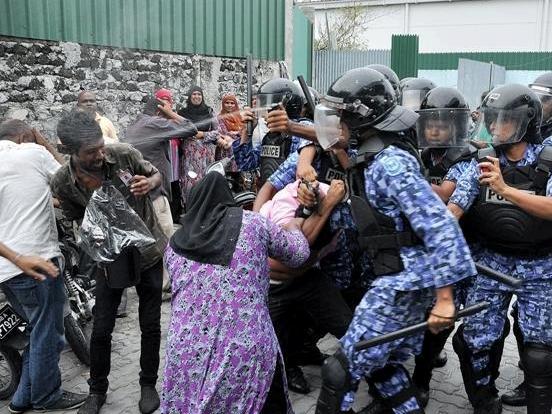
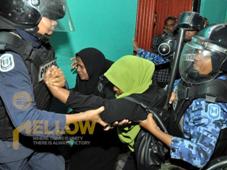
Police have refuted “in the harshest terms” allegations of police brutality by Amnesty International, after the human rights body released a statement on June 11 condemning the “excessive use of force” against demonstrators.
Amnesty’s statement followed its investigation of the police crackdown on a Maldivian Democratic Party (MDP) protest against the dismantling of the MDP’s Usfasgandu protest camp on May 29 – a crackdown which included “beatings, pepper-spraying, and arrests. Those attacked include peaceful demonstrators, members of parliament, journalists and bystanders.”
In a press release yesterday, police insisted that “the minimum required force” was used to arrest 52 protesters on May 29, which included those who “obstructed police from performing their duty” and “disobeyed and resisted orders” as well as others taken into custody “on suspicion of attempting to inflict physical injury on police officers” and “for behaving in ways that cause loss of public order.”
Minivan News however observed one protester sustain a head injury after he was hit in the head by a baton, and was rushed to hospital in a pickup truck refueling at the nearby petrol shed.
Local daily Haveeru uploaded video footage showing violent confrontations between police and demonstrators during the arrests.
Minivan News also witnessed a cameraman from local TV station Raajje TV being pepper-sprayed by police while he was attempting to film police arresting a demonstrator.
“Incalculable damage”
The police statement noted that a report on the day’s events by a monitoring team from the Human Rights Commission of Maldives (HRCM) “stated in very clear terms that excessive force was not used to arrest those among the demonstrators who threw objects at police, used obscene language and tried to obstruct police duties and that no physical harm was caused by police.”
The HRCM monitoring team however observed a police officer chase two demonstrators and strike them with his baton on the night of May 29. After protesting behind police barricades at the Usfasgandu area, MDP supporters began to gather at the intersection of Chandanee Magu and Majeedhee Magu in the centre of Male’ around 8:45pm.
The police statement explained that force was used to disperse the crowd at the Chandhanee Magu junction after protesters began throwing rocks at police officers from a construction site in the area.
“While six police officers sustained varying degrees of injury during the disturbances that day, two police vehicles were severely damaged,” reads the statement.
It added that police have concluded investigations of five demonstrators taken into custody on May 29 – including MDP MP Imthiyaz Fahmy ‘Inthi’ – and forwarded the cases for prosecution.
Police also noted that “very few complaints” were lodged concerning alleged misconduct and brutality by police officers.
A complaint by Maimoona Haleem, wife of former Foreign Minister Ahmed Naseem, alleging excessive use of force in her arrest was being investigated by the police professional standard command, the statement revealed.
According to the Amnesty statement, ‘Mana’ Haleem was “walking home with her female friend in Majeedee Magu Street when police stopped them and began beating them repeatedly with their batons on their arms, back and hips before taking them in a van to the police station.”
“In her testimony Mana Haleem says: ‘I asked why we were being held, but received no answer. Later, they [police] told us it was because we had not obeyed their orders. We asked them how we could have disobeyed their orders if they had not given any, but they were not interested. I have bruises on my shoulder, my back and my hip.'”
However, the police statement claimed that in addition to a complaint filed at the HRCM by a detained demonstrator alleging the use of obscene language during his arrest, no complaints were lodged at the Police Integrity Commission (PIC), the oversight body for police.
The police statement slammed Amnesty for not reporting the “incalculable damage caused to police officers and property” during the MDP protest.
“Maldives Police Service calls on Amnesty International to clarify information from the relevant authorities and state the facts impartially and without bias when issuing such reports in the future,” the statement reads.
The statement concluded by urging “anyone with a complaint regarding police conduct” to formally lodge complaints at independent institutions.
In previous reports highlighting human rights abuse by police, Amnesty has noted police response denying the allegations and its recommendation that victims complain to HRCM.
“HRCM has told Amnesty International that they have serious limitations in terms of trained investigative staff and dealing with human rights issues in a highly politicised environment is an overwhelming challenge for them,” Amnesty has previously noted.
“By referring cases of police abuse of power to the HRCM, when it is clear that such investigations are beyond its capacity, the government is in effect forfeiting its own responsibility to enforce respect for human rights within the police force,” the organisation noted.
“Minimum force”
In its statement on the May 29 incidents, Amnesty had said that despite police claims to have used “the minimum required force to dismantle the area and arrest unruly demonstrators”, “it is clear that by far the majority of demonstrators were not using violence, and any such incidents cannot be used by police as an attempt to justify the ill-treatment of bystanders and those rallying peacefully.”
“Amnesty International believes that the police response to the demonstrations on 29 May was a clear example of excessive use of force.”
Amnesty’s statement included testimony from a number of protesters, noting that the latest reports “are consistent with many other testimonies Amnesty International has gathered previously.”
“One woman protesting peacefully in Majeedee Magu Street told Amnesty International that police officers suddenly pushed into them, and hit her and other peaceful demonstrators with their riot shields. Police hit them repeatedly on their back, and then pepper-sprayed them, aiming at their face and eyes. She said that police grabbed one demonstrator by the neck, shouted at him to open his mouth, and sprayed directly into his mouth,” the human rights organisation reported.
“Police also beat bystanders who showed no signs of violence. An eyewitness saw a man sitting on a stationary motorbike taking no active part in the demonstrations. Police went for him and hit him on his head with their batons. He lost consciousness. His friends took him to a nearby house where they arranged private medical treatment for him – they did not take him to hospital straight away as they were afraid he would be arrested.”
Amnesty called on countries supplying police and military equipment to the Maldives, particularly pepper-spray, to ensure that the substance was not being used to commit human rights violations.
“Any country that knowingly supplies police or military equipment to a force that uses them to commit human rights violations is itself partly responsible for those violations,” the human rights organisation warned.
“Amnesty International is calling on the government of Maldives to halt attacks on peaceful demonstrators including beating and pepper-spraying; bring to justice any police personnel who have used excessive force; ensure that security forces in the Maldives receive comprehensive training on what constitutes human rights violations, which they should not commit.”
The Prosecutor General’s (PG) Office has appealed cases concerning the alleged involvement of Deputy Speaker Ahmed Nazim in defrauding the Atolls Development Ministry, in the purchase of 220 harbor lights worth Rf1.95 million (US$126,000) in 2004 to the High Court.
PG also stated that it would appeal the remaining three cases of corruption charges levied against the deputy speaker.
The case appealed by the state in the High Court concerns the Nazim’s use of equipment and employees of Namira Engineering while he was the company’s Managing Director to submit bids in the name of two companies called Tech Media Service Pvt Ltd and Standard Electric Works Pvt Ltd, to provide 220 harbor lights to the Atolls Ministry without the company’s prior knowledge in 2004.
The prosecutors requested the Criminal Court recover the money paid to Nazim for the supply of the goods, on the grounds he defrauded the ministry.
However, during the trial Nazim had submitted six witnesses to prove the companies were aware of the submission of bid and presented Saleem as a witness to establish that the ministry received the 220 harbor lights.
The prosecution meanwhile presented as evidence the police investigation report, cheques issued by the state and bogus letterheads found during a police raid on Namira Engineering in May 2009.
Further, the prosecutors presented employees of Namira as key witnesses to prove they were acting on Nazim’s orders.
However, Judge Saeed Ibrahim dismissed the testimonies of the prosecutor’s witnesses on the grounds that they were the employees who had prepared the fraudulent bid estimates which were submitted.
Even though the witnesses had told the court that they had prepared the bid estimates on Nazim’s order, the judge concluded that it does not mean Nazim had ordered them to prepare the bids fraudulently.
Judge Ibrahim also argued that the act of asking was not enough to prove criminal intent.
Therefore, in reference to article 51 of the constitution which guarantees the rights of the accused, the judge concluded that the charges cannot be filed against Nazim
An official from the PG confirmed to Minivan News about the decision to appeal, but refused to provide any further details.
Multiple counts
Deputy Speaker Nazim, who is also the Deputy Leader of government aligned party People’s Alliance (PA), along with MP Ahmed “Redwave” Saleem (then-finance director at the ministry) and Abdulla Hameed, former Atolls Minister and half brother of Gayoom, was charged in late 2009 on multiple counts of conspiracy to defraud the Atolls Ministry.
The scam – first flagged in an audit report released in early 2009 – involved paper companies allegedly set up by the defendants to win bids for projects worth several hundred thousand dollars, including the fraudulent purchase of harbor lights, national flags and mosque sound systems.
According to the report, the documents of Malegam Tailors, the company which won the bid, show that it shared the same phone number as Namira. Fast Tailors, another company that applied, also shared a different phone number registered under Namira.
The other company Needlework Tailors that submitted the bid had an employee of Namira sign the documents as the General Manager while the fourth company named “Seaview Maldives Private Maldives” did not have any record of its existence, according to the report.
However, the auditors noted that Searview bid documents had an exact date error found on Fast tailors documents, which according to the auditors prove same people had prepared both company’s bids.
The prosecution began in late 2009, after police uncovered evidence that implicated Hameed, Saleem and Nazim in a number of fraudulent transactions.
At a press conference in August 2009, police exhibited numerous quotations, agreements, tender documents, receipts, bank statements and forged cheques showing that Nazim received over US$400,000 in the scam.
A hard disk seized during a raid of Nazim’s office in May 2009 allegedly contained copies of forged documents and bogus letterheads.
Police maintained that money was channeled through the scam to Nazim who laundered cash through Namira Engineering and unregistered companies.
“Politically cleansed”
On February 23, 16 days after the controversial transfer of power on February 7, the Criminal Court dismissed three remaining counts of fraud against Nazim, stating that his “acts were not enough to criminalise him”.
All four cases against Nazim concerned public procurement tenders of the former Atolls Ministry secured through fraudulent documents and paper companies.
Criminal Court Judge Saeed Ibrahim on at the time ruled that two counts of fraud against Nazim – for setting up several paper companies to win a bid worth US$110,000, provide 15,000 national flags for the atolls ministry in 2003, and a similar tender worth US$92,412 to provide 15,000 national flags in 2005, could not be prosecuted.
The third count – conspiracy to defraud the ministry in 2003 in a similar manner to win a public tender for procuring US$115,758 worth of mosque sound systems – was also dismissed.
In an interview to the local media outlet Sun following the rulings, Nazim claimed the four cases were baseless and had been leveled at him by former President Mohamed Nasheed’s administration, using false evidence.
He welcomed the ruling as a testimony to the existence of an independent judiciary: ”Today we are guaranteed of the existence of an independent and trustworthy judiciary. Former President Nasheed and the Maldivian Democratic Party (MDP) will now believe we have an independent judiciary, because they know that the four cases were schemed with manufactured evidence. These are are absolutely untrue and baseless cases.”
Following the dropping of the charges post-February 7, the MDP claimed that the courts rewarded Nazim by “politically cleansing” him from all the corruption charges, following the toppling the party’s government after it had attempted to reform the corrupt judiciary.
Minivan News tried contacting Nazim but he did not respond at the time of press.
The police on Wednesday requested the Prosecutor General’s Office (PG) charge six people in connection to the murder of 33 year-old Ali Shifan ‘Tholhi Palay’, third victim to be killed in the spree of gang-related stabbings across capital Male’.
A statement released by the police says that cases have been forwarded against: Ali Nabeeh,22, of M.Nalahiyaa Manzil, Mohamed Shaifan,18, of Male’ Dhaftharu no 3912, Razzan Abdu Rahman,19, of Kaanimaage house in Thulhaadhoo island of Baa atoll, Abdul Thilmeez,20, of M.Thilmeez, Mohamed Asif,19, of Maafahi house inKurendhoo island of Lhaviyani atoll and Mohamed Mishaan Abdul Haadhy,20, of M.Silver Nest.
The attack widowed Shifan’s wife of three years.
Shifan was attacked at about 4:15pm on April 1 outside the Westpark restaurant on Boduthakurufaanu Magu, the outer ring road of Male’.
He was stabbed multiple times in the back and arms by two men on a GN motor bike as he stepped out of a restaurant to meet a friend, the police said. He had no previous records of any gang involvement, police confirmed. But it was unclear as to why he was targeted in a gang related attack.
“Shifan was a very peace loving man and he always said he did not want war,’’ a friend of Shifan previously told Minivan News, claiming the assailants attacked Shifan because of his friends, who were themselves allegedly involved in a previous gang attack.
The source also alleged the attack was politically motivated and that gangs were being set against each other.
Prior to the brutal stabbing of 33 year-old Shifan on April 1, a pair of 21 year-olds – Abdul Muheeth and Ahusan Basheer -were stabbed to death on February 19 and March 17 respectively. Both cases are now in court with charges against a total of nine people, including four minors.
In addition to these murders, a 16 year-old boy named Mohamed Arham was also found dead with multiple stab wounds on May 30, while controversial blogger and journalist Hilath Rasheed made a miraculous recovery from a fatal attack in which his throat was slit by the assailants. Both cases are currently under investigation. No arrests have been made.
Several more victims, including expatriates, have been brutally injured or killed in gang related attacks.
The spate of stabbings and murders have provoked pressures from the public to impose stricter punishments to the perpetrators. Families of the victims have both in court and in public platforms are calling for justice and the death penalty to be implemented to curb the increasing gang violence.
Though the Islamic Sharia and the penal code states death penalty as a punishment, it has not been executed for decades. Death penalty sentences are traditionally changed to life imprisonment.
The government has meanwhile said it will not hesitate to implement death sentences if the parliament approves it.
The Commonwealth Ministerial Action Group’s (CMAG) has released a statement emphasising its hope that “no action should be taken by any party or authority that would negatively affect the functioning of the Commission of National Inquiry or the ability of individuals to provide testimony to the Commission,” following its teleconference yesterday.
The Commission of National Inquiry (CNI) was established by President Dr Mohamed Waheed Hassan to investigae the events surrounding the controversial transfer of power in February.
The statement follows a week in which the fallout from alternative reports of these events – two from the Maldivian Democratic Party (MDP) and one from the original CNI – saw the arrest of the Chief of Police Intelligence Mohamed Hameed for his alleged involvement in the compilation of the MDP report.
The Criminal Court decided to release Hameed this week after extending his initial detention period by five days.
The MDP released a statement alleging that Didi’s questioning was related to the release of her own report which had argued President Waheed should face prosecution for his involvement in the events of February 7.
“The MDP strongly believes this is a cowardly act to intimidate people who are willing to come forward and provide reliable information to the newly composed CoNI,” said the MDP statement.
The police told local media that the timing of the questioning had been planned for the Thursday before but had been rescheduled at Didi’s request.
Former President Nasheed had also suggested to local media that the delays to the CNI’s reform was a sign of the government’s reluctance to do so.
The original deadline for the changes had been May 31, although the MDP and the government failed to agree on the final member of the commission until June 4.
President Office spokesman Abbas Adil Riza told Minivan News today that he did not believe the CMAG statement was referring to such incidents.
“The police are independent and have not been conducting any unlawful activities,” said Abbas.
Abbas said that the government welcomed CMAG’s words of encouragement regarding the CNI, adding that it was pleased the Commonwealth had “finally accepted the roadmap talks.”
The talks appeared to have been scuttled following a three day retreat at Bandos, at which parties in the ruling coalition presented the ousted Maldivian Democratic Party (MDP) with a list of 30 demands to “resolve the problem of public disturbances”.
They included demands that the MDP “stop practicing black magic and sorcery”, “stop the use of sexual and erotic tools”, and “not walk in groups of more than 10”.
CMAG’s statement today said that it “welcomed and encouraged efforts underway to establish a Maldivian-led dialogue process among key political leaders, which could promote high-level discussions on issues of national concern, including those identified in the Political Party Talks agenda.”
CMAG also welcomed the reformation of the CNI, instigated at the behest of both the international community, the MDP and civil society groups.
The statement outlined the reasons for the formation of the group before expressing its hope that the CNI was now in a position to fulfil its objectives.
“The Commission of National Inquiry was established to undertake an investigation into the circumstances that led to the transfer of power in Maldives on 7 February 2012. This was to enable an independent and impartial investigation to be conducted that would be credible, rigorous and provide confidence to the Maldivian people.”
“The Group noted that the reformed Commission had been formally established on 17 June 2012 and was now operational. It expressed hope that the Commission would be fully able to carry out its work in its own best judgement, and urged all concerned to extend their full co-operation to the Commission.”
The reformed commission includes the three original members – Ismail Shafeeu, Dr Ibrahim Yasir, and Dr Ali Fawaz Shareef – with the addition of retired Singaporean Supreme Court Judge G.P. Selvam and Ahmed ‘Gahaa’ Saeed who was nominated by former President Mohamed Nasheed.
The CNI yesterday announced that anyone wishing to give information to the commission can do so up until June 30. It also welcomed evidence from those who had spoken to the commission before the reforms were enacted.
The commission stated that the evidence and identities of witnesses would be protected.
At a press conference this morning, the CNI told local media that the government would allocate the four Maldivian members “some sort of allowance”, having worked without remuneration up to this date.
The expenses of Selvam, it was revealed, will be borne by the Commonwealth.
Police have concluded investigation and forwarded for criminal prosecution a case against Maldivian Democratic Party (MDP) MP Imthiyaz Fahmy ‘Inthi’.
According to a police statement, the Prosecutor General’s Office (PGO) has been requested to charge Inthi with disobeying orders, obstructing police duty and physically assaulting a female police officer during an MDP demonstration on May 29 that followed the dismantling of the former ruling party’s protest camp at Usfasgandu.
However in a statement condemning “excessive use of force” against demonstrators, Amnesty International reported that according to MP Imthiyaz, “police in Dhoonidhoo told him he was arrested for ‘disrupting peace’. The next day, in court, police stated that he had been detained for ‘physically attacking a woman police officer.”
Police arrested Inthi along with 56 other MDP activists on May 29 after police raided the MDP protest camp with a search warrant from the Criminal Court.
“I was arrested at the MDP protest camp and the court released me, after the police told the judge that I had assaulted a female officer at Usfasgandu,” Inthi told local media.
Police have also forwarded a case against MDP activist Shiyan ‘Shiyalhey’ Shafeeq of H. Hedheythundi to the PGO.
Shiyalhey faces charges of arson, disruption of public order and attacking officers of the armed forces.
 (3)Dislikes
 (0)
(0)