When thirst became a crisis in Maldives: Business Standard

“On December 5, the Indian Railway Catering and Tourism Corporation (IRCTC) received a phone call from the Union external affairs ministry, routed through the railway ministry,” recalls Jyoti Mukul for India’s Business Standard.

“It was not a usual communication but a direction to pull out something as basic as drinking water to meet a diplomatic call.

A day earlier, the Maldivian capital of Male had experienced a crisis. Its only desalination plant, which supplies drinking water to citizens after treating sea water, had caught fire. It, indeed, was a disaster for the island nation; India offered help and so did China and Sri Lanka.

Since the sea route would take at least four days, the quickest relief was to air-lift drinking water from India and take it to Male.

The need to rope in IRCTC, Indian Railways’ government-owned catering and tourism company, was felt.”

Read more

Likes(0)Dislikes(0)

Government and opposition send messages to mark Sri Lankan independence

Both the government and opposition have extended felicitations to the people of Sri Lanka on the occasion of the country’s 67th Independence Day.

President Abulla Yameen sent messages to the newly elected President Maithripala Sirisena, and his Prime Minister Ranil Wickremesinghe, extending good wishes from the people of the Maldives.

Meanwhile, the opposition Maldivian Democratic Party released a statement noting that Maldivians have always followed development in Sri Lanka, saying that “progresses in foreign and political affairs [in Maldives] have always reflected developments in Sri Lanka.”

“The Maldivian Democratic Party joins our cousins in Sri Lanka in reflection that this Independence Day holds much significance, as it reflects a history of great sacrifices made by many Sri Lankans in the attainment of its freedom,” said party Spokesman Hamid Abdul Ghafoor.

President Sirisena inflicted a surprising defeat on the ten-year incumbent Mahinda Rajapaksa in last month’s presidential polls.

Sri Lanka gained independence from British rule on February 4, 1948. The Maldives will itself celebrate 50 years since it gained total independence from the British Empire on July 26 this year.

Likes(2)Dislikes(0)

Environmental coalition urges President to stop oil exploration

Twenty NGOs have urged President Abdulla Yameen to stop plans for oil exploration in Maldivian waters, or risk the country’s economic and environmental health.

In a joint statement of concern, marine conversation NGO OceanCare’s President Sigrid Lueber warned that the oil explorations could have “severe socio-economic consequences in the fisheries and tourism sector”.

After pledging during his election campaign to begin new efforts to find oil, President Yameen’s government has claimed investor interest in the project, while a German research vessel carried out a seismic survey last August.

Speaking to Minivan News today, founder of local environmental NGO Ecocare, Maeed Zahir, said that the public does not take seriously the concerns put forward by local NGOs.

“Several people have questioned our technical expertise on oil exploration and used it as an excuse to dismiss our concerns,” said Maeed. “However, with several international NGOs speaking out against the exploration we hope it will be taken more seriously.”

The statement of concern was also sent to several members of the cabinet, including fisheries minister Dr Mohamed Shainee, tourism minister Ahmed Adeeb, economic development minister Mohamed Saeed, and environment minister Ahmed Thoriq.

President’s Office Spokesperson Ibrahim Muaz said that only the president could comment on correspondence addressed personally to him, directing Minivan News to the relevant ministers for updates on the exploration project – none of whom were responding to calls at the time of publication.

The Maldives has also been included OceanCare’s silent oceans campaign. The NGO – which was granted Special Consultative Status with the UN’s Economic and Social Council in 2011 – is encouraging people to write to Adeeb urging an end to exploration.

Seismic impact

The NGO coalition’s statement of concern warned that exploration will have adverse effects on the Maldivian economy as a result of negative impacts on fisheries.

Seismic air guns – one of the most commonly used survey methods for offshore oil exploration – produce loud bursts of sound by introducing air into water at high pressure which then penetrates hundreds of kilometers into the earth’s crust.

OceanCare stated that the air guns produce a pulse of noise lasting 20 to 30 milliseconds, which is repeated an average of every 10 to 15 seconds, often for 24 hours a day.

“Three decades of controlled scientific studies leave no doubt that intense sound damages fish and impact fisheries,” said the Swiss NGO. “Ocean noise has a negative effect on at least 55 marine species.”

A recent study commissioned by the Namibian government revealed a sharp decline in catch as a result of increased seismic exploration in the Orange River Basin. The country’s tuna catch shrunk from 4,046 tons in 2011 to a mere 650 tons in 2013 after a shift in migratory routes.

(IMAGE: Championsforcetaceans.com)

Similarly, the Australian tuna industry has said the process may threaten the survival, abundance, or evolutionary development of native species or ecological communities.

Additionally, a recent study into the impacts of air guns on marine life ranked them as the second highest contributor of underwater noise caused by humans – only underwater nuclear detonations have been found to cause more.

The NGO statement also noted the adverse effects on marine biodiversity as a result of such surveys, pointing out that Maldivian tourism is heavily dependent on a healthy and diverse marine eco-system.

Tourism and fishing account for 90 percent of the Maldives’ GDP, while providing three-quarters of all employment and two thirds of foreign exchange earnings.

The government’s development plans include both a reduced reliance on tourism, as well as minimising the country’s dependence on imported fuel through the enhanced use of renewables. Imported fuel consumes around one third of the Maldives’ GDP.

Preliminary Research

Last year, the German research vessel ‘Sonne‘ – which came to the Maldives to conduct research into global warming – conducted preliminary research exploration free-of-charge on the government’s request.

While pointing out the importance of proper Environmental Impact Assessments in oil explorations, the coalition of environmental groups expressed concern that no such EIA or public consultation was undertaken prior to this research.

Speaking at the time, fisheries minister Dr Shainee said that explorations will be carried out in one of three areas which have properties suggesting the presence of oil and gas. The identified locations were located 100 miles east of the area between Laamu and Thaa atoll.

Shainee also said that the information obtained will be shared with the Maldives in the first quarter of 2015. He said that the data would not be shared with any third party, and that further explorations would follow to confirm any positive findings.

In February 2014, the Maldives National Oil Company Ltd – a subsidiary of the State Trading Organization – said it would soon begin advertising the country as a destination for oil exploration.

Speaking at the 18th Saarc Summit held last year, Indian Prime Minister Narendra Modi said that India wishes to assist Maldives in its search for oil reserves, while cabinet members reported that oil exploration was on the agenda of the first China-Maldives joint commission on trade, held in December.


Related to this story

Maldives to begin oil exploration with assistance of research vessel

Oil drilling and Maldives’ tourism “cannot coexist”, says NGO Bluepeace

Maldives National Oil Company seeks assistance with oil exploration

Likes(6)Dislikes(1)

Free trade feasibility talks begin with Chinese delegates

The Maldives government has started technical discussions with China regarding the feasibility of a free trade agreement between the two nations.

At a meeting held at the Ministry of Economic Development today (February 4), a technical committee consisting of experts from both countries engaged in discussions over what would be the Maldives’ first free trade agreement with a single country.

Haveeru reported economic development minister Mohamed Saeed as saying that the committee is tasked with determining the feasibility of such an agreement and identifying any potential difficulties.

“The truth is we want to set up the free trade agreement as soon as possible,” he told the paper.

He said the two main reasons in pursuing a free trade agreement with China were duty-free exports of fisheries products, and an increase in air travel between the countries which will bring more Chinese tourists to the Maldives.

Fish accounts for 98 percent of the Maldives’ exports, while Chinese tourists make up 30 percent of all visitors to the Indian Ocean nation.

Speaking with Minivan News today, former Economic Development Minister Mahmoud Razee said that free-trade is most advantageous when taken up by nations at the same level of development, with a demand for goods exported by both countries.

“Maldivian fisheries products are mainly imported by European countries, Japan, and America. The question is whether China imports enough fisheries products from the Maldives,” he said.

Razee also said noted that there was a potential risk of  China ‘dumping’ low quality and undesirable goods into the Maldivian economy.

Minister at the President’s Office Mohamed Shareef has previously said that free trade talks were initiated by the Maldives, and that China has taken a flexible approach with regards to the final agreement.

Last year, President Abdulla Yameen declared a foreign policy shift to the East, slamming the European Union after regulations resulted in the non-renewal of the Maldives’ preferential trade partner status.

The government’s decision to engage in free-trade with China was revealed in December 2014 after the cabinet’s economic council visited China to hold discussions on Chinese-assisted projects in the Maldives.

“The biggest advantage of the free trade will go towards fishermen. With free trade, the 12 percent export duty will be gone, thus the 12 percent becomes profit for fishermen,” said fisheries minister Dr Mohamed Shainee at the time.

The cabinet members’ visit to Beijing in December also saw the Maldives officially sign up to the Maritime Silk Road project, which will provide a trade route between China and east coast of Africa and the Mediterranean.

China currently has free trade agreements with eight countries – including Pakistan, Costa Rica, Peru, and New Zealand – as well as a regional agreement with the Association of South-East Asian Nations.

The Maldives is currently a member of the South Asian Free Trade Area, along with its fellow SAARC nations.


Related to this story

Maldives backs new Chinese investment bank, pursues free trade deal

Silk road deal to be concluded in China-Maldives economic committee

President Yameen slams “Western colonial powers,” declares foreign policy shift to East

EU refuses to extend duty-free status of Maldivian fish imports on human rights grounds

Likes(3)Dislikes(1)

Rise in child abuse reports “tip of the iceberg”, says ARC

Local child protection NGO Advocating the rights of Children (ARC) says that the recent increase in reports of child abuse cases following the death of Rakeedhoo toddler Mohamed Ibthihaal is only the “tip of the iceberg”.

ARC’s advocacy manager Muruthala Moosa explained that existing societal and cultural norms are contributing to an environment that put children at risk of abuse.

The high profile case of Ibthihaal has resulted in a spike in reports of child abuse as the public and media campaign to raise awareness of the issue. Authorities are meanwhile conducting a series of parallel investigations after it was revealed that abuse within the troubled family was known to officials.

“In the absence of such a high profile case, child abuse continues unabated and unreported,” said Muruthala.

Numerous cases of child abuse have been reported to police following the death of the three-year-old last week. Police have since revealed that his mother confessed to the crime while under police custody after the Criminal Court issued a warrant against her.

Haveeru reported that she has been transported to Malé today (February 3) for further investigation.

Muruthala said that ARC had consistently stated that the existing Child Protection Act (Act no. 9/91) was “inadequate and does not contain major provisions and principles of the UN Convention on the Rights of the Child which the Maldives acceded to in 1991.”

Additionally, he noted that despite a new act being drafted, “not enough political capital or priority is being afforded to fast track this legislation”.

The implementation of laws and regulation is also a major problem, said Muruthala: “Even if the new and improved Act is to take effect, it needs to be enforced thoroughly.”

“The tragic [Ibthihaal] case has highlighted the need to address serious deficiencies in the child protection system in the Maldives,” he said.

Meanwhile, a police media official told Minivan News today that there has been a marked increase in the number of child abuse cases being reported in the past week.

Police confirmed reports that a 42-year-old man from Lhaviyani Hinnavaru was arrested today for sexually abusing a 14-year-old, while her mother has also been arrested for giving the man consent to carry out the abuse.

Hinnavaru police have also started an investigation into another case in which a man branded a six-year-old on the hand with a red hot screwdriver, confirmed the media official.

Police have also started an investigation into a case where an 11-year-old boy was allegedly held in chains at Haa Dhaalu Kulhudhuhffushi, the official continued.

Sun reported sources as saying that the child is mischievous and often misbehaved, and that the family was keeping him chains for his own safety. The Human Rights Commission of Maldives is investigating reports that authorities were aware of the abuse.

Elsewhere, a court warrant has been issued for the arrest of a divorced couple from Laamu Gan for threatening their four children, while a 23-year-old in Hulhumalé has been arrested for neglecting her six-month-old baby on January 31.

Police media said that the Family and Child Protection Department will be assisting and providing guidance to the island police stations on how proceed with such cases.


Related to this story

ARC condemns “systematic laws” after death of Rakeedhoo toddler

Body of abused child found in Vaavu Rakeedhoo

State negligence investigated in death of Rakeedhoo child

Likes(2)Dislikes(0)

Indian High Commission holds cancer screening camps

The Indian High Commission to the Maldives will be hold free cancer screenings at ADK Hospital on February 4 and 5, and in Ghaafu Dhaalu Thinadhoo on February 6, as part of its health and wellness month.

In addition to the screenings, the high commission is organising a cancer awareness walk in Malé on February 4 at 4pm, in partnership with Basavatarakm Indo American Cancer Hospital (BIACH) in Hyderabad, ADK hospital, and the Cancer Society of Maldives.

The walk will be followed by yoga instruction at the artificial beach, while similar yoga workshops are to be organised in Himmafushi, Villingili, and Bandos during the month.

Last month the high commission held a number of Bollywood themed events, including a dance show, quiz, and a film festival as part of year-long celebrations of diplomatic relations with the Maldives.

“In celebration of the 50th anniversary of relations and Maldivian Independence, every month will include thematic activities as part of a year-long celebration,” said Indian High Commissioner to the Maldives Rajeev Shahare.

Other events for the wellness month include a blood donation camp held on February 27. The high commission requests everyone to register in advance for these camps by calling 763 8246.

Likes(1)Dislikes(0)

Transparency reviews the Majlis in 2014

Transparency Maldives has published its 2014 Majlis review, reporting that 10 bills were passed in 59 sittings of the 18th People’s Majlis.

Of the 85 members elected to the expanded parliament in March, only 16 have had a flawless attendance record since, with an overall attendance figure of 90 percent.

The members from the opposition Maldivian Democratic Party (MDP) had the worst average attendance of the three main parties – 85 percent, compared with the Jumhooree Party’s (JP) 91 percent and the ruling Progressive Party of Maldives’ (PPM) 93 percent.

It was the Maldivian Development Alliance leader, and Progressive Coalition member, Ahmed ‘Sun Travel’ Shiyam who had the worst attendance of any MP, appearing at less than half the sessions, reported Transparency.

Other than the Adhaalath Party, for whom Makunudhoo MP Anara Naeem is the only MP, Siyam’s MDA was the only party whose representation in the 18th Majlis has remained stable.

Despite winning 33 seats in the March polls, the PPM has now gained an additional 11 MPs, while its former ally the JP has a net loss of 2 seats.

After winning a disappointing 26 seats in the house, the MDP lost 4 MPs to opposition parties as well as expelling Majlis Deputy Speaker ‘Reeko’ Moosa Manik from the party.

Legislation

The most important legislative changes brought by the Majlis in 2014 were the Anti-Money Laundering and Counter-Terrorism Financing Act, the new Penal Code, the Special Economic Zone Act, and amendments to the Judicature Act.

The report describes the benefit of the money-laundering bill as preventing terrorism financing, kleptocracy, narco-trafficking, human trafficking, illicit arms trafficking, counterfeiting currency, corruption, and transnational organised crimes.

“Money laundering has potentially destructive social and economic consequences. It allows criminals such as drug traffickers, corrupt officials, and transnational organised crime syndicates to introduce illicit proceeds or ‘dirty money’ into legitimate finance streams as legal funds,” explained the anti-corruption NGO.

The new penal code – to be introduced in April this year – represents the culmination of 10 years’ work and will replace an old code that has been described by legal experts as obstructing the course of justice due to its “outdated” nature, read the review.

“In April 2004, the new penal code was finally passed, making it the first modern, comprehensive penal code in the world to incorporate the major tenets and principles of Islamic law.”
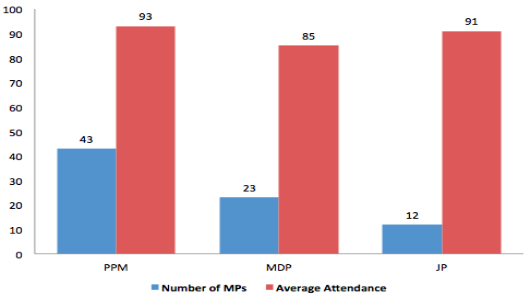
Parliamentary group attendance

The report described the government’s flagship Special Economic Zones Act as laying “an edifice for economic, industrial, social, financial and infrastructural development.”

“It allows economic activities to be carried out under a relatively liberal manner through tax exemptions to investors and developers.”

Despite the promise of major ‘transformative’ investment – yet to be realised, the opposition has argued that the bill will “allow the government to conduct transactions broadly with no transparency and no opportunity for oversight, as a result of which the possibility of losing the country’s independence and sovereignty would be high”.

The SEZ was passed in August in the face of 300 proposed MDP amendments.

Appointments and dismissals

Regarding the changes to the Judicature Act – which facilitated the removal of two Supreme Court judges – Transparency’s report pointed out its previous concerns over the “political influence on the judiciary in the Maldives”.

Amendments requiring the reduction of the bench from seven to five in December saw the JSC swiftly select Chief Justice Ahmed Faiz and Justice Muthasim Adnan in a decision marked for its lack of transparency.

The Majlis’ subsequent approval of the pair’s dismissal was described as a “black day for the constitution” by Faiz, while UN Special Rapporteur Gabriella Knaul predicted a “chilling effect” on the work of the judiciary.

Finally, the review of the Majlis’ work for 2014 noted the appointment of a number of key figures, including Prosecutor General Muhuthaz Muhsin – appointed after political wrangling saw the constitutionally mandated deadline for filling the position missed by six months.

After the Supreme Court removed the Elections Commission’s senior leadership less than a month before the Majlis elections, MPs appointed Mohamed Shakeel and Ahmed Sulaiman to the commission in November. They were also joined by Ismail Habeeb Abdul Raheem and Amjad Musthafa in receiving Majlis approval.

The Majlis appointment of President Abdulla Yameen’s nomination of Hassan Ziyath as the new auditor general in November was also a source of controversy, with outgoing auditor general Niyaz Ibrahim arguing that his removal had been unconstitutional.

Niyaz was ousted as a result of last minute changes to the Auditor General’s Act, proposed to the the Majlis by the PPM on the same day the audit office published a report implicating tourism minister and deputy PPM leader Ahmed Adeeb in a US$6 million corruption scandal.


Related to this story

Transparency Maldives notes “grave concern” over undemocratic trends

Building trust – Transparency Maldives calls for enhanced asset disclosure

Transparency Maldives concerned over “stagnation of democratic consolidation”

Likes(1)Dislikes(0)

Maldivians fighting wars abroad a concern, says Police Commissioner

Commissioner of Police Hussain Waheed says that it is a cause of concern that Maldivians nationals are leaving the country to fight in wars abroad.

It is necessary for all police officers to work together in order stop Maldivians joining wars abroad, he told fellow officers at a police function held yesterday (February 2).

If police receive any information regarding such a case, he added, it should be investigated by the intelligence department and adequate preventative measures should be taken immediately.

The commissioner’s remarks closely follow reports that a former mosque employee at Malé’s Indhira Gandhi Memorial Hospital and his wife had travelled to Syria for Jihad, entering ISIS-held territory after travelling to Turkey via Dubai.

The exact number of Maldivians abroad for Jihad remains unclear, with Haveeru reporting a group of six having departed last week, as well as a dozen more said to have gone to Syria at the start of January.

Waheed has previously estimated that around 50 Maldivians are working with foreign rebel groups, dwarfing figures suggested by Home Minister Umar Naseer in December.

Commissioner Waheed has said that police are working with the Islamic ministry and relevant government departments to prevent radicalisation, though he said the variety of people travelling for jihad made it hard to target the most vulnerable groups.

Despite assurances that the activities of radicals are being monitored, the group said to have left in early January included a number of individuals known to police.

The group included Azlif Rauf – a suspect in the murder of MP Dr Afrasheem Ali, and an individual arrested over the disappearance of Minivan News journalist Ahmed Rilwan. A private investigation into Rilwan’s case implicated radicalised gangs in what is believed to have been the 29-years-old’s abduction.

Last month, four would-be jihadis were apprehended in Malaysia, with media reporting that they were brought back to the Maldives and released after the authorities seized their passports. A similar group were returned from Sri Lanka in November.

In November, a jihadist group called Bilad Al Sham Media (BASM) – which describes itself as ‘Maldivians in Syria’ – revealed that a fifth Maldivian had died in Syria.

Defending the government’s stance on extremism and ISIS, Islamic minister Dr Mohamed Shaheem Ali Saeed told the Majlis late last year that “Maldives will not allow Maldivians to go and fight in foreign wars”.

“We do not support their [ISIS] extremist policies. We have repeatedly appealed to our beloved youth to refrain from falling prey to these ideologies,” he said.


Related to this story

Hospital worker and wife latest to travel for Jihad

Over 50 Maldivian militants fighting in foreign wars, reveals Commissioner of Police

Maldives a “land of sin”, says jihadist after departing with family for ISIS territory

Islamic Minister advises Maldivians against participating in foreign wars

Likes(2)Dislikes(0)

Police start sea search for Maail, missing for 7 days

Maldives Police Services have initiated a sea search for Abdullah Maail, a 24-year-old from Dhaalu Kudahuvadhoo who has been reported missing for seven days.

Police media told Minivan News that officers have finished searching the island where Maail was believed to have disappeared, and have now extended the search to the surrounding seas.

A police press statement released last week said that Maail was last sighted at Shaviyani Firunbaidhoo – an uninhabited island where he works as a farmer – and that he was last seen with his bags.

Police will work alongside the Maldives National Defense Force and have requested any information regarding Maail’s whereabouts be submitted to police hotline 332 2111.

Likes(1)Dislikes(0)