Islamic Foundation calls for death sentence if apostate fails to repent

The Islamic Foundation has called for self-declared apostate Mohamed Nazim to be stripped of his citizenship and sentenced to death if he does not repent and return to Islam.

Nazim claimed he was “Maldivian and not a Muslim” during a public question-and-answer session with Islamic speaker Dr Zakir Naik, the first time a Maldivian has publicly announced he is not a Muslim.

According to the Maldivian constitution all citizens are required to be Muslim, and the country is always described as a “100 percent” Muslim country.

The 37 year-old angered many in the approximately 11,000-strong crowd with his statement during Dr Naik’s ‘Misconceptions about Islam’ lecture on Friday.

Dr Naik responded that Nazim had read the wrong books and “deviated from Islam”, and requested him “to read correct books on Islam, and Inshallah, you’ll come back to Islam.”

However Nazim did not relinquish the microphone and pressed Naik to clarify the penalty for apostasy.

“In Islam, there are many cases, it doesn’t mean death penalty,” Dr Naik explained. “But if the person who reverts who was a Muslim then converts to and becomes a non-Muslim and propagates his faith and speaks against Islam, and if it’s Islamic rule, then the person should be put to death. But just because a person who is a Muslim becomes a non-Muslim, death penalty is not the ruling.”

Nazim was escorted from the venue by police for his own protection, after members of the audience attempted to attack him.

Police Sub-Inspector Ahmed Shiyam said two men who tried to attack Nazim were arrested after they attacked the police officers protecting him. Nazim himself “was not injured because police protected him,” Shiyam said.

He was taken to a police building where a crowd of protesters had gathered, calling for him to be punished. Shiyam confirmed that Nazim is now being held in an undisclosed location for five days while police investigate “in consultation with the Islamic Ministry and the Prosecutor General’s office.”

Today the Islamic Foundation of the Maldives issued a press statement calling on judges to give Nazim the opportunity to repent “and if he does not, then sentence him to death as Islamic law and Maldivian law agree.”

“The Islamic Foundation believes that the person who announces apostasy should be punished according to Islamic laws,” the NGO said, warning that Nazim represented “a disturbance to the religious views and the religious bonds that exist with Maldivians.”

“Hereby if this man does not do his penance and come back to the Islamic religion, the Islamic Foundation of the Maldives calls to take the citizenship away from this man as mentioned in the Maldivian constitution.”

If case crossed into areas not covered by the laws of the country, “then the judges should rely on Islamic law,” the NGO stated, as per article 142 of constitution which says judiciary shall look into Islamic shar’ia on matters not covered in law, and sentence accordingly.

“So it is requested that the commissioner of police run the legal research on this man and take this to the Prosecutor General’s office. We also request the Prosecutor General to go through this matter and to take this man to the criminal court for trial,” the Islamic Foundation said.

A government official involved in the legal process, who requested that his name and department be kept anonymous, said he was “really worried” and described the case as “a very sensitive subject”.

“Police are investigating the case,” he said. “My understanding is that the court authorities will give [Nazim] opportunities to change his mind. I think he will be given every opportunity to think about his decision.”

Minister for Islamic Affairs Dr Abdul Majeed Abdul Bari told Minivan News that Ministry officials had acted quickly to remove Nazim from the venue “for his own protection”, and had now handed the matter over to the legal system.

“I don’t know if there is a penalty for apostasy according to Maldivian law,” he said.

The Adhaalath Party issued a press statement claiming that the act violated the constitution of the Maldives and called on the government “to strengthen Islam and protect the constitution.”

Religious NGO Jamiyyathul Salaf declined to comment on the matter during a press conference held today on another matter, however NGO Jamiyyathul Musliheen expressed “concern and regret” over the incident.

”Not a few number of Maldivian youths are moving further from the religion, and many of them are going renegade,” the NGO said in a press statement, adding that “it is a responsibility of the government to strengthen Islam in the country.”

President of the Human Rights Commission to the Maldives (HRCM), Ahmed Saleem, said “what happened was really unfortunate.”

“I think the best thing will be to talk to him and to make him understand the situation and the repercussions, talks which HRCM will welcome,” Saleem said.

He said he was unsure how the Maldivian government would handle the incident.

“I’m afraid of the reaction from the international community should we resort to harsh action,” he said. “I don’t think it would be in our interest – we have just been given a seat on the UN Human Rights Council. This is something we need to think seriously about before we start using harsh language.”

Minivan News contacted several local human rights NGOs however they had not responded at time of press.

A senior government source, who requested anonymity, said he felt the case “will be a real test of how the government will abide by its international commitments.”

Press Secretary for the President Mohamed Zuhair was on medical leave and unable to comment.

Minivan News was unable to reach Nazim himself for comment, however a person close to the matter described him as “a very sensible guy who will think of the people around him. But he will not give up on calling for people to be more honest about themselves. I think he will become a genuine refugee if he refuses to take back his words,” she said.

A transcript Dr Naik’s response to Nazim is available here.

Likes(0)Dislikes(0)

Salaf dismisses feminist campaign to withdraw support for ”The Call”

Religious NGO Jamiyyathul Salaf has hit back at feminist movement Rehendhi and the ‘Enough is Enough’ group after they called on sponsors to withdraw support from the upcoming Salaf-hosted event, ‘The Call’.

At a press conference today, Salaf said it did not consider the voice of an unregistered, underground NGO “as an official complaint”.

Mohamed Sobah, Secretary General of Salaf who spoke on behalf of the NGO, said that “all NGOs and all Maldivians support the event”, which will feature talks and lectures from visiting Islamic scholar Dr Bilal Philips.

”There might be a few people who are concerned that a professional western scholar is to arrive to the Maldivies,” Sobah said.

Sobah said that as Salaf was a registered NGO,  it did not have to deal with “unlawful, unregistered and underground” groups.

”No one has officially complained about the event,” Sobah said. ”It is surprising that they fear to face us, and it is confusing because they use the internet to raise their voice while we are accessible easily anytime.”

Sobah said that the two visiting scholars, Dr Bilal Phillips and Dr Abdul Raheem Green, would deliver seven lectures on different topics.

”We are working to enhance the security and solving some other technical problems,” he said. ”We hope this event will be a very successful event.”

On May 5 Salaf has announced it would host ‘The Call’, a series of religious sermons to which it expects more than 10,000 people to attend.

Dr Bilal Philips was brought to the Maldives by Salaf last year. Many people attended the sermon and reportedly more than 100,000 people watched it via media.

The Maldives’ self-styled ‘underground feminist movement’ Rehendhi last week announced joint letter writing campaign with the ‘Enough is Enough’ group in protest against Sonee Company’s intention to sponsor the lecture.

They issued a press statement condemning Dr Philips’ preaching at last years’ Call, accusing him of “preaching that it is Islamic to marry off young girls as soon as they reached puberty, irrespective of their age.”

Sonee Company, reported by Rehendhi as one of the targets of the campaign, said it did not wish to comment on the matter at this time.

Correction: The original press statement from the Rehendhi group referred to ‘Sonee Company’, not ‘Sonee Hardware’ as previously stated in this article. Minivan News apologises for any confusion caused.

Likes(0)Dislikes(0)

GIP ‘not informed’ about termination of coalition agreement

Vice President Dr Mohamed Waheed Hassan said this morning that his party had not been officially informed of the Maldivian Democratic Party (MDP)’s decision to tear up its coalition agreement with Waheed’s party, the Gaumee Itthihaad Party (GIP).

Twenty-one members of the MDP’s national council voted in favour of the move, out of 23 present. The council also called on President Mohamed Nasheed to remove all GIP members from ministerial positions. Vice President Waheed and Education Minister Dr Mustafa Luthfy are the only two GIP members remaining in Cabinet, after Nasheed dismissed Minister for Economic Development Mohamed Rasheed several weeks ago.

“We no longer trust these guys,” Haleem said. “Our coalition partner is working with the opposition – I think [Waheed] will be joining [the opposition] Dhivehi Rayyithunge Party (DRP) very soon. I hope so, it would be best for him.”

Haleem added that he hoped the president would “obey” the MDP Council and remove the GIP members from government: “I hope so. MDP’s national council is one of the most powerful arms of the MDP,” Haleem said.

Dr Waheed recently raised the ire of MDP supporters when he held an apparently clandestine meeting with senior leadership of the DRP, including Umar Naseer and MPs Ali Waheed, Ahmed Nihan and Ahmed Mahlouf.

“I think the political sitaution requires that we talk to each other and work together,” Dr Waheed told Minivan News today. “There are bills we have to get through [parliament], especially revenue bills to address the deficit. I believe it is important, and I think I am in a position to speak. I met with opposition MPs partly at their request, and I indicated I would meet them.”

He said he was surprised at the inflamed response from MDP supporters – “I did not realise this would attract so much attention from the press and MDP activists,” he said.

Dr Waheed said the reaction of both parties following the meeting was “not helpful.”

“Under the current circumstances everyone is trying to score political points,” he said.

GIP had not been formally informed of MDP’s decision last night to sever the coalition, he noted.

“If this is true then of course we are concerned. We believe we have a valid agreement to work with MDP together until the end of term.”

The removal of GIP members from government would be an “unfortunate” outcome, Dr Waheed said.

“I had expected some kind of discussion. Since we were not consulted when the Economic Development [Mohamed Rasheed] Minister was dismissed, I felt I had grounds to talk, especially since no reason given except ‘political circumstances’.”

Dr Waheed called for discussions, concluding that “we can’t go on pretending the country has no problems, because that will not solve them.”

The President has not yet said whether he will take the advice of MDP’s national council. Press Secretary Mohamed Zuhair was not responding at time of press.

Likes(1)Dislikes(0)

Profits from resorts that serve alcohol are haram, explains Dr Zakir Naik

Visiting Islamic speaker Dr Zakir Naik clarified during a question and answer session this morning that profits generated from the sale of alcohol are haram (prohibited), and urged the Maldives to encourage investment in halal (permitted) tourism.

“In Islamic finance, you cannot involve in any business as the owner of that business if it is even one percent a haram activity,” Dr Naik said.

“As a main partner you cannot be involved. If you are investing as a pool and you are a small partner, then a little bit is permitted, but as a 100% owner I cannot say ‘fine, I will have a hotel that will allow alcohol, and that money I will give to charity.’ You cannot say that. Because you are involved in haram activity.”

It was permitted, Dr Naik explained, to invest in part in a mutual fund where a haram activity might be a small percentage of the investment, as “then I can give the small amount to charity, because I have no major say in the business. But if I am a bigger shareholder, I cannot allow even 0.1% of haram activity to take place.”

Under Islam the use, handling and sale of alcohol are considered haram to Muslims, a tenet that led to vigorous opposition against the government’s attempt in February to legalise the sale of alcohol to non-Muslims on inhabited islands. Critics of the regulations claimed they were unconstitutional, as Article 10(b) of the Maldives’ Constitution states that ‘no law contrary to any tenet of Islam shall be enacted in the Maldives..

However the country depends heavily on tourism for its economy, particularly resorts which profit from the sale of alcohol, many of which are owned by local businessmen.

Dr Naik, who is speaking tonight and tomorrow at Maafaanu Stadium, after being invited by the Ministry for Islamic Affairs, questioned why the Maldives had no resorts that were “100 percent halal.”

“Your country is so beautiful. I have visited many countries in the world and I have to profess, the islands in Maldives are par excellence. I’ve been to many parts of the world, been to many top resorts in the world, but the one where I am staying in the Maldives is par excellence. Allah has blessed you with such beauty, scenery and natural resources,” he said.

“I put forward the proposal that why don’t we have an Islamic resort? I’m aware the Maldives prohibits alcohol for citizens, but those people who come from outside the Maldives can have access to these things which are haram for Muslims.”

Such resorts, he suggested, should be “exclusively halal, free of pork and alcohol, and with proper segregation and dress code – it will be a benefit.”

Similar segregated, alcohol and pork free hotels in other parts of the world had proven very successful, he explained, “with revenue far more than other hotels. The same thing can be done here.”

“The income for people investing in such Islamic resorts will be much higher,” he suggested. “I have spoken to government officials about it, and they say Inshallah, they look forward to it. Believe me it will attract more tourists very soon, in the next couple of years, with better revenue and a better profit.”

State Minister for Islamic Affairs Sheikh Mohamed Shaheem Ali Saeed has similarly argued for promotion of Islamic “cultural tourism” within the Maldives, noting that “a lot of hotels, such as the Intercontinental in Medina, are without alcohol. What about developing alcohol-free resorts; Islamic tourism, just like Islamic banking?”

Dr Zakir Naik is speaking at an event at Maafannu stadium tonight and tomorrow, at 8:45pm.

Likes(0)Dislikes(0)

Feminist group launches letter writing campaign against sponsors of Dr Bilal Philips event

The Maldives’ self-styled ‘underground feminist movement’ Rehendhi has announced joint letter writing campaign with the ‘Enough is Enough’ group in protest against Sonee Company’s intention to sponsor an upcoming lecture by Islamic speaker Dr Bilal Philips.

The event, titled ‘The Call’, is being held in early June by Islamic NGO Jamiyyathul Salaf.

Rehendhi issued a press statement today condemning Dr Philips’ preaching at last years’ Call, accusing him of “preaching that it is Islamic to marry off young girls as soon as they reached puberty, irrespective of their age.

“We refuse to tolerate this misogynistic, regressive and repressive interpretation of Islam, especially in a public lecture,” Rehendhi claimed.

“The Ministry of Health and Family, UNICEF, Doctors Association, Child Protections Unit at the Maldives Police Services, Human Rights Commission, Ministry of Education and almost all the NGOs working on child rights in the Maldives remained silent, reluctant to be labeled as un-Islamic.”

Such interpretations of Islam conflicted with “numerous international treaties protecting the girl child” that the Maldives has signed, Rehendhi claimed, “including the Convention on the Rights of the Child, Optional Protocol to the CRC on the Involvement of Children in Armed Conflic, and Optional Protocol to the CRC on the Sale of Children, Child Prostitution and Child Pornography, and the Convention on the Elimination of Discrimination Against Women.”

Rehendhi also criticised “the insensitivity of the judges to the rights of the girl child”, claiming that “deficient coordination for the implementation and monitoring of the conventions and laws within the government leave the most vulnerable children in our society exposed to child sexual abuse, sometimes under the legal guise of the so called ‘Islamic marriages’.”

“In an environment where sexualized violence towards children and minors is rampant, irresponsible preaching results in both intended and unintended repercussions that affect our young population,” the group claimed, calling on Maldivian society to “stand up and implement the laws and conventions”.

State Minister for Islamic Affairs Sheikh Mohamed Shaheem Ali Saeed said the Ministry had received no information that Dr Bilal Philips’ preaching including the abuse of children’s rights, and “guaranteed” that the Islamic Ministry “would not let such acts happen in the Maldives.”

”We are confident that after our new Religious Unity regulations are implemented, it will be easier for us to take action against anyone who [preaches] this,” said Shaheem said.

Salaf said it did not wish to comment on the matter.

Rehendhi has previously protested “against misogyny in Maldivian society” by claiming to have sent undergarments to conservative Maldivian Sheikh Ibrahim Fareed on Valentine’s Day.

Correction: The protest is a joint campaign by the groups Rehendhi and ‘Enough is Enough’, not just Rehendhi as previously stated. Furthermore, Rehendhi only sent underwear to Sheikh Ibrahim Fareed, coinciding with a public lecture, not “conservative Maldivian Sheikhs” as originally stated.

Likes(0)Dislikes(0)

Ali Waheed reports leaking of documents to police, “too late” says Zuhair

Dhivehi Rayyithunge Party (DRP) MP Ali Waheed has also reported the leakage of several document concerning the Guantanamo Bay detainees to police. The Foreign Ministry said it was reporting the matter to the police on Tuesday.

Press secretary for the President Mohamed Zuhair said that Waheed was trying to escape after he was accused of being the recipient of a stolen secret document of the government.

Zuhair claimed Waheed had reported the case because ”he realised what he had done.”

”All the collaborators involved in the crime of stealing a government document and spreading it without clarifying its validity are also equally culpable,” said Zuhair. ‘They should be given the punishment that one receives for being a thief.”

Zuhair said the theft of the documents was a crime under articles 12 and 13 of the penal code.

”Politics is not an excuse for crime,” he said. ”Whoever stole the documents is a criminal shall be treated as a criminal.”

He said that government was not trying to bring Guantanamo Bay detainees into the country in secret.

”We will only bring him according to the law,” he said. ”What is the problem with it if he has a valid passport, the threat of being attacked if he goes back to his own country and he is a innocent Muslim?”

He said that Ali Waheed was aware the matter was not unlawful or dangerous, and dismissed counter-claims by the opposition as ”pure political circus”.

”That man [Waheed] has the look of a comedian,” Zuhair said.

Waheed, in a press conference yesterday, announced that he had reported the leaked document to police and said he had requested they investigate the case, so the government’s documents could be safely protected while the National Security Committee was investigating the Guantanamo Bay affair.

”I did not steal anything,” he claimed. “When I received government documents that I believed had the potential to harm the national security of the country I presented it to the national security committee to investigate,” he said.

”I do not believe that it is known as thieving. It was not leaked by my mistake.”

Foreign minister Dr Ahmed Shaheed has also reported the case to the police.

Dr Shaheed said the documents consisted of unofficial communications to the Maldives government from the US government, and a document sent to the Attorney General’s office by the Foreign Ministry.

Dr Shaheed said the documents also included an unofficial letter sent from the US discussing how a legal framework could be established to bring in the detainees.

Press Secretary for the President Mohamed Zuhair has recently said that the document was not leaked but was “deliberately stolen”, which he said caused “a lot of trouble” for the Maldives, by disrupting diplomatic relationships between countries.

Likes(0)Dislikes(0)

“Bad effects” if Dhivehi and Islam made optional, warns State Islamic Minister

State Islamic Minister Sheikh Mohamed Shaheem Ali Saeed has warned on the Adhaalath Party website that making Dhivehi and Islam optional subjects at A-Level would risk “bad effects” to the country.

Shaheem said that changing the subjects from compulsory to optional was one of the biggest disputes regarding the new developing school curriculum.

”In my view it would wiser to instead revise the school curriculum and keep Islam and Dhivehi as compulsory subjects,” said Shaheem.

He recommended that A-Level Islamic studies be improved through the inclusion of topics such as ‘human rights in Islam’, ‘freedom of expression in Islam’, and ‘the Quran and science.’

”It would prove to the students that Islam is a religion fit for all ages, and will lead students to understand how developed it is,” Shaheem said.

He said that changing Islam and Dhivehi to optional subjects was like ”breaking down a good habit attached to the country.”

He said the school curriculum should be designed in a way that would make Islam an interesting subject for students.

”We do not have to demolish mosques because people do not pray,” he said.

The controversial decision to make Dhivehi and Islam optional subjects for A-Level students has sparked a series of protests outside the home of Education Minister Dr Mustafa Luthfy.

Dr Luthfy recently said the decision was not finalised and was ”just a suggestion proposed by the Education ministry’s steering committee.”

The move led Independent MP Ibrahim Muthalib to push a no-confidence motion against the Education Minister over the decision, while the Adhaalath Party meanwhile warned that Dr Luthfy “has put the final nails in his political coffin.”

Likes(0)Dislikes(0)

Doubling salary spend in 2007-09 crippled economy: World Bank

An internal World Bank bank report produced for the donor’s conference, called ‘Placing the Macro Challenge Facing the Maldives in Context’ has revealed the full extent of the economic challenge facing the country.

“The Maldives faces the most challenging macroeconomic situation of all democratic transitions that have occurred since 1956,” the report claims, noting that the full level of financial strife “may not be fully appreciated.”

In terms of GDP growth rate the Maldives is in the lowest 10 percent of the distribution of all transitions, and in terms of public sector deficit, the Maldives faces the worst situation of all previous democratic transitions.

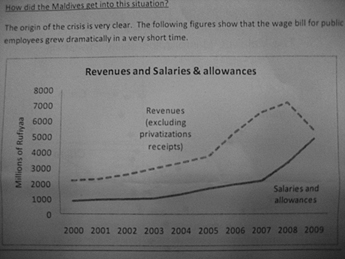
Under the heading ‘How did the Maldives get into this situation?’, the World Bank report notes that “the origin of the crisis is very clear… the wage bill for public sector employees grew dramatically in a very short time.”

An accompanying graph of the country’s total spending on ‘salaries and allowances’ shows a doubling of expenditure between 2003 and 2007, and a sharp increase between 2007 and 2009 as spending more than doubles yet again from Rf2 billion to almost Rf5 billion. Revenues meanwhile plummet steadily during 2008.

worldbanksitrep
Inflated spending on salaries in 2007 sparked an economic crisis

“Even before government revenues fell and when government revenues were at an all time high in 2008, the ratio of the wage bill to revenues at 46.5 percent was also at an all-time high (46.5 percent compared to an average of 38.1 percent between 2000 and 2007). When revenues plummeted in 2009, the share of the wage bill to revenues rose an astronomical 89 percent,” the report explains.

“While part of the increase was due to hiring more workers, the major part of the increase was due to the increase in compensation,” it said.

Increases to the salaries and allowances of government employees between 2006 and 2008 reached 66 percent, “by far the highest increase in compensation over a three year period to government employees of any country in the world,” the report noted.

Spokesman for the Civil Service Commission (CSC) Mohamed Fahmy said the increases needed to be considered in the context of “the total budget situation”, and were in line with government expenditure during the period.

“We have a tradition of salary increases every other year,” he said, rather than an annual increase based on inflation.

Those paid by the government included not only civil servants, “but political appointees, commissions, the judiciary”, he emphasised.

“Our case all long has been that everyone employed by the government has to be treated equally,” Fahmy said.

“If the government does not have the money to pay in full, then whatever it does have has to be paid out in an equitable manner that upholds the constitution. Everybody has to be treated equally – it is very important to make that distinction.”

World’s greatest tax haven

Meanwhile, the World Bank’s annual ‘Doing Business’ report for 2010 saw the Maldives’ ‘ease of doing business’ ranking fall from 71 to 87, and identified no ‘business-friendly’ reforms. The report acknowledges the Maldives as the world’s number one tax haven, although this could soon change if a pending bill on taxation is passed by Parliament.

Countries with successful business reforms “follow a longer-term agenda aimed at increasing the competitiveness of their firms and economy,” the report noted.

“But while successful reformers follow a clear direction in their policy agenda, they do not hesitate to respond to new economic realities,” it said. “Mauritius, the top-ranked economy in Sub-Saharan Africa, just announced a new insolvency act ‘to maintain the viability of the commercial system in the country.'”

The top countries in which to do business are Singapore, New Zealand and Hong Kong, the report noted.

Correction: An earlier version of this story described Mohamed Fahmy as a member of the ‘Civil Service Association(CSC)’.  Fahmy is a member of the Civil Service Commission (CSC).

Likes(0)Dislikes(0)

Maldives increasingly fundamentalist: Washington Times

“The Maldives, once considered a liberal Islamic nation, has been increasingly adopting fundamentalist Muslim practices,” the Washington Times newspaper claimed yesterday.

The piece, which appeared in the paper’s diplomatic news column Embassy Row, noted that the Maldives has been “hosting Taliban terrorists from Afghanistan and breeding a youth attracted to Islamic jihad. Many analysts report that Maldivian young people have been recruited by Pakistani terrorists.”

“The US ambassador to the Maldives is discussing the possibility of transferring some terrorism suspects from the USmilitary prison in Guantanamo Bay, Cuba, to the tropical island nation in the Indian Ocean, which some analysts say is a ‘paradise for Islamic radicalism’,” the newspaper claimed.

Likes(0)Dislikes(0)