Televised allegations by President spokeperson against Indian High Commissioner spark diplomatic incident

Additional reporting by Mohamed Naahii and Mariyath Mohamed.

The government has distanced itself from comments made at a rally on Friday by President’s Office Spokesperson Abbas Adil Riza, after his attacks against Indian High Commissioner D M Mulay were picked up and widely reported in Indian media.

During a rally organised by parties of the ruling coalition, calling for the seizure and nationalisation of Ibrahim Nasir International Airport (INIA) from Indian infrastructure giant GMR, Riza described Mulay as a “traitor and enemy of the Maldives and the Maldivian people”, accusing him of taking bribes and threatening the government.

“Trade between the Maldives and India reaches billions. Indian tycoons have the biggest share in Maldives tourism.  Indian people are deepest in Maldivian business.  We have to protect the businesses of those who import and sell potatoes and onions from India. We also have to protect the businesses of those who import gravel and sand from India. It should not be GMR that [Mulay] should take into account,” Riza declared.

Riza alleged that Mulay had been using his influence as the High Commissioner to threaten the Maldivian government, following the calls against GMR.

“Today, like someone who has chilli smoke on his eyes, like someone who has ants at his feet who is threatening us Maldivians, the Indian ambassador here has forgotten what his job here in Maldives is. We are not in the mood to allow him to commit the crimes he is committing in our country,” he told to crowd.

“I saw two folks who work in the Indian embassy go out of [this gathering] talking to a Bangladeshi. They asked him to take photos of the gathering. When this Bangladeshi was here taking photos, I confronted him and asked who are you to take photos? He then said his name was Aboobakr. I told him to leave immediately, just the way I am saying GMR must also leave immediately,” Riza said.

Riza added that the Maldives and India will always remain “good friends” and that the people of Maldives are so interconnected with Indians, but the “problem is that there are a few Indian traitors who take bribes”.

“A diplomat’s job is to work for his country and people and not to protect the interests of one private company… He is a traitor and enemy of Maldives and Maldivian people. We don’t want these kind of diplomats on our soil,” Riza said.

“Today we are also calling on for something else. On the day when we get GMR out of the Maldives, Mulay must also get out of here!”

Following several nights of poorly-attended rallies at the artificial beach, Minivan News observed more than a thousand present on Friday.

Noticing an expatriate in attendance reading a copy of local Dhivehi newspaper Haveeru, Minivan News asked what he was doing: “Boss asked me to look Maldivian,” the expatriate replied.

Riza’s comments were widely reported in Indian media.

Television channel Times Now described the “vicious targeting of the Indian envoy as leaving “a bitter taste”, and sparking a “huge diplomatic row”.

At time of press the story had also been picked up by the Hindu and the Indian Express.

Indian response

The remarks were quickly met with concern and condemnation by the Indian High Commission, which issued a statement dismissing the Presidential spokesperson’s allegations as being “against the diplomatic protocol”.

“We have told the government of Maldives that settling issues of huge mutual interest cannot be done on public space or on stage. This has to be done through discussion,” the High Commission said in a statement.

The Indian High Commission also made it clear that India would safeguard its interests including the investments of Indian companies.

“Similarly, all agreements signed by the previous governments will also be safeguarded and as such we have expressed our concern in very strong words to the government of Maldives. And we have also conveyed that India would safeguard the country’s interest, including these related to our investment,” it added.

The statement noted that the government’s issues with GMR were now the subject of arbitration in Singapore.

“If arbitration fails they (GMR and the government of Maldives) could find mutually accepted recourse either by going to the court of law or may be finding other mechanism available,” the High Commission stated, noting that President Waheed had personally given assurances to Indian Prime Minister Manmohan Singh that all the Indian investments, including GMR, would be protected and safeguarded.

“Our relations have been very strong and lot of goodwill have been invested in it. India is the Maldives’ largest investment partner, India is the largest technical and capacity building partner. India’s trade, aid and development partnership is also the biggest one,” the statement concluded.

Maldivian government retreats

Following complaints from the Indian government, the Maldivian government issued a statement on Saturday dissociating itself from comments made by Riza “and some other government officials, at a gathering held last evening against the involvement of GMR in the Ibrahim Nasir International Airport.”

“The gathering was organised by certain political parties including some members of the public. The views expressed at the gathering by Mr Abbas Adil Riza, though his own views, are regrettable, and do not reflect the views of the Government of Maldives, particularly those made against the Indian High Commissioner to the Maldives Mr D. M. Mulay,” the statement added.

Media Secretary of President’s Office, Masood Imad, told local newspaper Haveeru that Riza could have made the statements in a more “diplomatic way” and added that the Ministry of Foreign affairs has begun looking into Riza’s statements.

Political parties on both sides of the political divide, including the Maldivian Democratic Party (MDP), Dhivehi Rayyithunge Party (DRP) and even Riza’s own Jumhoree Party (JP), condemned his remarks.

The DRP in a statement claimed that party was of the view that the government and President Waheed should both apologise to Mulay and that such concerns should be raised in a more “ethical” and “diplomatic” manner.

JP Leader Gasim Ibrahim stated that Riza’s comments “go against the international standards of diplomacy, we are saddened by it and condemn it.”

The MDP also released a statement condemning Riza’s remarks, adding that the “baseless criminal accusations” were “highly concerning”.

“These undiplomatic, irresponsible, vulgar statements made towards a high-ranking diplomat of a neighbouring nation were initiated by the President’s spokesperson at a public gathering that was televised nationwide. MDP further condemns in the strongest terms, the similar public statements made by the president of a political party and by other political leaders at the gathering,” the party said.

However the MDP also has a track record of making accusations against Mulay.

MDP Chairperson ‘Reeko’ Moosa Manik and former Former National Security Advisor Ameen Faisal in May alleged that Mulay had played down the tumultuous political turmoil and change of government on February 7 as an “internal matter”, despite being able to “see what was happening from his window. The whole coup was being telecast live. As a diplomat, he should’ve known that the whole country was in chaos.”

“[Mulay] became so powerful that he started behaving like the prime minister and not a high commissioner,” said Manik.

“In early 2011, we felt that Mulay was drifting away from the MDP. He wanted to meet leaders of opposition parties. He wanted to be invited to all official functions that took place in Maldives. He was invited to many government functions, but not all. We found that a lot of companies were coming [to the country] for business through Mulay. We were floating tenders for big projects. He would act like a middleman,” Manik alleged to Open magazine.

“Mulay would visit various [Maldivian] islands with his Indian friends, many of them businessmen. The government did not know who they were. Mulay has good connections with opposition parties, particularly Gayoom’s party,” he further claimed.

India’s Ministry of External Affairs responded at the time: “We do not think it is appropriate to bring our High Commissioner into the discourse. He enjoys our full confidence,” while Mulay himself at dismissed the allegations as “completely baseless, a flight of fancy.”

Cash-strapped Maldives turns to India

Friday’s diplomatic incident follows urgent warnings from Finance Minister Abdulla Jihad in late October that the Maldives would be unable to pay state salaries for the rest of the year without a further US$25 million loan from the Indian government.

The US$25 million was agreed upon in September as part of the $US100 million standby credit facility signed with Prime Minister Manmohan Singh in November 2011.

Jihad told local media at the time that he believed the loan was being delayed due to the ongoing controversy over GMR’s development of INIA.

Since coming to power Waheed’s government has committed to reimbursing civil servants for wage reductions made during the austerity measures of the previous government, amounting to Rf443.7 million (US$28.8 million), to be disbursed in monthly instalments over 12 months from July.

The overall deficit for government expenditure has already reached over MVR 2billion (US$129 million). Jihad told the Majlis’ Finance Committee that he expected this figure to rise to MVR 6 billion (US$387million) by year’s end – 28 percent of GDP – alleging that the previous government left unpaid bills equal to over one third of this anticipated deficit.

Former Minister of Economic Development Mahmood Razee told Minivan News that this increased expenditure in the face of a pre-existing deficit represented the government “ignoring reality.”

Foreign investment concern

GMR is not the only Indian company to have expressed concern over political interference derailing their substantial investments in the country, according to a recent report in India’s Business Standard publication.

Officials involved in the Apex Realty housing development project – a joint venture between developers SG18 and Indian super-conglomerate TATA – told the Standard that the government was attempting to take over the site in Male’ given to the company, with the intention of building a new Supreme Court.

“A recent meeting held with the Maldivian Housing Minister is said to have ended abruptly with officials from the firm and the Indian High Commission being asked to leave,” the Standard reported.

GMR has meanwhile been forced to halt construction of the new terminal by the new government. Assorted parties now in the ruling coalition had opposed the handling of its concession agreement to manage and develop INIA while in opposition.

The company has previously sought to downplay its issues with the government in the media, however “public statements and press conferences of some government ministers and coalition party leaders are clearly aimed at arousing public sentiments against GMR and creating undue challenges for us,” the company told the Standard.

“To gain political advantage, some elements of the government itself have started hampering the smooth functioning and development of the airport,” the company added.

The comments follow a US$2.2 million bill handed to the government’s side of the airport contract – the Maldives Airports Company Limited (MACL) – following a third quarter in which the airport developer deducted the airport development charge (ADC) stipulated in its contract from concession fees due the state – the consequence of a Civil Court ruling in September won by the Dhivehi Qaumee Party (DQP) while in opposition.

In the first quarter of 2012 the government received US$525,355 of an expected US$8.7 million, after the deduction of the ADC. That was followed by a US$1.5 million bill for the second quarter, after the ADC payable eclipsed the revenue due the government.

Combined with the third quarter payment due, the government now owes the airport developer US$3.7 million.

Likes(1)Dislikes(0)

Global trade union rubbishes Maldives port operator’s claims on rights abuse resolution

The International Transport Workers’ Federation (ITF) has rubbished claims by the state-owned Maldives Ports Limited (MPL) that the company has allayed the organisation’s concerns over the alleged infringement of employee rights.

The ITF, a global trade union representing 4.5 million transport workers across 154 countries, said it continued to share concerns raised by the Maldives Ports Workers Union (MPWU) over alleged rights abuses by MPL management.  As a result the ITF has begun calls for international solidarity action by its worldwide members after a perceived failure by the MPL and the government to address the alleged rights issues.

Earlier this year, the MPWU, which represents staff employed at the MPL, accused the state-owned company of violating employee rights over, alleging amongst other concerns, that it had unfairly dismissed four employees due to their political activism.

Disputes between the MPWU and the MPL later escalated to a point where the trade union back in September accused the state corporation of forming a “paper union” to shove aside the alleged violations of employee rights.

MPL has denied all the accusations, claiming that the staff members in question were disciplined on the basis of “disobedience” and “punctuality” in line with national employment regulations.

MPL CEO Mahdi Imad told Minivan News on Wednesday (November 7) that the state-owned company had also responded to the ITF, which it said later “apologised” over having raised the issue without checking facts.

However, the ITF has rubbished the claims, maintaining that it had so far had no reply from the MPL regarding the concerns. The global trade union said therefore it dismissed the state-owned company’s assumption it had “won us over”.

“That’s rubbish. There has been no attempt by MPL and the government to address what’s happening to dockers in the Maldives, and in fact what’s happening in the country at large,” an ITF spokesperson told Minivan News.  The trade union group said it would now be stepping up pressure on the MPL and the Maldives government should negotiations with the MPWU not be forthcoming.

After having sent two letters to President Mohamed Waheed Hassan, the ITF announced Thursday (November 9) that it was now calling on the government to intervene over “union intimidation” or “face embarrassment wrought by widespread international solidarity action”.

ITF General Secretary David Cockroft said the organisation was calling for a real “dialogue and conciliation process with MPWU” that can lead to a negotiation settlement with the union’s members.

“Members of the union have been fighting off victimisation by the MPL in a campaign to prevent them from participating in union activities; union leaders have also been dismissed,” the ITF has claimed “These actions run counter to the government’s own employment legislation and constitution as well as International Labour Organization (ILO) conventions.”

MPWU representatives, alongside a delegation from the national union centre, were said to have held a meeting with President Waheed last Monday (November 5), though the ITF added that the ports union had failed to receive any “adequate assurances”.

“As a result the MPWU, with support from the ITF, has vowed to step up its campaign,” a statement on the trade union’s website read.

President’s Office spokesperson Masood Imad told Minivan News today that as the MPL was a public company, the government “don’t look into issues like this”.

“These companies are totally independent, we appoint a managing director and the CEOs, but it is the board that makes decision,” he added, referring enquiries on the matter to the MPL.

Workplace disruption

Despite the stance being take by the ITF, MPL CEO Mahdi stressed that workers alleging to have been dismissed on political grounds were actually punished for creating “disruption” in the workplace.

He contended that the workers behind the allegations still had the options of taking their cases to the country’s employment tribunal to resolve any grievances that the company would then have to abide by.

Mahdi claimed that workers dismissed under previous MPL management in 2009 and 2010 had under similar circumstances been reinstated under his stewardship, as well as receiving compensation.

“These people who have been disciplined, they know a tribunal would not come out in their favour,” he said.

Mahdi also vehemently denied that he operated the MPL in a politically motivated manner, adding that the company was run in a “very technical” manner that respected due process.

“I will challenge anybody who says we are politically motivated, I believe no one has a bigger right than anyone else,” he added.

Mahdi alleged that one of the dismissed workers who had gone onto make accusations about political motivation had come into his own office and shouted at him, adding that billions of companies allowed the world would discipline such actions by staff of a senior representative.

“This is work disruption, no one is allowed to break work regulations like this. Belittling and scolding me when I’m on the street in public is ok. But here in the work place they must show me respect,” he said. “I can understand that because of the lower education of some of these people that they don’t understand this.”

Mahdi said that in the present time, the entire country had become deeply politicised even seemingly down to a person’s choice of branded bottled water.

However, he rejected accusations the MPL management were politically motivated in their roles.

Mahdi accepted that with the change of government in February, top positions within state owned companies had changed, though this was the nature of political positions under each successive government and would continue to remain so.

“These are not dismissals,” he said.

Madhi said that despite sending several letters to the President’s Office, all concerns raised by the ITF had been resolved and were solely the result of the efforts of a handful of dismissed staff to try and

“There are no issues with ITF, these have been resolved, it is just two guys going to [Minivan News] and you coming to us,” he said.

“Fabricate the truth”

Earlier this year, sacked MPL employee and President of the MPWU, Ibrahim Khaleel, alleged that the MPL was trying to “fabricate the truth” about the violations of worker rights.

In a letter on July 12 to MPL CEO Mahdi Imad, Chairperson of the MPWU Ibrahim Khaleel said: “Although the constitution guarantees freedom of expression and freedom of assembly, it is now common within MPL to stop employees from expressing certain political views, and violate the Employment Act by unfairly dismissing employees and transferring employees to different departments without prior warning or explanation of any offence committed.”

Speaking to Minivan News, Khaleel said the company mainly targeted employees who supported the ousted Maldivian Democratic Party (MDP).

“They send people with cameras to MDP protests to check which MPL employees take part in the protests,” Khaleel said.

In addition to the four employees who have been dismissed at the time, 30 had intially been suspended and 10 have been transferred from their position at the Malé port to Thilafushi Island port, Khaleel claimed.

Likes(0)Dislikes(0)

Coral reefs begin to recover in the Maldives

Scientists have witnessed a “promising” recovery in the coral reefs around the Maldives, a recent survey has revealed.

The results show that some reefs now have more live coral cover than before the catastrophic El Niño bleaching event in 1998, which killed 95 percent of the country’s reefs – a key attraction for foreign tourists.

The project was set up by international conservation non-profit organisation Biosphere Expeditions. Scientists from the UK-based Marine Conservation Society (MCS) and the Maldives Marine Research Centre (MRC) surveyed areas known to have suffered from heavy bleaching.

The reef check conducted in September showed that many badly damaged reefs have recovered to populations in excess of 60 percent live coral. On one site, the survey team found there was more coral cover now than there was in 1997.

The latest findings follow a severe case of coral bleaching in 2010, when the MRC reported a resurgence of coral bleaching following a prolonged sea temperature rise.

The project found that the isolated, offshore and cleaner waters of the Maldives appeared to offer better conditions for coral recovery – contrasting findings published from the Great Barrier Reef, which noted that coral cover had  reduced by more than 50 percent in the last 27 years.

Lead scientist for the project, MCS Biodiversity Officer Dr Jean-Luc Solandt, said: “Although our surveys aren’t as comprehensive in scale and number as those from the Great Barrier Reef, we have witnessed a promising recovery in the reefs we’ve visited.

“The number of chronic impacts to the reefs of the Maldives are fewer than those to the Great Barrier Reef, and that has probably resulted in this more positive response to the initial bleaching event die-off in the sites we visited in Ari Atoll.”

The focus of this year’s project was to undertake reef check surveys in areas first surveyed before and during the El Niño bleaching in 1998.

Meaning ‘little boy’ in Spanish, El Niño is a phenomenon which damaged more than 95 per cent of the Maldives’ reefs following three months of unusually high seawater temperatures that year.

Even the slightest rise in water temperature can put stress on the coral, causing it to lose its colour and turn white, before eventually dying.

Coral bleaching was named as one of the three main causes of coral death, along with outbreaks of coral-eating starfish and damage from major storms.

Despite the findings, Dr Solandt warned conservationists and stakeholders in the Maldives that they cannot afford to be complacent.

“There is over-fishing of large predatory fish and further ocean warming events on the horizon, and some of the reefs nearer to Male’ appear not to have recovered as extensively as those further afield,” he added.

Founder and Executive Director of Biosphere Expeditions Dr Matthias Hammer said that whatever the current state of the Maldive’s reefs, the future outlook was important.

“Even though the Maldive’s reefs are generally in waters of excellent purity from man-made pollutants and are seldom hit by coral-damaging storms or attacks by coral eating starfish, the consistently high sea temperatures, averaging 29 degrees Celsius, around the Maldives could lead to bleaching once again if temperatures reach over 30 degrees for any length of time,”  he noted.

Environment Minister Dr Mariyam Shakeela was not responding at time of press.

Likes(0)Dislikes(0)

Employees of health corporations transferred to Civil Service

Employees working under the health corporations have been transferred to the civil service from the first of November.

According to local media reports, the Health Ministry informed all health corporations across the country that their employees would be transferred to the Civil Service last week.

However, reports suggested that health corporations have not been yet abolished and the framework of employees in the corporations have not been adjusted to that of the Civil Service.

According officials from health corporations, the new change would mean that wages of employees would be adjusted in accordance with the wages set for the civil servants by the Civil Service Commission (CSC), although a decision on the matter is yet to be made.

The decision to transfer all the employees of health corporations came following discussion in cabinet.

Likes(0)Dislikes(0)

Government to form institution providing pilgrimage services

The Islamic Ministry has said it will form the “Maldivian People’s Hajj Fund”, an institution that will work to provide affordable pilgrimage services.

In a press conference Islamic Affairs Minister Mohamed Shaheem Ali Saeed said the purpose of the institution was to provide people with the opportunity to go on the hajj, by paying a smaller amount of money.

He also added that work was under way in preparing the documents needed to be presented to the cabinet to discuss the matter.

Shaheem added that he had already discussed about the proposal with President Mohamed Waheed Hassan and Finance Minister Abdulla Jihad.

Shaheem further said that even if a person deposited money to the fund, it would not necessarily mean that he would be granted with a placement from the quota of pilgrimages that the Maldives receives from Saudi Arabia.

According to the Minister, the institution would be formed on the principles of a similar institution set up in Malaysia.

Likes(0)Dislikes(0)

Speaker Shahid denies asking Nazim to delay vote on secret no-confidence ballots

Deputy Speaker of Parliament Ahmed Nazim told local media on Sunday that although the amendment to allow secret ballots when taking no confidence votes had been passed in the General Affairs Committee, Speaker Abdulla Shahid had asked to delay placing the vote on the agenda.

However, Shahid has denied having asked for the delay, stating that Nazim had not brought up the matter for discussion. He stated that it was normal to table larger issues for voting after giving ample time to MPs to prepare, and that the same procedure would be followed in this issue.

“As a rule, I have always tabled larger issues in parliament in such a way which gives ample time to members. Otherwise, if such a huge issue is put on agenda suddenly, it is the Parliament Speaker who will get blamed,” Shahid was quoted as saying, adding, “Had the deputy speaker discussed the matter with me, the answer would still be that the members must be given enough time.”

Shahid confirmed that the report of the General Affairs Committee would be sent to the MPs once work resumes on Monday, stating that the voting would then be duly put on agenda.

To be deemed official, amendments to parliament’s regulations and procedures have to be approved through a vote at the parliament floor even though they are passed at committee stage.

No confidence vote on Home Minister

Meanwhile, a no confidence vote against the Minister of Home Affairs Mohamed Jameel Ahmed has been scheduled for next Tuesday.

“It was my understanding that we needed to come to a decision on the matter of secret ballots before the no confidence vote [against Jameel] is taken. But the Speaker who is in Islamabad asked for the vote to be delayed. Thus no decision will be made on the secret ballots before the no confidence vote,” Nazim said.

Shahid, however, said that he sees no reason why the matter of allowing secret ballots needed to be settled before the taking of the no confidence vote against Jameel, stating he saw no relation between the two issues.

“The matter of allowing secret ballots was raised in majlis after I had already scheduled the no confidence vote on Jameel. Now, the issue which was first placed on agenda must be carried forward, shouldn’t it?”

The Maldivian Democratic Party (MDP) has also proposed a no confidence vote against President Mohamed Waheed Hassan.

Minivan News tried contacting Deputy Speaker Ahmed Nazim but he was not responding to calls at the time of press.

Likes(1)Dislikes(0)

New soft loan scheme to be launched by BML

A new loan scheme is to be introduced by the Bank of Maldives (BML) following its previous soft loan plan, the bank has announced.

BML has previously issued MVR 15,000 (US$970) loans without a mortgage as part of their soft loan scheme, which the bank claimed had proven popular with the public.

The new scheme will be an extension of the existing plan, however BML has not stated its ceiling value or interest rates.

Only BML customers who have had their salaries deposited into their respective accounts continuously for one year will be eligible for the new soft loan scheme.

BML have stated that the new product will not require customers to submit quotations, and that the service is expected to commence soon.

The previous MVR 15,000 small loan scheme will not be ceased with the introduction of the new plan, the bank said.

Likes(0)Dislikes(0)

Comment: Maldivian faith to Maldivians

This article first appeared on DhivehiSitee. Republished with permission.

Political prostitutes who pose as religious scholars and sell their Islamic learning to the highest bidder have become some of the biggest contributors to the current socio-political and economic turmoil in the Maldives.

Chief among them is Sheikh Imran Abdulla, current president of Adhaalath Party – an organisation which uses the religion of Islam as its chief recruitment and fundraising tool, and proudly exploits people’s faith for political purposes.

Sheikh Imran Abdulla was one of the chief choreographers of the Islamists’ role in the downfall of the Maldivian democracy. On 2 February 2012, he issued an ultimatum to the then President Mohamed Nasheed: resign within five days or be forced out of office.

Nasheed was forced to resign on 7 February.

Yesterday, Sheikh Imran, now a chief mover and shaker in the current ‘Coalition Government’ issued another ultimatum. This time to the government he helped put in place: get out of the 25-year contract with India’s GMR Group for upgrading and running the Ibrahim Nasir International Airport within six days (by 15 November), or else.

He issued the ultimatum at a public rally widely believed to be funded by rich tourism tycoons, currently openly fighting over the country’s airports, and who have vested interests in getting GMR out.

The rally was a colourful affair, aimed chiefly at rousing the masses into a fervour by making the GMR issue into a religious one. The aim, it appears, is to incite enough public discontent to pressure the government into reneging on its agreement with GMR.

Ahead of the rally, held at the Artificial Beach in Male’, leaflets were distributed all over the island, encouraging people to attend the rally in the name of Islam, to save the Maldivian airport from foreign ‘economic invaders’ of ‘other religions’.

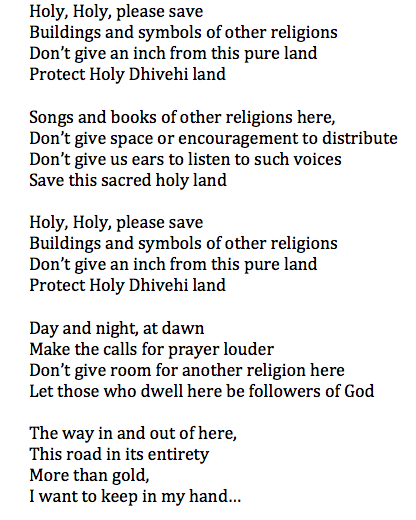
Songs were played on loudspeakers attached to pick-up trucks that went round and round the island, stopping at mosques after Friday prayers for maximum effect.

One of the songs has the title—Maldivians’ Prayer: Maldivian airport to Maldivians. Another is called simply Maldivian Airport to Maldivians. The latter raises the volume on nationalism and the former suggests ending the agreement with GMR is a religious duty of Maldivians.

Here’s some of the lyrics from Maldivians’ Prayer:

You get the picture.

The rally was not as big as the Mother of All Rallies, or the so-called Mahaasinthaa, held on 23 December 2011 to ‘Defend Islam’ by removing President Nasheed from office and endorsing his then Vice President Dr Waheed as his replacement.

But there was still a sizeable crowd of hundreds gathered around the nationalistic/religious banners.

Sheikh Imran told them it was their religious duty to deliver the airport from India’s GMR. Men and women (strange this, given that Imran has repeatedly stated that women should stay home and breed instead of joining political rallies) stayed listening to Sheikh Imran and his fellow Islam-sellers long after midnight and in the pouring rain.

Before ending the rally for the night, another ‘scholar’ led a prayer calling on Allah to bring his wrath upon GMR and cause it great destruction.

Such rhetoric not only fools a lot of people into accepting this economic/political issue as a religious matter, it also helps increase the intolerance and xenophobia which have become defining characteristics of the Maldivian society today, thanks mainly to the religion-political-tourism industry complex that now reigns supreme over Maldivian affairs.

Moreover, as former Maldivian High Commissioner to the United Kingdom Farah Faizal quickly highlighted, turning the issue into a religious one also has the potential to make life very difficult for the tens of thousands of Maldivian immigrants in India by creating tensions between them and the largely Hindu majority Indian population.

The rising radicalisation of Maldivians has been a cause for concern in India for several years, and it is well-known that a Maldivian was involved in the Mumbai attacks of 2008, as is the fact that the terrorist organisation Lashkar e Taiba has beenoperating and recruiting in the Maldives.

Young disaffected Maldivians are many, and most are highly vulnerable to ideological indoctrination by individuals who propagate extremist ideologies.

Sadly, many do not see beyond ‘The Scholar’ façade behind which these individuals operate. Tens of thousands remain incapable of looking further than the carefully cultivated beards, or the Pashtun garb—no more Islamic or Maldivian than GMR itself.

Hundreds everyday accept these individuals as devout religious scholars and remain blind to how they turn Islamic teachings into a commodity that can be bought and sold to equally unscrupulous businessmen/politicians.

It is these individuals, worked into a frenzy by individuals like Sheikh Imran, who have travelled abroad to kill themselves and others in the name of Islam.

Several government officials were at yesterday’s rally, including the President’s Spokesperson Abbas Adil Riza. Riza loudly accused Indian High Commissioner to the Maldives D.M. Mullay—a key figure behind India’s quick acceptance of Dr Waheed’s government as legitimate—of taking bribes to ensure GMR was awarded the Maldives airport contract.

Here’s Dr Waheed’s spokesperson Abbas Riza at the rally:

But, as is now coming to be expected, the government has stayed wholly silent on the rampant exploitation of religion for political purposes, further reinforcing the perception that it is complicit in this phenomenon and condone it as a valid political strategy.

It is still silent, for instance, on the Salafists’ call last week to have Maldivian girls declared women at puberty. A children’s Afternoon with Ali Rameez remains scheduled to go ahead on 15 November as planned, despite the fact that Ali Rameez is the man leading the call to end girl-childhood at puberty.

And, as we shall see on 15 November (also the date of the GMR ultimatum), there will be many parents who would take their children to this pop-singer turned ultra-religious conservative without pausing to think about what they are doing.

These people will represent the thousands of Maldivians who have already bought into the dogma, among others, that it is their religious duty to have their girl-children married off at puberty to men old enough to be their grandfathers.

The official silence over ‘religious scholars’ and their exploitation of Islam to suit various socio-political and economic purposes must end. Such voices must be strongly countered and condemned.

The long term consequences of their actions will not be seen only in the political economy, but in the Maldivian identity itself which has already changed so drastically in the last decade as to be unrecognisable.

From a laid-back island community of moderate and tolerant Muslims whose relationship with God was their personal affair, Maldives has become a highly radical and tense society in which a large percentage of the population is bigoted, intolerant and xenophobic.

Among them will be the few who will join the violent militants.

What is of equally great concern are the tens of thousands of Maldivians who fail to see these political prostitutes for what they are, and willingly give up their own human rights and dignity and deny others theirs in the name of Islam.

All comment pieces are the sole view of the author and do not reflect the editorial policy of Minivan News. If you would like to write an opinion piece, please send proposals to [email protected]

Likes(1)Dislikes(0)

Nasheed’s trial and Maldives’ human rights record debated in Westminster

The ongoing trial of former President Mohamed Nasheed was again the subject of debate in London this week, as well as the current human rights situation in the country.

On Tuesday night, the Conservative Party’s Human Rights Commission convened to discuss the Maldives, inviting speakers from the government, the opposition, and civil society to participate in the event titled “Human rights and Democracy in the Maldives: Where do we go from here?”

The following day, a private members debate was secured by Karen Lumley MP in the House of Commons to discuss the role of the UK government and the Commonwealth in ensuring a fair trial for Nasheed, whose case was postponed on Sunday following a high court injunction.

Tuesday’s meeting was attended by former High Commissioner to the United Kingdom Dr Farahanaz Faizal, former Foreign Minister and current UN Special Rapporteur Dr Ahmed Shaheed, barrister – and current member of Nasheed’s legal team – Sir Ivan Lawrence QC, as well as Amnesty International’s South Asia specialist Abbas Faiz.

Invitations were also extended to the Acting High Commissioner to the United Kingdom Ahmed Shiaan and Minister for Tourism Ahmed Adheeb.

However, after queries from panel members in attendance as to the whereabouts of the government’s representatives, the committee’s Chair Robert Buckland MP informed those present that, despite having initially accepted the invitation, the government representatives had withdrawn.

A Foreign Office spokesperson said that Adheeb had been unable to attend the meeting as it had clashed with a ministerial dinner. He had also been busy with duties related to the 2012 World Travel Market, which had been the primary purpose of his visit to London.

Where do we go from here?

Shaheed was the first to speak at the Conservative’s meeting, urging the government to uphold the commitments made via its international commitments as well as the pledges made this summer at the United Nations Human Rights Commission (UNHRC).

Farah was the next to speak, choosing to focus in particular on the issues of gender based violence and rising religious extremism in the country.

She argued that the treatment of female protesters in the aftermath of the February 7 transfer of power had highlighted this endemic abuse.

Farah deviated from her prepared testimony to mention the recent incident of the 11 year old girl who gave birth in Seenu atoll last week.

“The silence of the authorities is disturbing,” she added, before chastising President Mohamed Waheed Hassan for failing to speak out, despite his history of working with UNICEF.

Abbas Faiz spoke next, taking time – after distributing a copy of the recent Amnesty International publication, ‘The other side of paradise’ – to assert the independence of his organisation: “Some still believe we are not. We do not take sides.”

After the release of the report in the summer, Amnesty was accused by Home Minister Mohamed Jameel Ahmed of acting with bias towards anti government supporters.

Faiz pointed out that Amnesty also condemned any acts of violence by protesters and stated that it still considered the detention of Judge Abdulla Mohamed in January this year to have been “arbitrary”.

Sir Ivan Lawrence QC contended that the “arbitrary” arrest of Abdulla Mohamed was yet to be proven in a court of law.

The member of Nasheed’s current defense team recalled his previous work in the country in 2005, noting the proven gains to be made from garnering global attention on human rights abuses.

He did acknowledge the difficulty of this task, with far greater human rights atrocities occurring elsewhere in the world, and expressed his belief that the Commonwealth was best placed to help solve the country’s current problems.

When taking questions from the floor, Farah expressed her concern that international observers were often sheltered from the real Maldives when visiting the country, arguing that this must change if observers are to assist with free and fair elections.

Buckland, the Chair, concluded the meeting by saying that he would pass on the details of the forum to the Foreign Secretary William Hague as well as the Under Secretary Alistair Burt.

Private members’ debate

Burt was unable to attend the private member’s debate the following day, sending Mark Simmonds to represent the Foreign Office on his behalf.

Lumley described the 2008 election victory as a “political fairy tale”, but argued that Nasheed had been left with a “constitutional time bomb” regarding the unreformed judiciary, which the Commonwealth ought to have offered greater assistance with.

Robert Buckland, also present at this debate, remarked that the “current government is in a supremely ironic situation.”

“They criticised the former president for interfering in the judiciary and now it seems they are using judicial processes to frustrate a free and fair election,” he said.

“Is not the message we need to send to them that the guarantee of a true democracy is an independent judiciary, and that they had better make sure that is so,” he asked.

Both Karen Lumley and John Glen MP both stated their firm belief that the events of February 7 amounted to a coup.

On behalf of the Foreign and Commonwealth Office (FCO), Simmonds said that he disagreed with the assertion that the Commonwealth had “taken its eye off the ball” in the Maldives.

“I do not think that is an entirely accurate reflection of matters,” he said.

He said that the Commonwealth Ministerial Action Group (CMAG) was concerned about the situation – noting that the recent meeting in New York went on for five hours, despite being scheduled for 45 minutes – and that it had pledged additional support for civil society and judicial reform.

Simmonds was keen to stress that, after the Commission of National Inquiry (CNI), “we fully accept the legitimacy of the current president and his government.”

He described the current legal proceeding as a “significant test” which was being “watched closely” by the international community before noting that the government had previously sought and received assurances from President Waheed that the trial would be free from political influence.

“At this stage of proceedings, we have no reason to believe that this will not be the case,” said Simmonds.

“I have no doubt that the Maldives government and judiciary will feel the eyes of the world on them, and that they realise that a fair and impartial trial is most evidently in the national interest,” he added.

The second hearing in Nasheed’s trial had been scheduled for last Sunday but was postponed pending a High Court ruling on the procedural points raised by his legal team.

A High Court decision had been expected on the day after the private members debate, but the Supreme Court was reported to have instructed the lower court to halt its hearings on Wednesday afternoon.

Likes(0)Dislikes(0)