Comment: Extremism affecting the daily lives of every Maldivian

This article originally appeared on DhivehiSitee. Republished with permission.

Islamic extremism is very real in the Maldives. It affects the daily lives of every Maldivian, and is gaining in scope, intensity and violence every day with the pseudo-democratic government that came to power on 7 February.

This is not to say that Islamic extremism did not exist during the three short years in which the Maldives was a democracy. On the contrary, it was during democratic rule that extremism gained its strongest foothold in Maldivian society.  It is a myth that democracy is an antidote to extremism, as is widely proposed in much of the existing anti-radicalisation literature. Democracy, with its many freedoms, provides a much more conducive environment for radicalisation than does an authoritarian regime, as has been seen in the Maldives.

When Islamic extremism began to be imported into the Maldives in the late 1990s with the advent of the so-called international ‘religious terrorism’; and when the export of extremist ideologies intensified globally with the War on Terror, the Maldives was under the dictatorial regime of Maumoon Abdul Gayoom.

Although in recent times Gayoom has aligned himself with the ideologies of the hardline Islamist Adhaalath Party, during his rule, he presented himself as a moderate Muslim who believed in freedom of religion and advocated religious pluralism in the Maldives.

What he did not tolerate was extremist ideologies spread in the name of Islam. His methods of suppressing such beliefs – imprisonment and torture – cannot be condoned, nor are they compatible with the values of democracy. It cannot be denied, however, that they held Islamic extremism in check in the Maldives for over a decade.

The transition to democracy in November 2008 opened the door for Maldivian Islamists to push their agenda forward.

A confluence of events had helped them consolidate support even under Gayoom’s repressive policies: the 2004 tsunami which literally put the fear of God into many a Maldivian living on remote islands, and which the Islamists exploited as a means of spreading their ideology by depicting it as punishment from God for man’s ungodliness; and the War on Terror, which was used by Islamist states and movements to intensify their efforts to fund and spread their ideology to Muslim populations across the world.

Despite a tourism industry worth billions of dollars, three decades of authoritarian rule in the Maldives left behind a population that was mostly on the poverty line, had extremely low levels of education, and contained tens of thousands of disaffected youth with few prospects for social mobility or economic success. All are factors that have been shown to facilitate the spread of extremist ideologies.

Added to this was the supposedly inescapable need for the newly democratic government to form a political alliance with the Islamists, and a democratic president who believed in freedom of expression in absolutist terms, and who failed to fully appreciate that such freedoms are not always exercised with responsibility by those who enjoy them.

While during the War on Terror most democratic governments everywhere sought to find a balance between freedom of expression and the need to curb incitement to violence in the name of religion, under Mohamed Nasheed’s government Maldivian extremists enjoyed absolute freedom of expression.

Bookshops came to be laden with publications that spread their teachings; their message was constantly transmitted in mosques, on air, and on the Internet. The success of their efforts are now there for all to see.

Of course, under Nasheed’s government it was not just the extremists who had the freedom to express their views. Those who disagreed with their ideology, too, enjoyed the same freedom. This was, in fact, Nasheed’s strategy and hope: that the civil society would counter extremism without requiring any intervention from the government.

It was a huge mistake. The civil society was not strong enough to take on the Islamists, especially in the face of the institutional support that the Islamists enjoyed under the MDP (Maldivian Democratic Party) government with its politically expedient alliance with the Islamist Adhaalath Party. Nasheed also underestimated the power of the label of ‘un-Islamic’ or anti-Islam as a tool for suppressing dissent.

The fight against extremists was thus left to individuals who worked alone or in very small groups. Their discourse was easily slapped down and condemned by the extremists using the ‘anti-Islam/un-Islamic/heretic’ label. As it turned out, this label was also the most powerful tool used against Nasheed himself to help facilitate the downfall of the MDP government, demonstrating just how much power such a designation wields in a rapidly radicalising society.

Despite the knowledge that Nasheed was a firm believer in freedom of expression, few dared to take on the extremists openly then, or now. When they did, the MDP government utterly failed to support them. The lack of any assistance or support for Mohamed Nazim, who in May 2010 dared to publicly declare his disbelief in Islam, and of Ismail Mohamed Didi in July 2010 who felt persecuted for his lack of belief and committed suicide at the age of 25, brought into sharp relief the absence of any serious commitment by the MDP government to fighting extremism.

Instead of tackling the oppression that the Islamists were imposing on Maldivians, the MDP – beleaguered by continuous authoritarian attempts at a reversal – often chose to ignore the problem, or worse, sided with the Islamists.

With the regime change of 7 February, the problem has grown acutely worse. Not only did the new caretaker President Dr Waheed enthusiastically demonstrate a previously unknown affinity with Islamists, his Coalition Government has, from the beginning, continued to deny extremism even exists in the country.

This deliberate denial, coupled with the appointment of Islamists to top positions in government and society, has resulted in the opportunity for extremism to grow unchecked. It now has deep roots within all state institutions including the executive, the parliament, the judiciary and most worryingly, within the security forces.

Recent events of extraordinary violence and their aftermath have gone a long way in demonstrating the truth of this claim.

The attempted murder of Hilath Rasheed

Hilath Rasheed is the only openly gay human rights activist in the Maldives. He, along with fellow blogger and writer Yameen Rasheed, were among the very few Maldivians who dared to voice their anti-extremist opinions publicly. Most bloggers and other writers used pseudonyms. Such caution was not without reason. Death threats against such writers were common.

On 4 June 2012 extremists carried out their threats and attempted to murder Hilath. I met Hilath a few weeks after the attack. There was a scar about 10 inches long  running across his throat horizontally. His voice was only just coming back, and his whole being appeared shaken.

Hilath told me that the last words he heard from the man who cut his throat were:

This is a present from Shaheem, Mutthalib and Imran.

The three men referred to are: Sheikh Shaheem Ali Saeed, the current Minister of Islamic Affairs; Ibrahim Muththalib, an MP who is the most ardent advocate of the death penalty in Parliament; and Imran Abdullah, president of the Adhaalath Party and one of the main actors in the Islamists’ contribution to the change of government on 7 February.

Hilath also made the allegations openly on his blog (banned in the Maldives since November 2011), and they were also reported in Minivan News, although the latter stopped short of identifying the politicians by name.

There has been no official response bar an attempt to mislead the international community by portraying Hilath as a violent criminal caught up in gang violence.

While it is a fact, related by Hilath, that the man who cut his throat named the said politicians, it is quite possible the attacker may have been lying about their involvement. It is also possible that the attackers (there were three altogether) decided to act on their own, motivated not by direct orders but by the ideologies perpetrated by the named politicians.

In the absence of a proper investigation by the Maldives Police Services (MPS), it is hard to know for sure.

In the four months since the attack, and despite existing evidence such as CCTV footage of the incident, the MPS has made no progress whatsoever in their investigations. Without police protection and fearing, instead, persecution by them, Hilath now lives in self-imposed exile. And the MPS has, for all intents and purposes, abandoned the investigation.

This failure by the Maldives Police Services to investigate the attempted murder of Hilath is not simply the incompetency one can expect from a heavily politicised police force. It also implies the existence of dangerous connections between law enforcement leaders and Islamists that go to the very heart of the increasing extremism in the country.

This is a proposition I make on the basis not of Hilath’s case alone – a similar failure has plagued the MPS in the most recent attack associated with Islamists: the murder of MP Dr Afrasheem Ali.

The murder of Dr Afrasheem

Dr Afrasheem Ali was among the increasing number of politicians in the Maldives who also act as religious scholars and pundits, blurring further the already thin line between politics and religion. He was a staunch Gayoom loyalist, an MP for Gayoom’s Progressive Party of the Maldives (PPM) who played a key role in the successful authoritarian attempts to hijack judicial independence in the Maldives.

Although some of Dr Afrasheem’s views on women and their role in society was far from liberal, he is reported to have spoken against forcing women to cover-up and also said that a believing Muslim cannot be declared an unbeliever simply for their failure to grow a beard or display other such ‘religious’ trappings – apparently daring statements for a religious scholar and what passes as ‘moderate’ (or ‘un-Islamic’) in the Maldives these days.

Dr Afrasheem’s killing was no random act of violence. It was a targeted assassination, carried out without mercy within the premises of his own home. He had been the victim of previous attacks, targeted for his beliefs that contradicted those of extremists. In conservative religious circles he was often referred to as Dr Iblis (Dr Satan).

The last major activity he participated in before his death was to appear on television, reportedly at his own behest, to “ask for forgiveness from citizens if he had created a misconception in their minds due to his inability to express himself in the right manner.”  The Islamic Ministry has denied reports that it pressured Dr Afrasheem into making the apology. And, Islamic Minister Shaheem has stated that, contrary to reports, there had been no disagreement between them.

And, just as with the attempted murder of Hilath, the government’s immediate response was to mislead the international media. This time it implicated Nasheed, with the President’s Office spokesperson sending an SMS to international news agencies reading:

Nasheed’s strongest critic Dr Afrasheem has been brutally murdered.

And again, just like with Hilath’s attempted murder, the investigation of Dr Afrasheem’s death appears to be going nowhere.

Not only has there been zero progress, the MPS has also been busy making political use of the murder—a trend which started with the murder of a policeman on 22 July 2012.

So far, a total of six people have been arrested in connection with Dr Afrasheem’s murder. Two weeks later, no charges have been brought against any of them, lending much credence to the allegation by MDP and other democrats that some of the arrests are intended more as a means of persecuting MDP/democracy activists rather than solving a murder. One of them, a young MDP activist, Mariyam Naifa, was released without charge, explanation or apology – but with many conditions – just yesterday, after 15 days in jail.

The MPS is not the only institution where murder is regarded as a political opportunity. Within days of Dr Afrasheem’s death, the Islamist-led push for the death penalty has received new vigor in parliament while the government has moved rapidly to revoke licenses for twenty-four hours shops and cafes citing ‘national security’.

The fact of the matter is that extremist ideologies have taken root within the national security apparatus as much as it has in political institutions. This is evident from the role that religion played in motivating the police and army personnel who refused to obey the ‘heretic’ Nasheed’s orders on 7 February.

It appears that crimes committed in the name of Islam are being pushed to the side by law enforcement personnel who are more interested in turning such atrocities into political battlegrounds, and/or see them as religious duties that do not deserve punishment.

If this continues to be the case, there is little doubt that the Maldivian people stand to suffer even more serious civil and political repression in the not too distant future as the Islamists continue to turn their extremist ideologies into government policy.

Is there a solution?

Islamism in the Maldives is a fact. It may not be the sort that blows people up and turn buildings into ash, but it is rapidly changing the Maldivian society into one of religious intolerance, xenophobia, and a place of violent punishments for those who refuse to follow its ideologies.

If extremism and its associated hatred and violence are to be stopped, or at least held in check, the MDP must start standing up to the politicians and ‘religious scholars’ who propagate such views, and it must stop giving into their demands for the sake of political expediency.

Nasheed has promised that MDP would refrain in the future from forming political alliances that require it to sacrifice its ideals. If he keeps his promise, this is indeed good news. Despite the corruption manifest among many members of its upper echelons, MDP is the only political party in the Maldives right now that has shown a strong commitment to reinstating democratic governance in the Maldives. And, Nasheed remains a beacon of hope for most Maldivian democrats who firmly believe in his commitment to democratic governance despite past mistakes.

The MDP is also the only such body in the country with the clout to push for anti-radicalisation measures without losing the support of a majority of its members. Many of MDP’s supporters are secularists and/or those committed to religious tolerance – values of democracy that are said to be universal.

The United Nations Human Rights Committee stated categorically in July 2012 that there should be no reason for the Maldives to cling on to its current reservation on Article 18 of the International Covenant on Civil and Political Rights (ICCPR). Under the circumstances, it makes no sense for MDP officials to back down when confronted with militant beliefs as it has done in the past.

Even if the MDP does find the courage to stand up against extremism, however, the Maldives needs the support of the international community in fighting the phenomenon. It failed miserably in coming to the aid of the Maldivian democracy in its hours of need, choosing instead to support the pseudo-democratic government of Dr Waheed. But, it cannot afford to be so blasé about the growing extremism in the Maldives.  A failure to properly understand the current Maldivian malaise poses a danger not just to the people of the Maldives, but to its neighbours and the world at large.

Even the most realist of international actors should, therefore, pay close attention to the activities of Maldivian Islamists and refuse to take the new government’s word that ‘there is no extremism in the Maldives’ like it accepted the government’s declaration that ‘there was no coup on 7 February.’

Azra Naseem holds a doctorate in International Relations.

All comment pieces are the sole view of the author and do not reflect the editorial policy of Minivan News. If you would like to write an opinion piece, please send proposals to [email protected]

Likes(1)Dislikes(0)

Comment: On the ‘Vaudhuge Dhathuru’ campaign trail

I spent the past two weeks traveling with the Maldivian Democratic Party (MDP) on its Vaudhuge Dhathuru (‘Journey of Pledges’) campaign, all the way from Kolamaafushi Island in Gaaf Alif Atoll to Addu City. We visited more than 20 islands, including Addu City.

I was born and raised in the capital city of Male’. I am 19 years-old, but except for brief vacations with my family I have not traveled very much in the Maldives. Hence, I have not been able to experience “island life” and by this I do not mean the white sandy beaches or crystal clear waters of the Maldivian islands, but the daily lives of the residents who spend their whole lives on these isolated islands.

The trip was an absolute adventure; one that made me realise my own privilege in growing up in Male’, and the huge discrepancies between the urban centers and the rural islands. I have lived all my life in a bubble created by my parents. Can you believe I’ve never had to make my own bed? To live in a kanneli dhoni for 12 days was a huge challenge for me.

I was on Reyva Dhoni, known as ‘Media Odi’, along with 52 others. Everyone else wanted to be on Reyva Dhoani. We had all the photographers, media and the young and energetic ‘Yellow Force’ on board, so you can imagine how much fun it was. And really, you could actually see how prepared MDP was for this trip. They had thought of everything; there was a kitchen boat that came along with us, and a small launch, in case we may had a need for it.

Meals were prepared and we’d enjoy them in the middle of the ocean. There would always be someone singing a classic bodu beru song, or at times, a couple of guys getting together for Lava Baazee. It was never silent, it was so happening, and it would always turn out to be something exciting. As for the toilet arrangements, there was one toilet and usually 52 people on board, so you do the math. It was so small, you wouldn’t believe. Someone would always be knocking on the door, and as you can guess, it was always an emergency.

I would very much like to tell you about the first 24 hours of the trip. We left Male’ at around 5:00PM and it soon got dark. And all of a sudden, without warning, out of nowhere the boat started to wobble and it suddenly hit me, I’m going to have to stay put for 22 hours or perhaps even longer.

I started to miss my family and my bed… and mostly the toilet. I thought to myself, ‘I couldn’t survive in this place, why the hell did I even come…’ I was on the rooftop all night, inside my sleeping bag, because it was so cold, trying so hard not to puke (you don’t want to be the one who pukes, believe me!). I was not able to lift my head, because I didn’t want to pop like a puke-filled balloon.

After 22 hours we arrived at our first stop, Kolamaafushi Island in Gaaf Alif Atoll. I got myself together and took a shower, changed my clothes and set foot on the harbour, and the first thing I saw was the beautiful monument that was built for fishermen’s day.

On top there was a banner stating: ‘Welcome to the first democratically-elected President, Mohamed Nasheed’.

After become acquainted with the friendly, welcoming people of Kolamaafushi, MDP Youth Wing Leader Aminath Shauna and I went to the island’s MDP office, and we arranged our policy workshop. A handful of people joined us for the workshop, mostly people who’ve previously worked in the island’s health post or utilities company, people who’ve lost their jobs due to political reasons.

I was really glad to see a couple of elders and single mothers in this small crowd, it was what you would call ‘A little bit of everything.’ Shauna explained to them what the MDP had achieved in government during the past three years, and how many lives have been changed over the few years we were able to serve in government. For instance, in Kolamaafushi alone 889 people were covered by some sort of social protection program, and Shauna explained that Nasheed’s administration had spent about 4.2 million rufiya (US$272,000) for that.

That was just Kolamaafushi. We discussed housing projects, infrastructure and education, we were told by someone from the group that the pass percentage had increased to 62 percent in 2011, which I thought was remarkable. And it elated me to see how fired up they were and how determined they were to increase the pass percentage to even higher in the coming years.

When Shauna concluded her presentation, the islanders began to express their thoughts. They told us they haven’t seen a single laari of the ‘Disability & Single Parent’ benefit for the past three months. They said they had not been able to purchase medicine from the local pharmacy. The island’s Women’s Development Committee had set up the pharmacy, but the health corporation acquired the place and had decided to stop services.

They expressed anger at having to travel to a neighboring island for shopping and for medicine. I thought to myself, why are they complaining about that? The neighboring island isn’t that far, and then there’s the nation-wide state transport system, introduced by the MDP during President Nasheed’s administration. But then I got a ‘slap in the face’ from the locals: apparently the state transport service has not been consistent at all. What really made me upset was seeing so many young people without a job or education. I thought to myself, the ‘Skill [Hunaru] program’ could have changed the lives of a few of these youngsters, maybe a whole bunch in five years.

That day I realised it is not that these kids want to live off their parents. They want to earn a honest living. They just want opportunity, for someone to believe in them and to give them the chance, to change their lives. Someone to take an interest in them, someone or even a program to drive them to where they need to be.

After hearing all that, it suddenly didn’t matter that I had to shower in a small cube, or that I had to sleep on a mat most nights. It was a small price to pay to see what I saw in person, and of course the islands were so beautiful. It is true what Anni said, even if you’ve lived your whole life here, you can’t fail to be impressed by the beauty of these islands.

The trip made me realise that there’s so much we could do to change the lives of the hopeful people of this country, from the youngster who has just finished his A-levels to the diabetic single mother with three kids who needs constant medication.

Waheed and the government coalition boast about making tough decisions, but never took them. They seem to lack the confidence and guts to take risks. I personally believe we were on the right track.

It was so comforting to learn that the things that mattered the most for the people of these islands were health care, transport, social security, and anything that would help their daily lives. I believe that these were the kind of real, concrete, lasting changes President Mohamed Nasheed and MDP government brought, and I am convinced that they are the kind of radical changes that Kolamaafushi and the rest of the country desperately needs.

We must link the great divides in this country – and where better to start than the gap between the islands and the capital?

I have learned a lot. I had no idea what I was getting into, but I’m so glad that I went.

All comment pieces are the sole view of the author and do not reflect the editorial policy of Minivan News. If you would like to write an opinion piece, please send proposals to [email protected]

Likes(0)Dislikes(2)

Maldives “enslaving” migrant workers by withholding passports, warns Indian official

A senior Indian diplomatic official in the Maldives has expressed concern over the ongoing practice of confiscating passports of migrant workers arriving to the country from across South Asia – likening the practice to slavery.

The diplomatic source, who wished not to be identified, has told Minivan News that although several government ministries were critical of the practice of withholding the passports of foreign staff coming to work in the country, the state had taken no action.

Some Ministries – such as the Education Ministry – themselves routinely confiscate passports of migrant workers.

“I’ve not met a single government minister who says that such a system [withholding passports] is legal,” the source said, claiming that they had seen little “real progress” from authorities in trying to address these concerns over the last 10 months.

The Maldives has come under strong criticism internationally in recent years over its record in trying to prevent people trafficking, with the country appearing on the US State Department’s Tier Two Watch List for Human Trafficking three years in a row.

In the report, the Maldives is mainly flagged as a destination country for victims of labour exploitation, particularly from Bangladesh and to a lesser extent, India, but was also noted as a destination for sex trafficking.

“An unknown number of the 80,000 to 110,000 foreign workers that government officials estimate are currently working in Maldives – primarily in the construction and service sectors – face conditions indicative of forced labour: fraudulent recruitment, confiscation of identity and travel documents, withholding or nonpayment of wages, or debt bondage,” the 2012 report notes.

According to the source within the Indian High Commission, by impinging on a person’s right of movement – such as by taking their right to travel freely between different countries – migrant workers without passports were essentially being subjected to “slavery” in the Maldives.

“Slavery is of course not permitted under Islam, but this system also incurs cost for the Maldivian people,” the source claimed, pointing to the rising costs of trying to attract skilled workers such as teachers to the country, when compared to other countries like Sri Lanka.

According to the High Commission, Indian workers experienced similar treatment with regard to their passports being withheld when they first began migrating to nations within the Organisation of the Petroleum Exporting Countries (OPEC) in the 1970’s and 1980’s.

“This was at a time when there was not much opportunity for work for skilled Indian workers,” he said. “However, now they have the choice of where to work and conditions have greatly improved.”

The diplomatic source said that countries such as Saudi Arabia had moved away from keeping the passports of migrant workers, as well as ensuring improved working conditions so they could attract the best staff for positions.

From the perspective of the Maldives, the high commission representative likened the attitude of many of the country’s employers towards hiring foreign staff as being synonymous with “ownership”, something he said did not reflect the critical need for foreign workers in the Maldives – both skilled and unskilled.

“If you are giving visas to these people then they are obviously needed. But if you need something you must also value it. Should you buy a expensive piece of electronic equipment, you would not go throwing it around and treating it badly,” the source suggested.

Contacted about the passport issue, Abdul Razak Ibrahim, Director General for the Ministry of Human Resources, Youth, and Sport, forwarded enquiries to the Department of Immigration and Emigration, which he said now dealt with employment issues.

Both Immigration Controller Dr Mohamed Ali and Deputy Controller Ibrahim Ashraf were not responding to calls from Minivan News at time of press.

Indian concerns

The issue of retaining passports is one of a number of concerns about the wider treatment of migrant workers from India and the South Asia region in the Maldives.

Earlier this year, the High Commissioner of Bangladesh in Male’, Rear Admiral Abu Saeed Mohamed Abdul Awal, questioned the treatment of workers from the country, who he said were regularly being brought to the Maldives to perform unskilled work, usually in the construction industry. Awal alleged that upon arriving, expatriates from Bangladesh were suffering from the practices of “bad employers”.

“This is a real problem that is happening here, there have been many raids over the last year on unskilled [expatriate] workers who are suffering because of the companies employing them. They are not being given proper salaries and are paying the price for some of these employers,” he said.

Rear Admiral Awar added that it was the responsibility of employers to ensure expatriate staff had the proper documentation and suitable living standards.

Concerns about the treatment of expatriates from across the South Asia region were also shared by Indian High Commissioner Dynaneshwar Mulay. Speaking to Minivan News, Mulay has previously raised concerns over the general treatment of Indian expatriates in the Maldives, particularly by the country’s police and judiciary.

Mulay claimed that alongside concerns about the treatment of some Indian expatriates in relation to the law, there were significant issues relating to “basic human rights” that needed to be addressed concerning expatriates from countries including Sri Lanka and Bangladesh.

Likes(0)Dislikes(0)

Maldives to sign UN convention against organised crime

The Majlis’ National Security Committee has agreed to the Maldives becoming signatory to the United Nations (UN) Convention against Transnational Organised Crime, reports Sun Online.

The convention, adopted by the UN General Assembly in 2000, has been signed by 147 states before Maldives.

The UNODC website states that country’s which sign and then ratify this convention commit themselves to the following:

  • The creation of domestic criminal offences (participation in an organized criminal group, money laundering, corruption and obstruction of justice)
  • The adoption of new and sweeping frameworks for extradition, mutual legal assistance and law enforcement cooperation
  • The promotion of  training and technical assistance for building or upgrading the necessary capacity of national authorities

The committee agreed that the Maldives becomes a party to the convention provided it does not contain protocols that run contrary to the constitution or the tenets of Islam.

Likes(0)Dislikes(0)

Finance Ministry Director General challenges dismissal

The Finance Ministry has dismissed its Deputy Director General Ali Arif following a report from the Anti Corruption Commission (ACC), local media has reported.

Permanent Secretary Ismail Shafeeg told Haveeru that Arif was taking his dismissal to the employment tribunal.

Arif himself told the paper that he was unaware of the reason for his dismissal.

“I’ve only been told that I had violated the laws and regulations. I informed them via a letter that I cannot be fired until it’s proven that I’m guilty of wrongdoing. But I’m yet to receive a response,” he told Haveeru.

Likes(0)Dislikes(0)

Four arrested in connection with Fuvamulak stabbings

Three men and a minor have been arrested in connection with a gang fight that occurred in Fuvamulah yesterday.

According to police, an 18 year-old, 21 year-old, and 23 year old man and a minor were arrested in connection with the stabbing.

Police said the incident occurred at around 7:40pm, withtwo men aged 21 and 22 years-old stabbed on the island of Fuvamulah in Gnaviyani Atoll.

Police said the 21 year-old man was stabbed in the neck and was brought Male’ after Fuvamulah Atoll Hospital declared his condition was critical.

The man was brought Male’ this morning and was admitted to Indira Gandi Memorial Hospital (IGMH)’s Intensive Care Unit.

The injured pair were identified the police as Ahmed Muslim, 21 and Ibrahim Shifaz, 22 both from the island of Fuvamulah.

Shifaz was stabbed three times. According to doctors police said blood was leaking inside Muslim’s body from the cut in his neck.

Police officers attended the scene and carried the pair to Fuvamulah Hospital.

Fuvamulak Police Station is now investigating the case, police said.

Likes(0)Dislikes(0)

MDP’s Ali Waheed “confident” Majlis will remove President and Home Minister

Deputy Leader of Maldivian Democratic Party’s Parliamentary Group Ali Waheed has expressed his confidence that his party will get the votes it needs to secure no-confidence motions against the President and the Home Minister.

“We have full confidence in this. That is why we proposed it in the first place,” he said. “We want things to go in a democratic way and we accept the decision of the Maldivian people.”

The opposition MDP announced its intentions to submit the motions earlier this month.

Regarding President Dr Mohamed Waheed Hassan, the MDP alleged that he had destroyed the sensitive economy of the nation and that his handling of the economy had destroyed foreign investor confidence in the Maldives.

Justifying the move against Home Minister Dr Mohamed Jameel Ahmed, MDP members have criticised what they see as Jameel’s failure to probe human rights abuses surrounding the February 7 transfer of presidential power.

The party also cited this year’s increase in murders and assault as the reason behind the move.

Majlis regulations state that 26 votes are needed to get a no-confidence motion onto the floor of the house, with a two-thirds majority of the full assembly (52 of 77) required to impeach the president.

Ali Waheed said that he was unable to reveal the stage at which negotiations with other parties had reached, saying instead.

“I’m not in a state to disclose that. However, we believe that the truth will be revealed in time. Let’s work with the positive things and success will follow.”

An official from the Majlis confirmed today that the necessary votes had been received and that the Counsel General had advised the Speaker of the Majlis that the motion can be tabled.

Figures received from the Majlis show that the MDP currently holds 30 seats in the Majlis, with government-aligned parties holding 39 seats and 7 independents remaining.

One seat in the Majlis is currently empty after the murder of Dr Afrasheem Ali earlier this month. A by-election for his Ungoofaru constituency has been scheduled for December.

Speaking at a press conference outside the Majlis yesterday, Ali Waheed said that discussions within the Majlis had indicated potential divisions within the governing coalition, reported local media.

Nasheed’s Allowances

At the same press conference Ali Waheed expressed his concern over the withholding of office allowances to President Nasheed, suggesting that Finance Minister Abdulla Jihad may be summoned before the Majlis if these privileges continue to be withheld.

“This is just another obstacle put up in front of us and we will tackle it accordingly,” he told Minivan News today.

Local media this week gave conflicting statements regarding the reasons for the withholding of Nasheed’s office allowance.

Sun Online reported Jihad as saying that the issue was related to the unknown location of Nasheed’s office whereas Haveeru said that the suspension of privileges was related to a disagreement over whether former presidents were required to conduct charitable activities.

“In reality, the office should be involved in holding social activities. However, the concern of these members is that there is no social work to be seen by the (Nasheed’s) office,” Jihad was quoted by Haveeru.

“It has to be clarified. Hence the financial allowances have been halted for the time being. We still haven’t been provided with the information we sought in relation to the office,” Jihad told the paper.

Jihad was not responding to calls at the time of press when contacted for clarification.

Article 8 of the Protection and Privileges for Former Presidents Act (Dhivehi) states, “In the event that a former president wishes to conduct social work beneficial to the community, the state shall provide up to MVR175,000 a month to arrange for an office, employees and other matters.”

Article 128 of the constitution states that a former president “serving his term of office lawfully without committing any offence, shall be entitled to the highest honour dignity, protection, financial privileges and other privileges entitled to a person who has served in the highest office of the land.”

Nasheed is currently on trial for the alleged illegal detention of Chief Judge Abdulla Mohamed shortly before his controversial resignation in February this year.

However, Jihad was reported as saying earlier this week that  Nasheed would be provided any allowances forthcoming from the 2009 Former Presidents’ Privileges and Protection Act .

Likes(0)Dislikes(0)

President opens Dharavandhoo airport in Baa Atoll

President Dr Mohamed Waheed Hassan and the First Lady Madame Ilham travelled to Baa Atoll yesterday to officially open Dharavandhoo airport.

Waheed gave a speech highlighting the importance of catering to tourist in the atoll which last year became the country’s first UNESCO Biosphere Reserve.

He also discussed the importance of developing the Maldives’ transport infrastructure  and aviation capacity.

Local media reported that helium balloons were used to remove the cloth covering the airport’s sign, marking the official opening.

Waheed had travelled the twenty minutes to Baa atoll from Ibrahim Nasir Interational Airport (INIA) in Male’ where, this morning, a giant helium balloon could be seen reading ‘Go Home GMR’, by the Indian company’s office.

The development of INIA by GMR – the largest in the country’s history – has been beset by controversy since it was agreed by the former administration with current government-aligned parties calling for the airport’s nationalisation.

Likes(0)Dislikes(0)

State expenditure rises 13.5 percent for first eight months of 2012

State expenditure for January to August this year increased 13.5 percent on the same period last year, according to figures from the Department of Planning.

According to statistics from the Finance Ministry, the Maldives is facing a budget deficit of MVR 2.1 billion (US$136 million) on the back of revenue of MVR 7.7 billion (US$499 million), and expenditure of MVR 9.8 billion (US$635 million).

Meanwhile, revenue figures published by the Maldives Inland Revenue Authority (MIRA) for September showed an increase in revenue of 16 percent compared to the same month in 2011, however this was 2 percent less that expected.

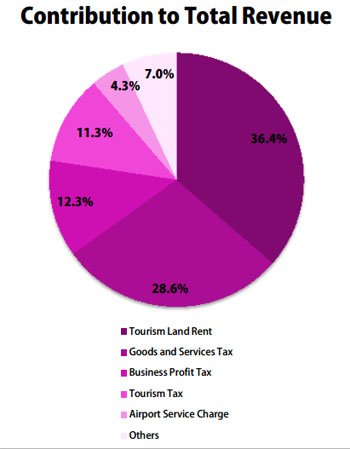
More than a third of total revenue (36.4 percent) came from tourism land rent, an increase of US$1.8 million on the previous year to 14.6 million, followed by the Goods and Services Tax (GST) which increased US$2.6 million to US$7.2 million – representing 28.6 percent of total revenue for the month.

Source: MIRA

The MIRA figures do not include import duties which are received by customs.

The Maldives Monetary Authority (MMA)’s September review observed that while an increase in tourism arrivals had registered improvements in both monthly and annual terms, real GDP growth was expected to fall to 5.5 percent in 2012, a fall of two percent on 2011.

“As per the latest government cashflow statement, the overall fiscal deficit of the government
worsened during Jan-Aug 2012 compared to the same period of 2011,” the MMA observed, predicting a higher than expected budget deficit for the year.

Fishing – the Maldives’ second largest industry after tourism and responsible for almost 40 percent of the country’s employment, has steadily declined in terms of both catch and export earnings. MIRA’s figures for US dollar earnings highlight the country’s near total-dependency on tourism as a means of earning foreign exchange.

Likes(0)Dislikes(0)