No coup, no duress, no mutiny: CNI report

The Commission of National Inquiry (CNI) has released its report into the circumstances surrounding the controversial resignation of former President Mohamed Nasheed and the transfer of power on February 7.

The CNI was initially a three member panel (Dr Ibrahim Yasir, Dr Ali Fawaz Shareef and chairman Ismail Shafeeu), formed by incoming President Mohamed Waheed Hassan to examine the circumstances surrounding his own succession to the Presidency.

Nasheed and the ousted Maldivian Democratic Party (MDP) have maintained that the former President’s resignation took place under duress during a police and military mutiny, and that Dr Waheed’s government was illegitimate.

The MDP and the Commonwealth subsequently challenged the impartiality of the CNI, and it was reformed to include retired Singaporean judge G. P. Selvam and a representative of Nasheed’s, Ahmed ‘Gahaa’ Saeed.

Retired Court of Appeal judge from New Zealand, Sir Bruce Robertson, and Canadian UN Legal Advisor Professor John Packer, were appointed as international advisers representing the Commonwealth and UN respectively.

Nasheed’s representative Saeed resigned from the CNI on the evening of August 29, denouncing its credibility and alleging that the final report excluded testimony from key witnesses as well as crucial photo, audio and video evidence.

The investigation did not consider the police crackdown on demonstrators on February 8, focusing largely on the events of February 6-7.

Report findings

According to the published report, which was delivered by Selvam to President Waheed on Thursday morning, the change of government was “legal and constitutional”, and the events of February 6-7 “were, in large measure, reactions to the actions of President Nasheed.”

“The resignation of President Nasheed was voluntary and of his own free will. It was not caused by any illegal coercion or intimidation,” the report claimed.

In addition, “There were acts of police brutality on 6, 7 and 8 February 2012 that must be investigated and pursued further by the relevant authorities.”

The report dismissed the MDP’s allegations that the government’s ousting was a ‘coup d’état’, stating that the Constitution “was precisely followed as prescribed.”

“There appears nothing contestable in constitutional terms under the generic notion of a ‘coup d’état’ that is alleged to have occurred – quite to the contrary, in fact,” the report claimed.

“In terms of the democratic intent and legitimacy of the authority of the Presidency, as foreseen in the Constitution, President Waheed properly succeeded President Nasheed.”

“As President Nasheed clearly resigned and now challenges the voluntariness and legitimacy of his action, the onus is on him to establish illegal coercion or unlawful intimidation.”

Witnesses “lying”

In the course of its work the CNI interviewed 293 witnesses, 15 on multiple occasions. It also reviewed documentary evidence.

“The Commission notes that in many disputes, there can be difficulty in getting to what actually historically occurred as opposed to what an individual now honestly and sincerely believes to have happened,” the CNI report stated.

“Many people have heavy commitments to certain positions and on occasion their recollections were simply wrong. They had a recall that could not be correct when viewed alongside videos, photographs and other evidence. It is unhelpful to call this ‘lying’ but it must be allowed for as conclusions are sought,” it noted.

“Many people seem to think that because an allegation has been made, someone is under an obligation to counter or undermine it. When the allegation lacks substance or reality, nothing is required in response.”

The timeline produced by the three member panel meanwhile faced “virtually no challenge of substance”, and the reformed commission “affirms its own reliance on the timeline.”

Definitions: Not a coup, not under duress, not a mutiny

Regarding Nasheed’s allegation that his resignation was under duress, the report stated that “because of the seriousness of the charge, [the] person who alleges illegal duress or intimidation carries the legal burden as well as the evidentiary burden of proof.”

“It is an inevitable conclusion of the totality of the credible evidence that the only available firearms which were anywhere near the President between 4.37 am and 1:30 pm on 7 February 2012 were those which were carried by his SPG [bodyguards]. There is no evidence to suggest that the arms in possession of the SPG were a threat to him,” the report stated, in its conclusion.

“The Commission does not accept that his activities were closely monitored or that the military or the three civilians were issuing orders. Even if they had been, that does not signify coercion.”

The report dismissed claims by former Foreign Minister Ahmed Naseem that Brigader General Ahmed Shiyam was armed with a pistol in the company of Nasheed.

“Yet another witness, the Minister of Tourism in President Nasheed’s government, Maryam Zulfa, said that it was Riyaz who had a gun. This was because according to her there was a bulge in the pant pocket of Riyaz,” the report stated.

“The Commission is forced to conclude that this is evidence which although it may be the presently-held view of those people, is so inconsistent with the totality of the material that it cannot be relied upon.”

“All the credible evidence showed that neither [retired Colonel] Nazim, nor anyone else, delivered the threat alleged by President Nasheed.”

The report noted that coercion “as a result of unlawful activities by other people was a constant theme from many witnesses.”

“Because illegal or unlawful acts or omissions were going on in the community, it seemed to be the view of a number of witnesses that this had the effect of coercing the President to resign. The Commission does not comment on the allegations of such activities because they are not within our mandate but there is clear and unequivocal evidence before us that there are serious allegations of wrongdoing by the military, the police and private citizens. For the Maldives to move forward, these matters must be addressed.

“However, the Commission is unable to see how it can be contended that such wrongdoings perpetrated upon others can be said to have any coercive effect upon the President.”

“Indeed, until the time of his resignation, President Nasheed possessed of many powers under the Constitution that he could have utilized including the lawful use of force. He chose not to.

“That decision may be classified as praiseworthy, but he cannot now contend that because he made those choices, that he was ‘forced’ into resigning because of what others were doing around him,” the report stated.

Definition of a coup

The report also reviewed several definitions of the term “coup d’état”.

The World Book definition, “a sudden take-over of a country’s government by a group of conspirators. Usually, the conspirators are public officials who infiltrate and then use their country’s armed forces, police, and communications to seize power”, was rejected in favour of “whenever the legal order of a community is nullified and replaced by a new order in an illegitimate way, that is in a way not prescribed by the first order itself.”

The report also defined the word “mutiny” as “under the law of the Maldives an internal matter within the military. Its aim is not to remove the President from office or to overthrow the government.”

As for the police, “The Maldives Police Act 2008 does not contain the offence of mutiny by police. So the offence of mutiny is confined to the military. Any illegal subordination by a policeman would be an internal matter subject to disciplinary proceedings.”

CNI conclusions

Nasheed provided the commission with a “with a list of some 67 names, whose bank accounts and telephone logs he requested be scrutinised. These allegations were unsupported by any evidence,” the report stated.

“All sorts of allegations were made against Retired Colonel Nazim on how he purportedly stalked President Nasheed, controlled his movements and dictated what he should say. Nazim, it was said, even wanted the pen used by President Nasheed to write his resignation. There was ample credible evidence rebutting these false allegations.

“Such allegations are very easy to make and some naively suggested that if the Commission trolled through scores of bank accounts, telephone records, SMS logs and intelligence reports, all would be revealed.

“The Commission lacks the ability to do so comprehensively, although when it made specific requests in individual cases, information was provided and revealed nothing of consequence.

“Aslam, while appearing before the Commission, read about an SMS attributed to Mr Saleem, the Permanent Secretary of the Ministry of Environment. The SMS spoke of a distribution of MVR 2.4 million (US$155,640) to the ‘mutinying’ policemen. The Commission summoned Mr Saleem. He debunked the message effortlessly, claiming that he did not recall sending such a message.”

“After hearing him, the Commission would not invade and investigate the privacy and personal affairs of all and sundry as desired by President Nasheed and his aides in the absence of minimally credible supporting evidence,” the report said.

“A coup d’état required positive action against President Nasheed. Non-action and inaction cannot constitute a coup d’état. Moreover, the Constitution does not call for loyalty of anyone to the President. It calls for the loyalty to the Constitution.

“In sum, the Commission concludes that there was no illegal coercion or intimidation nor any coup d’état. The Commission has received no evidence supporting or to substantiate these allegations. This disposes the main mandate of the Commission.”

Read the full report

Likes(0)Dislikes(0)

High Court invalidates Hulhumale’ court’s rejection of case against former president

The High Court has invalidated the decision of the Hulhumale’ Magistrate Court to rule it did not have the jurisdiction to proceed with lawsuits pressing charges against former President Mohamed Nasheed and certain defence figures serving under him.

The Prosecutor General (PG) initially submitted the cases against the Former President, former Defence Minister Tholhath Ibrahim and three Maldives National Defence Force (MNDF) officers for their alleged role in the “unlawful detention” of Criminal Court Chief Judge Abdulla Mohamed.

The High Court ruling stated the case was based on the “unlawful detention” of a person, adding that magistrate courts have the jurisdiction to proceed with such cases.

The ruling also said that as the incident occurred in Male’ area, the Hulhumale’ Magistrate Court again had the jurisdiction to proceed with the case.

On July 18, the Hulhumale’ Magistrate Court rejected a case filed by the Prosecutor General’s (PG’s) office against former President Nasheed and former Defence Minister Tholhath Ibrahim as well as three other senior military officers over the arrest of the judge.

Hulhumale’ Court Magistrate Moosa Naseem told Minivan News at the time that the case was sent back to the PG’s Office after the court decided that it did not have the jurisdiction to deal with such cases.

“We studied the case and we found that we do not have the jurisdiction to deal with the case according to article 66 of the Judicature Act,” Naseem explained.

According to the Judicature Act, Naseem said, the Hulhumale’-based court can only accept the case after the Chief Justice issues a decree in agreement with the Judicial Service Commission (JSC) and the Judicial Council as stated in the article 66(b) of the Act.

Article 66(b) of the Judicature Act states that: “in accordance with section (a) of this article, if additions or omission to the jurisdictions stipulated in schedule 5 of this Act has to be carried out, the modification has to be done in agreement with the Judicial Service Commission and the Judicial Council and by a decree issued by the Chief Justice.”

On January 16, Chief Judge Abdulla Mohamed was detained by the military, after he had opened the court to order the immediate release of former Justice Minister, current Home Minister and deputy leader of the Dhivehi Quamee Party (DQP), Dr Mohamed Jameel Ahmed.

In late 2011, Judge Abdulla was himself under investigation by the JSC, the country’s judicial watchdog, for allegedly politically biased comments made to private broadcaster DhiTV. The Judicial Services Commission (JSC) was due to release a report into Judge Abdulla’s ethical misconduct, however the judge approached the Civil Court and successfully filed an injunction against his further investigation by the judicial watchdog.

The Nasheed administration accused the judge of political bias, obstructing police, stalling cases and links with organised crime, describing him as “taking the entire criminal justice system in his fist” to protect key figures of the former dictatorship from human rights violations and corruption cases.

Judge Abdulla’s arrest sparked three weeks of anti-government protests in January, leading the Nasheed administration to appeal for international assistance from the Commonwealth and UN to reform the judiciary.

Likes(1)Dislikes(0)

Broadcasting Commission demands Raajje TV apologise for publicising defence minister’s text messages

Maldives Broadcasting Commission (MBC) has demanded private broadcaster Raajje TV apologise for reporting 57 leaked text messages allegedly received to Defence Minister Mohamed Nazim’s mobile phone during the controversial transfer of power on February 7.

In a letter sent to the station yesterday, with MBC’s investigation report attached, the commission demanded that the station broadcast an apology statement from last night for three consecutive nights at prime time from 8:00pm to 10:00pm.

The commission contended that the opposition-aligned TV station violated the “code of practice” of broadcasting by airing the text messages.

Upon receiving the MBC letter, Raajje TV last night aired an apology statement “to respect the demands from “MBC to issue an “unconditional apology” following complaints of its alleged “publicising of text messages received to a man named Mohamed Nazim of M.Seenukarankaage on 22 July 2012, Raajje TV would like to apologise for this action.”

Contacted by Minivan News, Deputy CEO of Raajje TV Abdulla Yameen said that the station did not wish to comment on MBC’s decision

The MBC action followed a complaint filed by Defence Minister Nazim in June in the wake of the publication of the text messages.

In a press statement posted on social media twitter at the time, Nazim argued that Raajje TV had violated article 24 of the constitution, which guarantees right to privacy as well as article 37 of the Broadcasting Act, which prohibits the broadcast of illegally obtained information.

The text messages allegedly received on Nazim’s phone reportedly offered congratulations from officers of the security forces, family members and, prominent businesses figures, including tourism tycoon Ahmed Nazeer of Crown Company Pvt Ltd.  Prominent politicians such as Deputy Leader of the Progressive Party of the Maldives (PPM) Umar Naseer were also reported to have sent the messages.

“Raajje TV’s actions contravene the constitution and laws of the Maldives, as well as broadcasting ethics. Hence, I have asked the Maldives Broadcasting Commission and Maldives Police Services to investigate the matter,” Nazim said at the time.

Raajje TV News Head ‘Asward’ Ibrahim Waheed responded to Nazim’s claims insisting that the station was not responsible for the leaked text messages.

Asward explained that the text messages were made public at an opposition Maldivian Democratic Party (MDP) rally, which Raajje TV televised.

“Numerous print media outlets have also written articles on these text messages. Therefore, Nazim’s targeting of Raajje TV on this matter again illustrates the Maldivian security forces’ attempt to gag free media,” Waheed said.

Controversial text messages

According to the document publicised by the MDP, Speaker of Parliament Abdulla Shahid sent a message to Nazim at 1:42pm stating “Need to talk urgently.”

PPM Deputy Leader Umar Naseer at 2:51 pm allegedly says: “Extremely grateful for your service in saving this country and its religion, thank you, Umar Naseer.”

Three phone numbers registered with the Crown Company Pvt Ltd also offered congratulations to Nazim. Tourism Tycoon Ahmed Nazeer allegedly said at 1:28 pm: “Congratulations. Once a soldier, always a soldier. Keep up the good work, but don’t go overboard. Thanks and regards, Nazeer.”

A Malaysian number which the MDP claims belongs to retired MNDF Lieutenant General Anbaree Abdul Sattar at 4:39 pm said: “Heartfelt congratulations. I pray Allah gives you the patience and wisdom as you proceed to be magnanimous and be mindful of the vow you have made to uphold the constitution and the constitution of the Maldives, Anbaree.”

Anbaree had served as former President Maumoon Abdul Gayoom’s Ambassador to India.

Two text messages also appear to discuss details of the then VP’s movements and logistics for a press conference. A number registered with the MNDF at 2:51 pm says: “Sir VP getting ready to move to Majlis,” while a man identifying himself as Colonel Adurey at 3:21 pm asks when media briefing should be scheduled.

Several security forces personnel also allegedly sent text messages to Nazim thanking and congratulating him for his role in Nasheed’s resignation.

A text message from retired Deputy Commissioner of Police Abdul Shakoor Abdulla said: “Allah Akbar Allah Akbar Akbar Alh’amdhu Lillah. Congratulations! Abdul Shakoor Abdulla Rtd. Dy Com of Police,” whilst a number registered with Lieutenant Colonel Zakariyya Mansoor reportedly sent a text message saying, “Congratulations, Mansoor.”

Another text message from a man identifying himself as “Riya” from an unlisted number said: “Moosa Jaleel’s 15 year savage reign is now over. I was one of those forced to resign. I am really proud to say I’m done STF with you in same platoon. Congratulations, Riya, five rises.” Moosa Jaleel was Chief of the Defense Forces under Nasheed. He resigned shortly after President Waheed took his oath of office.

Attacks on Raajje TV

In recent weeks, the government has stepped up verbal attacks on Raajje TV claiming the station incites hatred and violence against security forces by broadcasting “baseless allegations” regarding alleged police brutality and the service’s role in the controversial transfer of power on February 7.

The police have said it will no longer cooperate with or provide protection to Raajje TV journalists.

The President’s Office meanwhile stopped inviting the station to press conferences and other events.

Raajje TV has since filed a lawsuit against the decision by the police to not cooperate with the station. Hearings have commenced on the case.

Home Minister Mohamed Jameel, Police Commissioner Abdulla Riyaz, and Attorney General Azima Shukoor have said Raajje TV must bear responsibility for the murder of a police officer last month, and have pledged to take legal action against the station.

Raajje TV has previously accused the Maldives security forces of regularly targeting, attacking, threatening and harassing the station’s journalists.

In a July 10 statement, Raajje TV said: “Raajje TV journalists have been forced to live in fear as they have increasingly become targets of attacks by the national security forces, particularly the police service. The station also believes that these attacks and harassment has been the source of emotional distress and psychological damage to all Raajje TV employees.”

Likes(0)Dislikes(0)

President Waheed meets coalition members ahead of CNI report release

President Dr Mohamed Waheed Hassan has this afternoon meet with representatives of the parties making up his national unity government to discus how to address the findings of the Commission of National Inquiry (CNI)

According to a press release on the President’s Office website, the meeting saw discussions on agreeing a way forward upon the release of the report compiled by the CNI. The report, which was scheduled to be released today, has been delayed for at least an additional 24 hours.

The President’s Office stated that a consensus was reached at the meeting whereby all the coalition partners pledged to back Dr Waheed’s views concerning the investigation and its findings.  No further details were provided on the discussions in the statement.

President’s Office Spokesperson Abbas Adil Riza was not responding to calls at the time of press.

Local media quoted government-aligned Adhaalath Party President Sheikh Imran Abdulla, as saying that the coalition parties had assured President Waheed that they would not allow any persons to create unrest in the Maldives upon the report’s release. He also said that all the coalition parties were ready to help security forces in their work to maintain peace and order.

Chief Spokesperson of Jumhooree Party, Moosa Rameez, speaking to Minivan News today said: “Mohamed Waheed Hassan Manik is the president of a coalition government and all the coalition parties have decided to work together with whatever decision he makes regarding the CNI results.”

Rameez said that the coalition parties also agreed not to hold any protests or demonstrations following the CNI report, no matter its final outcome.  He added that although government-aligned parties in the coalition had pledged to follow the president’s views on the matter, they had not yet received any additional information about it.

The opposition Maldivian Democratic Party (MDP) has alleged that President Waheed’s government came to power on February 7 in a “coup e’etat”.  These claims form the central focus of the CNI’s investigation into the exact details surrounding the controversial transfer of power.

Likes(1)Dislikes(0)

Government confirms CNI report release delayed by at least 24 hours

The Commission of National Inquiry (CNI) report will not be released to authorities and former President Mohamed Nasheed for at least a further 24 hours, authorities in the Maldives have today confirmed.

The President’s Office has previously said that it anticipated receiving the report by today. However, speaking at the time of press, President’s Office Media Secretary Masood Imad denied that the government had expected a completed copy of findings to be received today.

President Mohamed Waheed Hassan agreed last month to extend the deadline by which the CNI must conclude its report into February’s transfer of power by August 30, 2012.  CNI Co-Chair – retired Singaporean Judge G P Selvam – had requested a deadline extension in order to conclude the report due to the hundreds of people wishing to provide information.

When contacted by Minivan News, a spokesperson for the CNI office confirmed that the final deadline to release the report would now be tomorrow, but declined to give a reason for the delay.

Earlier this week, former President Nasheed’s representative on the CNI panel, Ahmed ‘Gahaa’ Saeed, expressed concern over a draft report compiled by the commission’s co-chair Judge Selvam.  Saeed alleged that there were “significant gaps” in the report concerning certain evidence and statements that had been given to the commission during its investigation.

A statement released by the CNI today, said that no material obtained as part of its investigation had been lost or mislaid.

“All interviews, evidence and information received to the commission have been stored in a safe and secure manner. Hence this commission is quite certain that no material have been lost or mislaid,” the statement read, according to local newspaper Haveeru.  While the CNI has confirmed the authenticity of the statement, Minivan News has yet to see of copy of the document.

Among the stakeholders expecting to receive the CNI report today were the Maldivian Democratic Party (MDP), which contends that its presidential candidate Mohamed Nasheed was removed from office during the events of February 7 in a “coup d’etat”.

The validity of these allegations is at the centre of the CNI’s investigation.

MDP MP and Spokesperson Hamid Abdul Ghafoor said that there had previously been “an understanding” that former President Nasheed was to have received the report between 9:00am and 12:00pm today, alongside authorities including the President’s Office, parliament and the Prosecutor General’s (PG’s) Office.  Ghafoor said that the party was now expecting to receive the report at the same time as the public tomorrow.

“It appears that [the CNI] have changed their minds and are releasing the report in one go,” he said.

According to Ghafoor, the decision to provide the report to key stakeholders like the government and parliament before a wider public release had been decided to allow time for the report to be reviewed by various state institutions and political parties.

“This would have helped, as they way it looks right now, it doesn’t seem the CNI will address Mr Saeed’s concerns. Over the last three days we have not heard from the CNI at all regarding issues such as whether they would include CCTV footage from the President’s Office building [on February 7],” he claimed. “This means we will not be able to fill the gaps in the report before they bring it out.”

In a statement released this week, the Commonwealth Secretary-General’s Special Envoy to Maldives, Sir Donald McKinnon, called on all “Maldivian stakeholders” to address the CNI’s findings in a calm and responsible manner.

“I look forward to the imminent completion of the work of the reconstituted Commission of National Inquiry and to its being able to agree on its report,” Mckinnon stated. “As we approach the release of that report, I would encourage all stakeholders to respect the commission’s findings, and to take time to reflect carefully on how to act upon them in a manner that maintains harmony in Maldivian society and helps strengthen democratic practice and institutions in the country.”

Responding to the statement, Ghafoor said he hoped the next 24 hours would be used by the CNI panel to try and find agreement on the report’s findings in light of Saaed’s concerns over the earlier the draft.

“[Commonwealth] Special Envoy Sir Donalod Mckinnnoon has this week talked about finding consensus on the findings,” he said. “However, if this consensus is not found between the commission’s members, then we would have to question if the CNI report was the report outlined in the Commonwealth’s recommendations.”

With the report now scheduled for release tomorrow, Andrew Cox, the United Nations Resident Coordinator in the Maldives said that social media reports claiming the CNI report would be launched from the organisation’s headquarters in Male’ were inaccurate.

“We understand that the CNI report will be directly delivered to the major actors concerned as per prior agreements,” Cox stated. “The report will not be released at the UN Building.”

Likes(0)Dislikes(0)

President prepares to receive completed CNI report as authorities raise prison unrest fears

President Dr Mohamed Waheed Hassan will make an official statement today concerning the final draft of the Commission of National Inquiry’s (CNI’s) findings as the Commonwealth reiterates hope that all members of the commission’s panel will be “able to agree” on the finished report.

As the opposition Maldivian Democratic Party (MDP) has continued its criticism of an early draft of the Commission’s findings, claiming it fails to meet criteria set by the Commonwealth, authorities have this week been raising concerns about potential violence in response to the release of the CNI report.

Both the Maldives Police Service and the Ministry of Home Affairs have detailed fears of unrest spreading across the Maldives following the reports release, both in the capital and the wider atolls, as well as the country’s prisons.

Once having received the CNI’s report today, President’s Office Media Secretary Masood Imad confirmed that President Waheed would likely be releasing a statement on the findings.  At the time of press, Masood said that no time-line had been given by the CNI panel for when the completed report would be delivered to the president.

Along with the President’s Office, key state institutions like parliament, as well the prosecutor general (PG) and the attorney general will be receiving the report a day ahead of the planned public release.

However, Deputy Prosecutor (PG) General Hussein Shaheem told Minivan News that even if it received the report today, the PG’s office was unlikely to issue a statement itself until the findings had been studied and analysed.

“If the report does come out [today], it will be our responsibility to comprehensively read it and study the findings,” he said. “So far, we are not fond of making statements to the media, particularly without fully reviewing the report.”

Meanwhile, the MDP has itself continued to criticise a draft of the CNI’s finding that it has alleged contain “significant gaps” in the evidence it was provided.  The party has claimed these “gaps”, unless rectified, amount to “non-compliance” of Commonwealth guidelines in line with concerns initially raised by former President Nasheed’s own appointee to the committee, Ahmed ‘Gahaa’ Saeed.

In a statement, the party drew particular concern with the draft findings of CNI Co-Chair, retired Singaporean Judge GP Selvam, claiming they had been put together without the submission of statements from a number of individuals that hold key positions during February 7. These figures included, Former Commissioner of Police Ahmed Faseeh, Brigadier General (Retired) Ibrahim Didi (MNDF Male’ Area Commander on February 7), Brigadier General Ahmed Nilaam and Col. Mohamed Ziyad.

“The MDP shares Mr Saeed’s concerns as to how Judge Selvam’s draft could be complete when the commission has not adhered to its Commonwealth Agreement derived mandate to look into bank statements and telephone records of principal characters involved in 7 February’s questionable transfer of power,” the party stated. “The MDP’s National Executive Committee has previously stated that it will accept the findings of an inquiry that adheres to the guidelines and agreement reached between Mohamed Waheed Hassan Manik and the Commonwealth. MDP notes that the concerns raised by Mohamed Nasheed’s nominee to the Commission signal non-compliance with the rules and spirit of the inquiry commission set forth by the Commonweath Ministerial Action Group. “

However, echoing a statement released Monday (August 27) by the Commonwealth’s Special Envoy to the Maldives, Sir Donald McKinnon, the intergovernmental organisation said that it was calling on “Maldivian stakeholders” to address the CNI’s findings in a calm and responsible manner.

“[The Commonwealth] looks forward to the members of the [CNI] being able to agree on their report, as well as urges all stakeholders in Maldives to respect the Commission’s findings,” Commonwealth Secretariat Spokesperson Richard Uku yesterday clarified.

With the public release of the CNI report set for Thursday (August 30 ) the government and security forces have both expressed concerns over the potential for violence and unrest in the country with the Ministry of Home Affairs raising fears over alleged “plans” by some inmates to create violence in the country’s prisons.

According to Sun Online, Minister of State for Home Affairs Mohamed Fayaz alleged information had been received that inmates were to create violence within prisons at the behest of unidentified political groups.

Fayaz, who also serves as Head of the Department of Penitentiary and Rehabilitation Service (DPRS), claimed that communications with political figures had been facilitated by by mobile phones smuggled into prisons, with inmates suspected of such communication having been separated from other prisoners.

“Military fire capacity and police backup will be available on that day,” he was quoted as telling Sun, adding that additional checks had been carried out at the country’s prison as of yesterday evening.

Fayaz himself was not responding at the time of press, with Minivan News also awaiting a response to questions submitted to Minister of Home Affairs Dr Mohamed Jameel.

Minister of State Fayaz’s comments come days after the Maldives Police Service (MPS) launched an operation to introduce increased scrutiny of Male’s streets and its surrounding waters in order to try and control fears of a potential outbreak of unrest ahead of release of the CNI findings.

Maldives Police Service Assistant Commissioner Hussain Waheed told reporters at the time that authorities had decided to strengthen security across the capital and other islands, in order to “not give any opportunity to create unrest”.

However, Waheed claimed police would provide full support and security services to demonstrations held “peacefully and within the contours of laws”.

Despite the claims, the International Federation for Human Rights (FIDH) NGO this week called for the international community to send observers to Male’ in time for the release of the findings of the Commission of National Inquiry (CNI).

FIDH said that it was “extremely concerned” about the potential for violence in the build up and aftermath of the report’s release.

“The CNI was established in May to determine the nature of the transition of power in February, which led to the so-called resignation of President Mohamed Nasheed,” the NGO stated.  “These events were followed by continuous unrest in the streets of Male’ and severe repression of demonstrations by state security forces. FIDH calls on the international community to immediately send observers to Male’ to prevent further deterioration of the human rights situation in the country.”

Minivan News last night observed minor confrontations between anti-government protesters and police as about a thousand protesters took to Male’s streets ahead of the CNI release.

Police Spokesperson Sub-Inspector Hassan Haneef was not responding to calls at the time of press to clarify if any arrests had been made during the demonstrations.

Likes(0)Dislikes(0)

PG appeals Hulhumale’ Magistrate Court decision not to proceed with case against Nasheed

The High Court yesterday concluded hearings of an appeal by the Prosecutor General’s Office (PGO) against a decision by the Hulhumale’ Magistrate Court not to proceed with a case against former President Mohamed Nasheed over the military’s detention of Criminal Court Chief Judge Abdulla Mohamed.

On July 18, the Hulhumale’ Magistrate Court rejected a case filed by the PGO against former President Nasheed and former Defence Minister Tholhath Ibrahim as well as senior military officers over the arrest of the judge.

Hulhumale’ Court Magistrate Moosa Naseem told Minivan News at the time that the case was sent back to the PGO after the court decided that it did not have the jurisdiction to deal with such cases.

“We studied the case and we found that we do not have the jurisdiction to deal with the case according to article 66 of the Judicature Act,” Naseem explained.

According to the Judicature Act, Naseem said, the Hulhumale’-based court can only accept the case after the Chief Justice issues a decree in agreement with the Judicial Service Commission (JSC) and the Judicial Council as stated in the article 66(b) of the Act.

Article 66(b) of the Judicature Act states that: “in accordance with section (a) of this article, if additions or omission to the jurisdictions stipulated in schedule 5 of this Act has to be carried out, the modification has to be done in agreement with the Judicial Service Commission and the Judicial Council and by a decree issued by the Chief Justice.”

According to local media reports, Assistant Public Prosecutor Abdulla Rabiu argued at the High Court yesterday that the magistrate court had jurisdiction to hear any cases involving criminal offences in the court’s judicial district.

The PGO lawyer requested that the High Court overturn the magistrate court’s decision and rule that the court has the jurisdiction to hear the case.

He noted that the Hulhumale’ Magistrate Court had accepted a separate case involving threats made against Judge Abdulla Mohamed based on advice from the Supreme Court.

Adjourning yesterday’s hearing, High Court Judge Yousuf Hussain said that a verdict would be issued at the next trial date if there were no further issues to clear up after reviewing the appeal.

On January 16, Chief Judge Abdulla Mohamed was detained by the military, after he had opened the court to order the immediate release of former Justice Minister, current Home Minister and deputy leader of the Dhivehi Quamee Party (DQP), Dr Mohamed Jameel Ahmed.

In late 2011, Judge Abdulla was himself under investigation by the JSC, the country’s judicial watchdog, for allegedly politically biased comments made to private broadcaster DhiTV. The Judicial Services Commission (JSC) was due to release a report into Judge Abdulla’s ethical misconduct, however the judge approached the Civil Court and successfully filed an injunction against his further investigation by the judicial watchdog.

The Nasheed administration accused the judge of political bias, obstructing police, stalling cases, links with organised crime and “taking the entire criminal justice system in his fist” to protect key figures of the former dictatorship from human rights violations and corruption cases.

Judge Abdulla’s arrest sparked three weeks of anti-government protests in January, leading the Nasheed administration to appeal for international assistance from the Commonwealth and UN to reform the judiciary.

Back in February, a spokesperson for Catherine Ashton, the EU High Representative for Foreign Affairs,  said the bloc remained committed to discussing judicial reform with the Waheed administration on the back of concerns raised by former President Nasheed about the nation’s judges.

“Shortly before the events of February 6 to February 7, we were asked for assistance [with judicial reform], as were the UN and Commonwealth. We were ready to look into this matter and hope to discuss the matter further with the Maldivian authorities,” added the spokesperson for High Representative Ashton at the time.

“Judicial interference”

During his inaugural address back in March, President Waheed claimed he would look to avoid “judicial interference”.

President’s Office Spokesperson Abbas Adil Riza at the time said the government hoped to “strengthen” independent institutions like the parliament and the courts.

Riza claimed that the executive branch under former President Mohamed Nasheed was often involving itself in parliamentary and judicial affairs that were supposed to function independently as separate bodies under the constitution.

“We want to empower institutions, not interfere with the decisions they are taking,” the spokesperson said.

Likes(1)Dislikes(0)

HDFC to provide housing loans to police officers

The Housing Development Finance Corporation (HDFC) has decided to introduce a loan scheme for allowing Maldives Police Service (MPS) officers to build their own homes, according to local media reports.

Haveeru today reported that the Commissioner of Police Abdulla Riyaz had used his official twitter stream to announce that the scheme would allow all police officers to get a home loan.

Police Sub-Inspector Hassan Haneef has said that the loan will be released to officers to build houses which are registered in their own names. He went on to say that the Police Commissioner was undertaking a lot of efforts for the development of the police force.

HDFC states that it has been providing housing loans to all government employees, but that the scheme has only recently been introduced to the police. Haveeru quoted a HDFC official as saying that they have previously received numerous requests from police officers for the loan, and that it has now been facilitated since the corporation has come to an agreement with the MPS.

Likes(0)Dislikes(0)

Different strokes: Maldives power transfer expressed through art

Two exhibitions currently taking place in the capital are offering their own unique takes on the controversial transfer of power in February- interpretations that are being expressed through a variety of mediums during the next few days.

Closely following the Maldivian Democratic Party’s (MDP’s) announcement of their intention to hold the Exhibition of Public Inquiry (XOPI), the government-aligned religious-conservative Adhaalath Party held a press conference announcing their own art festival, Fall of a regime: An Artist’s View. Both exhibitions yesterday opened to the public and will run until tomorrow.

XOPI, organized by the MDP, is taking place in the grounds of Male’ City Council.  With the theme “Truth Is Ours”, XOPI features the work of many artists, who adopt a number of approaches to express their thoughts of the events surrounding the change in power.

XOPI was officially opened by President Nasheed on Monday (August 27). The event also doubled as the launching for a book titled “Naakaamiyaabuvi Himeyn Baghawaiy: Gaiy Birun Negee Badi”, meaning ‘The Failed Silent Coup: Fear Raised The Gun’.  The book’s author is the former president’s appointee to the Judicial Service Commission (JSC) and Deputy Minister of Home Affairs, Aishath Velezinee.

Representing the organizing committee of XOPI, Ali Saeed said to Minivan News “XOPI is like a public inquiry, a presentation of the people’s perception of the events of, and following, February 6. Since then, there has been a lot of artistic material being shared on social media. XOPI intends to provide a platform for these to be presented in the same place.”

One participant whose work forms part of XOPI explained that they were taking part in the exhibition to express feelings and concerns surrounding February 7.

“I am participating because this is another venue to express my thoughts and feelings about the coup, freedom, liberty and justice. At a time when our freedoms to assemble and express are getting limited, this space suddenly becomes very important to me,” said Fazail Lutfi, founding member of Emmenge.com, a website which creates stories about political and social issues.

Another artist, Maryam Omer, has produced an exhibit that introduces guests to the exhibition.

As the visitor opens the lone door placed in the middle of the pathway, they are met with the sight of a charging bull. Part of the description reads “Grasping to comprehend the reality of the situation and describe something so phantom and menacing in my head was the image of a charging bull at the door,” the artist explains. “What matters is the individual’s perception of a universal event. It’s important to express how we feel about the events that occurred back in February.”

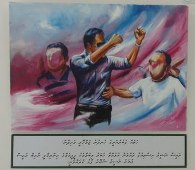
Meanwhile,the Adhaalath Party organized exhibition at the National Art Gallery was officially opened by President Waheed at a ceremony held Monday afternoon. The exhibition features the work of one artist known simply as ‘Siru’. Siru’s work captures events from the controversial hanging of banners for last year’s SAARC summit and proceeds as a story, ending with a painting of Dr Waheed taking the presidential oath in February this year.

An Adhaalath Party representative at the gallery, Hussain Wafeer, told Minivan News yesterday that the 60 pieces exhibited were all painted by Siru in a span of no more than a month. The artist himself said he did not wish to speak with any media.

In response to widespread speculations about the religious-based party depicting people in drawings, and whether it conflicts with the party’s ideology, the Adhaalath Party has released a statement saying it is not prohibited in Islam to draw figures as long as the facial features are not detailed.

President of Adhaalath Party, Sheikh Imran Abdulla and Vice President Dr. Mauroof Hussein were not responding to calls at the time of press.

Both Exhibition of Public Inquiry and Fall of A Regime: An Artist’s View will be open to the public until August 30.

Likes(1)Dislikes(0)