Police crack down on ‘harassment’ of politicians

Police are taking stronger measures against people who harass politicians and such incidents are falling, according to President’s Office Abbas Adil Riza.

The Maldivian Democratic Party (MDP) has meanwhile alleged that freedom of speech is being unfairly restricted by the crackdown.

Commenting on the arrest of an MDP activist known as Okay Zahir – who allegedly called the Islamic Affairs Minister a ‘baaghee’, or ‘traitor’ – Abbas said that Zahir stood accused of harassment.

Local media reported yesterday that Zahir’s period in detention had been extended by a further 10 days after his original arrest on August 7. Zahir is a former director of the Thilafushi Corporation (TCL).

Abbas alleged that the accused “verbally abused the Islamic Minister”, engaging in “indecent behaviour” towards Sheikh Mohamed Shaheem Ali Seed whom he claimed was in the company of his nine year-old son at the time of the incident.

Neither Sheikh Shaheem nor Police Spokesman Sub-Inspector Hassan Haneef were responding to calls at time of press.

A source who had seen the arrest warrant claimed that Zahir was accused of approaching Shaheem’s son on a number of different occasions, inquiring as to the whereabouts of “baaghee Shaheem”.

The source stated that police obtained the warrant due to their belief that this alleged offence would be repeated.

MDP spokesman Hamed Abdul Ghafoor stated that the charges against Zahir seemed “very bizarre”, and expressed his concern that “the scope of freedom of speech is being severely constrained.”

“One could argue it is unconstitutional,” continued Ghafoor. “I don’t see how giving your opinion of the truth equals harassment”.

Maldivian Democratic Party (MDP) Lawyer Hisaan Hussain used social networks to express her belief that calling someone a ‘baaghee’ is not a criminal offense.

Meaningful dialogue

Since his accession to the Presidency, Dr Mohamed Waheed Hassan’s public appearances have often been accompanied by heckling crowds disputing the legitimacy of his government.

As well as calling for early presidential elections, the anti-government demonstrations have attempted to mock and ridicule leading government figures as part of a well-choreographed non-violent strategy.

The harassment of politicians has recently been central to the government’s negotiations with the opposition MDP.

During the last round of the UN-mediated roadmap talks in June, pro-government parties presented the MDP’s representatives with a list of 30 suggestions for resolving political tensions in the country which included calls to stop the harassment of political figures.

However, the list also included calls for the MDP to stop the use of “black magic” and “erotic tools”, leading the MDP to interpret a lack of sincerity on the part of the pro-government group.

More recently, President Waheed said that he would not engage in the all-party talks until the harassment of his officials stopped.

The MDP announced last week that it intended to suspend its program of anti-government demonstrations in order to “facilitate meaningful dialogue”.

This move was initially welcomed by the government, before protesters targeted Vice President Waheed Deen as he attended a ceremony in Hulhumale, causing Abbas to tell local media that the government’s participation in talks may have to be reconsidered.

Freedom within limits

During a speech given in June, President Waheed stated his belief that freedom of expression ought not to be permitted to the extent that it impinged on the rights of others.

“People misuse the right to freedom of expression and yell whatever words that come to mind at other people. You have seen and heard this, not just on TV or radio, but on the streets, in front of houses and schools. This is not how it should be,” Dr Waheed was reported as saying.

As well as being enshrined in the Universal Declaration of Human Rights, the right to freedom of expression is listed in the 2008 Maldivian Constitution as one of the fundamental rights and freedoms of its citizens.

The right to freedom of speech, however, has long been met with caveats and provisos which in effect limit the ability of individuals to unrestricted expression.

Article 10 of the European Convention on Human Rights espoused the right to freedom of expression whilst delineating restrictions it describes as “necessary in a democratic society”.

The list of exceptions includes constraints “for the prevention of disorder or crime, for the protection of health or morals, for the protection of the reputation or rights of others”.

Similarly, the right to freedom of speech is guaranteed by the first amendment to the US constitution but has been restricted by subsequent Supreme Court rulings which have included issues concerning incitement, false statements of fact, and obscenity.

During the speech, Waheed expressed his hope that the People’s Majlis would move to curb the actions of those who, he felt, were abusing this fundamental freedom.

Likes(1)Dislikes(0)

Vice president’s party talks solely focused on resuming Majlis: President’s Office

Talks scheduled this week between senior parliamentary representatives and Vice President Mohamed Waheed Deen will be focused solely on trying to find a resolution to the ongoing suspension of the Majlis, the President’s Office has said.

However, the opposition Maldivian Democratic Party (MDP)  today accused government representatives of giving “conflicting” messages after contending that an agreement had been made for discussions to also focus on facilitating early elections to resolve the deadlock surrounding the controversial transfer of power on February 7.

Government Spokesperson Abbas Adil Riza told Minivan News today that talks at the President’s Office scheduled for 11am on Tuesday August 14, were being held at the request of Parliamentary Speaker Abdulla Shahid following the suspension of the People’s Majlis late last month.

Abbas maintained that Tuesday’s talks would be focused solely on addressing parliament’s suspension rather than topics already agreed under the agenda of the all-party talks, which include issues such as early elections.

“This meeting is being held at request of the speaker as the various parties felt they needed to speak with the executive,” he claimed.

In a statement released today, the opposition MDP said the vice president had agreed to an offer to engage in dialogue to try and find what it called a way forward in the “current political crisis.”

“[President] Waheed’s government has assigned their Vice-President Mohamed Waheed Deen to participate in the talks agreed among leaders of political parties represented in parliament,” the statement read.

Speaker Shahid opted to suspend parliament “indefinitely” on July 31 after claiming that “an atmosphere of calm necessary to conduct sittings could not be assured” following confrontations between MPs in the Majlis chamber.  Several sittings had been cancelled owing to disorder in the lead-up to the suspension amidst reports of MDP MPs confronting the speaker.

On Thursday (August 9), the now opposition Maldivian Democratic Party said that a date to resume parliamentary sessions was “yet to emerge”, though claimed it was confident discussions were on the right track.

MDP spokesperson and MP Hamid Abdul Ghafoor today claimed that the severity of the speaker’s decision to suspend parliament last month had effectively seen the country come to a political standstill.

“The party made it very clear at the time in a statement that we would not be cooperating with the Majlis unless we were able to address our grievances,” he said.

Ghafoor added that Tuesday’s talks between key parliamentary figures and the vice president would be aimed at addressing the issue of hosting early elections before those presently scheduled by the Waheed administration for July 2013.

Responding to President’s Office claims that only the issue of parliament’s suspension would be focused on in the talks, Ghafoor alleged that the party was continuing to receive inconsistent responses from the government.

“Right from the start of this process we have seen the government giving us conflicting messages,” he said. “We have chosen to ignore these contradictions for practical purposes.”

As such, the MDP claimed that its representative at the talks – MP Ali Waheed – would look to discuss issues including facilitating early elections.

Likes(0)Dislikes(0)

MDP denies involvement in Hulhumale’ demonstration against VP, pledges commitment to talks

The Maldvian Democratic Party (MDP) said it remains committed to ceasing street demonstrations in order to facilitate talks with government-aligned parties, playing down fears that protests by a number of “individuals” against the vice-president on Thursday could derail negotiations.

MDP spokesperson and MP Hamid Abdul Ghafoor claimed today that the party had not been behind demonstrations held Thursday (August 9) on the island of Hulhumale’ during a visit by Vice President Mohamed Waheed Deen. Ghafoor added that there had been no official communication from the government so far following these demonstrations with regard to stopping talks between the country’s political leaders.

Since the controversial transfer of power that brought President Dr Mohamed Waheed Hassan into office on February 7, former President Mohamed Nasheed has alleged he was removed from office in a “coup d’etat”. The allegations have lead to months of political uncertainty across the nation, resulting last month in the indefinite suspension of parliament.

Less then 24 hours after welcoming the MDP’s decision to suspend ongoing street protests against the government to “facilitate meaningful political dialogue” with the coalition government, the President’s Office yesterday told local media it might reconsider participation in talks following demonstrations held Thursday (August 9) in Hulhumale’.

President’s Office spokesperson Abbas Adil Riza was quoted by the Sun Online news service as saying that the government’s decision to participate in fresh talks had “to be reconsidered”, alleging the MDP had been directly involved in the protests that reportedly saw offensive language used against the vice president.

Both Abbas and President’s Office Media Secretary Masood Imad were not responding at time of press.

Thursday’s demonstrations were directly targeted at a visit by Vice President Deen, who was in Hulhumale’ to attend the opening ceremony of the State Trading Organisation (STO)’s new futsal field.

Police spokesman Hassan Haneef told Minivan News today that eight people had been arrested in relation to the incident, with seven having been released at the time of press. Haneef said that the suspect’s had been arrested over charges including blocking the vice-president’s car, and “disobeying and disturbing” police as they performed their legal duties.

However, MDP MP Ghafoor claimed that the party had not been involved in organising demonstrations against the vice president, contending that the reaction of Abbas in local media had been a “knee-jerk response to a minor incident”.

“I have read comments about this in the media, but we have not heard anything official from the government on [stopping talks],” he said. “It appears that a sporadic incident has been used as an excuse by some to criticise us because of a couple of angry activists. We have stopped our street demonstrations as we promised, but individuals will still get upset in the current political environment.”

Ghafoor added that he believed it was unlikely that the actions of independent demonstrators would set back wider-efforts to attempt to find a resolution the present impasse between the MDP and government-aligned parties.

“This is not a culture we have had before 2008, but people are now free to come out and speak their mind about concerns they have,” he said. “This just appears to be people being over-sensitive regarding minor incidents.”

Demonstration concerns

The unity government’s insistence on an end to the MDP’s continued demonstrations before discussions could resume had been outlined in the agenda of the all-party roadmap talks. Of a six point agenda agreed upon by participants, public order and stability were one of the first points to be addressed.

However, during the most recent round of all-party talks in June, the list of demands presented to the MDP by government-aligned groups were claimed to be lacking in seriousness. The 30-point list presented to the opposition party included demands to desist from using “black magic” and “erotic tools” as well as walking in groups of more than ten.

Since that time, the MDP has continued regular demonstrations, particularly in the capital Male’, where consecutive nights of protests in July resulted in violent clashes between protesters, security forces and journalists.

The immediate aim of inter-party discussions, however, would be to agree upon an arrangement which might allow the reopening of the People’s Majlis, which was suspended last month after angry confrontations between opposing MPs and the Speaker of the House.

The Speaker Abdulla Shahid invoked his authority to suspend sessions indefinitely if he felt dialogue between party leaders was necessary to restore calm to proceedings. Government-aligned parties have been critical of the role they allege MDP MPs played in stymieing the work of the People’s Majlis.

Likes(0)Dislikes(0)

MDP to mark ‘Black Friday’ anniversary

The former ruling Maldivian Democratic Party (MDP) has announced that it will mark the eighth anniversary of ‘Black Friday’ August 13, 2004 with a special rally and photo exhibition on Monday night.

The spontaneous gathering of the public at the Republic Square on August 12 and 13, 2004 against the regime of former President Maumoon Abdul Gayoom was a watershed event in Maldivian history.

The unprecedented 22-hour pro-democracy demonstration was quashed in a brutal crackdown on the afternoon of August 13 by the former National Security Service (NSS).

Shortly after the crackdown and arrest of scores of demonstrators, President Gayoom declared a state of emergency, which lasted two months.

In August 2005, then-Chairperson of MDP, former President Mohamed Nasheed, was arrested on the first anniversary of Black Friday during a vigil at the Republic Square.

According to the party website, the rally planned for Monday night to mark the anniversary will feature a video presentation about torture.

Likes(0)Dislikes(0)

MNDF doctor removed from post after alleging brutality against demonstrators

Maldives National Defence Force (MNDF) Captain Dr Fathmath Thahsyna Ibrahim has been removed from her post as Deputy Commander of Medical Services, after she expressed outrage on social media about alleged brutality by security forces against demonstrators.

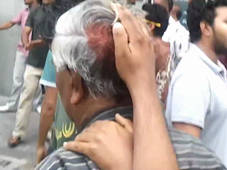
Dr Thahsyna’s 61-year-old father, Ibrahim Abubakur (Kottafaru Dhonthu), was allegedly struck on the head by an MNDF officer during an opposition Maldivian Democratic Party (MDP) protest on August 2.

Videos surfaced on social media showing Abubakur emerging from the crowd holding his bloodied head while MNDF officers pushed protesters back to the Chandanee Magu junction. The Republic Square area was cordoned off by MNDF officers while former President Mohamed Nasheed was attending police headquarters.

Captain Dr Fathmath Thahsyna IbrahimFollowing the incident, Dr Thahsyna – who was the first female MNDF doctor – took to Facebook alleging that her father was “hit by an MNDF personnel.”

“Every civilian has the right to freely express their views. No uniformed personnel has any right to beat up their own citizens, no matter what!” she wrote on August 2. “My father was hit on the head and he has a 7cm deep laceration on the back of his head.”

Verbal protest or abuse should not be “answered with the baton,” she added.

“I know my father is an MDP activist and he may have called you names, but still even he doesn’t deserve to be hit on his head,” she wrote.

When she posted the same comments on the MNDF medical page on Facebook, Thahsyna revealed that only two officers expressed well wishes for her father, “out of good will and humanity.”

Abubakur meanwhile told newspaper Haveeru yesterday that his eldest son saw the MNDF officer hit him with a baton.

“That day I was on the pavement in front of the Umar Shopping Arcade. I was behind theBrutality against MDP demonstrators fence. When the army officers charged and tried to disperse the civilians on the road, someone fell outside the fence and I was hit on the head while I was bending over to help him back up.”

Speaking to Minivan News today, MNDF Spokesperson Lieutenant Colonel Abdul Raheem confirmed that Dr Thahsyna was removed from her post as deputy commander on August 5.

Raheem however stressed that she was not demoted to a lower rank but had “a change of appointment,” which “happened routinely” in the army.

“She is still working at the medical services,” he said. “She has not been transferred to a different unit.”

While Colonel Raheem could not “definitely say at the moment” that Dr Thahsyna’s removal as deputy commander was in response to her comments on Facebook, the MNDF spokesperson confirmed that an “internal investigation” was ongoing into the allegations of brutality against Dr Thahsyna’s father.

He however added that Dr Thahsyna’s remarks on Facebook was related to the investigation as she was a uniformed officer making public comments concerning the army.

On August 3, Dr Thahsyna posted on Facebook asserting that she has “never crossed my limitations as a solider and never will.”

“I don’t believe expressing my sentiments about my father being beaten up unlawfully is ‘being political’,” she wrote. “What is wrong is wrong no matter who does it. And we should not hide these unlawful acts, in order to make people responsible for their actions.”

Raheem meanwhile insisted that the MNDF would take action against any officers who assaulted civilians “if the investigation finds that any officer was involved.”

“The MNDF does not support violence and will never support it,” he said. “We have been telling our officers continuously that no harm should be caused to anyone. We have internal mechanisms to investigate such allegations and take measures.”

In the wake of the controversial transfer of power on February 7, Amnesty International, the UN High Commissioner for Human Rights and UN Human Rights Committee have expressed concern over the “excessive use of force” against demonstrators of the formerly ruling MDP calling for early elections for the past six months.

Likes(0)Dislikes(0)

MDP suspends demonstrations to “facilitate meaningful dialogue”

The Maldivian Democratic Party (MDP) yesterday announced it would be suspending its anti-government protests and demonstrations in a bid to open dialogue with the government in the closing weeks of Ramadan.

In a press release, party spokesman Hamid Abdul Ghafoor stated that the demonstrations would be halted in order to “facilitate meaningful political dialogue to end the political crisis the country faces.”

“The MDP strongly believes unless there is political dialogue and agreement at a political level, the Maldives will not be able to come out of the current political crisis. In this regard, the MDP decides to halt its demonstrations to sincerely re-assure its commitment to meaningful dialogue,” read the statement.

Whilst Minivan News was today unable to elicit a response from the President’s Office, the office’s spokesman Abbas Adil Riza has expressed his scepticism in the local media.

“Though MDP tells the media that they’ve stopped their direct action protests – considering the actions of the party’s members, it’s hard to trust them. There’s a lot of intimidation,” Abbas told Haveeru.

“They’re attacking the vehicles belonging to ministers, harassing their families, disrespecting mosques, so the government needs assurance that the harassing will stop. We need to see it happen from their actions,” he continued.

The protests have been almost continuous since the resignation of President Mohamed Nasheed on February 7 – a resignation the party continue to allege was forced.

February 8 saw clashes between Nasheed’s supporters and the police, whose mutiny had brought to the boil what had been a simmering political crisis.

Tensions were heightened once more last month as the MDP embarked on a campaign of protests on Chaandanhee Magu in the political and military heart of the capital. More clashes with the police resulted in multiple arrests and injuries which, again, provoked international consternation.

The persistent activities of the anti-government activists have regularly been cited as an impediment to high-level political dialogue.

Following the tense exchanges on Chaandanhee Magu, President Waheed stated that he would not engage in discussions with the MDP whilst it continued to back street protests.

Chances for dialogue?

The most prominent vehicle for dialogue since late February has been the all-party ‘roadmap’ talks initiated by current President Dr Mohamed Waheed Hassan with the backing of Indian diplomats and United Nations mediators.

After a series of failed attempts to define a mutually acceptable agenda for the discussions, six points were agreed upon in May to be dealt with in consequential order.

The MDP’s protests since February have focussed predominantly on calls for early presidential elections. The discussion of a date for these elections was agreed upon as the last of the six points to be discussed in the roadmap negotiations.

The first of these points – public order and stability – resulted in a 30-point list of demands being presented to the MDP delegates by pro-government parties during the talks at Bandos Island Resort in June.

These demands, which included calls for the MDP to desist from using “black magic” and “erotic tools”, were deemed by the MDP to be indicative of the coalition’s lack of seriousness in progressing through the agreed agenda.

In yesterday’s statement, Ghafoor described some of these points as “plainly farcical”.

“We are committed to ensure an environment conducive to hold political talks at the highest level. Therefore, today, the MDP National Executive Committee decided unilaterally to halt the demonstrations. We hope leaders of political parties take this time to seriously engage in dialogue”.

In a further attempt to expedite progressive talks between political groups in the country, Nasheed last month offered an apology to former President Gayoom for accusing the 30-year ruler of orchestrating a coup d’etat.

Gayoom, leader of the parliament’s second largest party, the Progressive Party of Maldives (PPM), had stated that he would be unwilling to sit down and negotiate with a man who made such accusations.

The roadmap talks have formed one half of a two-pronged approach to resolving the political crisis in the Maldives. The Commission of National Inquiry (CNI), after much coaxing from the international community, was established to conduct an investigation into the events up to and including Nasheed’s resignation.

The Commission is expected to conclude its investigations by August 31 after having received testimony from a reported 244 people, including President Waheed himself.

Abbas told Sun Online that he expected the MDP would merely halt its current activities in order to prepare for a mass protest on the day the CNI report is published.

Likes(0)Dislikes(0)

Government must assess financial, investor impacts of airport renationalisation: Thasmeen

The Dhivehi Rayyithunge Party (DRP) has called on the government to consider the potential financial repercussions and impact on investor confidence should it renege on a contract with Indian infrastructure group GMR to develop Ibrahim Nasir international Airport (INIA).

DRP Leader Ahmed Thasmeen Ali today said the party had asked the current government to assess the possible implications of cancelling the GMR agreement in three key areas before his party decided on whether to agree to proceed with renationalising INIA.

An agreement now thought to amount to US$511M was signed between GMR and the previous government of Mohamed Nasheed in June 2010 to manage and build a new airport terminal by 2014, as well as renovate the existing airport facilities in the meantime

The deal, the largest single financial investment in the Maldives’ history, has since faced several protracted legal disputes resulting this month in the infrastructure giant referring a disputed US$25 Airport Development Charge (ADC) included in its contract to a court of arbitration in Singapore.

Several pro-government parties – including the DRP, the Dhivehi Qaumee Party (DQP), People’s Alliance (PA) and Jumhoree Party (JP) – advised President Waheed in June this year that they continued to endorse an agreement signed in June 2010 calling for the airport to be taken back from GMR and nationalised.

The agreement endorsed six main points which included taking legal action to prevent the government’s decision to award the contract to GMR.

Thasmeen’s comments today about assessing the potential impacts of terminating the contract were made as Progressive Party of Maldives (PPM) Deputy Leader Umar Naseer alleged in local media that the DRP was now the “main obstacle” to the state resuming management of the airport.

The PPM is a coalition partner of the DRP in the government of President Dr Mohamed Waheed Hassan.

According to newspaper Haveeru, Naseer contended that an invitation from Indian Prime Minister Manmohan Singh to meet with Thasmeen this week was directly related to the GMR airport dispute.

With the Maldivian Democratic Party (MDP) and the PPM respectively holding the majority and minority leadership roles in parliament, he questioned the reason for Thasmeen’s invite other than discussing the airport case.

“I do not think this trip is related to anything else. The DRP not the main opposition anymore as everyone knows. Even if it is taken in an official manner, the parliament minority leader is from PPM,” Naseer was quoted as saying.

Naseer also claimed that President Mohamed Waheed Hassan’s government wanted to reclaim the management of the airport from GMR – a pledge he hoped would be carried out even without the support of the DRP.

An Anti-Corruption Commission (ACC) investigation into allegations that DRP Leader Thasmeen and Parliamentary Speaker Abdulla Shahid accepted US$1 million in bribes from GMR was last year reported to have “investigated thoroughly”, both men were cleared of wrongdoing over the case.

Thasmeen, Shahid and GMR have all vehemently dismissed the allegations of bribery.

Responding to Naseer’s claims today, Thasmeen told Minivan News that his recent visit to India was the result of a long-standing invitation by the Indian government to discuss a number of issues including the current political situation in the Maldives. He added the visit had not been related to GMR’s dispute with the government.

Thasmeen was not drawn into whether the issue of the GMR contract formed part of discussions, adding only that the prime minister had shown a desire for long-term stability in the Maldives during the talks.

“He was clear in his desire to see a resolution to the current political problems in the Maldives,” he said.

In addressing the issue of GMR, Thasmeen claimed that the DRP has already responded to a request by President Waheed for the views of his coalition government on how to proceed over the matter of the GMR case – but had yet to decide on possible renationalisation.

“In making a decision on this case and the GMR contract, there are three things to consider. These are the impacts on investor confidence from pulling out of such a deal,  the impact this will have on bilateral relations with friendly nations and the extent of the financial repercussions from terminating such a contract,” Thasmeen claimed. “What sort of compensation might there be for example?  The government is best placed to make such an assessment and we will wait for it to do so before making a decision on the case.”

While GMR has pledged to have the new terminal open by July 1, 2014 “irrespective” of outside issues, the Maldives government has pledged to back the will of parliament should it decide on re-nationalising the project.

The relationship between the airport developer and the government soured further late last month after the government temporarily called for a halt to work on the new airport terminal, alleging it had “violated rules and regulations” by not acquiring certain permissions from the Civil Aviation Authority.

In a statement, the infrastructure giant said the GMR Malé International Airport Private Limited (GMIAL) joint venture company had obtained “requisite approvals” under the regulations at the time construction commenced, but had since been asked to seek further approval from authorities.

“We have received a letter from Maldives Civil Aviation Authority asking us to seek its approval pursuant to a recent regulation, for the construction works related to the proposed new Passenger terminal building. Pending the approval, MCAA has directed stoppage of the said works,” GMR stated. “This has no impact on the operations of the airport at the existing terminal.”

Amidst claims by Attorney General Aishath Azima Shakoor that the “doors for dialogue” were still open over resolving the matter of the ADC case, a GMR spokesperson told Minivan News today that the company was not able to comment if fresh discussions with the government were taking place.  Shakoor was not responding to calls by Minivan News at the time of press.

The attorney general told Sun Online that the company could be waiting for up to two years for a resolution to the ADC court case in Singapore. She claimed that discussions between the company and the government remained the “best way” to resolve the issue therefore.

Compromise

Earlier this year, GMR said it had sought to compromise with the government by offering to exempt Maldivian citizens from paying the ADC. However, the Transport Ministry continued to demand that the infrastructure giant repay US$8.2 million deducted from the concession agreement.

Under the concession agreement, a US$25 Airport Development Charge (ADC) was to be levied on all outgoing passengers to part-fund the airport development.

However, while in opposition, the Dhivehi Qaumee Party (DQP), led by Dr Hassan Saeed, now President Dr Mohamed Waheed’s special advisor, and Dr Mohamed Jameel, now Home Minister, filed a successful case in the Civil Court in December 2011 blocking payment of the ADC on the grounds that it was effectively a tax not approved by parliament.

Nasheed’s government as a stopgap measure agreed to deduct the ADC from the concession fees payable by GMR, while it sought to appeal to verdict.

As a result, Dr Waheed’s government received only US$525,355 from the airport for the first quarter of 2012, compared to the US$8.7 million it was expecting, at time the country is facing a crippling budget deficit, a foreign currency shortageplummeting investor confidencespiraling expenditure, and a drop off in foreign aid.

According to financial statements sent to MACL and released to local media, in the second quarter of 2012, GMR deducted the ADC revenue of US$7.1 million from total revenues of US$5.6 million, leaving the government with a bill for US$1.5 million.

Managing Director of MACL Mohamed Ibrahim told local newspaper Haveeru at the time that the government would not pay the amount, alleging that GMR’s deduction of the ADC from the revenue was illegal.

In its defence, MACL has said that its board of directors had been reformed with the arrival of the new government, and a decision made to annul the old board’s agreement to deduct the ADC revenue.

The government meanwhile sought to invalidate the GMR contract – and the clause invoking arbitration – by challenging the handling of the bidding process by the International Finance Corporation (IFC), a member of the World Bank group and the largest global institution focused on private development sector in developing countries.

“The advisory work was supported by AusAid (Australia), the Ministry of Foreign Affairs of the Netherlands, and DevCo. DevCo is a multi-donor program affiliated with the Private Infrastructure Development Group and funded by the UK’s Department for International Development, the Ministry of Foreign Affairs of the Netherlands, the Swedish International Development Agency, and the Austrian Development Agency,” the IFC explained, following a visit by the delegation in June to address the government’s concerns.

Following the first quarter deduction, GMR announced an employee benefits scheme converting 50 percent of employee salaries to US dollars from July onwards, and a one-percent profit-share.

Likes(0)Dislikes(0)

“Come clean” on Grant Thorton’s US$10 million penalty fee, MDP tells AG Shakoor

The Maldivian Democratic Party (MDP) has asked Attorney-General Azima Shakoor to “come clean” over a US$10 million invoice from accountancy group Grant Thorton, contending that the charge was a result of the present government prematurely terminating its investigation.

In a statement released today, the MDP contested claims made by Attorney General Shakoor to local news outlets that her office received two invoices totalling US$358,000 and £4.6 million from Grant Thorton. Shakoor claimed that the charges were for legal advice provided to the MDP government, for which it had not even received a report.

She made the comments at a press conference held on Sunday after documents were leaked revealing that President Dr Mohamed Waheed’s government spent £75,000 (MVR 1.81 million) on advice from former UK Attorney General, Baroness Patricia Scotland, prompting opposition criticism against the spending.

She said similar legal advice had  been sought previously and specifically pointed out the Grant Thorton agreement.

The ousted former President Mohamed Nasheed tasked the UK-based accountancy group to uncover large amounts of state funds allegedly embezzled during Former President Maumoon Abdul Gayoom’s 30 year-old rule, several of which were flagged in the state’s audit reports.

Attacking the attorney general’s claims, the MDP claimed that the terms of engagement contracted with the UK forensic investigators was “not on a contingent fee basis” and instead, government had agreed to pay the fee as a percentage of the proceeds of the stolen assets that were recovered.

“This type of fee was used because a fee-paying engagement would have been too expensive,” the MDP contended.  “However, given that the firm was not charging any fees, the engagement letter that was signed between the GOM and GT included a penalty clause in the event the investigation was unreasonably stopped by the government.”

Under these circumstances, the party said, the penalty would include retroactive charges for the work done by the GT but also a fine for not proceeding towards a full recovery.

“Thus the invoice for the penalty fees was submitted to the government last month when the government decided to close the investigation rather than continue with the criminal and civil complaints that had been lodged in Singapore Courts,” the statement reads.

The MDP also contended the US$10 million penalty was a “small price” to pay in order to suspend the civil and criminal proceedings reportedly underway in Singapore over a suspected illegal oil trade worth US$800 million, which was allegedly undertaken by Abdulla Yameen – Gayoom’s half-brother – while he was the head of state-owned State Trading Organisation (STO). The scheme was alleged to involve the purchase of subsidised oil through the STO in Singapore, which was sold on through an entity called ‘Mocom Trading’ to the Burmese military junta, at a black market premium.

Yameen however has denied these allegations.

Nasheed’s Presidential Commission on corruption, which had been charged with investigating the STO case was disbanded – one of incoming President Dr Mohamed Waheed Hassan’s first acts in power.

Meanwhile, MDPs spokesperson for international affairs has also pointed out that Grant Thorton’s investigators have not submitted a full report because they might decide to litigate in UK courts to recover the US$10 million in penalty fees.

“I believe that GT has not submitted a full report on what it uncovered in stolen assets by the members of the dictatorship because they might want to litigate in UK courts to recover the penalty fees. Clearly, the work undertaken by GT revealed the illegal monies embezzled through the Mocom scam and the existence of secret offshore companies owned by members of the former dictatorship,” Hamid Abdul Ghafoor said in the statement.

“A criminal complaint was ready for filing in Singapore courts in February when the coup d’etat intervened,” he added, alleging that: “the old boys are back in power and the money swindling operations are ready to take off again.”

Following the controversial transfer of power on February 7, 2012 that saw the ousting of President Nasheed’s government, the case fell silent – despite the matter having been forwarded to the Prosecutor General’s office a week earlier, according to MDP.

However, the Prosecutor General Office confirmed the office had not received the illegal oil trade case for prosecution from the former government and therefore no one had been charged.

Attorney General Shakoor was not responding to calls at time of press.

Likes(0)Dislikes(0)

Parliament agrees to extend General Regulations Act in spite of Majlis suspension

Parliament briefly reconvened today despite its ongoing suspension, as both government-aligned and opposition MPs agreed on extending the General Regulations Act until April 2013.

The General Regulations Act – parent legislation for 47 regulations governing a number of government and party political functions – was due to elapse at midnight today creating fears of a potential “legal void”.  This was avoided after the act was renewed with cross party support in a brief Majlis session held following discussions between the country’s key political parties in recent days.

However, the government-aligned Dhivehi Rayythithunge Party (DRP) has said that “no party in the country” stood to gain from the continued political deadlock that saw parliament suspended indefinitely last week amidst forced cancellations.

Despite the Majlis suspension, 48 MPs out of 51 present in the chamber voted in favour of extending the regulations contained in the General Regulations Act during this morning’s session.  The session was concluded with a vote 15 minutes after commencing.

Both Parliamentary Speaker Adbulla Shahid and his deputy, Ahmed Nazim, were not responding to calls by Minivan News at the time of press following today’s vote.

General regulations

The General Regulations Act was passed prior to the adoption of the new constitution on August 7, 2008 as a parent legislation for over 80 regulations without a statutory basis, or were not formulated under an Act of parliament. These included regulations for political parties, freedom of assembly, criminal justice procedures, companies and finance leasing transactions, insurance, jails and parole, freedom of information and building codes.

Article 271 of the constitution states, “Regulations derive their authority from laws passed by the People’s Majlis pursuant to which they are enacted, and are enforceable pursuant to such lawful authority. Any regulations requiring compliance by citizens must only be enacted pursuant to authority granted by a law enacted by the People’s Majlis.”

The parent act prolonged the lifespan of the regulations for a one year period until new legislation, such as a Criminal Procedures Act, Evidence Act, Freedom of Information Act and Political Parties Act, could be enacted.

The act provided for further extensions based on recommendations by parliament’s Rules Committee. The last extension was approved in December 2011.

Addressing today’s vote, DRP Deputy Leader Ibrahim Shareef said that the parent act has been renewed every year since the new constitution came into affect to ensure government was able to function correctly – with parliament failing to have to passed certain key legislative requirements.

Despite the approval, Sharref claimed that “any political party” seeking to stall the Majlis from functioning had nothing to gain beyond adding to current public disillusion with the current democratic process in the nation.

“It is not for the good of the nation for any one political party to stall parliament. The parliament must work efficiently, as it is the only place where we as politicians can debate,” he said. “I believe that parliament must find a solution quickly [to the current Majlis deadlock] as there is much disillusion among the public who had believed democracy was designed to solve problems.”

Shareef contended that in the current environment, “many people” in the country appeared to be questioning the direction of democracy in the Maldives.

“I am not sure whether people may have been expecting too much? I wouldn’t like to say. But right now what has democracy brought us? The nation is polarised as it never has been before, where even some families are not speaking due to political divides,” he said.

“Something somewhere appears to have gone terribly wrong with democracy. It is not enhancing welfare or development here.”

When questioned as to the possible solutions to apparent public apathy regarding parliament’s work, Shareef claimed it was the duty of all parties to return to negotiating through the Majlis to try and settle political differences without hindering legislative process.

“All the main parties need to understand that the country is going down the drain right now,” he said. “No one party to stands to gain in the present environment and they need to help find a solution and stop inciting violence, by putting forward an agenda.”

While not naming a specific party, Shareef’s calls to stop “inciting violence”, were made as President Dr Mohamed Waheed Hassan’s government – with whom the DRP serves as part of a coalition government – said is would not not consider reconvening talks with opposition leader, former President Mohamed Nasheed until threats of violence ceased.

Nasheed and the Maldivian Democratic Party (MDP), which represents country’s only elected opposition, said last week it would not rule out halting ongoing protests to facilitate fresh “high-level talks” with its political rivals. However, the party said it would only do so if it obtained  “substantial” commitments from government-aligned parties.

Proposed “Roadmap” talks were launched in February with the stated aim of overcoming the political deadlock resulting from the controversial transfer of power that brought President Dr Mohamed Waheed Hassan into office. Former President Nasheed and his party continue to allege that Waheed came to power in  a “coup d’etat” – and that the government is illegitimate.

MDP MP and Spokesperson Hamid Abdul Ghafoor told Minivan News last week that while the party’s protests which it maintains are “largely peaceful”, were “totally within” the law, it would not be a “big deal” to stop the street demonstrations if it would help secure meaningful talks.

However, Ghafoor claimed that the party was ultimately sceptical over the commitment of government-aligned parties to ensure “substantial” and “worthwhile” dialogue.

“We have always maintained dialogue is the best way to proceed in the current situation,” he claimed. “What we have seen in the last party talks has just been ridiculous demands such as the issues about keeping crows and using black magic. We found out as a party that we are not dealing with serious people.”

The last round of the UN-mediated talks, held at Vice President Waheed Deen’s Bandos Island Resort and Spa in early June, collapsed after parties aligned with the government presented the ousted Maldivian Democratic Party (MDP) with a list of 30 demands.

The list included calls that the MDP “stop practising black magic and sorcery”, “stop the use of sexual and erotic tools”, and “not walk in groups of more than 10”.

Likes(0)Dislikes(0)