PPM to propose removing Nasheed nominee from CNI

Former President Maumoon Abdul Gayoom’s Progressive Party of Maldives (PPM) has said that it will propose removing Ahmed ‘Gahaa’ Saeed from the Commission of National Inquiry (CNI) after the nominee of former President Mohamed Nasheed publicly criticised the commission’s draft report yesterday.

Speaking at press conference today, Fonadhoo MP and PPM interim council member, Abdul Raheem Abdulla, condemned Saeed’s remarks as “a serious betrayal of the people and the government” and said that the party planned to send a letter to President Mohamed Waheed requesting his “immediate removal”.

“We believe that it is completely unacceptable for a person on such a commission to give interviews publicly about the report before the final outcome or report is released,” he said.

In a brief statement to media outside Muleeage yesterday, Saeed said that the draft report presented to the commission by co-chair G P Selvam, a retired Singaporean judge, “somewhat refutes or denies what we Maldivians saw and experienced” on February 7, when former President Nasheed resigned after elements of the police and army assaulted civilians, ransacked MDP Haruge (meeting hall) and mutinied at the Republic Square.

“February 7, 2012 was a day that shocked Maldivians – a day when the Maldivian government was changed in a sudden confusion. Now, however, the report that Judge Selvam has written and brought is a draft that somewhat refutes or denies what we Maldivians saw and experienced – or a draft that somewhat confuses things, the way it is now,” Saeed explained.

“While this is happening, for me to stay here, at Muleeage, would I believe be a betrayal of my country and the Maldivian people. I see the draft report as having been written without considering the witness testimony of many, many people to CNI as well as the many scenes we saw.”

Saeed added that he would continue efforts to “include my concerns” in the final report.

In the wake of Saeed’s media statement, government spokesperson Abbas Adil Riza argued in local media that Saeed had violated the agreement with the Commonwealth concerning the reconstituted CNI.

“The Commonwealth agreement Nasheed signed states that a Singaporean Judge will reside in CNI. No one must interfere with the work of the commission and also states that everyone must accept the findings of the commission. But the representative from Nasheed sharing the draft report with the public is an indication that Nasheed does not respect any agreement,” Abbas was quoted as saying in newspaper Haveeru.

Meanwhile, speaking at a PPM rally Saturday night, former President Gayoom assured supporters that there was “no cause for concern” over the CNI outcome.

CNI members were “reputable people with high integrity,” Gayoom said, adding that the report would not contain “anything but the truth.”

However, immediately after giving a statement to CNI on July 30, Gayoom had said he would not accept that Nasheed’s government was toppled in a coup d’etat even if the commission came to that conclusion.

Reconstituted CNI

The first three-member CNI panel was appointed by President Mohamed Waheed to investigate the circumstances that brought him to office with former President Gayoom’s one-time Defence Minister, Ismail Shafeeu, serving as chair.

Facing pressure from the Commonwealth and civil society NGOs regarding the commission’s lack of independence and impartiality, the government eventually agreed to reform the CNI to include a retired Singaporean judge and a nominee from Nasheed.

Nasheed’s representative, Saeed, who was formerly both Principal of ‘Ahmadiyya School’ and Deputy Principal of the British College of Sri Lanka was finally accepted after the government of President Waheed rejected almost 11 names Nasheed proposed to the commission.

In a statement welcoming the government’s acceptance of Nasheed’s nomination of Saeed, Commonwealth Special Envoy to Maldives Sir Donald McKinnon expressed satisfaction with “the resolution on the issue of Mr Nasheed’s nominee.”

“Now that we have agreement on the reconstituted Commission, I look forward to it starting its work and carrying out its important mandate. I hope also that with its enhanced terms of reference and revised composition, the Commission will be a more broadly acceptable mechanism and will allow the country to move forward,” the statement read.

Following Saeed’s criticism of the draft report, the formerly ruling Maldivian Democratic Party (MDP) convened an emergency meeting of the party’s National Council and passed a resolution expressing concern in line with Saeed’s reservations.

The resolution stated that the CNI report must be compiled in accordance with the agreement signed between the government and the Commonwealth, which stipulated that instead of relying solely on witness statements, the commission would also accept photos, videos, audios, personal bank statements and phone recordings as evidence.

However, at a press conference on August 2, commission members revealed “difficulties in getting the phone recordings” from the Telecommunications Authority of Maldives (TAM).

Meanwhile, according to local media reports, retired Brigadier General Ibrahim Mohamed Didi attended the commission at 4:30pm yesterday to provide his statement on February 7, two days before the final report is due to be shared with the authorities.

Didi, who resigned in July, was the Male’ Area Commander of the Maldives National Defence Force (MNDF) at the time of President Nasheed’s resignation.

Prior to attending the commission, Didi told private broadcaster Raajje TV that he had been awaiting an invitation to testify before CNI.

While he did not wish to discuss the events leading up to President Nasheed’s resignation, Didi said “I know how it happened very well. I don’t think there would be any other officer who would know what happened in Male’ on the 6th and 7th [of February] better than I. But I am not ready to share it with the media.”

Likes(0)Dislikes(0)

Police crackdown on February 8 “brutal”, “without warning”: HRCM

A police crackdown on a Maldivian Democratic Party (MDP) march across Male’ on February 8 that left dozens of demonstrators injured was “brutal” and “without prior warning,” the Human Rights Commission of Maldives (HRCM) concluded in an investigative report (Dhivehi) made public yesterday.

Based on its findings, the HRCM recommended that the Maldives Police Service (MPS) and Police Integrity Commission (PIC) should investigate the “disproportionate” use of force in violation of police regulations authorising use of less-lethal weapons. Legal action should be taken against the officers responsible for any such offences, the commission concluded.

“This commission notes that the human rights of a number of people were violated as a result of police using disproportionate force in violation of the constitution, the Police Act and regulations, and international conventions the Maldives is signatory to in dispersing a gathering of MDP supporters at the MMA [Maldives Monetary Authority] area on 8 February 2012 ,” the HRCM report concluded.

“The commission believes that those who carried out these acts must bear responsibility.”

On February 8, thousands of MDP supporters took to the streets after former President Mohamed Nasheed declared that his resignation the previous day was “under duress” in a “coup d’etat” instigated by mutinying Special Operations (SO) police officers.

The HRCM report on the human rights violations that occurred on February 8 was compiled based on interviews with senior MDP leaders who participated in the walk, police commanders, senior military officers, eyewitnesses, victims of police brutality and media personnel as well as photo and video evidence.

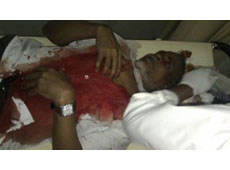
An injured protester

While 32 people filed complaints with the commission concerning varying degrees of injuries sustained in the crackdown, 20 people submitted medical documents of their treatment of injuries.

Among the injuries caused by the police baton charge, the HRCM report noted that several people were bruised and battered, one person fractured a bone in his leg, one person was left with a broken arm and six people sustained head wounds.

Two fingers on the left hand of one demonstrator were crushed, the report noted, and the victim had to undergo treatment at the operating theatre.

The former ruling party meanwhile informed HRCM that the march across Male’ was spontaneous and that the party had not planned to stage any protests on the day.

According to the MDP, participants of the walk were sitting down at the MMA area when the police charged without warning and caused serious injuries, noting that most people were attacked from behind.

Senior members of the party told the commission that police were asked to let MDP supporters continue their march along the outer ring road of Boduthakurufaanumagu.

MDP claimed that police refused to transport victims of the alleged brutality to the hospital and that former President Nasheed’s military bodyguards left the area before the baton charge.

“Emotionally charged”

In interviews with senior police officers and commanders in the field on February 8, the HRCM was told that police intelligence had learned that the MDP supporters were planning to “confront” police officers.

Participants of the MDP walk “attempted to cause damage” to the Family and Child Protection Unit building and Galolhu police station, the officers claimed, at which point they determined that the gathering was not peaceful.

Police did not allow the march to continue because participants could have entered the Republic Square or green zone, where gatherings are prohibited under freedom of assembly regulations.

Police further claimed that protesters hit police shields and that armed gangs “under the influence of drugs” were part of the crowd.

While protesters did not cross the police line, the senior officers said that rocks were thrown at the police. About 30 riot police and plain-clothed officers from other departments were in the area at the time, police said.

While police conceded that “a large number of civilians were injured by police officers” on February 8, senior officers interviewed by the HRCM revealed that the riot police were not acting on commands.

The violence occurred “because individual police officers were too emotionally charged at the time,” the senior officers said.

“And when civilians were getting injured by individual police officers, [they said] senior police officers went to the area and attempted to gather all police officers in one place,” the report stated.

The senior police officers further claimed that police were “very psychologically weakened” due to the events of February 7.

Following the crackdown, police admitted that “use of force” forms were not filled out and an “after action review report” was not drafted as was required under normal procedure.

Meanwhile, the Maldives National Defence Force (MNDF) informed HRCM that about 15 soldiers were active in the area during the crackdown, but claimed that military personnel did not witness police brutality.

When the protesters reached the MMA junction, they began striking the MNDF riot shields and throwing water bottles. They were then pushed back about 20 feet, where they sat down, the MNDF explained.

Contrary to the HRCM’s findings, the MNDF claimed that police advised the protesters to disperse and issued warnings before advancing with riot shields.

Military personnel used coloured smoke “to minimize damage and for ease of controlling those gathered,” the MNDF informed the commission.

Concluding observations

Opposition-aligned private broadcaster Raajje TV meanwhile provided video footage to HRCM showing the arrest of MDP MPs ‘Reeko’ Moosa Manik, Mariya Ahmed Didi, Imthiyaz Fahmy and Ibrahim Rasheed.

MDP Chairperson 'Reeko' Moosa Manik

An HRCM team that visited Dhoonidhoo detention centre observed “bruises all over the body” of one of the MPs, while her eyes were bloodied and swollen.

The commission noted in its concluding observations that police officers “acted very harshly” towards the politicians “in ways that could cause physical and psychological harm” even though they showed “no resistance.”

While the Raajje TV cameraman was shooting the arrest of MDP Chairperson Reeko Moosa Manik, HRCM was told that two plain-clothed officers “pushed and shoved” Raajje TV reporters to the Republic Square and severed the camera cable, ending the station’s live feed.

However, in its concluding observation, the commission reprimanded the private broadcaster for their coverage of the events, which “incited fear and hatred among citizens, instilled a spirit of vengeance and caused serious damage to private and public property.”

Conversely, the commission noted that reporters from private broadcasters DhiTV and Villa TV – alleged by the MDP to have incited hatred against the administration of former President Nasheed and promoted the “coup d’etat” – were “threatened and intimidated” by MDP supporters and were consequently prevented from covering the march.

The HRCM also noted that students at Immadhudeen School during the afternoon session were adversely affected by the MDP supporters gathering outside the party’s Haruge camp on the afternoon of February 8. The party’s gathering area was ransacked by rogue riot police and army officers prior to President Nasheed’s resignation.

The commission contended that MDP supporters were loud and used obscene language outside Haruge, which was reclaimed by supporters led by President Nasheed to the area after the MDP national council meeting earlier in the day.

Citing article 72(b)(1) of the Police Act, which prohibits “commission of an act that could obstruct the execution of any of the police powers and discretions, or plotting to commit such an act, or participate in the commission of such an act, or call for or encourage or assist others to commit such an act,” the HRCM claimed that MDP supporters who participated in the walk “obstructed the performance of police duties.”

Moreover, the commission noted that patients and staff at hospitals ADK and IGMH faced “serious difficulties and inconveniences” due to MDP supporters gathering outside both hospitals following the police crackdown.

However, the BBC reported “a baton charge by police on crowds gathered outside one of the main hospitals.”

“People scattered as officers sprinted towards them silhouetted against the lights of passing traffic,” the BBC’s Andrew North reported from Male’. “Inside the hospital, dozens of Mr Nasheed’s supporters are still being treated for injuries, following earlier scuffles in the main square. Among them is Reeko Moosa Maniku, chairman of Mr Nasheed’s Maldives Democratic Party – who was with the former president when the clashes broke out. With a large head bandage and his shirt bloodied, he regained consciousness as we arrived. The police said they would kill me, he told us, as they beat me. Another MP was still unconscious in another ward.”

The crackdown

While riot police baton charged the front of the protest march on February 8, Minivan News observed riot police officers charging the crowd from a narrow alley leading to the MMA area.

The Special Operations officers used obscene language, pointed to and chased after individual MDP activists and severely beat unarmed civilians.

Parts of the attack from the rear were filmed by Al Jazeera, which reported on February 8 that “police and military charged, beating demonstrators as they ran – women, the elderly, dozens left nursing their wounds.”

Amid the clashes, a group of opposition demonstrators infiltrated the crowds, attacking MDP supporters, according to witnesses.

Former President Nasheed was reported among the injured, and received head injuries during the clashes. He was briefly taken under police custody before being released back into the crowd.

Minivan News also observed several youth with head injuries queuing up for x-rays in the waiting area outside the reception area at IGMH.

One young woman who had gone to IGMH with her sister was being treated for a head wound. A gauze wrapped around her head was spotted with blood, and she claimed the wound was still bleeding as she went in for an X-ray.

“The police were just standing there and suddenly we were being beaten with batons and pepper spray was thrown in our face. They threw us to the ground and kept beating us,” she said.

Explaining that she, her sister and most women had joined the party’s “walk around Male” because they understood it was not a violent protest, the young woman said she had never seen indiscriminate beating of men and women on Male’ under Mohamed Nasheed.

“It was just supposed to be a peaceful walk. That’s why we went, and why more women than usual went. But there was no warning of the attack, no announcements, we were all beaten even after we began retreating. My sister was almost trampled,” she said. “I just think it’s disgusting that the police could beat so many unarmed women.”

Likes(0)Dislikes(0)

HRCM findings will reflect CNI conclusions on transfer of power: President’s Office

The government will not make “special” preparations to address the findings of the Commission of National Inquiry (CNI) once they are published next week, claiming it does not expect any “abnormal” outcome from the report that would see its legitimacy questioned.

President’s Office Spokesperson Abbas Adil Riza today told Minivan News that while it did not wish to speculate on the CNI’s outcome before receiving its findings on August 29, the government expected similar conclusions regarding the transfer of power to those of the Human Rights Commission of the Maldives (HRCM).

The opposition Maldivian Democratic Party (MDP) has dismissed the government’s claims, adding that the CNI was an independent body, overseen by international partners, and would therefore focus on the “big picture” concerning the power transfer, rather than any individual report.

The HRCM yesterday publicly released several reports around alleged human rights abuses committed in the lead up to February 7, as well as reported violations that occurred once the government of President Dr Mohamed Waheed Hassan came into power on February 8.

Among some of the key findings of the reports were that former President Nasheed gave “unlawful orders” to the Maldives National Defence Force (MNDF) and police officers at the Artificial Beach area on the evening of February 6. The HRCM also concluded that the Maldives Police Service needed to investigate alleged brutality conducted by its own officers after the transfer of power.

The HRCM’s findings are expected to be taken into consideration by the panel currently overseeing the CNI, which includes members appointed by President Waheed and a representative for former President Mohamed Nasheed. Under its reformed composition, the CNI is also co-chaired by retired Singaporean judge Govinda Pannir Selvam. Representatives from the United Nations and the Commonwealth will also advise the CNI’s work.

The CNI was initially established by President Dr Mohamed Waheed Hassan to investigate the details of February’s controversial transfer of power, before having its board reconstituted following international and domestic pressure.

Potential outcomes

With the government expected to receive the CNI’s report on August 29 – a day before it will be released to the public – Abbas Adil Riza said that the President’s Office saw “no need” to devise plans to address the potential outcomes of the CNI.

“The HRCM report has proven what we have always maintained about how this government came to power. We expect similar findings [from the CNI] that the previous chief executive displayed gross negligence and a violation of laws. We don’t expect a different stand,” he claimed. “However, on the basis of the CNI report, we will take necessary actions against any criminal behaviour found to have been committed at the time, should issues be raised.”

Abbas added that elections were therefore still scheduled for July 2013. Both the MDP and the Commonwealth Ministerial Acton Group (CMAG) have called for early elections to be held during 2012 to resolve the increasingly bittier political divide in the country.

With President Waheed expected to travel to Sri Lanka tomorrow for a postponed state visit, Abbas claimed that no discussions regarding the CNI and its outcomes were planned with Sri Lankan President Rajapaksa.

He added that the visit would therefore be focused on high-level talks concerning wider bilateral relations and commercial opportunities between the two nations.

“Out of context”

Responding to the release yesterday of the HRCM’s findings, MDP Spokesperson and MP Hamid Abdul Ghafoor said the party’s “experts” were studying the individual reports at present before making comment.

However, on a first glance basis, he accused the HRCM of publishing a “convoluted array of statements” that were additionally “out of context” with wider happenings during the transfer of power.

“The report accuses [former] President Nasheed of issuing unconstitutional orders, the whole thing is out of context and frozen over a 48 hour period,” he said. “At this stage, I would say there are many oversights in these findings.”

Ghafoor added that Abbas’ claims that the CNI would draw a similar conclusion to the HRCM’s findings reflected the position taken by Umar Naseer, Interim Deputy Leader of the government-aligned Progressive Party of Maldives (PPM).

On Sunday (August 19), Naseer leaked details of the HRCM’s findings before they had been released publicly, focusing on claims that Nasheed had given “unlawful orders” to the Maldives National Defence Force (MNDF) and police officers at the Artificial Beach area on the evening of February 6.

He added that the HRCM report concluded that the MNDF and police officers at the Artificial Beach area were “unlawfully” ordered to leave the area, which led to a breakdown in command and control of the security forces.

The HRCM report was also said by Naseer to conclude that Nasheed’s orders to leave the area violated article 245 of the constitution, by obstructing security forces from fulfilling their lawful duties.

However, Ghafoor added that he was “not concerned” that the HRCM’s findings would lead the CNI to dismiss the MDP’s allegation that it was removed from office in a “coup d’etat”.

He claimed that due to international participation, the CNI, as an independent body, was well placed to view the HRCM report in the wider context of Maldivian politics. Ghafoor claimed that the CNI would be aware of alleged concerns over the conduct of the country’s independent institutions to do their work without political influence.

Ghafoor alleged that during the last three years, the majority of former opposition, now government-aligned, MPs had allowed the country’s independent institutions to be “shielded” from scrutiny concerning the outcomes of their work.

“The HRCM has always been a source of problems concerning independence” he claimed. “You just need to look at its failure to investigate the atrocities committed under the former government [of President Maumoon Abdul Gayoom].”

Likes(1)Dislikes(0)

MJA expresses concern over alleged media boycotts

The Maldives Journalist Association (MJA) has expressed concern over boycotts of certain media outlets by state institutions, political parties and other entities.

In a press release issued yesterday, the MJA stated it had received multiple complaints from media personnel regarding the issue. One such complaint alleged that private broadcaster RaajjeTV had been given exclusive access to interviews with the MDP following former President Nasheed’s recent trip abroad.

The MJA also highlighted the President’s Office’s apparent refusal to cooperate with private broadcaster Raajje TV.  The organisation has claimed that these alleged media boycotts, which are perceived as being sympathetic to opposing political views, were becoming alarmingly common in the Maldives.

Speaking to Minivan News, MJA President Ahmed ‘Hiriga’ Zahir said that although the boycott issue had been present from the time multi-party politics was established in the Maldives, the problem had become a growing concern of late.

“At a time when media itself is so polarized and prone to political rivalry, we are concerned that political actors are finding it harder to accept media reports which are not aligned with their own personal opinions. This leads state institutions or parties to allow access only to selected media, in effect denying other media the opportunity to fulfill their journalistic tasks,” he said.

Hiriga stressed that owing to a lack of resources, media outlets may not be able to attend every event they are invited to, adding that state institutions and political parties must however remain equally accessible to all media.

He emphasized the importance of not boycotting any media outlet based on their editorial policies or perceptions of political leaning, while at the same time noting the importance of the media’s objectivity in its reporting of news.

The MJA also stated that a boycott of any media institution would be neither encouraged nor accepted by the association.  The statement also called for political actors and the general public to lodge complaints with the relevant media authorities should they have complaints concerning standards of journalism.

In response to the MJA press statement, MDP Spokesperson and MP Hamid Abdul Gafoor stated that the party held no such policies to boycott media outlets. He went on to say that the party’s events were open to all media and that he felt some outlets opted to not attend them intentionally.

President’s Office Spokesperson, Abbas Adil Riza, Media Secretary Masood Imad and the Commissioner of Police Abdulla Riyaz were not responding to calls at the time of press.

Last month, state officials accused Raajje TV of acting irresponsibly with its reporting by spreading what it called “baseless” allegations about the conduct of officers and inciting violence.

Minister of Home Affairs, Dr Mohamed Jameel Ahmed previously named RaajjeTV as ‘enemies of state’ in a press conference held on July24, the same day on which the Maldives Police Service released a press statement stating its refusal to cooperate with or provide protection to the same channel.

Meanwhile, Raajje TV last month continued to accuse police of targeting, assaulting and harrasing its reporters.

A statement from Raajje TV on July 10 read: “Raajje TV journalists have been forced to live in fear as they have increasingly become targets of attacks by the national security forces, particularly the police service. The station also believes that these attacks and harassment have been the source of emotional distress and psychological damage to all Raajje TV employees.”

Likes(1)Dislikes(0)

International community “aligned” on plans to address Maldives’ instability: MDP

Maldivian Democratic Party (MDP) representatives have claimed the international community favours pursuing a settlement with the Maldives government to resolve ongoing political instability before next week’s publication of the Commission of National Inquiry’s (CNI’s) findings.

Observing ongoing dialogue between the international community and local political figures, MDP MP and spokesperson Hamid Abdul Ghafoor claimed that the opinions of foreign governments on how to resolve the country’s political deadlock were “now aligned” largely with the stance currently held by the Commonwealth.

He claimed additionally that key regional players such as India appeared committed to “negotiating a settlement” on resolving political disputes that have resulted in the breakdown of political talks and the temporary suspension of the country’s parliament over the last month.

While currently travelling, President’s Office Media Secretary Masood Imad told Minivan News by SMS today that there had been no discussions on any settlement with foreign governments regarding potential commitments it would take following the outcome of the CNI.

The CNI was initially established by President Dr Mohamed Waheed Hassan to investigate the details of February’s controversial transfer of power.

The Maldivian government said earlier this month that in the interests of not interfering with the work of the CNI, it would not hold any dialogue on the commission’s findings until its report was published.

Former President Mohamed Nasheed this week told local media that talks had been held with “prominent officials” in the respective government’s of Sri Lanka and India about the MDP’s strategy on how to proceed regarding its calls for early elections following the release of the CNI’s findings.

MDP spokesperson Ghafoor said he was unable to add any further details to Nasheed’s comments, claiming the “bigger picture” of ongoing international discussions reflected a mutual commitment to resolve political deadlock through dialogue and commitments to early elections.

He added that through ongoing dialogue with government representatives, its coalition partners, and the country’s political opposition, international opinion now generally favoured the stance taken by the Commonwealth Ministerial Action Group (CMAG).

“CMAG has reached a binding decision that has called for early elections, an independent investigation into the transfer of power and dialogue between national stakeholders” he said. “This is position we are seeing shared between a number of international partners. “

With just over a week until the CNI releases its findings, Ghafoor alleged that parliamentary representatives within President Waheed’s coalition government had not forwarded any potential resolutions to resolve the stalled political process.

“[The president] must remember that there are ten days to try to come to a resolution and their biggest demand so far is to cease protests, a commitment that we have carried out,” he claimed.

Despite the MDP’s claims of ceasing street protests, President’s Office Spokesperson Abbas Adil Riza claimed on Saturday (August 18) that the “harassment” of state officials by opposition party members was continuing.

Abbas told Minivan New that President Waheed was committed to taking part in roadmap talks between government-aligned parties and the MDP to try and overcome the country’s political deadlock, but only when he was confident the opposition had stopped its alleged harassment.

President Waheed also reiterated to local media over the weekend that the government would not discuss any outcome of the CNI until the body concluded its work later this month.

The CNI is scheduled to publish its report by August 29 on the events leading to Dr Waheed assuming the presidency . The report will first be made available to the authorities and to the Prosecutor General (PG). The public will be given access to the findings on August 30.

Abbas stressed that the government was committed to not “intervene” in the inquiry’s work, as it had been set up, and later amended under international pressure, to operate without state interference.

“The outcome will be respected by the country’s various institutions such as the Prosecutor General’s Office, the Human Rights Commission and the Police Integrity Commission,” he said.

Senior representatives from several government-aligned parties were not available for comment when contacted today about their plans following the publication of the CNI report.

Dhivehi Rayyithunge Party (DRP) leader Ahmed Thasmeen Ali and Deputy Leader Ibrahim Shareef both had their phones switched off at the time of press.

Jumhoree Party (JP) MP Abdulla Jabir said he was presently travelling and would contact Minivan News once he returned.

Meanwhile, Progressive Party of Maldives (PPM) Interim Deputy Leader Umar Naseer and MP Ahmed Mahlouf were not answering calls at the time of the press.

Likes(1)Dislikes(0)

Government alleges continued opposition “harassment”, while MDP slams “terrorism” charges

No date has been set  for President Dr Mohamed Waheed Hassan to participate in all party talks, the government has said, claiming the opposition Maldivian Democratic Party (MDP) continues to “harass” state officials despite agreements to the contrary.

Speaking following his return from Saudi Arabia, the president spoke with local media about several issues affecting the country,  including financial and political stability.  He also talked of the likelihood for his participation in talks with key parliamentary and opposition representatives.

The comments were made as the MDP this weekend hit out at the government over accusations it is conducting a string of “seemingly politically motivated charges” to destabilise the party, ahead of the publication of findings by the Committee of National Inquiry (CNI). The CNI was established to investigate the events surrounding February’s controversial transfer of power that brought Dr Waheed into office.

President’s Office Spokesperson Abbas Adil Riza claimed that despite the MDP’s pledge to cease its street protests over the last 10 days of the holy month of Ramazan to facilitate fresh talks, harassment by party members was continuing.  Abbas pointed to an attack on two police officers yesterday (August 17), that he alleged that were politically motivated and carried out by MDP members.

Police Spokesperson Sub Inspector Hassan Haneef confirmed to Minivan News that attacks on two officers had taken place yesterday evening, but claimed that they were not at present being treated as politically motivated assaults. Investigations are continuing into the matter, Haneef added.

According to police, a group of 20 men reportedly attacked two on duty officers yesterday evening near the Dolphin View Cafe’ in Male’. Two male suspects aged 18 and 19 years of age have been arrested in connection to the incident.

CNI outcomes

Upon his arrival today at Ibrahim Nasir International Airport (INIA) in Male’ after representing the Maldives at the fourth extraordinary session of the Organisation of Islamic Cooperation (OIC) Conference, President Waheed told local media that the government would not discuss any outcome of the CNI until the body concluded its work later this month.

The CNI is scheduled to publish its report by August 29, on the events leading to Dr Waheed assuming the presidency on February 7. The report will first be made available to the authorities and prosecutor general. The public will be given access to the findings on August 30.

Abbas stressed that the government was committed to not “intervene” in the inquiry’s work, as it had been set up, and later amended under international pressure, to operate free from state interference.

“The outcome will be respected by the country’s various institutions such as the Prosecutor General’s Office, the Human Rights Commission and the Police Integrity Commission,” he said.

Abbas also told Minivan New that the president was nonetheless committed to taking part in road-map talks between government-aligned parties and the opposition MDP to try and overcome the country’s political deadlock, but only once he was confident the opposition had stopped its alleged harassment.

“The president has continued to reiterate that this harassment needs to stop. It is not stopping and two police officers have been beaten this weekend by MDP supporters,” he went on to allege. “As long as harassment continues we will not join talks.”

Last week, the government alleged that protests against Vice President Mohamed Waheed Deen on the island of Hulhumale’, where he was met with a barrage of offensive language, were directly linked to the MDP, despite the party’s decision to temporarily suspend street demonstrations.

However, the MDP at the time denied any direct involvement in the incident – which saw eight people arrested – claiming it represented the frustrations of individuals against the present political situation.

Ahead of the government’s ongoing accusations that it was being harassed by the MDP, the country’s only opposition party yesterday released a statement expressing “grave concern” at the prosecution of its members, who it alleged were being targeted unlawfully.

“The MDP believes this is a deliberate attempt by the regime to destabilise the country ahead of the Commission of National Inquiry report into February’s transfer of power, which is due to be published on 30 August,” the party stated.

“The regime is pressing charges against MPs for Male’: Hamid Abdul Ghafoor – for obstructing police duty, MP Ibrahim Rasheed for obstructing police duty, assaulting police officers, threatening and creating unrest and MP, Imthiyaz Fahmy, for allegedly assaulting a police officer.”

According to the statement, there was also particular concern over terrorism charges the party said had been filed against MP Mohamed Rasheed and Addu City Councillor Ahmed Mirzad.

“Terrorism charges against these two individuals are being levied under allegations that they incited violence and arson attacks on public buildings and police stations on 8 February 2012 in Addu City. Furthermore, last month the Prosecutor General lodged a case at the criminal court against MP for Thoddu constituency and Deputy Leader of MDP’s Parliamentary Group, Ali Waheed,” the statement read. “The charges against him are also for obstructing Police duty. All the MPs have denied the charges. The MDP believes all of the charges to be politically motivated.”

Coupled with uncertainty over whether former President Mohamed Nasheed will face trial for his role in the controversial arrest of Criminal Court Chief Judge Abdulla Mohamed, the MDP alleged that its members continue to be the victims of a “witch-hunt” orchestrated by the state.

“While politically motivated prosecutions continue, the MDP notes with dismay that no action has been taken against security forces who mutinied and used excessive force on peaceful protesters, although these concerns have been highlighted by international organisations and international media agencies,” the party claimed. “At a time when the people of the Maldives and the international community are also questioning the legitimacy and the impartiality of the government and the courts, it is concerning the government is continuing to press politically motivated charges against pro-democracy activists.”

OIC funding talks

Beyond domestic politics, President Waheed also today discussed the (OIC) that saw the establishment of an institute of dialogue to allow member states within the organisation to collaborate and reach agreement on religious issues.

Abbas said that the president has also had meetings with a number of fellow OIC member states regarding unspecified funding projects.

“The president will in due course reveal the details on these funding projects and how they will work,” he said.

Likes(0)Dislikes(0)

MDP to hold mass rally ahead of CNI report, but will “accept findings”

The steering committee of the Maldivian Democratic Party (MDP) has decided to stage a mass rally before the publication of the Commission of National Inquiry’s (CNI) report, but has also committed to accepting the commission’s conclusion should it find there was no illegal activity involved in the ousting of former President Mohamed Nasheed on February 7.

A successful resolution proposed that should the CNI conclude February’s transfer of power was illegal, former members of the government should be reinstated, early elections scheduled, and legal proceedings initiated against those implicated.

However, should the CNI conclude that there was no coup in February, the steering committee decided it would wait for constitutionally scheduled presidential elections in 2013.

Deputy Leader of the Progressive Party of Maldives (PPM) Umar Naseer has responded to the MDP’s “amusing” proposals by stating his party’s intention to take the matter to the Supreme Court should the CNI’s findings indict the current government.

Local paper Haveeru reported on August 2 that Naseer, after refusing to testify a second time before the CNI, had argued the reconstituted commission represented an attempt by “foreigners to enter into the country’s internal affairs through the backdoor”.

Following his own statement to the committee last month, the interim leader of the PPM and former President Maumoon Adbul Gayoom told the press that he would not accept that the ousting of Nasheed amounted to a coup, regardless of the CNI’s findings.

Current President Dr Mohamed Waheed Hassan, during an interview with the BBC in June, stated his belief that he would not feel compelled to resign if he was found to have played no role in any alleged coup.

“If [the commission] find out that I had a role in bringing about a coup, then I would definitely resign,” he said. “But if I have no role – if somebody else has done it – it doesn’t mean I have to resign, according to the law of the Maldives.”

In the interview, Waheed argued that premature elections would be far more harmful to the country than his continuing presence in the President’s Office.

The CNI, originally created in February by presidential decree to investigate the events leading up to and including Nasheed’s resignation, was reconstituted in June following concerns, both domestic and international, that the committee lacked independence and impartiality.

The revised commission includes the addition of a Nasheed nominee as well as a retired Singaporean judge as co-chair.

Calm before the storm?

Last week, the MDP announced its decision to suspend its ‘direct action’ protests for the remainder of the Ramazan period in order to foster an atmosphere in which inter-party dialogue might progress.

Prior to this, the party had intensified its anti-government campaign during July, spending consecutive nights demonstrating on Chaandanhee Magu near the political and military headquarters of the capital, Male’.

The concurrent raising of tension in Male’ brought clashes between police and protesters. Injuries on both sides of the barricades brought claim and counter claim of police brutality and violent protests.

High-level parliament-initiated talks were scheduled to take place yesterday morning but appeared to stall after a number of senior party figures failed to attend.

There was apparent confusion regarding the aims of yesterday’s meetings. Jumhoree Party (JP) leader Gasim Ibrahim told local media that the meeting was “meaningless” unless the issue of resuming Majlis sittings was discussed.

The Majlis has not met since the end of July following Speaker Abdulla Shahid’s decision to suspend sittings owing to escalating tensions in the house.

Alternatively, the MDP’s representative at the meeting left the President’s Office yesterday speaking of early elections and the course of action to be taken after the CNI report’s publication.

Likes(0)Dislikes(0)

Comment: MDP decision revives hopes on Roadmap Talks

The opposition Maldivian Democratic Party (MDP) has now called off the daily protest demonstrations in the capital city of Male’, demanding early presidential polls ahead of those due in July-October 2013.

This in a way has revived the hopes of early resumption of the All-Party Roadmap Talks, initiated by President Mohammed Waheed Hassan at the insistence of visiting Indian Foreign Secretary Ranjan Mathai in March.

More importantly, the agenda for the Roadmap Talks have elements that have the nation’s long-term interests in mind, and on which a certain unanimity has emerged, owing to national compulsions that are for real.

Independent of existing expectations, both within the party and outside, the MDP leadership has gone ahead with the protest rally in the Islamic fasting month of Ramadan.

However with the Eid festival season arriving with consequences for the local community, including trade and business, the MDP seems to have thought better of it. The party said that the decision to withdraw the protests should lead to the revival of the peace talks, in which the MDP’s demand for fast-tracking presidential polls is a part of the agenda.

Reacting positively to the MDP’s decision, the President’s Office said that it would help in the revival of the Talks. Following protests against Vice-President Waheed Deen in suburban Hulhulumale Island, off Male’, President Waheed has since clarified that harassment of government officials should stop before he would consider participating in the talks.

President Waheed said that he was in continuous touch with Ahmed Mujuthaba, moderator for the All-Party Talks. He has also been promised by all participant parties that either their leaders or a senior deputy (with decision-making authority) would be fielded when the talks resumed. Earlier rounds had failed to reach any decision owing to the diffused focus of the talks and also improper representation by the parties.

Interestingly, the influential former President and founder-leader of the Progressive Party of Maldives (PPM), Maumoon Abdul Gayoom, who had refused to return to the talks until his successor Mohamed Nasheed tendered an ‘unconditional apology’ for charging him with a plot behind the latter’s February 7 resignation, has not reacted yet to the protest-withdrawal by the MDP. He was not satisfied with the ‘qualified apology’ tendered by Nasheed’s aides, and has also said that despite the international probe that is now on, he would not accept the ‘coup theory’.

Intermediate confusion however crept in after the MDP interpreted the All-Party Talks being called by Vice-President Deen for resuming the stalled Parliament session, as one leading to early elections. The government has since clarified that the Vice-President’s talks flowed from Speaker Abdullah Shahid’s decision to indefinitely suspend the proceedings of the Majlis on July 31, following days of interruptions in the house. In a way, any decision on early resumption of Parliament session will help create the right environment for the revival of the Roadmap Talks, too.

Will the CoNI report come in handy?

Independent of the agenda-point on early presidential polls, the Roadmap Talks concerns national priorities that have been overtaken time and again by the political developments of the past years. On presidential polls, there is a general agreement that the international probe by the Commission of National Inquiry (CoNI) appointed by President Waheed, holds the key. The probe, with a retired Singaporean Judge on board, is expected to submit its report by the extended deadline of August 31.

Some government parties have since murmured their protests about the inclusion of an MDP nominee in the probe. Yet, they did not contest the nominations when the government – of which they were all a part – made its original nominations.

However, there is a greater realisation that any advancement of the presidential polls can be done only by Parliament amending the Constitution through a two-thirds majority, or by President Waheed quitting office, based on a public statement to the effect after the MDP flagged the ‘plot theory’ in the aftermath of President Nasheed’s resignation.

In the latter case, too, there is no constitutional guarantee to the effect, nor is the constitutional position clear. Under the law, the Vice-President steps into the shoes of the President, as Waheed did, and unless the former too quits, there be no case for early polls, it is argued. Under the Constitution, the Parliament Speaker takes over if the top two jobs become vacant, and has to conduct presidential polls within three months. Whether the CoNI report could lead to such a situation, or if the MDP would return to the streets, either way are questions for the future.

Commonality yes, consensus, not yet

On larger issues that have been flagged at the Roadmap Talks, there is some commonality of approach in individual parties, and across the board in many others. On the issue of early elections, for instance, the Dhivehi Rayyathunge Party (DRP), which is a partner in the government, has said that it would support the MDP position (without saying so) if the CoNI report endorsed the ‘plot theory’. With the DRP’s backing as the party-wise position in Parliament now stands, the MDP could hope to get the Constitution amended to facilitate early polls. But there are ifs and buts there too.

However, a consensus of sorts is required to emerge, at least among the major political players, if only to ensure stability of the polity and continuity of policies, independent of the party or leader elected to power. It would be more so considering the inherent inability of the Maldivian polity to throw up a strong president with a first round victory for self on his own and his party’s steam. Worse still would be the situation of the kind that haunted the Nasheed presidency, when the government party did not enjoy a parliamentary majority, required for amending laws, reflecting the political agenda and electoral manifesto of the president or of the parliamentary majority – whenever it cannot be both.

On governance issues, on which the MDP had quarrels with the rest of the nation’s polity even while President Nasheed was in office, the party may be tempted to have a relook at its position since. For instance, the Civil Court and the High Court have consistently come down on the Maldives Police Force for forcing the MDP cadres out of their Usfasgandu ‘camp site’ in Male. A legal row has emerged between the government and the MDP-controlled Male Municipal Council over the usage of the Usfasgandu property, taken out on lease by the latter.

The MDP thus may have to relook its position on institutional reforms. In the case of the judiciary, for instance, the party should wait till the seven-year deadline for empowerment and training ends. Having talked about institutional reforms much while President Nasheed was in office, the MDP should instead be working on a roadmap with specifics on training and legislation, possibly as a part of its promised poll manifesto.

On other issues of common concern outlined in the agenda for the Roadmap Talks, economic issues take a high place. Independent of what individual parties have to say in public, there is a general acceptance about the need for relooking at the budget and economic issues. If the Nasheed Government was vociferous in proceeding with economic reforms, subsidies-cut and increasing the tax revenue to the government, the successor Waheed government has proceeded on similar and at times stronger lines. Government leaders are not shy of talking about austerity measures, and government parties cannot change halfway through.

On the equally sensitive issue of allowing resorts on inhabited islands, which was among the charges levelled against the Nasheed Government, the Waheed presidency has since granted permission for allowing a third party to set up a resort on Thanburudh island training and recreation facility of the Maldivian National Defence Force (MNDF), the nation’s army.

While it may be a stand-alone case, compared to sanction for resorts in other inhabited islands, the question remains if that third-party could involve overseas investors or partners, in the context of the controversy still surrounding the ‘GMR contract’ for the airport project.

In this context that the Waheed Government’s current initiative for amending the Finance Act, to give the Executive freedom from parliamentary oversight and passage for selling public assets to private parties assumes significance, in political and economic terms.

As may be recalled, Parliament rushed to amend the Finance Act in 2010 after the Nahseed Government had entered into the Male airport modernisation contract with the Indian infrastructure giant, the GMR Group. It is another matter that the GMR contract did not involve the sale of any Maldivian Government assets, yet the otherwise divided opposition of the times, all of them now on the Treasury Bench, joined hands, among other things, to depict the modernisation contract as an ‘assets sale’.

Questions also remain about the wisdom of the present government entering into a joint venture with the MNDF, for the new company to enter into businesses and investments, to augment the budget for the nation’s defence forces. Experience elsewhere in South Asia too has proved that independent economic resources in the hands of the armed forces, if only after a long time, have made the services independent of the nation’s political and bureaucratic leadership in other ways, too.

Though not mentioned in the Roadmap Talks, such are also issues on which a national consensus needs to evolve, and clarity and consistency thrown into the operationalisation of whatever decision that is arrived at.

All comment pieces are the sole view of the author and do not reflect the editorial policy of Minivan News. If you would like to write an opinion piece, please send proposals to [email protected]

The author is a Senior Fellow at the Observer Research Foundation.

Likes(0)Dislikes(0)

MDP commemorates ‘Black Friday’ anniversary

The former ruling Maldivian Democratic Party (MDP) commemorated the eighth anniversary of the brutal crackdown of the pro-democracy demonstration on ‘Black Friday’ August 12 and 13, 2004 with a special rally last night.

The rally featured video presentations about systematic torture under the regime of former President Maumoon Abdul Gayoom and testimony of victims of the crackdown on the unprecedented 22-hour public gathering at the Republic Square.

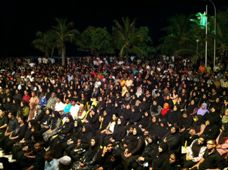
Addressing a capacity crowd at artificial beach last night, former President Mohamed Nasheed said that Black Friday was the day that the Maldivian people started to believe that they could assert their will and power over the government.

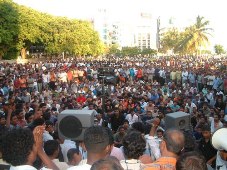
August 12, 13
Black Friday gathering

“It was the day when the Maldivian people found courage,” he said. “It was the day when the people started to believe that they could come out and reverse the autocratic rule of this country and eradicate torture and brutality.”

The former Amnesty International ‘prisoner of conscience’ paid tribute to the hundreds of demonstrators and reformist MPs arrested and beaten by the former National Security Service (NSS) on August 13.

Nasheed urged reformists to “continue the journey” begun on August 12 and 13 with the lessons of the past eight years, vowing not to stop the fight “until true freedom and independence is established in this country.”

The hopes of the Maldivian people for a better future was “tied to forming a civilised security forces,” Nasheed said, adding that everyone in the police and army were not “bad and ruthless people.”

It was MDP’s “duty” to work with numerous youth and experienced officers “of a national spirit” in the security services to reform the institutions, he continued.

Nasheed said he was “certain beyond doubt” that the Commission of National Inquiry’s (CNI) report would note that a number of mutinous officers of the security forces committed crimes and unlawful acts on February 7.

“After CoNI’s report, we should only go back home after bringing them to justice,” he said.

He added that the nation could not be held as the “spoils of war by a few police and army officers.”

‘The hidden baton’

Speaking at the rally, former Male’ MP and first president of MDP, Ibrahim ‘Ibra’ Ismail, argued that the “biggest success for the people” on August 12 and 13 was to show the outside world as well as the Maldivian people “the culture of brutality concealed by Gayoom.”

“The hidden baton” was made exposed through the efforts of reformists, said Ibra, which was put away after Gayoom’s election defeat only to be brought out again on February 7, 2012.

“This is not something the Maldivian people will accept. You cannot tie the tongues of the Maldivian people again. Today, the Maldivian people no longer fear that baton,” he said.

In a video message aired at the rally, Naushad Waheed – brother of President Mohamed Waheed Hassan Manik – spoke of torture in jails during President Gayoom’s 30-year reign.

Naushad, former deputy high commissioner to the UK, warned that those in power would not willingly relinquish it regardless of the conclusions of CNI’s report, urging MDP to remain vigilant and within legal bounds.

Former Special Majlis MP Mohamed ‘Nafa’ Naseem meanwhile said that the reformists drew courage from the months spent in Dhoonidhoo detention island following the crackdown on August 13.

“If I remember correctly, more than 300 people were put in jail for a long period,” he said. “I never saw anyone cry out of fear. Everyone was smiling. [We] crossed the threshold of fear.”

In a video interview, Mariyam Manike – mother of Evan Naseem, who was beaten to death in Maafushi prison on September 19, 2003 – recounted her treatment at the hands of NSS officers after her arrest outside her residence on August 13.

Manike said she was beaten by NSS officers after being taken to the main army barracks and was kept for hours with her hands cuffed behind her back.

NSS officers threatened to kill her while one officer told her that “this is the handcuff your son was wearing when we killed him,” Manike said.

Likes(0)Dislikes(0)