Adhaalath Party enters coalition agreement with resort tycoon’s Jumhoree Party

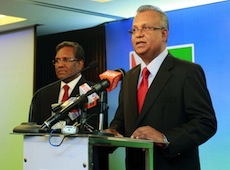
The religious conservative Adhaalath Party (AP) has declared it has entered into a coalition agreement with resort tycoon Gasim Ibrahim’s Jumhoree Party (JP).

The AP recently severed its coalition agreement with President Mohamed Waheed, following his remarks to the AFP newswire that it was “better to work with” the self-claimed Islamist party, despite suggesting some elements in the party held “extreme views”.  He told media at the time that excluding the party from mainstream politics risked marginalising its members, having a “negative long-term effect”.

In a statement announcing its new coalition partner, the AP praised Gasim’s campaigning for the 2013 election and said it believed the presidential candidate was “the person most capable of defending the country from foreign influences, to safeguard the country’s highest of priorities, and that he is capable of working in an independent manner.”

Local news outlet Sun Online observed that the AP had similarly allied with the JP ahead of the 2008 presidential election, noting that the party’s then spokesperson and current Minister of Islamic Affairs, Sheikh Mohamed Shaheem Ali Saeed, had qualified the alliance on the grounds that “a person capable of controlling four wives is more than capable of controlling the country.”

Following its departure from Waheed’s ‘Forward with the nation’ coalition last week, the Adhaalath Party was reported to have been in talks with the Progressive Party of the Maldives (PPM).

While the extent of the Adhaalath Party’s electoral support in the coming elections is uncertain (the party received 0.9 percent of the votes in the 2009 parliamentary election), its numbers make up the bulk of the ranks of the Ministry of Islamic Affairs and it remains a loud voice in Maldivian politics.

Independent MP Ibrahim Muttalib, while not elected as an Adhaalath MP, has since declared association with the party. His bills have included motions calling for a blanket ban on the sale and import of pork and alcohol in the Maldives, a luxury tourism destination with an economy dependent on over 100 resorts targeting the lucrative UK, German, French and Russian markets.

Gasim Ibrahim meanwhile remains one of the country’s single largest importers of alcohol, with customs records for 2011 showing his Villa Hotels chain – including the Royal, Paradise, Sun, and Holiday Island resorts – importing approximately 121,234.51 litres of beer, 2048 litres of whiskey, 3684 litres of vodka and 219.96 kilograms of pork sausages annually, among other haram (prohibited) commodities restricted to ‘uninhabited’ islands.

The Adhaalath Party also endorsed a flogging sentence given in February to a 15 year-old rape victim found guilty of a separate fornication offence, on the grounds that “if such sinful activities are to become this common, the society will break down and we may become deserving of divine wrath.”

After an Avaaz petition calling for the repeal of the sentence reached more than two million signatures – double the country’s annual tourism arrivals – Waheed’s administration pledged to appeal the matter. The case remains stalled in the High Court.

Gasim in March 2013 complained he had lost US$16 million as a result of a selective tourism boycott, orchestrated he claimed by his political rivals the Maldivian Democratic Party (MDP).

While in coalition with Waheed, the Adhaalath Party also notably clamped down on singing and dancing, including requesting in April 2012 that the Education Ministry cancel the Maldives’ inter-school singing competition on the grounds that singing was haram in Islam.

Gasim was meanwhile heavily critical of the MDP’s recently-launched youth policy, titled ‘Entertainment without fear’, accusing former President Nasheed of being a “monster” guilty of “every despicable act ever to be found in the world”.

“He doesn’t understand what the law says, so a crazy person like him may say that he would give the opportunity for people to limitlessly entertain themselves. Look, it is not something Allah has given us human beings,” Gasim declared.

Likes(0)Dislikes(0)

Nasheed announces former university chancellor Musthafa Luthfy as running mate

Former President Mohamed Nasheed has announced Dr Musthafa Luthfy as his running mate in the September 2013 elections.

Maldivian Democratic Party (MDP) Spokesperson Hamid Abdul Ghafoor confirmed the announcement, made at a meeting of the party’s national executive committee this morning.

One of the conditions Dr Luthfy had agreed to, Ghafoor said, was that if Nasheed was elected President and later “killed or incapacitated”, Luthfy would declare an election.

“Nasheed discussed the choice with the national council, but it believed the choice should be left to Nasheed,” Ghafoor said. “The general opinion was that the person should be faithful, a party member, totally in support of the party’s manifesto, and not necessarily an expression of who the next president would be.”

He noted that Nasheed during a previous committee meeting had narrowed the choice to what he described as a “religious person, a military person, and a development person. In our context, these are very relevant [themes].”

Development person

Dr Luthfy served as Education Minister during Nasheed’s administration, initially appointed to the post under a coalition agreement with then-Vice President Dr Mohamed Waheed’s Gaumee Ithihaad Party (GIP), alongside Economic Development Minister Mohamed Rasheed.

One of the founding members of incumbent President Dr Mohamed Waheed’s GIP, Dr Luthfy joined the Maldivian Democratic Party (MDP) following its acrimonious split with GIP in 2010.

The MDP severed the coalition agreement after GIP leader and then-Vice President Mohamed Waheed’s publicly criticised the government on an opposition-aligned media outlet.

Rasheed was ejected from the government following the split, while Luthfy remained in the post of Education Minister until the mass dismissal of Nasheed’s cabinet by parliament in late 2010. He was subsequently appointed as the first Chancellor of the Maldives National University, resigning from the post in protest against Dr Waheed’s controversial ascension to the presidency in February 2012.

Education reformist

As Education Minister, Dr Luthfy was among the first to flag the country’s low O-level pass rate as the source of many social challenges facing young people, such as high levels of unemployment and lack of both tertiary and vocational education opportunities.

“When students finish Grade 10, and when they do not have many other avenues to go to for education, they remain in society and have two years before they become adults at 18 years. So they have two years of not being able to get a job, and this is also a crucial period in their physical development,” Dr Luthfy told Minivan News, in an extensive 2010 interview.

“During this time they are not in a school and due to this I think there will be negative impact on their behaviour and also on society. We are trying to keep students in the system until they are 18. We can do that by diversifying our curriculum – some can do A-Level, some can go for other programmes such as foundation and certificate level courses, and through that proceed to higher education,” he said.

Luthfy and his successor, Shifa Mohamed, presided over “mega reform” of an education sector which had last been revised in 1984, overseeing an increase in the O-level pass rate from 27 percent in 2009 to 32 percent in 2010, and 37 percent in 2011. In 2012, the pass rate leapt to 46 percent.

Some proposed reform attracted controversy, and was quickly exploited for political leverage by the government’s opponents.

One of these was the proposal to make Islam and Dhivehi optional subjects at A-level, which became a wedge issue with the MDP’s remaining coalition partner, the religious conservative and nationalistic Adhaalath Party (AP).

A-Level students typically study between four to five subjects. Some university prerequisites demand as many as three or four subjects, particularly for university-level science courses. Luthfy had suggested that making the subjects optional would give A-level students greater ability to pursue careers of their choosing, and become “world citizens”.

Speaking to Minivan News in 2010, he justified the Education Ministry steering committee’s recommendation as opening many more doors for students to seek tertiary education, stating that it would “give students many different subject options, so they are not forced to take some subjects – rather they have the freedom to choose whatever they want.”

Religious groups and the Adhaalath Party seized the issue as an assault on national identity and evidence of the government’s supposed irreligiousness, a point of view disputed by Dr Luthfy.

“I think there is a certain group of people who actually think that it is their responsibility and their duty to safeguard Maldivian culture and Maldivian religion, and that others are not treating this fairly,” he told Minivan News at the time.

“But in fact we, as the educationalists, we are also taking care of our culture and religion and trying to train our students to become world citizens, rather than narrowing their perspective. That may be one of the reasons why they have suspicions that we are not trying to do justice to the religion or language [of the Maldives], and that is obviously untrue. Whether the subjects will be optional or not, we will revise them, and the curriculum, and we will train our teachers to teach these subjects in a better manner.”

Adhaalath-aligned MP Ibrahim Muttalib – who had previously sought the total elimination of alcohol from the tourism dependent economy – levelled a no-confidence motion against Luthfy over the issue in June 2010.

The day before the vote was due to be held Nasheed’s entire cabinet resigned in protest over what they termed the “scorched earth politics” of the opposition-majority parliament.

Nasheed subsequently re-appointed the ministers, however the constitutional requirement for newly appointed ministers to receive parliamentary approval ultimately led to the mass dismissal of all but five members of Nasheed’s cabinet later that same year. Luthfy was among the seven ministers dismissed, but was soon after appointed the first Chancellor of the newly-opened Maldives National University.

Likes(0)Dislikes(0)

President Waheed and running mate Thasmeen to contest elections as “independent pair”

President Dr Mohamed Waheed and his running mate Dhivehi Rayithunge Party (DRP) Leader Ahmed Thasmeen Ali will be competing in the September’s presidential election as independent candidates.

Waheed announced today (July 16) his intention to officially register with the Elections Commission (EC) as an independent candidate, despite heading the Gaumee Ithihad Party (GIP) and leading the ‘Forward with the Nation’ coalition.

The coalition backing Waheed’s and Thasmeen’s bid for election in September currently includes the government-aligned Dhivehi Rayyithunge Party (DRP) and the Dhivehi Qaumee Party (DQP), in addition to the GIP. However, several key members of DQP have since defected to the Progressive Party of the Maldives (PPM), while DRP leader Thasmeen was recently taken to court by a series of creditors.

Waheed told local media during a press conference held in the President’s Office today that he would be contesting the election as an independent candidate, since “certain parties” have questioned GIP’s legitimacy and the Supreme Court has not yet ruled on the dissolution of political parties with less than 10,000 members.

“If I decide to compete as a party candidate before the matter is decided [by the Supreme Court], it will be questioned. There are people trying to bar me from competing. I will not be the one to get caught in that trap,” said Waheed.

Candidates unaffiliated with a political party are required to submit signatures of at least 1,500 supporters with their official candidacy application, according to local media.

“So I intend to take the form and go on the streets. I will visit houses, carrying the form, during the next two days and ask those who wish to see me remain in this post for another term to sign,” Waheed explained.

Investigations are currently underway into 46 cases of fraudulent political party enlistment filed by the EC, as well as another case individually lodged, Police Chief Inspector Abdulla Shatheeh told local media. Some of the people signed up to the party were alleged to already by deceased at the time of their registration.

The fraudulent political party forms are said to include 15 people signed to President Waheed’s GIP, five from his DRP running mate Thasmeen, and 27 from prominent businessman and MP Ahmed Siyam’s Maldives Democratic Alliance (MDA).

The Maldives Police Service has recently said it is experiencing “difficulties” investigating the 47 cases of fraudulent enlistment, with “no way” to hold the respective political parties accountable.

“No other legal way”

“Now Waheed is working as a coalition president, however the Constitution doesn’t allow a coalition president to be nominated or contest as a presidential candidate,” ‘Forward with the Nation’ Coalition Spokesperson Abdul Rasheed Nafiz told Minivan News today.

“There are two options; President Waheed has to apply through a political party or as an independent candidate,” said Nafiz. “There is no other legal way to become a presidential candidate.”

“Now because he is in a coalition with other parties – which work as one under the brand name ‘Forward with the Nation’ – he doesn’t want to say he’s president of GIP only,” he continued.

“In that case, he would have to use the GIP logo on campaign materials, etc, so this was the only solution,” he added.

Nafiz noted that Waheed had mentioned his intention to run as an independent candidate “a long time ago” and that his coalition partnerships would not be negatively affected by the decision.

“The strongest part of the coalition is Dr Waheed, and the coalition partners remain with us and public support is also the same as before,” said Nafiz.

“There is no problem even though Adhaalath has left the coalition, as they [are still] part of the government. They have said that although their leader has decided to leave [the coalition] they will support President Waheed as a candidate,” he added.

Earlier this week the Adhaalath Party (AP) withdrew from ‘Forward with the Nation’, a day after the party slammed Waheed for telling the AFP newswire that the party had “extremist” individuals. The party left the coalition citing “mysterious events” as well as the coalition’s prospective inability to succeed in “saving the nation” from former President Mohamed Nasheed’s “sacrilegious actions”, AP President Sheikh Imran Abdullah told local media at the time.

Waheed will be conducting his social policy launch on Thulusdhoo Island in Kaafu Atoll tonight, noted Nafiz. He has also announced the coalition’s health, education, and youth policies.

“As the ruling coalition, they have shown they have the capacity to rule the country with opposition parties,” said Nafiz. “Waheed has proved that he has brought peace, order and done good work to improve the economy.”

Meanwhile, DRP Parliamentary Group Leader MP Dr Abdulla Mausoom told Minivan News that Waheed’s running mate will also be registering as an independent candidate.

“Of course Thasmeen is the leader of DRP, but in the presidential campaign he will be running as an independent,” said Mausoom.

“There is no slot to represent DRP because he is Waheed’s running mate. They are an independent pair,” he continued.

Mausoom noted that although Waheed made the announcement today, the decision was made previously and that there is “no change at all” between DRP’s relationship with the coalition.

“It not a surprise at all, this was discussed,” said Mausoom. “The coalition leaders have an agreement.”

“This is how the coalition wanted to go, it’s the way it is and it’s the right way forward,” he continued.

“It is a coalition of political parties and individual people,” he added.

“The DRP coalition with Dr Waheed will give people an alternative vote, an opportunity other than [former President Maumoon Gayoom’s] 30 years or [former President Mohamed Nasheed’s] three years,” he declared.

Eailer this week EC announced it will open the opportunity for presidential candidates to formally file their candidacy at the commission to contest in the presidential elections, from July 22 until July 24.

The Adhaalath Party President Sheik Imran was not responding to calls at time of press.

Likes(3)Dislikes(0)

President Waheed obstructing decentralisation, failing to deliver pledged concessions: LGA

Local Government Authority (LGA) Vice President Sujau Hussain has claimed that President Mohamed Waheed Hassan Manik’s government has failed to extend any of the concessions previously pledged and is obstructing decentralisation, reports local media.

Waheed promised atoll and city councils 50 percent of the leases from atoll stores as well as 50 percent of the leases given under ‘varuvaa’ (islands given to individuals for caretaking) to increase the income of councils.

“While Waheed claims he wants to implement decentralisation, the only thing he does is to further obstruct those activities which the councils are already in a position to carry out,” Hussain said during a conference held to mark two years of decentralisation.

Waheed noted in February that the government had used a “major amount of income from the public accounts”, so he would arrange for next year’s government budget to address the issue and recover the funds, according to local media.

Likes(0)Dislikes(0)

Alert issued after migrant construction worker dies of dengue in Male’

The Maldives Health Protection Agency (HPA) has issued a dengue fever alert, following the death of a foreign migrant worker and the hospitalisation of two children for hemorrhagic dengue fever in Male’, with the HPA and World Health Organisation (WHO) emphasising that construction workers are particularly at risk.

Dengue is transmitted by the bite of an Aedes mosquito infected with any one of the four dengue viruses. It occurs in tropical and sub-tropical areas of the world, including the Maldives, which only has two strains of the virus. Though the Maldives holds South-East Asia’s record for being malaria-free, since 2004 the country has been battling a growing epidemic of dengue fever annually with nearly a 1000 reported cases and three deaths annually.

The year 2011 saw quite a severe outbreak of dengue in Maldives – though far below the 2788 cases recorded in 2006, the worst year ever for dengue in Maldives, according to the WHO. Fatalities reached 10 in 2006 and 12 in 2011 – a record high in the country’s history. While in 2012 there were a total of 1083 dengue cases in the Maldives.

Between January 1 and July 13 of this year, a total of 256 cases of dengue have been reported, with 90 in Male’ and 166 in the atolls, while dengue hemorrhagic fever accounts for 16 of those cases, the Health Ministry’s HPA has noted.

“The HPA issued a general alert – the first one for 2013 – regarding dengue fever to raise the level of public awareness a bit,” HPA Epidemiologist Dr Aishath Aroona Abdulla told Minivan News today (July 15). “Since it’s Ramazan it’s very difficult to conduct normal activities, so we wanted to alert people early.”

“We are beginning to see a rise in reported cases, but starting in May [the beginning of the south west monsoon season] this is to be expected,” said Dr Aroona. “Generally dengue peak season is June to early July, so this year its coming a little later, which could be because of changing rainfall patterns.”

She explained that while one of the dengue virus strains found in the Maldives is not fatal, the hemorrhagic strain is life threatening.

“The hemorrhagic variety is usually found in the Atolls, however people are getting sick from that strain of the virus in Male’,” explained Dr Aroona.

“Unfortunately one person, a foreign construction site worker, already died from the hemorrhagic strain [of dengue],” she continued. “He was in the country for about 15 days, according to the report we received.”

“Construction workers and people living near construction sites are at very high risk [for contracting dengue],” she noted.

Dr Aroona explained that when the sites are abandoned or the owner is not there, no one takes responsibility to ensure standing water or items that could collect water are removed.

“It’s important for the owners – the government or private businesses – to get rid of the [standing] water at the sites,” she said. “If removing all the water is not possible, large areas can be filled with sand as an alternative.”

“[However,] the Male’ City Council (MCC) or Local Government Authority (LGA) can be contacted to help control mosquitoes in these areas,” she added.

Foreign workers at risk

“While any reports of dengue are not good, comparatively, dengue cases in 2013 are not something to think of as an outbreak,” WHO Representative Dr Akjemal Magtymova told Minivan News today.

“However, there has been an unfortunate case of death and a few individuals in critical condition,” she noted.

While the children have subsequently been released from the hospital, the death of one foreign migrant worker has highlighted the risk foreign construction workers face due to their lack of social safety net support.

With an abundance of active construction sites in Male’ and the lack of inspection and control of these sites to prevent and control mosquito breeding places, it is expected that vector borne diseases will continue to persist in the capital, the WHO has noted.

“This [HPA alert] relates to foreign migrant workers. The individual who died was only here for about two weeks and must not have had a social safety net support,” said Dr Magtymova.

“While Maldivians are generally aware of dengue fever, migrant workers need more information and support because they may not know about dengue or have a support network if they fall ill,” she added.

“There should be more forceful promotion of awareness materials,” emphasised Dr Magtymova. “Everyone needs to be vigilant and aware, we don’t want people in critical condition.”

The WHO is working with the Health Ministry to leverage resources and extend dengue awareness. Additionally, the WHO in the Maldives has been an active partner in all aspects of dengue prevention, control and management – including training of doctors and nurses in clinical management of dengue, technical support in surveillance and situational analysis, provision of supplies and support in health promotion activities both at national and local levels.

Prevention

The Aedes mosquito breeds in small clean water collections in and around the home, places where people live (e.g. rainwater collections, pots, wells, tanks, tires, gutters, etc.). This is why controlling mosquitoes is everyone’s responsibility, noted the HPA.

“The dengue carrying mosquito bites in the early morning and in the evening close to sunset,” said HPA’s Dr Aroona.

There are two primary ways to prevent the spread of dengue, the most effective being to remove breeding areas and also to protect against bites.

“In addition to standing water at construction sites, garbage areas are also prime breeding grounds, especially since only a small amount of water is needed for mosquitoes to lay their eggs,” Dr Aroona said.

“It is very important for people to keep their gardens and homes clean, by collecting cups, cans, and other items that collect water,” she explained. “It takes seven days for mosquitoes to hatch after the eggs have been laid, so cleaning at least once a week is essential.”

The HPA has highlighted additional preventative measures individuals can take to protect themselves and their families from contracting the disease:

  • Keeping windows and doors shut in the early morning, as well as covering air vents.
  • Not littering, including throwing trash into air vents – which is particularly problematic in Male’.
  • Covering any open tanks or wells and putting fish that eat larvae into them.
  • Adding a little soap or salt to water to prevent eggs from being laid in planters, or they can be covered with cotton wool.
  • Wearing clothes that cover the arms and legs.
  • Using mosquito nets and screens.
  • Using sand to fill areas that collect standing water.

Seek medical attention

“Although individuals can develop a lifelong immunity after recovering from dengue, they are only immune to that particular strain and are still at risk of infection,” explained Dr Aroona.

Dengue symptoms appear three to 14 days after the infective bite.

The fever is typically high grade, above 38oC (101oF) and continuous. The fever may not disappear even after taking paracetamol, although paracetamol may reduce the fever to some extent, noted the HPA.

Other accompanying symptoms are headache, body aches, backache and joint pains, and sometimes a transient rash or reddening of skin.

Symptoms of simple viral fever generally last less than 3 days. Dengue fever, a more severe form of viral fever caused by the dengue virus may last slightly longer, between three to five days, and may be accompanied by more severe symptoms like vomiting and fatigue, particularly when the fever begins to subside, the HPA has highlighted.

If an individual has a fever, the HPA recommends rest, drinking coconut water, oral rehydration solution, fruit juices, milk or any home-based drinks, and only taking paracetamol – not other medication which can lead to bleeding.

“Fever is an important part of your immune reaction to the virus in your body, and helps to kill the virus. So you need not be alarmed, so long as you do not have any of the warning signs or danger signs,” stated the HPA.

The HPA has urged people to seek immediate medical attention if the fever lasts more than three days, or any warning signs of hemorrhagic dengue are present, which include:

  • Continuous vomiting and an inability to take fluids by mouth
  • Severe pain in the abdomen
  • Difficulty breathing
  • Not passing urine for more than six hours
  • Cold hands and feet
  • Bleeding from the nose or gums, vomiting blood, or black, tarry faeces
  • Changes in behaviour, such as lethargy or drowsiness, often with inability to stand, sit up or get up from the bed; Restlessness or irritability (excessive crying in children, adults may have behavioural changes and use foul language)

The Epidemiology and Surveillance Unit of the Health Protection Agency is conducting weekly monitoring of dengue nationwide and is issuing weekly reports.

Likes(3)Dislikes(0)

Police arrest man who stole, swallowed MVR 4500

A man who allegedly stole and swallowed MVR 4500 (US$292) after breaking into a house in Hulhumale on Saturday evening has been admitted to hospital after his condition deteriorated.

According to police, two men aged 19 and 26 were arrested at around 5:45 on Sunday morning after police received reports the pair had robbed two apartments on Hulhumale’.

When police arrested and searched the pair they discovered a Samsung S3 mobile phone and a laptop that had been reported missing from the apartments.

One of the men was taken to Hulhumale hospital after he informed police that he had swallowed MVR 4500.

The currency was confirmed to be present in the man’s stomach by hospital staff following an x-ray.

According to local media reports, the man has since been transferred to Indira Gandhi Memorial Hospital (IGMH) after his condition worsened, despite regurgitating MVR 800 (US$52).

Likes(0)Dislikes(0)

Letter: Appeal for right to a lawyer

Allow me to introduce myself. I am a member of the Writers’ Bureau of Manchester UK.

Even before the Maldives Democratic Party (MDP) was officially recognised by the Maldivian government I was actively involved in trying to promote democracy in the Maldives.

Once we were able to topple the 30 year dictatorship of Abdul Gayoom through the ballot box the MDP was able to rule for three years before we were deposed by the military.

Now I find I am back on top of the persecution list by the government.

About a month back I was pulled in on a drugs charge. At the hearing I told the judge that he cannot ask the police investigative officer to take an oath – with the Holy Quran as witness – as the said police officer had not attended the scene of the crime. He was parroting second hand information supplied by others.

This made the judge so mad he called me into court to begin proceedings of a case dating back almost five years. Apparently five years ago the police had found a small pen-knife with remnants of cannabis. According to a local lawyer, this could get me a 15 year sentence.

I told the judge I was prepared to answer the charges once I was given my legal rights. A Maldivian citizen is entitled to legal counsel by law. I appealed for the state to provide me with a lawyer.

The judge refused. He stated that it was only where high profile cases were concerned that the state provided lawyers. I pointed out that according to the Maldivian constitution that all citizens are equal before the law.

I have a hearing on the 18th of this month and despite what the constitution says, I doubt the state will provide me with a lawyer because at present almost 90 percent of those facing trial are deprived of legal counsel.

I would very much appreciate if Amnesty would do their best to lend me a helping hand in countering the judiciary’s autocratic methods. The judiciary in the Maldives is a remnant from the dictatorship of Abdul Gayoom’s 30 year reign.

Yours truly

Ali Rasheed

All comment pieces are the sole view of the author and do not reflect the editorial policy of Minivan News. If you would like to write an opinion piece, please send proposals to [email protected]

Likes(0)Dislikes(0)

Former President Nasheed granted Saudi visa for Umra pilgrimage

Former President Mohamed Nasheed has been granted a visa to visit Saudi Arabia to conduct an Umra pilgrimage, reports local media.

The Saudi Embassy in Sri Lanka requested Nasheed ‘hand over’ his passport for visa processing and the request has been forwarded to the former president’s office, said State Foreign Minister Hassan Saeed.

Parliament Speaker Abdulla Shahid and former Attorney General Ahmed Ali Sawad have also been granted visas, according to local media.

Likes(0)Dislikes(0)

Torture victims require redress, thwarted by institutionalised impunity

Maldivian victims of systemic and systematic torture that has been occurring for decades have yet to find redress, while the legacy of wide-scale human rights violations continues to be perpetuated by state institutions due to institutionalised impunity, government, state institutions and civil society organisations have said.

The Human Rights Commission of the Maldives (HRCM) has confirmed it is investigating three recent cases of detainees being tortured by Department of Penitentiary and Rehabilitation Services (DPRS) officers while in the Custodial Reception and Diagnostic Centre (Male’ Jail).

Officials from the HRCM visited Male’ Jail June 2, 2013 after the family of a detainee informed the HRCM on May 31, 2013 that the victim had been beaten by DPRS officers.

In March this year local media reported that the HRCM was investigating allegations of torture in Male’ prison, however due to authorities “not cooperating” with the investigation the HRCM team was forced to visit Maafushi Prison instead.

In response to the allegations, DPRS Commissioner Ahmed Shihan told CNM that thus far no warden was found to have been involved in the torture of detainees and if a prison warden was found to have acted unlawfully, action will be taken against the officer.

“We will keep monitoring to ensure that all wardens act according to the law,” said Shihan.

In May 2011, former Prisons Division Head of the DPRS Isthafa Ibrahim Manik was detained and questioned by police, after disturbing photographs of tortured victims in custody were obtained by the – now dissolved – Presidential Commission and leaked to the media.

While instances of Maldivians in state custody suffering human rights abuses remains problematic, it is symptomatic of a long standing history of torture that has yet to be remedied or seriously addressed.

“It is quite worrying that we keep hearing about accounts of torture in custody. These recent accounts are an indication of the consistence and continuing abuse in custody,” Maldivian Democracy Network (MDN)’s Executive Director Humaida ‘Humey’ Abdulghafoor told Minivan News yesterday (July 13).

“There is systemic and systematic abuse of detainees [in the Maldives], therefore the practice of torture is unlikely to just disappear over a short period of time,” she emphasised.

While the HRCM’s national preventative mechanism should protect people from the state committing human rights violations, Humaida believes this mandate has been inactive and not working effectively.

“The HRCM has a national preventative mechanism that legally obligates them to ensure mistreatment of prisoners is prevented from happening in jails,” she said.

“Monitoring and oversight is very important because of the history we have, but this mechanism is not working effectively,” she added.

Given the physical and psychological harm torture victims suffer that “cannot be dissociated”, supportive mechanisms that account for this trauma need to be established for Maldivians, explained Humaida.

“There must be an enabling environment for victims to come forward, which doesn’t seem to be there,” she said.

“Many families and victims are afraid and not willing to talk or report these violations because they feel intimidated [by the state] given the risks of revictimization and possible harassment,” she continued.

“Things on the surface may appear quiet, however that doesn’t mean everything is good,” she noted.

Humaida explained that without an enabling environment for victims to report the human rights abuses they have suffered, there is subsequently a lack of documentation and enquiries that would ultimately identify the root causes and/or perpetrators of torture in the Maldives.

“It is impossible for HRCM to know how this torture is happening without proper documentation and enquiries,” she said.

“The Torture Victims Association (TVA) is the only organisation doing such work,” according to Humaida. “The TVA [also] submitted torture victims’ testimonies to the HRCM February 6, 2012, which the victims were able to provide because they no longer felt afraid.”

“A report [by TVA and international NGO Redress] about ill treatment of prisoners was submitted to the HRCM in July 2012, containing the most concrete evidence produced regarding torture occurring while in detention,” she continued.

“Victims’ testimonies were also presented to the UN Human Rights Committee [July 2012 in Geneva], which made recommendations that the Maldives has not yet implemented,” she added.

Reports that included testimonies of police brutality, in addition to torture and ill-treatment of detainees in jail, were presented during the meeting held in relation the to International Convention on Civil and Political Rights, which the Maldives is a signatory.

It has been over a year since the reports were submitted and Humaida cited the “inactivity and apathy of authorities” as a possible reason there has not been any action to redress these past, wide-scale instances of torture.

“I’m very surprised the HRCM has not given updates on how these investigations are proceeding,” she said.

“[Additionally,] while they used to visit prisons regularly and produce reports, that is not something they seem to be doing anymore, which is also a concern,” she added.

HRCM mandate limited

The HRCM mandate specifies that the commission’s focus should be on incidents post-2000, however there is a clause that does allow investigations of past human rights violations if a case is “serious enough”, HRCM Vice President Ahmed Tholal explained to Minivan News yesterday (July 13).

“Torture occurs when state authorities function with impunity, which does not produce a society that is respectful toward human rights,” said Tholal.

He explained that the HRCM is coordinating a strategy to holistically approach past human rights violations on a wider scale.

“We have discussed as a commission how to address human rights violations on a wider scale and how to approach cases to systemically root out torture,” Tholal stated.

“It is very important to ensure absolvement of that feeling [state authorities function with impunity] amongst the people,” he continued.

“The Maldivian people need some sort of redress and closure,” he added.

In regard to the accounts of torture submitted to the HRCM last year by TVA and Redress, Tholal explained that if a human rights violation has occurred then the HRCM looks into the issue on a case by case basis and that allegations of torture submitted by the organisations are currently under investigation.

“We are currently looking into the complaints of each victim [from the reports]. However, some information and evidence is hard to come by,” said Tholal. “For example, we are not able to contact the actual people directly, we have to seek their contact information from the organisation. But we are trying to move as fast as we can.”

Institutionalised impunity

Meanwhile, the Commonwealth Ministerial Action Group (CMAG) was given an update on the current human rights situation in the Maldives this past April, by MDN in collaboration with the International Federation for Human Rights (FIDH).

The brief noted that while some steps have been taken in the past decade to reform institutions and investigate allegations of human right abuses, including torture committed by the security services, limited mandates, a lack institutional will, and senior officials publicly dismissing these concerns has prevented redress.

“A culture of impunity has been institutionalised for perpetrators of past human rights violations that… encourages the security forces to disregard the rule of law and commit further human rights abuses in impunity,” stated the brief.

In September 2012, FIDH released a report detailing the human rights situation in the Maldives, titled “From Sunrise to Sunset: Maldives backtracking on democracy”.

FIDH noted that the government of President Mohamed Waheed Hassan Manik has been accused of a wide range of human right violations, including violent harassment of street protesters, torture and harassment of pro-opposition media as wells as legal and physical harassment of the opposition.

“Practices to silence political dissent that had disappeared in the course of Nasheed’s presidency, have once again become prevalent under Mohamed Waheed’s presidency,” said FIDH.

Police station and prison torture

There are many accounts of the systematic and sustained use of torture within the state’s prisons and police stations perpetrated by military personnel, police, coast guard, and prison officers, according to the Redress/TVA report which included accounts of individuals who allege that they were tortured or ill-treated during former President Maumoon Gayoom’s regime between 1978-2008.

“Most victims were initially tortured or ill-treated during interrogation and questioning, either at police stations or at various detention centers,” stated the report. “Torture and ill-treatment continued in prisons and detention facilities, typically as a form of intimidation and punishment.”

“But until now, the victims of such treatment have not been provided with any justice for what has been done to them. Despite accepting that torture and ill-treatment occurred on a wide scale, the Maldives is yet to address its legacy,” the report noted.

The findings highlighted that “While there was no apparent limit to the forms of torture and ill-treatment used, many were quite specific to the island environment.”

Torture and ill-treatment of detainees was often inflicted outside the prison buildings, and guards appear to have been given free range to use whatever methods they choose, including: beatings, burning, being tied to palm trees, the use of high-pressure hoses, the use of stocks and other painful restraints as well as suspension, near drowning, being restrained and covered in sugar water to attract ants, subjection to noise and sleep deprivation, sexual abuse and sexual humiliation, etc., the report found.

The government of Maldives previously acknowledged that the use of torture was systematic in the country, as stated in its Universal Periodic Review report to the UN Human Rights Council in 2010.

However, current government officials deny torture and ill-treatment of detainees is problematic, and claim that human rights reports conducted by civil society organisations are subject to political bias in favor of the Maldivian Democratic Party (MDP).

Meanwhile, former President Mohamed Nasheed – a previous torture victim himself – pledged to institute structural changes to reform police and military institutions upon his re-election in September, during an MDP function held at the JW Marriott Hotel in Kuala Lumpur, Malaysia July 13.

The Department of Penitentiary and Rehabilitation Services (DPRS) and Maldives Police Service (MPS) had not responded to enquiries at time of press.

Likes(3)Dislikes(0)