Canada condemns Maldives govt’s “politically motivated threats to arrest its opponents”

Canada’s Minister of Foreign Affairs John Baird has issued a statement expressing “deep concern” over ongoing political tensions in the Maldives, in particular the government’s “politically motivated threats to arrest its opponents.”

As Canada’s foreign minister, Baird is a member of the Commonwealth Ministerial Action Group (CMAG), the international body’s democracy and human rights arm that suspended the Maldives following the controversial transfer of power on February 7, and was behind the strengthening of President Mohamed Waheed’s Commission of National Inquiry (CNI).

“It is clear that the arrests of senior officials of the Nasheed government are politically motivated. Such actions are completely unacceptable and must be reversed,” Baird stated.

“The threats of the present government to arrest its opponents, including former President Nasheed – the only democratically elected president in the last four decades – so as to prevent his candidacy, undermine that government’s credibility and violate its undertakings to the Commonwealth Ministerial Action Group. They also fly in the face of the core Commonwealth values of democracy, human rights and the rule of law,” Baird stated.

“The Maldives has been given the benefit of the doubt by the Commonwealth so far. Continued intimidation, illegal arrests and other authoritarian tactics by the present government may require the Commonwealth to consider a different approach, in our view.”

Nasheed was today ordered to attend police headquarters on August 2 concerning comments made during a tapped phone conversation released by police last week, in which the former President states “I think we need to fight back [against police].”

The government’s actions were, Baird said, “further evidence of the need for early elections, as Canada has repeatedly urged. These disputes must be settled, and the will of the people must be heard.”

“In order to safeguard the important democratic progress made in recent years, an inclusive political solution is critical to the future of Maldives. Canada will continue to work with the Commonwealth Ministerial Action Group to push for greater respect for democratic values.”

Canada’s statement on the state of the Maldives is among the most strongly-worded issued by another nation following the political turmoil of February 7, with the exception of Timor Leste (East Timor).

Nobel Peace Prize recipient and President of Timor Leste, José Ramos-Horta, issued a statement on February 21 condemning “the ousting under military pressure” of President Mohamed Nasheed in an ““obvious” coup d’état.

“It should be of concern to the World that extremist elements abusively invoking Islam were instrumental in stirring up violent demonstrations, religious intolerance and social upheaval as the coup d’état set in motion,” Ramos-Horta said at the time.

“Therefore, it is all the more strange and unsettling the silence with which big powers and leading democracies respond to the undemocratic developments in the Maldives. It has been a sad day for democracy in the Maldives and beyond.”

President’s Office Spokesperson Abbas Adil Riza said the Canadian Foreign Minister’s statement was “based on misinformation” as “no arrests have been made and all political opponents are free to conduct their protests every day.”

Riza suggested that the statement was based on information “received only from one side”.

As for the suggestion of a “different approach” by the Commonwealth, Riza said the government was “very much engaged” with the international body, and that Baird’s was “one isolated view” that the Maldives Foreign Ministry would look into.

“We met with several [international] authorities while in Geneva and the Maldives is not much of a concern [to them]. They welcome the work the government is doing regarding human rights and development,” Riza said.

According to tourism statistics 2243 Canadian tourists had visited the Maldives as of June this year, an increase of 4.5 percent on the same period last year.

Likes(0)Dislikes(0)

MPs Ali Waheed and Ahmed Mahloof facing criminal charges for obstructing police duty

Two former Dhivehi Rayyithunge Party (DRP) MPs Ali Waheed and Ahmed Mahloof are facing criminal charges for allegedly obstructing police duty during an opposition protest that took place in 2010.

Prosecutor General (PG) claimed that the two MPs entered a restricted area cordoned off by police during the night of March 25, 2010, near the former presidential residence of Muleaage, and had showed disobedience to the police officers in the area.

Both Mahloof and Waheed are facing charges under the article 75 of the Maldives Police Services Act.

During the first hearing held yesterday, after the charges were read to the defendant MPs, Mahloof requested the judge carry out the trial separately stating that although he and Waheed were once in the same party, times had changed and the pair now followed different political beliefs and parties.

However, presiding judge Abdulla Didi declined Mahloof’s request stating that the state had levied one charge against both him and his parliamentary colleague, and said that differing political beliefs was immaterial to the case that was being heard.

Meanwhile, Waheed stated that he was unclear about the charges pressed against him. He added that he was not someone who would ever confront police with arms and questioned whether it was only him and Mahloof that were there during the protests.

Responding to Waheed’s claims, the state attorney stated that the charges did not mention that Waheed had attempted to confront the police with arms, and also mentioned that others were involved.

The state prosecutors said they had decided to prosecute Waheed and Mahloof because they had obtained evidence supporting the charges.

Both Mahloof and Waheed requested to proceed with the trial after seeking legal counsel.

During today’s hearing, the judge questioned the state as to why the case had been delayed for such a long period. The state responded that the case had been earlier submitted but later withdrawn because the PG observed that there was a “lack of fairness” in sending cases to court.

Adjourning the session, Judge Abdulla stated that a date for the next hearing would be announced later and that the case would be scheduled at the earliest available date.

This is the second time the case has been forwarded to trial.

Earlier in November 2010 the case was sent to trial but the PG withdrew the matter, stating that police had failed to submit a case that involved then ruling Maldivian Democratic Party (MDP) activists entering the Civil Services Commission (CSC) office and harassing their staff.

The former government had criticised the PG following their actions, and claimed that the PG was politically-aligned instead of being impartial. In their defence, the PG stated that police had been sending cases involving [former] opposition politicians and while failing to send cases of MDP activists, which meant that the government was pressing charges that were politically motivated.

An official from the PG told local media today that the case had been re-sent along with the case involving MDP activists harassing CSC employees.

Concerns

With the trial to proceed, the now-opposition MDP has raised concerns stating that the case had lost its meaning because of the delay in prosecution.

In a statement, the MDP claimed that “Without considering the legal principle ‘justice delayed is justice denied’,  we would like to bring to notice that the state is prosecuting meaningless cases while more important cases remain unprosecuted, while others have already been dismissed,” read the statement.

MDP described the prosecution as a “series of attempts to hurt” its members after the MDP government was toppled on February 7.

Waheed, speaking to local media after the hearing, stated that he would not be threatened by such cases that the current government was pressing against him, and said he would “face the charges with courage”.

He also asked the PG to prosecute him for even “slightest” wrong he had committed.

“This prosecution is not just a prosecution levied against me, this is a prosecution that is levied against the 50,000 members of MDP and the majority of the citizens of Thoddu constituency,” he said.

Waheed further said that despite the efforts by the government to pressure him, he would not leave the MDP to support an illegitimate government.

Both Waheed and Mahloof were elected to parliament under the ticket of DRP.

However, following the split of the DRP into two factions, both Waheed and Mahloof chose to leave their former party and head to two different directions.

Mahloof joined the newly formed Progressive Party of Maldives (PPM), the party formed by the DRP members who supported former President Gayoom and opposed the DRP’s leader, MP Ahmed Thasmeen Ali.

Waheed defected to MDP and was later elected as the deputy parliamentary group leader of the party.

MDP Spokesperson Imthiyaz Fahmy was not responding at time of press.

Likes(0)Dislikes(0)

PPM’s rally: MDP protesters “dogs”, vow to put Nasheed “in solitary confinement”

Members of former President Maumoon Abdul Gayoom’s Progressive Party of the Maldives (PPM) have vowed to put ousted President Mohamed Nasheed “in solitary confinement”, at a rally held last night.

An approximately 300 PPM supporters arrived at 10:30pm to the Artificial Beach area, calling on the opposition Maldivian Democratic Party (MDP) to stop “attacking” the security services and bring peace to the streets of Male’.

Interim Vice President of PPM Umar Naseer, along with several council members of the party including MP Ahmed Nihan, Ahmed ‘Maaz’ Saleem and Deputy Minister of Transport Ahmed Nazim, led the rally.

Speaking during the rally, PPM council member Saleem said the party had been requesting the government bring an end to the MDP’s protesting for the last six months.

“One month after the transfer of power, we went and asked the government to put an end to the street activities but nothing happened. The second month we went, nothing happened. Third, fourth and fifth month we went but nothing was done. Now we have decided it is time we come out,” he said.

Saleem blasted the government of President Mohamed Waheed Hassan for not being able to “put down” Nasheed “and his 200 hounds”.

“We had to come out because the government has failed to do anything about ‘Keneryge’ Nasheed and the 200 dogs that are behind him. In each island there are five dogs like that. These dogs should be put behind bars,” Saleem said.

“I believe ‘Keneryge’ Nasheed is not behind the ruthless actions [against police]. Instead he is leading these violent attacks. What we know is that Nasheed’s family were the only people who attempted to bring about a coup d’état in this country,” he alleged.

Saleem claimed that Nasheed during his presidency had “done injustice” to the people, for which he should face trial.

Deputy Minister of Transport Ahmed Nazim, who spoke after Saleem, repeated calls for government to take action against MDP protesters and to bring peace to the streets of Male.

He also highlighted the party’s efforts to topple Nasheed’s government, and praised the patience of those who took to streets to “end Nasheed’s dictatorship”.

“When we come out to do something, we won’t back down. We proved that when we came out to bring Nasheed down, and we only stopped after bringing an end to Nasheed’s dictatorship,” he said.

“Now we have come out to put an end to all this. I assure you all, we will only stop after putting Nasheed in solitary confinement,” Nazim said.

Following Nazim’s speech, members of the rally gathered near Boduthakurufaanu Magu as hundreds of MDP protesters passed by.

Verbal confrontations took place between the MDP protesters and the participants of the rally. PPM members called the MDP protesters “ganjabo” (hash user) while the MDP protesters called back “golhaabo” (toddy thief) and “baaghee” (traitor).

With an apparently lower turnout than expected, MP Ahmed Nihan was observed calling people in the Artificial Beach area to gather closer and not confront the MDP protesters prior to his speech. Umar Naseer later reiterated Nihan’s calls.

MP Nihan, speaking in the rally after the situation had calmed down, stated that the party had come out to inform the government that they too had the power to take action against those who broke laws and jeopardised the peace and stability of the country.

Nihan also raised skepticism over the UNHCR report on the Maldives, questioning the UN’s motives and claiming that they had been silent over the recent “extremist attacks” on the Burmese Rohingya Muslims.

“Where is the UNHCR when our Muslim brothers in Burma are suffering? I challenge Nasheed to at least for once condemn those attacks,” he said.

Nihan described the day of Nasheed’s toppling as the new “victory day” for the Maldivian people, and vowed that he would not stop until Nasheed was brought in front of justice.

“I am saying this as the deputy chair of the parliament’s temporary committee set up to look into crimes that Nasheed has committed. I assure you we will thoroughly investigate what he has done in the last three years,” he said.

Nihan also claimed that Nasheed had used up to MVR 300 million (US$19.45 million) as money received from the state as privileges for a former president, which he alleged was not used in a proper manner.

“People laughed at me when I first proposed the bill of privileges for former presidents in 2009, but today it is Nasheed who is getting the most of it. Up until today, he has eaten MVR 300 million from the state as for privileges, but I am now considering putting an amendment to that law to bar him from that,” Nihan said.

He vowed he would propose an amendment to the act to make sure that the former president would only be eligible to receive state beneficiaries if he stayed within the law and “refrained from causing public nuisance”.

Toppling Nasheed was a “Golden Goal”

Speaking during the rally, Umar Naseer said that Nasheed knew that the current government could not be toppled from the streets.

“Mohamed Nasheed is very much aware that the government cannot be toppled from the streets. Umar Naseer knows how it can be done,” Naseer said.

Naseer said he succeeded in his work on February 7, which he had begun after Nasheed assumed presidency.

“I scored the golden goal and went home,” he said.

Naseer also promised that in a PPM government, the death penalty would be implemented.

“We will bring peace to this country, from Haa Alif atoll to Seenu Atoll. Here in the Maldives, people can’t murder others, they can’t stab people to death and they can’t rape women either. If they murder they would face death penalty,” he said.

He also followed Saleem in labeling MDP protesters as “animals”, and stated that after PPM takes over the presidency, “barking animals” will not roam the streets of Male’.

“Even former President Ibrahim Nasir drove away the asses and monkeys that were living in Male’. So for reasons concerning public health, some animals that ‘shout too loud’ will be not allowed to live in Male’ in a PPM government,” he said, in reference to the MDP protesters.

PPM announced that the rallies would continue every Saturday night throughout the month of Ramadaan.

Minivan News tried contacting Umar Naseer but he had not responded at time of press.

PPM “sick and in need of serious counseling”

Speaking to Minivan News regarding PPM’s rally, former Transport Minister and MDP National Council member Adil Saleem described actions of PPM members as “sick”, and the party in need of “serious counseling”.

“They just don’t get us. President Nasheed could be in jail but he will inspire every heart. The voice of freedom will only get louder,” he said.

Following the comments made about arresting Nasheed, Adil said that the PPM would “try anything at this moment”.

“I’ve been inside police headquarters and their detention centre. There is no proper police service now. So the possibility of a rogue element arresting him is possible. Later the service will have no option but to defend the actions of the rogue officers.  Anything is possible,” he said.

“My first arrest was the previous night near the Dhiraagu head office. They took me to the station and told me I was mistakenly arrested for sexually assaulting a female officer on the road. These officers were saluting us six months back,” he said.

He further said that he believed the rally was “a desperate act” by PPM, as international pressure grew.

“I don’t believe anyone who had associated him or herself with the coup and still has brains left would want to go on display at PPM gatherings, when all the pieces of the very clear puzzle are falling into place. I don’t believe they have much support,” he concluded.

Likes(0)Dislikes(0)

Broadcasting Commission President Badr Naseer resigns over government’s allegations of “negligence”

President of the Maldives Broadcasting Commission (MBC), Badr Naseer, has resigned after the government accused MBC of negligence following the murder of Lance Corporal Adam Haleem last week.

Attorney General Azima Shukoor had said that the MBC had failed to take disciplinary measures against opposition aligned Raajje TV, alleging Haleem’s death was a result of the station inciting violence against the security forces.

“Institutions that must take responsibility are not doing their job. [We have] to take action against them. The executive will conduct necessary legal work to take such action. We will submit this case to the Majlis. We are also ready to take necessary action through the courts,” she told state broadcaster Television Maldives (TVM) on July 23.

Naseer denied the allegations, claiming consecutive governments had expressed “no interest” in strengthening the MBC. Further, the government’s claims had increased public hatred towards the commission’s members to the point members were unable to walk on the streets, Naseer said in a statement published today.

“The government has shown no interest in strengthening the Broadcasting Commission, and this commission has now become the recipient of government and public hatred. I have been defamed in the process and hence, I do not see any reason why I should spend the rest of my life in this state of psychological and physical danger,” Naseer stated.

Tensions have been on the rise in Malé after Haleem’s death. The government has stepped up verbal attacks on Raajje TV and ousted Maldivian Democratic Party (MDP), pledging to take action against the two parties for “inciting hatred and violence” against security forces.

Police have said they will no longer cooperate with or provide protection to Raajje TV for broadcasting CCTV footage of some police officers, whom the station alleged were “caught on video” while they were stealing petrol from a motorbike parked in a small road in Male’.

The MBC has ordered Raajje TV to broadcast an apology over the report.

Although the MBC was established on April 4, 2011 as an independent state institution mandated with developing and regulating broadcast media, consecutive governments had not provided the necessary technical and human resource needs for the commission to function, Naseer claimed.

The MBC had asked successive foreign, transport and finance ministers for assistance, but had received little response, he added. Furthermore, new President Dr Mohamed Waheed Hassan had not responded to repeated requests for a meeting, Naseer said.

Despite countless requests for a media-monitoring system, the commission at present only had facilities to monitor four TV channels, but had no equipment to monitor content on radio channels, Naseer said.

He raised concern over the lack of a monitoring system, “because we know the importance and dangers of broadcast media given the direction Maldives is taking.”

He said 20 additional TV channels will be established in the Maldives before the next presidential election.

“Although the commission is independent on paper, we have to question how independent the commission can be when the commission’s budget is controlled by the Finance Ministry,” Naseer said.

Naseer defended the commission’s record, arguing that although commission members had worked from around a conference table, they had published several laws and broadcasting standards and ethics, and had taken disciplinary action against broadcast media when necessary.

Explaining his decision to resign, Naseer said: “Instead of harassment and political hatred from the public and government, I want a peaceful life more suited to my age.”

Naseer has worked in state media until he retired at 65 years of age. He was then appointed to MBC with unanimous support from the People’s Majlis.

International non-profit organisation, the committee to Protect Journalists (CPJ), has expressed concerns that press freedom was “deteriorating” under the present government of President Dr Mohamed Waheed Hassan.

“Reports of police brutality against journalists amid political chaos, and a vicious attack for writing about religious tolerance, are disturbing signs that the Maldives is backsliding on press freedom,” CPJ Senior Researcher Madeline Earp wrote on the organisation’s blog.

“[The president] must ensure that journalists are free to report if he wishes to distance himself from [Maumoon Abdul] Gayoom’s legacy and stabilise the nation for elections.”

Likes(1)Dislikes(0)

Finance Ministry orders government institutions to reduce budgets by 15 percent

The Finance Ministry has ordered all government institutions to immediately reduce their budgets by 15 percent, in a circular sent out by Minister Abdulla Jihad.

Independent and government institutions were in early June  instructed to reduce their budgets by June 20 and June 15 respectively.

According to Haveeru, only 14 of the 35 government offices met the deadline.

“Even though we have not received any complaints so far, they did express concern over reducing the budgets. Some offices will face difficulties. But we don’t have a choice,” Jihad told the paper.

In a statement, the Minister said that the state budget had to be decreased by 15 percent as income estimated for 2012 had fallen short of expectations.

Despite the order to cut budgets, a circular issued by the Finance Ministry on July 19 ordered all government offices to repay the amount cut from civil servant salaries from January 2010 to December 2012 by the former government, starting from July onwards.

The circular said the money should be paid monthly and not in a lump sum, and advised all institutions to pay the amount from the annual budget for wages. If the money in budget was not enough, the finance ministry advised the institution to cut the money from the budget allocated for other expenses.

The wage repayments, amounting to Rf443.7 million (US$28.8 million), has not been accounted for in this year’s state budget, contributing to a 27 percent budget deficit that has already drawn concern from the International Monetary Fund.

Besides a crippling deficit, the Maldives is also facing a foreign currency shortage, plummeting investor confidence, spiraling expenditure, and a drop off in foreign aid.

MIRA revenue

The Maldives Inland Revenue Authority (MIRA) has meanwhile published its second quarter report for 2012, detailing the majority of government revenue (with the exception of import duties).

The MIRA report highlights a 16.8 percent increase in revenue collected compared to the same period for 2011, attributable to the increase in tourism GST from 3.5 percent in 2011 to 6 percent in 2012.

Tourism land rent collected for the period was MVR 465.4 million (US$30.2 million)  – a drop of 24.9 percent that was 12.3 percent lower than expected.

Airport Service Charge revenue meanwhile fell 18.6 percent, to MVR 172 million (US$11.2 million).

Total revenue collection for the first half of the year was MVR 3.5 billion, an increase of 59.2 percent compared to the corresponding period of 2011 but 8.4 percent lower than projected.

Likes(0)Dislikes(0)

UN Human Rights Committee calls for widespread institutional reform in the Maldives

The UN Human Rights Committee (UNHRC) has urged the Maldives to guarantee citizens’ right to democracy, permit freedom of religion, reform the Judicial Services Commission (JSC), abolish flogging and the death penalty, and deal with human trafficking, among other recommendations.

The  Committee has issued concluding observations regarding the Maldives’ commitment to universal human rights, following the country’s defence of its record in Geneva on July 12-13.

The Maldivian delegation to the UNHRC was headed by Home Minister Dr Mohamed Jameel, a former Justice Minister during the 30 year rule of President Maumoon Abdul Gayoom and co-author of a pamphlet entitled ‘President Nasheed’s devious plot to destroy the Islamic faith of Maldivians’, published in January 2012.

Dr Jameel was accompanied by State Minister for Foreign Affairs, Dunya Maumoon – Gayoom’s daughter – as well as the Maldives’ Permanent Representative in Geneva, Iruthisham Adam.

Religion

A core concern of the committee involved the Maldives’ reservation to Article 18, concerning freedom of religion, the validity of which was questioned by the committee on the basis that it was “not specific, and does not make clear what obligations of human rights compliance the State party has or has not undertaken.”

Particular concerns included the tying of religion to citizenship, prompting the UNHRC to call on the country to revise its constitution, and abolish the crime of apostasy in legislation.

The committee also expressed concern about the clause in the constitution enabling the limitation of rights and freedoms “in order to protect and maintain the tenets of Islam”, challenging the broadness of the clause and warning that such a provision could be “invoked to justify the failure by the State party to fulfil its [human rights ] obligations”.

Concern was also raised about the criminalisation of homosexuality, and the “stigmatisation and marginalisation of homosexuals in [Maldivian] society”.

For its part, during its defence, the Maldives’ delegation stressed that the country was a homogeneous society and spoke one language and followed one religion, adding there was therefore no debate in Maldivian society regarding the removal of the provision relating to freedom of religion.

“This is not dogmatic government policy or preference, but rather a reflection of the deep societal belief that the Maldives always has been and always should be a 100 percent Muslim nation. Laws, like government, should be based on the will of the people,” Dunya told the panel.

Controversial transfer of power

The Committee noted in particular “the legal and political circumstances” under which the Feburary 7 transfer of power took place, and called on the government to ensure a citizen’s right to self determination – “ which lies at the core of democratic government based on the consent of the people.”

The report called on the Maldives to ensure that the Commission of National Inquiry was able to function “in conditions guaranteeing its complete independence and impartiality”, and called on the government “as a matter of urgency” to protect individuals who had provided information to the inquiry.

Torture inquiry commission

The UNHRC called for the government to establish an independent commission of inquiry to investigate “all human rights violations, including torture that took place in the State party prior to 2008 and provide compensation to the victims.”

The Committee should further investigate all allegations of torture that took place at the time of the demonstrations of February 8, 2012, in Malé and Addu, prosecute those responsible, and provide compensation and rehabilitation to the victims. The State party should implement the findings of the Commission of Inquiry set up to investigate events that took place during the political transition period.”

The committee also expressed concern at the composition of the police integrity commission, which was “hampering its independence”, and said it was concerned at the low number of cases relating to torture and ill-treatment received by the Commission as well as at the low number of police officers sanctioned.”

Legal reform

The composition and the functioning of the Judicial Services Commission (JSC) was “seriously compromised”, the UNHRC observed, a state of affairs which was affecting the independence of the judiciary “as well as its impartiality and integrity.”

“The Committee is concerned that such a situation undermines the judicial protection of human rights and fundamental freedoms in the Maldives,” the report stated, and called on the government to reform the JSC.

The UNHRC also called on the Maldives to abolish flogging and the death penalty.

Human trafficking

The committee expressed particular concern over reports relating to “trafficking in migrants from neighbouring countries for labour and sexual exploitation purposes.”

“No legislation has yet been enacted by the State party to prevent and protect against trafficking in persons. The Committee is further concerned at the lack of statistical data on the number of trafficked persons, the investigations conducted, the number of prosecutions and convictions, and the protective measures put in place, as well as the absence of a strategy to combat trafficking,” the Committee stated, calling on the government to study the root cause of the problem, provide data, punish traffickers, and provide protection to victims.

Domestic violence

Positive observations included the enactment of an Anti-Domestic Violence Act in April 2012, although the committee expressed concern at the low rate of complaints lodged for domestic violence, and at the lack of effective mechanisms of protection and rehabilitation for victims.

“The State party should take the necessary measures to implement fully the Domestic Violence Act. It should facilitate complaints from victims without fear of reprisals, intimidation or exclusion by the community; investigate, prosecute and punish those responsible with appropriate penalties; and provide compensation to victims. The State party should further establish a proper mechanism of protection, including by setting up shelters and by providing psychological rehabilitation and conduct awareness-raising campaigns on the negative impacts of domestic violence,” the report noted.

The Maldives is required to respond within one year detailing how it had implemented the Committee’s recommendations.

Likes(0)Dislikes(0)

Government has “no choice” but to hold early elections this year: MDP

The opposition Maldivian Democratic Party (MDP) has claimed that the government of President Dr Mohamed Waheed Hassan will have no choice but concede to holding early elections this year amidst what it sees as “intense” domestic and international pressure to do so.

MDP Spokesperson and MP Hamid Abdul Ghafoor made the claims amidst what he alleged was a background of “intense diplomatic activity” currently taking place in the country on the back of the ongoing protests and political deadlock that have followed February’s controversial power transfer.

The MDP has alleged that former President Mohamed Nasheed was forced to resign under “duress” on February 7 in a “coup d’etat”, leading to calls from the party for early elections this year over concerns about the present government’s legitimacy.

However, President Waheed, who contends he came to power legitimately after Nasheed’s resignation from office, has said the earliest fresh polls can be held under the constitution is July 2013.

President’s Office Media Secretary Masood Imad and spokesperson Abbas Adil Riza were not responding to calls at the time concerning the comments.

As state and private celebrations took place this weekend across the country to mark 47 years of the Maldives becoming an independent nation, President Waheed used a national address to call for citizens to maintain a “high regard” for the country’s laws and legislation.

MDP supporters have themselves continued nightly demonstrations in the capital.  Police Spokesperson Sub-Inspector Hassan Haneef has said the protests were conducted without serious incident and have resulted in no arrests over the last two days.

The MDP anticipates that thousands of its supporters took to the streets on Thursday evening during a march in the capital to call for early elections and an end to alleged arbitrary arrests of demonstrators.

International concern at “political tension”

The demonstrations, which have been held consecutively over the last month, have led to international bodies such as the Commonwealth and EU raising concerns over what they claim has been as an “escalation of political tension and violent protests” in the nation of late.

These statements were followed this week by calls from British Foreign Office Minister Alistair Burt for “high level talks” between the country’s opposing political factions. The minister said such discussions were needed to find a more peaceful political resolution to the violent clashes between protesters and police.

Burt said that while welcoming the formation of a reconstituted Commission of National Inquiry (CNI) – established initially by President Waheed to investigate the transfer of power that saw his administration inaugurated on February 7 – the UK wished for a quick and fair conclusion to the body’s work.

“I encourage all relevant actors in Maldives to refrain from any actions that could jeopardise the stable environment necessary to allow the Commission of National Inquiry to complete its work and for free and fair elections to take place,” he said.

“I call on all sides to show restraint in the interest of achieving a sustainable political solution to Maldives’ recent problems. Protests must be peaceful and the security response professional and proportionate. Violence and any cases of excessive use of force should be investigated and those responsible held to account,” the statement continued.

“Very successful” protests

MDP MP Ghafoor claimed the month’s ongoing demonstrations had been “very successful” in galvanising support for early elections to be held this year – an aim he believed that would “soon” be realised.

The protests have continued amidst allegations of protesters inciting violence against reporters and security forces, as well as counter claims of unchecked police brutality.

“Many people were there for the Independence Day protests regardless of how the current administration wants to make it appear otherwise,” Ghafoor alleged. “This coup administration is now very shaky, they are unable to run the country, of which they have made a complete mess. I cannot see how they can hold on [to power].”

The MDP spokesperson said that despite the international community prioritising ongoing violent clashes in Syria at present, concern was increasing among foreign diplomats over the rhetoric and demands of former president Maumoon Abdul Gayoom, who currently serves as leader for the government-aligned Progressive Party of Maldives (PPM).

Ghafoor added that Gayoom has, on separate occasions, called for an apology from, and the arrest of former President Nasheed over insinuations he was directly involved in organising the alleged “coup d’etat” on February 7.   The MDP meanwhile has alleged that the PPM leader was refusing to sit down to talks between the country’s various political heads.

After Nasheed appeared to offer a conditional apology to his predecessor, Ghafoor added that Gayoom’s continued refusal to engage in dialogue with opposition figures in the country threatened to make him an “irrelevant” figure in the current political process.

“When Gayoom refuses to engage in dialogue and has his tantrums, he is showing the international community that he is not a 21st century politician,” he claimed. “When these people are against dialogue they show there is no interest in moving ahead peacefully.”

PPM MP and Spokesperson Ahmed Mahlouf and the party’s Deputy Leader Umar Naseer were not responding to calls at the time of press regarding the MDP’s claims.

With the holy month of Ramazan commencing last week, the MDP contended that the mindset of its supporters had not changed in regards to its so-called “direct action” demonstrations – with the recent nightly protests expected to continue indefinitely.

Ghafoor claimed that he expected tensions could rise further with PPM-backed protests also potentially taking place in and around the capital during the next few weeks.

The party’s demonstrations have in part been linked in local media to concerns over the high-profile murder this week of policeman Lance Corporal Adam Haleem whilst he was on duty on the island of Kaashidhoo.

The officer’s death saw figures on both sides of the country’s political divide accusing their opponents of using the death to forward their own respective agendas, particularly in relation to the legality and conduct of ongoing opposition protests in the capital.

Ghafoor has alleged that in the current environment, and with opposition allegations of arbitrary arrests and violence against civilians, a growing number of police and military personnel were not wanting to be identified with the current government.

He also alleged that while a number of officers had acted in a mature manner with their approach to trying to control crowds, a number of “thugs” working within police ranks had continued to incite violence against demonstrators, while targeting specific opposition individuals and media personnel.

The Maldives Police Service has maintained that its officers have continued to exercise minimum force against protesters despite a handful of serious injuries sustained within its ranks during the sporadic eruption of violent clashes during the last month.

During the month’s protests, Minivan News has at times witnessed a general atmosphere that has verged between noisy and almost playful to sudden bouts of cat and mouse baiting of police by anti-government figures in the crowd.

The MDP has maintained that its protests are “largely peaceful” and that it was police who were responsible for instigating violence and making arbitrary arrest of senior figures. The UN Office of the High Commissioner for Human Rights has also this month expressed concern over violent protests and use of “excessive force” against demonstrators.

In this volatile climate, the Police Family Association yesterday released a statement calling for the public to consider that police officers were human beings who have “rights like others, and their persons and dignity must be held in due regard by everybody”.

According to local media, the statement also raised concerns over the death of Lance Corporal Haleem, stating that lessons should be taken from his “sacrifice” in order to motivate offcers to peacefully restore law and order.

“The Statement of PFA also said that it was ‘proud of the exemplary service rendered by the Police and for the great sacrifices by police officers without a step backward, in order to protect this nation from the challenges posed by social changes today,’” reported the Sun Online news service.

“At times of sadness, hatred and anger, everyone must accept that police officers are also human beings, and that they are also entitled to human rights just as others are, and the dignity of their lives must be respected. Especially, this Association believe that everyone must respect the rights of police officers serving this nation if we wish to strengthen and prolong democracy and human rights in this country”, the statement continued.

CNI extension

Aside from protesting, Ghafoor also pointed to the CNI’s ongoing work on the country as being another key focus for the MDP during the next month, despite raising concerns about who exactly had given permission for an extension to the body’s deadline until the end of next month.

“Who has allowed for the extended deadline to go ahead? The CNI was scheduled to conclude by July 30, but now this Judge Selvam has said there will be one more month for its work,” Ghafoor claimed. “We also see that there is a two month process involved here, yet the judge has at times taken a four-day weekend off from CNI. Similarly there is just one media briefing a fortnight. Considering this is just a two-month process, there should be at least one a week.”

Likes(0)Dislikes(0)

Comment: Burial of the truth

This article first appeared on Dhivehi Sitee. Republished with permission.

Last Sunday night Lance Corporal Adam Haleem was stabbed to death on the island of Kaashidhoo. He was en route to duty and in full uniform. He died from multiple stab wounds just after midnight. He was 26 years old, and the father of a son not yet a year old.

Before the young policeman’s body was cold, his death had become a political opportunity for many. Politicisation of life and death is not a new phenomenon in the Maldives. It was on the rise before the change of government on 7 February. But the extent to which the current ‘Unity Government’ of Dr Mohamed Waheed Hassan Manik is going, to squeeze every drop of political juice from the death of Lance Corporal Hameed, is a revolting spectacle to behold.

It was Dr Waheed himself who set the ball rolling.

What was this about hate-mongering? What did he mean? Was the policeman’s murder linked to the current political unrest? That was certainly the inference, as he reiterated shortly after:

One of the first political figures to put into words what Waheed insinuated was MP for Kaashidhoo area Abdulla Jabir. He told the Sun within an hour of the news breaking:

[I] condemn this murder in strictest words. It is sad that such incidents are increasing. The reason for this is the continued actions by MDP [Maldivian Democratic Party] to spread lies about the police and create anger against them among the people.

Sun also reported that ‘Private MP’ Ahmed Mahloof (PPM), less than two hours after the news broke, said:

What we have seen tonight is the democracy that MDP talks about. The democracy we have seen is the one which calls to attack the police. I condemn this. Nasheed and MDP must take responsibility for this.

Several others were jostling for space on the bandwagon. Home Minister Mohamed Jameel Ahmed said this:

Here are some significant others.
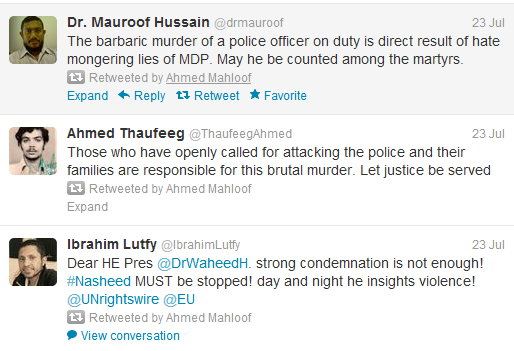
Human Rights Commissioner Mariyam Azra, too, appeared convinced that what the Unity Government and its supporters were saying was indeed true. Within the hour she had this to say:

Very sad that a policeman has been killed like this. Nobody should speak in ways that incite hatred against another.

Politics of death

The death of a policeman—especially when hostilities between anti-government protesters and the security forces are at an all time high—is a potent event, laden with political consequences. For the Unity Government it became the ‘evidence’ with which to prove a ‘truth’ they have been peddling from the beginning: MDP is a violent political group determined to regain power at any cost.

This strategy for criminalising dissent and constructing all supporters of MDP as ‘terrorists’ who are also the cause of all the social unrest of today, has been at the forefront of this government’s efforts to legitimise itself since day one.

The government was helped in its campaign to exploit the young policeman’s death by the police themselves. Lance Corporal Haleem died at around quarter past midnight on Sunday night. Between then and mid-afternoon Monday—despite being in possession of all facts surrounding the murder—the police did not make public any details surrounding it. The only thing said was ‘a policeman has been murdered,’ and where.

This left a long Speculation Window in which the Unity Government could air as fact its message that Lance Corporal Haleem had been murdered by an MDP thug, driven to it by calls for violence against the police by MDP leaders.

During the midnight hours, knowing that most people stay up late during Ramadan, key figures in the Unity Government saturated the media with the message. Jumhooree Party (JP) leader Gasim Ibrahim appeared on his Villa TV with Kaashidhoo MP Jabir and JP’s President Dr Didi to discuss ‘the problem of MDP’s continuous incitment of violence against the police.’

They intertwined news of the policeman’s death with the narrative of ‘MDP violence against the police’ so often and with such conviction that by the time the police finally revealed more facts, most people—except the accused—were convinced MDP was behind the policeman’s murder. Here’s a tweet that encapsulates the sentiments of government supporters the following day.

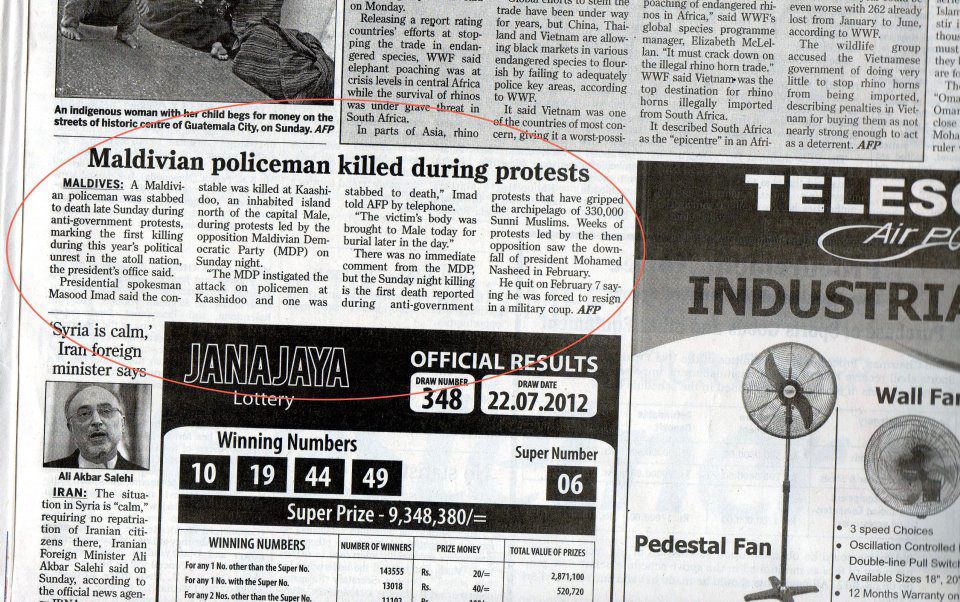
Dissemination of the message did not stop at the country’s borders. In fact, when spread to the international community, the Unity Government didn’t bother with the insinuations. It just came straight out and pointed the figure at MDP. Before Monday morning, the President’s Office Spokesperson, Masood Imad, had told the AFP in Colombo:

The MDP instigated the attack on policemen at Kaashidoo and one was stabbed to death.

Here’s how a Sri Lankan newspaper ran the story the next morning:
Whither the truth?

The truth of the matter, when details began to come out on Monday, was very different. Lance Corporal Haleem was killed by a criminal he had investigated for about a year, and was about to arrest.

The murder was straightforward, and Mohamed Samah, the 22-year-old culprit from the same island, was arrested at the scene. There was an eye-witness and several people, including the police, were on the scene within seconds.

The subsequent scramble to pinpoint the political party to which the accused belonged was ugly. And it was a malaise that affected not just the Unity Government but the general population in its majority. It was as if the violent death of a young man would only begin to matter once the murderer’s political affiliation was established.

His connections with various key figures in different political parties were discussed; his identity card number was keyed into the Elections Commissions website; his membership of one party thus established without doubt—only for that party to come out and say: “There are many MDP members who signed up to other parties by mistake.” Seriously. In a ‘functioning democracy’, as Dr Waheed describes the Maldives, the facts of Lance Corporal Haleem’s death would have required a formal retraction. And, at the very least, it would have elicited an apology to the MDP for very serious wrongful accusations made against it.

But that is not what happened, for it was not Lance Corporal Haleem’s death that was important but the concurrent narrative of MDP’s violence that it was used to construct. Under the circumstances, truth was irrelevant. Thus the political abuse of Lance Corporal Haleem’s body continued apace.

After the condemnations came the heavily publicised State funeral. Of course, the fallen must be honoured. Policemen put their lives at risk protecting society, and we should appreciate that, especially so when they die on duty.

But was the public spectacle put on by the Unity Government and Maldives Police Service really necessary? It is not part of Maldivian culture to hold ostentatious, loud, photographed and televised funerals.

We are humble and simple in our bereavement. But, pictures of Lance Corporal Haleem’s coffin being carried to Islamic Centre on the shoulders of sombre looking policeman were splashed across the media. As were pictures of various key Unity Government figures consoling the family, looking appropriately grieved, and even praying. Faith, like death, reduced to a photo opportunity.

In a slight digression: I could not help but notice Lance Corporal Haleem’s distraught mother photographed at the burial ground paying her respects. I know several mothers, wives, daughters and sisters (myself included) who have desperately wanted it to be otherwise. But it has always been maintained that a woman cannot partake in the burial. What was it about this occasion that allowed the bending of a seemingly inflexible Islamic rule?

Retaliation against the wrongfully accused

As the day passed, the rhetoric of MDP’s violence against the police was only ratcheted up, not lowered. Now the Unity Government’s efforts were on making people forget the truth.

It seems as if the fact of Lance Corporal Haleem’s death has been buried with him. What remained of concern was the accompanying narrative – MDP is deliberately inciting violence against the police and must be stopped.

Thus the Maldives Police Service began ‘retaliation’ against MDP for a crime it had nothing to do with. Chief among several actions taken to avenge Lance Corporal Haleem’s murder was the ’leaking’ of a telephone conversation between Nasheed and MDP Mariya Didi, one of his closest allies and friends. In the March 29 conversation, Mariya is heard updating Nasheed about police violence and use of pepper-spray against protesters resisting their dismantling of Usfasgan’du [MDP’s protest camp] that day. She asks for Nasheed’s advice, and he replies:

There’s not much we can do. I don’t know. What is there to do? I think [we] need to get people out to fight if we can get them. If we can get people to fight, get them out. It’s very clear to me, I think we need to fight back. If we can get people to fight. Find kids from Male to fight the police.

Mariya laughs. Not the response one would expect from a person who thinks she has just been assigned the task of recruiting a gang of thugs to take on the national security forces. Regardless, the police thought it prudent to release the audio clip. For what purpose? It was certainly not aimed at calming tensions or to make real the rhetoric of reconciliation.

Nasheed’s supporters are unlikely to accept the private conversation between him and Mariya as evidence of his alleged brutality. For them, his commitment to non-violence was proven beyond doubt when not just the MDP-affiliated Coup Report but also the so-called CONI Timeline documented Nasheed’s unequivocal refusal to use weapons against the mutinying police, or anyone else, on 7 February.

The only purposes the audio clip served was to harden government supporters’ dislike and mistrust of Nasheed, and to fortify government’s efforts to construct Nasheed as the cruel leader of the violent political organisation that is said to be MDP. To support their claim that MDP leaders are all characterised by political extremists prone to violence, they have also unearthed statements made by key MDP figures encouraging—wrongly so—retaliation against the police for their brutal violence against them during the events surrounding the transfer of government.

Whether or not their words bear any relation to the murder of the policeman, once again, is of the least consequence. What it did beautifully was fit the government narrative. What use to make of the audio clip, which the police has been in possession of since March, was decided shortly after Lance Corporal Haleem’s murder and long before facts of his killing were made public. Home Minister Jameel hinted at it on the night of the murder itself:

The ‘evidence’, with the allegation, is continuing to play across the media—mainstream and social–since then.

Before they brought foreigners and shot them dead, now getting Maldivians to stab them…Bravo to the democracy Anni is bringing.

The poster with the last Tweet from President’s Spokesperson Abbas Riza reads:

6 February Massacre

Main reasons why a massacre was desired:

—to declare a state of emergency

—to abolish the JSC and give MDP the power to appoint judges

—to arrest the leaders who stepped up to defend Islam and the Constitution

—to hand MPL (Maldives Ports Limited) to a company of which India’s GMR is a shareholder

These are not the words and actions of members of a government eager to calm the political and social turmoil afflicting Maldives today. On the contrary, they are intended to cause the opposite effect.

If the Unity Government were serious about reconciliation in the five long months gone, it would have taken due action against members of the police who mutinied. It would not have given them promotions instead.

It would not have appointed as leaders of the security forces men like Mohamed Nazim, Abdulla Riyaz and Mohamed Fayaz, men who the whole country saw playing a key role in the change of government on 7 February. The seeds of public mistrust of the police were planted on that day, and on 8 February. And they grow and mushroom with every day that passes without this government’s acknowledgement of the these facts.

There can be no reconciliation without the truth.

All comment pieces are the sole view of the author and do not reflect the editorial policy of Minivan News. If you would like to write an opinion piece, please send proposals to [email protected]

Likes(1)Dislikes(0)

Government demands GMR “temporarily halt” construction of new terminal

The Maldives government has called for a cessation of work on the new airport terminal by Indian infrastructure group GMR, over allegations the company has “violated rules and regulations” regarding the construction.

President’s Office Spokesperson Abbas Adil Riza confirmed to Minivan News that the cabinet, acting on information provided by the Transport Ministry, had requested that building work on the new terminal at Ibrahim Nasir International Airport (INIA) be halted.

“When the government decides that a project be stopped, we will make sure this happens,” he said. “GMR have not discussed the construction with relevant authorities.”

Abbas did not clarify if the alleged violation of rules and regulations by the company was related to previous reports that construction on the project commenced last month without obtaining  construction permits from the country’s Civil Aviation Authority.

Transport and Communications Minister Dr Ahmed Shamheed was not responding to calls at the time of press.

A GMR spokesperson said today that the company itself had received no letter or communications calling for a halt to work.

However, local media has reported that the cabinet opted on Tuesday (July 24) to call for a “temporarily halt” on work on the terminal, over claims GMR had not acquired necessary authorisation and permit approval from the country’s Civil Aviation Authority.

GMR told Haveeru earlier earlier this month that terminal construction had been approved in an existing master-plan agreed with the government. The company has pledged that it will open by July 2014, “irrespective” of outside issues.

Addressing the matter of GMR’s construction work earlier this month, the government at the time claimed that the permit was “not a huge issue” and was believed to have resulted from an error by contractors presently working on the airport’s construction.

Development plans

The development of the airport – expected by the company to total US$511m in costs – is the largest foreign investment project undertaken in the Maldives’ history and includes commitments to renovate INIA’s existing terminal by September both in terms of operational efficiency and customer services, according to GMR.

With contractors already having begun work on the new structure in June, the administration of President Dr Mohamed Waheed has previously stressed that it would not seek to interfere or “disturb” the project that officially commenced back in November 2010 under the administration of former President Mohamed Nasheed.

However, President’s Office Spokesperson Abbas previously claimed that the long-term prospects of the construction ultimately depended on GMR validating the legality of their contract – a document that was overseen by the International Finance Corporation (IFC). The IFC is a member of the World Bank group and the largest global institution focused on private sector in developing countries.

Abbas added that should the (now government party controlled) parliament also decide on nationalising the airport in line with the wishes of certain pro-government parties to take back the project from GMR, then the present administration would have to comply with such a decision.

The government of President Dr Mohamed Waheed Hassan comprises a coalition of former opposition parties that represent the majority of elected representatives. The now-opposition Maldivian Democratic Party (MDP) presently has 29 MPs in the Majlis, the largest number of MPs belonging to a single party.

Nationalisation calls

Several pro-government parties – including the Dhivehi Rayithunge Party (DRP), Dhivehi Qaumee Party (DQP), People’s Alliance (PA) and Jumhoree Party (JP) – advised President Waheed last month that they continued to endorse an agreement signed in June 2010 calling for the airport to be taken back from GMR and nationalised.

The agreement endorsed six main points which included taking legal action to prevent the government’s decision to award the contract to GMR.

Likes(0)Dislikes(0)