The spirit of Orange Day

Orange has always known to be a powerful color: it stimulates enthusiasm, creativity and symbolises vitality with endurance. It is also said be one of the healing colors.

So what other better color than Orange to show peoples’ solidarity in the fight to end all forms of violence, abuse and discrimination inflicted on millions of women and young girls worldwide in pandemic proportions.

Available country data reveals that up to 70 per cent of women experience physical or sexual violence from men in their lifetime – the majority by husbands, intimate partners or someone they know.

Among women aged between 15 and 44, acts of violence cause more death and disability than cancer, malaria, traffic accidents and war combined.  It is one the most pervasive human rights violation that is devastating millions  lives, fractures communities, and stalls development.
The violence takes many forms and occurs in almost all places – domestic violence at  home, sexual abuse of girls in schools, sexual harassment at work, rape by husbands or strangers, in refugee camps or as a tactic of war.

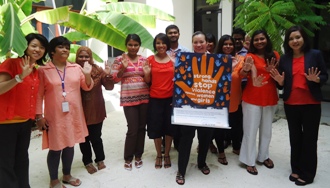
The Global Unite Youth Network, a group of over 40 young activists from around the world working to end gender inequality and violence against women and girls, launched its first action on Wednesday, 25 July: UNiTE Orange Day, under the UN Secretary-General’s campaign UNiTE to End Violence against Women.

The young activists, including myself, decided to raise awareness about the issue of violence against women and girls and bring this pandemic to people’s atention, not only once a year on 25 November (International Day for the Elimination of Violence against Women), but every month.

The goal was simple: Generate interest and conversations about the issue, and encourage people to start thinking and talking about how to end violence against women and girls.

On the same day, the UNiTE campaign also launched the new UNiTE Ribbon as symbol for preventing and ending violence against women and girls. The mission is to make this symbol universal.

Therefore, through social media campaigns,the Global Unite Youth Network members, including myself, asked men, women, boys and girls, young and old in our countries to wear something orange on 25 July and wear the orange ribbon, together creating a historical global movement.

Orange Warriors from across the world

Following just almost a week of campaigning, on Wednesday, we witnessed the rise of several hundreds of “Orange Warriors” from beyond borders, nationalities and cultures, ready to stand up to violence committed against women and girls.

From Bosnia to Bangladesh, France to Sri Lanka, Thailand to Phillipines, US to Russia, Georgia to India – both young and old alike – joined the campaign, uploading their pictures shining with multiple shades of orange to social networks such as Twitter and Facebook.

From the Maldives a small butspirited group of individuals also joined the campaign, including my family and close friends, colleagues at Minivan News and staff of UN agencies.

The island nation of 350,000 people gripped by widespread gender-based violence including domestic abuse, harassment and discrimination with every 1 in 3 woman reported to be victim of violence.

UN Staff marks Orange Day

UN Women Representative in Maldives Michiyo Yamada said violence affects not only women and girls themselves but everyone in a community and society. We all need to understand the gravity of the issue and show a commitment individually.

“It is very encouraging to see young people taking a lead to advocate to end violence against women and girls, as they are a key agent of change.” Yamada noted.

She added: “We hope everyone will join this campaign and say NO every day to emphasise zero tolerance to VAWG.”

Next Orange Day is scheduled for August 25th. Will you wear orange and Say No?

Likes(0)Dislikes(0)

Civil Court dismisses ruling of own watchdog body against Chief Judge Abdulla Mohamed

The Civil Court today dismissed a decision by its own watchdog body, the Judicial Service Commission (JSC), to take action against Chief Judge of the Criminal Court Abdullah Mohamed for violating the Judge’s Code of Conduct.

An investigation into a complaint of ethical misconduct against Judge Abdulla was completed by a JSC special committee which recommended in the final report to the commission that action be taken against the Judge for violating the Judge’s Code of Conduct – specifically, by making a politically biased statement in an interview with DhiTV.

However, during the period given to Judge Abdulla to respond to the report, he instead obtained a Civil Court injunction against his further investigation by the judicial watchdog.

The JSC appealed the injunction on January 24 of this year, claiming that the Civil Court had disregarded the commission’s constitutional mandate which allowed it to take action against judges, and argued that the court did not have the jurisdiction to overrule a decision of its own watchdog body.

But the appeal was rejected, concluding that the commission had not provided the court “any substantial reason to terminate the injunction and that the High court cannot make a decision on the case while the case is pending at a lower court.

As the final verdict on the case came out today, the Civil Court overruled the the decision stating that Judge Abdulla was not given an opportunity to respond to the allegations during the investigation.

According to the decision, providing a chance to submit any complaints after the investigation is completed cannot be deemed as an opportunity for the Judge to present his defence.

Like all other state institutions the JSC must also be held accountable in front of the law, the court noted, addding that party who believes to have suffered damages due to a decision by the commission have the right to litigate  matter to protect his rights.

Furthermore the Civil Court concluded that action cannot be taken against the Abdullah under the Judge’s Code of Conduct, because the said violation predates the regulation.

Charges against the Judge

Apart from the ethical misconduct complaint, the JSC revealed that a total of 11 complaints have been submitted to the commission against Judge Abdulla Mohamed, among which are serious allegations of corruption and abuse of authority.

The first complaints against Abdulla Mohamed were filed in July 2005 by then Attorney General Dr Hassan Saeed – now Dr Waheed’s political advisor – and included allegations of misogyny, sexual deviancy, and throwing out an assault case despite the confession of the accused.

Among the allegations in Dr Saeed’s letter was one that Judge Abdulla had requested an underage victim of sexual abuse reenact her abuse for the court, in the presence of the perpetrator.

In 2009, those documents were sent to the JSC, which was requested to launch an investigation into the outstanding complaints as well as alleged obstruction of “high-profile corruption investigations”.

The JSC decided not to proceed with the investigation on July 30, 2009.

Former President’s member on the JSC and whistleblower Aishath Velezinee for several years contended that Abdulla Mohamed was a central, controlling “father figure” in the lower courts, answerable to former President Maumoon Abdul Gayoom and a key figure responsible for scuttling the independence of the judiciary under the new constitution.

Central figure in Nasheed’s downfall

Abdulla Mohamed was also a central figure in the downfall of former President Mohamed Nasheed, following the military’s detention of the judge after the government accused him of political bias, obstructing police, stalling cases, links with organised crime and “taking the entire criminal justice system in his fist” to protect key figures of the former dictatorship from human rights violations and corruption cases.

Judge Abdulla’s arrest sparked three weeks of anti-government protests starting in January, while the government appealed for assistance from the Commonwealth and UN to reform the judiciary.

As protests escalated, elements of the police and military mutinied on February 7, alleging Nasheed’s orders to arrest the judge were unlawful. A Commonwealth legal delegation had landed in the capital only days earlier.

Nasheed publicly resigned the same day, but later said he was forced to do so “under duress” in a coup d’état. Nasheed’s Maldivian Democratic Party (MDP) has taken to the streets in recent months calling for an early election.

Judge Abdulla was released on the evening of February 7, and the Criminal Court swiftly issued a warrant for Nasheed’s arrest. Police did not act on the warrant, after international concern quickly mounted.

Likes(1)Dislikes(0)

Lance Corporal Haleem killed by “MDP loyalist”, government tells foreign media

The government has claimed that murdered policeman Lance Corporal Adam Haleem was stabbed to death by a “Maldivian Democratic Party (MDP) loyalist”, in a text circulated to foreign media outlets.

President’s Office Spokesperson Masood Imad was reported as stating in a story published by AFP that “MDP instigated the attack on policemen at Kaashidoo and one was stabbed to death” during protests.

Police meanwhile held a press conference today during which they claimed that the murdered policeman was attempting to arrest his alleged killer, 22 year-old Mohamed Samah, at the time of his death.

Police stated that Haleem had observed Samah wandering the street despite being under house arrest, and asked him to accompany him to Kaashidhoo police station. Samah had reportedly been released to house detention on Sunday following a two day arrest over an assault case.

According to local media, police stated that Haleem had asked Samah to get ready to go to the station with him, and had waited outside his house. Samah allegedly came out of the property with a knife, which he used to stab Haleem while the officer was on the phone to the police station.

Police further alleged that Samah was intoxicated at the time of the incident, and stated that he had tested positive for cannabis following his arrest.

Speaking to Minivan News, Imad said “I can assure you that he was an MDP loyalist, and an active member of the Donbileih Kaashidhoo campaign. The attack took place moments after calls to engage in violence against police, in an MDP rally.”

MDP Spokespersons Hamid Abdul Ghafoor and Imthiyaz Fahmy were not responding at time of press.

Haleem suffered serious stab wounds in the attack, including a nine-inch deep stab wound to the chest. He was alive but in critical condition when brought to the hospital, but died soon afterwards while undergoing treatment.

The death has been swiftly politicised amid spiraling political tensions in the country.

The government condemned former President Mohamed Nasheed and his Maldivian Democratic Party (MDP) for the murder, claiming that MDP’s ongoing protests against the police in the capital Male’ provoked the attack on Kaashidhoo island.

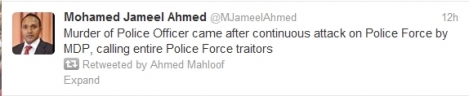
Home Minister Dr Mohamed Jameel Ahmed tweeted that the “murder of police officer came after continuous attack on police force by MDP, calling [the] entire police force traitors.”

In another tweet, Jameel also said that “evidence available to police [which] exposes MDP top leadership calling for violence against the police force.”

Police subsequently released a recording of a phone call between Nasheed and MDP MP Mariya Didi, in which Nasheed expresses frustration with the police dismantling of the party’s protest site at Usfasgandu: “I think we need to fight back. If we can get people to fight. Find kids from Male to fight the police. That is what I think. I don’t know if we can get people to fight. I want to fight against them,” the former President is heard to say.

The MDP retaliated by publishing a screenshot of the Elections Commission party registry indicating that Samah was a member of the government-aligned Progressive Party of the Maldives (PPM).

The party further alleged that the suspect was a key supporter of Jumhoree Party (JP) MP Abdullah Jabir, who won the Kaashidoo constituency in the recent by-election with official endorsement from PPM.

Jabir has denied the claim and alleged the suspect had actually been working with MDP candidates at local elections, and was mentioned in a police report at the time for attacking a member of the JP’s campaign personnel.

PPM’s Council Member Ahmed Saleem yesterday stated during a press conference that “Party is not important. What’s important is the crime committed by the criminal.”

“We have also heard people say that he is from PPM. But we have not checked if it’s true. The reality is that MDP members have been registered under other parties by mistake,” Saleem claimed.

Likes(0)Dislikes(0)

Hulhumale’ court has jurisdiction to hear Nasheed case: Deputy Prosecutor General

Deputy Prosecutor General (PG) Hussein Shameem has said that Hulhumale’ Magistrate Court does have the jurisdiction to hear the case of former President Mohamed Nasheed over his role in the detention of a Criminal Court Chief Judge.

Shameem contended that should the court maintain its decision against hearing the case, there were few other judicial alternatives in trying to ensure a “fair trial”.

The comments were made as the PG’s office called on the Hulhumale’-based court to review its decision to send back the case to authorities on the grounds that it did not have the jurisdiction to hear the former president’s trial as written under the Judicature Act.

Nasheed, along with three Maldives National Defence Force (MNDF) officers, face charges over the controversial detention of Criminal Court Chef Judge Abdullah Mohamed – a decision the former president claimed was taken over national security concerns.

Chief Judge abdulla was detained by the military, after he had opened the court outside normal hours to order the immediate release of former Justice Minister and current Home Minister and Deputy Leader of the Dhivehi Quamee Party (DQP), Dr Mohamed Jameel.

The opposition Maldivian Democratic Party (MDP), of which Nasheed is the presidential candidate, has claimed it expects the trial – whether in Hulhumale’ or another court – to go ahead regardless of legality.  The party has alleged the case serves solely as a means to convict the former president and potentially prevent him from contesting in the next general election.

However, Shameem claimed today the PG’s office had opted to hold the case against the former president in Hulhumale’ as it believed a fair trial could not be held at the country’s Criminal Court, an institution Judge Abdulla continues to oversee.

“We believe the Hulhumale’-based court does have the jurisdiction to hear this case under provisions outlined in the Judicature Act. We do not believe a fair trial could be held at the Criminal Court in this particular case,” he said.

Alternatives

Shameem claimed that there was a seemingly limited number of alternatives for hearing the case should Hulhumale’ Magistrate Court maintain it does not have the mandate to host such a trial.

“We would not be sending the case [to the Criminal Court],” he said. “So if the Hulhumale’ magistrate feels uncomfortable with the case or maintains it does not have the jurisdiction, we would have to appeal at the High Court about this.”

A statement sent to local media yesterday by the PG’s office claimed that despite Hulhumale’ Magistrate Court’s initial reservations, it could hold the case as the island was under the same judicial constituent as nearby Male’ and Villimale.

The statement also contended that judicial regulations did not prevent a magistrate court from investigating allegations of the “deliberate arrest of an innocent individual”.

Addressing the issue of court jurisdiction, President’s Office Media Secretary Masood Imad said that the government remained committed to not interfering with the country’s judiciary. Masood said he would not therefore comment on the case against the former president, who has alleged his successor Dr Mohamed Waheed Hassan came to power in a “coup d’etat” on February 7.

“We would not want to touch the issue with a ten-foot pole,” Masood added, referring any questions on the case to Attorney General (AG) Azima Shakoor.

AG Shakoor was not responding to calls at time of press.

Former President to justify judge’s detention

Former President Nasheed has previously that he is “prepared” to justify the reasons for the arrest of Judge Abdulla, and said he was ready to appear in court and prove his actions were valid.

MDP MP and Spokesperson Hamid Abdul Ghafoor claimed that that despite the present uncertainty over the exact legal body that would be hearing the trial, he believed authorities would be going ahead with the trial.

“Nobody, can stop them from doing it,” he claimed. “They have no choice to go ahead with such a thing. It is the only way to avoid talk of an early election by arresting Nasheed and trying to dismantle the MDP. The dictatorship is back.”

Ghafoor alleged that the MDP did not presently take the potential trial of the former President Nasheed “seriously”, owing to what he claimed was institutionalised bias and political influence in the country’s judiciary.

“Today for example, a lower court was able to overrule the JSC [the country’s judicial watchdog] to take action against Chief Judge Abdullah over concerns of his conduct,” he said.

Ghafoor claimed that the judiciary’s reputation and conduct reflected a wider societal attitude that the Maldives did “not have a culture of law” for citizens to rely on.

“The courts and judiciary are not up too much here. During the thirty years of dictatorship we had, the media published propganda about these institutions and people thought they were quite capable,” he said. “Yet in the democracy we have had, you have to prove yourselves”

Ghafoor claimed that as the issue of Nasheed’s trial continued to wear on, more members of the public were becoming are “that the trials are a sham”.

In late 2011, Judge Abdulla was himself under investigation by the JSC, the country’s judicial watchdog, for allegedly politically biased comments made to private broadcaster DhiTV. The Judicial Services Commission (JSC) was due to release a report into Judge Abdulla’s alleged ethical misconduct, however the judge approached the Civil Court and successfully filed an injunction against his further investigation by the judicial watchdog.

Judge Abdulla’s arrest sparked international criticism of the Nasheed administration as well three weeks of anti-government protests in January, leading the former government to appeal for international assistance from the Commonwealth and UN to reform the judiciary.

Likes(0)Dislikes(0)

Nazim files complaint against Raajje TV with police, broadcasting commission over leaked texts

Defense Minister Mohamed Nazim has asked the Maldives Police Services and the Maldives Broadcasting Commission (MBC) to investigate opposition-aligned Raajje TV over the station’s reporting of 57 leaked text messages allegedly received to Nazim’s cell phone during the controversial transfer of power on February 7.

In a press statement posted on social media twitter, Nazim said Rajje TV had violated Article 24 of the Constitution which guarantees right to privacy, and contravened the Article 37 of the Broadcasting Act which prohibits use of illegally recorded information and defamation.

The text messages received to Nazim’s phone appear to offer congratulations from security forces, family members, prominent businesses including tourism tycoon Ahmed Nazeer of Crown Company Pvt Ltd, and prominent politicians including Deputy Leader of the Progressive Party of the Maldives (PPM) Umar Naseer.

“Rajje TV’s actions contravene the Constitution and laws of the Maldives, as well as broadcasting ethics. Hence, I have asked the Maldives Broadcasting Commission and Maldives Police Services to investigate the matter,” Nazim said.

However, Raajje TV News Head Asward Ibrahim Waheed said the station was not responsible for the leaked text messages. Opposition Maldivian Democratic Party (MDP) had publicised the text messages at a rally held at its protest camp at Usfasgandu on Sunday night, and Raajje TV had broadcast live coverage of the event, Waheed said.

“Numerous print media outlets have also written articles on these text messages. Therefore, Nazim’s targeting of Raajje TV on this matter again illustrates the Maldivian security forces’ attempt to gag free media,” Waheed said.

The MDP contends former President Mohamed Nasheed was deposed through a coup d’état, orchestrated by remnants of the former dictatorship, funded by resort interests, and carried out by mutinous elements of the police and military.

Nazim, a colonel during former President Maumoon Abdul Gayoom’s administration, was a central figure in Nasheed’s downfall. Video footage on February 7 shows the retired colonel addressing police and military officers gathered in Republican Square, saying he had delivered an ultimatum on their behalf demanding Nasheed’s resignation. New President Dr Mohamed Waheed Hassan appointed Nazim as Defense Minister the next day.

MDP Spokesperson Hamid Abdul Gafoor said the text messages were evidence that the “coup was pre-planned and executed to stakeholders’ satisfaction.”

Although Nazim has asked the police and MBC to investigate Raajje TV, he told local media today that he still could not comment on the authenticity of the text messages.

Controversial text messages

According to the MDP publicized document, Majlis Speaker Abdulla Shahid sent a message to Nazim at 1:42 pm stating “Need to talk urgently.”

Deputy Leader of PPM Umar Naseer at 2:51 pm allegedly says: “Extremely grateful for your service in saving this country and its religion, thank you, Umar Naseer.”

Three phone numbers registered with the Crown Company Pvt. Ltd also offered congratulations to Nazim. Tourism Tycoon Ahmed Nazeer allegedly said at 1:28 pm: “Congratulations. Once a soldier, always a soldier. Keep up the good work, but don’t go overboard. Thanks and regards, Nazeer.”

A Malaysian number which the MDP claims belongs to retired MNDF Lieutenant General Anbaree Abdul Sattar at 4:39 pm said: “Heartfelt congratulations. I pray Allah gives you the patience and wisdom as you proceed to be magnanimous and be mindful of the vow you have made to uphold the constitution and the constitution of the Maldives, Anbaree.” Anbaree had also served as former President and ruler of 30 years Maumoon Abdul Gayoom’s Ambassador to India.

Two text messages also appear to discuss details of then VP’s movements and logistics for a press conference. A number registered with the MNDF at 2:51 pm says: “Sir vp getting ready to move to majlis,” while a man identifying himself as Colonel Adurey at 3:21 pm asks when media briefing should be scheduled.
Several security forces personnel also allegedly sent text messages to Nazim thanking and congratulating him for his role in Nasheed’s resignation.

A text message from retired Deputy Commissioner of Police Abdul Shakoor Abdulla said: “Allah Akbar Allah Akbar Akbar Alh’amdhu Lillah. Congratulations! Abdul Shakoor Abdulla Rtd. Dy Com of Police,” whilst a number registered with Lieutenant Colonel Zakariyya Mansoor reportedly sent a text message saying, “Congratulations, Mansoor.”

Another text message from a man identifying himself as “Riya” from an unlisted number said: “Moosa Jaleel’s 15 year savage reign is now over. I was one of those forced to resign. I am really proud to say I’m done STF with you in same platoon. Congratulations, Riya, five rises.” Moosa Jaleel was Chief of the Defense Forces under Nasheed. He resigned shortly after President Waheed took his oath of office.

Attacks on Raajje TV

The government has stepped up verbal attacks on Raajje TV, following the murder of Lance Corporal Adam Haleem on Monday, claiming the station incites hatred and violence against security forces by broadcasting “baseless allegations” regarding police brutality and the police’s role in the controversial transfer of power on February 7. The police have said it will no longer cooperate with or provide protection to Raajje TV journalists.

Home Minister Mohamed Jameel, Police Commissioner Abdulla Riyaz, and Attorney General Azima Shukoor have said Rajje TV must bear responsibility for the murder Haleem, and have pledged to take legal action against the station.

Raajje TV has previously accused the Maldives security forces of regularly targeting, attacking, threatening and harassing the station’s journalists. In a July 10 statement, Raajje TV said: “Raajje TV journalists have been forced to live in fear as they have increasingly become targets of attacks by the national security forces, particularly the police service. The station also believes that these attacks and harassment has been the source of emotional distress and psychological damage to all Raajje TV employees.”

Likes(1)Dislikes(0)

Tensions escalate as government accuse MDP, Raajje TV of “inciting hatred and violence against police”

Following the murder of Lance Corporal Ahmed Haleem on Sunday, the government has said deposed President Mohamed Nasheed, opposition Maldivian Democratic Party (MDP), and the opposition aligned Raajje TV are responsible for attacks on police, and have pledged to summon Nasheed for questioning over charges of inciting hatred and violence against police.

Superintendent of police Mohamed Riyaz at a press conference this evening publicised an audio conversation held between MDP MP Mariya Ahmed Didi and Nasheed on May 29, in which Nasheed allegedly told Mariya to find people to fight the police. Riyaz said the police would obtain a court order to summon Nasheed for questioning within the week.

A few hours later, former Deputy Home Minister Hassan Mahir was arrested under a court warrant on charges of inciting violence against the police during a speech given at the MDP’s protest camp at Usfasgandu.

Meanwhile, in a separate joint press conference held at noon at Iskandhar Koshi today, Home Minister Mohamed Jameel and Police Commissioner Abdulla Riyaz said Raajje TV had spread “baseless allegations” about police brutality and the police role in the controversial change of government on February 7, thereby inciting and encouraging violence against the police and their families. Further, deposed President Nasheed was directly responsible for planning and inciting violent attacks on police, Abdulla Riyaz said.

Nasheed had resigned from office on February 7, but later claimed he was ousted in a coup d’état, planned by the remnants of the former dictatorship, funded by resort interests, and carried out by mutinous elements of the police and military. The MDP has since held regular protests calling for early elections.

Attorney General Azima Shukoor has also told state broadcaster Television Maldives (TVM) that the government will take action against the Elections Commission and the Maldives Broadcasting Commission (MBC) for respectively failing to discipline Raajje TV and the MDP, claiming the two bodies must be held responsible for encouraging attacks on police and the death of Haleem.

Police have arrested Mohamed Samaah, 22, over Haleem’s death, but have declined to give any further details. The MDP have said Samaah belonged to government coalition member and former President of 30 years Maumoon Abdul Gayoom’s Progressive Party of the Maldives (PPM).

Nasheed- Mariya conversation

Nasheed and Mariya’s leaked audio conversation appears to have been held during the police’s attempt to dismantle the MDP’s protest camp at Usfasgandu on May 29. Police had obtained a search warrant claiming MDP was performing black magic, conducting criminal activity and damaging public property in the area.

In the audio clip, Mariya says: “[Police] are forcing people back! They are using pepper spray! That is why we are unable to hold a national council meeting. And we have also received a second letter, ordering us to vacate the area by ten o’clock tonight. We cannot file an appeal at court or do anything. We cannot even hold the National Council meeting. We won’t have [enough members for] quorum. Shihab is here. But they are using pepper spray and forcing people back. Can only vacate the place if we could only get in there. This is all very unjust. What shall I do?”

Nasheed then replies, “There’s not much we can do. I don’t know. What is there to do? I think [we] need to get people out to fight if we can get them. If we can get people to fight, get them out. It’s very clear to me, I think we need to fight back. If we can get people to fight. Find kids from Male to fight the police,” Mariya laughs at this point, but Nasheed continues, “That is what I think. I don’t know if we can get people to fight. I want to fight against them.”

Amnesty International released a statement on June 11, alleging the police had used excessive force against protesters on May 29, by pepper spraying, beating and arresting peaceful protesters, bystanders and journalists. Police denied the allegations.

Superintendent of Police Mohamed Riyaz today said the police had decided to publicize the audio conversation “because we have no other choice.”

Riyaz said Mariya had been summoned for questioning over the audio clip on June 20, but the MDP had spread baseless allegations that the police were arresting and harrassing opposition politicians for no apparent reason. Hence, “the time has come to reveal the truth,” Riyaz said.

The audio clip was obtained legally through a court warrant, he added.

At approximately 9:00 pm this evening, former deputy Home Minister Hassan Mahir was arrested for comments made at Usfasgandu, in which he had allegedly incited violence against the police. Video footage of February 7 shows Mahir being attacked by men in civilians as police in riot gear watch outside the Police HQ and another man screams, “Kill him!”

The MDP has consistently raised concerns over new President Dr Mohamed Waheed Hassan’s failure to prosecute the police for brutality on February 7, 8 and at subsequent MDP demonstrations.

“Enemies of the state”

Speaking at a press conference at noon, Home Minister Jameel and Police Commissioner Abdulla Riyaz condemned MDP and Rajje TV’s alleged incitement of hatred and violence against police and their families.

Jameel described MDP and Raajje TV as “enemies of the state,” while Riyaz said Nasheed and senior MDP officials were behind the planning of psychological and physical attacks on the police.

“I note that former President Mohamed Nasheed is behind the planning of the attacks and damage caused to police property and repeated physical attacks on police officers.” Riyaz said.

Claiming Raajje TV’s reporting was “not responsible journalism,” Riyaz said that the station had spread baseless allegations regarding police brutality towards protesters and police role in the controversial change of government.

“Raajje TV has repeatedly attempted to defame and raise questions over police professionalism by broadcasting baseless allegations to create distrust towards the police,” he added.

He went on to refute a recent Raajje TV report that police had stolen fuel from parked motor cycles, claiming Raajje TV was attempting to falsely cast the entire police force as “brutal” and as “thieves.”

Earlier in the day, the Police released a satement saying they  will no longer cooperate with Raajje TV or provide protection to the station due to its attempts to defame the institution. The Maldives Broadcasting Commission (MBC) subsequently told Raajje TV to issue an apology for the report on police officers stealing petrol.

Conversely, Raajje TV has also accused police of targeting, assaulting and harrasing its reporters during MDP’s protests.

A statement from Raajje TV on July 10 read: “Raajje TV journalists have been forced to live in fear as they have increasingly become targets of attacks by the national security forces, particularly the police service. The station also believes that these attacks and harassment has been the source of emotional distress and psychological damage to all Raajje TV employees.”

However, Riyaz stressed today that the police force did not discriminate.  “I believe the police are professional. I am not under any political influence,” he added

During MDP’s protest on February 8, 64 policemen had been injured while police stations had sustained over Rf 130,000 (US$ 8387) worth damages, Riyaz said. It was Raajje TV’s broadcasting of false reports that police had killed a man in Male’ that led to the vandalism and arson attacks on police stations and court buildings throughout the Maldives, Riyaz alleged.

“We will take action against whoever incites violence against the police, no matter who it is or what kind of position they hold or have held in the past,” Jameel said.

Police have already filed criminal charges against Nasheed for his alleged role in the detention of Criminal Court Chief Judge Abdulla Mohamed in January and the discovery of alcohol bottles at Nasheed’s residence following his resignation. The Prosecutor General (PG) this month filed charges against Nasheed at the Hulhumale’ Island Court over Abdulla’s detention, but the court has rejected the case claiming the case was outside its “jurisdiction.”

The Commonwealth’s Special Envoy to the Maldives Sir Donald McKinnon and the UN Human Rights Commissioner Navi Pillay have expressed concern over the state’s attempt to prosecute Nasheed.

Complaints against EC, MBC

Attorney General Azima Shukoor, speaking on TVM’s Raajje Miadhu programme, said the Elections Commission (EC) and the Maldives Broadcasting Commission (MBC) had failed to discipline Raajje TV and MDP for inciting violence despite the government filing numerous complaints.

Azima said MDP’s call for violence were “a fact. You cannot dispute this. Look at the tweets, the materials on Facebook, and the speeches at meetings and protests.”

However, the failure of independent oversight institutions to take action had put the democratic process in the Maldives in jeopardy, Azima claimed. “The country is not functioning when space is given for democracy,” she said.

“Institutions that must take responsibility are not doing their job. [We have] to take action against them. The executive will conduct necessary legal work to take such action. We will submit this case to the Majlis. We are also ready to take necessary action through the courts,” she stated.

In response, the Elections Commissioner Fuad Thawfeeq told TVM that the commission “will not yield to threats and intimidation.”

Regarding the MDP’s protests, he said: “The constitution guarantees freedom of assembly and speech. The elections commission cannot narrow such freedoms.” Thawfeeq said it was the executive’s resonsibility to investigate criminal activities.

Likes(1)Dislikes(0)

“Crime is more important than party” says PPM, after suspected cop killer is revealed to be member

The crime is more important than the political party the criminal is from, the Progressive Party of the Maldives (PPM) has said during a press conference, after it was revealed that the suspect arrested in connection to the murder of Lance Corporal Adam Haleem murder is a registered member of the party.

In the wake of police officer’s murder, government-aligned parties including PPM and cabinet ministers have vociferously blamed the ousted former President Mohamed Nasheed and his Maldivian Democratic Party (MDP) for the murder, claiming that MDP’s ongoing protests against the police in the capital Male’ provoked the attack on Kaashidhoo island.

The MDP have held consecutive demonstrations since the controversial resignation of former President Nasheed on February 7, who contends that he was forced to do so “under duress” amid a police and military-backed coup.

The protests often have led to multiple arrests and violent clashes between the security forces and protesters, with rising concerns of police brutality, torture and human rights violations.

However, in response to the accusations, the MDP released a photo of the arrested suspect Mohamed Samaah, 22, and a screenshot of the Elections Commission’s party registry showing him listed as a member of the PPM.

Local media reports said that Samaah, from Suvaasaage of Kaashidhoo, has a multiple criminal records including drug, assault and theft.

PPM’s Council Member Ahmed Saleem today contended at a press conference that “Party is not important. What’s important is the crime committed by the criminal,” after a reporter asked him to verify the claim.

“We have also heard people say that he is from PPM. But we have not checked if it’s true. The reality is that MDP members have been registered under other parties by mistake,” Saleem added.

“But, whatever party [the suspect] is from, no police officer or citizen should be attacked,” he noted.

Meanwhile, the MDP has also alleged that the suspect was a key supporter of Jumhoree Party (JP) MP Abdullah Jabir, who won the Kaashidoo constituency in the recent by-election with official endorsement from PPM.

The MDP  today released another photo with the suspect allegedly standing next to Jabir, while JP leader Gasim Ibrahim is seen nearby giving a speech.

Jabir’s wife Dhiyana Saeed, the newly-appointed Minister for Gender and Human Rights, is also pictured in the image.

Speaking to Minivan News today, Jabir rejected any possible links between the suspect and his party, accusing the MDP and media sources including Minivan News of propagating false rumours.

“This suspect has nothing to do with the JP,” he said.

Conversely Jabir said that the suspect had actually been working with MDP candidates at local elections, as well as being mentioned in a police report at the time for attacking a member of the JP’s own campaign personnel.

“There is evidence of this and reports of the incident with the Kashidoo police.  Anyone can check this,” he added.

Likes(0)Dislikes(0)

Government pledges Aasandha health scheme “will not collapse”

The government remains committed to running the Aasandha universal health insurance programme initiated in January, claiming the scheme “will not collapse” despite the present economic difficulties facing the country.

State Health Minister Thoriq Ali Luthfee told Minivan News that there was “no cause for alarm” about the future of the scheme, following the revelation that it has yet to settle four months of unpaid premium charges it owes to cover medical treatments.

Aasandha is a public-private partnership with Allied Insurance. Under the agreement, Allied splits the scheme 60-40 with the government. The actual insurance premium will be paid by the government, while claims, billing and public awareness will be handled by the private partner.

Aasandha Managing Director Mohamed Shafaz has claimed that the government had failed to cover weekly premium payments as agreed under the Aasandha contract since March.  He alleged that while the scheme was continuing to run, the shortfall in state funding was creating some difficulties for service providers such as hospitals and pharmacies both in the Maldives and the wider South Asia region.

Thirty day target

Without detailing specifics, State Health Minister Luthfee said that the government was presently involved in consultations to clear outstanding bills. He added that a target of 30 days had been set to try and settle outstanding debts to creditors such as Aasandha’s management.

“The important factor is the scheme is continuing,” he said. “The country is going through a difficult time economically and ongoing consultations are currently taking place to clear our bills. We are trying to do this right now. The system is not going to collapse.”

Aasandha’s MD Shifaz said that several general meetings had been held with the government about the issue of back payments – charges he claimed were not contested by authorities.

“I’m not sure the reason for the delay, but the outstanding amounts have not been disputed. It appears they are having difficulty in making payments,” he said.

He did not reveal the exact amount of premium charges presently owed by the government.

When questioned on the impact that failure to pay debts might have on the scheme’s stability, Shafaz claimed that Aasandha’s future was directly tied to service providers such as hospitals and pharmacies, particularly smaller enterprises in the outer atolls.

“The difficulties right now are for the service providers. If they can accept the credits terms we are offering right now, then perhaps they can manage,” he said.

Shafaz said that pharmacies and medical centres on smaller islands were more likely to suffer as a result of failure to secure government payments for the scheme.  He added that certain hospitals in Sri Lanka and India also affiliated with Aasandha would need to cover expenses accrued under the universal health system.

Privatised concerns

Back in April, Parliament’s Finance Committee proposed ceasing the provision of universal health care in private hospitals, stating that the scheme would not be economically viable unless private hospitals were excluded.

The proposals were made in a report published by the committee, that recommended the Aasandha service only be made available at the state-run Indira Gandhi Memorial Hospital (IGMH) and other government health centres and corporations around the country.

Calls to limit Aassandha have so far proved divisive in the Majlis and the coalition government. Ahmed Thasmeen Ali, head of the government-aligned Dhivehi Rayyithunge Party (DRP), has previously been an outspoken critic of limiting the provision of universal healthcare at private premises.

Thasmeen told local media at the time that the amendments forwarded by the parliamentary Finance Committee were not the “right way to go” to bring about changes to the scheme, alleging they could undermine parliament’s role in holding the government to account in future, Haveeru reported.

He added that should amendments to the scheme need to be made, he did not want to see the cessation of free healthcare to the public.

Both Thasmeen and DRP Deputy Leader Ibrahim Shareef were not responding to calls by Minivan News at the time of press today.

The Aassandha service was initially intended to cover emergency treatment, including treatment overseas if not available locally, along with all inpatient and outpatient services, domestic emergency evacuation, medicine under prescription, and diagnostic and therapeutic services.

However, Aassandha Managing Director Shafaz said that consultations were set to take place over the possibility of amending the main contract signed between the government and the health scheme’s provider to include an extended number of private practices under the project.

He stressed that there remained “huge concern” at present that such an extension would actually serve to exacerbate the present shortfall in government payments.

“Deluge”

Despite these extension talks, one private doctor not affiliated with Aasandha raised concerns that an apparent “deluge” of patients to IMGH and the private ADK hospital in Male’ were overburdening hospitals linked to the universal coverage scheme.

Conversely, the same doctor contended that large numbers of other health centres and laboratories had seen patient numbers plummet, endangering their long-term existence.

Dr Ahmed Razee, a former Director General of IGMH hospital presently serving as an internist with special interest in diabetes and kidney diseases across Male’ , alleged that under the current agreement, Aasandha had served to create a “grossly unfair monopoly”. Dr Razee added that the scheme had created an environment where even established practitioners were losing regular patients to an “inferior behemoth”.

“When ADK and IGMH pharmacies give you free drugs, why would go to any other pharmacy? I am afraid only Aasandha registered prescriptions are honoured,” he said. “These are available only at IGMH and ADK. Who will go any further – and pay also in the bargain – to another pharmacy?”

Dr Razee contended that when the scheme was launched during the administration of former President Mohamed Nasheed, government promises of a fair share of service provision for private health centres saw a number of enterprises – not just ADK – investing millions of rufiya in health provision.

“With the current monopoly that the government has created, these clinics, pharmacies and labs – representing over a thousand jobs – are going bankrupt,” he claimed. “The deluge of patients on ADK and IGMH is creating too much work for staff and is reducing standards and causing mistakes and making the waiting period entirely too long, and thus expensive, for people from the islands.”

Budgetary factors

Beyond the implications for healthcare, the Maldives has also come under increasing pressure from international organisations to make widescale cuts to state funding.

While recent Maldives’ Inland Revenue Authority (MIRA) figures for May showed national revenue had increased f 9.5 percent compared with the corresponding month in 2011, the figures were not substantial enough to shrink the present national budget deficit.

Governor of the MMA Dr Fazeel Najeeb recently stated that the Maldives was “in a dangerous economic situation never before seen in recent history.”

The International Monetary Fund (IMF) has expressed its concern over the country’s dire balance of payments situation which has been estimated by the Majlis’s Financial Committee to be 27 percent of GDP this year.

The 2012 budget was initially estimated to be around 9.7 percent of GDP, but in May was revealed to be much larger after significantly reduced expenditure and increased expenditure was taken into account.

Spending unaccounted for in the 2012 budget following the controversial change of government of February 7 has included the promotion of a third of the police force, lump sum payments to military personnel, Rf100 million (US$6.5 million) in fishing subsidies, reimbursement of Rf443 million (US$28.8 million) in civil servant salaries following cuts by the previous administration, the creation of two new ministries, and the hiring of international PR firms to counter negative publicity.

Former President Mohamed Nasheed had previously criticised President Waheed and his government for attempting to introduce fees for Aasandha, claiming the administration had squandered funds marked for development on the police and military.

Likes(0)Dislikes(0)

Comment: Blame game hardly solves problems

Lance Corporal Adam Halym of Maldives Police Service was on his way to start a new shift, leaving his baby daughter and loving wife at home, when he was mercilessly knifed and murdered in a dark alley leading to Kaashidhoo Police Station. He never returned home.

I strongly condemn the heinous crime of killing an officer of the law and as well the eight innocent people, whose blood was spilled before him. Thoughts, prayers and well wishes are with all those victims family at time of this great tragedy.

While the families and public is grappling with the aftermath of this ongoing carnage, much more appalling than the gruesome murder of the police officer is the notorious blame game started by the politicians. It took one or two hours tops before prominent political figures, most of them holding key portfolios in current government, to sinisterly twist the tragedy and manipulate in ways that it advantageous to their own political stand or disadvantageous to their political opponents. The former president Mohamed Nasheed and his party MDP  was on the receiving end of much of the accusations.

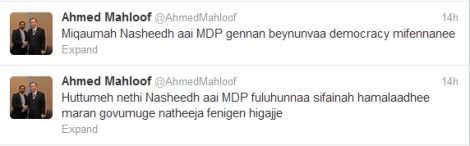
On twitter Ahmed Mahloof, MP for Galolhu Dhekunu Constituency, was amongst the first to break the news by posting a tweet saying “Innaalillahi vainna ilaihi raajioon” (a Quranic verse Muslims recite upon hearing the news of someone’s death) and ” mikamuge zinmaa seedha MDP nagan jeheyne”(MDP should directly take the responsibility of this)” along with a hyperlink to the news story on the Haveeru website.

Among many other tweets that followed, government-aligned Progressive Party of the Maldives (PPM) MP Mahloof emphatically blamed Nasheed and the MDP. One tweet when translated reads, “What we are seeing is the democracy Nasheedh and MDP wanted to bring to this country” while the another tweet reads: “We are seeing the result of Nasheed and MDP calling to attack police and military officers non stop.”


One hour into Mahloof’s tweets President Waheed himself posted a tweet saying “Strongly condemn the killing of a policeman while on duty. Enough of hate mongering against officers of the Law.”

In a subsequent tweet  an hour later the president emoted: “No excuses to kill anyone let alone policemen on duty. Shame on cowards hiding behind anonymity and inciting violence.” While he does not elobarate on who the “anonymous” is,  his counterparts have clarified it well with their own facts: Nasheed and MDP killed LCPL Adam Halym.

Here is what the Minister of Home Affairs said:

Not just that, while the President, his ministers, and other key government officials were all commotional on twitter, Dr Ibrahim Didi, Qasim Ibrahim and Abdullah Jabir – belonging to Jumhoree Party of Dr Waheed’s unity government – were doing their fair share of the blame game on VTV during late hours of last night.  They reiterated the crux of the above mentioned tweets, blaming Nasheed and his party.

I am taken aback by the heedless audacity of especially government officials to create a diversion from the real issue, by using the oldest tactic in the book: the blame game. Every second spent accusing Nasheed and the MDP is a second wasted by the current government to address the cause of the  issue. At a time when the government is expected to take proactive and immediate measure to ensure the safety and security of the people of Maldives they are engrossed in politically assassinating their opposition party and its presidential candidate for the murder of LCP Adam Halym.

In the very press statement from police about the brutal murder of Adam Halym it was clearly stated that a suspect was brought under custody. The police already had a lead. Local media concurrently identified the killer as Mohamed Samah from the same island.

Only hours later more details were reported on local media shedding light on the attack and the killer: Samah has a criminal record for aggravated assault among other crimes and was also released  from police detention to house confinement the previous day.

The police have not revealed that Nasheed, the MDP or for that matter any political party had a role in the murder of Adam Halym: but from the few reports surfacing in the media, we can draw a conclusion that it was indeed a a preventable crime carried out by a dangerous criminal who found his murderous opportunity through a loophole in the very system that is intended to keep his like at bay.

But these facts did not get in the way of the vociferous accusations echoed by the self declared political pundits, nor did it stop MDP from making counterblasts over social networks, spreading picture of the suspected killer alleging that he was in fact from the government-aligned PPM’s members.

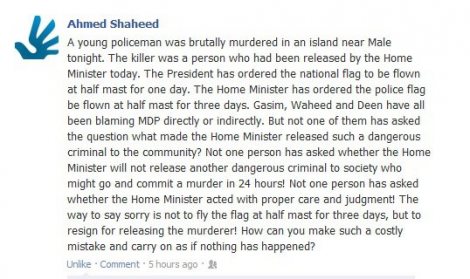
One of the most noticeable remarks was made on Facebook by former Foreign Minister Dr Ahmed Shaheed:

While Dr Shaheed has rightly indicated to what really lead to the murder of LCPL Adam Halym, it would be unfair not to say he has again shot the blame at Home Minister. Doesn’t only a judge have the jurisdiction to release a criminal from police custody to house arrest? So why blame the Home Minister who has no direct authority under the current legal framework to release a criminal from police custody to house arrest?

Why are not we questioning which court or judge released Samah, only to kill a police officer in less than 24 hours?  Has the judiciary failed us again and this time we had  to pay with the life of an officer of the law? If it wasn’t a judge, who gave the authority to police to move the criminal?

These are fundamental questions that lurks around the murder of Adam Halym that neeed to be answered by the police, before we engross ourselves in this “you killed him” game, helping no one except fuelling the opportunistic politicians ready to feed on humanity when it suits them.

At difficult times like this, we humans might blindly seek solace in band aid solutions like the death penalty. Implementing dealth penalty right now in Maldives would only be a coping mechanism that would would provide a temporary relief to the community but leave the root cause of the problem untouched.

It was just few days ago that the whole nation came to a standstill over the murder of lawyer Najeeb. Najeeb’s murderer has said in court that he was inebriated at the time of killing.

Afterwards when his faculties were back to normal and realised what he had done, he cried  in regret.  Moving onto LCPL Adam Halym’s murder, what are the chances Samah too was intoxicated during the murder? More importantly would implementing death penalty prevent an angry, intoxicated person from murdering someone? Since drugs have become the root cause of all mischief in Maldives, and since the punishment under Islam for spreading mischief on Earth is capital punishment, isn’t it more just and appropriate to sentence drug lords to death?

Half of the youth population are enslaved to these substances marketed by these “untouchable” drug lords. They have destroyed lives of thousands of youth and their families. More will follow if we do not stop the menace and provide better opportunities for the younger generation.

Samah found his chance to kill LCPL Adam Halym through a loophole in the judiciary. Therefore when God has specifically prescribed in Quran “ Take not life, which God has made sacred, except by way of justice and law” how can we entrust the current judiciary, with its major loopholes, to rule “by way of justice and law”? For God’s sake, prerequisites laws to implement the death penalty do not even exist in Maldives as of yet and who knows when they will be passed. Let’s be realistic.

We know that Islam stipulates strict conditions that prevent arbitrary administration of any penalty, no matter how mild it is. The Prophet Mohamed has instructed us to“Avert punishments if suspicions arise”. According to Dr Hamdy Murad, an Islamic thinker and Professor of Sharia at Al-Balqa Applied University, “Suspicion means that for any offence that cannot proved 100 percent, so to speak, punishments should be averted.”

In the case of Murrath and Hana, the couple who murdered lawyer Najeeb who were sentenced to death with a fortnight, isn’t there room for suspicion? Did no one hear the girl say she did not kill him and was sleeping while her boyfriend did it?

Besides, should we not question why a convicted criminal like Murrath – who was suppose to be in jail – and Samaah, a criminal with a record of multiple assaults – was out of the streets instead of confinement?

In the wake of such tragic events, it is tempting to blame someone for the pain simply because it absolves the person from shouldering any responsibility. But, one must not forget the most effective tool we can utilise for hate mongering is these slanderous accusations. It never yields solution or heals the scars, but fuels more hatred and divisions in the community.

More than ever, we as a nation need to skip this blame game and find solutions to address the real issues that have jeopardised the very fundamental human right our people have: the right to life.

All comment pieces are the sole view of the author and do not reflect the editorial policy of Minivan News. If you would like to write an opinion piece, please send proposals to [email protected]

Likes(0)Dislikes(0)