Police regulations do not adequately protect constitutional rights, says MDN report

Current policing regulations do not adequately address and protect the rights guaranteed to all citizens by the Constitution, says the Maldivian Democratic Network (MDN).

After reviewing the relevant laws, MDN’s ‘Review of the legal framework of Maldives Police Service’ found “worrying signs of an erosion of the democratic policing framework enshrined in the Constitution”.

“The police are being vested with greater powers and discretion without the prerequisite checks,” read the report released yesterday. “Alarmingly, these dangerous trends are being written into law.”

Speaking at the launch ceremony yesterday, Deyvika Prasad from the Commonwealth Human Rights Initiative (CHRI) did note that, even though there are problems with the Maldives’ police regulations, it was good to have such procedures in place.

Prasad said that the Maldives was the first in the South Asian region to come up with a policing strategic action plan, and that the 2008 Maldives Police Act is the only national police legislation in the region which is not a colonial-era Police Act.

The review’s stated intention is to “identify legal gaps” within the current legal framework to ensure compatibility with both the Constitution and international standards.

It noted that as the police regulation came only three months after the ratification of the new constitution in 2008, “there was a lack of practice or practical experience among the law enforcement agencies relating to implementation of these procedural rights and the boundaries of such rights”.

Among the issues described in the report, the procedures in the police regulation regarding the powers to arrest and detain without a court warrant were called “highly problematic” and in contradiction to Articles 46 and 49 of the Constitution.

The NGO recommended that regulations be reviewed and rewritten in order to “ensure safeguards in the constitution are maintained”, and to review the provisions relating to arrests and detention in light of the Supreme Court’s decisions and relevant interpretations provided by the judiciary.

MDN Executive Director and former President of the Police Integrity Commission (PIC) Shahinda Ismail said the report had been compiled after consultations with various stakeholders including the Human Rights Commission of the Maldives, Transparency Maldives, and the UNDP.

The Maldives Police Services and the Police Integrity Commission had been invited to participate in the consultations but the MPS did not respond to the invitations while the PIC declined to take part.

Police earlier this year labelled a report published by MDN into the disappearance of Minivan News journalist Ahmed Rilwan “politically motivated” and “irresponsible”.

The review was produced as part of the police reform project by Commonwealth Human Rights Initiative (CHRI) conducted in South Asia. Former Prosecutor General (PG) Ahmed Muizzu’s law firm Muizzu and Co LLP acted as the local consultation for the review.


Related to this story

Australian Commissioner notes challenges facing police in emerging democracies

NGOs suggest government’s failure to engage is damaging civil society

MDN investigation implicates radicalised gangs in Rilwan’s disappearance

Likes(2)Dislikes(0)

Friends of Rilwan hold event to mark missing journalist’s 29th birthday

Friends and family of missing Minivan News journalist Ahmed Rilwan gathered outside Hulhumalé ferry terminal yesterday to mark his birthday.

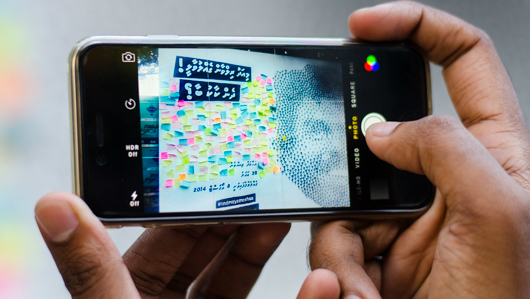
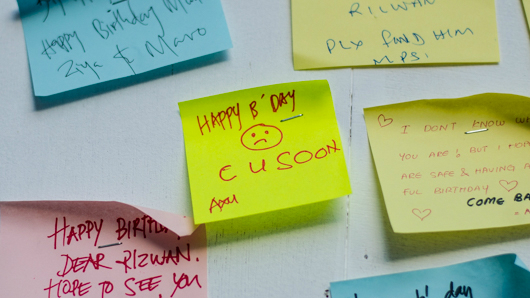
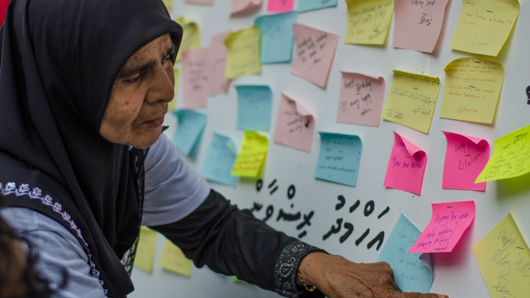
Members of the public and supporters of the campaign to find Rilwan wrote messages of support which were attached to a mural created earlier in the five month campaign.

Messages posted on the mural included: ‘We haven’t given up on you yet’, ‘You are missed’, ‘Hoping for your safe return’, ‘Please come back, we need you’, and ‘You are late for work!!!’.

Hulhumalé terminal was the place in which Rilwan was last sighted on CCTV on August 8, shortly before eyewitnesses reported a man fitting his description being pushed into a vehicle outside of his apartment in Hulhumalé.

Rilwan’s mother Aminath Easa, told Minivan News this week that she would would never give up the search for her son, who turned 29-years-old yesterday.

“God willing, I will do everything in my power to find him, with patience, until I die. I will not stop, no matter what anyone says.”

The Maldives Police Service is continuing the search for missing Rilwan as a top priority, without “interruption or boredom”, Commissioner of Police Hussein Waheed told the press earlier this month.

“I assure Rilwan’s family in this opportunity that the police will continue the search without any interruption or boredom. I wish for Rilwan’s safe return,” he said.

“From our investigations so far, there is no evidence to suggest Rilwan is dead. Therefore, our hope is he is still safe and alive,”

Rilwan’s family has asked the Police Integrity Commission to look into potential negligence in the apparently stalled investigation into his disappearance.

Home Minister Umar Naseer has previously acknowledged involvement of gangs in the case, although police have refused to reveal any information to the family regarding potential theories or avenues of inquiry.

“I am not at all happy with the government’s response,” said Aminath. “I know the police are capable, they have solved cases they work on. They caught the two dangerous convicts who escaped from jail, without firing a single shot.”

“They work when their leaders tell them to. But the government hasn’t told them to find my son. The police will look for him and find him if their superiors order them to do so. I believe government officials are complicit in this case.”

For more pictures of yesterday’s event click here


Related to this story

Q&A: “With patience, until I die” – Rilwan’s mother vows to continue the search

No apparent progress in police search for Rilwan, family plans protest for Friday

MDN investigation implicates radicalised gangs in Rilwan’s disappearance

Likes(2)Dislikes(1)

Government announces completion of all tsunami housing units

The government has announced the completion of all housing units constructed by the state for people made homeless in the 2004 tsunami disaster.

In a joint press conference held today by the housing and finance ministries, Minister for Housing and Infrastructure Dr Mohamed Muizzu declared that 298 housing units in four islands in Gaafu Dhaalu Atoll, and 41 housing units in Thaa Madifushi have now been completed.

Muizzu stated that the government had taken direct control of the project last November on the decision of President Abdulla Yameen following numerous attempts to negotiate with the contractors regarding the delays in work.

On the ninth anniversary of the disaster in December 2013, Yameen had pledged to complete permanent housing for all the 427 families who remained homeless.

Muizzu did not reveal whether new private contractors had been brought in to complete the unfinished work, saying only that there would be no “legal problems in any of the work the government has directly been involved in”.

He also stated that the government took over the project after seeking legal advice from the attorney general and noted that the Anti Corruption Commission and the auditor general were invited to review the proceedings.

Finance minister Abdulla Jihad stated that Vimla Construction Pvt Ltd was awarded a US$20 million contract in October 2008 to build the housing units in Gaafu Dhaalu Atoll for completion within 14 months. Jihad said that approximately US$16.6 million had been spent up to now.

He also noted that the delays and the need for the government to become directly involved in the completion of the housing units meant the projects were likely to cost more than expected, although the full amount has not yet been determined.

“STO has supplied substantial amounts, we estimate that the value (of supplies by STO) will be a significant sum,” Jihad said.

The finance ministry’s audit report of 2011 revealed that it had spent MVR17.5 million to transport materials for the construction of the tsunami housing units in Gaafu Dhaalu. The audit report noted that the expenses, which were not included in the finance ministry’s budget, should not have been paid.

Further, the audit report also recommended a specific audit be done and a report published on the tsunami housing units contracted to Vimla Construction.

The 2004 tsunami resulted in 82 deaths and 26 missing persons in the Maldives. Figures from the UN show that the disaster displaced nearly 10 percent of the Maldives’ population, severely damaging a quarter of inhabited islands with 14 completely evacuated.


Related to this story

Tsunami survivors still without permanent housing

Foreign Minister calls for greater resilience to climate change impacts

Likes(3)Dislikes(0)

Australian Commissioner notes challenges facing police in emerging democracies

Commissioner of Police for Western Australia Karl O’Callaghan delivered a lecture to police officers this morning on the challenges facing police forces in emerging democracies.

O’Callaghan – who oversees a force of more than 5,800 officers – explained that the growth of democracy meant the need for greater accountability and openness within the police force.

“As democracy emerges, the media will become more interested in what you do – the media will want to ask more questions about what you do,” he noted.

“That can be really challenging, and it’s still challenging for me after ten years as commissioner in Western Australia.”

“What we see in the Maldives is still changes of instability, so governments have changed quite a bit in the last ten years and that has an impact on your executive and your command.”

Mutinying police officers were involved in the overthrow of the Maldivian Democratic Party government in February 2012, later being found by the Human Rights Commission of Maldives (HRCM) to have used “excessive” and “discriminatory” force in a “brutal” crackdown against MDP supporters.

A subsequent Commonwealth-led inquiry into events called for investigation of acts of police brutality as well as recommending “immediate steps” to improve the performance of a number of state institutions, including the police and the HRCM.

Attorney General Mohamed Anil told the Majlis last August that five cases concerning police brutality on February 8 were ongoing, after the Police Intergrity Commission had recommended 45 officers be investigated.

Western Australia’s police force has been working with Maldivian authorities since 2006, assisting with the transition of the National Security Services into the Maldives Police Services and the Maldives National Defence Force.

Commissioner of Police Hussain Waheed has also thanked O’Callaghan during his visit for the help of the Western Australia police, as well as giving details of his owe force’s community outreach work.

Scholarship opportunities were launched by the University of Western Sydney (UWS) last year promising Maldivian police officers three-year doctoral research courses to increase the capacity of the Maldivian police.

“In the beginning it’s hard as, under the old system there was less scrutiny, less accountability, under the new system there will be much more but you’ll get used to it cos you’ll get better at what you do,” O’Callaghan told officers today.

Resource constraints also put pressure on police forces to improve efficiency, he noted, requiring feedback from officers on the ground to improve the service. Moreover, greater performance will result in improved relations with the public and government.

“A democratic police force is impartial but is compassionate,” O’Callaghan told the hundreds of officers in attendance, stressing the importance of the words of Robert Peel – the British reformer credited with creating the modern police force: ‘Police are the people and people are the police’.


Related to this story

Police not only solving crimes, but developing responsible youth: Commissioner Waheed

Comment: The Maldives Police Service – politicised or incompetent?

No coup, no duress, no mutiny: CNI report

Likes(2)Dislikes(0)

New HIV prevention strategy to target injecting drug users, gay men, sex workers

The Health Protection Agency’s (HPA) new national strategy on HIV prevention will scale up prevention programmes in key affected populations of injecting drug users, sex workers, men who have sex with men.

By 2016, the HPA aims to reach at least 60 percent of injecting drug users to promote the safe use of injecting equipment and consistent condom use with sexual partners.

The HPA aims to reach 80 percent of sex workers and men who are having sex with men to promote the consistent use of condoms.

The health ministry has previously said the Maldives was sitting on an HIV “time bomb” due to the lack of prevention programmes and specialised care for groups at risk.

The HPA has previously expressed concern over the prevalence of behaviors that increase risk of HIV spread such as promiscuity, unsafe sex and intravenous drug use.

There are nine individuals receiving treatment for HIV at present. The HPA estimates there are 32 individuals living with HIV in the Maldives. The figure could reach 123 by 2020 if prevention measures are not put in place, the agency said today.

Meanwhile, the Society for Health Education (SHE) has called for the integration of sexual reproductive health services and HIV prevention efforts.

“Integrating sexual reproductive and HIV prevention has the potential to stem an HIV pandemic. When vulnerable groups have increased access to and use sexual reproductive health services, it decreases the spread of HIV,” Shiyama Anwar of SHE said.

“Integration of these services provides a more comprehensive service that benefits both the clients and service providers,” she added.

According to the HPA, it currently only receives 15 percent of requested funds for HIV prevention, care, and treatment. The majority of the funds released from state budget are spent on treatment of infected individuals rather than on prevention.

The agency has called on the government to scale up sexual reproductive services and HIV prevention programmes, arguing interventions such as life skill programs for youth would only cost MVR350 per person while the state spends over MVR50,000 on each individual infected with HIV.

In the period between 2006 and 2013, 161 female victims of rape, which included underage girls became pregnant, HPA figures explain. The state spends MVR 174,000 on each child every year under state care. In comparison, providing quality contraceptives only costs MVR 1000 per person annually.

Meanwhile, the state spends MVR 22,900 per month on every individual receiving state care at drug rehabilitation centers. However, methadone or oral substitution treatment would only cost MVR14,400 and comprehensive awareness programmes would only cost MVR 800 per child, says the agency.

The HPA has called on the People’s Majlis to integrate services on HIV prevention, sexual reproductive health, and drug abuse, and grant service providers with adequate financial resources.


Related to this story

Health Ministry seeks to protect mothers and infants from HIV “time bomb”

“Worst fears over HIV coming true”: Health Minister

High-risk behaviour leaves Maldives at risk of HIV/AIDS “explosion”

Likes(2)Dislikes(0)

Islamic Ministry proposes compulsory Zakat in new bill

Islamic minister Dr Mohamed Shaheem Ali Saeed says proposed legislation to collect, distribute, and manage Zakat would facilitate the collection of MVR500 million annually.

Speaking at a workshop involving stakeholders to the Zakat bill, Shaheem said Zakat systems are protected by law in Saudi Arabia, Bahrain, Sudan, Kuwait, and Malaysia.

“In these countries, Zakat systems have been set up and protected by law, while institutions involved in the management of Zakat have been empowered by law. Hence, it is very important that such a system be organised by law in our 100 percent Muslim country,” he said.

The Islamic ministry collected MVR52 million as Zakat last year.

The comprehensive bill defines Zakat as part of a property that must be given by a Muslim individual or business entity for charity to entitled recipients – which includes the poor, heavily indebted individuals, and travellers.

Zakat payment in the Maldives has traditionally been voluntary, but the new bill makes the annual payment compulsory and imposes a jail term of five years or a fine of MVR500,000 for non-compliance.

Wealth, assets, and income are zakatable – subject to the levy – under the new law. These include precious metal holdings, cash and other securities, trade and business inventories, and earnings from agriculture, fisheries, service delivery and mining.

Draft regulations introduced with the bill propose collecting 2.5 percent of the value of financial assets, business goods, net business profits and rent. The regulations also propose collecting 2.5 percent of net income as Zakat.

Analysis of the bill suggests the legislation avoids double taxation by deducting money collected as Zakat from taxes.

The Islamic ministry is to manage the Zakat fund. Money collected as Zakat is not property of the state and cannot be borrowed by the state for fiscal purposes, the bill said.

Protected by law

The Islamic Ministry must set up a Zakat Management Council to manage Zakat funds under the draft legislation. The council is to be supported through the state budget and advised by a Shariah Advisory Committee, appointed by the Islamic ministry.

Zakatable assets and wealth include gold, silver and other precious metals, cash and other securities, and trade and business inventories.

The persons eligible for Zakat are the poor, paupers, those under bondage, those in heavy debt, “those whose hearts are inclined towards Islam,” travellers and zakat officials. Zakat funds can also be used for ‘fi Sabililah’ (‘in the cause of Allah’) purposes or to defend Islam and improve the well being of Muslims.

The poor and paupers include those who are unable to work due to old age, those who are disabled, widows, and students who have no means of income, or those who do not have a legal benefactor.

It also includes legal guardians who are unable to provide for those under their guardianship, those who are unable to initiate an economic activity due to lack of initial capital, and victims of natural disasters.

When allocating money to the poor, the council must consider other forms of state aid and assistance they receive.

Zakat fund could also be utilised to encourage conversion to Islam, for those who strive to prevent harassment aimed at Muslims by non-Muslims and to assist those who have recently embraced Islam.

Zakat allocated for travellers may be given to Muslims who get stranded and become helpless while travelling for a lawful purpose.

The Zakat Management Council will determine the amount of money to be allocated for each category.

According to the bill, property of the state is not zakatable, while draft regulations say Zakat cannot be levied on property or money obtained via a transaction that is not permissible in Islam.

If a non-Muslim owns shares in a company being valued for Zakat, the value of their shares shall not be included in the valuation for Zakat, the draft regulations state.

Zakat funds are to be deposited in an account called the Baithul Maal as a separate and specialised account with the Maldives Monetary Authority.

The auditor general is to perform an annual audit of the Zakat Management Council under the proposed legislation.


Related to this story

More than 53,000 poor to receive Zakat

Donations made from Zakat fund to children’s home, centre for persons with special need

Alms Act to increase zakat contributions

Likes(2)Dislikes(0)

Charlie Hebdo massacre demonstrates “profound need to counter radicalism,” says President Yameen

In a message of sympathy towards the victims of the France attacks, President Abdulla Yameen has said the massacre of 12 cartoonists demonstrates “yet again the profound need to counter radicalism, and to promote tolerance and moderation, which are the true values of Islam”.

On January 9, two masked gunmen armed with AK-47 assault rifles forced themselves into the Paris offices of French publication Charlie Hebdo, killing 12 cartoonists including the editor before escaping by car.

The message addressed to the French President, H.E Mr. Francois Hollande, condemned the “massacre at the Charlie Hebdo office in Paris, and other barbaric acts of terrorism unleashed on France in the last few days by a radical group of terrorists”.

Charlie Hebdo has a history of controversy due to its publication of satirical cartoons depicting Prophet Mohamed, which is strictly forbidden in Islam as it is believed to be akin to idolatry.

Audio from CCTV footage captured during the attack revealed that the attackers shouted: “We have avenged the Prophet Mohamed. We have killed Charlie Hebdo,” before departing from the scene.

Both the attackers were since killed at a later confrontation by French Security Forces, while a woman believed to be an accomplice to the attacks have been reported to have travelled to Syria.

In a tweet, Former President Mohamed Nasheed also strongly condemned the attack, while extending his co‎ndoleces to the families and friends of the victims.

Meanwhile, Bristish tabloid newspaper the Daily Mirror reported that a Maldivian born man – believed to be an Islamic State Jihadist fighter in Syria – hinted that France would suffer a tragedy the day before the attacks in a tweet. Minivan News has not been able to independently verify these reports.

Speaking to the media last week, Commissioner of Police Hussein Waheed revealed that there are over 50 Maldivians fighting in foreign wars.

“These people leave the country under normal procedures. So it is not easy to identify if they are traveling to go fight with foreign rebel groups,” Waheed told the press on Thursday.

In the last two weeks, two immigration officers and a suspect in the brutal murder of MP Dr Afrasheem Ali were reported to be among a group of twelve Maldivians to travel to Syria for Jihad via Turkey. The group also consists of two women and a one-year-old infant.

Maldivians are not barred from international travel, Waheed said, and so “it is not easy to figure out what motive they are traveling for”.

In November, Sri Lankan police detained three Maldivians who were allegedly preparing to travel to Syria through Turkey.

The incident followed reports of a couple from Fuvahmulah and a family of four from Meedhoo in Raa Atoll travelling to militant organisation Islamic State-held (IS) territories.

In November, a jihadist group called Bilad Al Sham Media (BASM) – which describes itself as ‘Maldivians in Syria’ – revealed that a fifth Maldivian had died in Syria.

protest march took place in the capital, Malé, in September, with around 200 participants bearing the IS flag and calling for the implementation of Islamic Shariah in the Maldives.

In late August, Foreign Minister Dunya Maumoon issued a press statementcondemning “the crimes committed against innocent civilians by the organisation which identifies itself as the Islamic State of Iraq and the Levant or the Islamic State of Iraq and Syria.”


Related to this story

Two immigration officers and Afrasheem murder suspect among group of twelve jihadis

Police detain Maldivian jihadis caught in Sri Lanka

More than seven Maldivians fighting in foreign civil wars, reveals home minister

Six Maldivians reported as latest to travel for jihad, taking one-year-old infant

Likes(6)Dislikes(0)

Teacher’s Association welcomes salary hikes

The Teacher’s Association of Maldives (TAM) has welcomed rises to teacher salaries, but noted that the organisation needs to analyse the changes in order to see if teachers’ demands were “satisfactorily met”.

Speaking to Minivan News, TAM’s Secretary General Ali Nazim said the government had not yet released details of the new pay structure despite schools opening up for the new academic year today.

“We welcome the increases in salaries. We have some concerns, we will release a full statement after analysing the changes brought, if they satisfactorily meet our demands”, Nazim said.

The education ministry on Friday announced teachers’ salaries would be increased by 35 and 15 percent depending on the qualification they held.

Those with a Bachelors degree were awarded a MVR3,600 hike – increasing take home pay from MVR11,238 to to MVR14,894, and teachers with a Diploma Certificate were awarded a MVR2,600 hike – increasing take home salary from MVR8,671 to MVR11,337.

Teachers who hold other qualifications were awarded increases between 25 and 15 percent.

Vice president Dr Mohamed Jameel Ahmed today said that the increment to teachers’ salaries would improve the quality of education throughout the country.

Ad hoc policy

Speaking to Minivan News regarding the implementation of the new curriculum for grades one through three, former education minister Shifa Mohamed stated that the introduction of the curriculum came without adequate preparation. Parents and teachers have not been properly briefed on the changes to the teaching style, approach and the aims of the curriculum, she said.

“According to a baseline study, communication and comprehension skills of students are decreasing. Teachers and parents must know that those skills are the skills that are to be targeted and improved through the new curriculum,” said Shifa.

She also expressed concern over the government’s “indecisiveness and lack of consistency” with regards to changes brought to the school management structure, claiming the government had decided to remove the post of deputy principals and leading teachers who play a decisive role in implementing the new curriculum. The ministry had made the decision due to pressure, she said.

“Deputy principals and leading teachers did not have the guarantee that they would have a job by the start of the academic year. That will surely affect their performance.”

Shifa, who currently serves as the Malé City deputy mayor, also said that 14 political appointees were heading all the departments in the ministry despite the civil service regulations requiring otherwise.

“Despite the many political appointees, what we are seeing is the lack of planning and organisation. Quran, Islam, and Dhivehi textbooks for grade 1, 2 and 3 have still not been printed,” Shifa said.

The education ministry’s Permanent Secretary Dr Abdul Mushin said although the ministry had not printed all the books, they are compiled and ready for printing.

Muhsin claimed it was customary to print the final copies after hearing responses from students, teachers, and parents. He also assured that all lessons would be printed individually and made available to students as they are printed.

Opposition leader and former President Mohamed Nasheed, in his message on the start of the new academic year, stated that the key to building a civilized and developed society is education, and stressed the importance of a single session school system.

Meanwhile local media have reported that parents of Feevah Island school in Shaviyani Atoll have closed the school in protest as only six out of 13 teachers turned up for work today. Haveeru reported that the school had not received text books.

Similary, Gulhi Island school, in Kaafu Atoll, local teachers did not turn up for work today in protest against the principal.

Furthermore, students enrolled at the new Hulhumalé pre-school were forced to go to school in plain clothes to the old temporary building as the education ministry had failed to find a party to run the new school on a contract basis.


Related to this story

Education Ministry hikes teachers’ pay by 35 and 15 percent

Teachers’ Black Sunday protest prompts government talks, strike decision pending

Teachers across Maldives take part in ‘black protest’

Likes(2)Dislikes(0)

Education Ministry hikes teachers’ pay by 35 and 15 percent

The Ministry of Education has increased the salaries of some teachers by 35 percent, and others by 15.

At a ceremony at the Islamic College on Friday (January 9) the ministry’s Permanent Secretary Dr Abdul Mushin said Leading Teachers with a Masters degree will now take home a monthly salary of MVR17,334, having previously received MVR13,218.50.

Teachers with a Masters degree have been awarded a MVR4,000 hike in salary, increasing take home pay from MVR12,228 to MVR16,374.

Those with a Bachelors degree were awarded a MVR3,600 hike – increasing take home pay from MVR11,238 to to MVR14,894, and teachers with a Diploma Certificate were awarded a MVR2,600 hike – increasing take home salary from MVR8,671 to MVR11,337.

Teachers who hold other qualifications were awarded increases between 25 and 15 percent.

The academic year is to start on January 11 and will end on November 24.

The increase in salary comes after 90 percent of the country’s teachers protested in September last year – wearing black clothing to raise awareness over issues such as poor pay, inadequate protection of teachers, and the failure to grant the Teachers Association of Maldives official recognition.

Speaking at a press conference today, education minister Dr Aishath Shiham said President Abdulla Yameen had fulfilled his pledge to honor teachers, and that the government’s aim was to employ qualified teachers and provide them with adequate pay.

The ministry had made all necessary preparations for the academic year, the minister said, adding that no student would have to stay home from school due to lack of space or facilities.

Meanwhile, State Minister for Education Adam Shareef said schools would begin teaching the newly compiled national curriculum starting tomorrow.

President Yameen in October made creative arts – including music and dance – optional subjects in curriculum after pressure from religious conservatives and political parties.

Shareef said the ministry will hold training on changes to the curriculum for media, parents, and teachers in the next few months.

Although all books for the new curriculum have not yet been printed, the first packages for the first term have been printed and are being dispersed to schools, Shareef said.

Deputy Minister of Education Ibrahim Ismail today said the government had spent MVR12 million on repairing and renovating 212 schools for the new academic year.

Deputy Minister Azleen Ahmed said the education ministry had given out loans and scholarship to over 1000 students for higher studies in 2014. The same opportunity will be extended this year, he said.

The ministry’s top priority for 2015 was to establish an Islamic University, Azleen said. A bill had been drafted to facilitate the establishment of the Islamic University and will be submitted to the parliament when it opens in March, he continued.

In November, the Maldivian Democratic Party’s budget review committee suggested that the government had not budgeted the required MVR532 million (US$34.5 million) needed to raise the salaries of teachers despite promises made by both President Yameen and Vice President Dr Mohamed Jameel.


Related to this story

Teachers’ Black Sunday protest prompts government talks, strike decision pending

President Yameen announces rise in teachers’ salaries

Likes(6)Dislikes(0)