The Civil Service Commission (CSC) has published the compliance audit report of the Islamic Ministry, the first report of its kind that has been completed by the independent commission.
The compliance audit report found that staff at the Islamic Ministry had been referred to with disparaging terms that could be considered as a form of injury or harm under the civil service regulation while some senior officials used inappropriate language against civil servants.
The report also noted the absence of clear procedures to help civil servants understand their duties at the ministry. Moreover, the report observed that there was no procedure to follow for reporting a civil servant if he or she had violated a law or regulation.
“Security officers and laborers have sometimes been used for employees’ personal work,” the report stated. “Employees have been misusing the internet as internet usage has not been regulated.”
Administrative policy of the ministry meanwhile did not adhere to civil service regulations, the report noted.
“All the required information that has to be in the salary slip is not included in the slip that staff receive,” the report read. “Staff have not been informed about overtime work procedure and employees working overtime have been paid the same amount that they are paid when they work on official days.”
The compliance report also found that allowances had been given to some employees without prior authorisation from the CSC.
“Staff have been shifted from one section to another not in accordance to the CSC regulations, while some staff have started work without signing the employment agreement,” it read. “Staff are not provided with all the amenities that civil servants should receive.”
It also noted that staff had been assigned work continuously for eight days without a break of 24 hours, and male employees were not attired in accordance with the civil service dress code.
Husnu Suood is a former Attorney General and prominent lawyer in the Maldives. This op-ed first appeared in newspaper Haveeru on August 29, 2011. Translated and republished with the author’s permission.
Corruption has spread and taken root in the Maldives to extreme levels. Corruption allegations can be levelled everywhere. This evil disease has become common in state institutions, government offices, public companies as well as private companies and businesses. As a result of corruption allegations against persons filling high posts of state institutions, public confidence in these institutions are lost and instead of places with public respect it becomes the target of public ridicule.
The loss of public funds and opportunities for the public due to corruption is increasing daily. If Rf1,000,000 of public money is spent to purchase a generator instead of the Rf700,000 that should actually have been spent, the public ends up losing Rf300,000. If this Rf300,000 is not pocketed by employees, it could have been spent on other projects for the public. In this vein, we can only imagine the amount of money that is lost on a national level.
If an employee of a private business sells goods at a higher price and deposits the difference into his personal bank account, the business is going to go bankrupt instead of developing and prospering. While the shopkeeper who is employed with a salary Rf4,000-a-month builds two dhonis of his own, the owner of the shop goes bankrupt. If businesses do not lose money in this manner, national productivity is going to rise.
If a state employee spends in excess of his means, buys expensive items, changes his lifestyle and visits Europe for two-week holidays, he must have sources of income or the resources to prosper.
When the personal income tax comes into force, individuals would be legally compelled to file tax returns or financial statements once a year. The statement would clearly show sources of income as well as the level of income. If a person buys expensive items disproportionate to his income or spends in excess of what the financial statement shows is his actual income, the way will be open to determine whether or not he earned that money legitimately.
For example, if tax returns show that a person’s income for the past five years was Rf30,000 and he suddenly buys an expensive brand new BMW car, that would reveal that he has received illegitimate monetary gain. It would mean that he either falsified his true income to evade taxes or that he somehow received a large amount of money through illegal means.
Therefore, if an investigation is launched into such a case, the individual would have to bear responsibility for proving how he suddenly came about the assets or money. If he got the money through selling an ambergris he found, he would have to prove it. If the person got the money through legitimate means, he would not have to worry. If for instance he brought a plot of land legitimately, it would not too difficult to prove.
Drug trafficking and money laundering are two very serious issues currently facing the Maldives. A solution to these problems must be found without further delay. Finding solid evidence for conviction is a major problem faced by investigative authorities. We see a person who is unemployed buy expensive cars, land and property. Although people whisper in secret to each other of their wealth and prosperity, due to the lack of a legal framework to compel them to reveal their sources of income, they are able to stay hidden and benefit from illegal activities. When individuals are forced to file tax returns and details of their income and expenditure, the doors that are now open to commit crimes with impunity, beyond the reach of the law, will be closed.
Taking these matters into consideration, it is not just state revenue that will increase when the personal income tax legislation is passed into law. In addition, it will provide new facilities or means within the tax system to combat the plagues of corruption and drug trafficking. The taxation system will help to establish a strong, sound and fair state.
All comment pieces are the sole view of the author and do not reflect the editorial policy of Minivan News. If you would like to write an opinion piece, please send proposals to [email protected]
Parliament yesterday approved sending Maldivian troops to join UN peacekeeping operations.
In August this year, parliament’s National Security Committee voted in favor of signing a memorandum of understanding with the UN to send Maldivian soldiers to UN conflict zones for peacekeeping operations.
All members of the committee were present at the meeting last Monday when voting took place, including Dhivehi Rayyithunge Party (DRP) MP Rozaina Adam, Peoples Alliance Party (PA) MP Abdul Raheem Abdulla and DRP MP Mohamed Nashiz.
On April 5, the cabinet decided to sign the memorandum of understanding with the UN and forwarded the matter to parliament, noting that it would be important for the Maldives to contribute to international efforts to ensure that every country, society and individual had the opportunity to live in peace and security.
According to 243(b) of the constitution, “if the President, as Commander in Chief, authorises or orders the employment of the military service in defence of the republic or as part of an international undertaking, the President shall without delay submit the authorisation to the People’s Majlis. The People’s Majlis may at any time approve the authorisation, or revoke the authorisation.”
During yesterday’s final debate stage at parliament, opposition MP Ahmed Mahlouf said the issue was “not a joke.”
“This is a very serious issue,” he said. “I do not think any honorable member would want to send some Maldivians abroad to their deaths.”
Religious NGO Jamiyyathul Salaf also expressed concern over the issue and called on the government to withdraw the decision.
Salaf at the time claimed that any Muslim who assisted non-Muslims in a war against Muslims would themselves be branded infidels.
“Muslims will be obliged to treat him as a non-Muslim in all ways, such as if dead, burying without enshrouding the body, burying the body with other non-believer, and when dealing with inheritance matters the terms and condition that applies to a non-believer who dies in a war against Muslims will be applied to him,” the NGO said.
MPs Ibrahim Muthalib, Abdul Raheem Abdulla, Yousuf Abdul Ghafoor, Mohamed Mujthaz, Hassan Latheef, Ahmed Rasheed Ibrahim, Moosa Zameer, MP Abdul Azeez Jamaal Abu Bakur, Hussein Mohamed, Maldivian Democratic Party (MDP) MP Mohamed Nasheed and Dhivehi Qaumy Party (DQP) Riyaz Rasheed voted against signing the MoU with the UN.
Under the proposed legislation, an experienced Muslim foreigner may be appointed among the seven-judge bench for the court, which will have jurisdiction to handle cases relating to transactions concerning tourism, construction, international business, insurance, civil aviation, maritime, shipping, leasing, banking and finance, securities, fishing, company disputes, partnership, professional liability and intellectual property rights.
The mercantile court will also handle contract, trade and service provision, consumer and service recipient protection in cases worth more than Rf15 million (US$1 million).
During today’s preliminary debate on the bill, opposition MPs raised concern that allowing a foreign judge to sit on a Maldivian court would threaten the country’s independence.
MP Ibrahim Muttalib, who recently rejoined the religious conservative Adhaalath Party, alleged that the bill was part of a government “plot to destroy and dis-empower the judiciary.”
“We should be alert to the government’s efforts to change this country’s constitutional system with the scheming of the Jews,” he said, adding that the bill was drafted “under this scheme” by Independent MP for Kulhudhufushi South Mohamed Nasheed, who served as Legal Reform Minister in the last years of the former government.
“If this court is established, in order to bring the judiciary into disrepute, within a few days of its formation there will be courts established in every inhabited island and existing courts will be made redundant,” he claimed.
Other opposition MPs contended that there were enough qualified professionals with the requisite experience in the Maldives.
“If there aren’t competent enough judges, they can be trained,” suggested MP Hassan Latheef.
Appointing foreign judges to a Maldivian court was “completely unacceptable,” said MP Abdul Azeez Jamal Abubakur, objecting to different criteria for Maldivian and foreign judges in the bill.
MP Dr Abdulla Mausoom of the Dhivehi Rayyithunge Party (DRP) acknowledged the need for the legislation but questioned the provision for two foreign judges.
Presenting the legislation on behalf of the government, MP Mohamed Musthafa of the ruling Maldivian Democratic Party (MDP) stressed the “urgent” importance of establishing international standards for dispute resolution in the Maldivian judiciary.
The lack of legal protection for foreign investors in the country was “the main challenge” to operating their businesses, Musthafa explained.
The provision to allow a foreign judge on the bench is to seek expert assistance from foreign judges to establish the court, Musthafa continued, which would have the same status or rank as a superior court.
The court would also have the authority to transfer cases from other courts that fall under its jurisdiction.
Investor confidence
The legislation comes in the wake of concerns aired by international organisations such as the International Committee of Jurists (ICJ) that the existing Maldivian judiciary lacked the independence and capacity to rule in cases involving complex civil proceedings.
Speaking to Minivan News in March after several weeks observing the operation of the Maldives’ Judicial Services Commission (JSC), former Australian Supreme Court Justice Professor Murray Kellam said that an impartial judicial system was a key factor in encouraging foreign investment and could have a direct and significant impact on the economy.
This was something that Singapore recognised 15 years ago, he said.
“They understood the value of a civil system that is incorruptible and competent. They spent a lot of money on their judiciary and Transparency International now rates their civil legal system as one of the best in the world.
“Singapore realised that one of the best ways to attract investment was to have a system whereby international investors knew they would get a fair go in domestic courts. If you look at the circumstances in other parts of the world where investors have no confidence in the judiciary, that deters investment and takes it offshore. They’ll go somewhere else.
Citing Adam Smith, considered one of the founders of modern capitalism, Kellam observed that “Commerce and manufacturers can seldom flourish long in any state which does not enjoy a regular administration of justice, in which people do not feel themselves secure in possession of their property, in which the faith of contracts is not supported by law.”
As a foreign investor, Kellam said, “you want to know that contact you enter into with domestic partners will be understood and enforced by courts if there is a breach. You want courts to judge you impartially – you don’t want to be discriminated against because you are a foreigner.”
“Secondly, it’s no good getting judgement if no there is enforcement – which is a major factor in developing countries. Sure you can get a judgement, but it’s not worth the paper it’s written on because there is no process for getting it enforced, and you can’t turn judgements into anything productive.”
Singapore had recognised this, and become not only a hub for foreign investment but also a regional hub for commercial arbitration, Kellam said.
“People from around the region will use Singapore as a place of law and business,” Kellam observed.
The Civil Court today rejected a case filed on behalf of a civil servant challenging the legality of controversial Rf20,000-a-month committee allowances for MPs.
A group of concerned civil servants filed the case on behalf of Maah Jabeen, Seenu Maradhoo Fenzeemaage, arguing that releasing funds for committee allowance without reimbursing civil servants for amounts deducted from their 2010 salaries violated constitutional provisions on fairness and equal treatment.
On 26 September, the civil court issued an injunction prohibiting the Finance Ministry from releasing funds to parliament until the court delivered a judgment on the case.
In October 2009 – almost a year into the new administration – unpopular pay cuts of up to 15 percent for civil servants were enforced as part of austerity measures to alleviate the country’s ballooning budget deficit.
The austerity measures were met with a severe political backlash. In December 2009, the opposition-controlled parliament added Rf800 million (US$62 million) to the 2010 state budget, including the restoration of civil servant salaries to previous levels.
In January 2010, however, the Ministry of Finance and Treasury refused to restore the salaries after just three months of the cost-cutting measure.
After weeks of legal wrangling with the parliament-appointed Civil Service Commission (CSC), the ministry accused the independent commission of hiding “a political agenda”, and in February 2010 filed a case with the police asking them to investigate it on suspicion of trying to topple the government “and plunge the Maldives into chaos.”
At the height of the dispute in early 2010, permanent secretaries at ministries were ordered to submit different wage sheets by both the Finance Ministry and the CSC.
In April 2010, the Civil Court ruled that Finance Ministry did not have the legal authority to overrule the CSC. Although the government contested the ruling and refused to restore salaries to previous levels, the High Court upheld the lower court ruling in May this year.
Meanwhile in the verdict issued today, the Civil Court noted that the state had appealed the High Court ruling at the Supreme Court, which has since agreed to hear the case.
The court ruled that there were no legal grounds to order the Finance Ministry not to release the funds to parliament as the two budget items in question were “not in the same state or condition.”
Civic action
After parliament’s Public Accounts Committee decided to issue the committee allowance as a lump sum of Rf140,000 as back pay for January through June, a loose association of concerned citizens launched a campaign noting that the state had a staggering fiscal deficit of Rf1.3 billion (US$85 million) as of the first week of September.
Neither lawyer from the civic action campaign was available for comment today.
Some sources have meanwhile criticised the MPs for comparing their salaries and privileges to those of United States congressmen.
“You can’t do that, the two countries are too different,” said No MP Allowance Media Coordinator Hamza Khaleel.
“The salary difference between the highest-paid civil servant and a congressman in the US is 175%, while in the Maldives it’s 365%,” Khaleel pointed out. “Our MPs get as much as MPs in Sweden, but our GDP is nowhere near Sweden’s.”
NGOs have retreated from the issue in recent weeks, but No MP Allowance, a group of concerned citizens which operates primarily through social media outlet Facebook and has almost 3000 members, has been networking to protest the allowance since February. Khaleel said the group is the “single largest civil movement for this issue.”
“You can see that our Facebook page is very active. All of the members might not show up to protest but they are writing letters and suggesting ideas, so you can see that they are involved,” said Khaleel.
Khaleel noted that MP opposition and negative media have deterred the group from publicising its plans, but he said media coverage lately had improved.
Upon hearing of the court’s verdict today, Khaleel said No MP Allowance’s campaign did not depend on a court ruling but on the constituents’ opinions.
“If you ask the MP’s constituents, they will say that the MPs aren’t doing as much as they could have. Very few MPs have taken up issues that are community-focused,” he said.
“Our main focus is still to get constituents to write to their MPs asking them not to take the allowance. We have drafted sample letters that we are distributing for signatures, and will collect and deliver to the MPs. We represent the constituents, if they are not satisfied then we still have work to do,” Khaleel said.
President Mohamed Nasheed’s energy advisor Mike Mason has unveiled the technical and economic justification for transforming the Maldives into a solar-powered nation.
“I have the oily rag job,” said the former mining engineer, speaking at Soneva Fushi’s Slow Life Eco Symposium about the government’s ambition to generate 60 percent of the country’s electricity needs through solar. “It’s a bit like trying to build a complex aircraft while the captain’s trying to fly it.”
Last year the Maldives spent 16 percent of its GDP on fossil fuels, making the country staggeringly vulnerable to even the tiniest oil price fluctuations and adding an economic imperative to renewable energy adoption.
Mason evaluated available renewable alternatives to diesel and concluded that solar was the most abundant, cost-effective and realistic resource to exploit.
“We can forget ocean currents for now,” he said, explaining that as the currents were wind driven and therefore seasonal, marine current generators would only generate significant electricity for half the year.
Ocean thermal was “very exciting”, Mason observed, although he noted that Soneva Fushi bore the scars of a failed ocean thermal project: “I suggest we wait for someone else to pioneer this,” he said.
Biomass generation “fits us rather well”, as even if the most expensive form of biomass was imported from Canada it would represent 50-66 percent the current cost of diesel.
“It is cheap but can only be used at scale, such as Male’ and possibly Addu,” he said.
Wind and solar
That left wind and solar, the potential for which was “fascinating”.
The challenge with wind, however, was that it was inconsistent, and there were large periods of the year with little resource available.
“What do you do in the eight months without enough wind?” Mason asked, displaying wind data collected in the country’s north.
“What you do is put up solar. In that case, why bother to put up wind at all? With solar the sun rises every day – it is wonderfully predictable.”
The trick was going to be to transform solar from a green, niche, “subsidy hungry creature, to something so obvious that the current government of the time sees it as a sensible and intelligent thing to do. The reality is that it is easy to get to 30-40% emission reduction, but getting beyond first stage to the 80-90 percent that has been proposed by cabinet will be more difficult.”
Mason collected data concerning the cost of generating electricity using diesel at 100 of the country’s inhabited islands, “as I felt there was not enough data available”, and found staggering levels of inefficiency.
The numbers, he said, “are really scary. At best it costs 28-29 cents to produce a kilowatt hour, but at the top right of the graph it is costing 77 cents per kilowatt hour. Anything beyond 28-29 cents for a big island and 32-33 cents for a small island is just money being burned.”
The Maldives could quickly and easily save US$0.5-1 million dollars a month “simply by fixing power stations by doing boring, sensible stuff.”
“Diesel engines are designed to work at their rated power – they like going flat out. The moment you back off by half, you end up with a less efficient engine. Many islands have power stations with engines out of proportion to the size of the island’s energy needs – in some cases they are running at 15-25 percent capacity. That is a real cost we have.”
Mason then displayed a graph detailing the cost of providing solar, and observed that the cost plummeted quickly when it came to providing 30-40 percent of the country’s energy needs but sharply increased thereafter to a point where it was less competitive.
The challenge, he explained, was storage – how to retain electricity to operate devices such as lights, fridges and air-conditioners at night.
“Energy storage is the big hole in our story here. The key for me is to reach that 80 percent goal without the [cost] graph rising beyond where it is today,” Mason explained.
Using data detailing the energy use patterns of the island of Maalhos in Baa Atoll, Mason observed a high variability in power demand. Introducing solar without storage – “from panel to fridge” – would complicate that by requiring more flexibility from the existing power plant.
Energy Advisor Mike Mason
“Stick a solar panel on [Maalhos] and you can generate 29kw at midday with zero demand [on the powerplant]. But the maximum you need from the powerplant [without solar] is 42kw. This is a fundamental problem – the more solar you get, the more we have to get the power stations right.”
The cost of providing solar electricity straight from the panel was far below the cost of using diesel on any island, including Male’. On Maalhos, by pointing the solar panel in the same direction all day, “you can meet midday demand easily. But between 6-11 am in the morning, and after 2pm in the afternoon, you still need to meet the cooling load of fridges and air-conditioners.”
Mason had two suggestions – the first was to use (more expensive) tracking solar panels that would follow the sun and extend the daytime period in which demand could be met using solar. This would also generate the maximum yield from each panel, mitigating another problem – space.
“The challenge will be getting tracking to work in a hot, humid, salty environment,” he acknowledged, particularly if the panels were mounted in shallow lagoons.
The cost of providing electricity from solar in conjunction with current commercially available battery technology was not much different from existing diesel arrangements on many islands, Mason observed. “You lose 20 percent of the electricity putting it in and taking it back out, and it is expensive to fix. It’s not good enough.”
However on Maalhos, Mason noted, 28 percent of the electricity demand was for cooling.
“I had a think about storage. We could use really cold water refrigerated during the day, and use that to drive air-conditioning and fridges at night. This applies as much to resorts as it does home islands.”
This innovation would drop the cost to the level of the country’s most efficient diesel generators, Mason explained. For those powerplants currently running at 77 cents a kilowatt, “this is an opportunity to print money – and there aren’t many of those available to the government.”
Challenges
The major problem was obtaining the capital, Mason said, estimating that such an overhaul for the nation would cost US$2-3 billion, “although half of that would come from the tourist industry.”
“With renewable energy, on day 1 you buy 25 years of electricity. It might be cheap, but you still need enough cash on day 1.”
Attracting the investment in a country such as France or Germany would be “a no brainer”, Mason said, however because of the Maldives turbulent political history and fiscal deficit, it had a very weak credit rating.
“There is a shortage of knowledge and skills as well,” he said. “We need an energy technology support unit, and an energy finance corporation that can for this project provide guarantees and get countries to underwrite us. We do not want to be reliant by subsidies.”
In response to a question regarding the planned Gaafaru wind farm, Mason acknowledged the build, own and operate agreement STELCO had signed with Chinese wind turbine manufacturer XEMC to develop a 50mw wind farm at Gaafaru was a potential commercial pressure for adopting solar.
Under this agreement, a backup liquefied natural gas (LNG) plant would also be built, capable of providing up to 30 megawatts on windless days, or when there is not enough wind to meet demand.
Minivan News raised concerns in an article published in April 2010 that according to figures published in a 2003 report by the US National Renewable Energy Laboratory (NREL), North Malé Atoll had an annual average wind speed of 4.9 m/s (17.7 km/h), while a 2005 report by the American Wind Energy Association (AWEA) described the minimum average wind speed needed to run a utility-scale wind power plants as 6 m/s (21.6 km/h).
Mason described the contract as crafted with “more enthusiasm than technical involvement”, and noted that an LNG plant put out 92 percent of the emissions of a diesel plant “of the kind that STELCO already run very well.”
“A single cycle gas turbine of the kind described is very efficient but does not have the flexibility [required]. There is a technical challenge. We need to think about how we integrate things before we sublet the parts, so my instinct is that the contract will not be enacted in form presented.”
Speaking of the solar plan, now backed at least by data if not the finance, a senior government official remarked that the plan to turn to solar was “no longer froth. There’s a shot of espresso in the cappuccino now.”
The Maldives has meanwhile become the first country to crowdsource its renewable energy plan on the internet.
Forum topics in the comprehensive crowdsourcing project include solar and wind technology, energy storage, system control and demand management, novel technologies (including marine current and ocean thermal), biomass power generation, and finance.
Under each topic the Maldives appeals for expert assistance on several technical questions, around issues such as the use of solar panels in corrosive environments, the economics of tracking or fixed solar panel systems, and the viability of low velocity wind turbines.
Dr Abdul Majeed Abdul Bari was reappointed Minister of Islamic Affairs this morning, less than a week after he resigned from the position in the wake of the religious conservative Adhaalath party’s decision to sever its coalition agreement with the ruling Maldivian Democratic Party (MDP).
Dr Bari told Minivan News last week that he resigned “out of respect” for his party’s decision.
While both Dr Bari and State Islamic Minister Sheikh Hussain Rasheed Ahmed were asked to resign by the Adhaalath Party as they could “no longer represent the party in this government”, the latter issued a statement saying he would not resign unless he was asked by President Mohamed Nasheed.
Speaking to press at the Islamic Ministry today, Bari claimed that he accepted the post “as an individual” after “98 percent” of the people he consulted with – including religious scholars, businessmen and members of the general public – had advised him to do so.
Bari explained that he did not resign out of dissatisfaction with the government or difficulties in performing his duties, insisting that he accepted the post again “as a second opportunity to serve the nation.”
President Nasheed had welcomed Bari’s decision to accept the post while remaining a member of the Adhaalath Party, he said, insisting that he had no intention of resigning from the party.
Bari added that he expected Adhaalath Party to be “satisfied” that a member of the party would be filling the post of Islamic Minister.
Bari went on to criticise the party’s decision to sever the coalition agreement, claiming that a decision had been made before the consultation council held a meeting.
Moreover, he added, the meeting was held in violation of party rules and regulations as members were not informed of the items on the agenda. Dr Bari said he had argued against leaving the MDP-led coalition.
Adhaalath Party Spokesperson Sheikh Mohamed Shaheem Ali Saeed, who resigned as State Minister for Islamic Affairs last year, told Minivan News today that Dr Bari’s resignation was “a drama.”
“It was a drama he played so I would not like to comment on his action,” he said.
Adhaalath Party meanwhile issued a press statement today strongly condemning Dr Bari’s decision as going against “the spirit of the party’s constitution as well as the party’s decisions.”
“We also note that Dr Abdul Majeed Abdul Bari lied when he claimed to have assumed the post again after consulting with the party,” it reads, characterising the move as “lowly conduct” on the minister’s part.
The government expects the fiscal deficit to have fallen to a single digit at the end of the year, below the previous forecast of 11 percent of GDP, President Mohamed Nasheed said in his weekly radio address on Friday.
“The budget deficit as a percentage of GDP or national productivity has been estimated for next year at [budget] meetings with ministers and heads of government offices,” he said. “From that estimate we know that government expenditure has been substantially reduced in a number of different areas. For this year, we forecast a budget deficit of 11 percent. We have noted now that it has been reduced by three or four points.”
The government hoped that the fiscal deficit would be below 10 or “a single digit figure” when it is calculated at the end of the year, he said.
The budget deficit, which stood at just 1.9 percent of the economy in 2004, expanded to 7.3 percent in 2006 and ballooned to 23.9 percent in 2007, according to the International Monetary Fund (IMF).
The fiscal deficit exploded on the back of a 400 percent increase in the government’s wage bill between 2004 and 2009, with tremendous growth between 2007 and 2009. On paper, the government increased average salaries from Rf3000 to Rf11,000 and boosted the size of the civil service from 24,000 to 32,000 people – 11 percent of the total population of the country – doubling government spending from 35 percent of GDP to 60 percent from 2004 to 2006.
While preliminary figures had pegged the 2010 fiscal deficit at 17.75 percent, “financing information points to a deficit of around 20-21 percent of GDP”, down from 29 percent in 2009, the IMF noted in March this year.
“We see bringing the fiscal deficit down as the key macroeconomic priority for the Maldives,” the IMF’s Mission Chief to the Maldives, Rodrigo Cubero, told Minivan News at the time. “A large fiscal deficit pushes up interest rates, thereby undermining private investment and growth, and also drives up imports, putting pressure on the exchange rate and inflation, all of which hurts the Maldivian people, particularly the poor.”
“Further efforts are still needed to reduce the fiscal deficit. Those efforts should comprise further tax reforms as well as measures to reduce expenditure and to improve the channelling of social expenditures to the needy.”
Meanwhile in a booklet issued to media titled “the DRP’s response to the government’s economic nuisance package,” the main opposition Dhivehi Rayyithunge Party (DRP) strongly objected to a bill on fiscal responsibility currently before parliament.
The DRP also noted that provisions on imposing limits to government spending would only come into force after 2013.
“In the past three years, the MDP [Maldivian Democratic Party] government earned billions of rufiya by selling off state assets, facilitating business opportunities for their friends and introducing new taxes,” the DRP said. “Nonetheless, while the health sector, the education and overall standard of living has gone from bad to worse, it is unclear how the government spent the billions and billions of rufiya it received.”
The viability of the Maldivian tuna fishing industry is being threatened by the mass harvesting of fish stocks by foreign fishing vessels just outside the country’s exclusive economic zone (EEZ), Minivan News has learned.
Fishing is the Maldives’ second largest industry after tourism, and the country’s largest employer. The sustainability of centuries-old ‘pole and line’ fishing methods is not only considered a source of national pride, but also attracts buyers from premium supermarkets in the UK and Europe.
“We have noticed a decline in skipjack tuna due to the operation of purse seniers, mainly French and Spanish, along our EEZ,” Fisheries Minister Dr Ibrahim Didi tells Minivan News. “We have heard they are using FADS (Fish Aggregation Devices) across a very big area.”
Purse seining is a fishing method whereby a vessel deploys an enormous net to encircle and capture entire schools of fish at once. The method is very cost effective but indiscriminate, and generates a large amount of bycatch.
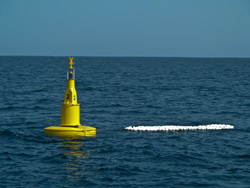
It is particularly efficient used in conjunction with FADs. Fish such as tuna are naturally attracted to the floating object, such as a buoy, typically fitted with a sonar device capable of determining the quantity of fish below, and a satellite uplink that communicates this to the nearby fishing vessel. The vessel’s net does not discriminate between the predators and scavengers attracted by the target fish population around the FAD.
“Nothing escapes,” says Solah Mohamed, Head of Production for the Maldives’ Felivaru fish cannery, which was opened in 1982 in collaboration with a Japanese company.
“Just outside the Maldivian EEZ are thousands of FADS, with sonar and live tracking systems. There are so many deployed that the natural migration of the skipjack is changing,” he says. “Fish that are supposed to migrate into Maldivian waters are being stopped because so many FADS are deployed.”
Solah claims the FADs are deployed by purse seines belonging “mainly to Spain, France and Japan, and also Iran.”
The Maldivian fishing fleet is simply unable to compete due to its reliance on pole and line fishing methods, says Solah, “one of the most sustainable methods of fishing.”
“The issue is that purse seines have become so efficient – and their sizes are becoming huge – as large as 100-400 tons. They say the sonar detects dolphins, but I don’t think it sounds very effective. Sharks, dolphins, turtles – they take everything. I doubt they can be bothered to sort it all out before pulling it on board.”
The under-resourced Maldivian coastguard is unable to monitor the vastness of the Maldivian EEZ, and local fishermen rarely go beyond the 100 nautical miles (the EEZ is 200 miles).
However the issue is not one of legality or of policing capacity. Many vessels at least in the EU fleet are fitted with vessel tracking devices ensuring they do not stray into Maldivian waters. But in international waters, almost anything goes – and seeking to hold foreign countries to account for over-exploitation is near impossible.
“We may as well be under siege,” a senior government source told Minivan News, of the ring of vessels surrounding the country.
Officially, the government is more diplomatic. “This is happening on the high seas and not in our EEZ, so there is very little we can do to raise our concerns,” says Fisheries Minister Dr Ibrahim Didi.
“Purse seiners are operating without limitation in the Indian Ocean near our EEZ, and the Indian Ocean Tuna Commission (IOTC) has not taken any measures against it.
“Since we became a full member of the IOTC we have tried to raise the issue and talk with neighbouring countries to take a joint stand. But the IOTC is dominated by European countries.”
Solah from Felivaru has observed the same problem: “We are just becoming a full member, but Japan, Spain and France are big players in the Commission. I have been to one of their conferences and I feel that their voices are heard more than those of the coastal islands. They have more expertise and they can put forward more resolutions, more numbers – we simply don’t have the expertise to beat them.”
A fish aggregation device, or FAD
Last gasps of the tuna catch
Meanwhile, the pole and line catch in the Maldives is in decline.
Felivaru’s Deputy General Manager Mohamed Waheed observes that the Maldivian tuna catch has fallen from “very high” figures in 2005-2006 “to now less than it was in 1995-1996.”
“The main thing is that the pattern of fishing changed. May to August is the low season, but we can usually still catch fish in the southern waters of the country. But this season it did not happen – we had hardly any fish in the north, and very little in the south.”
The foreign purse seines have not reported a declining catch, notes Solah.
“In commercial fishing we talk about ‘catch’ and ‘effort’,” he explains. “The Maldivian catch is going down but according to the IOTC, the purse seine catch is stable. This means the purse seines have hugely increased their effort.”
Value-adding means employment
Felivaru buys fish from local fishermen, canning, labelling and adding value to the commodity prior to export. The company has high demand for its product from upmarket UK supermarkets such as Waitrose, but has been forced to scale down its production lines because it just cannot buy enough fish.
“We are now processing 15 tonnes per day. We can go up to 50 tonnes if we can get the fish – but our cannery has had to scale down because we don’t get enough,” says Solah.
That has impacted employment: “At the beginning of 2008 we employed 1100 employees,” says Waheed. “Four years later we’re down to half that – 550 workers. And all these people are going to lose their jobs when the fisheries collapse.”
“Maybe tourism brings the most money to the country, but fisheries still provides most of the jobs. It accounts for more than half the employment of the entire country,” he explains.
A question of economics
Former head of the Maldives Industrial Fisheries Company (MIFCO), Adhil Saleem, now the country’s Transport Minister, attributes the decline in local fisheries to the industry’s struggle to meet global pressures and remain competitive.
He espouses a pragmatic, free market view. Marketing the Maldives’ pole and line fishing as a premium ‘eco’ brand pleases environmentalists and looks fine on paper, he explains, “But our gains in the market are eaten up by the supermarkets, because they are the only outlets marketing the product. ‘Maldivian fishermen saving the world’ does not fetch a premium, because as much as they talk about it, the world is not prepared to pay for eco-friendly fishing.”
Saleem contends that small rises in ocean surface temperatures due to climate change are driving fish deeper, further reducing the stocks within reach of the traditional pole and line method.
“Our method only works near the surface,” he says. “But with changes in weather and sea temperature, fish will not surface.”
“At the same time, look at the way we fish – most countries do multi-day trips, sticking with the same school of fish until it is fished out. Our fishermen fish for bait early in the morning, and then in the afternoon if they are lucky they find a school of tuna, fish it and then leave. The next day they make a wild guess as to where it has gone, and hope they get lucky.
“I also get the feeling that because of the high price we get, our fishermen are not putting in their best efforts. At Rf 25-30 (US$1.6-2) a kilogram, in the south it’s not uncommon for a fisherman to be on Rf 11,000 (US$720) a month. The mentality is: ‘I have enough for today, so I can relax. I don’t need to think about tomorrow.’”
Saleem believes the Maldives will eventually have no choice but to begin purse seining, augmenting traditional fishing know-how with technology such as aerial surveys to share with local fishermen sightings of birds circling the schools.
“The Maldives can certify pole and line fishing, while simultaneously conducting purse seining,” he says. “We need field officers to go on board and teach multi-day fishing techniques, such as using lights at night to catch squid and reef fish so that when they come back they have something to sell.”
Thailand tramples Maldives canning industry
As for Felivaru, the Maldives has to come to terms with the fact that it now competes in a global marketplace, and that maintaining such a level of industry is not economically competitive, Saleem suggests.
“If [Felivaru] is unable to compete in the global market it would be better to do something else. Do we ask why Airbus has not built a manufacturing plant in the Maldives? If [fish canning] is a matter of national pride, then so is having a nuclear plant.”
Based on an island in the north of the Maldives, Felivaru is faced with the high logistical costs of feeding and accommodating large numbers of staff, which other canneries in South Asia do not have to contend with.
“The main problem is that Felivaru is an old factory, and secondly the labour cost in the Maldives is very high compared to Sri Lanka or even Thailand,” adds the Fisheries Minister, Dr Didi.
“There is also a problem of quantity and [consistent supply]. If they are running a factory they require a certain amount of fish per day, which is not economic or feasible as the pole and line method means our fishing is seasonal. Felivaru has four production lines, but I doubt they have ever used more than 1-2 lines because not enough fish is available.”
Saleem adds that the Felivaru cannery “has expanded in the north, while the fish are in the south. It would be better for them to operate in Galle in Sri Lanka where they would not have pay the extra costs such as accommodation.”
The outsourced model has been embraced by Felivaru’s competitor, Kooddoo Fisheries, which now exports pole and line tuna caught in the Maldives to the Thai Union cannery in Thailand for processing and export to UK supermarkets such as Sainbury’s and Marks & Spencer (M&S). Kooddoo also buys cheaper purse seines-caught tuna, then processes and sells it to the Maldivian market at a cheaper price point, undercutting Felivaru. The company has recently opened a shop in Male’ and launched a marketing blitz.
“In Male’ we can buy fish caught one-by-one in an eco-friendly manner for Rf 18-19 (US$1.2). We can also buy an imported can of the same fish caught with purse seines for Rf 11 (US$0.70),” says Saleem.
“Instead we should eat the Rf 11 tin and export the Rf 19 tin to increase the amount of foreign currency available. The Maldives, Japan and India are not bothered about pole and line – it is only fashionable in Europe.”
Felivaru’s Solah complains that this approach forces the cannery to compete for the dwindling supply of fish with companies that are simply exporting the raw commodity without adding value.
“The government should be encouraging the fisheries industry to remain in the Maldives, because if the fish stay it means jobs and wealth stay in the country,” Solah argues.
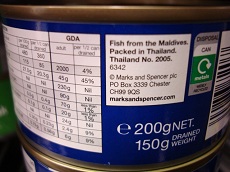
“It is really sad to see the label on these cans that reads ‘Maldivian pole and line tuna’, complete with a picture of a Maldivian island, next to ‘Packed in Thailand’. Who is checking how much the Maldives supplies, compared to how many cans come out of Thailand? They can buy 1000 tons of Maldivian pole and line fish, and supply 2000 tons of Maldivian ‘pole and line fish’ to UK supermarkets. There is no regulatory board monitoring them.”
Saleem argues that Felivaru “cannot expect fish to be sold to it at a subsidised rate. Kooddoo is exporting because the price is better. The companies would not export if Felivaru was prepared to pay world market rates – they just wouldn’t, because of the increased cost of shipping.”
Solah concedes that the Thai Union cannery can afford to pay more for unprocessed fish, even including transport costs, because of the operation’s economies of scale, cheaper labour and lower overheads.
“People are willing to pay more for a premium pole and line product, but currently there is no disincentive to export unprocessed fish,” he says. “Government policy should be to add value while the fish is in the country, and to make sure there is enough fish available to run the factories inside the country at full capacity before exporting it.”
Maldives pole and line tuna, packed in Thailand
Sustainability sells, says Sainsbury’s
Minivan News contacted Sainsbury’s supermarket in the UK, which sells the Thai-processed product marketed as Maldivian pole and line tuna.
“The pole and line method is recognised as the most responsible fishing method for catching tuna mainly as a result of minimising bycatch in the fishery,” explained Sainsbury’s Aquaculture and Fisheries Manager, Ally Dingwall.
Media coverage around the issue of sustainability in fisheries meant it was “increasing in the public consciousness in the UK,” she said.
“The Maldives is associated with a pristine environment and clear, clean waters which deliver great quality tuna, and this is clearly attractive to consumers.”
The supermarket regularly audited its supply chain and was able to trace its products to the capture vessel via the batch code, she said.
“Sainsbury’s have had tuna products packed in the Maldives in the past but encountered logistical difficulties in supply. We are reviewing the situation at present with a view to recommencing an element of our supply from Maldivian canneries,” Dingwall explained. “Our suppliers of products such as sandwiches and sushi which contain tuna as an ingredient are already sourcing pouched, pole and line caught tuna from Maldivian processing establishments.”
Yet while the Maldivian fishing industry grapples with the pressures of climate change, globalisation and appeasing Big Grocery, the ring of foreign purse seines sieging the country’s EEZ are, according to the IOTC, scooping up tuna to the tune of US$2-3 billion a year.
“By catching fish one by one we are using a bucket to scoop from the well, while the rest of the world is pumping,” says Saleem. “It is going to finish – and we will not have got our share of the catch.”
On this, Solah agrees.
“If the Indian Ocean fisheries collapse, the European, Japanese, Chinese and Iranian vessels can go to other oceans. But what can we do? This is the only industry we know. We have to negotiate and beg other countries to please stop, because this is killing us.”
 (0)Dislikes
 (0)
(0)