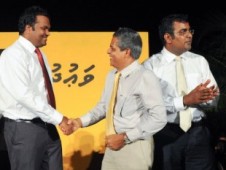
Jumhoory Party MP Muthalib resigns from party

MP Ibrahim Muthalib has resigned from the opposition-aligned Jumhoory Party (JP) led by MP ‘Burma’ Gasim Ibrahim claiming that his dreams of making JP the country’s third most active party had been “shattered due to lack of cooperation.”

“Nine months ago I joined the Jumhoory Party with the hope of making it the third most active party in the Maldives, because I felt that the Maldives was in need of a third party,’’ MP Muthalib today told Minivan News. “Currently only the ruling Maldivian Democratic Party (MDP) and the opposition Dhivehi Rayyithunge Party (DRP) are really heard, and no one says a word against them.’’

He said he was not originally invited to join the JP by Gasim, but joined the party on his own wish.

‘’I have worked nine months to accomplish this but it does not seem to be happening, so I thought it would be best to resign,’’ he said. ‘’The decisions we make are not implemented in the party and the JP really needs more time to stand on its own feet and walk.’’

Muthalib said he had not yet decided to join any other party for the moment.

‘’I resigned because I did not want to remain depressed with these thoughts. For now I just want to relax and remain independent for the time being,’’ he said, adding that he still believed that the Maldives was in need of an active third party other than the DRP or MDP.

Muthalib was elected to the parliament as an independent MP.

”I have officially informed the Elections Commission (EC) and the Speaker of the parliament about my resignation,” he said.

However, newspaper Haveeru quoted Muthalib as saying that his resignation came following Gasim’s vote in favor of the appointment of Dr Ibrahim Didi for Fisheries Minister and and Thalhath Ibrahim for Defense Minister.

Following Muthalib’s resignation, only two MPs of the Jumhoory Party will be left in parliament, Gasim and MP Ahmed Moosa.

Likes(0)Dislikes(0)

“Taxation system long overdue,” says MATI

The Maldives Association of Tourism Industry (MATI) has declared its support for the government’s economic reform programme and the introduction of direct taxation.

In a press statement yesterday, the association of industry leaders noted that the absence of a taxation system in the country “similar to tax regimes successfully implemented in other countries” was a serious impediment to development and economic growth.

“The introduction of such a taxation system to the Maldives is long overdue,” MATI said in its statement.

As the enactment of direct taxation would increase state revenue and reduce government borrowing from banks, “this association believes that banks lending to private businesses will increase and job opportunities will be created.”

“This association believes that as a result of [the economic reforms], economic growth will quicken and challenges faced by the Maldives tourism industry will be solved,” the statement reads.

MATI warned that “it is certain” that if state revenue was not increased “with immediate effect” the domestic economy would be adversely affected.

Consultations

The statement of support from MATI comes after the Tourism Ministry last week condemned “misleading statements in the media” by the organisation about the government’s proposed economic reforms.

The Tourism Ministry claimed that “MATI’s misleading statements in various media recently about the tax bills of the government’s economic reform agenda imply that the government’s efforts were undertaken without consulting officials from the tourism industry.”

The Ministry said it had “consulted a number of parties active in the tourism sector and sought advice for shaping the tax bills so that it would not be a disproportionate burden on the industry.”

“After these consultations, the Ministry is assured that businesses in the tourism industry support the reform agenda. Likewise, those in the front ranks of the tourism industry as well as MATI support it. Therefore, [the ministry] regrets an organisation like MATI making statements that are contrary to the advice and suggestions of senior industry leaders.”

President Mohamed Nasheed has meanwhile welcomed MATI’s support for the government’s fiscal and economic reform plans.

“The President believes that the fact that MATI agreed to fully support the government in its economic reform programmes, after deliberations between MATI and the government, is a sign that they support the measures taken by the government to improve the state of the Maldivian economy and increase the state’s income,” reads a statement from the President’s Office today.

Recommendations

Following consultations with the government, MATI proposed a series of recommendations on the new taxes.

In its comments on the proposed legislation – obtained by Minivan News – MATI stressed the need to educate the public and ease in the taxes gradually.

“There is a need to study the effects of the combined burden of having to pay all these taxes on those affected,” the association noted.

On the introduction of a five percent General Goods and Services Tax, despite the successful introduction of a Tourism Goods and Services Tax (T-GST) in January this year, MATI noted that “T-GST was collected from a highly regulated sector of the economy. The same cannot be said of the other sectors of the economy or of the general public who would end up paying this tax.”

MATI argued that the GST could stoke inflationary pressures, urging “careful study of the effects of GST on the economy.”

“For the tourism industry – Costs of local purchases will go up by the GST amount or more. Direct imports will increase in order to avoid GST. Resorts will have to pay both T-GST & GST,” MATI noted. “Confusion will arise due to different rates being applied. In view of this it is suggested that eventually the two taxes should merge into one GST.”

The organisation also recommended delaying the introduction of a private income tax (PIT) to January 2013 to establish a regulatory framework and raise public awareness.

The organisation contended that the progressive income tax rates – from 3 percent to 15 percent for incomes above Rf30,000 (US$1,900) – were “especially targeted at the very rich.”

“Under the proposal, people earning one million rupees per year will pay about 2.8% of their income as PIT, whereas a person earning MRF10 Million per year will pay about 13.25% of the income as PIT,” it noted.

Moreover, MATI urged that plans to raise the current 3.5 percent T-GST to 6 percent in January 2012 and 10 percent in January 2013 be scrapped in favour of retaining the current rate until a recommended hike to 7 percent in January 2013.

“Tourism industry is already paying a lot to the Government and therefore, we urge the Government to give the industry a breathing space to help the industry revive from low occupancy, heavy operating costs and the economic chaos caused by recent financial crisis in Europe,” MATI said, cautioning against high taxes leading to the Maldives becoming “an even more expensive destination.”

MATI further noted that the taxes were “especially heavy on the tourism industry and will result in a very negative impact on the industry.”

“Tourism will cease to be an attractive industry to invest in. As a result, new investments will be slowed. Proposals to banks to borrow will not look that attractive any more. Bank lending to this sector will become more and more selective. This is not what we like to see in this country,” MATI stated. “Finally, should we continue to ‘milk the cow dry’? Certainly not is the answer.”

“Agreeable”

President Mohamed Nasheed responded to MATI’s recommendations in a letter yesterday, expressing the government’s gratitude for the comments.

“The purpose of these reforms are to set in place the foundation needed to build a strong and modern economy befitting the Maldives’ status as a middle-income country, and to enable the state to provide the necessary services that the people of this country expects,” the letter reads. “In addition to the tax reforms that will allow for a sustainable revenue base, the government’s programme include important reforms such as facilitating the ease of doing business and strengthening property rights.”

On the recommendations by MATI, the President’s letter noted that “the government is agreeable to reduce the proposed rate of tourist sector GST to become effective from January 2013 to 8 percent from the current proposed rate of 10 percent.”

The government was also “agreeable” to MATI’s proposals on capital allowance, pension payments and deducting interest payments from banks and other financial institutions in full, the President’s letter states.

On the impact of the taxes on the economy, the letter notes that “studies have shown that proposed tax rates are lower than those in other island economies and thus will not have an overbearing effect.”

Addressing skepticism of balancing the state budget with the new revenue sources, President Nasheed said that “the revenue impact on the proposed taxes will bring income up to a level where necessary expenditures can be met and lead to a balanced budget in 2015.”

Likes(0)Dislikes(0)

Government submits bill to establish mercantile court

The government has introduced a Mercantile Court bill to the parliament with the purpose of establishing a separate court with a separate seal and special jurisdictions to solve disputes involving business transactions in the Maldives.

Maldivian Democratic Party (MDP) MP Mohamed Musthafa submitted the bill to parliament on behalf of the government.

According to the bill, the Mercantile Court will consist of a Construction Division, Banking and Financial Division, Tourism Division, Investment Division, Goods and Services Division and Proprietary Division.

The bill also gives the Chief Judge of the Mercantile Court the powers to include any other divisions that the court finds that it lacks.

The bill will give the court jurisdiction to handle cases relating to business transactions concerning tourism, construction, international business, insurance, civil aviation, maritime, shipping, finance leasing, banking and finance, securities, fishing, company, partnership, professional liability and intellectual property rights.

The Mercantile Court will also handle contract, trade and service provision, consumer and service recipient protection in matters worth more than Rf 15 million (US$1 million).

According to the bill, the Mercantile Court has the jurisdiction to issue any sort of warrant or orders on its own initiative or upon a request made by a person to uphold justice or to prevent the judiciary from being misused.

The court’s bench will consist of seven judges, and significantly, a Muslim foreigner may be appointed as a judge at the court.

The bill comes following concerns aired recently by international organisations such as the International Committee of Jurists (ICJ) that the existing Maldivian judiciary lacked the independence and capacity to rule in cases involving complex civil proceedings.

Speaking to Minivan News in March after several weeks observing the operation of the Maldives’ Judicial Services Commission (JSC), former Australian Supreme Court Justice Professor Murray Kellam said that an impartial judicial system was a key factor in encouraging foreign investment and could have a direct and significant impact on the economy.

This was something that Singapore recognised 15 years ago, he said.

“They understood the value of a civil system that is incorruptible and competent. They spent a lot of money on their judiciary and Transparency International now rates their civil legal system as one of the best in the world.

“Singapore realised that one of the best ways to attract investment was to have a system whereby international investors knew they would get a fair go in domestic courts. If you look at the circumstances in other parts of the world where investors have no confidence in the judiciary, that deters investment and takes it offshore. They’ll go somewhere else.

Citing Adam Smith, considered one of the founders of modern capitalism, Kellam observed that “Commerce and manufacturers can seldom flourish long in any state which does not enjoy a regular administration of justice, in which people do not feel themselves secure in possession of their property, in which the faith of contracts is not supported by law.”

As a foreign investor, Kellam said, “you want to know that contact you enter into with domestic partners will be understood and enforced by courts if there is a breach. You want courts to judge you impartially – you don’t want to be discriminated against because you are a foreigner.”

“Secondly, it’s no good getting judgement if no there is enforcement – which is a major factor in developing countries. Sure you can get a judgement, but it’s not worth the paper it’s written on because there is no process for getting it enforced, and you can’t turn judgements into anything productive.”

Singapore had recognised this, and become not only a hub for foreign investment but also a regional hub for commercial arbitration, Kellam said.

“People from around the region will use Singapore as a place of law and business,” Kellam observed.

Likes(0)Dislikes(0)

Parliament approves appointment of Defence and Fisheries Ministers

Parliament today approved the appointments of Dr Ibrahim Didi as Minister of Fisheries and Agriculture and Tholhath Ibrahim Kaleyfan as Minister of Defence and National Security.

Dr Didi was approved 40-35 after Jumhooree Party MP Gasim Ibrahim and Independents Ahmed ‘Sun Travel’ Shiyam Mohamed, Ahmed Amir, Ali Mohamed, Ismail Abdul Hameed and Mohamed Zubair voted with the ruling Maldivian Democratic Party (MDP).

Tholhath Ibrahim meanwhile received parliamentary consent with 50 votes in favour and 24 against.

Both the main opposition Dhivehi Rayyithunge Party (DRP) and the independently functioning opposition parliamentary group had declared their intention to reject the reappointment of Dr Didi on the grounds that he had failed to receive parliamentary consent in November, 2010.

Dr Didi was among seven ministerial appointees who did not receive parliamentary consent in November.

DRP Leader Ahmed Thasmeen Ali told press last month that the party did not accept “the President appointing someone parliament has already rejected.”

In its report presented today after evaluating Dr Didi, the Government Oversight Committee – comprised of six oppositon and four MDP MPs – meanwhile recommended that his appointment be rejected on the same grounds.

The committee however recommended approving the nomination of Tholhath Ibrahim as Defence Minister.

Likes(0)Dislikes(0)

DQP MP submits resolution to cut fuel surcharge

The Dhivehi Qaumee Party (DQP) has submitted a resolution to parliament calling on the government to cut the fuel surcharge included in the electricity bill every month.

In the resolution, DQP MP Riyaz Rasheed claims that the fuel surcharge was “a type of tax unapproved by the parliament and taken from the citizens, despite the laws clearly stating that any tax could only be taken after parliament approves it.’’

“When President Mohamed Nasheed was campaigning for the presidential election, the pledge he made publicly was to lower the electricity tariff,” Riyaz Rasheed said in the resolution. “It could be believed that raising the electricity tariff from month to month is a deliberate attempt made by the government to make the citizens poor.”

In the resolution the MP says that electricity is one of the country’s basic needs and that due to the hike in electricity tariffs, “today citizens have to spend bulk of their wage on electricity.”

The resolution also says that the owners of medium-sized businesses were worried about the future of their businesses “because of the government’s decision to float the dollar exchange rate in to a band of Rf10.28 – Rf15.42 which has made the prices of goods increase.”

The MP also called on the government to cease withdrawing taxes from the citizens in the name of fees or charges “at a time when adults and children are forced to live in poverty.”

In May last year the main opposition Dhivehi Rayithunge Party (DRP) led protests outside State Electric Company (STELCO) complaining about increased electricity tariffs.

Likes(0)Dislikes(0)

“Moosa is a big liability”: MDP MP ‘Colonel’ Nasheed

MPs of the ruling Maldivian Democratic Party (MDP) representing Upper North constituencies boycotted a rally last night dubbed “Big Picture for Bodu Thiladhunmathi [Haa Alif, Haa Dhaal, Shaviyani and Noonu Atolls]” in protest of acting Chairperson ‘Reeko’ Moosa Manik allegedly using party resources for “self-promotion.”

MDP MP for Nolhivaram ‘Colonel’ Mohamed Nasheed explained that the MPs decided not to attend the rally as “the purpose was not made clear and there was no discussion with us before it was organised.”

“The second reason is because we believe the party mechanism is being abused to promote a certain person,” Colonel said, referring to former parliamentary group leader Moosa Manik.

Colonel speculated that Moosa was preparing to launch a bid for the MDP ticket for the 2013 presidential campaign.

“We have advised President [Mohamed] Nasheed repeatedly that we should not be making enemies,” he said. “But what we’re seeing from Moosa every day are calls for someone to be killed or arrested.”

Moosa had become “a big liability” for the government and ruling party because of his tendency to “make enemies” and put personal interest before the party, Colonel said.

“Major successes of the party are rolled back because of one word from Moosa,” he continued. “MPs [from other parties or non-aligned] that we bring to the party after a lot of hard work is lost because of Moosa’s personal issues.”

He added that the ruling party suffered as a result of Moosa “making enemies of politicians, businessmen, the judiciary and certain media.”

“There is no one in this country who isn’t an enemy of Moosa Manik now,” he said.

Moosa has been engaged in a long-running feud with private broadcaster DhiTV, which routinely carries allegations of corruption against the MDP Chairperson, notably in the awarding of a US$21 million reclamation project to Moosa’s company Heavy Load.

Moosa meanwhile alleges that 168 bottles of alcohol found in his car while he was in Singapore was an attempt to frame him by the owner of DhiTV, Champa Mohamed Moosa.

“A media channel in this country has used my photo, my car, my family, my children and my name to do business and I want to sue for compensation,” Moosa told Minivan News at the time, referring to DhiTV’s continuous coverage of the incident.

Colonel noted that the allegations in the media were harmful to the ruling party: “I’m not saying the accusations are true, but Moosa has not been able to prove his innocence,” he said.

He urged the party’s acting chairperson to be “more focused” and “make friends instead of enemies.”

Speaking to Minivan News today, Moosa Manik however claimed that he was “not aware that anyone boycotted last night’s rally.”

Moosa also dismissed Colonel Nasheed’s criticism: “Colonel wouldn’t seriously say that about me,” he insisted. “He must have been trying to fool somebody. It must have been a joke.”

Haa Alif Hoarafushi MP Ahmed Rasheed told Minivan News that last night’s rally was announced “suddenly without any discussion” while MPs were busy preparing for a ceremony tomorrow night to unveil the government’s economic reform agenda.

While MPs Hamid Abdul Gafoor, Ilyas Labeeb and Hussein Waheed were only MPs who attended the rally, Rasheed claimed that all three left when they “understood what was happening.”

Rasheed speculated that the “hidden agenda” behind the rally was Moosa’s campaign for the MDP presidential ticket.

“I am certain of [Moosa’s plan to run for presidency],” he said. “Otherwise he wouldn’t be trying to damage and undermine the dignity and integrity of the government.”

President Nasheed met MPs recently to discuss the economic reform package, said Rasheed, and “asked us not to act like children in parliament and argue and scream at each other all the time.”

“[But] Moosa’s nuisance is now worse for us than nuisance from the opposition,” he said, claiming that “every time there is an important vote Moosa angers all the opposition MPs and businessmen in Majlis.”

He added that Moosa’s habit of “making enemies” resulted in MDP losing support of opposition and Independent MPs.

“There is a very important vote tomorrow where we are going to need the support of two opposition MPs,” he explained, referring to a vote on the agenda for Monday’s sitting to approve the president’s nominees for Fisheries Minister and Defence Minister.

Likes(0)Dislikes(0)

Umar Naseer’s fire and security firm denies contract to supply GMR

Local fire and security technology firm Alarms Pty Ltd, owned by prominent opposition politician Umar Naseer, has refuted media reports that it won a contract to supply equipment for GMR’s development of Ibrahim Nasir International Airport.

MNBC and Haveeru quoted an unamed GMR official as confirming that Alarms had been contracted to supply fire and security services to the airport. However a press statement from Umar Naseer’s company denounced the “false media reports”, stating that it was “regrettable that such a false report could be made public by two of the largest media outlets in the country.”

Umar Naseer was among the most vocal opponents of the decision to hand the upgrade and management of the international airport to the Indian infrastructure giant, variously accusing the government, GMR, DRP Leader Ahmed Thasmeen Ali and Speaker of Parliament Abdulla Shahid of corruption in the deal.

Speaking to Minivan News in June last year, Naseer described the decision to hand the management of the airport to GMR as “ridiculous”, alleging that it would not only result in the loss of thousands of jobs, but also take away the Maldives’ authority to decide which flights would be permitted to land at the airport.

”That means, if [the operators] allowed it, an Israel flight can come and stop over after bombing Arab countries,” Naseer claimed at the time.

Spokesperson for GMR Mohamed ‘Kudu’ Ibrahim told Minivan News that Alarms was the sole distributor for a particular system supplied to the existing airport 3-4 years ago when it was under the management of Maldives Airports Company Limited (MACL).

“It is not even a contract. Alarms is the sole distributor for the system and it is impossible to get the brand from anyone else [in the Maldives],” he explained. “If there is a problem or a breakdown GMR also brings in technicians from Alarms.”

On its website, Alarms explains that “the very essence of Alarms Pte Ltd comes from the various experiences of Mr Umar Naseer. During his 7-year career in the National Security Services (NSS) he led several investigations of resort fires. He also investigated the cause of many major fires that occurred in Male’ during that period. His experience led him to believe that a private fire and security industry would help the country in many ways.”

Likes(0)Dislikes(0)

No maritime agreement, confirms Sri Lankan High Commission

The Sri Lankan High Commission has refuted the existence of a special agreement allowing Sri Lankan vessels to cross Maldivian territorial waters.

News of such an agreement was published last week in Maldivian media after Sri Lanka’s Deputy External Minister Neomal Perera was quoted in Sri Lanka’s Daily Mirror newspaper as saying such an agreement had been signed.

In the Maldives, Fisheries Minister Dr Ibrahim Didi and Foreign Minister Ahmed Naseem denied such an agreement existed, while the President’s Press Secretary Mohamed Zuhair said foreign vessels already had such permission under the UN Convention on Law of the Sea.

The opposition Dhivehi Rayithunge Party (DRP) denounced the supposed agreement as an assault on soverignity and “an insult to Maldivian fishermen”, questioning the capacity of the country to monitor illegal fishing, while Maldivian Democratic Party Chairperson ‘Reeko’ Moosa retaliated by saying such a statement was “very irresponsible” as it implied Sri Lanka were “thieves”.

The matter entered parliament and MDP MP Mohamed Musthafa threatened to present a motion without notice to reverse the supposed agreement.

However in a letter sent to the Maldives Foreign Ministry seen by Minivan News, referring to articles on the matter published in local newspapers Haveeru and Miadhu, the Sri Lankan High Commission stated that “The Deputy Minister of External Affairs of Sri Lanka has made no statement claiming that a maritime agreement to facilitate Sri Lankan vessels to cross Maldivian territorial waters has been signed between the two countries. This is the official position of the Government of Sri Lanka.”

Attached to the letter was the original statement from Sri Lanka’s External Ministry, reporting that the minister had successfully negotiated the release of seven Sri Lankan vessels held by the Maldives on suspicion of poaching, but made no mention of a signed agreement to allow vessels traffic through the Maldives.

The Ministry of Fisheries meanwhile noted that while “innocent passage” was routinely granted for foreign vessels, unlicensed foreign fishing vessels were required to notify the ministry before entering the Maldives exclusive economic zone.

Likes(0)Dislikes(0)

President forms office to oversee “second chance” inmates

President Mohamed Nasheed has formed an office to oversee the release of almost 400 inmates released under the “second chance programme”, and has also formed a steering committee and a technical committee to monitor the reintegration of former inmates into society.

According to the President’s Office, the Second Chance Office will be administered by the Department of Penitentiary and Rehabilitation Services (DPRS), which is under direct authority of the Ministry of Home Affairs

“The Second Chance Programme Office is a government agency which will provide employment assistance, counselling for substance abuse, mentoring and other services that can help to reduce recidivism and promote social reintegration of inmates,” the President’s Office said.

The Steering Committee consists of Minister of Health and Family Dr Aminath Jameel, Minister of Human Resources, Youth and Sports Hassan Latheef, Minister of State for Home Affairs Mohamed Naeem, Deputy Minister for Health and Family Lubna Mohamed Zahir Hussain, and Director at the Ministry of Human Resources, Youth and Sports Aishath Rasheed.

The members appointed to the Technical Committee are the Mayor of Male’ City Maizan Ali Maniku, Deputy Minister of Islamic Affairs Mohamed Farooq, Deputy Commissioner of Police Ahmed Muneer, and Deputy Director at the Maldives Police Service Sabra Nooraddeen.

At a press conference today, Deputy Health Minister Lubna Mohamed announced that 47 inmates will be released this evening.

Lubna told press that all inmates will be given three days free to spend with their families before they will have to come out for work and attend programmes held at the Second Chance Office.

Of the 47 inmates to be released tonight, 16 have job placements secured at the Maldives National Defence Force (MNDF) engineering corps, Lubna said.

Speaking at the press conference, State Minister for Home Affairs Mohamed Naeem stressed that all the inmates will be closely monitored by police.

He added that any inmate that fails to fully comply with the Second Chance Office will be promptly sent back to prison to complete the rest of their sentence.

Likes(0)Dislikes(0)