Former DRP MP wins beachfront house in Hulhumale’ with Rf4.6 million bid

Former opposition Dhivehi Rayyithunge Party (DRP) MP Ali Waheed, who recently joined the ruling Maldivian Democratic Party (MDP), has just won a beachfront house for Rf4.6 million (US$300,000), bidding Rf3020 per square foot.

Local newspaper Haveeru reported that Ali Waheed’s wife had also won a house from the 36 beachfront residential plots on Hulhumale, bidding Rf 3020 per square foot, for Rf 4,749,651 (US$310,000). Waheed and his wife were the third highest bidders for the property, under the Hulhulmale Development Corporation (HDC)’s housing programme.

Waheed’s former opposition colleague, MP Ahmed Nihan, questioned Waheed’s ability to afford such a property on his MP’s wage. Waheed, he alleged, “was quite a poor boy when we first met him as a DRP MP – that’s why we spoke with a friend and arranged him a house for rent that did not require an advance paid upfront,” said Nihan. “There was no way that Waheed could afford to buy a house in Hulhumale’ for Rf4.6 Million unless there was a hand of corruption in it.”

Nihan claimed that Waheed “earns a little more than Rf 60,000 (US$4000) a month like other MPs, pays Rf 25,000 (US$1600) in monthly rent for the apartment he currently lives in, and has to spend the rest on living expenses and helping constituents and travelling to islands to attend meetings and stuff – where did he get the Rf 4.6 million?” Nihan questioned.

Waheed, who was dropped to parliament every session by a fellow MP, “now owns a Mazda 3 with a driver”, Nihan added, further claiming that the MP had paid an advance for his apartment in US dollars.

“Since he joined MDP he always seems very happy and contented. He now has a Mazda 3, has paid the advance payment of his rented house in US Dollars – the payment we delayed for him because he wasn’t wealthy and the landlord was a DRP supporter.”

If Waheed got all the money genuinely by being a MP, “Why does no other MP get to buy a beachfront house in Hulhumale’ for Rf4.6 Million? I cannot afford that,” Nihan claimed.

“MDP MPs are not only fortunate enough to win houses, they also have been winning reefs, uninhabited islands and resorts as well,” he claimed.

Waheed was not responding to calls at time of press.

Aside from Ali Waheed, President Mohamed Nasheed’s brother Dr Ibrahim Nashid and two children of Human Rights Ambassador Mohamed ‘Go Go’ Latheef also won bids for houses in Hulhumale’.

Likes(0)Dislikes(0)

Fiscal responsibility bill presented to parliament

A fiscal responsibility bill to impose limits on government spending and ensure public debt sustainability was proposed to parliament yesterday.

Presenting the draft legislation on behalf of the government, MP Ahmed Easa of the ruling Maldivian Democratic Party (MDP) said that a lot of effort was needed to “change the inherited, outdated and indebted economic system.”

“Since 2005, [expenditure] in the annual state budget was out of proportion to income and the budgets had a very high level of debt,” he explained.

As a consequence of issuing treasury bills (T-bills) to finance the budget deficit, Easa continued, banks reduced lending to local businesses in favour of buying government securities, which exacerbated unemployment and slowed growth.

Easa noted that according to the World Bank, a 66 percent increase in salaries and allowances for government employees between 2006 and 2008 was “by far the highest increase in compensation over a three year period to government employees of any country in the world.”

“We are seeing the bitter consequences today of spending out of the budget without any control or limit,” he said.

As measures to mandate fiscal responsibility, said Easa, the legislation would set limits on government spending and public debt based on proportion of GDP (Gross Domestic Product).

Borrowing from the central bank or Maldives Monetary Authority (MMA) should not exceed seven percent of the projected revenue for the year, Easa said, while the loan would have to be paid back in a six-month period.

Moreover, a statement outlining the government’s mid-term fiscal policy must be submitted annually to parliament at the end of the financial year in July.

Opposition

Opposition Dhivehi Rayyithunge Party (DRP) MP Dr Abdulla Mausoom however argued that the purpose of the legislation was to negate controversial amendments brought to the Public Finance Act last year.

Mausoom explained that the passage of the fiscal responsibility bill would abolish article five of the Finance Act amendments bill, which stipulated that the government must seek parliamentary approval before obtaining loans.

According to the amendments voted through by the opposition majority, “any relief, benefit or subsidy provided by the state” would also be subject to parliamentary approval.

The amendments were cited as the main reason for the cabinet resignation on June 29 last year – President Mohamed Nasheed announced at the time that he would veto the bill as the new laws would make it “impossible for the government to function.”

While President Nasheed has since ratified the bill after parliament overrode the veto, the government filed a case at the Supreme Court in December 2010 contesting the constitutionality of some provisions.

The DRP MP for Kelaa meanwhile argued that the fiscal responsibility bill was drafted to “take away all the powers given to local councils [under the Decentralisation Act] and give it back to the Finance Minister and President.”

Mausoom also criticised a provision that would empower the Finance Minister to change cash flow plans proposed to the state budget by independent commissions.

Debt sustainability

Finance Minister Ahmed Inaz informed parliament yesterday that the public debt of the Maldives – excluding government securities – stands at US$637.6 million – including US$446 million outstanding debt inherited from the previous administration.

A UNDP paper on achieving debt sustainability in the Maldives published in December 2010 observed that “as a percentage of GDP, public debt levels have almost doubled from 55 percent in 2004 to an estimated 97 percent in 2010.”

“Public debt service as a percent of government revenues will more than double between 2006 and 2010 from under 15 percent to over 30 percent,” it continued. “The IMF recently classified the country as ‘at high risk’ of debt distress.”

As short-term contributing factors for the country’s “rapid accumulation of public and private debt,” the paper identified the devastating tsunami of December 2004; the cost of the democratisation process that began in the same year; the concurrent global food-fuel-financial crises between 2007 and 2010; and the Maldives’ graduation from a Least Developed Country (LDC) in January 2011.

The UNDP paper noted that the reconstruction effort was largely financed by international donors: “Following the tsunami, ODA [Official Development Assistance] increased sharply from US$72 million in 2004 to US$824 million in 2005. ODA levels remained above US$500 million annually for the next four years,” the paper explains.

However as a consequence of high demand for local expertise by multilateral agencies, “increases in public sector salaries were implemented in order to retain qualified personnel with the government.

“Between 2004 and 2009, the average monthly salary of a government sector worker increased from MRF 3,223 (US$250) to MRF 11, 136 (US$866),” the paper notes.

It adds that the government of former President Maumoon Abdul Gayoom responded to growing calls for democratisation with “a substantial fiscal stimulus programme” of increased government spending, “much of which was not related to post-tsunami reconstruction efforts.”

“This strategy led to a large increase in the number of civil servants from around 26,000 in 2004 to around 34,000 by 2008 or 11 percent of the total population. Thus the government simultaneously increased the number of public sector workers as well as their salaries,” the paper notes.

Consequently, by 2010 recurrent expenditure – wage bill and administrative costs – was projected to exceed 82 percent of total expenditures “while capital expenditures will amount to just 18 percent in the same year.”

Moreover when the impact of the worst global recession in decades struck the Maldives in September 2008, “the Maldivian economy was already in the middle of a severe economic crisis with substantial fiscal and current account deficits, high liquidity growth, double digit inflation, pressure on the fixed exchange rate, increases in public and private sector debt, rising inequalities between the capital and the atolls, and a costly civil service.”

Meanwhile as the ballooning fiscal deficit reached 26 percent of GDP in 2009, tourist arrivals declined ten percent in the first year of the new administration.

However the new government’s efforts to reduce government spending with pay cuts of up to 20 percent and plans to downsize the civil service – which employs a third of the country’s workforce – was met with “a severe political backlash from parliament.”

“In March 2010, the parliament passed a 2010 budget with amendments which increased the government’s proposed budget by 7 percent (or 4.5 percent of GDP),” the paper observed.

“Three quarters of this increase funded a reversal in civil service wage cuts implemented the previous year. Progress on redundancies has also been slower than expected and reforms in this area are unlikely to be completed until the end of 2011 at the earliest. This will have important fiscal consequences.”

Likes(0)Dislikes(0)

Tourism Ministry condemns “misleading statements” from MATI over economic reform

The Tourism Ministry has condemned the Maldives Association of Tourism Industry (MATI) for “making statements to media outlets in a way that misleads the public about the government’s economic agenda”.

In a statement, the Ministry claimed that “MATI’s misleading statements in various media recently about the tax bills of the government’s economic reform agenda imply that the government’s efforts were undertaken without consulting officials from the tourism industry.”

The Ministry said it had “consulted a number of parties active in the tourism sector and sought advice for shaping the tax bills so that it would not be a disproportionate burden on the industry.”

“After these consultations, the Ministry is assured that businesses in the tourism industry support the reform agenda. Likewise, those in the front ranks of the tourism industry as well as MATI support it. Therefore, [the ministry] regrets an organisation like MATI making statements that are contrary to the advice and suggestions of senior industry leaders.”

Secretary General of MATI ‘Sim’ Mohamed Ibrabim was not responding at time of press.

The government has presented a raft of economic reform bills to parliament detailing several new taxes, including a business profit tax, general GST and income tax of those earning over Rf 30,000 (US$2000) a month. The government is also looking to increase its previously-passed tourism goods and services tax (TGST) of 3.5 percent to 6 percent, in exchange for lowering import duties, claiming that this will benefit businesses by allowing them to pay tax at the point of sale.

Secretary General of the Maldives Association of Travel Agents and Tour Operators (MATATO), Mohamed Maleeh Jamal, told Minivan News that his organisation had been consulted by the Maldives Inland Revenue Authority (MIRA) prior to the passage of the TGST, and was pleased to see some clauses implemented reflecting the input.

While no government body had sought to meet MATATO regarding the latest batch of bills, Jamal said parliament had forwarded them to MATATO for comment and input.

The Maldives pledged to the International Monetary Fund (IMF) earlier this year that it would pursue a package of policy reforms in exchange for a a three year economic programme to stabilise and strengthen the Maldives’ economy.

Under the new IMF program the Maldives has committed to:

  • Raise import duties on pork, tobacco, alcohol and plastic products by August 2011 (requires Majlis approval);
  • Introduce a general goods and services tax (GST) of 5 percent applicable to all sectors other than tourism, electricity, health and water (requires Majlis approval);
  • Raise the Tourism Goods and Services Tax (TGST) from 3.5 percent to 6 percent from January 2012, and to 10 percent in January 2013 (requires Majlis approval);
  • Pass an income tax bill in the Majlis by no later than January 2012;
  • Ensure existing bed tax of US$8 dollars a night remains until end of 2013;
  • Reduce import duties on certain products from January 2011;
  • Freeze public sector wages and allowances until end of 2012;
  • Lower capital spending by 5 percent
Likes(0)Dislikes(0)

Kuredhu quad-bike unregistered and unauthorised for use, MDP MPs claim

A quad-bike that crashed into a tree in Kuredhu Resort killing two British tourists last week was neither registered nor authorised for use, MPs of the ruling Maldivian Democratic Party (MDP) claimed during debate on a motion without notice today.

The emergency motion proposed by MDP Chairperson ‘Reeko’ Moosa Manik noted that the King Quad 700 model bike was not legally registered at the Maldives Transport Authority while its driver Filip Eugen Petre – a Swedish national and son of a resort shareholder – did not have a license to operate the vehicle.

“Two kinds of vehicles are commonly used in Maldivian resorts,” Moosa said in his opening remarks of the debate. “That is vehicles used for lifting goods and golf carts or buggies for transporting guests.”

Moosa alleged in parliament that attempts were made to “to hide the boy [Petre] and put the blame [for the accident] on a Maldivian employee in the resort.”

The former MDP parliamentary group leader called on the government to investigate the accident “even if it involves bringing officials from the British government to uncover how this really happened.”

Other MDP MPs expressed concern about the impact of such incidents on the tourism industry and repeated calls for a thorough investigation.

“I don’t know for what reason such a vehicle used in big mountains or at high speeds should be used in resorts,” observed MP Ahmed Sameer, deputy parliamentary group leader of the ruling party.

Several opposition MPs however strongly objected to the motion, arguing that it should not have been tabled in the agenda as it represented “a personal attack” by Moosa.

Opposition Dhivehi Rayyithunge Party (DRP) MP Ali Azim claimed that Moosa was motivated to submit the motion by DhiTV’s continuing coverage of alcohol bottles found in his car – a network owned by Champa ‘Uchoo’ Mohamed Moosa, who also owns the Kuredhu resort.

The motion was however approved for debate in a 29-7 vote.

“Some people who have resorts in this country are using private media to defame others and hide their crimes,” Moosa said, referring to DhiTV.

“It is noteworthy that some media connected to this resort has not covered any news of [the Kuredu accident].”

Moosa also strongly criticised resort owners for “mortgaging state property” and propping up an autocratic regime to enrich themselves.

MP Riyaz Rasheed of minority opposition Dhivehi Qaumee Party (DQP) meanwhile accused the MDP chairperson of corruption – in a US$21 million deal to reclaim land in Thilafushi – and suggested that Moosa should be evaluated to “see if he is even fasting today.”

Independent MP Ahmed Amir cautioned against speculation regarding the accident as foreign media could report “MPs implying in parliament that this was done by Maldivians.”

In his turn, Jumhooree Party (JP) MP Ibrahim Muttalib alleged that police destroyed or hid evidence in some criminal cases “probably on orders from the government.”

DRP Leader Ahmed Thasmeen Ali meanwhile contended that the incident should not be debated at parliament as a police investigation was ongoing.

Likes(0)Dislikes(0)

Opposition Parliamentary Group to reject appointment of ministers Didi and Tholhath

The opposition parliamentary group has announced that it will reject the appointment of Dr Ibrahim Didi as Fisheries Minister and Tholhath Ibrahim as Defense Minister.

Spokesperson for the group, MP Ahmed Mahlouf  of the Dhivehi Rayyithunge Party (DRP)’s Z-faction, has confirmed the decision.

DRP MP Abdulla Mausoon said the faction of the party loyal to leader Ahmed Thasmeen Ali had decided to accept Tholhath but reject Dr Didi.

“Our parliamentary group found that it does not make much sense appointing someone who has been already dismissed by us,” Dr Mausoom said. “Our leader MP Ahmed Thasmeen Ali met with the press when they both were appointed by the President and revealed our stand.”

Dr Mausoom insisted that the same procedure had to be applied for everyone, recalling that when President Mohamed Nasheed reappointed Dr Ahmed Ali Sawad as the Attorney General after the parliament rejected him once, he was rejected a second time.

DRP MP Ahmed Mahlouf and DRP MP Ahmed Nihan did not respond to Minivan News at time of press.

Dr Didi is currently the President of the ruling Maldivian Democratic Party (MDP), but was reappointed as Fisheries Minister by President Nasheed on July 19.

Dr Didi resigned from his position as the Fisheries Minister along with the other cabinet members in protest to the opposition parliamentarians alleged obstruction of executive power in June last year. His subsequent reappointment was dismissed by the opposition-majority parliament, along with seven other ministers.

Likes(0)Dislikes(0)

Maldives calls for end to state-sponsored violence against civilians in Syria

The Foreign Minister of the Maldives Ahmed Naseem has called on Syria to immediately stop all the violence committed against civilians and urged the United Nations Human Rights Council (UNHRC) to refer the issue in its upcoming session if the Syrian government continues to oppress its citizens.

Syria remains in turmoil following anti-government riots that spread across the Arab world earlier this year. Al-Jazeera reports that 1730 civilians and 406 security personnel have been killed in clashes in Syria since the start of the violence.

“The Maldives, like many other peace-loving Muslim nations as well as the wider international community, is deeply disturbed by the State-sponsored violence being perpetrated against civilians in Syria, violence which represents a serious violation of Islamic values, as well as of international human rights and humanitarian law,” Naseem said.

“The fact that such violence is increasing as we enter the Holy Month of Ramadan, a period of devotion and compassion, makes the actions of the Syrian authorities even more unacceptable.”

The Foreign Minister called on Syrian authorities to cease all violence against citizens and to begin a process of democratic and human rights reform.

“The time for promises is over – it is now time for action. That means the government must immediately stop all violations of human rights, including arbitrary killings, arbitrary detention, disappearance and torture; and must immediately allow the full enjoyment of all core human rights including freedom of expression and freedom of assembly. It also means that stated commitments of reform – which the Maldives has welcomed in previous statements – must be translated into real and urgent change, including free and fair multiparty elections.”

In addition Foreign Minister Naseem said that Syria must also fully comply with UN Human Rights Council resolution S-16/1, noting that Syria had yet to comply with any of the provisions of the  resolution including the call to cooperate fully with the United Nations Fact-Finding Mission.

“The indiscriminate killing of innocent Muslim men, women and children by the Syrian State security forces, especially during the Holy Month of Ramadan, is completely unacceptable to the Maldives,” Naseem said.

“The Maldives, which is a member of the United Nations Human Rights Council, voted in favor of resolution S-16/1 because of our strong commitment to human rights, especially in the Muslim world.”

“The Maldives takes note of, and supports, the recent statements on this matter made by the Kingdom of Saudi Arabia, Turkey, the Arab League and the Gulf Cooperation Council,” he added.

Likes(0)Dislikes(0)

Government inherited outstanding debts of US$446 million, says Finance Minister

The former government left a dispersed outstanding debt of US$446.5 million owed to foreign and local banks, Finance Minister Ahmed Inaz informed MPs today during Minister’s Question Time in parliament.

In response to a query by Dhivehi Qaumee Party (DQP) MP Riyaz Rasheed about the amount of loans obtained by the previous and incumbent governments, Inaz revealed that as of April 30 2011, the new administration has taken loans amounting to US$196.4 million.

“Out of that, US$5.1 million has been paid back in accordance with the agreement,” he said. “Therefore, the total dispersed outstanding amount is US$191.2 million.”

Inaz stressed that the loans of both governments were being paid on schedule “without any default.”

Outstanding debts of the previous government included a loan obtained for a fisheries project in 1979, Inaz said.

Asked by MP Abdulla Yameen – leader of minority opposition People’s Alliance – if the figures provided included receipts from sale of treasury bills, Inaz explained that “the total figures I’ve provided do not include treasury bills because the question today was about loans, which is different from securities.”

The total domestic debt in November 2008 – including T-bills issued by the former government – when the new administration took office stood at Rf809 (US$52.4 million), Inaz revealed.

“As of July, 2011, there is now Rf4.9 million (US$317,700) as total debt in T-bills,” he said, adding that parliament approved a budget with Rf1.3 billion (US$84 million) from issuance of T-bills to cover recurrent expenditure.

Inaz noted that the state budget passed by parliament in past years was structurally in deficit, with expenditure outstripping revenue: “To solve this, the tax bills proposed by the government has to be passed and I hope the honourable Majlis will solve this,” he said.

Jumhooree Party (JP) Leader Gasim Ibrahim – who as Finance Minister oversaw the expansionary fiscal policies – meanwhile asked to clarify if the total outstanding debt of the former government included foreign loans to assist victims displaced by the December 2004 Asian tsunami.

According to a UNDP paper on the Maldives’ debt sustainability published in December 2010, “as a percentage of GDP, public debt levels have almost doubled from 55 percent in 2004 to approximately 97 percent in 2010.”

“Public debt service as a percent of government revenues will more than double between 2006 and 2010 from under 15 percent to over 30 percent,” the paper noted. “The IMF [International Monetary Fund] recently classified the country as ‘at high risk’ of debt distress. From a human development perspective, the extent to which increased debt service obligations may put at risk key social and infrastructure expenditures give serious cause for concern.”

In May, 2011, the IMF warned that the Maldives “continues to suffer from large fiscal and external imbalances.”

The IMF agreed to a “medium-term” policy from the government to reduce its budget deficit “substantially”, “both through additional revenue measures – which would require the support and approval of the Majlis – and through expenditure restraint.“

“The authorities have introduced an initial voluntary separation plan for government employees and are continuing their detailed analysis of the public service, with an eye toward right-sizing government over the medium term,” the IMF noted.

Likes(0)Dislikes(0)

Maldivian fishermen to teach pole-and-line method to Seychellois, says President Nasheed

A bilateral agreement has been reached for Maldivian fishermen to instruct the Seychellois in environment-friendly pole-and-line fishing methods, President Mohamed Nasheed told press yesterday upon his return from an official visit to Seychelles this month.

President Nasheed explained that the Seychellois fisheries industry was based on long-line fishing by licensed foreign parties, with an annual catch of 250,000 tonnes compared to 140,000 tonnes per annum in the Maldives.

Long-line fishing and bottom trawling in the Indian Ocean has adversely affected fishing in the Maldives, which has been declining steadily for the past eight years.

“Our thinking was to carry out discussions with the Seychelles government for the Maldives to help introduce pole-and-line fishing to the Seychellois people,” he said.

While about 25,000 Maldivians were employed in fishing with 5,000 privately-owned fishing boats, Nasheed continued, the Seychellois were not involved in the local fishing industry in the country.

Indian Ocean Island Games“We believe that if this is done, the Seychelles government could easily stop issuing [fishing] licenses without any loss,” he said. “The Seychelles government has agreed for Maldivian fishermen to go to Seychelles, fish there and teach pole-and-line fishing skills to the Seychelles people.”

Discussions also took place over the possibility of establishing a trans-national shipping line comprising the Indian Ocean island states of Maldives, Seychelles, Mauritius, Comoros Islands and La Reunion, President Nasheed revealed.

A team with officials from the five nations is to be formed with a view to forming a joint shipping line with a board representing all the countries, Nasheed said.

“The third point we discussed with the Seychelles government was to import goods jointly,” he said, adding that a mechanism for joint imports would significantly lower the prices of oil, foodstuff and pharmaceuticals.

Nasheed also noted the remarkable economic recovery of the Seychelles following the turnaround of its economic policies – which was faced with similar macro-economic challenges as the Maldives – including foreign exchange, market liberalisation and floating of the rupee.

President Nasheed said that the Maldives can learn from the Seychelles’ successful economic reform activities and recovery following its debt crisis in 2008.

Speaker Abdulla Shahid – who participated in the visit along with senior MPs of the ruling Maldivian Democratic Party – meanwhile discussed the possibility of forming an inter-parliamentary organisation for Indian Ocean island states.

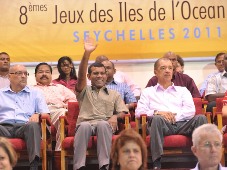
Anni and Ashfaq 'Dhagadey'President Nasheed however added that the “main purpose” of the official visit was to attend the opening of the Indian Ocean Island Games of 2011 and provide support and encouragement to the Maldivian sports teams, which was one of the largest delegations from the country for an international sporting event.

The competitions at the games include football, basketball, volleyball, swimming, laser sailing, badminton, weight lifting, boxing, table tennis, cycling, and judo.

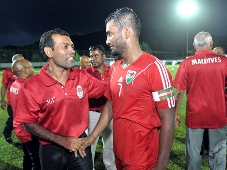
Maldives is participating in the basketball, volleyball and badminton events. The national football team drew its first two matches against Mauritius and Comoros and are due to face host nation Seychelles tonight at 7:00pm local time.

Likes(0)Dislikes(0)

Confusion over Sri Lankan fishing vessel traffic a political red herring: Zuhair

The government has confirmed that no specific agreement has been signed with Sri Lanka allowing Sri Lankan fishing vessels to cross Maldivian waters enroute to the Arabian Sea.

Maldivian Foreign Minister Ahmed Naseem said yesterday that the only development of note with Sri Lanka’s External Minister was the release of seven fishing vessels detained by the Maldives on suspicion of illegal fishing.

The confusion was sparked after an article published on August 5 in Sri Lanka’s Daily Mirror referred to a statement from the country’s External Minister Neomal Perera, claiming such an agreement existed so long as vessels gave 48 hours notice to the Ministry of External Affairs in Sri Lanka or the High Commission in the Maldives.

“[Local newspaper] Haveeru went to town when Fisheries Minister [Dr Ibrahim Didi] said no such agreement had been signed with Sri Lanka,” President Mohamed Nasheed’s Press Secretary Mohamed Zuhair told Minivan News today.

“The opposition seized it as an opportunity to whip up confusion and say the government had compromised the sovereignty of the Maldives – their latest favourite red herring.”

Zuhair said that on being informed by Haveeru that Sri Lankan’s External Minister had made such a statement, he had told the journalist that Sri Lankan fishing vessels – or the vessels of any nation – were already entitled to cross Maldivian waters as the Maldives was party to the UN Convention on the Law of the Sea (UNCLOS).

“The Maldives became party to it in 1982, became a signatory in 1994, and ratified it in 2000. It provides for ‘innocent passage’, and in the case of a fishing vessel requires that such gear be stowed,” Zuhair explained.

Article 17 of the convention states that “ships of all States, whether coastal or land-locked, enjoy the right of innocent passage through the territorial sea”, while Article 24 further states that a state “shall not hamper the innocent passage of foreign ships through the territorial sea except in accordance with this Convention.”

‘Passage’ precludes activities such as research surveys, military exercises, “serious” pollution and fishing.

“This may have been taken from an erroneous observation from the Minister during his visit,” Zuhair said, “but the Daily Mirror story is broadly correct, and I told Haveeru that this was permission [Sri Lanka] continued to have. The embassy needs a system where authorities can ID the vessel [to combat illegal fishing].”

The Ministry of Fisheries and Agriculture issued a statement yesterday strongly denying that the reported maritime agreement with Sri Lanka had been signed by the government.

While discussions about allowing passage for Sri Lankan fishing vessels through Maldivian waters had taken place on numerous occasions, “the Maldives has always said that foreign vessels could cross Maldivian seas only in accordance with Maldivian law.”

The press release explains that “innocent passage” was routinely granted for foreign vessels as the Maldives is signatory to the UN Convention on Law of the Sea but foreign fishing vessels without a license to operate in Maldivian waters are required to seek the ministry’s authorisation before entering the Maldives’ economic zone.

Moreover, the Ministry of Defence and National Security must be consulted before authorising passage for such vessels and the Fisheries Act “empowers the ministry to require monitoring systems in the vessels to locate its position through satellite.”

Parliament spent several hours yesterday debating the non-existent agreement with Sri Lanka, which led to a rare split in MDP ranks after MP Mohamed Musthafa vowed to submit a binding resolution demanding the government recall the ‘decision’ as “[Sri Lanka’s] intention is to steal our fish. I cannot just stand aside and watch while they take away our fish, which is the only source of natural resource we have in abundance. It is a right that has to be preserved for future generations.”

The issue quickly fell victim to the Maldives’ highly partisan politics, after head of the opposition Dhivehi Rayyithunge Party (DRP)’s fishing branch, Ali Solih, denounced the supposed agreement as “an insult to Maldivian fisherman” and “a dangerous deal,” as the Maldives did not have the capacity to monitor illegal fishing.

DRP MP Ali Saleem then proposed a motion without notice yesterday demanding that parliament “look into what is hidden behind this. Did you know that even if Sri Lankan fishing vessels traveling to the Arabian sea are carrying sharks or fish catch, there is no way to know because of this agreement signed yesterday?”

MDP Chairperson ‘Reeko’ Moosa hit out at the opposition for labelling Sri Lanka as “thieves” in the pursuit of local political gain, and claimed the allegation was “very irresponsible”.

MDP MP ‘Colonel’ Mohamed Nasheed suggested during yesterday’s impromptu debate that “it would be better for us to find out accurate information on the matter”.

The Sri Lankan High Commission had not responded to Minivan News at time of press.

Likes(0)Dislikes(0)