Defence Minister forbids soldiers to publicly participate in politics

The Maldives’ Defence Minister has ordered soldiers to surrender their rights to political participation, despite allegations he has forming a political party.

Minister of Defence and National Security Colonel (Rtd) Mohamed Nazim said soldiers must forgo rights granted to civilians, refrain from politics, and limit their political participation to voting only, as stipulated in the Constitution and military law.

Speaking at an early-morning flag hoisting ceremony on Sunday (April 21) as part of the military’s 121 anniversary celebration, Nazim stated that there is “no room for politics in the military as long as I remain in this office”.

“Every soldier has to accept that some of the rights granted to a civilian in an open society are restricted to a soldier. One of these rights is the right to participate in political activities. I would like to tell you that the Constitution and the military law have curbed these rights from the soldier for a greater and larger purpose,” Nazim stated, according to local media.

“I would like to tell you today, that the role of a soldier is done once you exercise your right to cast your vote, entitled to every person above the age of 18. I would like to bid from all military personnel to refrain from partaking in political activities,” he added.

Nazim “assured” soldiers he will not issue political orders as long as he remains Minister of Defence.

He also stated that welfare benefits would be given to the defence forces once the government’s budgetary constraints are relieved, according to local media.

“Keep quiet and obey”

Maldives National Defense Force (MNDF) Spokesperson Colonel Abdul Raheem reiterated that military personnel cannot take part in any political activities or gatherings at any time. This includes registering for, or being a member of, any political parties.

Asked why the rule applies to military personnel, Raheem emphasised that orders must be followed.

“The MDNF does not want any soldiers participating in political activities. They have to keep quiet and obey,” Raheem said.

He explained that political activities even in a personal capacity are not allowed.

“Soldiers are not seen as ever being off duty, even when they are on leave or in the barracks,” Raheem said.

“The only time military personnel can politically participate is when they go to vote. They can decide for themselves who to vote for. Around 7-10 years ago soldiers could not vote,” he added.

Nazim was not responding to calls at time of press.

Nazim already involved in politics: MDP

“Nazim seems to be swallowing his own words and reflexively wriggling back,” claimed Maldivian Democratic Party (MDP) MP Hamid Abdul Ghafoor.

“Nazim had political ambitions and wanted to profit, but he is trying to cover that up now because the [Maldivian] people won’t accept it,” said Ghafoor.

“They pulled of a coup, but couldn’t sustain it. Now Nazim’s trying to look more mainstream,” he added.

Ghafoor alleged that Nazim had himself created an as-yet unregistered political party called the Maldivian Industrial Development Alliance.

He also accused Nazim of seeking to emulate Turkish and Pakistani history, whereby a military-affiliated political party gains political power in order to maintain the status quo and influence civil affairs.

“The forms were filled [to create the party] and he could then attract all the armed forces to his political entity,” said Ghafoor. “It would also be used to protect and sustain Waheed.”

“The MDP’s position is that uniformed civil servants and military personnel should be able to vote. Any citizen should have the right to vote, but it doesn’t mean your institution should be engaged in politics,” Ghafoor stated.
Anniversary celebration

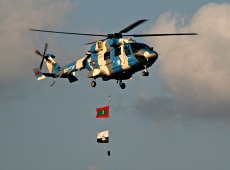
Following a week of practice preparations, the MNDF celebrated the 121 anniversary of the security services Sunday (April 21) with the Commander in Chief’s Force and Fleet Review as well as a “show” for spectators.

Thousands of Maldivians gathered near Raalhugandu and the Tsunami Monument areas of Male’ – in addition to President Mohamed Waheed Hassan Manik, Chief Justice Ahmed Faiz Hussain, Defence Minister Nazim, and other senior government officials – to witness the spectacle.

“I wanted to bring my son to watch the baghee (traitor) show,” the father of a toddler told Minivan News.
The celebratory events began with an MNDF parade of soldiers carrying assorted firearms, a military band, as well as three armored vehicles, a tank, and firefighting vehicles.

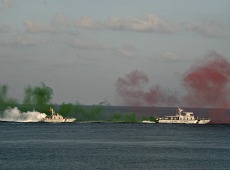
Five Coast Guard ships of assorted size “steamed” by the east coast of Male’, with smoke billowing fromtheir decks in the national colors of red, green and white.

The MNDF also staged a “show” whereby terrorists hijack a local fishing boat.

“The MNDF made it a show so the public could enjoy [themselves] and get a feeling for how the MNDF conducts operations, it was not actually how a tactical operation would be run,” Colonel Raheem said.

Following a helicopter reconnaissance fly-by of the hijacked boat, six small coast guard vessels descended on the fishing dhoani.

The special forces, coast guard, and marine corps then “destroyed the terrorists” to gain control of the dhoni, followed by a casualty being airlifted out, Raheem recounted.
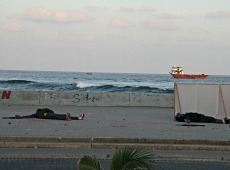
A portion of the special forces show also included “an attack of the terrorist hideout on land”.

“Dead” bodies accompanied by fake blood could be seen sprawled on the pavement.

“The parade was of no cost, since soldiers had the equipment and uniforms already. Additionally, coast guard vessels are in daily use anyway,” said Raheem.

“All of the MNDF’s units combined forces to take part in the anniversary,” he added.

Although the MNDF was not established in name until 2006 – two years after the National Security Service (NSS) was split to create the Police Service – the presence of Maldivian security forces has remained constant, according to Raheem.

Likes(0)Dislikes(0)

MTCC and government finalising agreement for construction of 22 harbours

The Maldives Transport and Contracting Company (MTCC) is in talks with the government to finalise an agreement to construct 22 harbours under a so-called contractor finance policy.

MTCC CEO Dr Ahmed Adham has told local media that the government has agreed to guarantee a loan of US$30 million required for undertaking the project, with the state then having a five year grace period to pay for the construction under the proposed policy.

“Despite the government guarantee, we will be repaying the loan. In addition we are currently engaged in discussions with our equipment partners to come to an agreement,” Adham was quoted as saying by newspaper Haveeru.

Reports over the new agreement come days after the government announced it would be delaying implementation of any new development projects financed out of the state budget due to shortfalls in its revenue.

The decision to suspend new projects was revealed earlier this week by Housing Minister Dr Mohamed Muiz during the signing of contracts to build harbours in four islands.

Muiz said at the time that he was instructed by the finance ministry not to commence any further infrastructure projects included in the 2013 budget, such as harbour construction or land reclamation.

Speaking to Minivan News today, Finance Minister Abdulla Jihad said the reported agreement set to be signed between the government and MTCC was not related to the decision to delay starting any further development projects.

Jihad added that the harbour developments currently under discussion as part of the contractor finance policy had already been included within the state budget.

“It is just the mode of financing that is different,” he said today.

According to local media, the MTCC plans to sign the new harbour agreement with the government next week.

There have been “constraints” to obtain funds for projects already awarded by the government, however Adham Haveeru he was “confident the government will hold up its end in the new contracts and make the progressive payments.”

“We are presently carrying out projects under progressive payment policy. Government has assured us that it would make the payments without interruption.”

Currently the MTCC is conducting work on harbor projects for 17 government-assigned islands.

Likes(0)Dislikes(0)

Govt parties need to reassess power sharing, after thousands attend MDP rally: MP Nihan

The Progressive Party of Maldives (PPM) said today it would not rule out forming a coalition with President Dr Mohamed Waheed or any other fellow government-aligned parties ahead of  elections scheduled for September.

PPM MP Ahmed Nihan told Minivan News the party was already engaged in talks over the possibility of forming a power sharing agreement with other parties in the government of President Waheed.

Nihan said that after thousands of people attended a gathering held by the opposition Maldivian Democratic Party (MDP) last Friday (April 19) to announce the signing of Parliamentary Speaker Abdulla Shahid, all political parties needed to reassess their views on power sharing.

“Risky business”

Nihan’s comments were echoed this week by Home Minister Dr Mohamed Jameel Ahmed, who claimed that a changed political landscape since the country’s first multi-party elections in 2008, necessitated a willingness to share power more than ever.

“We have to recognise that the PPM and the MDP are the two major political forces in the country capable of winning elections. Hence, if the governing coalition desires to forge an alliance, it cannot realistically exclude the PPM from any such move. Whether a coalition, inclusive of the PPM can be realised prior to the elections is possible or not, we cannot alienate major political parties in an election,” he told Minivan News this week.

“Therefore, the role of smaller parties attempting to win an election of this scale without the inclusion of major political parties is in my opinion, a risky business,” Dr Jameel added.

While declining to give exact details on the nature of power sharing discussions currently held by the PPM, MP Nihan claimed the party’s supporters were divided on the need to form a coalition after considering the size of the crowd that attended Speaker Shahid’s inaugural address as an MDP member last week.

“We are not in a position to give the media more details on coalition talks as of today. However, the PPM has engaged in talks with various parties,” he claimed.

“Many of our supporters are divided over whether we need a coalition with the Jumhoree Party (JP) and other government parties. After the MDP rally [on Friday] there has been lots of speculation [about coalition forming]. Let’s not rule anything out.”

Nihan stressed that the PPM’s preferred option would be to stand individually in the first round of elections to try and secure an outright elections victory.

However, he claimed that the PPM’s founder, former President Maumoon Abdul Gayoom, had already explained within local media that the party remained open to the idea of forming coalitions with any party except the MDP.

DRP approached

Addressing speculation over the formation of a “broad coalition”, the government-aligned Dhivehi Rayyithunge Party (DRP) today said it had also been approached by representatives from President Waheed’s party over potentially standing in the election through a pwoer sharing agreement.

DRP Deputy Leader Mohamed Shareef said he did not wish to provide further details on discussions at present or confirm if any decision had been taken on entering a power sharing agreement.

However, discussing the DRP’s experiences as being part of the unity government of President Waheed, Shareef added that power sharing in the country was not without challenges.

“There are some who believe that the elections will be easier in a coalition. While they may be right, there have always been lots of differences of opinion in the current unity government,” he said.

Shareef added that in forming the current government – sworn in after former President Mohamed Nasheed resigned from office following a mutiny by sections of the police and military – there had not been any “formal discussions” on individual roles that would be taken by coalition members.

Shareef claimed that securing any future agreement between different political parties and their respective presidential candidates on who should lead any coalition would prove more difficult.

Shareef therefore said he believed that the PPM was one party that would only be interested in a coalition that stood behind its own presidential candidate, MP Abdulla Yameen.

“The PPM will not be interested unless people would back their candidate. They are presently the largest party [in the current government] and will believe everyone must follow them,” he said. “However, in a coalition everyone must be equal.”

Shareef claimed that a failure to listen to the opinions of coalition partners had led to the previous government, formed behind Mohamed Nasheed’s MDP, eventually alienating all other parties, before the administration was toppled last February.

Just last month, the DRP said it would reject any possibility of forming a coalition with the PPM  beyond the present government, calling any discussion on the matter a “waste of time” considering previous disagreements between the two parties.

The PPM was formed by DRP founder, former President Maumoon Abdul Gayoom in 2011 following an acrimonious war of words with the party’s current leader, Ahmed Thasmeen Ali. Thasmeen was directly appointed by Gayoom to be his successor as head of the DRP.

However, Shareef today refused to comment on speculation over any possible coalition agreement with the party.

Agreed coalition

At present, President Waheed’s GIP has formally agreed to stand in a coalition during the elections with the Dhivehi Qaumee Party (DQP).

Both parties, which have no elected representatives in parliament , currently face potential dissolution for lacking the minimum requirement of 10,000 members as stipulated in the recently passed Political Parties Act.

The religious conservative Adhaalath Party has also publicly pledged its support to President Waheed, last month announcing plans to form a coalition with the GIP.

Meanwhile, after the JP rejected speculation it would form a coalition with President Waheed last week, Party Leader and presidential candidate MP Gasim Ibrahim was later quoted in local media on Thursday (April 18) as saying he would consider power sharing. However, Gasim stated at the time that that he would not stand as a running mate in such a coalition.

“Bitter lessons”

Senior figures of the opposition MDP including former President Mohamed Nasheed claimed earlier this month that sharing cabinet positions among different political parties would not result in an efficient government in the Maldives.

Former President Nasheed stated at the time that leaders of different political parties had learned “bitter lessons” surrounding their inability to run a government by sharing cabinet positions among different political parties over the last four years.

“A cabinet in which one minister belongs to this party and another belongs to that party, cannot run a government,” he said.

Aerial view of an MDP rally held on Friday April 20 to welcome the signing of Speaker Abdulla Shahid:

https://www.youtube.com/watch?feature=player_embedded&v=lu1rLkgH9IA

Likes(0)Dislikes(0)

Umar Naseer’s PPM future to be decided on Thursday

A five-member disciplinary committee will decide the future of Umar Naseer in the Progressive Party of Maldives (PPM) on Thursday (April 25), according to local media, following the lapse of a seven-day period for Naseer to ‘reform and realign’ with the party’s charter or face expulsion.

Umar stands accused of violating the party’s charter or regulations by levelling serious allegations against PPM presidential candidate MP Abdulla Yameen at a rally held shortly after he was defeated in the party’s presidential primary.

The rally was organised without the approval of the PPM council, which contended that it was held in violation of the party’s rules mandating support for the presidential candidate after the primary.

Umar went ahead with the rally despite pleas for unity by the party’s leader and figurehead, former President Maumoon Abdul Gayoom.

Umar alleged at the rally that primary winner MP Abdulla Yameen was backed by the Gayoom family and the PPM parliamentary group, controlled all of the party’s organs, including the council and election committee, and had “rigged” the primary by ballot stuffing, falsifying the count and “pouring black money” to buy votes.

He further alleged that criminal gangs, convicts and drug smuggling “networks” were part of Yameen’s campaign team.

“Less than 24 hours after my brother Abdulla Yameen won the primary, the foremost person in the Maldives’ corruption network, Deputy Speaker of the People’s Majlis Ahmed Nazim joined the PPM,” Umar said, declaring that he would not back Yameen if he contests the September presidential election with “corrupt people” in his team.

Yameen, who is also half brother of former President Gayoom, denied the accusations, while the PPM later asked Umar to apologise for his remarks or face disciplinary action.

Following his refusal to publicly apologise or defend himself at a subsequent disciplinary committee hearing, Umar’s case was sent to the PPM council and he was given an ultimatum to “come back into the party’s charter” and “reform” himself within seven days.

Umar however remains defiant and addressed supporters on Saturday night in front of his “Command Center” campaign office in Male’.

Umar advised his supporters not to leave the party even if the PPM council or disciplinary committee decides to expel him.

The former PPM deputy leader said he would not cease “speaking the truth” even if he was either dismissed from the party or “hung upside down.”

Umar said he made the allegations of the primary being rigged to inform PPM members of how the election was conducted.

“But we must remain with PPM. We have spoken the truth. We have not lied or deceived,” he said.

Umar asserted that he would prove his allegations of wrongdoing in the primary in court.

PPM member Rahma Moosa, an Umar supporter, filed a case at the Civil Court last week challenging the results of the primary.

“Broad coalition”

Umar also warned that the PPM would face the same fate as the Dhivehi Rayyithunge Party (DRP) in 2008 if the party contested the presidential election in September without a “broad coalition.”

Umar revealed that discussions were ongoing between Jumhooree Party (JP) presidential candidate MP Gasim Ibrahim and President Dr Mohamed Waheed to reach a power sharing agreement beneficial to both parties.

If the talks were successful, Umar said an invitation would be extended to the PPM leadership to join the coalition.

“If our parties face MDP [formerly ruling Maldivian Democratic Party] in this year’s presidential election without forming a broad coalition, [they] would have to eat sand like DRP did in 2008,” Umar said.

“MDP cannot be defeated without such a broad coalition,” he added. “If it is every one for himself, every one going their own way separately in the first round, I am certain that there is the danger of MDP coming back.”

Umar urged all parties to compromise in order to reach an agreement on forming the alliance.

While former President Gayoom was a “truthful and trustworthy” person with integrity, Umar said the same could not be said of PPM presidential candidate MP Abdulla Yameen.

Meanwhile, speaking at a press conference yesterday (April 21), Dhunya Maumoon, state minister for foreign affairs and PPM council member, said the party was not worried about the coalition forming around Dr Waheed.

Compared to the smaller parties, Dhunya said, PPM had more members as well as parliament seats.

Former President Gayoom’s daughter suggested that other parties were worried because they were “certain” that PPM would win the election.

PPM MP for Laamu Fonadhoo, Abdul Raheem Abdulla, meanwhile claimed that the party would face the election with 70,000 or 80,000 members.

Likes(0)Dislikes(0)

MP Riyaz Rasheed withdraws amendments to keep tourism bed tax in place past 2013

MP Riyaz Rasheed of the Dhivehi Qaumee Party (DQP) has withdrawn a government-sponsored amendment to the Tourism Act to keep a US$8 bed tax in place beyond 2013, citing lack of support from parties in the ruling coalition.

The flat rate of US$8 per occupied room, per night, was to be abolished at the end of this year to be offset by sales and land taxes.

The MP for Thaa Vilifushi announced that he was pulling out the legislation after the preliminary debate started at today’s sitting of parliament.

Riyaz expressed concern with the lack of support from coalition partners for revenue raising measures proposed by the government.

Riyaz, who had submitted the bill on behalf of the government, called on President Dr Mohamed Waheed’s administration to consult with pro-government parties represented in parliament before proposing further legislation.

During today’s brief debate on the proposed amendment, most MPs argued that the tourism industry would be adversely affected if the bed tax was not discontinued as planned with the introduction of Tourism Goods and Services Tax (T-GST).

Riyaz’s decision to withdraw the bed tax amendment follows parliament’s rejection last week of government-sponsored legislation to raise the airport service charge to US$30, which was among a raft of measures proposed by the Finance Ministry in the estimated 2013 budget to raise MVR 1.8 billion (US$116 million) in new income.

MPs voted 28-27 against proceeding with the bill at committee stage following preliminary debate.

During the debate last week, MPs of both the opposition Maldivian Democratic Party (MDP) and government-aligned Progressive Party of Maldives (PPM) – respectively majority and minority parties in parliament –  accused President Dr Mohamed Waheed of using state funds to finance his presidential campaign.

Parliament’s rejection of the government-sponsored bill prompted the Finance Ministry to suspend new development projects financed out of the state budget due to shortfalls in revenue.

Finance Minister Abdulla Jihad said that the cabinet decided to postpone planned infrastructure projects that have not yet started in an attempt to ease cash flows.

Speaking to press yesterday (April 21) following the signing of contracts for construction of harbours in four islands, Housing Minister Dr Mohamed Muiz said he was instructed by the finance ministry not to commence any further infrastructure projects included in the 2013 budget.

“As you know, the government’s budget is in a very fragile state. We can only spend what is earned as income. The government proposed new revenue measures when it submitted the budget. It was approved on principle when the budget was passed,” Muiz said.

“However according to my information, difficulties have arisen in implementation [of the measures]. As a consequence, aside from these four islands, the finance ministry has instructed me not to sign or commence with any infrastructure project in any island from now on. Unless the People’s Majlis passes new means of earning income for the government, the finance ministry has instructed us not to begin any project financed out of the government budget, be it harbour construction or land reclamation or any project undertaken by the housing ministry.”

Housing Minister Muiz – a senior member of the government-aligned religious conservative Adhaalath Party – called on all state institutions to cooperate and work together to “improve the country’s economic condition.”

Other revenue raising measures proposed with the 2013 budget included hiking Tourism Goods and Services Tax (T-GST) to 15 percent from July 2013 onward, leasing 14 islands for resort development, introducing GST for telecom services, raising oil tariffs, and “selectively” reversing import duty reductions.

Finance Minister Jihad confirmed to Minivan News yesterday that the government was in the process of formulating a supplementary budget by the end of April.

Economic Development Minister Ahmed Mohamed – a senior member of the government-aligned Dhivehi Rayyithunge Party (DRP) – however told newspaper Haveeru last week that a supplementary budget would be of no use if parliament failed to approve the proposed revenue raising measures.

“Numbers written on paper will not increase funds. One or two billion rufiya can be added to the budget through the supplementary budget,” he explained. ”But shouldn’t there be a way to get that three or four billion rufiya?”

During the budget debate in December 2012, Majority Leader MP Ibrahim Mohamed Solih warned that the additional revenue projected in the budget was unlikely to materialise.

The MDP parliamentary group leader claimed that the import duty revision to raise tariffs on oil “will not be passed in this Majlis.”

Moreover, he said at the time, the MDP would not support increasing T-GST without consultation with the tourism industry.

Predicting that revenue in 2013 would reach “only MVR 11 billion at most,” Solih had warned that income would not be enough to meet recurrent expenditures on salaries and administrative costs.

Likes(0)Dislikes(0)

MDP propose US$1.05 billion mariculture industry as part of election pledge

The opposition Maldivian Democratic Party (MDP) has pledged to develop a mariculture industry in the country should former President Mohamed Nasheed be reelected in September 2013.

Mariculture is a specialised form of aquaculture which involves the cultivation of marine products such as pearls, oysters, fish and sea cucumbers in the open sea, or in nets or ponds exposed to the sea.

During a function launching the party’s policy on Kendhikulhudhoo island in Noonu Atoll on Saturday, the former president suggested that such an industry could generate US$1.05 billion (MVR 16.19 billion) within five years, should the government be able to successfully run at least 60 mariculture projects throughout the country.

“If we can successfully run  60 projects within five years, we will create 1800 new jobs and the country will receive MVR 16 billion in export revenue,” Nasheed said.

Nasheed claimed the party would establish a soft loan scheme worth MVR 200 million to support the people who wished to become involved in the new industry. He said the MDP hoped to establish mariculture as one of the country’s key industries, alongside fishing and tourism.

The Marine Research Center (MRC) established in the Maldives in the 1980’s has extensively researched the country’s reefs and lagoons and identified several ways in which mariculture activities could be carried out, Nasheed noted.

“What we have learned from this research is that mariculture is a very viable industry that could reap a lot of benefit to the country,” he said.

According to the MRC’s website, current aquaculture products farmed in the Maldives include grouper, sea-cucumber and pearls.

The MRC noted that the first pearl culture activity occurred with financial assistance from the United Nations Development Programme (UNDP) in 1996. When the five year project ended, MRC and the UNDP carried out a follow-up five year project from 2003 to 2008.

During a function to launch a sea cucumber development project on the same island in 2011, Nasheed – then President – elaborated that aquaculture and mariculture projects in the Maldives would ensure “the economic growth and economic viability of the society”.

Nasheed, who partook in a sea cucumber hunt during the event, also claimed at the time that it was beneficial for the country utilise the commercial benefits of marine resources in order to “achieve means of income other than revenues gained from the tourism industry”.

Speaking during Saturday’s function, Nasheed highlighted that while successful mariculture projects had been carried out during the three years of his government, a lack of technical expertise in the field was a key challenge for the expansion of such an industry.

A future government led by the MDP would open higher education opportunities in the country in collaboration with the Maldives National University (MNU), he said.

Eco-education

In 2011 during Nasheed’s presidency the MNU began offering courses in environment management – the first higher education program focused on environmental consolidation in the country – with levels varying from bachelors degree, advanced diploma, diploma and degree foundations.

In a bid to encourage people to take up the program, then Ministry of Environment and Energy also opened full scholarship opportunities to those who wished to take up the course.

Nasheed, speaking of the challenges involved in establishing a mariculture industry, said the lack of a hatchery to produce fish-feed was a key challenge.

Others included difficulties with transportation and logistics, which he said could be resolved by enhancing the transportation system established during the last three years of his presidency, would resolve the issue.

“Attention must be given to the environment surrounding us when we carry out any type of business and we should not obstruct the natural life surrounding us while carrying out any business,” he said

Nasheed also promised to establish both quarantine facilities and research facilities that will monitor and evaluate the businesses and would utilise the existing Maldives Food and Drug Authority (MFDA) to ensure the products produced by the industry met the necessary standards.

“Everything we do should be carried out in a sustainable way. MDP will seek to maintain the mariculture industry in a sustainable manner and that businesses involving mariculture will be properly monitored and evaluated,” he said.

Large-scale mariculture not viable; “Fish feed doesn’t grow on trees,” says DRP

Deputy Leader of the government-aligned DRP, Ahmed ‘Mavota’ Shareef, questioned the viability of introducing large-scale mariculture to the Maldives, and slammed the MDP’s economic predictions as inaccurate and an election ploy.

Shareef told Minivan News that when considering the huge investment costs required for mari-culture, funding would be better spent on providing technologies and know how into expanding industrial fishing in the Maldives.

“As opposed to mariculture, which needs large amounts of capital investment, it is much easier to go out and catch fish,” he claimed. “Tuna here is easy and cheap to catch, all people need is a boat. With freshly-caught fish you will get a much higher price than for mariculture.”

As a comparison, Shareef argued that massive amounts of bait and feed would be required to support the MDP’s predictions of a mariculture industry that would generate just over a billion US dollars in revenue over a five year period.

“The availability of fish feed will be a major issue. It does not just grow on trees,” he added.

Shareef also claimed that the mariculture sector was presently dominated by India, China and the US, mainly based around shellfish. However, he argued that mariculture represented just a small proportion of total global fisheries industry.

Shareeef said the DRP would instead favour boosting resources available to the country’s fishermen through supplying bait, satellite communications equipment, longer lines and focusing on forming cooperative fishing companies to boost catches and help establish large-scale industrial fishing.

Responding to Shareef’s remarks, former Press Secretary during Nasheed’s presidency Mohamed Zuhair dismissed claims that the MDP’s predictions were an election ploy, insisting the party had extensively studied the subject.

“The DRP is entitled to their own views. But I don’t believe they have studied the matter that is being discussed. Our predictions are based on extensive research study. The Maldives has previously tested and tried mariculture and the results are promising,” he said.

Zuhair also claimed the MRC had promoted many opportunities in the field of mariculture during former President Maumoon Abdul Gayoom’s government, but these had not progressed because of a lack of incentives from the central government.

“Each of our islands has direct access to the sea and can easily engage with mariculture. This is not something new to the Maldives; it is tried and tested,” Zuhair said.

Likes(0)Dislikes(0)

State, private sector divided over responsibility for Maldives garbage dumping

Divisions have arisen between different ministerial bodies and the private sector over who should take the majority of blame for garbage being dumped into the sea.

While the Environment Ministry this month raised fears about increased levels of garbage in the sea as a result of resort waste not being properly disposed of, the Tourism Ministry responded that the more likely culprits were boat operators.

Meanwhile, the country’s safari boat industry has rejected allegations that a large number of liveaboard operators were responsible for dumping trash into the country’s waters, claiming the main problem lay with boats hired by resorts to transport waste to landfill.

Mounting complaints

Minister of Environment and Energy Dr Mariyam Shakeela told local media earlier this month that the majority of waste being produced by resorts was not reaching land set aside for disposal on the island of Thilafushi.  She claimed it was instead being dumped in the sea.

Dr Shakeela stated that complaints about resorts dumping their trash were mounting and that “close inspection of waste accumulating in the sea near the capital Male’ has proved that it had been dumped by resorts”.

“The reason I say this is because most of the photos sent in by EPA [Environmental Protection Agency] and other such authorities show large quantities of orange peel. Bits of apples and tomatoes amount to most of the waste. Where does it come from? It comes from the resorts,” Shakeela said.

She added the amount of waste produced by resorts amounted to 7.5 kg per head.

Environmental authorities have nonetheless pledged to “try to establish a focal point on each resort” and conduct a waste study.

Responding to Dr Shakeela’s comments, Tourism Minister Ahmed Adheeb told Minivan News this month that resorts had their own waste management facilities, adding that dhonis (boats) were more likely to be behind dumping the garbage.  He mantained that the matter was presently under investigation.

Addressing concerns about the levels of trash found in the sea, Adheeb also highlighted the lack of a nationwide waste management system.

He said that while the previous government of former President Mohamed Nasheed had proposed generating energy from incinerators – referring to ongoing uncertainty over a previous waste management project – it first needed to have incinerators in place and working.

The Ministry of Tourism, Arts and Culture has previously pledged to take the “lead” in addressing waste management issues in Male’ should the city’s council and the Ministry of Environment and Energy fail to effectively deal with concerns about garbage.

In early January, Adheeb said the issue of waste management posed an immense threat to tourism in the country.  He added at the time that his department would “take the lead” to actively address the problem should other authorities fail to resolve ongoing concerns by February 2013.

However, opinion about levels of trash being dumped in the sea appears further divided among boat operators in the country – particularly within the safari boat industry, which provides trips and cruises for both tourists and Maldivians.

Safari boat waste dumping

A source with over 16 years experience in the safari boat industry has alleged that approximately 75 percent of safari (liveaboard) boats were responsible for prolific waste dumping.

“Every night when all the guests go to sleep around 12:00am to 1:00am, the liveaboard staff throws everything into the sea. This includes basically everything, all the trashcans [bags], plastic bottles, foods, lube oil, for example,” the source said.

The source further explained that the practice of dumping waste depended often on the company operating the boat, their hiring practices, and staff regulations.  He alleged that the worst practices were often committed “by the ones in charge of the Liveaboard Association”.

“When you have a proper establishment they won’t let staff do that. Very good local and foreign companies strictly forbid staff to throw even cigarette butts into the ocean,” the source said.

“However, there are no regulations or requirements to work on a liveaboard and it’s all about [securing] cheap labour.  This is a very big issue in the dive industry. They do not go for the qualified people,” he added.

The source claimed that with the number of foreign workers on liveaboards increasing, their work status was often illegal – making them unaware and sometimes careless regarding issues concerning waste dumping.

“It’s all about awareness and getting the right people to do the right job. At least to keep a responsible person on each liveaboard to make sure no one is illegally dumping garbage,” the source declared.

He further explained that dumping waste into the ocean was very harmful to the local ecosystem.

“The big, huge, messy black garbage bags can drift with the current and then trap healthy table coral. Harm also comes to mantas and whale sharks which stay near the surface, while sea turtles ingest plastic bags mistaking them for jellyfish,” the source said.

“If things continue like this we won’t have any healthy reefs in the next 10 to 15 years. The Maldives won’t be the same,” he claimed.

The source believed that the government in recent years – both the current and former administrations – has not taken any proper actions to try to combat the problem.

“The tourism ministry doesn’t do anything aside from talking. Actions speak louder than words and there has been no enforcement of the laws.”

In regard to the allegations of safari boats dumping waste, Tourism Minister Adheeb told Minivan News that a proper place was needed for the liveaboards to moor so the vessels can be monitored.

Liveaboard Association response

Meanwhile, the Liveaboard Association of Maldives (LAM) Secretary General Ismail Hameed told Minivan News that the allegations of safari boat waste dumping applied only to a limited number of operators.  Hameed claimed that some companies would always try to flout the rules.

“Many liveaboards are following regulations [and not dumping waste into the sea], but there will be some vessels that do,” he said.

Hameed alleged that dhonis carrying resort waste are responsible for illegal waste dumping.

“Resorts send their garbage to Thilafushi on dhonis. The dhonis cut the trip short and dump the waste in the ocean. I’ve seen boxes labeled with resort names,” explained Hameed.

“Not all resorts are guilty of improperly dumping waste, just as not all liveaboards are guilty either,” he added.

Hameed additionally complained that the liveaboard industry has been neglected for 40 years “under every government administration”, further complicating efforts to monitor operators.

“Our main concern is there are no proper mooring and harbour system for liveaboards. There needs to be a local marina patrolled to ensure safety, proper garbage disposal, and refueling for these vessels,” he said.

“There has not been a proper mechanism for waste management implemented by the [national] government or island societies.”

Hameed claimed that the LAM has been communicating these issues to the government for “a couple of years”, explaining that the cabinet had recently approved work on a harbour for safari vessels in the Male’ area.

LAM aims to “find solutions to difficulties, issues and other things involved in liveaboard operations, including environmental issues and staff development”,

Likes(2)Dislikes(1)

NGO urges government to address “inadequate” child protection measures

A Maldivian NGO has criticised child protection measures currently in place in the country as “inadequate”, while urging government authorities to incorporate several key human rights obligations into domestic law.

Local NGO Advocating the Rights of Children (ARC) told Minivan News today (April 21) that although the Maldives has signed and agreed to be legally bound by the provisions in the Convention on the Rights of the Child (CRC) and its Optional Protocols, the commitments have yet to be adopted into law.

ARC said it therefore “strongly urged” the Maldivian government to ratify the CRC Optional Protocol on a Communications Procedure as soon as possible to “enhance child protection measures in the country and to uphold its international legal obligations and responsibilities under the convention.”

ARC today claimed that provisions outlined in the CRC had not been fully adopted by the state into domestic legislation, thereby limiting the promotion and protection of child rights.

“Even though there is work being done to protect children, it is not enough,” the organisation said.

“The CRC’s optional [communications] protocol allows individuals, a group of individuals or their representatives to submit complaints to the UN Committee on the Rights of the Child claiming to be victims of a violation by the state, of any rights enshrined in the convention or any of its optional protocols which the Maldives is a party to.

“What is very important is that children themselves or their parents can submit complaints if domestic [legal measures] have been exhausted,” ARC added.

ARC cited the recent example of the 15-year-old rape victim from the island of Feydhoo in Shaviyani Atoll who was convicted of premarital sex at the Juvenile Court in February and sentenced to 100 lashes and eight months of house arrest.

“The recent case of a 15-year old girl, whose rights were violated and abused by her step-father is a clear example of how domestic judicial and legal mechanisms failed to address and rectify the violation over a substantial period of time, at different levels,” ARC said.

“This is a situation where an individual complaint to the UN Committee could hold the government accountable even if the ‘domestic remedial system’, including judicial and legal mechanisms, fail to address the issue of abuse.

“Ratifying this optional protocol will help protect the rights of children as it could help reduce the number of cases in the Maldives where a lack of legislation, clarity and commitment to international human rights law allow serious injustices to proliferate,” ARC added.

Council heads and senior civil society figures have previously slammed the judiciary, state authorities and welfare groups over their systemic failure to protect the 15 year-old girl, despite her history of alleged sexual abuse dating back to 2009.

The 15-year-old’s case has brought international attention to the Maldives’ legal system, including the launch of an online Avaaz.org petition signed by over 2 million people that has threatened to boycott Maldivian tourism.  The sentencing of the minor has also come under high-profile public criticism from British multi-billionaire Sir Richard Branson, founder of the Virgin group of companies.

Former Attorney General Azima Shukoor has already appealed the court’s sentencing decision against the minor.

ARC said it hope ratifying the treaty in the Maldives would instill “a sense of transparency on child rights issues and encourage the government to be more accountable to its obligations.”

“The protocol is specifically designed to allow members of the public to submit complaints to an international body if children’s rights have been violated,” ARC added.

ARC said it had been informed by the Maldivian government that the ratification process had been started and was hoped to be concluded  “at the earliest opportunity”.

UNICEF’s view

The UN General Assembly adopted the CRC’s optional communications protocol (treaty) in December 2011.  Tt was first opened for signature in February 2012.  Currently only four countries have ratified the treaty, agreeing to be legally bound by its terms.

UNICEF Representative Zeba Tanvir Bukhari explained to Minivan News that the CRC’s optional communications protocol would require a minimum of 10 ratifications before the treaty enters into force.

“Signatures usually happen faster than ratification, however what is signed should be ratified to help enable implementation,” said Bukhari.

She added that achieving societal change in attitudes to child rights was difficult, but there were “many ways of managing” it in the Maldives.  Bukhari pointed to maintaining civil society pressure and media attention on the Maldivian government to ratify the CRC optional protocol, as two notable examples on how to secure such changes.

UNICEF previousy backed a study published by the Human Rights Commission of the Maldives (HRCM) in January of this year highlighting numerous policy deficiencies in children’s participation and protection.  These deficiencies were highlighted in the report as potentially putting Maldivian children at serious risk of harm.

Ultimately the report recommended that government and civil society organisations “push for a radical change in the traditional thinking which dominates Maldivian perceptions of children: children should be seen and not heard.”

The Maldives has ratified the Convention on the Rights of the Child (February 1991), the Optional Protocol on the Sale of Children, Child Prostitution and Child Pornography (May 2002), and the Optional Protocol on the involvement of children in armed conflict (December 2004).

Legal obligations

A senior legal expert with experience of working under both the present and former governments spoke with Minivan News earlier this year about how minors were identified and viewed in the eyes of Maldivian law.

The legal source stated that the culpability of children was identified in a regulation called ‘Kuda kudhin kuraa kushuge masala thah balai, thahugeegu koh, insaafu koh, adhabu dhinumugai amalu kuraane gothuge gavaidu’.

The legal source said that the culpability of minors is specifically dealt with in section five of the regulations.

“According to section five, children above the age of 10 and below the age of 15 are criminally responsible for five offences, which are apostasy, treason, fornication, falsely accusing fornication and consumption of alcohol,” the source said.

“Children above 15 years are criminally responsible for their actions. With children who are below 10, parents are required to make good any damage because of a criminal act. There is no criminal liability for below 10.”

Meanwhile, neglect and abuse of children were reported to have increased to an “alarming level“, compelling the the Maldives’ Ministry of Gender, Family and Human Rights to submit an amendment (April 7) that would transfer parental guardianship of children in cases of negligence.

Earlier this year, ARC called on the Maldivian government to pass legislation concerning the treatment of sexual abuse victims. The NGO also raised concerns over the potential impact on the state’s ability to prevent sexual offences following reductions to the state budget approved by parliament in December 2012.

ARC has identified a lack of specific legislation protecting rights for children and adults – despite the Special Measures Act 2009.

The NGO also previously called for reforms of the juvenile justice system and reform of the current protection mechanisms provided to minors who are kept in state run institutions, such as homes and foster programs.

Likes(0)Dislikes(1)

Government suspends new development projects due to budget constraints

The government has decided to delay implementation of new development projects financed out of the state budget due to shortfalls in revenue, Finance Minister Abdulla Jihad confirmed to Minivan News today.

Jihad said that the cabinet decided to postpone planned infrastructure projects that have not yet started in an attempt to ease cash flows rather than deducting a specific amount from the development budget.

“We are in the process of [drawing up a supplementary budget]. Hopefully by the end of the month we will have something,” he said.

The decision to suspend new projects was revealed by Housing Minister Dr Mohamed Muiz today following the signing of contracts to build harbours in four islands.

Speaking to press after the signing ceremony, Muiz said he was instructed by the finance ministry not to commence any further infrastructure projects included in the 2013 budget, such as harbour construction or land reclamation.

Muiz explained that government-funded projects in the pipeline will be pushed back until parliament passes bills to raise additional revenue.

The move follows parliament’s rejection last week of government-sponsored legislation to raise the airport service charge to US$30, which was among a raft of measures proposed by the Finance Ministry in the estimated 2013 budget to raise MVR 1.8 billion (US$116 million) in new income.

Other measures included hiking Tourism Goods and Services Tax (T-GST) to 15 percent from July 2013 onward, leasing 14 islands for resort development, introducing GST for telecom services as well as oil, and “selectively” reversing import duty reductions.

Following the narrow defeat of the airport service charge amendment bill in parliament, Jihad told local media that a “significant amount” would be lost from projected revenue as the additional income was anticipated in budget forecasts.

“If the amendments for the import duty are not passed, we will find it extremely difficult to manage the budgets of institutions. So it’s critical that the parliament expedites work on the bills and support them,” he was quoted as saying by newspaper Haveeru.

The bill proposed by the government to raise the airport service charge was defeated 28-27 despite the ruling coalition’s provisional majority in the 77-member house.

During the parliamentary debate last week, MPs of both the opposition Maldivian Democratic Party (MDP) and government-aligned Progressive Party of Maldives (PPM) – respectively majority and minority parties in parliament –  accused President Dr Mohamed Waheed of using state funds to finance his presidential campaign.

Supplementary budget

Dr Waheed meanwhile told the people of Thulusdhoo in Kaafu Atoll yesterday (April 20) that there was no cause to worry about the budget or rumours of impending bankruptcy.

“The Maldivian economy is not really that bad,” he was quoted as saying by Haveeru.

President Waheed however conceded that “difficulties” had arisen due to spending beyond the country’s means in the recent past.

As a consequence of deficit spending financed by loans, Dr Waheed said the government had to spend an amount almost equal to the state’s wage bill on interest and loan repayments.

“We Maldivians are not indebted to anyone. We are proud people. We pay back what we borrow. We don’t have any outstanding payment, to any party,” Dr Waheed said in his speech, according to the President’s Office website.

He added that the finance ministry was preparing to submit a supplementary budget to parliament before the end of April, which would seek funds needed to provide services to the public without interruption.

Economic Development Minister Ahmed Mohamed – a senior member of the government-aligned Dhivehi Rayyithunge Party (DRP) – however told Haveeru last week that a supplementary budget would be of no use if parliament failed to approve the proposed revenue raising measures.

“Numbers written on paper will not increase funds. One or two billion rufiya can be added to the budget through the supplementary budget,” he explained. “But shouldn’t there be a way to get that three or four billion rufiya?”

The minister also referred to media reports suggesting that some government offices have exhausted their annual budgets after the first three months of the year.

Parliamentary approval

During the budget debate in December 2012, Majority Leader MP Ibrahim Mohamed Solih warned that the additional revenue projected in the budget was unlikely to materialise.

The MDP parliamentary group leader claimed that the import duty revision to raise tariffs on oil “will not be passed in this Majlis.”

Moreover, he said at the time, the MDP would not support increasing T-GST without consultation with the tourism industry.

Predicting that revenue in 2013 would reach “only MVR 11 billion at most,” Ibu warned that income would not be enough to meet recurrent expenditures on salaries and administrative costs.

Meanwhile, Minority Leader MP Abdulla Yameen, parliamentary group leader of the PPM, said at the time that the government’s objectives or policies could not be discerned from the proposed budget.

“These projects are very random or ad hoc. The government’s planning should be better than this,” he said.

While President Waheed had taken note of the high salaries paid by institutions such as the People’s Majlis as “a serious problem,” Yameen said he could not see “any kind of sign” of reducing recurrent expenditure or salaries and allowances for government employees.

The state’s wage bill amounts to 48 percent of recurrent expenditure, which accounts for 70 percent of government spending.

2013 budget

A public sector investment program (PSIP) of MVR 3.1 billion (US$201 million) was proposed within the 2013 budget.

This included MVR 1.5 billion (US$97 million) from the state budget, MVR 21 million (US$1.3 million) from domestic loans, MVR 1.2 billion (US$77 million) as foreign loans and MVR347.6 million (US$22.5 million) as free aid.

After parliament trimmed more than MVR 1 billion (US$64.8 million) from the MVR 16.9 billion (US$1 billion) budget submitted by the Finance Ministry, Jihad warned that funds allocated in the budget would not be enough to manage expenses and predicted that a supplementary budget would be needed before the end of the year.

Parliament’s Budget Review Committee approved MVR 1.6 billion (US$103.7 million) in cuts from recurrent expenditure and added MVR 389 million (US$25.2 million) for infrastructure projects.

The budget items that the committee reduced included; overtime pay (cut 50 percent), travel expenses (cut 50 percent), purchases for office use (cut 30 percent), office expenditure (cut 35 percent), purchases for service provision (cut 30 percent), training costs (cut 30 percent), construction, maintenance and repair work (cut 50 percent) and purchase of assets (cut 35 percent).

The committee also instructed the Finance Ministry to reduce an additional MVR 605.7 million (US$39.2 million) from office budgets.

In December 2012, the Finance Ministry ordered offices to cancel all overseas trips, such as for study tours and training, and to seek approval from the ministry for all official trips that were not completely funded by foreign parties; cancel all repair work for the rest of December; and cancel purchases of capital items that were not included in the public sector investment programme (PSIP).

In the circular, the Finance Ministry noted that 15 percent had previously been deducted from office budgets to reduce the fiscal deficit “as a result of income being lower than estimated in the 2012 budget passed by parliament.”

However, since government spending necessary to provide essential services to the public could not be reduced, “the state’s expenditure has to be further controlled as additional measures are needed to reduce the state’s budget deficit,” the circular stated.

In July 2012, the Finance Ministry instructed all government offices to reduce their budgets by 15 percent, with only 14 of 35 offices complying by the given deadline.

“Some offices will face difficulties. But we don’t have a choice,” Jihad told local media at the time.

Likes(0)Dislikes(0)