Police forward nine names to PG regarding VTV attack

The police have forwarded nine names to the Prosecutor General’s (PG) Office in relation to the attack on Villa Television (VTV) on March 19, reports Haveeru.

Police Inspector Abdulla Shatheeh is also reported that the police are searching for five more individuals in relation to the incident. In order to trace the whereabouts of the suspects the police have made public the photos of those under suspicion. They have also appealed to the public for any information regarding this incident.

Shaheeth told Haveeru that the nine names forwarded to the PG are:  Hussain Hameed – 26,  Ahmed Hameed – 29, Mohamed Hameed  – 50, Ahmed Naeem – 27, Ghaanim Haasan – 19, Hussain Shifau Jameel – 19, Ismail Hammad – 19, Ahmed Muheen – 22, and a 17 year old who could not be named for legal reasons.

The attack on VTV occurred during protests against the re-opening of the people’s Majlis on March 19. The building, as well as the soldiers guarding its entrance on Sosun Magu, came under attack as police tear gas forced the protesters south, past the building from the police barricades nearer to the Majlis building.

Likes(0)Dislikes(0)

Potential for power cuts across Male’ today as STELCO test new generator

The State Electricity Company (STELCO) has announced that there may be power cuts in Male’ between 3:00PM and 5:00 PM today as it tests one of its two new generators, reports Haveeru.

“We have notified customers that there would be a possibility of power failure as the performance of the new generators is being tested today. We have estimated that the process would take approximately two hours,” a STELCO official told Haveeru.

The official added that the second generator will undergo similar testing soon, with both devices scheduled to be up and running by June 5.

It is anticipated that the installation of these two generators, said to cost Rf547 million (US$36million), will end the regular power cuts experienced in the capital Male’. The frequency of these cuts has obliged the company to provide an update service on its website, informing its customers when and where their districts will be without power.

The current grid is capable of providing 36MW, whilst the city requires 39MW. The two new generators will provide an additional 8MW each.

Likes(0)Dislikes(0)

Condoms and black magic: police raid Usfasgandu

Additional reporting by Daniel Bosley

Police raided the opposition Maldivian Democratic Party (MDP) protest camp at Usfasgandu this morning, after obtaining a search warrant from the Criminal Court and cordoning off the area from MDP demonstrators.

MDP MP Mariya Ahmed Didi was inside the cordon showing the warrant to a group of media representatives shortly after 8:00am, as dozens of police began to gather in the area.

Reasons for the search as stated on the warrant included: “suspected criminal activity”, “damage to public property”, and “suspected black magic performed in the area”.

Under evidence, the warrant alleged that people in the Usfasgandu area verbally abused police officers and damaged a police vehicle on April 20, obstructed a Maldives National Defence Force (MNDF) exercise of May 9, and on May 25 “MDP protesters threw a cursed rooster at MNDF officers.”

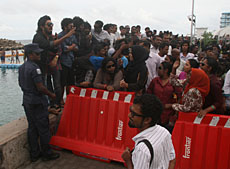
As blue-gloved officers from the Drug Enforcement Department (DED) arrived, a group of largely female protesters began to gather at the barricades set up near the STELCO building. The barricade was itself lightly manned by police, however a group of police stationed further back near the Dharubaaruge convention centre were equipped with riot shields, gas masks and rubber bullet guns.

The crowd was noisy and upset, but non-violent. An altercation erupted at the front between a group of women and several young men, whom protesters claimed had been sent by a government-affiliated party to provoke the crowd. Minivan News later observed one of these men being arrested by police after trying to break through the barricade.

Meanwhile, DED officers fanned out at the Usfasgandu site and began poking through plants and debris around the padlocked container under the main stage. A large group of police on the other side were picking through rocks along the seawall, while a police boat waited outside the harbour.

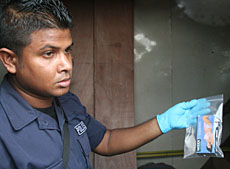
Media raced over to photograph the first discovery, retrieved from a nearby bush: cigarette butts and a brown substance wrapped in an MDP membership form. Police near the stage had meanwhile lifted up a wooden board and found a small plastic baggie containing the remnants of a dried substance.

A major find occurred after police broke open the container, searching through old paint tins and debris before reaching into a ceiling cavity, triumphantly producing a packet of condoms (‘Moods’ ultrathin).

The Usfasgandu area had been given to the MDP by the (MDP-dominated) Male’ City Council, after it was evicted by police from its previous camp just metres down the road at the tsunami monument. Police at the time claimed the area was being used as a hub for criminal activity and assorted deviancy, and a similar raid uncovered beer and condoms. The camp was immediately dismantled by the police and MNDF, and walls were painted over grey to remove all trace of the MDP from the area.

The Usfasgandu raid this morning ends a stalemate between the Home Ministry – headed by former Justice Minister during Maumoon Abdul Gayoom’s rule, Dr Mohamed Jameel – and Male’ City Council.

The Housing Ministry initially sought to repossess the area from the Council, which refused to cooperate. The Home Ministry then instructed police to retake the area, who approached the Criminal Court for a warrant. The court initially denied this warrant, stating that the repossession was a civil matter and not within its jurisdiction.

Eight days later and Home Minister Jameel yesterday announced that the Ministry had received complaints of criminal activity in the area: “No complaints of any criminal activities had been raised with us at the time [of the original court order request]. But now many complaints have been received including criminal offences,” he told local media.

Police Spokesperson Sub-inspector Hassan Haneef said that following a search of the area a decision would be taken on whether to shut down the site.

“If there is reasonable evidence of crimes being committed there, we would look to close the area,” he said.

Male City Mayor Ali ‘Maizaan’ Manik was standing next to a cage full of crows – kept on the site by the MDP demonstrators to mock President Mohamed Waheed, who is caricatured as a crow on the popular Maakanaa Show.

“I’m too angry to talk right now,” he told Minivan News, as police were left to pick through the area after media scurried to protect their cameras from the sudden downpour.

Back through the police barricades, one visibly upset protester expressed frustration at what he described as “a police state”.

“We just want somewhere to peacefully protest,” he said. “They are just going to plant something, like drugs or explosives, so they can blame us. What can we do? We are helpless.”

An older man came up, put his hand on his shoulder, and led him out of the rain.

Likes(0)Dislikes(0)

Former shark fishermen learn farming and aquaculture at M&S-sponsored workshop

Mohamed Rauf is a father of three from Kanditheemu in Shaviyani Atoll. Like most fishermen in his island, he took up shark fishing as a means to provide for his family.

For three years Rauf’s family depended on selling sharks to local buyers until the government of the Maldives imposed a nationwide shark fishing ban, bringing a halt to his income from shark fishing.

In March 2010, the government banned all types of shark fishing within its territorial waters, which covers about 90,000 square kilometres, technically making it the largest shark sanctuary in the world at the time. A trade ban on all shark products was imposed in July 2011.

Rauf is just one of the estimated 200 shark fishermen whose livelihood was affected following the ban.

Although the government in March 2010 said it would provide the fishermen with financial support and retraining, Rauf had to wait two years for any action on the matter. Last week, his hopes were finally raised.

‘Alternative livelihoods for former shark fishermen’ is a training workshop funded by UK retailer Marks & Spencer, focusing on farming and aquaculture training. The workshop was held last week for former shark fishermen and their families from the islands of Kulhudhuffushi in Haa Dhaal Atoll and Kan’ditheemu and Goidhoo in Shaviyani Atoll.

Seamarc Pvt Ltd, an environmental consultancy in the Maldives, coordinated the workshop in collaboration with the Ministry of Fisheries and Agriculture and New England Seafood.

Environmental consultant at Seamarc, Marie Saleem, said the workshop was conducted by experts from the Hanimaadhoo Agriculture Centre and Marine Research Centre, and was a great success.

“The workshop served as an inspiration to people – they have being asking for this since 2010. Now they realise they can really do things like hydroponics and agriculture on the islands,” Saleem said.

The farming course focused on home gardening and hydroponic techniques. Participants learned to cultivate different crops including chilli, watermelon and papaya. Participants also acquired knowledge on common pest and disease control related to these crops.

The aquaculture course focused on different species of aquaculture including food fish, clown fish, grouper, pearl, seaweed and sea cucumber cultivation. A lecture on the commercial aspects of mariculture was also given by the Maldives Industrial Fisheries Corporation (MIFCO).

The Hanimaadhoo Agriculture Centre will conduct a further, more in-depth agricultural training course later this year. The three-month course and another two-week long training on aquaculture planned for the year are expected to equip the participants with more hands-on experience.

“It was more of an introductory workshop this time. We really hope participants will continue with the other workshops that are coming up,” Saleem added.

Rauf, who has now achieved a certificate from the workshop, agreed that further workshops, especially in aquaculture, would be helpful.

“The workshop was great. We learned a lot of new things. But I am only confident with the farming techniques so far. Another workshop in aquaculture will be very useful,” he said.

Likes(0)Dislikes(0)

Maldives eyes underwater festivals and bio-reserves among dive innovation efforts

This story was originally published on Minivan News’ spin-off travel review site, Dhonisaurus.

Diving has been a long-standing part of the Maldives’ attempts to appeal to tourists as a tropical island holiday paradise over the last 30 years. With almost every Maldives-based resort island now providing a certified dive centre to guests, the local tourism industry has begun looking at means to bring further innovation to underwater exploration.

Beyond the establishment of high-profile sub-aquatic spas and restaurants in the country, some resorts are opting to play up the emergence of nearby protected marine parks and reserves. Other properties have even moved to hold underwater festivals in attempts bolster interest in exploring life beneath the Maldivian waters.

With an estimated 95 percent of the Maldives landmass underwater, Dolores Semeraro, PR Manager at the LUX* Maldives resort in South Ari Atoll, believes snorkelling and diving are a must-try experience for guests visiting the country.

Underwater festival

In order to try and better play up the appeal of diving to guests of all experience levels, the LUX* Maldives resort this month hosted what is claimed to be the country’s first ever underwater festival. The event had a central focus on underwater photography, as well as the chance to spy some of the Maldives’ most exotic – not to mention attention grabbing – wildlife in the form of whale sharks and manta rays.

Experts including photographer Junji Takasago and free diver Jean-Jacques Mayol joined the resort’s Resident Marine Biologist Chiara Fumagalli during the week to oversee the festivities and provide special programmes and presentations on diving and photography.

To Semeraro at least, while Maldives tourism is often associated with resorts offering high-end, beach-side indulgence and relaxation, the country’s reefs and dive spots are a hugely important contributor to the destination’s overall mystique.

“Events like the underwater festival highlight positively the destination from this point of view and it is incredible to see how interested our guests are in subjects such as whale sharks, snorkelling, coral reefs and so on,” she said.

The festival, which ran during a seven day period this month, concluded on May 20 with a prize giving ceremony for underwater images captured by guests during the week that were judged to be the best.

The resort said the festival was designed to cater for a wide variety of guests; ranging from accomplished underwater explorers, to holidaymakers looking for a more sedate spot of high-brow after-dinner entertainment.

LUX* Maldives therefore promised guests in attendance during the festival a number of special programmes such as free diving courses, the chance to learn special free diving breathing techniques, and illuminated outings for night time reef exploration. Presentations and screenings by marine experts in attendance during the festival were also conducted.

According to Semeraro, after six months of planning, the festival passed with favourable reactions from both media and attendees. She claimed that on average, two full boats of divers were heading out daily with underwater photographers, or to take part in the free-diving and apnea (special breathing) programmes.

When addressing some of South Ari Atoll’s more unique dive sites available to the festival’s attendees, Semeraro claimed that the Kudarah Thila and Digurah Thila sites were among the area’s most notable and popular destinations for underwater exploration.

“It’s hard to choose the key dive sites, they are all amazing,” she claimed. “South Ari Atoll showcases a few dive sites of world-wide renown.”

Semeraro stressed that the resort had committed itself to try and make the festival inclusive even to guests unaccustomed to underwater photography or diving.

“Divers are always keen photographers while underwater. However, it can be disappointing to check your pictures and find out that they were out of focus or not properly set once back on the surface,” she said. “That is when our underwater photographers stepped in to coach divers of all levels on how to have a more confident approach to photography while diving. For the non-divers, we opened several snorkelling sessions guided by our resident marine biologist for guests who are keen on trying snorkelling/underwater photography.“

Semeraro said that all guests who stayed at the resort were invited to participate in the festivities with a complimentary discovery scuba diving session being made available for newcomers to acquaint themselves with the Maldives’ underwater environment.

Semeraro claimed that diving and reef-based events were being monitored “at all times” by its diving instructors and marine biologists.

Sustainable promotion

Amidst the outspoken attempts of former President Mohamed Nasheed to try and put the Maldives on the global map during his tenure with an ambitious carbon neutral plan, Maldives tourism authorities had previously sought to promote the destination under the banner of “Always Natural”. After receiving a mixed reception, the branding was dropped earlier this year by the new government of President Mohamed Waheed Hassan.

Alongside claims by resort operators of their commitments to bring their operations in line with international sustainability standards, the country has begun to see the formation of marine parks and other underwater reserves that may have implications for their properties in the future.

Over in Baa Atoll for example, which has recently been awarded the United Nations Educational, Scientific and Cultural Organization (UNESCO) Biosphere Reserve status, properties like the Reethi Beach Resort are uncertain as to the direct impact protected marine areas may have on their operations.

Resort General Manager Peter Gremes told Dhonisaurus that while obtaining the UNESCO reserve status last year was a “prestigious” accolade for properties in the atoll, it was unlikely to impact visitor numbers on a significant basis.

With the UNESCO reserve area situated on the other side of Baa Atoll, Gremes claimed that he expected a negligible impact on the number of divers already coming to his resort to explore local underwater sites.

“We have a very high occupancy rate here at the resort, so we don’t really need to use the reserve in terms of a marketing tool,” he said. “At present, discussions are still taking place on how the atoll will aim to make use of its status as well as the costs involved. A lot of unanswered questions remain on this.”

The resort manager said he did welcome increased regulation and protection measures to the waters of the atolls that would – in theory – mean much tighter restrictions on the amount of divers coming to the area at any given time.

Gremes pointed to developments in the country’s renowned Hanifaru Bay area that previously led some tour operators and local people to raise concerns about the huge traffic of visitors coming to an area deemed to be of significant natural interest.

In 2010, amidst a 260 percent increase in tourist arrivals to the area, local island authorities raised concerns about the number of safari and dive boats that were attempting to cram themselves into the bay – a small enclosed reef the size of a football field.

Increased government regulation in terms of diving and other activities conducted in the area were likely to be beneficial in the long-run for local resorts, at least according to Reethi Beach General Manager Peter Gremes.

“After some of the issues we have had with the number of safari boats coming to dive sites, this will be beneficial for us at the resort,” he claimed.

Local NGOs have welcomed the previous government’s commitments to establish and extend several protected ecological preserves in areas like Baa Atoll, despite calling for amendments to the efficiency of collaboration between different ministerial branches in ensuring eco-protection.

Environmental NGO Bluepeace said last June that government action to protect marine areas was an “encouraging development”, despite wider concerns about the efficiency of collaboration between different ministerial branches over eco-protection.

Ali Rilwan of Local environmental NGO Bluepeace said at the time that he supported government in regard to environmental protection across the southerly atoll, yet insisted the measures were more of a “first step” towards a comprehensive national preservation system rather than a finalised commitment to conservation.

Yet Baa Atoll is not the only stretch of the country’s waters to be afforded greater enforcement in protecting its reefs.

Within the seclusion of the country’s northerly Noonu Atoll, the Hilton Iru Fushi resort has began working with the country’s first Marine National Park (MNP) at Edu Faru in a bid to play up the surrounding natural appeal of the area for guests.

According to the MNP’s management, after signing a Memorandum of Understanding (MOU) with the previous government in August 2011, guests staying at certain nearby properties like the Iru Fushi resort are cautiously being welcomed to explore the protected underwater habitats.

“The project is still in its early development stages and we are working towards having an official opening ceremony at the end of 2013,” said a representative for the MNP.  “The level of protection is yet to be determined in collaboration with the government and experts in the field.”

As a marine reserve, the MNP’s management team have said they continue to work on outlining exact policies for resort guests coming to the area.  A representative for the MNP told Dhonisaurus that balancing tourist interest in the area with the need to preserve coral and other inhabitants would always create “ecological challenges” for its operations, but it was working to overcome them nonetheless.

“The MNP will rely on marine-based tourism such as scuba diving and snorkelling,” the MNP spokesperson said.  “We strive to achieve a balance between recreational use and preservation of ecological values that form the MNP and the biological carrying capacity and prevent overuse of the site.”

In bringing guests to the site, the Hilton Iru Fushi resort has presently been set strict guidelines by the MNP on how guests can visit the site.

At present, guests are able to enter the house reef of the reserve for snorkelling and diving expeditions on the basis of private, non scheduled tours consisting of a small number of people.

Additionally, boats used to transport guests are also not permitted to anchor with the MNP area over concerns about the potential damage to the coral.

“At this stage, we prevent guests going ashore the islands within the MNP until we adequate knowledge about the specific biological values and vulnerable species and habitats and how they can best be protected,” said the MNP spokesperson.  “Therefore, we will have to seek more advice to develop appropriate management strategies for the marine-based tourism industry.”

In terms of costing, the MNP’s management said that as a non-profit organisation, the scheme would be run on grants and donations.  A sum of US$10 will be donated to the MNP project by guests who visit the site, the project’s management added.

Master plan

Marine parks and bioreserves are currently said to be among the “wide number” of options being considered by Minister of Tourism, Arts and Culture Ahmed Adheeb to try and diversify the appeal of the country’s tourist properties.

Adheeb claimed that the exact nature of there diversification plans was as yet undecided.  Authorities are now trying to devise a fourth Tourism Master Plan outlining developments in the country’s travel industry.  The third master plan was concluded last year.

“My predecessor, [Dr Mariyam Zulfa] explored a number a number avenues in terms of diversifying tourism here,” the tourism minister said.  “We have been provided with a large number of options.”

Adheeb claimed that with a fourth Tourism Master Plan expected to be completed later this year, discussions were currently taking place with industry stakeholders and bodies like the World Tourism Organization (UNWTO) on what direction future developments in the country should take.

“Before making decisions we need to know what is the current situation with the tourism industry here.  We need to see what the industry feedback is as well,” he said.  “What I can say right now is that we are already seeing bio-reserves and marine parks being set up here in the country.  Some of these have already by endorsed by the UNESCO.  A lot of value can be added to the market from these programmes.”

Adheeb stressed that it was also important to account for shifts like the growing interest in the Maldives from Asian markets like China when devising future plans to develop the industry.

Likes(0)Dislikes(0)

MDP prepares for internal elections while party’s frustrated former president decides to switch ship

The Maldivian Democratic Party (MDP) has announced that internal elections for the party chairmanship and presidential candidate will be held on June 16, with all members registered before April 12, 2012 eligible to vote.

Speaking to Minivan News, MDP’s Deputy Secretary General Ahmed Akram said that the decision was made in accordance with the article 95 of the party constitution and that details of eligible voters were available from the party’s website and the main headquarters of the party.

Article 95 of the party constitution states that a list of eligible voters must be made public 30 days prior to the election date.

Akram said that a total of 16 candidates will be taking part in all internal elections including the party presidential primaries and the party presidential elections. He also stated that about a thousand officials from the party would be involved in administering more than 260 ballot boxes.

“All the eligible voters will  be able to cast their vote for the positions of the party chairperson and the party’s presidential primaries, while the participants of the party’s last congress will be eligible to vote for the position of administrative deputy chairmanship,” he said.

“The votes would be counted in the presence of the observers at the polling station,” he added.

The party’s internal elections will also include the constituency presidential elections and the positions of some party constituency steering committees, to which only party members registered in the specific constituency will be able to cast their votes.

Elections for the party’s President and Vice President are due to be held on August 31, and several senior members of the party running for the posts have already started campaigning.

However earlier this week current interim chairperson of the party Moosa ‘Reeko’ Manik, the sole contender for the position of the party chairpersonship elections, in a statement called on candidates running for the MDP Presidency and Vice Presidency to halt their campaigns, after the MDP National Council has questioned whether the positions were necessary.

Moosa said members of the council had questioned whether the responsibilities of the President and Vice President overlapped with chairmanship, and that some members were proposing that the positions be removed.

‘’Because of the way the MDP Charter states the responsibilities of the President and Vice President of the party, during the last meeting of the National Council members questioned whether the positions were necessary,” he said.

‘’Some members of the National Council proposed a meeting to remove the two positions from the party, while others called to amend the inconsistencies in the party’s charter that makes the responsibilities of the two positions conflict with the responsibilities of other positions in the party,” the statement read.

However, Akram stated that Moosa’s comments were not made in his official capacity of the party interim chairperson but in his personal capacity.

“It’s his opinion. The party’s elections committee is doing their job in accordance with the party constitution. If the elections are to be delayed, we would need to go for a congress and make necessary amendments to pave way for that,” he said.

Akram also said that no decision has been made regarding Moosa’s remarks, and the election to elect party president and vice president are scheduled to take place on the announced date.

The positions were declared vacant last month after the MDP National Council almost unanimously voted (95 percent) to oust President Dr Ibrahim Didi and Vice President and MP Alhan Fahmy in a no-confidence motion.

The MDP stated that the motion was triggered after both Dr Didi and Fahmy made public statements contradicting the party’s position as established by a resolution passed on February 8, recognising that former President Mohamed Nasheed and his cabinet were ousted illegitimately in a coup d’état.

Ousted party president decides to switch ship

Ousted party president Dr Didi has appealed against the decision claiming that it was illegal, however the matter was dropped by the Elections Commission (EC). Dr Didi yesterday told the local media that he has decided to join another political party.

Didi said Nasheed had “kicked” him out of the position, the same thing he had done to two former presidents Ibrahim ‘Ibra’ Ismail and Dr Mohamed Munavvar.

MDP has earlier denied the claims that Nasheed had undue influence over the party.

Didi further alleged that Nasheed was been trying to bring in former Party Chairperson Mariya Ahmed Didi to the position of the party president, after removing him from the position.

“[The no confidence motion] was taken because Nasheed wanted to bring in Mariya for the position of party president. From the moment I realised that Nasheed had done the same to remove me from the position just like he did with the former party presidents, and when I realised that all the doors had been closed to work in a democratic means, I decided to join another party,” said Didi.

Didi did not mention which party he would be joining but stated that he would consider the national interest and would join a party “that works in the best interest of the nation and the people.”

“I haven’t decided which party yet. But I will decide after consulting with several people and will consider the national interest,” he said.

Didi however said that he would still file the matter in court and would submit it as soon as he acquired the necessary documents from the MDP.

Didi was not responding at the time of press.

Likes(0)Dislikes(0)

Obstructing sermons “a great war to destroy religion”: Adhaalath

Obstruction of religious sermons across the country by supporters of the ousted Maldivian Democratic Party (MDP) amounts to “a great war to destroy religion”, the religiously conservative Adhaalath Party has claimed.

In a strongly-worded statement released on Sunday, the Adhaalath Party condemned MDP-led protests against visiting Sheikhs in several islands as “lowly and secular acts” allegedly intended to “sow discord in society” and “lead the people astray from Allah’s path.”

In recent weeks, city and island councils controlled by the former ruling party have refused to authorise sermons in mosques by prominent religious scholars of Adhaalath Party, on the grounds that it could “disrupt the peace and create unrest”.

Under the landmark Decentralisation Act enacted in 2010, permission to preach in mosques and other public places must be sought from local councils.

“Obstruction”

In the past month, attempts by Sheikh Ilyas Hussein, head of the Adhaalath Party’s scholar’s council, to preach in Addu City, Male’ City, Baa Atoll Thulhaadhoo and Haa Dhaal Vaikaradhoo were met with refusals by MDP-dominated local councils and angry protests by the party’s supporters.

On May 18, police arrested five people from a group of MDP supporters protesting outside al-Furqan mosque in Male’ during a sermon by Sheikh Ilyas, which saw clashes between rival supporters outside the mosque.

Prior to the unrest, Male’ City Council had asked police to stop the sermon from proceeding. The disturbance in the capital followed a similar dispute between the Adhaalath Party and the MDP-controlled Addu City Council, which had also refused to authorise Sheikh Ilyas to preach.

Local media reported violent clashes between MDP and Adhaalath Party supporters in the southernmost atoll following the Addu City Council’s decision.

Vaikaradhoo Island Council Chair Ahmed Waheed told Minivan News last Thursday that the council denied permission to the Sheikh because “we are certain that we could not control any unrest that might be created if Sheikh Ilyas is allowed to preach here.”

A number of MDP supporters meanwhile protested at the Vaikaradhoo jetty with chants of “traitor” when the Adhaalath delegation arrived, forcing the party leaders to disembark under police protection.

“An effort to eradicate Islam”

“What [the protesters] are saying is that they do not want to listen to religious counsel from scholars sent by the present government,” reads the Adhaalath statement.

“But they have no problem accepting salaries and services provided to citizens by the current government, such as healthcare, electricity, water and other services. Therefore, it is certain that their action is a great war to destroy religion in the guise of political activity.”

As the Maldives is “a 100 percent Muslim country,” the statement continued, religious scholars should not face any obstacle to preach and raise religious awareness among the public.

The Adhaalath Party called on the government to impose “harsh measures” against persons who obstruct religious sermons.

Meanwhile on its official twitter account, the party contended that “the ongoing harassment of scholars is nothing but an effort to eradicate Islam here in Maldives and open up the country to other religions.”

Islamic Minister Sheikh Mohamed Shaheem Ali Saeed – who represents the Adhaalath Party in President Mohamed Waheed’s cabinet along with Housing Minister Mohamed Muizz – told Sun Online today that obstruction of religious sermons was carried out to show the outside world that there were Maldivians “opposed to Islam.”

Councils that refuse to permit religious sermons should be dissolved, the Islamic Minister said, adding however that some MDP-controlled councils had welcomed religious scholars and were cooperating with the ministry.

“Coup-Sheikhs”

In September 2011, following frequent clashes with President Mohamed Nasheed’s administration over various issues— selling alcohol on inhabited islands, making Islam an optional rather than a compulsory subject in secondary school and introduction of ‘religious unity regulations’ – the Adhaalath Party voted to sever its coalition agreement with the former ruling party.

In late 2011, Adhaalath Party teamed up with a coalition of eight political parties and religious NGOs to stage a ‘mega-protest’ on December 23 to ‘Defend Islam’ from an alleged “securalisation agenda” pursued by the deposed president.

Responding to the religious conservative party’s charges today, MDP Spokesperson and Maafanu North MP Imthiyaz Fahmy argued that “the coup itself is the war to destroy the religion, civilisation and democracy in the Maldives.”

“The coup-sheikhs and their partners in crime are the real culprits to blame and no one else,” MP Imthiyaz said. “People of those islands or the vast majority of citizens of the Maldives do not consider them Sheikhs anymore but rebels and traitors. So certainly people will protest against such rebels and coup-sheikhs wherever they go.”

On the role of local councils denying permission to preach “politicised” sermons, Imthiyaz said the party’s councils would “act in conformity with laws and regulations.”

“MDP is an advocate and promoter of a decentralised system of governance,” he continued. “But this coup government has been trying to destroy the system. [Plans to bring] mosques directly under the [Islamic] ministry is such an attempt, thus back to the old days.”

Imthiyaz further argued that the MDP government “freed Sheikhs from jails and allowed them to freely delver speeches and sermons.” Under the 30-year rule of former President Maumoon Abdul Gayoom, a number of religious scholars were reportedly detained and tortured. A number of scholars claimed they had their beards shaven with chili sauce.

“We are the only party which does not use religion as a political tool or exploit religion for that purpose,” Imthiyaz said, adding that the party accorded “the highest degree of respect to religion.”

Likes(0)Dislikes(0)

HRCM’s report on Judge Abdulla case sent to PG

The Human Rights Commission of Maldives’ (HRCM) report into the detention of Chief Justice Abdulla Mohamed has been completed and forwarded to the Prosecutor General’s (PG) Office, Sun Online has reported.

“We received the report from HRCM after office hours yesterday. We are assessing the report now. We have requested them to send the statements and evidence in relation to this case,” an official at the PG’s official told Sun.

HRCM member Ahmed Abdul Kareem told Sun the decision on whether to disclose the report to the media had not yet been made.

The PG will now decide on how to proceed with the charges against former President Mohamed Nasheed in relation his role in detaining judge for 22 days at the Maldives National Defence Force’s (MNDF) training centre at Girifushi.

Judge Abdulla was arrested by the MNDF on January 16 this year, in compliance with a police request. The judge’s whereabouts were not revealed until January 18. He was released the day the presidency changed hands.

The charges against Nasheed state that the Judges detention were in violation of the constitution.

Former President Nasheed gave his testimony to the HRCM in March, saying: “The Home Minister wrote to the Defense Minister that Abdulla Mohamed’s presence in the courts was a threat to national security. And to take necessary steps. And that step, the isolation of Abdulla Mohamed, was what the [Defense] Ministry deemed necessary.”

Likes(1)Dislikes(0)

Government to upgrade all ID cards to smart cards

The Home Ministry has announced that all national ID cards are to become smart cards, containing fingerprint information.

State Minister for Home Affairs Ahmed Fayaz said that discussion were under way with the Department of Planning as well as the Pension Administration Office to determine the best way in which the changes can be implemented. The new smart cards are to replace the old ones as they expire.

Fayaz is also reported as saying that the ministry may collaborate with the police of the National Registration to obtain this information.

Home Minister Dr Mohamed Jameel Ahmed is reported as saying that a list of 23,000 people awaiting new cards when the current government came to power has been reduced to around 3,000, with 1,000 cards nearly ready for distribution.

It was reported that the additional information would make the cards multi-functional, potentially doubling and insurance cards and driving licenses.

Likes(0)Dislikes(0)