Missing journalist’s family accuses police of negligence, files complaint

Missing Minivan News journalist Ahmed Rilwan’s family has accused police of negligence in investigating the reporter’s disappearance and has filed a formal complaint with the Police Integrity Commission (PIC).

Speaking at a press conference today, Rilwan’s sister Mariyam Fazna noted that 82 days had passed without apparent progress in police investigations.

“Our family is in deep mourning. We have no way forward. We believe police negligence is behind the lack of progress in finding Rilwan,” said Fazna.

The police have failed to take the case seriously, despite an abduction outside Rilwan’s apartment building on the night of his disappearance and reports that he had received numerous death threats and had been followed, she said.

Eyewitnesses had reported the abduction at knifepoint at around 2am on August 8, but police only took their statements on August 14, the family said. The police had also failed to track down and search the car used in the abduction.

“If the abduction had been investigated immediately at the right time, the police would have been able to find the victim and clarify if it is our brother or not,” Fazna said.

The police only searched Rilwan’s apartment 29 hours after the abduction was reported and searched his office 11 days afterwards. The police also failed to make a public announcement on Rilwan’s disappearance – despite a request by the family – and did not inform the public on how to act if they had any information related to the case, the family explained further.

Meanwhile, Rilwan’s sister Fathimath Shehenaz condemned the police for disrespecting a family in grief, pointing to a police statement on September 23 in which they claimed political parties were using the family to obtain information about the investigation.

“These words are extremely disrespectful to a family suffering the disappearance of a loved one,” she said.

The People’s Majlis on Tuesday threw out a 5055 signature petition urging MPs to pressure police for a through and speedy investigation. The parliament secretariat later admitted the rejection was “a mistake,” according to MP Imthiyaz Fahmy who sponsored the petition.

Four men have been arrested over Rilwan’s disappearance, but only one man remains in custody at present. The police have revealed few details on the case.

Home Minister Umar Naseer said he believed Rilwan is alive and promised to return him safe to his family. He has also acknowledged involvement of criminal gangs in the case.

Human rights NGO Maldivian Democracy Network released a report in September implicating radicalised gangs in Rilwan’s disappearance.

Discounting theories of voluntary disappearance and suicide, the investigation – conducted by Glasgow-based Athena Intelligence and Security – concludes the disappearance is likely to have been an abduction.

The report confirmed evidence of possible “hostile surveillance” at the terminal conducted by two known affiliates of Malé based Kuda Henveiru gang.

The NGO on October 23 accused the police of negligence in investigating the disappearance for their failure to inform the public on progress and failure to confirm if the abduction reported on the night Rilwan went missing was related to his disappearance.

Likes(0)Dislikes(0)

“President Yameen, the world is watching you”, warns Australian senator

Australian Senator James McGrath has warned President Abdulla Yameen that the eyes of the world are on the Maldives’ deteriorating human rights situation.

“Do not lead your country into the shadows of fear and hate and violence. Stamp on ISIS and the other agents of hate. Let the Maldives be free – President Yameen, the world is watching you,” McGrath told the Australian Senate yesterday (October 28).

The Queensland senator told the house of judicial corruption, political violence, media suppression, and religious extremism in the Indian Ocean nation.

He gave special attention the the ongoing Supreme Court case against the Human Rights Commission (HRCM) and the disappearance of Minivan News journalist Ahmed Rilwan 82 days ago.

McGrath informed the assembly that he had worked with former President Mohamed Nasheed during his successful 2008 presidential election campaign, describing the transition to democracy as a “political fairy tale”.

The governing Progressive Party of Maldives last week accused Nasheed’s Maldivian Democratic Party (MDP) of attempting to use the international community to influence the case against the HRCM, to “discredit Maldives reputation”, and to “impoverish the Maldivian people”.

Recent events in the Maldives, including consistent attacks and threats against opposition MPs and property, have prompted concern from the EU, Amnesty International, the Inter-Parliamentary Union, and the Canadian government.

McGrath – who described the suo moto proceedings used against both the HRCM and the Elections Commission earlier this year as “unusual” – said “a worrying trend has been for the supreme court to violate the separation of powers outlined in the 2008 constitution”.

Noting the likely abduction of 28-year-old journalist Rilwan had come after a series of attacks on the media in recent years, McGrath observed a “slide into authoritarianism and religious extremism” in the aftermath Nasheed’s departure from office in February 2012.

The senator’s comments regarding ISIS followed one week after UK Under-Secretary of State for Foreign and Commonwealth Affairs Tobias Ellwood responded to a written question from Karen Lumley MP on the group’s potential activities in the Maldives.

“We are aware of the activity of ISIL sympathisers in the Maldives, and we will continue to engage with the Maldives government about the promotion of religious freedom and moderation,” Ellwood informed Lumley.

While up to four Maldivians are reported to have been killed fighting in the Syrian civil war this year, a family of four were reported to have migrated to ISIS held territory last week.

Up to 200 demonstrators marched through the capital Malé last month, brandishing the flag made famous by ISIS, calling for the full implementation of Shariah in the Indian-ocean archipalego.

McGrath yesterday expressed alarm at recent moves to subject the publication of poems and prose to government approval – a move he called “blatant censorship” – before concluding his speech.

“The world is watching you president Yameen. Be a true leader and let your people be free. Let them speak freely, let them be without fear of violence, let them have rights of association, let them talk right and join together as free peoples.”

Likes(0)Dislikes(0)

Majlis passes amendment allowing president to reappoint auditor general

Parliament today approved an amendment proposed by Progressive Party of Maldives (PPM) MP Ahmed Thoriq to the Audit Act enabling the president to reappoint the auditor general – four years before the end of the incument Niyaz Ibrahim’s seven year term.

Following the presentation of a report (Dhivehi) by the economic affairs committee to the People’s Majlis floor after reviewing amendments submitted by the government to the Audit Act, Thoriq proposed adding a clause stating that the president shall nominate for parliamentary approval an individual or individuals to the post of auditor general within 30 days of ratifying the amendments.

Thoriq’s amendment – seconded by PPM MP Ibrahim Didi – passed with 36 votes in favour and 22 against while opposition Maldivian Democratic Party (MDP) MPs protested vociferously, contending that the amendment was unconstitutional.

The amendments should not have been put to a vote as it allows the dismissal of an incumbent auditor general without following the constitutional process for impeachment, opposition MPs argued.

Article 218 of the Constitution states that the auditor general could be removed from office “(a) on the ground of misconduct, incapacity or incompetence; and (b) a finding to that effect by a committee of the People’s Majlis, pursuant to article (a) and upon the approval of such finding by the People’s Majlis by a majority of those present and voting, calling for the Auditor General’s removal from office”.

Thoriq’s amendment was added to revisions to the Audit Act submitted on behalf of the government by PPM MP Ibrahim Waheed to bring the 2007 law in line with the Constitution adopted in August 2008.

The legislation was part of a raft of bills submitted by the government to abolish provisions in conflict with the new constitution.

Waheed’s amendments did not include revisions to sections dealing with the appointment and dismissal of the auditor general.

During the final debate on the government-sponsored amendments at today’s sitting, Thoriq said he proposed the amendment with reference to Article 211(b) of the Constitution, which states, “A statute shall specify the responsibilities, powers, mandate, qualifications, and ethical standards of the Auditor General.”

Thoriq noted that the Audit Act was passed in 2007 before the ratification of the constitution the following year and did not specify the responsibilities, mandate, qualification and ethical standards of the auditor general.

However, he added, the amendments submitted by the government do specify the criteria.

“The current auditor general is competent. I wish and believe as well that when this amendment is passed and ratified his name will be sent for our approval,” he said.

However, MDP MPs insisted that the purpose of Thoriq’s amendment was replacing the current auditor general.

The amendment bill – with Thoriq’s amendment – was passed with 40 votes in favour and 25 against.

Appointment and dismissal

The 17th People’s Majlis unanimously approved former President Mohamed Nasheed’s nomination of Niyaz Ibrahim to the post of auditor general in May 2011.

During a meeting of the public accounts committee last week with Niyaz and Finance Minister Abdulla Jihad concerning the audit office’s budget for 2015, Thoriq alleged that 60 percent of audit office staff were unhappy with Niyaz’s leadership.

Thoriq also accused the auditor general of releasing a damning audit report of the finance ministry ahead of the parliamentary polls in March and withholding reports exposing corruption in the MDP government.

In response, Niyaz said he was not surprised that employees of the audit office met politicians to complain about the auditor general, contending that some staff members were unhappy with stricter workplace regulations.

A timetable or schedule for publishing audit reports has been shared with the public accounts committee, he noted.

Moreover, the majority of audit reports released during his tenure were of government ministries and state institutions under the administration of former President Mohamed Nasheed, Niyaz observed, adding that it was used as “campaign material” against the MDP presidential candidate during last year’s presidential election.

Niyaz was appointed to the post following parliament’s dismissal of former Auditor Ibrahim Naeem in March 2010 in a no-confidence motion.

Naeem was accused of corruption by the Anti-Corruption Commission (ACC) of using state funds to buy a tie and visit Thulhaadhoo in Baa Atoll.

Naeem had claimed the charges were an attempt to discredit his office and prevent him from reclaiming the government’s money stored in overseas bank accounts.

“A lot of the government’s money was taken through corrupt [means] and saved in the banks of England, Switzerland, Singapore and Malaysia,” Naeem told the press ahead of the no-confidence vote.

Likes(0)Dislikes(0)

Majlis throws out 5055 signature petition on Rilwan’s disappearance

The People’s Majlis on Tuesday threw out a 5055 signature petition which urged the parliament’s National Security Committee to pressure the Maldives Police Services to conduct a speedy and thorough investigation.

In a letter to MP Imthiyaz Fahmy, who sponsored the petition, Majlis Secretary General Ahmed Mohamed said the petition had failed to fulfill requirements outlined in the Majlis standing orders.

Condemning the move, the opposition Maldivian Democratic Party (MDP) MP said Secretary General Mohamed had later admitted the rejection of the petition was “a mistake” and confirmed it had been submitted according to all procedures.

“We are extremely concerned. The MDP submitted the case to various subcommittees. Ruling party MPs killed the case in every single committee, and have now killed the 5055 signature petition submitted by Rilwan’s family,” Fahmy MP said.

“I don’t know whether they will be looking at it again. But they [Majlis] did admit that what they did was wrong when they threw out the petition. They have completely ignored the law when they issued a letter to me to saying the petition does not meet requirements.”

The Majlis secretariat had said the sponsoring MP had not signed all pages of the petition as Article 200 of Majlis regulations. However, Fahmy pointed out his signature was in fact present on all pages.

Article 199 the Majlis standing orders state a petition can only be submitted on a bill submitted to Majlis, an issue taken up in Majlis, or an issue of public concern.

Fahmy’s urgent motion on Rilwan’s disappearance on August 19 was accepted with bipartisan support.

“When I countered all of their arguments, they at last said it was a mistake. All the required signatures were there. Then, not knowing what to say, they said we will try to proceed. What kind of answer is this?” the Maafannu North MP said.

“The PPM holds a majority in Majlis. Their refusal to look into the issue via Majlis sub committees and rejection of the petition indicates the government’s stand on this issue.”

Despite public outcry, the PPM has largely remained indifferent. Today is the 81st day since the reporter disappeared.

The petition, submitted on September 4, asked MPs to investigate if the police had been negligent in investigating Rilwan’s disappearance and asked MPs to find out if an abduction reported on August 8 in front of Rilwan’s apartment building was connected to his disappearance.

Four men have been arrested over the case, but only one man remains in custody at present. The police have only revealed few details on the investigation.

Home Minister Umar Naseer said he believed Rilwan is alive and promised to return him safe to his family. He has also acknowledged involvement of criminal gangs in the case.

Human rights NGO Maldivian Democracy Network released a report in September implicating radicalised gangs in Rilwan’s disappearance.

Discounting theories of voluntary disappearance and suicide, the investigation – conducted by Glasgow-based Athena Intelligence and Security – concludes the disappearance is likely to have been an abduction.

The report confirmed evidence of possible “hostile surveillance” at the terminal conducted by two known affiliates of Malé based Kuda Henveiru gang.

The NGO on October 23 accused the police of negligence in investigating the disappearance for their failure to inform the public on progress and failure to confirm if the abduction reported on the night Rilwan went missing was related to his disappearance.

Likes(1)Dislikes(0)

President vetoes amendments to Child Protection Act

President Abdulla Yameen has vetoed amendments passed by the People’s Majlis to the Child Protection Act on October 14, requesting revisions based on advice from the attorney general.

In a letter to parliament – read out at today’s sitting – President Yameen explained that the government submitted the amendments to the 1991 law to remove inconsistencies with the new Constitution adopted in August 2008.

Article 36(b) of the Constitution states, “Primary and secondary education shall be freely provided by the State. It is imperative on parents and the State to provide children with primary and secondary education. Opportunity for higher education shall be generally accessible to all citizens.”

However, the amendment bill (Dhivehi) passed by parliament states that the state shall freely provide pre-school, primary, and secondary education to all “Dhivehi children living in the Maldives.”

President Yameen noted that the amendment to Article 5(b) of the Child Protection Act contravenes Article 36(a) of the Constitution – which states that “Everyone has the right to education without any discrimination of any kind” – as it implies that the state does not have to provide free education to foreign or expatriate children residing in the country.

“And considering Article 2 and 28 of the Convention on the Rights of the Child to which the Maldives has acceded, providing free primary education to all children living in the Maldives without discrimination is obligatory,” the president’s letter explained.

Therefore, it added, the amendment to the Child Protection Act was contrary to the obligations placed on the state by the convention.

Moreover, the president observed that the amendments make it mandatory for the state to provide pre-school education to all children.

The amendments also contravene rules for the state to assist pre-schools operated by local councils specified in the Pre-schools Act of 2012.

The president noted that providing mandatory free pre-school education in all inhabited islands would place a burden on the state budget and recommended consultations with the education ministry and finance ministry regarding government policy.

In the ensuing debate, opposition Maldivian Democratic Party (MDP) MP Mariya Ahmed Didi criticised parliamentary committees for hastily approving legislation without proper study or consultations with stakeholders.

Leader of the Majlis have in recent weeks, however, called upon committee members to speed up work after a number of Majlis sessions were cancelled due to lack of work on the house’s agenda.

Progressive Party of Maldives (PPM) MP Jameel Usman had submitted the amendments on behalf of the government in June. The social affairs committee reviewed the amendments and forwarded the legislation to the Majlis floor earlier this month, after which it was passed with 51 votes in favour and two abstentions.

MP Ahmed Nihan – parliamentary group leader of the PPM, the majority party in the Majlis – conceded that the inconsistencies with the constitution and pre-school law were missed due to an oversight in the legislative process.

Nihan said the majority party should ensure that such incidents do not recur in the future.

Following the debate, the amendment bill was returned to committee for further review with 58 votes in favour and one abstention.

Likes(1)Dislikes(0)

PPM has fulfilled many pledges in manifesto, says Tourism Minister Adeeb

The ruling Progressive Party of the Maldives (PPM) has fulfilled many of its pledges, deputy leader and tourism minister Ahmed Adeeb has said.

“This government’s pledges are laid out in our manifesto. I would like to note as this government marks 11 months in power, this young government has fulfilled many pledges,” Adeeb told reporters at a press conference to mark the PPM’s third anniversary on Monday.

The PPM has increased elderly pension from MVR2300 to MVR 5000, reduced fuel and food prices, and maintained the value of the Maldivian Rufiyaa, the minister said, while pledging to destroy the dollar black market.

Adeeb in March had promised the increase in elderly pensions would come through the sale of T-bills and other financial instruments and not through the state budget. But Finance Minister Abdulla Jihad in August admitted the government is forced to rely on the budget to finance the handouts.

The Finance Ministry has said the unplanned increase in handouts and debt servicing is responsible for a ballooning budget deficit, which currently stands at MVR 4 billion (US$260million). The Majlis had planned for a deficit of MVR1.3 billion when it passed the record MVR17.95 million budget.

The finance ministry in September cut back on planned development projects and announced a 20 percent cut in recurrent expenditure, excluding wages and allowances, to curb the deficit.

The PPM’s most noteworthy pledges include a cash handout of MVR10,000 to fishermen during lean months and MVR8,000 to farmers, a doctor for every citizen,and unlimited healthcare under the Aasandha insurance scheme.

After President Abdulla Yameen assumed power, the fisheries ministry announced the MVR10,000 fishermen handouts would be issued through an insurance scheme with a monthly premium of MVR500.

The health ministry launched the unlimited Aasandha scheme and a doctor for every family program in February, though the family doctor project is at present operating only in Malé’s suburb Villimalé and Faafu Atoll Nilandhoo Island.

The PPM also pledged to begin oil exploration in the Maldives, to create a youth city in Malé’s suburb Hulhumalé, to create 94,000 jobs, bring 11 resorts into operation every year, increase annual tourist arrivals to 5 million, and give resort workers shares in resorts.

Women will be allowed to work from home and will be given investment money to encourage female entrepreneurship. Senior citizens will also receive MVR 00,000 on retirement at 65 years of age, said PPM manifesto – launched just days before last year’s presidential poll.

The party also promised higher education to any student who passes tenth grade O’Level with three passes and promised to provide 2000 youths with opportunities for higher education.

Adeeb said the government had faced serious challenges when it assumed power in 2013 including debt repayment and a health and education sectors in ruin. But the PPM and the government has achieved great success, he said.

“We have five years to fulfill pledges in the manifesto. Of those five years, 11 months have passed. There are many days left. So I think we should be given time in evaluating this government’s success,” he said.

“There will be more prosperous changes in the next year,” he promised.

Meanwhile, opposition leader and former Maldivian Democratic Party (MDP) President Mohamed Nasheed has said the PPM government has failed to fulfill pledges or ensure security in the country. The country has been taken over by rebel police and gangs, he claimed.

Referring to the government’s failure to find missing Minivan News journalist Ahmed Rilwan or take action against several masked men who attacked MDP supporters in an Addu City rally, Nasheed said the government has failed to bring perpetrators of serious crime to justice.

He also criticised the government for its decision to ‘freeze employment’ in an attempt to reduce the ballooning budget deficit.

More than 5000 students are to finish their O levels, said the former president, with a further 2000 completing A levels – suggesting that these groups would be lost to gangs without gainful employment.

“The budget deficit has risen higher than ever before. The government is in huge amounts of debt after selling treasury bills to make ends meet,” he added.

Likes(0)Dislikes(0)

PPM slams MDP and international community’s attempts to influence HRCM treason trial

The ruling Progressive Party of Maldives (PPM) today slammed opposition Maldivian Democratic Party (MDP) for allegedly using international organisations to influence the Supreme Court trials against the state’s human rights body.

“The MDP in connection with various international organisations is attempting to influence an ongoing court case initiated by the highest judicial authority Supreme Court against the Human Rights Commission of the Maldives (HRCM),” the PPM said.

The Supreme Court in September charged the independent commission with undermining the Constitution and sovereignty of the Maldives by spreading lies about the judiciary in its Universal Periodic Review (UPR) submission to the UN Human Rights Council.

The trial was initiated under suo moto regulations that allow the Supreme Court to initiate proceedings, prosecute, and pass judgment.

In its statement today, the PPM said it “harshly condemns MDP’s irresponsible attempts to discredit Maldives reputation and impoverish the Maldivian people.”

The MDP and the international community’s work harm Maldivian democracy and negatively impacts on the country’s tourism sector, the ruling party said.

The MDP had on September 23, expressed grave concern over the Supreme Court’s charges and accused the court of the undermining the Constitution.

“We believe that by initiating a suo moto case, the Supreme Court is undermining the responsibilities vested by the Maldivian Constitution and international conventions on the independent commission,” it said.

In the second hearing, the Supreme Court reprimanded the HRCM for basing criticism of the judiciary on a “rejected” 2013 report by the UN Special Rapporteur for Independence of Judges and Lawyers Gabriela Knaul.

The court denounced the HRCM’s statements on the judiciary as “dangerous,” “irresponsible”, and poorly researched.

Chief Justice Ahmed Faiz censured the HRCM for alleged failure to fact check the UPR submission and said the commission had no authority to comment on the judiciary, review court verdicts, or monitor court proceedings.

The HRCM trial is only the second suo moto case in the country’s history. The first – in March this year – saw the Supreme Court sack the Election Commission’s president and vice president for contempt of court.

The United Nations Human Rights Council in 2012 said it was “deeply concerned about the state of the judiciary in the Maldives.”

The Supreme Court in particular needed “radical readjustment,” the committee said. “As 6 of 7 Supreme Court judges are experts in Sharia law and nothing more, this court in particular is in need of radical readjustment.  This must be done to guarantee just trials, and fair judgments for the people of Maldives.”

The 2006 Human Right Commission Act lists the promotion and protection of human rights in accordance with international conventions along with the assistance and support of relevant NGOs as basic objectives of the commission.

Additionally, Article 27 of the HRCM Act grant members immunity from prosecution in relation to acts carried out as part of the commission’s duties.

Article 27 (b) meanwhile says that a case can only be filed against the commission regarding published reports following an inquiry which proves components of the report to have been false.

The PPM in its statement today credited 30-year ruler President Maumoon Abdul Gayoom for establishing a modern democracy in the country and gaining the respect and support for Maldivian sovereignty.

President Abdulla Yameen is following in the same footsteps, the statement read.

Likes(1)Dislikes(0)

China to “favorably consider” financing Malé-Hulhulé bridge if project proves feasible

China will “favorably consider” providing financial support to the construction of Malé – Hulhulé bridge project, if the venture proves feasible, the Embassy of China has said.

Speaking at a brief press conference at the President’s Office, Charge d’affaires ad interim of China Embassy Mr Liu Qiang revealed details of the MOU signed between China President Xi Jingping and President Yameen Abdulla in September.

He also explained that a Chinese survey team will complete a preliminary feasibility study of the project within 40 days.

The preliminary study will be followed by a project feasibility study. Afterwards, a design plan will be determined and the two governments will explore options to finance the project.

The arrival of the preliminary feasibility study “shows that the Chinese government attaches great attention both to this project and to the friendly and cooperative relations between China and the Maldives,” said Qiang.

President Xi has previously expressed his hope that the bridge would be named the ‘China-Maldives Friendship Bridge’.

“If this is possible engineering-wise, and if nature allows it, we will do it,” Fisheries Minister Dr Mohamed Shainee said today.

The construction of a bridge was first announced during former President Maumoon Abdul Gayoom’s reelection campaign in 2008. President Mohamed Nasheed also pledged to link Malé to its suburb islands – Hulhumalé, Hulhulé, Villingili, and Gulhifalhu – via a bridge.

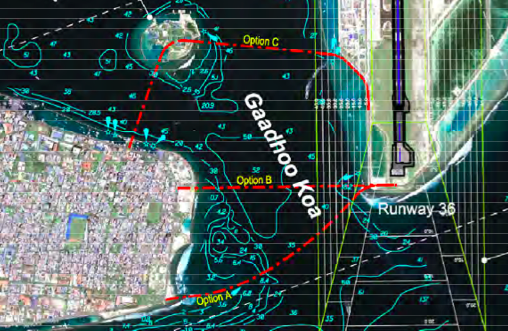
A 2011 feasibility study carried out by Ove Arup and Partners Hong Kong explored three options to link Malé and Hulhulé, through Funadhoo Island on the north, or through two different paths on the southeastern side of Malé over the surf point to the edge of the runway on Hulhulé.

The study said a floating bridge would be possible via Funadhoo and a fixed bridge may be possible via Malé’s Raalhugandu area.

The cost of the bridge may run between US$ 70 and 100 million, the study added. Tourism Minister Ahmed Adeeb revealed last week that the current survey – said to cost $3-4 million – will be covered through Chinese aid, of which 100 million Yuan (around MVR250 million or US$16 million) was pledged in August.

The following month President Xi became the first Chinese head of state to visit the Maldives, signing various MoUs as well as a preliminary contract agreement on the development of Ibrahim Nasir International Airport.

During the historic visit, President Yameen told his counterpart that he hoped to increase the number of Chinese visitors threefold before the end of his term. Chinese tourists already represents around one third of the market share.

Likes(4)Dislikes(0)

Adhaalath Party objects to compulsory creative arts subject in new curriculum

The Adhaalath Party is working ceaselessly to ensure that music and dance are not taught as compulsory subjects with the introduction of the new education curriculum next year, Sheikh Imran Abdulla has declared.

“Adhaalath will take all necessary measures against this,” the religious conservative party’s president said on his Facebook page on Thursday (October 23).

Music and dance have reportedly been included in the new curriculum as part of a compulsory creative arts subject from pre-school to grade three.

Islamic Minister Dr Mohamed Shaheem Ali Saeed – a senior member of the Adhaalath Party – has also officially requested the education ministry to make the creative arts subject optional.

Asked about the issue at a press conference of the cabinet’s Social Council on Thursday (October 23), Education Minister Dr Aishath Shiham said the whole curriculum was based on Islamic values and codes of behaviour.

“There will not be anything that conflicts or differs with Islam anywhere in the curriculum,” she insisted.

Islamic Minister Dr Shaheem meanwhile criticised the media for reporting the issue in a way that prompts concern from the public.

Shaheem noted that Quran was included as a compulsory subject in the new curriculum and declared his support for efforts to “broaden Islamic education and Arabic language”.

“We value [the education ministry’s] efforts. Along with that, I believe that we can discuss together in a friendly manner to solve the [dispute over compulsory creative arts],” he said.

Shaheem added that he did not wish to comment further on the issue at present.

However, Shaheem told newspaper Haveeru last week that “hundreds of citizens” were concerned about plans to teach music and dance as compulsory subjects.

Shaheem also denied claims by State Minister for Education Adam Shareef’s that the cabinet has approved the new curriculum, which is currently being implemented in a few schools.

While the social council has discussed the curriculum, Shaheem said the issue has not been deliberated by the full cabinet.

He noted that former President Dr Mohamed Waheed’s administration had decided to make music and dance optional subjects.

Several religious NGOs have also objected to the creative arts subject, claiming that music is haram (prohibited) in Islam.

NGO Jamiyyathul Salaf put out a press statement last month describing the decision to make music and dance compulsory as an “insult to Islam”, contending that music is prohibited in Islam.

Shaheem meanwhile warned that forcing children of parents who consider music haram to study the subject could worsen extremism in society.

The education ministry should accept the Islamic ministry’s advice on the issue, he said, expressing confidence that President Abdulla Yameen would amicably resolve the dispute.

Likes(1)Dislikes(0)