MDP condemns release of suspects in Alhan stabbing

The opposition Maldivian Democratic Party (MDP) has strongly condemned the release of two suspects arrested in connection with the stabbing of the party’s former MP Alhan Fahmy.

The Criminal Court yesterday ordered the release of the two suspects – Mohamed Sameeh of Shiny, Fuvahmulah, and Mohamed Naseem, of Ulfamanzil, Hithadhoo – who had been kept in pre-trial detention since their arrest on the night of February 1 shortly after Alhan was stabbed in the back at the Breakwater cafe’ in Malé.

The court freed the pair from custody reportedly due to delays by the Prosecutor General’s (PG) Office in formally filing charges.

Police told local media that one of the suspects was released following the court order. The second suspect was still in custody as he was serving a sentence in an unrelated case.

In a press statement released yesterday, the MDP noted that the court’s decision was evidently not based on lack of evidence as judges had been granting extension of remand detention since February.

The remand detention must have been approved because the court believed the suspects posed “a danger to society” based on preliminary evidence, the party contended.

The release of suspects in a near-fatal stabbing despite evidence showed that there was “no hope for attaining justice through the Maldivian criminal justice system,” the statement read.

The party also noted that numerous and persistent death threats to MDP MPs had not been properly investigated.

“And we note with concern that the relevant authorities have so far been unable to find Minivan News journalist Ahmed Rilwan, who is believed to have been abducted,” it added.

The party accused the government of negligence in ensuring public safety following multiple stabbing incidents and escalating gang violence.

“The party calls on all relevant state institutions to fully investigate the dangerous murder attempt on Alhan Fahmy and punish the perpetrators,” the press release stated.

Following the stabbing, eyewitnesses saw police catch and arrest one of the assailants. Alhan had received stab wounds to the back and was quickly flown to Sri Lanka for spinal surgery.

The former MP for Addu Feydhoo returned to the Maldives in early March, walking with a crutch following initial fears that the wounds may have caused permanent paralysis.

Speaking to Minivan News at the time, a family member alleged that the attack was politically motivated and well organised, claiming that Alhan’s car had been followed three days prior to the incident.

Last year, Secretary General of the IPU, Anders B. Johnsson wrote to former Speaker of the People’s Majlis Abdulla Shahid requesting an urgent visit to the Maldives to discuss steps to ensure MPs “can do their work unhindered, without fear of intimidation and harassment or attack on their physical integrity.”

Alhan’s name appeared on an IPU list of 21 Maldivian MPs being monitored by the group. The list included Progressive Party of Maldives MP Dr Afrasheem Ali who was murdered in October 2012.

Likes(0)Dislikes(1)

ACC spent MVR3 million in excess of approved budget, reveals audit

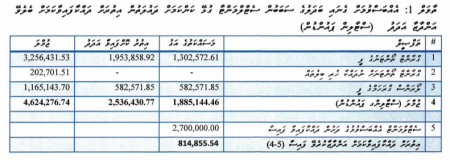
The Anti-Corruption Commission (ACC) spent MVR3.5 million (US$226,978) in excess of the annual budget approved by parliament, the commission’s audit report for 2013 has revealed.

“The overspent amount was facilitated by a budget extension of MVR3,605,647 made to the commission by the Ministry of Finance and Treasury,” explained the report released last week.

“However, it was observed that the parliamentary approval for this budget extension was not obtained as per clause 32(e) of the Public Finance Act.”

The report noted that the ACC Act stipulates that the finance ministry should provide the commission’s budget in accordance with the annual budget passed by parliament.

As a result of “the significance of the matter”, the Auditor General’s Office concluded that the ACC’s expenditures in 2013 were not made “in all material respects, for the achievement of its objectives and for the purposes intended in the budget” and in line with public finance law.

“Extending the budget of the commission by the Ministry of Finance and Treasury without the approval of the parliament negates the objective of approving the budget of public institutions by the parliament as set out in enabling laws of the former,” the report stated.

“It also creates the risk of spending over and above the budget set for the public institutions that could consequently increase the budget deficit.”

In early August, Finance Minister Abdulla Jihad revealed that the government was facing “great difficulty in managing the budget deficit” due to shortfalls in anticipated revenue.

The ballooning budget deficit – which Jihad warned could reach MVR4 million (US$260,000) or 10.6 percent of GDP – could affect the government’s ability to pay civil servants, the finance minister had said.

A budget deficit of MVR1.3 million (US$84,306) had been projected in the record MVR17.96 billion budget approved by parliament for this year.

Meanwhile, auditors also found that the ACC renewed an office cleaning contract in violation of public finance regulations.

A contract with its previous cleaner was renewed on September 8, 2013 for a monthly fee of MVR7,420 (US$481).

“This contract was made without obtaining and evaluating estimates from competing vendors,” the report noted.

“According to the commission, seeking new estimates may have increased their cleaning costs.”

However, public finance regulations require estimates to be sought and evaluated from competing bidders for services costing between MVR25,000 (US$1,621) and MVR1.5 million (US$97,276).

“By not following the public finance regulation, the commission has no assurance that it is obtaining the best service at the lowest price.”

Likes(6)Dislikes(0)

Termination of misappropriated state funds investigation cost government MVR66 million

The termination of an agreement to investigate the alleged misappropriation of state funds by the regime of former President Maumoon Abdul Gayoom cost the government MVR66.17 million (US$4.2 million), a special audit report of the defunct presidential commission has revealed.

The report released last month explained that UK-based firm Grant Thornton dissolved the ‘asset tracing, recovery and repatriation’ agreement on April 30, 2012, after the Attorney General’s (AG) Office failed to respond to eight emails seeking instructions on how to proceed following the controversial transfer of presidential power on February 7, 2012.

The report noted that a settlement agreement was reached following a mediation process in March 2013 for the government to pay the forensic accountancy firm MVR64.61 million (US$4.1 million).

The government also paid MVR1.56 million (US$101,167) for legal counsel – to Eversheds LLP – employed for the arbitration process.

Following full payment of the settlement claim, the report revealed that Grant Thornton handed over all documents and information related to its investigation as well as minutes of meetings and expert findings on November 13, 2013.

The AG’s Office shared the documents with the Anti-Corruption Commission (ACC).

“As the agreement was brought to an end before Grant Thornton’s investigation was fully concluded and because the presidential commission’s investigations had noted a number of cases of suspected corruption and embezzlement when its work came to a halt, this office believes that the investigations should be completed,” the audit report stated.

The Auditor General’s Office recommended the ACC conclude the investigations commenced by Grant Thornton.

Oil trade

Former President Mohamed Nasheed formed the presidential commission in May 2009 to investigate alleged corruption during his predecessor’s 30-year reign.

The audit report noted that the commission’s investigations were mainly conducted through Grant Thornton, which included the alleged illegal oil trade involving the State Trading Organisation’s (STO) Singapore branch, the 2007 audit report of the Bank of Maldives, and asset tracing of senior government officials.

Nasheed’s vice-president, former President Dr Mohamed Waheed Hassan Manik, dissolved the presidential commission shortly after assuming office on February 7, 2012.

A week before the transfer of power, the presidential commission forwarded for prosecution a case against then-opposition MP Abdulla Yameen for his involvement in the alleged oil trade during his time as chairman of the STO.

The allegations first appeared in February 2011 in India’s The Week magazine, which described Yameen as “the kingpin” of a scheme to buy subsidised oil through STO’s branch in Singapore and sell it through a joint venture called ‘Mocom Trading’ to the Burmese military junta, at a black market premium price.

The article drew heavily on an investigation report by Grant Thornton, which obtained three hard drives containing financial information detailing transactions from 2002 to 2008.

Investigators learned that Mocom Trading was set up in February 2004 as a joint venture between STO Singapore and a Malaysian company called ‘Mocom Corporation Sdn Bhd’, with a potentially lucrative deal of selling oil to Myanmar and an authorised capital of US$1 million, it acted as a front for an international money laundering racket.

The presidential commission sought criminal charges against Yameen and two other shareholders of STO Singapore – former Managing Director of STO Mohamed Manik and former Managing Director of STO Singapore Ahmed Muneez – and asked the AG’s Office to pursue civil compensation suits.

Yameen has dismissed the allegations on several occasions and disputed the illegality of the oil trade.

“It’s perfectly legitimate. I was a perfectly clean minister while in Gayoom’s cabinet. They have nothing on me,” he told Minivan News in February 2011.

Moreover, grilled by parliament’s national security committee in November 2011, he denied any involvement in “micro-management” of STO subsidiary companies. Upon assuming office in November, President Yameen called on the ACC to investigate the allegations.

Presidential commission audit

The audit report noted that the commission tasked Grant Thornton with investigating the finances of 12 associates and relatives of former President Gayoom.

If the amount of funds or assets recovered by Grant Thornton reached £1.5 million after deducting investigating costs, the government agreed to pay 25 percent as a fee and 35 percent if the figure exceeded £1.5 million.

In July 2010, the agreement with Grant Thornton was transferred from the audit office to the AG’s Office, the report noted.

Under revised terms of the agreement, the government agreed to pay Grant Thornton 2.5 times the cost of investigation if the agreement was terminated. Additionally, consultancy fees and rates were also raised.

Auditors calculated that the government had to pay MVR20.3 million (US$1.3 million) as a result of the modification.

Among other issues highlighted in the report, the audit office noted that the commission’s expenses were not monitored either by the President’s Office or other state institutions.

Moreover, emailed invoices and bills from Grant Thornton were paid without supporting documents, the report noted.

From May 2009 t0 February 2012, auditors found that the commission spent MVR36.02 million (US$2.3 million) for its investigations.

Likes(0)Dislikes(0)

Unauthorised aircraft identified as belonging to US military

The Civil Aviation Authority (CAA) has told local media that unauthorised aircraft spotted in Maldivian airspace belong to the United States Air Force.

CAA Director Abdulla Rasheed told local paper Haveeru the aircraft had originated from Foalhavahi – also known as the Chagos Islands – home to a US military base.

“No one can enter the area, without our knowing. If anyone were to enter, they would have to gain our permission first,” Rasheed told Haveeru.

The paper reported last week that the unidentified craft had been spotted over Huvadhoo Atoll – over 500 miles north of the base – on two consecutive days. Witnesses reported the aircraft circling the area at low altitude.

It was also revealed last week that the aircraft had dropped two buoys which were subsequently confiscated by the Maldives National Defence Force.

While the Maldives 1996 Maritime Zones Act stipulates that unauthorised foreign military aircraft cannot use Maldivian airspace, the US has previously disputed the legality of this restriction.

The Chagos Islands – a British Indian Ocean Territory – have been home to a US military base in the Diego Garcia atoll since the early 1970s, and are largely uninhabited since the indigenous islanders’ forced migration to Mauritius and the Seychelles.

The US had argued in 2001 that the Convention on the Law of the Sea – ratified by the Maldives in 2001 – grants all aircraft free access to archipelagic sea lanes.

An unclassified US State Department telegram sent to the US embassy in Colombo in 2001 noted that the Maldives’ restrictions on innocent passage “could set an adverse precedent regarding the development of international practice generally”.

Despite this objection, the department has noted that the Maldives offered the free use of its airspace to US aircraft during Operation Iraqi Freedom in 2003, as well as granting similar access during Operation Desert Storm in 1991.

A leaked Status of Forces Agreement (SOFA) revealed last year that preliminary discussions regarding a potential US base in the Maldives had taken place.

After President Abdulla Yameen was reported in January to have opted against the SOFA agreement for fear of upsetting regional partners, pentagon officials responded by saying that a permanent base had never been considered.

The US did, however, donate the Personal Identification Secure Comparison and Evaluation System – or PISCES – border control system to the Maldives in 2013.

The system, criticised by previous providers of Maldivian border control software as nothing more than a “terrorist tracking system”, came into use 12 months ago and was said to have been used to identify alleged hacker Roman Seleznyov before his controversial detention in June.

Likes(1)Dislikes(0)

Friends and family of missing journalist seek to submit a petition to parliament

Friends and family of Minivan News journalist Ahmed Rilwan are petitioning the Majlis, posing a series of questions which the family believes “arose due to the negligence of the Maldives Police Services in searching for Rilwan.”

“These are also matters on which state institutions have so far conducted no work in order to reach the truth,” read the questions to be submitted to the national security committee.

The petition calls on all relevant authorities to provide answers for the following questions, urging thorough investigation into the following issues:

  • What is the standard operating procedure for police once a report, such as the abduction that took place on August 8 in Hulhumalé, is lodged? Did police follow these procedures following the said incident?
  • To what extent have police explored the possibility of a connection between the abduction reported on August 8 and the report of Rilwan being missing on August 13?
  • What work has been conducted to date in the search for Rilwan? What are the current concerns and thoughts of the police regarding the condition and situation Rilwan might be in at present?
  • While friends and family who are working together to search for Rilwan have received multiple threats via SMS and other mediums, to what extent have the police provided them with assistance and protection? Additionally, to what extent have police explored the possibility of a connection between those issuing such threats and the disappearance of Rilwan?

Organisers of the petition are currently holding a variety of events through which they aim to collect the 3000 signatures required before it can be submitted to parliament.

Last weekend (August 29 and 30) friends and family held an event at the Artifiical Beach where signatories of the petition were given free t-shirts printed with the message ‘Today Rilwan has been forcefully disappeared. Will it be me tomorrow?’

Additionally, the group provided a screen projection in the same area on Saturday night displaying video clips of messages from Rilwan’s family and friends.

According to Yameen Rasheed – long time friend of Rilwan who is among the volunteers at the event – the group has already gathered over 1500 signatures, while today (August 31)) volunteers are covering different areas of Malé in order to seek more signatures.

“Friends and family have made tremendous efforts to seek the public’s support in finding Rilwan. This is sadly in contrast with the continued silence from the state,” Yameen stated.

State response

On Thursday, August 28, Commissioner of Police Hussain Waheed was summoned to parliament’s national security committee.

While the meeting was held behind closed doors, police released a press statement on the same day, revealing some details of the investigation as it has proceeded to date.

According to the statement, police have questioned 198 persons and taken statements from 80, including neighbours of Rilwan in Hulhumalé. It also stated that 293 hours of CCTV footage from over 30 locations are being reviewed and analysed.

Police also claim to have searched all public and industrial areas of the island, as well as an additional 50 places for which they had obtained warrants.

The island of Farukolhufushi – formerly Club Faru resort – near Hulhumalé, vessels moored at Hulhumalé harbour, and a number of other local islands have also been searched, the statement continued.

Police also claim that in relation to the reports of an abduction in Hulhumalé on August 8, officers were doing forensic tests on samples taken from three different cars.

The statement did not say whether any concrete information was gathered from these interviews and other investigative measures.

Meanwhile, Minister of Defence Mohamed Nazim speaking at a DhiTV event held on Saturday (August 31) that the government is doing all necessary to find Rilwan, saying “there is hope that we will find him”.

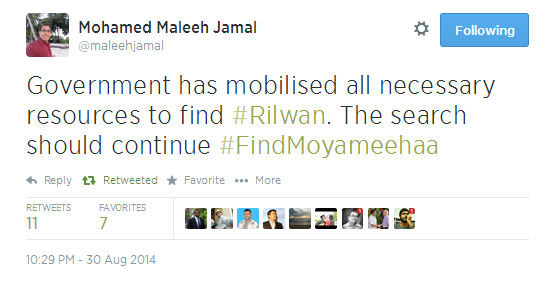
Minister of Youth and Sports Mohamed Maleeh Jamaal has also tweeted a similar message, stating “Government has mobilised all necessary resources to find #Rilwan. The search should continue #findmoyameehaa”.

The opposition Maldivian Democratic Party (MDP) has also met with friends and family of Rilwan on Saturday, pledging assistance to the cause.

In a press conference held on Sunday, newly-elected MDP Vice President Mohamed Shifaz stated that the party will work from within the parliament and all other possible avenues to assist the search for the missing journalist.

Likes(2)Dislikes(0)

PPM celebrates SEZ bill with fireworks

The ruling Progressive Party of the Maldives (PPM) celebrated the passage of President Abdulla Yameen’s flagship Special Economic Zone (SEZ) bill with fireworks and a music show on Friday night (August 29).

The ‘Development Certain – SEZ for the atolls’ celebration at Malé’s Alimas Carnival saw PPM MPs heap praise on President Yameen and Tourism Minister Ahmed Adeeb. MPs hailed Yameen as an economic expert and a president for the youth.

The SEZ bill “would bring unparalleled development” to the Maldives and accelerate development of the country’s rural atolls, MPs said. The SEZ bill, passed under PPM’s mantra ‘Economy, Youth, Hope,’ would usher in a prosperous future, the PPM said.

MPs also celebrated what it called a “war” against opposition Maldivian Democratic Party in passing the bill. The opposition had proposed over 180 of the 245 amendments to the bill at an extended sitting on Thursday. However, the bill passed with only six minor amendments, which had been proposed by the ruling party.

At the ceremony, Speaker Abdulla Maseeh and PPM parliamentary group leader Ahmed Nihan handed over a copy of the bill to President Yameen.

MDP contends the SEZ law would pave the way for money laundering and other criminal enterprises, undermine the decentralisation system, and authorise a board formed by the president to “openly sell off the country” without parliamentary oversight.

The government, however, maintains that SEZs with relaxed regulations and tax incentives were necessary for foreign investors to choose the Maldives over other developing nations and to launch ‘mega projects,’ including the I-Havan free port in northern Haa Alif atoll.

SEZ for the atolls

Tourism Minister Ahmed Adeeb, who spearheaded the drafting of the SEZ law, said benefits and tax breaks in the legislation would attract multi-million dollar investments and will bring benefits to all citizens.

“As I stand here, I see a very prosperous future. I know, in the past two years numerous investors have come wanting to invest in the Maldives. They ask, why should we go to Haa Alif? Why should we go to Addu Atoll? What’s so special there? There are islands and lagoons near Malé, why should we invest in the Malé region, build guesthouses here? That is true, before this, the government did not have any special offers on negotiation, such as designating special economic zones. But today, we have special offers on hand,” he said.

California had competed with other American states to attract car manufacturer Toyota with free water and electricity, he said. But investors in the Maldives have to establish water, electricity, and sewerage systems before they could make investments, he said.

He went on to dismiss opposition concerns over the legislation, including the proliferation of gangs and criminal activity, he said.

“But I think gangs are being formed even now. You don’t need a law for that. That happens outside the law,” Adeeb said.

Opposition leader and former President Mohamed Nasheed had dubbed the legislation the ‘Artur Brothers bill’, referring to the infamous Armenian brothers linked with money laundering and drug trafficking who made headlines last year after they were photographed with cabinet ministers.

Economic Minister Mohamed Saeed also defended provisions that allow 40 percent of investment in any special economic zone to be in tourism or tourism related industries.

Critics have said the excessive benefits and tax breaks to tourism related investments in SEZs would allows tourism owners to legally evade taxes.

But Saeed contended all SEZs, whether it is a free port or a financial center, require a tourism component, as “the Maldives’ unique selling point is sun, sand, and sea.”

With a US$1 billion investment, only US$400 million could be invested in tourism, just enough to build 250 rooms, Saeed said.

Dissolve councils

MP Ahmed Nihan warned the opposition dominated Malé City Council that the ruling party would not hesitate to dissolve councils that are “obstructing development.

“I am informing you tonight, as leader of the progressive party’s parliamentary group, I am closely observing Malé flooding and congestion in Malé,” he said.

“We will not hesitate to dissolve councils that obstruct the government in order to provide services. Our parliamentary group in general agrees to this. We know [councils] are obstructing development.”

The Maldives is a unitary state, he said and argued public land and assets do not belong to councils, but to the government and the president or a ministry designated by the president.

Meanwhile, MP Abdulla Rifau (Bochey) said the SEZs will create jobs for unemployed youth and Kudahuvahdoo MP Ahmed Amir pledged to stop any sort of corruption in SEZs.

Ratification

Speaking to the media on Thursday, Yameen said he would ratify the bill as soon as Attorney General Mohamed Anil reviews it, and start work on existing project proposals including the I-Haven project and SEZs in central Faafu and Dhaalu atolls.

“We will not wait until we get proposals. Our aim is to start work on evaluation of proposals we have already received. The government will compile the framework necessary for that under this bill. Then investors can come and start work. It will not be difficult for them to continue with their work with this bill,” he said.

President Yameen has said the SEZ law would “transform” the economy through diversification and mitigate the reliance on the tourism industry, while opposition leader Nasheed has dismissed SEZs and the touted mega projects as “castles in the air.”

Referring to the opposition to his administration’s public-private partnership projects on religious and nationalistic grounds – with opposition parties accusing the government of “selling off state assets” – Nasheed has previously argued that the current administration’s economic policies were far worse according to these standards.

Nasheed also contended that Maldivian law would not be enforced in the SEZs, claiming that gambling would be allowed in the zones.

Former coalition partner Jumhooree Party (JP) previously claimed the SEZ law would facilitate massive corruption and undermine independence, but on Wednesday announced a three-line whip in favor of the bill.

The change in the party’s stance closely follows the state’s cancellation of various business agreements made with the JP leader Gasim Ibrahim’s business Villa Enterprises.

Likes(1)Dislikes(0)

Nasheed elected uncontested to MDP presidency

Former President Mohamed Nasheed has been elected president of the Maldivian Democratic Party (MDP) after standing uncontested for the position.

Nasheed had taken over the leadership as acting-president of the part following the resignation of chairperson ‘Reeko’ Moosa Manik after March’s disappointing Majlis election results.

After the party won just 26 of the 85 seats in the legislature, MP Reeko resigned, urging new leaders to come forward and current leaders to follow his lead in stepping down.

Nasheed received 33,709 votes from a total of 57,203 eligible voters, while former MP Ali Waheed – a losing candidate in the March polls – secured the chairmanship, also uncontested, with 26,033 votes.

Nasheed had called for new leaders to come forward and lead the party immediately following the Majlis polls.

“I want new people to come forward to run the party. But I will not go away from the party, I will always remain in doing party work,” he added.

Senior party members, including Reeko and Parliamentary Group Leader Ibrahim ‘Ibu’ Solih,  suggested that the election setbacks had been a result of internal problems as well as the use of undue influence and bribery by other groups.

The position of both president and the vice president of the party have been vacant since Dr Ibrahim Didi and VP Alhan Fahmy were removed in a no-confidence vote in April 2012.

Former MP Mohamed Shifaz was also elected yesterday as party vice president, receiving 21,052 votes

March’s elections prompted the MDP to form a three-member committee tasked with collecting suggestions and ideas from the public for reforming and restructuring the party.

The suggestions – which include clearer delineation of leadership roles, greater transparency during internal elections, and better engagement with the media – will be considered at the party’s next national council meeting later this year.

Likes(1)Dislikes(0)

President Yameen hails passage of SEZ bill

President Abdulla Yameen has hailed People’s Majlis passage of flagship Special Economic Zone (SEZ) bill as an incentive for multi-million dollar investments in the Maldives.

The bill was passed with six minor amendments at an extended Majlis sitting at 10:54 pm on Wednesday night, with 60 MPs of the 85 member house voting in favor.

Opposition Maldivian Democratic Party (MDP) had proposed over 180 amendments, but all were rejected.

Speaking to the press today, Yameen said the SEZ bill dispels investor concern over short lease periods and legal protection.

“Investors willing to invest billions of dollars raise questions over land lease periods. If its 33 years, they are not interested in [investing]. This is why major investors lack interest in the Maldives. We cannot even hold discussions with such investors. We have now created the legal environment required to attract major investments. This creates such a framework,” he said.

People’s Majlis Speaker Abdulla Maseeh has also applauded the passage of the bill as an example of democracy, similar to that of American democracy.

The bill will be ratified after Attorney General Mohamed Anil reviews the bill, Yameen said.

Meanwhile, MDP MPs have contended the SEZ law would pave the way for money laundering and other criminal enterprises, undermine the decentralization system, and authorize a board formed by the president to “openly sell off the country” without parliamentary oversight.

Speaking to the press after the Majlis session, MDP MP Rozaina Adam said the passage of the bill without any consideration to concerns raised by the opposition indicates the return to authoritarian rule.

“We now have a dictatorship here. The People’s Majlis, the presidency and the courts are all under one party,” she said.

Amendments

The MDP proposed a large majority of the 245 amendments to the SEZ bill. These include revising a provision that allows leasing of land to foreign companies for 99 years to reduce lease periods and adding provisions to require 75 percent of jobs in the SEZs to be reserved for Maldivians.

The MDP also proposed companies with a 49 percent foreign shareholder stake to lease land instead of purchasing land.

It also proposed scrapping Article 74, which allows up to 40 percent of any zone to be tourism-related development with tax and duty exemptions.

Amendments were also forwarded for mandatory consultation with local councils ahead of declaring any region under council jurisdiction as an SEZ.

None of the opposition amendments passed.

The MDP had also proposed to return the bill to a committee for further review, although this proposition failed with 57 of 73 parliamentarians present voting against it.

Former ruling coalition partner Jumhooree Party (JP) previously claimed the SEZ law would facilitate massive corruption and undermine independence, but on Wednesday announced a three-line whip in favor of the bill.

The change in the party’s stance closely follows the state’s cancellation of various business agreements made with the JP leader’s business Villa Enterprises.

On Monday (August 25), the Civil Aviation Authority downgraded Gasim’s Villa International Airport based on the MP’s constituency island of Maamigili to domestic status.

Similarly, on August 14 the government terminated an agreement with Villa Air to develop and manage the regional airport on Gaaf Dhaal Kaadehdhoo, while the fisheries ministry has also decided to reclaim Laamu Atoll Baresdhoo from Villa, stating that the company had not used it for the agreed purpose.

“Castles in the air”

Former President Mohamed Nasheed had dubbed the legislation the ‘Artur Brothers bill’, referring to an infamous pair of Armenians linked with money laundering and drug trafficking who made headlines last year after they were photographed with cabinet ministers.

Nasheed has also dismissed SEZs and the touted mega projects as “castles in the air.”

Referring to the opposition to his administration’s public-private partnership projects on religious and nationalistic grounds – with opposition parties accusing the government of “selling off state assets” – in a speech at an MDP event on August 12, Nasheed argued that the current administration’s economic policies were far worse judging by their terms.

“There could be no bigger deception of the Maldivian people,” he said.

Nasheed also contended that Maldivian law would not be enforced in the SEZs, claiming that gambling would be allowed in the zones.

Likes(1)Dislikes(0)

Maldives condemns ISIS crimes, says foreign minister

Foreign Minister Dunya Maumoon has condemned human rights abuses carried out by the Islamic State of Iraq and Syria (ISIS), calling for the respect of life and dignity in the spirit of Islam.

“The Maldives strongly condemns the crimes committed against innocent civilians by the organization which identifies itself as the Islamic State of Iraq and the Levant or the Islamic State of Iraq and Syria,” she said in press release today.

Jihadist militants – who declared an Islamic caliphate in territory held across the state of Iraq and Syria – are accused by the UN of having committed mass murders against prisoners, enemy combatants, and civilians.

“IS is using the veil of religion as a pretext for inflicting terror, and committing violations of human rights,” said Dunya.

“Their philosophy blatantly violates the fundamental principles of peace, tolerance, and unity which are advocated by Islam, and their actions have tarnished the world’s perception of our great religion. A religion of peace and tolerance.”

Dunya’s remarks follow Minister of Islamic Affairs Dr Mohamed Shaheem Ali Saeed’s declaration that the ISIS would not be allowed to operate in the Maldives.

“ISIS is an extremist group. No space will be given for their ideology and activities in the Maldives,” Shaheem tweeted on Sunday night (August 24).

The opposition Maldivian Democratic Party (MDP) immediately seized upon Shaheem’s comments, suggesting that the words had not been backed up with concrete action by the government.

“We note with concern that neither the Islamic minister nor the government has taken any action while activities related to terrorism in different forms as well as extremism are carried out in the Maldives, religious strife and hatred is incited widely, and death threats are being made against various people over religious matters,” read an MDP statement.

Authorities are currently investigating the source of a number of death threats sent to journalists and politicians in recent weeks, some of which were send from a user identifying themselves as ‘ISIS’.

The threats also made reference to the recent abduction of Minivan News journalist Ahmed Rilwan Abdulla – missing since August 8. Rilwan had also been the subject of intimidation from extremists as a result of his writing and micro-blogging.

Foreign Minister Dunya also spoke in favour of moderate Islam during a meeting of the Organisation of Islamic Cooperation in June, calling for a thorough self-assessment to identify the reason Islam is being associated with intolerance, terrorism, violence, and backwardness.

“It is beyond imagination, or within the realm of belief, to think that we can overcome these dark times? Let us recommit ourselves to work together to overcome our challenges. United and strong we can once again become the standard bearers of tolerance and innovation,” she said.

Condemning Islamophobia, Dunya told the 41st session of the OIC’s Council of Foreign Ministers that the chaos seen in the Muslim world today was the result of not exercising true Islamic ideals.

Likes(1)Dislikes(0)