State Finance Minister warns National Movement will “break up” parliament

Minister of State for Finance Abbas Adil Riza has accused Parliamentary Speaker Abdulla Shahid of “challenging” the Supreme Court after he tabled a no-confidence motion despite an injunction from the court.

Riza’s comments follow parliament’s announcement last week that a no-confidence motion against Defence Minster Colonel (Retired) Mohamed Nazim has been tabled despite a Supreme Court injunction ordering parliament to halt all pending no-confidence votes.

Speaking at the artificial beach on Monday (December 17) Riza, who is also a National Movement Steering Committee member, said that Shahid’s decision to “challenge” the Supreme Court was a “cowardly act”.

“Unless Shahid immediately ceases his efforts to violate the constitution while holding the post of Speaker of Parliament, the National Movement will ensure that this comes to a stop,” local media reported Riza as saying.

Furthermore, Riza warned that should the parliament try to violate the constitution, the National Movement will “break up” the parliament.

Last week, the People’s Majlis secretariat revealed that Defence Minister Nazim has been given the required 14-day notice and his ministry also duly informed by Speaker Abdulla Shahid.

Repsonding to Riza’s comments, Majlis Deputy Speaker and fellow PA MP Ahmed Nazim said that the Parliament has not challenged the Supreme Court’s injunction, noting that it has given the full 14 days notice to the court as per stated by the law.

“We believe there is still time for Supreme Court to lift the temporary injunction, and I believe they will not see this as the parliament challenging the court.

“After 14 days, the motion will be put up on the agenda for discussion by party leaders. If the injunction remains then there is a possibility for party leaders to challenge the court,” Nazim told Minivan News.

Article 101(a) of the constitution states, “At least fourteen days notice of the debate in the People’s Majlis concerning a motion under article (a) shall be given to the concerned member of the cabinet, and he shall have the right to defend himself in the sittings of the People’s Majlis, both orally and in writing.”

When asked if there was concern from parliament over Riza’s comments, Nazim revealed that the institution as a whole did not feel threatened, however there had been “concern” expressed by individual parliamentary members.

“The institution is protected by the constitution and we have protection from the Maldives National Defence Force (MNDF), however at least one individual has told us he feels threatened and believes that security needs to be increased.

Abbas Adil Riza was not responding to calls at time of press.

On December 3, parliament voted 41-34 to approve amendments to the parliamentary rules of procedure to conduct no-confidence votes to impeach the President and remove cabinet members through secret ballot.

MPs of the government-aligned Jumhooree Party (JP) and Dhivehi Rayyithunge Party (DRP) joined the formerly ruling Maldivian Democratic Party (MDP) to vote the amendment through.

The no-confidence motion against Defence Minister Nazim was submitted by the MDP earlier this month on the grounds that he misused his authority as acting Transport Minister by using the military to influence termination of commercial contracts.

No-confidence motion against Home Minister Dr Mohamed Jameel Ahmed

Meanwhile, a no-confidence motion has again been submitted against Home Minister Dr Mohamed Jameel today (November 17).

The Maldivian Democratic Party (MDP) submitted the same motion to parliament on a previous occasion, but withdrew it at the last minute after the voting was scheduled for parliament.

An MP told local media that this latest motion was submitted with 17 signatures including the signatures of MDP MPs, however this has yet to be officially confirmed.

Likes(0)Dislikes(0)

MDP forwards no-confidence motion against Home Minister

The Maldivian Democratic Party (MDP) has forwarded a no-confidence motion against Home Minister Dr Mohamed Jameel, for the second time.

This is the second time the MDP has submitted a no-confidence motion against the Home Minister. The last time the motion was submitted the MDP withdrew the motion for unexplained reasons.

A statement issued by the MDP today accused the Home Minister of failing to control civil peace and order in the country, which it said had led to the loss of eight lives.

The MDP further referred to an incident in which a man on a motorcycle was killed after a police officer struck a second motorcyclist with his baton, causing him to collide with the first.

Police at the time did not reveal the involvement of the police officer in the death of the bystander. Video footage of the incident was subsequently leaked to the media.

The MDP alleged that Home Minister Jameel had tried to cover up police involvement in the death.

The no-confidence motion was signed by 17 MDP MPs.

Last week the parliament tabled a no-confidence motion filed against Defence Minister Colonel (Retired) Mohamed Nazim,despite a Supreme Court injunction ordering parliament to halt all pending no-confidence votes.

The People’s Majlis secretariat revealed that Defence Minister Nazim has been given the required 14-day notice and his ministry also duly informed by Speaker Abdulla Shahid.

A no-confidence motion against the President is also in the parliament awaiting scheduling.

Likes(0)Dislikes(0)

“There was a legitimate contract signed. We are disappointed”: Malaysian Trade Minister

The Malaysian government has expressed “disappointment” at the scrapping of the Maldives’ “legitimate” contract with the GMR-Malaysia Airports Holdings Berhad consortium.

Indian media reported that Malaysian Prime Minister Najib Tun Razak was scheduled to visit New Delhi towards the end of the week and would likely be discussing the matter with Indian Prime Minister Manmohan Singh.

Malaysia’s Consul General in Chennai, Citra Devi Ramiyah, told reporters in Delhi that it was too early to speculate whether MAHB would seek compensation from the Maldivian government, which voided the GMR-MAHB concession agreement and ordered the company to leave by December 7.

The government had earlier dismissed a stay order for the eviction granted by the arbitrators – the Singapore High Court – as an affront to the country’s sovereignty. A day before the end of the seven day notice period, the injunction was dropped on appeal after Chief Justice Sundaresh Menon of the Supreme Court of Singapore declared that “the Maldives government has the power to do what it wants, including expropriating the airport.”

Ramiyah told reporters that the Maldivian government had shown its intention “to do the project on its own and [was] willing to compensate financially. So, it is very early for us to comment.”

Malaysian Minister of International Trade and Industry Seri Mustapa Mohamad was more concerned, according to the Economic Times, and expressed hope that the Maldives would reconsider its decision to evict the investors.

“In Male we have enjoyed very close ties with the previous government for many years. The Maldives is 100 per cent Muslim country. Of course, with the new government the lesson for us is we should be more careful, more due diligent,” Mohamad said.

“We want our investments to be protected. There was a legitimate contract signed. We are disappointed,” he added.

GMR meanwhile handed over the duty free stores today after being ordered to do so by the government.

“GMR has vacated the duty free shops at the airport. So since they’ve cleared their goods, no services will be provided from the shops,” Maldives Airports Company Limited (MACL) Rahmathullah Ashraf told local media.

Andrew Harrison, CEO of GMR Male International Airport – GMR’s side of the voided airport development – dismissed claims in local media that the company had “stripped” the duty free store ahead of the handover.

“We were asked to close duty free by the 17th. It is not true we have stripped duty free. We have destocked and in some cases returned goods to suppliers, or found buyers through appropriate customs procedures,” Harrison said.

GMR had sought a smooth transition after being ordered to handover the airport “as we did not want passengers or carriers to suffer,” he said. “The only area left where we [were] active was duty free.”

GMR staff had begun returning to India, particularly those involved in the construction of the new terminal after the cancellation of the contracts to build it, he said.

The government has not yet declared what it intends to do with the foundations of the abandoned terminal project, built on 60 hectares of reclaimed land on the other side of the airport island.

Likes(0)Dislikes(0)

No plans to privatise airport, “might sublease”: Tourism Minister Ahmed Adheeb

Minister of Tourism Ahmed Adheeb has said the government is not planning to hand over full control of operations at Ibrahim Nasir International Airport (INIA), but might sublease specific development projects to international parties through a “transparent” bidding process.

Minister Adheeb told Minivan News that privatising the only international airport allowed it to become a monopoly which was not in the best interests of the country.

“What we saw was that handing over operation of the only international airport in the country meant it was monopolised. What we are saying is that if the airport is given like that without any competition, it is not in the best interest of the country,” he said.

Adheeb admitted that INIA needed further development and refurbishment, including the addition of an extra runway, and said such projects would be subleased to developers through a transparent bidding process. He also maintained that “operation and control” of the airport would not be given away as he alleged the former government had done with GMR’s concession agreement.

President Mohamed Waheed Hassan also highlighted in an interview to India’s Business Standard that MACL would “open tenders for major development projects”.

“I think it’s too early to talk about the rebidding but, yes, MACL will open tenders for major development projects in connection with the airport modernisation program. GMR is eligible to participate. I don’t see any reason why Chinese companies should be barred from participating in the bidding process,” he told the Business Standard.

However, when contacted by Minivan News, MACL Managing Director Mohamed Ibrahim denied any knowledge of such bidding processes and said he did not wish to further comment on the matter.

Minister Adheeb said 75 percent of the tourists coming into the country were from Europe and following the “European [economic] crisis, the Maldives government should have provided an incentive to those tourists arriving to the country, but because of INIA being operated by GMR, several airport fees were raised.”

“Flight operators operate as a business. They will not consider us if we give no incentives in such a time of crisis and when the airport handling charges are too high. We have to understand that INIA is a tourist airport, it is not a shopping airport or a transit airport,” he explained.

Therefore, the Minister said that the country needed an efficient airport where tourists can go through quickly, with an efficient check-in system.

Earlier on February 2, Qatar Airways CEO Akbar Al Baker warned the airline will re-consider flying to the Maldives if the airport operator maintained its plan to raise airport handling fees at INIA by 51 percent.

Reuters at the time reported that the airline was “‘dismayed’” over what it understood to be GMR’s plan to increase the handling fee at a future date, and suggested such a move would “threaten Qatar Airways’ continued presence in the Maldives.”

However, the GMR Group at the time denied the allegations stating that it had had received no official communication from the airline about its concerns.

GMR spokesman Amir Ali responded at the time saying that the fee hike had already been made by MACL shortly before GMR assumed control of the airport, adding that while there were no plans for a further increase at present, prices were dependent on factors such as fuel costs.

Adheeb also alleged that the former government intended to rush the development process of the airport rather than a “well contemplated phase by phase development plan”.

“Why do we really need to develop the airport to cater to four million people? We could have done that through proper planning in a phase by phase development process,” he said.

The INIA concession agreement

In 2010, the government of Maldives through its Finance Ministry, Maldives Airports Company Limited (MACL) and GMR-MAHB entered into a concession agreement withINIA whereby the Malaysian-Indian consortium were to develop and operate the airport for a period of 25 years.

According to the concession agreement a “project company” under the name GMR International Airport Limited (GMIAL) was to carry out the development project.

However, a lengthy dispute between the new government of President Mohamed Waheed Hassan and the GMR Group led to the eviction of the agreement.

On November 27, President Mohamed Waheed’s cabinet declared the agreement void, and gave the company a seven day ultimatum to leave the country.

Attorney General (AG) Azima Shukoor stated the government reached the decision after considering “technical, financial and economic” issues surrounding the agreement.

She also claimed the government had obtained legal advice from “lawyers in both the UK and Singapore as well as prominent local lawyers – all who are in favor of the government’s legal grounds to terminate the contract.”

The INIA was handed over to the government on December 8, in an invitation-only press conference; Finance Minister Abdulla Jihad presented the official handover documents to MACL Managing Director Mohamed Ibrahim, and said that the Maldives would pay whatever compensation was required “however difficult”.

With arbitration proceedings underway in Singapore over the contested airport development charge (ADC), GMR received a stay order on its eviction and appeared confident of its legal position even as the government declared that it would disregard the ruling and proceed with the eviction as planned.

On December 6, a day prior to its eviction, the government successfully appealed the injunction in the Supreme Court of Singapore. Chief Justice Sundaresh Menon declared that “the Maldives government has the power to do what it wants, including expropriating the airport.”

That verdict, effectively legalising the sovereign eviction of foreign investors regardless of contractual termination clauses or pending arbitration proceedings, was “completely unexpected”, according to one GMR insider – “the lawyers are still in shock”, he said at the time.

A last ditch request for a review of the decision was rejected, as was a second attempt at an injunction filed by Axis Bank, GMR’s lender to the value of US$350 million.

Scott Wilson Plan

Minister Adheeb said the Scott Wilson master plan produced during former President Maumoon Abdul Gayoom’s administration would have been “a better master plan to develop the airport.”

“Sir Scott Wilson’s master plan to development of INIA was a good master plan. We actually did not require a plan to be implemented immediately. The plan was to develop the airport in a phase by phase development process. Some of the development projects had already been completed at the time the airport was given to GMR for development,” he explained.

Following the signing of the concession agreement of INIA with India’s GMR group, the Scott Wilson master plan was abandoned for a new master plan produced by the International Finance Corporation (IFC) through another foreign consultancy firm – Halcrow – which the current government claimed was more costly.

“Scott Wilson’s phase one cost us US$390 million, and all the three phases summed up came to a figure around US$590 million. The IFC did not provide this information to the government. We are talking about a development of 30 years,” former Civil Aviation and Communications Minister Dr Ahmed Shamheed said previously.

The current government criticised the IFC for abandoning the Scott Wilson plan for a more “costly master-plan”  and alleged that the World Bank affiliated group had been “irresponsible” and “negligent” in advising the former government of President Mohamed Nasheed in the concession of INIA by Indian infrastructure giant GMR.

However the IFC denied the allegations, stating that its advice was geared towards achieving the “objective of upgrading the airport and ensuring compliance with applicable international regulations” and providing the Maldives government “with the maximum possible revenue”.

“A competitive tender was organised with the objective of selecting a world-class, experienced airport operator, who would rehabilitate, develop, operate and maintain the airport,” said an IFC spokesperson at the time.

Airport Development Charge

Highlighting the Airport Development Charge (ADC) that the former government intended to charge – prompting criticism from the opposition parties who are now currently in government of President Waheed – Adheeb said that the former administration proceeded to taking ADC without legislation.

“The way they intended to charge ADC was not a mechanism established in anywhere in the world. ADC is taken through a proper legislation and should be flexible and adjustable in parallel with the inflation rate,” he contended.

On November last year, former President Mohamed Nasheed’s government’s Transport Minister Adil Saleem announced that GMR will begin charging international passengers a US$25 (MVR 385.5) ADC at the departure check-in counters of INIA for all flights scheduled after 12:00am on January 1, 2012.

Saleem stated at the time that the fee had been previously approved by the government as part of its contract with GMR.

The matter was soon taken to Civil Court by then opposition Dhivehi Qaumee Party (DQP) – led by current Special Advisor of President Waheed, Dr Hassan Saeed. The DQP claimed that a pre-existing Airport Service Charge (ASC) of US$18 (MVR 277.56) invalidated the ADC.

The Civil Court in December 2011 invalidated the ADC charge, ruling that the clause in the concession agreement with GMR violated the Airport Service Charges Act of 1978, which was amended in 2009 to raise the charge to US$18 for foreign passengers and US$12 for Maldivians above two years of age.

The current government, after ascension to power, claimed in a “cabinet-committee report” that it was “not in the best interest of the country” to appeal the Civil Court decision to High Court, and thereby ignored the decision.

The former government had honoured the concession agreement following the civil court ruling, and,  under instruction from a letter sent by MACL, had been deducting ADC revenue from concession fees due the government.

Following the ousting of the Maldivian Democratic Party (MDP)-led government on February 7, the new government – which included the DQP – inherited the crippled concession revenues, under which it was effectively obliged to pay GMR to develop the airport.

The new government received a succession of bills from the airport developer throughout 2012. In the first quarter of 2012 the government received US$525,355 of an expected US$8.7 million, after the deduction of the ADC. That was followed by a US$1.5 million bill for the second quarter, after the ADC payable eclipsed the revenue due the government.

Combined with the third quarter payment due, the government owed the airport developer US$3.7 million (MVR 57.05 million).

On May 8, GMR offered to exempt Maldivian nationals from paying the contentious ADC in a bid to end a legal and contractual stalemate that had given rise to MACL going bankrupt and the deprivation of the majority of all airport revenue that the government was to generate through the agreement.

However, despite attempts to renegotiate the issue, the government decided to terminate the agreement at risk of compensation. The ADC case is still pending in the Singapore Arbitration Court.

Adheeb stressed that such major projects that is pivotal to the country’s economy should not be taken without thorough research and proper consultation and analysis. The current government, he said, would address these issues “with patience and with a proper plan.”

He also added that the current government of President Waheed would seek towards a “balanced economic and foreign policy” that would be in the best interest of the country.

Likes(0)Dislikes(0)

Alidhoo Resort staff allegedly still owed wages: “If they don’t like it, they can leave,” says resort owner Jabir

J Hotel & Resorts owner MP Abdulla Jabir has responded to no payment allegations made by Aldihoo Resort staff, declaring “If they do not like it, they can leave”.

Staff at the resort revealed how both Maldivian and foreign workers had not received pay for four months and six months respectively, despite complaints made to management and various external government organisations.

Alidhoo Resort in Haa Alif Atoll is run by J Hotel & Resorts, a company owned by Maldivian Democratic Party (MDP) MP Abdullah Jabir, the husband of former Human Rights Minister Dhiyana Saeed.

Five Alidhoo Resort workers living in the near-by island of Dhidhdhoo spoke to Minivan News – under condition of anonymity – of their frustration as management continues to withhold their pay.

The five workers claim that the Human Rights Commission of Maldives (HRCM) has “forgotten” about them, despite multiple complaints made to the institution.

“We [staff] complain every other week to the HRCM, but never receive any response. We contacted the Labour Ministry and they told us they would reply in November, but they still haven’t got back to us.

“Our verbal complaints never get us anywhere with management, usually they say ‘we can’t pay you right now”’even though the resort’s been at 100 percent occupancy the last few months,” alleged the staff.

Earlier this year the Tourism Employees’ Association of the Maldives (TEAM) released information revealing that Alidhoo’s management had not paid the resort’s 125 expatriate staff for six months, while the 85 local employees had not been paid since May.

“I am struggling more than the staff”: MP Abdulla Jabir

Responding to the no payment allegations, J Hotel & Resorts Chairman Abdulla Jabir explained that there was a delay in payment because of a “delay in making money”.

Jabir claimed that there had been less than 30 percent occupancy in the last year, despite staff claiming it being at 100 percent for the last two months.

“We have 250 staff [at Alidhoo Resort] and rather than go on leave and then come back during times of low occupancy they are telling us they want to stay.

“[The staff] are not struggling, that’s wrong. If they are struggling, they will not stay. They are staying and that means they are not struggling.

“I am struggling more than them,” he added.

Staff have gone on strike on three previous occasions over the salary issue, but have been met with harsh penalties including the dismissal of those staff involved in the strikes.

Sources from within the resort claim they face losing their jobs if they make a formal complaint to management and are therefore “trapped” over the payment issue.

Despite Jabir’s company owning Alidhoo Resort, the MDP MP distanced himself from allegations made by the workers claiming that he “is not involved in this” and that the media need to contact the people responsible for the matter, adding: “You don’t contact [Silvio] Berlusconi for every matter in Italy, you contact the respective ministers.”

“If I close the resort they don’t get pay, they don’t get food, they don’t get accommodation and they will be jobless.

“Maybe they get 10 days, 15 days delay in salary, or even a month’s delay in salary, but they are making it. It is not an issue,” Jabir told Minivan News.

“The staff can go home if they feel like not working for us.”

A mother from Baarah, Haa Alif Atoll who has worked at the Alidhoo Resort for the last four years, alleged to Minivan News that even when staff are paid late, they are rarely paid the full amount.

“In two months they will pay for just one month, and if pay is delayed for three months, we will still only get one month’s pay, that is how they operate,” she said.

“I went to Human Resources and asked why my salary has been cut off for the last four months and they said ‘we can only pay for one month’, and that’s MVR 3000 (US$ 195).”

Jabir has agreed to sell property to finance staff: Jabir’s wife Dhiyana Saeed

When the staff payment issue was raised back in June 2012, the now former Human Rights Minister Dhiyana Saeed – who is also the wife of J Hotel & Resorts chairman – said that no complaints had been made to her ministry.

Speaking to Minivan News over the recent claims, Dhiyana said that she was aware that her husband was having financial “trouble” and that there are outstanding payments to both staff and other people, however she claimed that Jabir is “doing his best” to repay the debts.

“We talk about these problems at home and [Jabir] has agreed to sell his property to finance staff and other people.

“It has been very hard for him to raise the money, but we are very close to making a deal with selling the property and clearing our debts,” said Dhiyana.

MDP members mark International Human Rights Day

Jabir, who recently switched from the Jumhoree Party (JP) to the Maldivian Democratic Party (MDP), joined the MDP’s Journey of Pledges tour as they visited neighbouring islands to Alidhoo Resort.

Minivan News raised the staff payment issue with MDP President Mohamed Nasheed moments after he had just completed a run to mark International Human Rights Day in Kulhudufushi earlier this week.

“There has been so many human trafficking allegations and you mention a certain entrepreneur having not paid [his staff], but I keep on going to work sites all over the country and there are so many ex-pats unpaid and their working conditions are also so bad, that is human trafficking,” said Nasheed. “If you have appropriate standards across the board then you won’t have this opportunity of cheap labour.”

HRCM’s Investigation Officer Aishaph Afreen Mohamed revealed that a complaint had been lodged by Alidhoo Resort staff in September, and that an investigation by the HRCM into the complaint is “ongoing”.

When asked how long the investigation is expected to last, Aishaph stated she was “not sure” as the HRCM has to obtain information “from all relevant departments”.

Almost all staff have now been paid: Alidhoo GM Jadhulla Jaleel

General Manager of the Alidhoo Resort Jadhulla Jaleel, admitted there had been a delay in paying staff, but claimed that as of today “almost all” staff had been paid.

“Sometimes there is a delay, but we always pay. Our staff trust us that they will be paid,” Jaleel said. “Only today (November 11) we have paid almost all of the staff, we paid a total of MVR 500,000.”

When asked to further clarify how many staff come under “almost all”, Jaleel then stated: “All staff, both foreign and local have been paid.

“If you call your sources, they will confirm they have been paid. Some of the staff won’t be able to confirm it because they won’t have collected their money today,” Jaleel claimed.

A reliable source within the resort confirmed to Minivan News that as of November 11 they had been paid, but for only two out of the four months owed. The source also alleged that foreign staff members were yet to receive any of their six-months of missing payments.

Likes(0)Dislikes(0)

High Court supports lower court’s decision to extend detention of Abdulla Javid

The High Court has upheld a  Criminal Court order to extend the detention of Abdulla Javid, the son-in-law of Maldivian Democratic Party (MDP) Chairperson and MP ‘Reeko’ Moosa Manik.

The High Court’s ruling stated that Javid was arrested in connection with the murder of late MP and Religious Scholar Dr Afrasheem Ali, and that at police had a phone call recording as evidence to support their accusation against Javid.

The case was filed at the High Court by Javid claiming that the Criminal Court’s extension of detention order was unlawful, however,the High Court ruled that there was no reasonable ground so support this.

Police Sub-Inspector Hassan Haneef told Minivan News that police policy when providing information about Dr Afrasheem’s death was to keep all information until the next press briefing.

Commissioner of Police Abdulla Riyaz has claimed that the murder of MP for Ungoofaaru constituency Dr Afrasheem Ali was a well-planned murder and insisted it was politically motivated.

The Commissioner alleged that the assassins were offered MVR 4 million (US$260,000).

He said that 200 items were collected as forensic and digital evidence.

“Over 500 hours of CCTV footage have been analysed, more than 100 people have been interviewed and about 13,000 phone call recordings have been analysed out of which 12,000 were from one single tower,” Riyaz said.

Afrasheem was killed on October 1. His wife discovered the body lying on the staircase of their home.

Dr Afrasheem was elected to parliament in 2009 as a member of the then-opposition Dhivehi Rayithunge Party (DRP). Following the opposition’s split, Afrasheem sided with the Progressive Party of the Maldives (PPM) of former President Maumoon Abdul Gayoom, and faded into the political background.

Widely considered an Islamic moderate, Dr Afrasheem took outspoken and controversial positions on issues such as the permissibility of playing music, and praying next to the deceased.

Likes(0)Dislikes(0)

Former SAARC Secretary General announces self-exile until establishment of democratic government

Former Secretary General of SAARC Ibrahim Hussein Zaki has announced that he will be remain in India in self -imposed exile until President Mohamed Waheed’s government is brought to an end and a new “democratic government” installed.

“I will go back to the Maldives to participate in the oath taking ceremony of a democratic president who gets elected through a free and fair election,” he said.

Zaki made the remarks in an interview with the opposition-aligned Raajje Television on Friday Night.

“How [police] attacked me while I was on Hodaidhoo island is a clear notion that I will be destroyed should I continue staying in Maldivian territory,” he said referring to his arrest while in the island of Hodaidhoo.

He claimed that the current government is a dictatorship that was severely failing in respecting the rights of the people, and therefore should be toppled. Zaki added that he was willing to sacrifice anything to see the installation of a democratic government.

The former SAARC Secretary General also criticised current Home Minister Mohamed Jameel Ahmed claiming that the minister was behind the government-led intimidation and harassment of opposition politicians.

“I am challenging him; [Jameel] should not be that stupid. I will go to any country except the Maldives. If you really can bring me back to the Maldives by force, then try it. I would salute you if you succeed. But I tell you, we will bring Jameel to justice for what he is being doing; he will be put to trial,” he said.

Zaki further said that he did not flee the country to escape punishment for criminal activities.

Attempt to escape from criminal prosecution – Home Minister

Meanwhile, Home Minister Mohamed Jameel Ahmed on Saturday told the media that Zaki fled the country to escape the impending criminal charges that he was likely to face.

“We have found liquor and drugs where Zaki was arrested. He had to face criminal allegations. We have also collected enough evidence to prosecute him,” Jameel said.

Jameel added that Zaki had been involved in criminal activities including consumption of alcohol and drugs. He added that more criminal allegations may follow based on the recent statements he had been making.

Responding to Zaki’s challenge that he would go to any country he wished, Jameel claimed that criminal prosecution did not actually require the suspect to be present in the country, and if investigation gives grounds for prosecution, the Prosecutor General would press charges.

Jameel added that if a suspect flees the country to escape from criminal prosecutions, the government could always bring the person back home with the assistance of Interpol.

“I just want to say is, that if you think you can escape criminal charges by fleeing the country, this is a very wrong idea. It cannot be done like that anywhere in the world. You cannot be on the run. There is a mechanism to summon those who are abroad just like those residing in the country,” said Jameel.

He also highlighted that it was not only Zaki, but several key figures within opposition Maldivian Democratic Party (MDP) including its presidential candidate former President Mohamed Nasheed could face “long term jail sentences”.

“When all these prosecution cases begin, a lot of key people in MDP leadership will face criminal prosecutions. There are cases of severe embezzlement of state funds. If these prosecutions succeed they may face long term jail sentences,” he explained. “So, in an attempt to overturn those criminal prosecutions, Nasheed has been speaking of a revolution and Zaki is talking about democracy,”

Jameel also reiterated that it is not the weakest among the society that should be brought in front of the law but that all must be equal in front of the law.

Arrest

Zaki – who was also the Special Envoy during former President Mohamed Nasheed’s government and a senior figure in opposition MDP – was arrested along with MP Abdulla Jabir and MP Hamid Abdul Ghafoor and several other senior opposition figures on the night of November 15, while on the uninhabited island.

Police said they found large amounts of “suspected” drugs and alcohol upon searching the island with a court warrant.

The arrests were made “based on information received by police intelligence,” police said. Sub-Inspector Hassan Haneef told Haveeru that the suspects were arrested with alcohol and “hash oil”.

Following the arrests around midnight, the suspects were taken to Kulhudhufushi on Haa Dhaal Atoll, and Zaki was hospitalised.

Zaki’s party MDP alleged the arrests were a politically-motivated attempt to disrupt parliament ahead of a no confidence motion against President Dr Mohamed Waheed Hassan Manik, and an amendment to voting procedure to make such votes secret.

However, despite the attempts, the vote was passed by the parliament 41 – 34 majority despite the initial attempt failed by a narrow margin of 39 – 34 votes.

The vote succeeded after MPs of the government-aligned Jumhoree Party (JP) and Dhivehi Rayyithunge Party (DRP) – including respective leaders MPs Gasim Ibrahim and Ahmed Thasmeen Ali – joined MDP MPs to vote in favour of the amendments.

Following release, Zaki left for India to seek medical treatment for injuries which he claimed were inflicted during the raid.

Media appearances

During his stay in India, Zaki has giving several interviews to Indian media, highlighting growing Islamic fundamentalism.

On one such occasion, he reportedly warned India that rising fundamentalism in the Maldives threatened the country’s economic interests.

“If we were in the government, definitely we would have done it by now… definitely [asked for] their [Indian forces] to be on the ground,” Zaki was quoted as saying.

“Zaki, 67, a former minister in successive Maldivian governments headed by former presidents Maumoon Gayoom and [Mohamed] Nasheed, said he would have called for Indian forces to protect the multi-million-dollar investment by Indian infrastructure firm GMR Group,” read the Indian media report.

Zaki explained that “many top figures in the Adhaalath Party are educated in Pakistan and draw their philosophy from the hardline Salafist form of Islam.”

“When Islamic fundamentalism takes over the country, if the Lashkar-e-Taiba can take over the country, then I have no choice [but to call in forces from India],” Zaki was quoted as saying, “referring to the Pakistan-based militant group that India blames for the 2008 Mumbai terrorist attack.”

Meanwhile, according to the Indian Express, Zaki’s meetings with External Affairs Minister Salman Khurshid, National Security Advisor Shiv Shankar Menon and Foreign Secretary Ranjan Mathai were “a clear signal from New Delhi of its unhappiness with Male’ over its handling of the opposition in that country to the GMR agreement for airport development.”

The Indian Express reported that Zaki received treatment at the Indian Army’s Research and Referral Hospital for injuries sustained during his arrest.

“Threat to national security”

Following the remarks, Maldives’ Ministry of Defence issued a statement condemning the remarks and contended that “such actions are very dangerous [threats] to national security and encourage activities that would harm the country’s independence and sovereignty.”

The press release from the Ministry referred to article 67(d) of the constitution, which states that every citizen has a responsibility “to promote the sovereignty, unity, security, integrity and dignity of the Maldives.”

The Defence Ministry appealed to politicians against making remarks that could undermine “national independence and sovereignty” and “issuing threats of confrontation and the use of force.”

The statement also warned that the Defence Ministry would take “necessary legal action against anyone who commits an act that harms the independence and sovereignty of the nation.”

Media Secretary of Presidents Office Masood Imad when contacted said that he was out of the country therefore said that he “did not want to talk”.

Likes(0)Dislikes(0)

Defence Minister signs military aid agreement with China

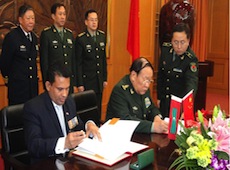
Defence Minister Colonel (Retired) Mohamed Nazim signed a military aid agreement with Chinese National Defence Minister General Liang Guanglie during his official five-day visit that concluded yesterday (December 15).

Following official talks between the defence ministers, Chinese state-run Xinhua news agency reported Nazim as assuring Guanglie that the Maldives was “willing to cement relations between the two countries and their militaries.”

General Liang reportedly said China would “continue to develop friendly, cooperative and mutually beneficial relations with the Maldives under the principle of building a good-neighbourly relationship and non-interference in internal affairs”.

“China has always positively developed its military relations with the Maldives and hopes to enhance communication and cooperation, promote the construction of both militaries, and safeguard regional peace and stability,” he was quoted as saying by Xinhua.

According to a press release by the Ministry of Defence and National Security, Defence Minister Nazim held talks with his Chinese counterpart on December 11, which focused on Chinese military assistance to develop the Maldivian military.

The agreement to develop military ties and provide free Chinese aid to the Maldives National Defence Force (MNDF) was signed at the meeting, the press release stated.

Defence Minister Nazim also met the Vice Chairman of the Chinese Central Military Commission, Xu Qiliang, and discussed strengthening Sino-Maldives military ties.

Defence Minister Nazim in ChinaDuring his visit, Nazim visited the Chinese National Defence University to discuss securing education opportunities and toured the People’s Liberation Army (PLA) Naval Submarine Academy as well as the PLA Navy’s North Fleet.

The Defence Minister met MNDF coastguard personnel training at the submarine academy, the press release noted.

Nazim’s official visit to China followed the government’s abrupt termination of a 25-year concession agreement with Indian infrastructure giant GMR to modernise and manage the Ibrahim Nasir International Airport (INIA).

The move fuelled speculation in the Indian media of a Chinese role in the government’s decision to void the agreement and evict the GMR-led consortium.

President Dr Mohamed Waheed Hassan Manik has however dismissed suggestions that China urged the Maldives to push out the Indian company.

“The only significant cooperation we have with China at this time is through development assistance… like building the museum, housing projects. I don’t think India should worry about it at all,” Waheed was quoted as saying by The Hindu.

Meanwhile, India’s The Economic Times reported yesterday that China’s strengthening of ties with the Maldives may be part of its larger plans of dominating strategically-important sea lanes in the Indian Ocean, “according to an assessment of the Indian intelligence agencies.”

“Beijing is reportedly wooing Male’ to pre-empt a US move to set up a new military base in the Maldives’ southernmost island of Gan,” The Economic Times reported.

The paper also took note of recent statements by former President Maumoon Abdul Gayoom suggesting that it was “natural for a country with such huge resources to come and help us.”

“China has been with us for 40 years,” Gayoom told Indian media last week.

In November 2011, China became the first non-SAARC nation to open an embassy in the Maldives.

AFP at the time reported Indian officials as expressing concern that it was “part of a Chinese policy to throw a ‘string of pearls’ – or a circle of influence – around India.”

Likes(0)Dislikes(0)

Former President Nasheed’s trial politically motivated: Bar Human Rights Committee

The trial of former President Mohamed Nasheed on charges of illegally detaining a judge appears to be a politically motivated attempt to bar the Maldivian Democratic Party (MDP) candidate from the 2013 presidential election, the Bar Human Rights Committee (BHRC) concluded in a report launched on Thursday (December 13).

The report was compiled by Stephen Cragg on behalf of the BHRC, the international human rights arm of the Bar of England and Wales, following a visit to the Maldives from November 3 to 6 to observe hearings of former President Nasheed’s trial.

“BHRC notes that Mr Nasheed’s lawyers have petitioned the prosecutor-general to review whether the prosecution of Mr Nasheed is in the public interest, and it seems to BHRC that this is an application worthy of very serious consideration,” the report stated.

“BHRC is concerned that a primary motivation behind the present trial is a desire by those in power to exclude Mr Nasheed from standing in the 2013 elections, and notes international opinion that this would not be a positive outcome for the Maldives.”

According to a press release by the BHRC, the report was based on “an investigation into the circumstances surrounding the trial of ex-President Mohamed Nasheed.” The BHRC observer, Stephen Cragg, is a member of the bar and barrister at Doughty Street Chambers.

Former President Nasheed faces criminal charges for the military’s controversial detention of Chief Judge of the Criminal Court Abdulla Mohamed on January 16 this year.

Home Minister Hassan Afeef sought to justify the arrest at the time on the grounds that the judge was a national security threat after he blocked investigation of his misconduct by the judicial watchdog and quashed a police summons for him.

The judge had “taken the entire criminal justice system in his fist,” Afeef said, accusing Abdulla Mohamed of obstructing high-profile corruption casesreleasing murder suspects, colluding with drug traffickers, and barring media from corruption trials.

Judge Abdulla “hijacked the whole court” by deciding that he alone could issue search warrants, Afeef contended, and had arbitrarily suspended court officers.

In the conclusions of the BHRC report, the author observed that the detention of the judge was “not a simple case of abuse of power.”

“Rather, the underlying narrative of the situation is that of a president desperate to bring change to a new democracy after decades of oppression, and finding himself thwarted by the inability of the organs of state set up by the constitution to deliver much needed  reform,” the report stated.

Referring to “the large number of international reports” that have found the Maldivian judiciary to be flawed, the BHRC noted that the Judicial Service Commission (JSC) “failed in its twin tasks of ensuring that the judiciary has the appropriate experience and qualifications, and in bringing to book the judges who fail to fully and fairly implement the rule of law.”

“Implicit in these criticisms is that Mr Nasheed cannot be guaranteed a fair trial,” the report concluded.

The BHRC also expressed concern with the “deterioration of human rights protection in the Maldives since the transfer of power in February 2012” as reported by Amnesty International and the International Federation of Human Rights (FIDH).

“Again, a failure to comply with human rights standards by the Maldivian authorities is a grave threat to the democracy so recently achieved,” the report stated.

“How the Maldives deals with this prosecution and trial (if it goes ahead) may well decide the course of its government for years to come.”

Back in September, the government criticised Amnesty International’s report, “The Other side of Paradise: A Human Rights Crisis in the Maldives”, as being “one sided”.

The BHRC is a UK-based independent body “concerned with protecting the rights of advocates, judges and human rights defenders around the world.”

JSC and failure of oversight

The BHRC report also noted that article 285 of the constitution mandated the JSC to determine whether or not the judges on the bench possessed “the educational qualifications, experience and recognized competence necessary to discharge the duties and responsibilities of a judge, [and] high moral character.”

“However, the JSC  failed to bring in any standards in the two years allowed and in August 2010 almost all judges, good and bad, were re-instated in post at that point amidst much controversy,” the report observed.

It added that the International Committee of Jurists (ICJ) expressed concern with the JSC’s failure to “fulfil its constitutional mandate of proper vetting and reappointment of judges.”

“The JSC (made up of politicians, lawyers and judges) has also been criticised as ineffective in its other role of overseeing  complaints about judges. Complaints about the worst judges built up and were not investigated. A large number of complaints were made about the head of the criminal court in Malé, Judge Abdulla Mohamed,” the BHRC report explained.

“In an open letter to parliament in March 2011, former President Nasheed’s member on the JSC and outspoken whistle-blower, Aishath Velezinee, claimed that the politically-manipulated JSC was protecting Judge Abdulla.

She claimed this protection was provided despite the existence of “reasonable proof to show that Chief Judge of the Criminal Court Abdulla Mohamed was systematically committing the atrocity of setting free dangerous criminals and declaring them innocent with complete disregard to the evidence [presented at court].”

Despite Judge Abdulla having been sentenced for a criminal offence, Velezinee wrote that Speaker Abdulla Shahid pushed for his reappointment and later “bequeathed the Criminal Court to Abdulla Mohamed until 2026″ under the Judges Act, which was passed hastily during the constitutional crisis period in July-August 2010.

Velezinee meanwhile told the author of the BHRC report that it was “the State’s duty to remove [Judge Abdulla] from the judiciary”.

“She has written a remarkable memoir of her time on the JSC, describing the machinations and tribulations of the Committee, and its failure to establish ethical or moral standards for judges,” the report noted.

Meanwhile, on January 16, 2012, “frustrated by an inability to remove allegedly bad judges, President Nasheed (or one of his ministers, it is still not entirely clear) ordered the detention of Judge Abdulla,” the BHRC report continued.

“He was taken to an island and kept there for almost three weeks, despite the protests of lawyers and judges. It does not seem that he was badly treated, and the government emphasised the lack of other effective powers to justify its actions.”

It added that the Supreme Court demanded the immediate release of the judge “as he was arrested not in conformity with the laws and regulations, and the acts of MNDF [Maldives National Defence Force] was outside its mandatory power.”

The trial

Former President Nasheed’s trial is set to resume after the Supreme Court on December 5 decided in a 4-3 ruling that the Hulhumale’ Magistrate Court hearing the case was legitimate.

The BHRC report noted that Nasheed was charged under article 81 of the penal code, which states: “It shall be an offence for any public servant to use the authority of his office to intentionally arrest or detain any innocent person in a manner contrary to law. A person guilty of this offence shall be punished with exile or imprisonment for a period not exceeding 3 years or a fine not exceeding MVR 2,000.”

The former President’s legal team informed the author that “a range of defences will be advanced” in his trial.

“For example, is the President a public servant to whom the Article applies? Does the Article relate only to the person who, in fact, takes a person into custody or directly orders an arrest? What effect does the term ‘innocent’ have in the Article?” the report explained.

“The team is to request that the Prosecutor General reconsiders whether the prosecution against Mr Nasheed should proceed, arguing that it is not in the public interest that it should do so. It was explained that if Mr Nasheed is sentenced to more than a year in custody then (even if he is immediately pardoned) he will be excluded from running in the 2013 elections.”

The author of the report also spoke to a number of lawyers, politicians and the Prosecutor General during their visit, and “almost all criticised the failure of the JSC to bring about reform of the judiciary in the way expected by the new constitution.”

“Opinion was split between those who thought there was no option  but to prosecute Nasheed, and those who wanted the wider context to be taken into account by the prosecutor,” the report noted.

“There was a strong  feeling amongst some that the politicians of the old regime had escaped prosecution for much worse abuses of power. The foreign government representatives I spoke to clearly see Nasheed as a force for good in the region and desperately want a solution  to the current proceedings which will allow him to stand in the election next year.”

Independent MP Mohamed ‘Kutti’ Nasheed, chair of parliament’s Independent Institutions Oversight Committee, meanwhile explained that the absence of powers to replace members of the JSC “severely restricted” the parliamentary committee from ensuring that the JSC was functioning effectively.

Nasheed also criticised the Supreme Court for overturning Acts of Parliament that “purported to legislate for the justice system” as part of its stance that “anything to do with the administration of justice was a matter for the [Supreme] Court.”

Former MP Ibrahim Ismail ‘Ibra’, chair of the constitution drafting committee of the Special Majlis, meanwhile contended that the President “had no choice but to arrest Judge Abdulla” as the only option to “remove a rogue judge from the criminal justice system.”

Ibra explained that the “backdrop to President Nasheed taking or authorising the action he did against the judge” was the JSC’s failure to investigate serious complaints, some dating back to 2005.

“However, when the JSC did adjudicate against Judge Abdulla in one case, the Judge went to the civil court and obtained an injunction against the JSC to stop them taking action against the judge. Essentially the system had ground to a halt,” the BHRC report stated.

Prosecutor General Ahmed Muizz however insisted that “it was right that Mr Nasheed should face trial and that even before Mr Nasheed had lost power it was considered the right thing to do.”

“I asked him whether there was a code of practice which governed prosecution decisions. He said that there was but that it was not in the public domain. He said that it was possible for prosecution decisions to take into account the public interest, but was a little vague as to how this was actually done,” the report stated.

“He mentioned that when Mr Nasheed had been president there had been a decision in the public interest not to pursue him in relation to fairly minor electoral offences. He did say that it was possible for the prosecutors to reconsider, following charge, whether a prosecution should continue.”

Likes(0)Dislikes(0)