Both Transparency Maldives and MDP call for greater transparency in water crisis fund

Transparency Maldives has called on the government to display more transparency in order to avoid “economic and political repercussions stemming from the water crisis”.

“The Government must publicly provide a breakdown of the estimated US$20 million (more than MVR300 million) needed to overcome the crisis, and how the government intends to spend it,” read a press release from the anti-corruption NGO.

Transparency’s statement follows the announcement this week that the government is seeking donations in order to meet the costs of the fire that crippled Malé’s sole desalination plant on December 4.

“Furthermore, the decision to seek donations from the public raises questions given that MWSC is a private, profit-making corporation with 80 per cent government shares,” said Transparency.

Minister of Tourism Ahmed Adeeb said today that the fund – which has already received support from both foreign and domestic donors – was not intended for the MWSC, but would be utilised by the government.
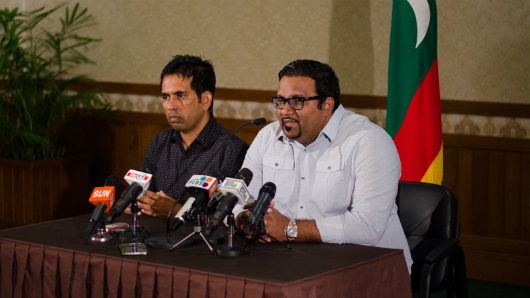
The opposition Maldivian Democratic Party (MDP) has also criticised the fund, stating that the government should only be able to demand US$20 million after they have decided how it is going to be spent.

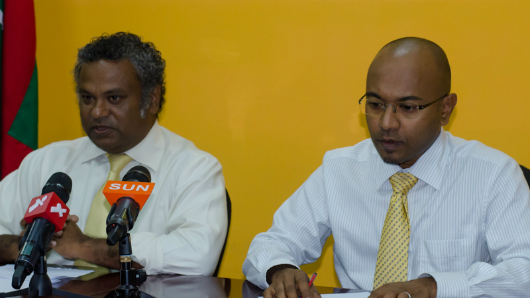
“The MDP along with the people of the Maldives demands answers from the government regarding the US$ 20 million fund,” said party Vice Chairperson Ali Niyaz at a press conference today.

“Where is the money going to go to? Why have not seen a breakdown on how the money is going to be spent? Will this be a new ring in the chain of corruption of the government?” he asked.

Additionally, party lawyer Hassan Latheef expressed concern that unnamed donors were giving large amounts of money to the fund.

“Relevant details should be provided as per the law on money laundering and corruption prevention law. Money laundering and financing for terrorism through donors is something which exists in the Maldives.”
Transparency has also called for an independent technical investigation to be conducted, and results to be made public before effective and preventative mechanisms are put in place.

“The investigation must scrutinise MWSC’s risk mitigation policy and asset management plan,” said the NGO.

With 130,000 citizens of the capital left without water, the government has said it could take up to two weeks to fully repair the extensive damage. President Abdulla Yameen has said that there could have been no back up plan for a “disaster of this magnitude”.

Former President and opposition leader Mohamed Nasheed has also called for an inquiry into the fire, suggesting that the Danish government previously recommended keeping 21 days of reserves in the capital.

Transparency noted that the crisis had demonstrated “the interminable relationship between good governance and citizens’ right to essential human needs,” calling for greater regulation of state-owned enterprises.

“Transparency Maldives believes that it is the responsibility of the government to hold accountable and to ensure that MWSC and other companies that provide essential services, such as the State Electric Company Limited (STELCO) and FENAKA Corporation  Limited, have mechanisms in place to review their working procedures so that similar incidents can be avoided in the future.”

MDP lawyer Latheef also criticised what he perceived to be the government’s attempts to pass the constitutional responsibility for water provision to the MWSC.


Related to this story

No fall back for disaster of this magnitude: President Yameen

Government seeks US$20 million in donations to repair Malé’s desalination plant

People’ Majlis disrupted after disorder over water crisis

UN Maldives commends government’s response in water crisis, opposition condemns

Likes(2)Dislikes(2)

People’s Majlis disrupted after disorder over water crisis

Allegation of assault against opposition MPs followed disruption in the People’s Majlis today as MPs attempted to debate the ongoing Malé water crisis.

Water services have been cut off from the capital for six days following a fire at the capital’s sole desalination plant.

The Majlis convened today – with debate on the proposed 2015 state budget and an urgent motion of the water crisis on the agenda. But proceedings were prematurely concluded after numerous points of order were raised by the opposition MPs.

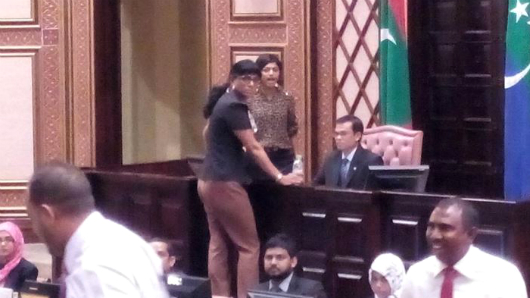
Maldivian Democratic Party (MDP) MP Mariya Didi expressed her discontent that the parliament was receiving running water while water services for Malé residents were disrupted.

“While there is no water for the general public, there is water in the parliament. There is even running water in the toilets,” local media reported Mariya as saying.

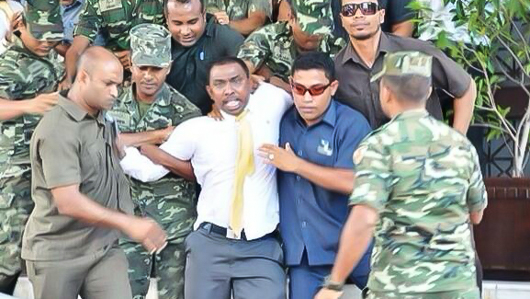
This subsequent commotion saw Mariya standing in front of the Speaker of the Parliament Abdulla Maseeh Mohamed in protest, while former Speaker of the Majlis and MDP MP Abdulla Shahid has alleged he was attacked by members of the ruling Progressive Party of Maldives (PPM).

Shahid had since submitted a letter addressed to the speaker urging an investigation, while the MDP released a statement condemning the attack on Shahid and alleging an additional attack on Mariya by a pro-government MP.

However, PPM Parliamentary Group Leader Ahmed Nihan has denied the attacks when speaking with local media.

“Shahid started calling for the resignation of the government during the commotion. Some of our younger MPs went near the table and then there were some disagreements,” Nihan told Haveeru.

Questioning the water fund

The MDP also raised several queries regarding the US$20 million ‘Malé water crisis management fund’ set up by the government in order to recover the cost of dealing with the situation.

Speaking at a press conference today, MDP Vice Chairperson Ali Niyaz said that the government’s demands for US$20 million without a detailed breakdown of how the money is going to be spent might lead to corruption.

“Even though MWSC managing director is present during the press conferences, he has not been given any opportunity to speak and we have not received any information on the damages from a technical viewpoint,” complained Niyaz.

Following calls from the defence minister not to politicise relief efforts, Niyaz said that the party is not trying to politicise the US$20 million fund but was demanding answers and correct information from the technical staff at the MWSC rather than the “political figures” in the president’s task force.

The team assigned by President Abdulla Yameen to deal with the crisis includes Minister of Defence Colonel (retired) Mohamed Nazim, Economic Development Minister Mohamed Saeed, Minister of Environment Thoriq Ibrahim, and Minister of Fisheries and Agriculture Dr Mohamed Shainee.

Meanwhile, 5 people were arrested last night at a protest voicing the public’s frustrations with the government’s handling of the water crisis.

A police media official told Minivan News that the people were arrested for disobeying police orders and that all have now been released.

The MDP denied involvement in the protests, saying that the protests did not feature any of the MDP flags and that it was merely people expressing their frustrations with the government.


Related to this story

No fall back for disaster of this magnitude: President Yameen

Government seeks US$20 million in donations to repair Malé’s desalination plant

President Yameen to return to Maldives as water crisis enters third day

UN Maldives commends government’s response in water crisis, opposition condemns

Likes(3)Dislikes(0)

Government scraps plan to impose import duty on staple foodstuff

The government has reversed its decision to impose a 10 percent import duty on staple foodstuff such as rice, flour, wheat and sugar, Minister of Tourism Ahmed Adeeb has revealed.

“Emergency economic council meeting ongoing where President [Abdulla] Yameen has just decided not to impose any duty on sugar, rice, flour (staple foods),” the council’s co-chair tweeted this morning.

Speaking at a press conference at the President’s Office later today, Adeeb said parliament and the Progressive Party of Maldives’ parliamentary group have since been informed of the decision.

“The president’s decision was made in light of requests from a lot of people as well as the current situation [with the capital’s water crisis] we are faced with,” he said.

Finance Minister Abdulla Jihad told parliament’s budget review committee last month that the government anticipated MVR533 million (US$34.5 million) in additional income from import duties.

The new duties were to represent 15 percent of the new revenue anticipated in the 2015 budget.

Revising import duties

Revising import duties was among several revenue raising measures in the record MVR24.3 billion (US$1.5 billion) state budget for 2015 currently before parliament.

Government-sponsored amendments (Dhivehi) to the Export-Import Act – which proposed raising custom duties from the current zero rate to 10 percent for staple foodstuffs – were subsequently submitted to parliament last month.

Scrapping plans to levy import duties on staple foodstuff from October 2015 was meanwhile among several amendments submitted to the budget by opposition Maldivian Democratic Party (MDP) MPs last week.

The minority party has issued a three-line whip for its MPs to vote against the budget if none of the proposed revisions are passed.

During last month’s parliamentary budget debate, opposition MPs strongly criticised the proposed tax hikes, contending that the burden of higher prices of goods and cost of living would be borne by the public.

The current administration’s economic policies – such as waiving import duties for construction material imported for resort development as well as luxury yachts – benefit the rich at the expense of the poor, MDP MPs argued.

In addition to a 10 percent tariff for oil, the government’s amendment bill also proposed raising custom duties for tobacco from 150 to 200 percent and raising the duty for a single cigarette to MVR1.25.

Additionally, a 20 percent custom duty would be imposed for luxury cosmetics and perfume and a 200 percent custom duty for land vehicles such as cars, jeeps, and vans.

The forecast for additional revenue for the 2015 budget was MVR3.4 billion (US$220 million), including US$100 million expected as acquisition fees for investments in special economic zones and MVR400 million (US$25.9 million) from the sale and lease of state-owned land.

The other measures included introducing a green tax of US$6 per night in November 2015 and leasing 10 islands for new resort development.

Tariffs were last revised in April this year after parliament approved import duty hikes for a range of goods proposed by the government as a revenue raising measure.

Targeting subsidies

Adeeb meanwhile told the press today that the government still planned to shift to a model of targeting government subsidies to the needy as part of efforts to consolidate public finances.

In his budget speech to parliament last month, Jihad also revealed plans to revise the electricity subsidy, which he said currently benefits the affluent more than the needy.

Targeting the electricity subsidy to low-income families or households would save 40 percent of the government’s expenditure on the subsidy, Jihad explained, and allow the government to provide a higher amount to the poor.

While Maldivians were not legally required to declare income and assets in the absence of an income tax, Adeeb said today that the National Social Protection Agency (NSPA) currently used criteria for means-testing for subsidies.

Minister of Economic Development Mohamed Saeed meanwhile noted that the International Monetary Fund (IMF) has recommended targeting subsidies and reducing recurrent expenditure to reign in the fiscal deficit.

“The electricity subsidy is one that goes to even the richest strata of society. Basic food subsidies are being enjoyed now by the resorts, and never mind the resorts, are being enjoyed by wealthy foreign visitors who stay at the resorts,” Dr Koshy Mathai, resident representative to Sri Lanka and Maldives, told MPs on the public accounts committee in February.

“That to us seems like a totally unnecessary policy.”

He added that “substantial savings” could be made from the budget by targeting subsidies to those most in need of assistance.

Meanwhile, in May, MMA Governor Dr Azeema Adam called for “bold decisions” to ensure macroeconomic stability by reducing expenditure – “especially the un-targeted subsidies.”


Related to this story

Finance minister presents record MVR24.3 billion state budget to parliament

Government proposes import duty hikes for oil, staple foodstuff

MDP, JP MPs propose 19 amendments to 2015 budget

Likes(4)Dislikes(0)

35 percent of Asian MPs’ human rights cases from Maldives, says IPU

The Inter Parliamentary Union (IPU) has revealed that the Maldives accounts for 35 percent of all its human rights cases concerning Asian MPs.

“Maldives has a very high number of MPs (27) with cases before the Committee. Arbitrary detentions and violations of freedom of expression are the most common complaints reported, followed by torture, ill-treatment and other acts of violence,” said the IPU.

The union’s ‘Human Rights Abuses of MPs – 2014′ report – released to mark Human Rights Day (December 10) – shows that Africa and Asia are the most dangerous regions for parliamentarians.

Earlier this year, the union had suggested that the authorities’ response  to the growing number of threats against MPs would represent a test of the Maldives’ democracy.

The union emphasised the “high price parliamentarians are paying to defend fundamental human rights and exercise their right to freedom of expression”.

Despite being the smallest country in Asia, the Maldives made up 27 of 78 parliamentarians from 12 countries in Asia who have cases lodged with the IPU’s human rights committee.

Previous statistics from the IPU show that the global average number of inhabitants per parliamentarian is 146,000. With 85 MPs, the Maldives’ 2014 census shows the country has 1 MP for every 4,014 inhabitants.

In October, opposition Maldivian Democratic Party (MDP) MP Eva Abdulla – the first Maldivian member of the IPU – met with the committee to raise concerns over the personal safety of parliamentarians and journalists in the Maldives.

At the time, Eva highlighted the lack of thorough investigations in cases of threats and assault, perpetrators not facing trial, the failure of law enforcement, the failure of the parliament to look into cases, and the creation of a culture of intimidation in the Maldives.

In a year in which MDP MP Alhan Fahmy narrowly avoided paralysis following a stabbing, threats against MPs and their families have become commonplace.

In October, the Maldives National Defence Force temporarily offered MPs additional personal security as well as urging Majlis members not to go out at night time unless absolutely necessary.

The IPU’s list of Maldivian cases also included the late Progressive Party of Maldives MP Dr Afrasheem Ali, brutally murdered outside of his home in October 2012.

MDP MP Ali Azim was controversially removed from the Majlis over an issued of decreed debt last year

Cases from around the world

The IPU explained that 311 parliamentarians from 41 countries had cases referred to the IPU Committee in 2014 – a 13 per cent increase from 2013, which saw 270 parliamentarians lodge cases, from 40 countries.

The most common human rights complaints are arbitrary detention, lack of fair trial, violation of freedom of expression and unlawful suspension and loss of parliamentary mandate.

Other dangers faced by parliamentarians include death, torture, threats and arbitrary arrests, explained the IPU

As per the 2014 statistics, the highest number of parliamentarians who have lodged cases at the committee are from Africa with 38 per cent, followed by Asia with 25 per cent.

Middle East and North Africa have 18 percent, while the Americas have 14 percent, and Europe 5 percent.

71 percent of these parliamentarians are from opposition parties, and 89 percent are male.

“These figures are extremely worrying as they show that all over the world MPs face serious harassment and sometimes even death, in a clear attempt to intimidate and silence critical voices and dissent,” said IPU Secretary General Martin Chungong.

“The figures we are presenting today are cases reported to IPU, but there are other abuses that remain beyond our scope, as the Committee can only intervene at the request of the MP concerned, family members, legal representatives, fellow MPs or human rights organisations,” he continued.

The statement reads that the majority of cases have been under the committee’s consideration for less than five years, while 10 percent of the cases are from more than 10 years ago, and another 5 percent date back to the 1990s.

It also notes that 101 new decisions were adopted by the IPU this year, calling on authorities of the relevant countries to “take effective steps towards a satisfactory settlement of the cases”.

Of the 314 cases, 71 are new cases involving parliamentarians from the Maldives, Cambodia, Colombia, Democratic Republic of Congo, Ecuador, Iraq, Israel, Oman, Palestine, Venezuela and Zambia.

The Committee also closed cases involving 12 parliamentarians in 2014.


Related to this story

Government’s reaction to death threats is a test of democracy: IPU

Inter-Parliamentary Union requests urgent visit to Maldives

Opposition MP Alhan Fahmy stabbed

MPs urged to stay in at night as MNDF offers personal security

Likes(2)Dislikes(0)

Dealing with the dry spell – Malé’s water crisis continues

Five days since the fire at Malé Water and Sewerage Company (MWSC) – the capital city’s sole provider of running water – disrupted water supplies, residents and local businesses struggle to make do with the limited resources available.

As politicians begin finger-pointing, the inhabitants of the capital continue to cope with the crisis in any way they can.

The Maldives National Defence Force (MNDF) and the Maldives Red Crescent have been distributing bottled water received as aid from neighbouring countries to citizens since December 5.

The drinking water distributed by the MNDF in this manner is being transported to the capital city voluntarily from nearby islands by local businessman Adam Manik of Galolhu Sentuge, owner of Tug Service Marine Pvt Ltd.

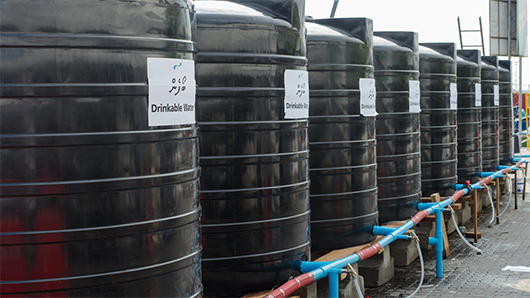
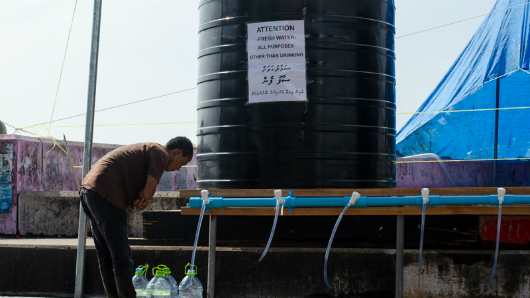
Adam Manik has also taken the initiative to set up nearly a dozen large water tanks near the Water Jetty, where drinking water is dispensed free of charge.

“I purchase the water, transport it to Male’ on my boats and distribute it for free to all and any citizens. I see this as a national effort and will continue to provide this service as long as the current water difficulties continue,” Adam Manik told Minivan News today.

Adam stated that his employees have been working relentlessly for the past 4 days on all his boats.

Three of his boats are being utilised for water transportation – ‘Adam 60’, which has the capacity to carry 200 metric tonnes of water, ‘Ifba’ carrying 60 metric tonnes and ‘Namoona’, carrying 20 metric tonnes.

Meanwhile, Happy Market is currently producing ‘Life’ bottled water at maximum capacity, catering to the public, businesses, and resorts.

Happy Market Purchases and Procurement Manager Akram stated that, while the company is unable to provide unlimited supplies, they are working to sell water at an equitable rate.

The public can at the moment purchase one case of four 5 litre bottles at any of the Happy Market outlets in the city for MVR56 (US$3)

Akram stated that other producers of bottled water are slowly resuming retail, which would stabilise the situation while taking some pressure off the sole seller of bottled water.

Leaving water troubles behind

While the queues at free distribution centres grow shorter, there are reports that many residents of Malé have chosen to travel to other islands, especially nearby Villingili and Hulhumalé – both of which have unaffected supply.

Guest house owners confirm that all accomodation at these islands are now fully booked, while some guesthouses have started a new strategy of only renting rooms to Malé residents on an hourly basis.

Traditionally, December is the time of the year when customary circumcision parties are held in the Maldives – which typically include a week long celebration after young boys undergo the procedure.

Fathimath Waheeda stated that on December 4, she had to move her son from the hospital to Villingili as, due to the water shortage, she could not cater to the multitude of guests who would visit her son’s party.

“I rented a room in Villingili and we are having the party here. Less people turn up, but at least there are no concerns of hygiene or catering here,” she said.

Limited water, Limited services

Local businesses are also facing hardship due to the water troubles, with some opting to temporarily close down business until water services resume.

Others continue to persevere, with many gathering water from distribution centres, or collecting water at the limited dispensing hours.

Fahari Cafe’ – run at the North Harbour of Malé – said it is attempting to run business as usual, assigning one employee the task of going to queue at water distribution centres, while another stays alert to collect water during dispensing hours.

Abdulla Saeed, owner of a food outlet called “Home Delivery” stated that they are following the same process.

“What else can we do? This is the work we do to feed ourselves. We cannot give it up regardless of how difficult it may be,” he said.

Marble Hotel owner Athif Saleem said that guests are aware of the crisis and that therefore very few complaints are received.

“We are providing well water to the guestrooms and notifying them of the water supply dispension hours. We are also using rainwater in the cafe for washing purposes and services are available. However, we are getting fewer local customers in the cafe’ during this crisis,” he explained.

Hair salons are also facing difficulties in providing normal services. Many claimed to be open only to offer a limited number of services – those which require a minimal amount of water usage.

Cyza Salon also spoke of decreased number of customers during the crisis.

“Like most others, we also bring water from the distribution centres. We aren’t getting too many customers these four days but if someone does come, we will try to provide services as best as we can”.

According to Special Task Force member Minister of Home Affairs Umar Naseer, it will take upto 10 days or more for regular water supply services to resume.

Likes(2)Dislikes(0)

PPM condemns MDP’s “unlawful” resolution for handover of presidency to JP Leader Gasim

The Progressive Party of Maldives (PPM) has strongly condemned a resolution adopted by the opposition Maldivian Democratic Party’s (MDP) national council yesterday calling for Jumhooree Party (JP) Leader Gasim Ibrahim to assume the presidency as an interim leader.

The ruling party slammed the move as “irresponsible and cowardly” in a press statement released last night.

“At a time when the government is carrying out swift efforts to resolve the water shortage in Malé, this party believes that the [MDP resolution] is an activity planned by the MDP leadership to cause loss of the country’s peace and security as well as the unity among Maldivians at this juncture,” read the statement.

The PPM also characterised the national council decision as an “undemocratic and uncivilised” attempt to topple a legitimately elected government.

The press statement praised the efforts of President Yameen’s administration and the ministerial task force to normalise the water supply crisis in the capital and declared the party’s “full confidence” in the president.

At an emergency session yesterday, the MDP national council voted 36-2 in favour – with four abstentions – of a resolution proposed by former President Mohamed Nasheed to back Gasim as interim president.

Nasheed contended that President Yameen has failed to perform his duties, was “ruling in absentia” and criticised his response to the ongoing water supply crisis.

The government has also failed to curb gang violence, he continued, noting that a 28-year-old man being stabbed to death the previous night.

Asked about the MDP’s resolution at a press conference yesterday, President Yameen said it was up to the people to change the government.

“Handing over the government to the Jumhooree Party leader or MDP’s leader has to be done when there is a vacancy for some reason,” he said.

“I don’t pay much attention to such talk by President Nasheed.”

Yameen claimed that the MDP government sold shares from the Malé Water and Sewerage Company (MWSC) to Japan’s Hitachi Plant Technology for US$16 million after buying it back for US$19 million.

Yameen said he had objected to the sale as an opposition MP at the time.

However, the Nasheed administration sold 20 percent of the company’s shares to Hitachi for US$16 million in January 2010 at US$ 305.90 per share.

In late 2008, the government bought back 24 percent of MWSC share’s from Denmark’s HOH Water Technology for US$19 million at the same share price.

Members of the MDP national council meanwhile noted that President Yameen was elected with the backing of Gasim and the JP.

After initially announcing that the party would remain neutral, the JP’s council decided to endorse Yameen three days before the second round of the presidential polls on November 16 last year. In the first round revote, Gasim had finished in third place with 23.37 percent of the vote.

However, the JP’s coalition agreement with the PPM was severed by the latter after Gasim stood for the post of parliament speaker.

Likes(2)Dislikes(0)

MDP calls on the government to hand power to JP leader Gasim

The Maldivian Democratic Party (MDP) has called on the government to hand over power to Jumhooree Party (JP) leader Gasim Ibrahim in light of recent events.

At the party’s emergency national council meeting, the council agreed to support a decree brought forward by former president Mohamed Nasheed urging the government changeover.

“The country is under a very dark cloud at the moment,” said former President Nasheed. “The president is not fulfilling presidential duties and ruling in absentia. So it is better for him to handover governance to Gasim Ibrahim.”

While presenting the decree to the members of the national council, Nasheed said that the government had failed in ensuring basic necessities for the people of the country and that President Abdulla Yameen should handover the government to Gasim since he was able to secure almost the same amount of votes in the first round of the 2013 presidential elections.

Gasim polled third twice in last year’s presidential elections – successfully requesting the first vote be annulled before again finishing behind Yameen and Nasheed in a rescheduled poll. Gasim eventually threw his support behind Yameen, forming a coalition that saw the latter win the presidency before relations soured earlier this year.

Nasheed highlighted the lack of a presidential response during the ongoing Malé water crisis saying that the president was nowhere to be seen.

As the MDP council was meeting, President Yameen briefed the public for the first time on the water crisis.

When about the MDP council decision, Yameen responded by saying that the governance of the country is handed over by the people, saying: “I do not pay much attention to such talk by Nasheed.”

“I would like to respond by saying that the shares of this country was sold to foreigners. I raised my voice against this as a member of the parliament. The question of handing governance will come when the presidential seat is empty,” said Yameen.

The former president also noted the growing insecurity amongst citizens, with an increase in gang violence, while saying that the government has done very little to curb these crimes.

“There has been 7 murders so far this year. While there has been overall 20 stabbing incidents there has also been cases of 6 people taken as hostages,” detailed Nasheed.

The early hours of this morning saw the most recent death in gang-related violence with a 28-year-old man being stabbed to death by group of men.

Police have denied any arrests related to the death although local media report that 10 men have been arrested related to the violence.

While discussing the decree before voting, MDP Rozaina Adam said that it is unclear who is really in charge of the government at the moment and that the president should step down if he is unable to fulfill his presidential duties.


Related to this story

28-year-old man stabbed to death in gang-related violence

No fall back for disaster of this magnitude: President Yameen

MDP condemns insecurity as PPM celebrates peace and order

Likes(3)Dislikes(0)

Nasheed calls for inquiry into MWSC fire

Former President Mohamed Nasheed has called for an inquiry into the fire at the Malé Water and Sewerage Company (MWSC) on Thursday (December 4) that caused the capital’s ongoing water supply crisis.

“We absolutely need an inquiry, an investigation, right now [in order to find out] how this happened,” the opposition leader said at a Maldivian Democratic Party (MDP) rally in Haa Alif Dhidhoo last night.

The public should be duly informed about the efforts of the ministerial task force formed by President Abdulla Yameen to resolve the crisis and given a date for resumption of water supply services, he added.

The MWSC cut off water supply in Malé after underground cables connecting the switch room and generator caught fire, causing damage to the reverse osmosis plant used to produce desalinated water.

Nasheed said the Danish government had advised MWSC to keep 21-days worth of water supply in reserve after completing a project to provide water to Malé.

The water crisis was caused by President Yameen appointing “thug activists” to the MWSC after dismissing experienced and qualified staff at the company, Nasheed contended.

The MDP government had a plan to deal with similar situations as well as natural disasters, Nasheed said, asserting that the crisis would have been resolved in 24 hours under his administration.

Of the 2 meters of annual rainfall in the capital, Nasheed observed that less than half was collected for use.

He went on to express gratitude to police and military officers for their efforts in assisting residents of the capital as well as the Indian government for promptly responding to pleas for assistance.

Referring to reports of foreigners denied water at collection points, Nasheed called on President Yameen to apologise to expatriates residing in the capital.

President Yameen’s “biggest failure” was his administration’s foreign policy, he continued, which he said should not be biased in favour of any particular country.

Nasheed also repeated his criticism of President Yameen “ruling in absentia” and called on the president to disclose his alleged health problems to the public.

Briefing the press this morning, Defence Minister Colonel (Retired) Mohamed Nazim urged the opposition to refrain from “politicising” the crisis.

The Maldives Police Service has meanwhile launched an investigation into the fire incident at MWSC. Commissioner of Police Hussain Waheed has reportedly tasked a special team with the investigation.


Related to this story

Indian aircraft arrives to ease Malé water crisis

Palm trees used by MDP to curse President Yameen, alleges senior government official

Public should be informed about president’s health, says Nasheed

Likes(4)Dislikes(1)

MDA Leader Siyam acquitted of alcohol smuggling charges

Government-aligned Maldives Development Alliance (MDA) Leader Ahmed ‘Sun’ Siyam Mohamed was acquitted of alcohol possession and smuggling charges by the Criminal Court on Thursday (December 4).

Chief Judge Abdulla Mohamed found the resort tycoon not guilty on the grounds that due process was not followed in accordance with the Maldives Customs Act.

The MP for Dhaalu Meedhoo was charged with smuggling and possession of alcohol in November 2013 after a ‘Johnny Walker Black’ bottle was found in his luggage at the airport upon returning from Sri Lanka in March 2012.

In June, two witnesses for the prosecution testified to finding a bottle of alcohol in Siyam’s luggage.

While the customs officers testified that they discovered the bottle when Siyam’s bag was screened, a Maldives Airports Company Ltd (MACL) staff member who handled the luggage said they were unaware of its contents prior to screening.

However, Siyam’s lawyer argued that the MP was being framed, noting that according to the prosecution’s witnesses the luggage was not searched in his presence.

Following multiple delays and cancellations of hearings, Chief Judge Abdulla Mohamed took over the case from Judge Ahmed Sameer Abdul Aziz in May after Siyam claimed the latter’s “hand gestures and facial expressions” indicated a personal grudge against him which could lead to an unfair trial.

Siyam wrote to both the chief judge and the Supreme Court requesting the removal of Judge Sameer from his case.

Responding to criticism of the court for providing preferential treatment to the coalition leader, Judge Abdulla declared at a ceremony in September that the court would provide VIP treatment and escort persons facing trial in and out through the back door in circumstances where it sees fit.

Siyam was reportedly escorted in and out of the backdoor when he arrived at the court for a trial date and was also seated in a separate area.

The penalty for alcohol possession in the penal code is either a fine of between MVR1,000 to MVR3,000 or imprisonment, banishment or house arrest for up to three years.

Under Article 73 of the constitution, an MP convicted of a criminal offence and sentenced to more than one year in prison will lose his or her seat in parliament.

Siyam’s MDA formed an alliance with the now-ruling Progressive Party of Maldives (PPM) in August to back PPM presidential candidate Abdulla Yameen.

In March 2012, an audio clip of a conversation between Siyam and Yameen was leaked on social media, in which the pair aired grievances against PPM leader and former President Maumoon Abdul Gayoom.


Related to this story

Chief Judge Abdulla Mohamed takes over Sun Siyam’s case

Sun Siyam’s alcohol possession trial delayed again

Likes(1)Dislikes(0)