GMR lodges US$803million claim, pleads for award of further damages for loss of reputation

Indian infrastructure giant GMR has claimed US$803 million in damages from the government of Maldives for its abrupt and wrongful termination of a concession agreement to develop Ibrahim Nasir International Airport (INIA).

The claim comes after a Singaporean arbitration court in June found the government of Maldives and state owned Maldives Airports Company Pvt Ltd (MACL) “jointly and severally liable in damages” to GMR for the termination of a “valid and binding” concession agreement.

In a letter to the Bombay Stock Exchange, GMR’s subsidiary GMR Malé International Airport Private Limited (GMIAL) said it had “submitted its claim for damages amounting to US$803 million.”

“In addition, a plea for award of further damages for loss of reputation caused to GMR as a consequence of wrongful repudiation of the concession agreement has also been made to the Arbitral Tribunal, the quantification of which is subject to expert evidence.”

The arbitration has proceeded in two phases, the first phase which ended in June determined liability while the second will determine compensation.

President Abdulla Yameen’s administration called the first phase verdict a success, claiming the arbitration court had capped the compensation amount, and have said the government would not be required to pay GMR’s initial claim of US$1.4 billion – a figure that eclipses the annual budget.

Minivan News understands the concession agreement does allow MACL to terminate the agreement for reasons of public interest and imposes a cap on losses in such circumstances.

Tourism Minister Ahmed Adeeb has on several occasions declared that the government is confident it can pay back any losses incurred, while Attorney General Mohamed Anil has said the government will honor the verdict to uphold investor confidence.

Yameen has previously said the compensation claim will amount to a “manageable” US$ 300 million. In a speech in August, he appeared to blame GMR for the company’s eviction, claiming it had failed to undertake a political risk assessment.

“At a time when you had a very heightened political environment in Maldives, at a time when the parliament was polarised, it was a pity that political risk assessment was not undertaken by GMR. Whenever we hear about GMR, the issue that comes right to the limelight is their inability to assess political risk at the time,” he said.

GMR won the 25-year concession agreement to develop and manage Ibrahim Nasir International Airport under former President Mohamed Nasheed. The US$511 million deal was the country’s single largest foreign investment.

The opposition at the time attacked the deal as part of a vitriolic anti- government campaign, which eventually led to Nasheed’s ouster in February 2012.

In December 2012, new President Dr Mohamed Waheed declared the agreement void ab intio – or invalid from the outset – and gave GMR seven days to leave the country.

The agreement’s abrupt termination saw cooling of relations with neighbor India and questions regarding foreign investor confidence in the Maldives.

The World Bank in December said GMR compensation will place severe pressure on the country’s already “critically low” foreign reserves.

The MDP has called on the government to reinstate the contract, while Nasheed has warned of an “imminent sovereign debt crisis” should Maldives be forced to pay the initial US$1.4 billion.

The government has recently revealed that a new agreement with China’s Beijing Urban Group and MACL to develop INIA were proceeding smoothly, with work expected to begin next year.

GMR were reported in the Indian media to have expressed surprise that the government of Maldives had entered into the new agreement, penned during the visit of China’s President Xi Jinpeng in September.


Related to this story

GMR wins arbitration case, tribunal deems airport deal was “valid and binding”

Government will honor arbitration verdict, says attorney general

GMR not worried about airport politicking, will invest US$373 million

Cabinet voids US$511 million GMR contract, gives airport developer seven day ultimatum to leave

GMR surprised with decision to give airport development to Chinese firm

Likes(2)Dislikes(0)

Yameen pledges to end violent crime at ‘Successful 365 Days’ rally

With additional reporting by Ahmed Naish and Ismail Humaam Hamid

The Progressive Party of Maldives will rebuild a devastated nation through job opportunities for the youth and a crackdown on violent crime, said President Abdulla Yameen while celebrating one year in office.

Yameen urged young people to take advantage of the opportunities that would be created by growing tourism and large scale foreign-funded infrastructure projects, while pledging to bring peace and security to the nation.

“I want to say tonight as well in your presence, this government will have no mercy at all for those who slaughter Maldivian citizens with no mercy,” said Yameen at the ‘Successful 365 Days’ event held in Male’ this evening.

He pledged to implement the death penalty – reintroduced under his government, for the sake of human rights and dignity.

“Saving the Maldives from these big atrocities is the biggest aim of this government,” he said, stating that Maldivians by nature sought peace and stability.

Yameen said that proposed changes to legislation would remove violent crime which has blighted the country in recent months, suggesting the framers of the 2008 constitution wanted to create unrest and anarchy.

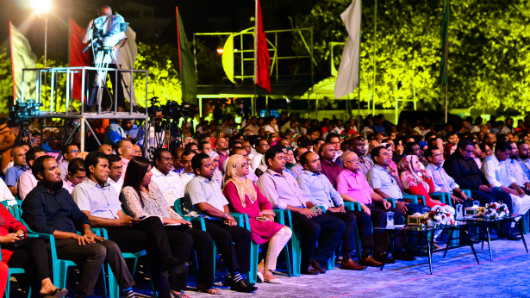
An estimated 3000 people attended the event at the carnival ground area to hear cabinet members and party colleagues detail the achievements of President Yameen’s anniversary.

While Islamic Minister Dr Mohamed Shaheem Ali Saeed said Yameen had united the nation, Speaker of the People’s Majlis Abdulla Maseeh Mohamed launched a book detailing the administration’s accomplishments.

Speaking earlier in the evening President’s Office Undersecretary Dr Hussain Faiz listed the achievements of the cabinet’s social council, which he said included a doctor for each island, opening 46 pharmacies, and introducing sea ambulance services in six atolls.

Faiz also noted that the government had introduced the unlimited Aasandha healthcare scheme for persons with chronic illnesses, as well as raising the old age pension to MVR5000.

Pledges to provide unlimited healthcare to all citizens as well as a doctor for every family were two of the administration’s aims for an ambitious 100 day programme twelve months ago, while nationwide sea ambulances had been promised within the first year.

Faiz also noted the feasibility studies carried out into an Islamic University in the Maldives, while saying that the role of Islam and Quran had been expanded in the new national curriculum.

Discussing the government’s record on development and the economy, Minister of Fisheries and Agriculture Dr Mohamed Shainee noted that the country’s dollar shortage had been alleviated, while MVR68 million worth of loans were issued.

Shainee claimed that, in addition to 1,700 new businesses being registered, and new resorts being put up for bidding, 19 foreign investors had registered a commitment of investing over US$600 million.

The government has introduced legislation for special economic zones – with a minimum investment of US$150 million – in an attempt to draw in new developers, though the only significant agreement signed as yet has been the Chinese deal to begin redevelopment of Ibrahim Nasir International Airport.

The fisheries minister suggested that President Yameen’s background as an economist had contributed to the administration achieving the equivalent of six year’s work in one.


Related to this story

President Yameen’s anniversary – The Year in Review

Analysis: President Yameen’s first year – Towards good governance?

MDP condemns insecurity as PPM celebrates peace and order

Likes(4)Dislikes(0)

Maldives economy “relatively buoyant” but fiscal imbalances continue to grow: IMF

While the Maldivian economy is performing well, fiscal indiscipline remains a problem as budget deficits continue to grow says the International Monetary Fund (IMF).

“We see that the economy is relatively buoyant,” said the IMF delegation in a statement given to the media today.

“However, despite the improvement in the real economy, the fiscal deficit has continued to widen and this is because of very high public expenditure and public debt is very high, so we think the fiscal position does need to be addressed.”

Parliamentary debate on the record MVR24.3 billion (US$1.5 billion) state budget for 2015 concluded this week, with opposition MPs expressing doubts over whether the MVR21.5 billion revenue forecast could be realised.

Regarding the recently introduced special economic zones (SEZs), the IMF delegation noted today the importance of a “transparent and even handed” regulatory framework and that any exemptions to tax are “clearly ring-fenced and limited”.

Meanwhile, it was noted that revisions to estimates of the current account deficit had indicated greater stability in the economy than previously thought.

During the IMF’s last visit to the country in February this year, the delegation expressed surprise at the resilience of the economy, admitting that it was still studying how the domestic economy has remained afloat in the face of soaring public debt and persistent budget deficits.

Maldives Monetary Authority estimates of the final current account deficits for 2014 fell from US$562.5 million in April to US$269.9 million in a macroeconomic report released in May.

The latter report,however, contained warnings against “slippages in revenue or current expenditure” which were echoed by the IMF today.

“The 2015 budget includes both revenue and spending measures to tackle the fiscal deficit and we think it’s very important that these measures are fully implemented,” explained the delegation today.

The IMF – which has previously urged greater taxation of the lucrative tourist industry – said today that it supported the recently announced green tax, as well as pushing for more efficient subsidies.

The delegation noted that measures to target electricity subsidies to areas where they are most needed had been included in next year’s budget.

MVR3.4 billion (US$220 million) – or 14 percent of the budget – is anticipated from new revenue raising measures which includes revisions of import duty rates from July onward, fees from investments to the SEZs, income from the home ownership programme, and leasing 10 islands for resort development.

Minister of Finance Abdulla Jihad noted in August that spiralling expenditure and revenue shortfalls could see the budget deficit balloon MVR4 billion (US$259 million), although he gave the Majlis a revised figure of MVR1.6 billion (US$103 million) when presenting budget this month.

While the World Bank recently predicted that the Maldives economy would grow by 4.5 percent this year, Jihad has said public debt is expected to reach MVR31 billion (US$2 billion) or 67 percent of GDP at the end of 2014.

“Despite achieving economic progress, the Maldivian economy is fragile and the Maldives’ financial situation is not in the most appropriate state at present,” Jihad told the Majlis.


Related to this story

Parliamentary budget debate concludes

Finance minister presents record MVR24.3 billion state budget to parliament

Slippages in revenue or expenditure will undermine debt sustainability: MMA macroeconomic report

IMF delegation surprised by resilience of Maldivian economy

Likes(4)Dislikes(0)

MPs debate restricting constitutional rights after arrest

The People’s Majlis yesterday accepted legislation that proposes restricting the constitutional rights to remain silent and retain legal counsel for suspects arrested for violent assault.

Presenting the amendments (Dhivehi) to a 2010 law banning “threats and carrying dangerous weapons and sharp objects” on behalf of the government, Progressive Party of Maldives (PPM) MP Ibrahim Didi said “special measures” were needed to curb increasing violent assaults, to ease the public’s fear and anxiety, and to establish public order and safety.

Opposition MPs contend that the changes are unconstitutional, suggesting that the government was blaming a lack of legislation for its failure to curb violent crime.

The amendments state that suspects arrested for assault with sharp objects or dangerous weapons could not exercise the right to remain silent “to any extent”.

Police could also question the suspect if he or she is either unable to have an attorney present within six hours or waives the right to retain legal counsel.

Moreover, the suspect could only consult a lawyer in the presence of a police officer for the first 96 hours after the arrest.

The legislation states that the rights of the accused would be narrowed in reference to Article 16(a) of the Constitution, which states that the rights and freedoms contained in chapter two could be limited by a law enacted by the People’s Majlis “only if demonstrably justified in a free and democratic society.”

While Article 49 of the Constitution states, “No person shall be detained in custody prior to sentencing, unless the danger of the accused absconding or not appearing at trial, the protection of the public, or potential interference with witnesses or evidence dictate otherwise,” the amendments state that the court must consider the criminal record of the accused, police intelligence reports, and other information submitted by police.

Additionally, the legislation stipulates that the Prosecutor General’s (PG) Office must press charges within 15 days of the arrest and the court must conclude the trial and deliver a verdict within 30 days of the case being filed.

In determining guilt, the court shall consider as evidence confessions or statements given at court, audio or video recordings of statements made by the accused to his or her lawyer, autopsy reports, and forensic evidence.

Attorney General Mohamed Anil revealed the government’s intention to narrow the constitutional rights at a press conference in October after a spate of violent assaults in the capital – which police said was a series of gang reprisals – saw three young men stabbed to death.

Speaking at a party rally earlier this week, PPM Parliamentary Group leader Ahmed Nihan reportedly said that the government would not stand to see young people labelled as gangsters.

Several incidents of gang violence have meanwhile occurred in recent weeks. Earlier this week, an 18-year-old was arrested after entering Billabong International High School with a machete during a gang fight.

Anil noted that the proposed amendments would specify harsher penalties for violent assault as the penalties in the current penal code were “far too lenient.”

The amendments propose the death penalty for premeditated murder in a violent assault using a dangerous weapon or sharp object as well as jail terms of up to 20 years for other offences specified in the law.

Following preliminary debate at yesterday’s sitting, the amendment bill was accepted with 66 votes in favour and five against and sent to the national security committee for further review.

“Incompetence and corruption”

Opposition Maldivian Democratic Party (MDP) MP Imthiyaz Fahmy – who voted against the amendments – told Minivan News that the obstacle to securing convictions for violent crimes was “incompetency and corruption within the criminal justice system.”

“When the government completely failed in tackling crimes that have gone out of hand they now blame it on legislation,” he contended.

“And true to their old style, the accused are to be beaten into confessing.”

Prior to the adoption of the new constitution in August 2008, the vast majority of convictions were based on confessions extracted during police interrogation and the police were often accused of torture and coercion.

During the parliamentary debate, PPM MP Ibrahim Didi said some cases were stalled at court for up to six years while the amendments would expedite the process and prevent the accused intimidating witnesses.

Several MPs objected to suspects being able to remain silent after committing serious crimes and insisted that violent crimes could be reduced if the bill is passed into law.

PPM Ahmed Thoriq suggested some rights guaranteed in the constitutional were unsuited to the Maldives.

Jumhooree Party Ali Hussain, however, contended that while fundamental rights and freedoms could be narrowed, completely depriving individuals of the right was unconstitutional.

PPM MP Mohamed Nasheed argued that preventing suspects from consulting a lawyer in private for four days was excessive and advised reducing the period to 36 hours.


Related to this story

AG seeks to strengthen prohibitions on carrying of sharp weapons

Five injured in spate of street violence in Malé

Gang assault with machete in Billabong high school

Likes(2)Dislikes(1)

PG withdraws disobedience to order charges against home minister

Prosecutor General (PG) Muhthaz Muhsin has withdrawn disobedience to order charges against Home Minister Umar Naseer.

Muhsin had raised charges against Naseer in April for violating Article 8 (a) of the General Laws Act of 1968 when he called on anti-government protesters in January 2012 to storm the military headquarters with 50 ladders.

The clause prohibits speech or writing contravening Islamic tenets.

If found guilty, Naseer would have faced imprisonment, banishment, or house arrest not exceeding six months or a fine not exceeding MVR150 (US$10).

PG Office Spokesperson Adam Arif said charges had been withdrawn in August for further review, and stressed that the PG is authorised to withdraw charges at any point until a sentence is issued. The moves comes after concluding statements had been delivered at the Criminal Court.

Opposition Maldivian Democratic Party MP Imthiyaz Fahmy said the move “is yet another act by a PG backed by the government to deliberately show the people that the government enjoys complete impunity.”

The decision appears to reflect a thawing of a tense relationship between Naseer and President Abdulla Yameen.

Naseer was summoned to court during the acrimonious dissolution of a coalition agreement between Naseer’s Jumhooree Party (JP) and the ruling Progressive Party of the Maldives (PPM).

Four ministers had been appointed to the cabinet on JP slots, but following the split two defected and a further minister was dismissed. Naseer now remains as the sole JP minister in the cabinet.

Naseer initially joined the JP after he lost the PPM primaries to Yameen in 2013. Following this defeat, he publicly alleged widespread vote rigging and accused Yameen of illicit connections with gangs and the illegal drug trade.

Naseer also implicated Yameen in MP Dr Afrasheem Ali’s death, claiming he had witnessed a meeting between Yameen and an individual who was under investigation for Afrasheem’s brutal death.

Naseer has since retracted his statement under oath during a Majlis sitting.

In August, Yameen also reduced the home minister’s powers after Naseer allegedly ordered police officers to investigate Minister of Tourism Ahmed Adeeb – the PPM deputy leader – for alleged unlawful activities.

Criminal Court Chief Judge Abdulla Mohamed took over the case mid-way through the trial from Judge Abdulla Didi, after Naseer requested a change of judge folowing Didi’s refusal to accept a procedural point raised by Naseer.

Didi, on June 12, had issued an arrest warrant ordering the police to present Naseer at court today after he had missed three consecutive hearings due to official visits abroad.

The police, however, made no move to arrest the minister on his return to the Maldives, and Naseer arrived at the court on June 17 with a bodyguard escort.

Naseer had initially refused to cooperate with the trial, claiming clause Article 8 (a) contradicted the freedom of expression guaranteed by the constitution.


Related to this story

Home Minister Umar Naseer’s trial concludes at Criminal Court

Home Minister refuses to cooperate with disobedience trial

President Yameen does not have gang affiliations, Umar tells the Majlis

Umar Naseer is not a fugitive from justice, says Home Ministry

Likes(1)Dislikes(0)

PPM dismisses rumors Gayoom may leave party

The ruling Progressive Party of the Maldives (PPM) has dismissed rumors that President Maumoon Abdul Gayoom may leave the party as “baseless and false”.

“We assure our beloved members [Gayoom] will not leave this party and join another party or take on any position in another party,” said a statement released on Tuesday (November 18).

The former president of 30 years was elected as PPM president at the party’s 2012 congress, a year after his acrimonious split from the Dhivehi Rayyithunge Party (DRP).

The statement came in response to rumors Gayoom may rejoin the DRP, local media have said.

Speculation of tension between Gayoom and his half brother President Abdulla Yameen has grown since the PPM parliamentary group’s decision to reject Gayoom’s choice for the post of Prosecutor General, his nephew Maumoon Hameed.

However, the two have presented a united front with joint-appearances at party functions on PPM’s third anniversary in power.

Gayoom on November 13 congratulated Yameen for allegedly fulfilling majority of pledges in the PPM manifesto and said Maldivians had found new life in Yameen’s presidency.

Gayoom had founded the DRP in 2005 and ran on the party ticket for the 2008 multiparty presidential election. When he lost, Gayoom retired from politics and handed over the party reigns to him former running mate Ahmed Thasmeen Ali.

He was then given the title of Zaeem or Honorary leader.

However in April 2011, Gayoom established the Zaeem DRP or Z-DRP as a separate branch of DRP amidst growing tension between himself and Thasmeen. He went on to  establish the PPM in September 2011.

Thasmeen defected to the opposition Maldivian Democratic Party (MDP) during the presidential elections of September 2013 after he and former President Dr Mohamed Waheed gained only five percent of the popular vote.

MP ‘Colonel’ Mohamed Nasheed – who had defected to the DRP from the MDP – ahead of the presidential vote took over DRP and announced a rebrand effort. He has said the next DRP congress will see a resolution to award Gayoom the title of Zaeem again.

Nasheed has previously described the party as now being in the ‘ICU’, accusing the party’s former leadership of leaving behind MVR10million in debt (US$ 64,5161) and abandoning the party with its data and assets.


Related to this story

PPM MPs to vote Muhthaz for PG in defiance of party leader’s appeal

Gayoom’s new party to be called Progressive Party of Maldives

DRP announces rebrand effort

Likes(1)Dislikes(0)

Parliamentary budget debate concludes

Parliament’s budget debate concluded at yesterday’s sitting after 79 out of 85 MPs shared their thoughts on the record MVR24.3 billion (US$1.5 billion) state budget for 2015.

While opposition MPs criticised higher taxes, deficit spending and alleged discrimination in the allocation of funds, pro-government MPs praised planned capital investments and contended that the budget was balanced.

Speaking at yesterday’s sitting, Majority Leader Ahmed Nihan insisted that funds and development projects in the budget were fairly allocated and denied discriminating against constituencies represented by opposition MPs.

“We won’t see the colour pink in any part of this page,” the parliamentary group leader of the ruling Progressive Party of Maldives (PPM) said, referring to the party’s colour.

The MVR6.3 billion (US$408 million) allocated for the Public Sector Investment Programme (PSIP) – 24 percent of the budget – would see an unprecedented number of infrastructure projects launched in 2015, he said.

All MPs were invited to request infrastructure projects for their constituencies before the budget was submitted, Nihan noted.

The budget was formulated to fulfil campaign pledges of the PPM, he continued, and President Abdulla Yameen’s administration would deliver during the next four years.

He noted that President Yameen has launched a MVR200 million (US$12.9 million) loan scheme for young entrepreneurs and small and medium-sized businesses.

Other PPM MPs claimed that the budget would bring “revolutionary” changes to the economy and spur growth, noting that recurrent expenditure of MVR15.8 billion (US$1 billion) would be covered by government income or revenue of MVR21.5 billion (US$1.3 billion).

Minority opinion

At Monday’s sitting, however, Minority Leader Ibrahim Mohamed Solih questioned whether the MVR21.5 billion revenue forecast in the budget could be realised in full.

The parliamentary group leader of the opposition Maldivian Democratic Party (MDP) predicted that revenue in 2015 would not exceed MVR16.4 billion (US$1 billion), which would be 16 or 18 percent higher than total revenue collected this year.

However, state expenditure was projected to rise by 40 percent, Solih said, adding that the revenue would not be sufficient to cover recurrent expenditure of MVR15.8 billion and MVR1.3 billion (US$84.3 million) for loan repayment – leading to a deficit of about MVR600 million (US$38.9 million).

While MVR340 million (US$22 million) was forecast in the budget as revenue from introducing a US$10 ‘green tax’ in the last quarter of 2015, Solih noted that the government has decided to lower the amount to US$6 per day and delay implementation to November, which would lead to a revenue shortfall of about MVR300 million (US$19.4 million).

Public debt

Solih further contended that PPM MPs had falsely claimed that the MDP government inherited a national debt of MVR4 billion (US$259 million) from the previous administration in 2008.

“That was domestic debt. The state’s total debt was MVR10 billion [US$648 million] at the time,” he said.

Moreover, the MDP government spent MVR2 billion (US$129.7 million) in 2009 and MVR1.5 billion (US$97 million) in 2010 to settle unpaid bills from the previous government, Solih said.

When the MDP government was ousted in February 2012, Solih said debt had reached MVR21 billion – about MVR3.6 billion a year for three years – which grew to about MVR25 billion (US$1.3 billion) during President Dr Mohamed Waheed’s two years in office.

However, state debt would reach about MVR32 billion (US$2 billion) – 67 percent of GDP – at the end of 2014, Solih noted, which means MVR7 billion (US$453.9 million) has been accumulated in debt during the current administration’s first year in office.

“So instead of pointing fingers at each other let’s all work together to solve this,” he said.

Solih also accused the government of spending millions in excess of the budget approved by parliament for 2014, which was done in violation of public finance laws.

Nihan, however, disputed the figures yesterday and claimed that a national debt of MVR24,000 per capita at the end of former President Maumoon Abdul Gayoom’s 30-year reign had risen to MVR100,000 at the end of former President Mohamed Nasheed’s three years in power.

The state’s expenditure rose dramatically in the aftermath of the December 2004 tsunami, Nihan said, which included repairing damage caused to infrastructure and assist displaced persons.

Instead of apportioning blame for driving up the state’s debt, Nihan said the responsibility of MPs and the government was saving the nation from debt.


Related to this story

Finance minister presents record MVR24.3 billion state budget to parliament

MPs quiz finance minister about revenue raising measures

Public debt to reach MVR31 billion by end of 2014, reveals finance minister

Likes(0)Dislikes(1)

More than one in three Maldivians offered bribes or witnessed vote buying, IFES survey reveals

More than one in three Maldivians were offered bribes for their votes or witnessed vote buying in the March parliamentary polls, a landmark study by the International Foundation for Electoral Systems (IFES) has revealed.

The ‘Money and Elections in the Maldives: Perceptions and Reality‘ report released today said vote buying in the Maldives has assumed “alarming proportions” and “if not addressed, it threatens to undermine the democratic process in the country.”

The survey gathered information from face-to-face interviews from across the Maldives and looked at prevalence of vote buying and fraud, and public perception on campaign finance.

Of the respondents who experienced or witnessed vote buying, 82 percent said they were offered cash. Of this, 53 percent said they were offered between MVR4,000 (US$262) and MVR20,000 (US$1,309) for their votes.

According to IFES, the figure for those who experienced vote buying is a conservative estimate as respondents to opinion surveys are generally reluctant to report unethical or illegal activity.

Ballot marking was the most common technique used to ensure that those offered money or gifts cast their ballot for the candidate or the party who offered them money or gifts (27 percent), the survey said.

A further eight percent were asked to swear an oath on the Qur’an while six percent were asked to turn over their identity papers.

More than a third of respondents believed fraud was committed during parliamentary polls.

Despite the alarming prevalence of vote buying, majority of Maldivians continue to have faith in the electoral process, with 8 out of 10 saying they believed voting gives them influence over decision-making in the country.

“Vote buying should be addressed before cynicism and apathy take root,” IFES said.

Campaign Finance

Nearly two thirds (66 percent) of Maldivians believed political parties and candidates spend most of their campaign funds on vote buying and gifts for voters, while 70 percent said they do not believe candidates are honest in reporting campaign spending.

When asked about key sources of campaign funding, most Maldivians believe political parties and candidates receive funds from party funds (40 percent), or that candidates are self funded (32 percent). Local businesses ranked third.

More significantly, nearly 4 out of 10 respondents said they did not know sources of funding, suggesting a significant lack of information regarding election campaign funding.

Despite the dismal picture, there is near unanimous support for campaign finance reform, specifically to combat vote buying, IFES said.

Approximately 90 percent said vote buying should remain illegal and 70 percent supported a cap on contributions by any one person.

Three quarters of respondents also said they would like to see campaign spending limits for political parties and candidates.

Hence, “Maldivian lawmakers have clear public support to introduce preventive measures to combat vote buying ahead of the next elections,” the report stated.

A clear majority, nearly 90 percent, do not believe government property, including vehicles and boats, should be allowed for campaigning or political purposes.

A majority also said candidates and political parties must not undertake charitable activities and community development activities such as building a playground or harbors, suggesting a majority recognised such activities can be utilised to generate support.

A slight majority also believed the hiring of local musicians during campaigns was inappropriate.

Survey findings indicated high levels of confidence in the Election Commission with 73 percent stating the commission performed well or very well.

Those who did not vote in the election identified re-registration and other logistical issues such as transportation as main reasons for not voting.

Nearly 4 out of 10 voters had to manually re-register before each election, the survey found. IFES has recommended legislative reform to ease the burden or re-registration and logistical difficulties for voters and the Election Commission

Of those who did not vote, 19 percent said there were no worthy candidates, while 16 percent said they had no interest and 7 percent said their vote does not matter.


Related to this story

Majlis elections: “Money politics threatens to hijack democratic process”, says Transparency Maldives

EU elections observers recommend legislation to improve future polls

Majlis elections: Undue influence, bribery, and disilussionment led to losses, says MDP

Likes(1)Dislikes(0)

President Yameen launches MVR200 million ‘Maldives Youth Entrepreneurship Programme’

President Abdulla Yameen launched the ‘Get Set – Maldives Youth Entrepreneurship Programme’ at a function held last night to mark ‘National Youth Day.’

According to the President’s Office, MVR200 million (US$12.9 million) worth of loans would be provided through the initiative to encourage entrepreneurship among youth and assist the development of small and medium-sized enterprises (SMEs).

“Two individuals may jointly apply ‎for loans to start up their businesses under this scheme,” the President’s Office explained in a statement.

“The recipients of the ‎scheme will be granted soft loans, along with the required technical ‎assistances through business incubation programmes.”‎

In his speech at the function, President Yameen pledged to help all young job seekers secure employment, adding that enough job opportunities were currently available for skilled youth.

“However, Maldivian youth should have the courage to remain in a job,” he said.

Yameen referred to a report released by the International Labour Organisation (ILO) two years ago, which found that the number of unemployed youth worldwide was 750 million or 16 percent.

The number of youth worldwide who earn less than US$2 a day was meanwhile 230 million, he noted.

At present, he continued, youth is synonymous with unemployed, homeless, and indebted.

However, the “strong, potent power” of youth could be “harnessed” to change the course of a nation, he said.

“The slogan I choose during the presidential election was ‘where there is life, there is hope’,” he said.

Efforts were underway to fulfil the Progressive Party of Maldives’ campaign pledge to create 94,000 jobs in five years, he said.

The government would establishe sports arenas in islands with a population in excess of 2,000 people by the end of 2015, Yameen pledged, which would include facilities and infrastructure for most sports played by Maldivian youth of both genders.

The government has allocated MVR300 million (US$19.4 million) in next year’s budget to conduct programmes aimed at youth, he noted, which Yameen said he considered “an investment”.

The government was also focused on rehabilitating wayward youth, he continued, and called on youth leaders to “harness positive energy” to enact “positive change” and “build the nation”.

The current administration believed Maldivian youth were “resourceful, innovative and productive,” he said.

Speaking at a function held last week to celebrate TC Sports Club’s promotion to the football first division, President Yameen said politicians would be “forced to walk down the path shown by youth”.

The government was erasing or expunging police records of youth who have served sentences under an inititiatve to provide employment opportunities, he said.

In July, Home Minister Umar Naseer told parliament that criminal records of more than 2,000 youth had been cleared.

A 2012 report on gang culture in the Maldives noted that lack of employment opportunities was one of the main reasons young people join criminal gangs.

Criminal records even for minor offences are not cleared for five years, the report noted.

Meanwhile, the Prosecutor General’s (PG) Office revealed earlier this month that it has declined to prosecute 56 first offenders as of the last week of October – part of the office’s ‘second chance programme’

Youth awards

At last night’s event, President Yameen also presented ‘National Youth Awards’ for 2013 and 2014 to “nine individuals and two NGOs for their outstanding accomplishments in the ‎areas of sports, journalism, Dhivehi linguistics, events management, fashion ‎design, and social service.‎”

“The National Youth Awards 2014 was presented to 4 individuals and two ‎NGOs for their ‎outstanding accomplishments in the areas of sports, ‎creative writing and social service,” the President’s Office noted.

The recipients included national football team captain Ali Ashfaq, who recently won the Malaysian league’s ‘Foreign Player of the Year’ title.


Related to this story

Criminal records cleared for over 2,000 youths, home minister informs parliament

PG announces policy for not prosecuting first time offenders

Yameen Abdul Gayoom identifies youth and economy as key focus for primary campaign

Likes(4)Dislikes(1)