Group storms home of Maleesha Hajj Group owner over fraud allegations

A group of people forced their way into the home of Maleesha Hajj Group owner Ismail Abdul Latheef yesterday (April 16) to confront him over allegations his company had defrauded 175 Maldivians seeking to perform the Hajj pilgrimage last year.

Latheef, 42, allegedly collected MVR 68,000 (US$4,400) each from the 175 would-be pilgrims before fleeing the country.

Police Spokesperson Chief Inspector Hassan Haneef told Minivan News today that police were informed about the incident at about 9:22pm yesterday and moved quickly to the scene where the protesters had gathered.

“In a short amount of time, police officers attended the area and dispersed the crowed,” Haneef said, adding that no confrontations occurred between protesters and police.

Police also confirmed to Minivan News that no arrests were made during last night’s gathering.

The protesters entered the house and yelled at Latheef’s father, who chose not to respond to the group, remaining silent, according to local media.

Some people have claimed Latheef was inside the house when they went in, accusing him of hiding somewhere inside the residence, local media reported.

In October 2012, the Saudi Gazette reported that Latheef’s father was in Mecca performing his 35th pilgrimage.

Hajj groups are authorised by the government to provide transport and accommodation for pilgrims in Mecca, as well as offering guidance in helping them complete the religious rituals.

Latheef’s father is the head of the Athama Hajj Group.

Latheef was meanwhile arrested in Colombo, Sri Lanka in November 2012, a month after police issued an Interpol red notice to locate and apprehend him.  Authorities were reported to have arrested Latheef while he was at the Mount Lavinia Hotel in Colombo.

He was released from remand detention and placed under house arrest in January.

Likes(0)Dislikes(0)

Police submits Asward assault cases for prosecution

Police have submitted cases against two suspects for prosecution on charges of assaulting Raajje TV reporter Ibrahim ‘Asward’ Waheed in February.

Police Spokesperson Chief-Inspector Hassan Haneef told Minivan News today that the cases had been forwarded to the Prosecutor General’s Office (PGO) yesterday (April 16), adding that the investigation into the murder attempt was still ongoing.

Police said evidence uncovered during the investigation implicated the suspects Ahmed Vishan, 22, M. Carinlight Northside, and Hassan Raihan, 19, G. Fehima, in the crime.

Asward, 22, news head of the opposition Maldivian Democratic Party (MDP)-aligned broadcaster Raajje TV, was attacked with an iron rod at 1:18am on February 23 while riding a motorbike near the artificial beach area of Male’.

Commissioner of Police Abdulla Riyaz described the attack via Twitter as a murder attempt.

The attack left Asward unconscious, and he was transferred to a hospital in Sri Lanka for treatment, where he had to undergo major surgery last month to correct a maxillary fracture (broken jawbone).

At a press conference in March, police said two suspects had been arrested in connection with the “planned” attacked.

Head of Serious and Organised Crime Department Mohamed Daud revealed that both suspects had criminal records and belonged to “groups” or gangs in the capital.

Daud claimed at the time that the attack was not thought to be politically motivated.

Violence against media

Maldivian journalists took to the streets of Male’ to protest in the wake of the assault, joining international organisations who also condemned the violence.

The Commonwealth’s Committee to Protect Journalists (CPJ) expressed alarm at the string of attacks against reporters, and “called on all sides in the political conflict to halt violence against the media.”

“We condemn these vicious attacks on reporters and call on all parties to do their utmost to ensure that journalists are able to work safely,” said CPJ Asia Program Coordinator Bob Dietz.

The CPJ said journalists in the island nation “have faced numerous attacks since elected President Mohamed Nasheed was ousted a year ago.”

The attack on Waheed was the most serious incident of violence against a journalist in the Maldives since July 2012, when a group of alleged Islamic radicals slashed the throat of blogger Hilath Rasheed.

Rasheed, who had been campaigning for religious tolerance, narrowly survived and has since fled the country.

President Dr Mohamed Waheed Hassan Manik meanwhile condemned the attacks on the journalists via his official Twitter account.

“Strongly condemn attacks on journalists. No justification for brutal acts of terror,” he wrote on the social media site.

Condemning the attacks in a press release, the opposition MDP called for a thorough investigation to determine the perpetrators “regardless of their political affiliation”.

Former President Mohamed Nasheed’s spokesperson, MP Mariya Didi said the attacks affected “everyone who believes in democracy and media freedom.”

“Since last year’s coup, journalists have been repeatedly threatened, harassed and, in some instances, violently attacked by the police and by criminals. However, the authorities continue to turn a blind eye to the problem,” she stated.

“Since the unlawful transfer of power there has been a sharp increase in violent crimes. But the police continues to preoccupy themselves with politically motivated arrests, rather than investigating these violent crimes. Over 800 MDP supporters have been arrested in the past year. Yet, murderers, drug traffickers and gangsters are left to roam freely,” she said.

“Months have passed since brutal murder of the MP Dr Afrasheem Ali and fatal attack on liberal blogger Hillath Rasheed, without perpetrators being found. Impunity enjoyed by the security forces is creating a culture of crime that is deeply concerning,” she added.

Likes(0)Dislikes(0)

President Waheed commences Haddhummathi Atoll visit

President Dr Mohamed Waheed has today commenced a visit to the islands of Dhanbidhoo and Kunahandhoo in Haddhummathi Atoll.

According to the President’s Office website, harbour projects for the two islands will officially be inaugurated by Dr Waheed during his visit.

Last Thursday (April 11), the president commenced a tour of North Maalhosmadulu Atoll in order to review the progress of island developments in the area.  The visits come ahead of presidential elections scheduled for September this year.

However, President Waheed’s electioneering has come under strong criticism from the government-aligned Progressive Party of Maldives (PPM) MPs in parliament this week.

MP Ali Arif accused the president of discontinuing public services and development projects, while using state funds to finance his election campaign, during a parliamentary session on Monday (April 15).

Likes(0)Dislikes(0)

DRP committee reveals contenders for deputy leader posts

Five people have expressed interest in standing for three vacant deputy leader posts within the government-aligned Dhivehi Rayyithunge Party (DRP), according to local media.

Ahead of the DRP congress scheduled to run from April 23 to April 25, the party’s Election Committee has said that MPs Ali Azim, Rozaina Adam and Mohamed Ramiz will be among those contesting for the posts, according to Sun Online.

Current Minister of Economic Development Ahmed Mohamed, as well as Deputy Minister of Fisheries and Agriculture Ali Solih are also expected to stand.

The committee also announced that 12 individuals had expressed interest in standing for six spots on the DRP’s council that are reserved for members of the public.

According to Sun Online, the DRP election committee has opted against holding votes to appoint a president and vice president for its women’s wing, along with a member of its Behavioural Committee as only one candidate had applied for each position.

Likes(0)Dislikes(0)

Parliament accepts extradition bill

Parliament today (April 16) accepted a government-sponsored bill that would allow for foreign prisoners to be extradited from the Maldives to their country of origin, local media has reported.

MP Riyaz Rasheed submitted the bill, which classifies the types of criminal offences that foreigners can be extradited for, as well as regulating the procedures for international prisoner transfers in the Maldives.

The bill states that only under special circumstances – after a request from the country of origin and a permit from the Prosecutor General (PG) – can a prisoner be extradited. Extradition requests can only be considered if the prisoner is to be tried and serve out their sentence(s) in their country of origin.

Likes(0)Dislikes(0)

Health Ministry conducts “routine” TB screening at Maafushi prison after inmate diagnosed

The Ministry of Health today confirmed it has conducted a routine tuberculosis (TB) screening of staff and inmates at Maafushi prison after a single case of the disease was diagnosed at the facility.

Health Minister Dr Ahmed Jamsheed Mohamed today told Minivan News that a screening for TB had been undertaken at the prison, but added that just a single inmate had tested positive and been diagnosed with the disease.

The screening comes a month after the country’s Health Protection Agency (HPA) warned that a drug resistant strain of TB had been found in the Maldives, posing a “quite a serious” health threat for authorities to deal with.

However, Dr Jamsheed said today that there was no information at present to suggest the single case of TB detected at Maafushi Prison was a drug resistant form of the disease.

According to the World Health Organisation (WHO), TB is an infectious bacterial disease that can be transmitted via droplets in the throat and lungs of an infected person.

Despite praising authorities for their efforts to eradicate the disease across the Maldives in recent years, the WHO has expressed concern that drug-resistant strains of TB have become a major public health problem resulting from patients not fully completing the recommended six-month course of treatment.

New challenges

The Ministry of Health released a report earlier this year concluding that authorities in the Maldives were facing new challenges controlling the disease.

HPA Public Health Program Officer Shina Ahmed told Minivan News shortly after the report’s publication in March 2013 that although the new strain of TB was “quite serious”, thus far cases of the disease in the Maldives were not resistant to every drug available to patients.

“We have had a few cases come in now with the new strain. The most important thing we have to do is to continue and complete the course of treatment,” Shina said at the time.

“Most of these drug-resistant strains are caused by patients stopping the treatment. We have enough drug supplies to give to them, but because the course goes on for six months, patients tend to go off taking the treatment towards the end.”

In April 2012, staff at the Maldives Criminal Court were screened by health authorities for TB after an employee was found to have tested positive for the disease.

Control programs

International health authorities have previously observed that the Maldives had achieved notable success in TB control since the establishment of a national control program by the Department of Public Health in 1976.

Maldives has an estimated incidence of 47 per 100,000 population of all forms of TB and has sustained meeting the global targets for TB control since 1996, according to the WHO’s communicable disease department for South East Asia.

Tuberculosis, which had a prevalence in the Maldives of 35 cases per thousand people in 1974, declined to about 0.66 per 1000 by 1996, according to the findings.

However, last year the Health Ministry raised concerns over the growing number of multidrug-resistant tuberculosis (MDR-TB) cases in the Maldives.

The rate of TB prevalence among the country’s expatriate population is also reportedly on the rise as well.  “A large migrant workforce from high TB-burden countries,” continues to identified by the WHO as major challenge for local health bodies.

Likes(0)Dislikes(0)

President Waheed “most patient, just and capable” among candidates: Dr Hassan Saeed

Dhivehi Qaumee Party (DQP) Leader Dr Hassan Saeed has said he believes President Mohamed Waheed is the only presidential candidate who has the required “patience and drive” to work alongside people with differing views.

The recent comments by Saeed – who currently serves as Special Advisor to President Waheed – were made the same month the DQP formally entered into a coalition with the President’s own Gaumee Iththihaadh Party (GIP) ahead of elections scheduled for September 7 this year.

Both the DQP and GIP are small political parties currently facing potential dissolution for lacking the minimum requirement of 10,000 members as stipulated in the recently passed Political Parties Act.

Speaking to local newspaper Haveeru on Sunday (April 14), Saeed said that President Waheed was the most “academically qualified” candidate.

“He stands even far taller when you compare his international experience  and experience in government than any of the candidates. So if you look at it in any angle, this man is far more capable than all of the remaining candidates,” he said.

Despite the remarks, in February 2012, in a leaked audio clip, Saeed was heard describing President Waheed as “politically the weakest person in the Maldives” .

In the audio clip, he also went onto mock the size of the GIP’s support base, claiming at the time that the party’s only members were “Dr Waheed and the wife, that Ahmed ‘Topy’ Thaufeeg, [Secretary General of the GIP] and Waheed’s secretary at the President’s Office”.

Dr Saeed was not responding to calls at time of press when contacted by Minivan News.

Saeed – who was himself a presidential candidate in 2008 and ended the race at third position with 16 percent of the popular vote – claimed that there was a high possibility that many other government-aligned parties would follow the DQP in joining President Waheed’s coalition.

Saeed said these parties could include the government-aligned Jumhoree Party (JP) of business tycoon MP Gasim Ibrahim, Dhivehi Rayyithunge Party (DRP) and the Maldivian Development Alliance (MDA), led by tourism magnate MP Ahmed ‘Sun Travel’ Shiyam.

Gasim and DRP Leader Ahmed Thasmeen Ali are both presidential candidates for their respective parties.

The religious conservative Adhaalath Party has also publicly pledged its support to President Waheed, last month announcing plans to form a coalition with the GIP.

Saeed claimed that all political parties, except the opposition Maldivian Democratic Party (MDP), were welcome to join the coalition.

He claimed that should such an alliance find an agreement on a common ideology, then it could possibly “change the face of Maldivian politics”.

Giving his reasons why the door was closed for the MDP – the largest political party in the country – Saeed claimed that party’s presidential candidate, Mohamed Nasheed, was not a person who had the capacity to work in a coalition government since he always had problems in “digesting opposing views”.

“Chasing and slowing down”

Saeed claimed that the former president’s “impatience” would not allow him to work in a coalition government, adding that the “science of making a coalition government work” required patience and tolerance.

“One cannot simply run at the pace he wants to,” he said. “A coalition partner would always chase the president and slow him down, should he take such a pace. There should always be an environment for dialogue. [In a coalition,] one cannot simply take a wrong way and jump into the sea. Likewise, you cannot go in the right direction as fast as you want. But in general, a coalition government would always be heading in the right direction. Nasheed cannot be like that,”
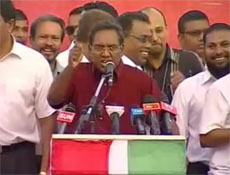
The MDP previously said that it would not look to form a coalition ahead of elections this year.  However, Saeed claimed by contract, that there was no political party interested in forming an alliance with the main opposition party of the country.

“[The MDP] are only getting the opportunity to work in a coalition within the parliament. Therefore, MDP is seen to work in collaboration with other parties in parliament. They don’t have a problem working as a coalition in parliament. But outside the parliament, they keep saying that they do not want a coalition. This is because, they really don’t have anyone to form a coalition with,” he said.

Speaking during a recent party gathering, former President Nasheed stated that leaders of various political parties had learned “bitter lessons” over the difficulties of running a government by sharing cabinet positions among different political parties over the last four years.

“A cabinet in which one minister belongs to this party and another belongs to that party, cannot run a government,” he said. “I want the people of this country to remember that, when there is word of coalition, it means of forming a weak government.”

Meanwhile, Chairperson of the MDP, MP Moosa ‘Reeko’ Manik echoed similar sentiments claiming that the MDP could not work with political parties demanding political positions as a pre-condition of any alliance.

“There is no place in the MDP for those who come to us and demand a package of four cabinet positions, 12 judges, three warehouses and the Maldives Monetary Authority (MMA). But it doesn’t mean all doors are closed for those parties interested in working under a common political ideology,” Manik said at the rally.

Political weight

Saeed this month also criticised former President Gayoom’s Progressive Party of Maldives (PPM).  The PPM is fielding Gayoom’s half brother MP Abdulla Yameen as its presidential candidate.  Saeed claimed that even Yameen should be backing President Waheed instead of the other way round.

Dr Saeed alleged that Yameen was a candidate who was too “hard to sell” to the public, claiming there remain a number of unpleasant “characteristics” that came to the minds of voters about him.

“Yameen will face the anger of anyone who hated Gayoom’s 30 years [in power]. Yameen will get the hatred of every person who was tortured during Gayoom’s time. He would not get the support of anyone who wished to leave the past. Even the person who wishes to support Yameen would hate him because Gayoom is right beside him,” he told Haveeru.

“There are a lot of people who hate dynastic rule.  A lot of businessmen also suffered during Yameen’s tenure as the trade minister. So they would have a hard time to back him.”

Saeed’s remarks in local media were met with harsh criticism from PPM MP Shifag Mufeed, who described the DQP leader as someone that lacked any political weight.

“The Maldives has two political ideologies. It is that of former President Gayoom’s ideology and that of former President Nasheed’s. Though he says that no one would join those two ideologies, Dr Hassan Saeed himself must know that he does not even have the weight of a wheat grain in Maldivian politics,” Mufeed said in parliament yesterday (April 15).

Shifag also slammed the government of President Waheed, claiming that a bill proposed to parliament on increasing an existing Airport Service Charge was an attempt by the government to recklessly increase its income so that it could be utilized in “fooling people” to vote for him.

The PPM and DQP are both members of President Waheed’s national unity government.

Saeed’s election history

After facing defeat in the first round of the 2008 presidential elections, Saeed publicly announced unconditional support to the MDP candidate Mohamed Nasheed during the subsequent run-off election.

Once Nasheed was elected president, the MDP alleged that Saeed took a U-turn on his own unconditional backing and had demanded several cabinet portfolios for his supporters.

Saeed was later appointed as the special advisor to the president – a cabinet minister level position – in the new government.  Meanwhile, Saeed’s running mate, Dr Ahmed Shaheed, was appointed as the Foreign Minister and current Home Minister Mohamed Jameel Ahmed was given the cabinet portfolio of Communication and Civil Aviation.

However, following a falling off with Nasheed, Saeed left the government claiming that his “diligent” advice was not considered by the former president.  Later, Jameel was sacked from the government and Shaheed joined forces the MDP.

Leaving the government, Saeed and his fellow party colleague Jameel quickly turned against former President Nasheed and became outspoken critics of his administration.

‘Hate-pamphlet’ scandal

In January 2012, just a few days before the controversial fall of Nasheed, DQP released a 30-page pamphlet accusing Nasheed’s government of working under the influence of “Jews” and “Christian priests” to weaken Islam in the Maldives.

“When the Nasheed administration established diplomatic relations with the biggest enemy of Islam [Israel], the government agreed to change the school curriculum and teach our small children about the goodness of Jews,” read the pamphlet. “The Jew’s plan and way of thinking is to divide Islamic countries.”

The Nasheed administration denied the allegations and claimed that the pamphlet was filled with “extremist, bigoted and hate-filled rhetoric” intended to incite hatred among public towards the government.

Following President Waheed’s controversial ascension to power on February 7, 2012, Saeed was reappointed as the Special Advisor for the President while his colleague Jameel was given the position of Home Minister.

Likes(0)Dislikes(0)

Hiking airport service charge to US$30 narrowly rejected at parliament

Legislation proposed by the government to raise the airport service charge from departing international passengers to MVR460 (US$30) was narrowly rejected by parliament today.

The amendment bill submitted by government-aligned MP Riyaz Rasheed was rejected with 28 votes against, 27 in favour and two abstentions.

At the parliamentary debate on the bill yesterday (April 15), MPs of the opposition Maldivian Democratic Party (MDP) and government-aligned Progressive Party of Maldives (PPM) opposed the proposed hike.

MPs of both the majority and minority parties alleged that President Dr Mohamed Waheed planned to use an expected MVR185 million (US$12 million) from raising the departure tax to finance his presidential campaign.

The 1978 law imposing the airport service charge on departing passengers was first amended under the previous administration and raised to US$18.5 for foreigners.

The imposition of a similar Airport Development Charge (ADC) of US$25 by Indian infrastructure group GMR was previously a major point of contention for the Waheed administration, which terminated the concession agreement with the GMR-led consortium to modernise the airport in December 2012.

Hiking the airport service charge from US$18 to US$30 was among a raft of measures proposed by the Finance Ministry within the estimated 2013 budget to raise MVR 1.8 billion (US$116 million) in new income.

Finance Minister Abdulla Jihad told MPs in December 2012 that additional revenue was needed to finance the fiscal deficit and rein in soaring public debt, which was projected to reach MVR 31 billion (US$2 billion) or 82 percent of GDP by the end of 2013.

On January 29 this year, the cabinet decided to impose austerity measures to manage the budget following revenue shortfalls.

“Members of the cabinet noted that, by late this year, the country might have to face enormous challenges unless strict budgetary control measures were not implemented,” the President’s Office said at the time.

During the budget debate in December 2012, Majority Leader MP Ibrahim Mohamed Solih warned that the additional revenue projected in the budget was unlikely to materialise.

The MDP parliamentary group leader noted that most of the proposed measures – such as hiking the Tourism Goods and Services Tax (T-GST) to 15 percent, introducing GST for telecom services, and “selectively” reversing import duty reductions – required parliamentary approval.

Acting Finance Minister Ahmed Mohamed was unavailable for comment today on the impact to government finances from the loss of projected revenue.

Fiscal responsibility

Meanwhile, legislation on fiscal responsibility submitted in 2011 by the previous government was passed with 42 votes in favour and 10 against at a sitting of parliament on Monday (April 15).

If the bill is ratified, the government would be prohibited by law from obtaining loans after January 1, 2016 to finance recurrent expenditure or loan repayment.

The bill also sets limits on government spending and public debt based on proportion of GDP, mandating the government to not allow public debt to exceed 60 percent of GDP.

Borrowing from the central bank or Maldives Monetary Authority (MMA) should not exceed seven percent of the projected revenue for the year, while such loans would have to be paid back in a six-month period.

Moreover, a statement outlining the government’s mid-term fiscal policy must be submitted annually to parliament at the end of the financial year in July.

Likes(0)Dislikes(0)

Civil Court orders Islamic Ministry to reconsider Hajj group selection

The Civil Court has ordered the Islamic Ministry to reevaluate the proposals of four groups it previously rejected from arranging Hajj pilgrimages to Saudi Arabia this year for Maldivians.

The court ruled that the tenders of Al-manasik Private Limited, Al-fathuh Hajj And Umra Group, Al-Safa Private Limited and Classic Hajj And Umra Private Limited, should all now be reviewed by the country’s religious authorities.

The case was filed at the Civil Court by the four Hajj groups, which claimed that the Islamic Ministry had failed to comply and follow the correct procedures in selecting local companies to take Maldivians to Saudi Arabia.

The Civil Court ruled that the Islamic Ministry had followed the correct procedures in its decision to reject the tender proposals submitted by the four groups.

State Islamic Minister Mohamed Didi today confirmed to local media that a decision had already been taken to appeal the ruling at the High Court.

Didi also claimed that the Islamic Ministry had already divided the Hajj quota among eight groups, adding that any changes would create more problems for pilgrims.

On Sunday (April 14), Didi expressed concern to Minivan News that Maldivians might not be able to make the Hajj pilgrimage this year if the court case contesting the ministry’s choice of eight groups was not resolved in time.

The Civil Court issued a stay order or temporary injunction (Dhivehi) on Thursday (April 11), instructing the Islamic Ministry not to proceed with the chosen Hajj groups pending a ruling on the legality of its selection process.

Didi said at the time that the Islamic Ministry would soon have to sign an official agreement with the Saudi Arabian government to finalise the approved Hajj Groups.

“We have already sent the names of Hajj Groups that we have allowed and the Saudi government will call us to sign the agreement any moment now.  If we had to say no we can’t sign the agreement because we are not sure these Hajj Groups would be able to take people to Saudi Arabia this year as planned, then the Saudi government might not give us another chance,” Didi explained.

Likes(0)Dislikes(0)