This article was first published on Dhivehisitee. Republished with permission.
With former President Mohamed Nasheed taking refuge at the Indian high Commission in Male’, the international community’s strange apathy towards the ongoing fight for democracy in the Maldives has been stirred, if not entirely shaken. As Male’ waits to find out how India will respond to the Maldivian government’s request to hand Nasheed over to the police today, it is worth looking at the intricacies of small island politics where personalities loom large. What is at stake, and equally importantly, who are the players?
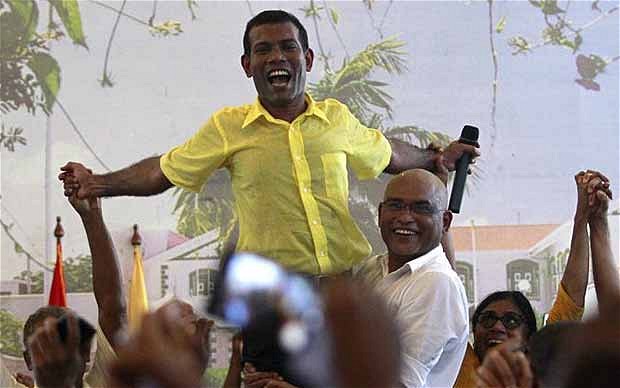
Mohamed Nasheed, the first democratically elected president of the Maldives, is holed up in the Indian High Commission in Male’. Seeking refuge in Indian diplomatic premises was a smart move by the former president, a veteran democracy activist. It not only provided him sanctuary and forced India’s involvement, it also provided India – smarting from Male’s recent insults and shabby treatment of GMR — with the opportunity to do a policy U-turn without embarrassment.
Nasheed has now been at the Indian High Commission for a week. If he leaves, his next long-term residence is most likely to be the prison island of Dhoonidhoo. The current government is prosecuting Nasheed for arresting Chief Judge of the Criminal Court, Abdulla Mohamed, in January 2012, a month before the coup. The pursuit of Nasheed through the courts began in July last year. Several summons and arrest warrants have been issued, cancelled and enforced since. In October last year, the police made a deliberately high profile arrest of Nasheed while campaigning on an island far from Male’. The last arrest warrant, issued on Monday, five days after Nasheed took refuge at the High Commission, expires at 4:00pm today.
Nasheed, an Amnesty prisoner of conscience who spent several years in jail for dissent, has said the prosecution is politically motivated. The purpose, he says, is to ensure he cannot run in the presidential elections scheduled for 7 September. Any sentence will disqualify him from the race. If Nasheed is prevented from running, there will be unrest like the country has never before seen. He is loved by many, more than he is loathed by coup-makers and their supporters. His Maldivian Democratic Party (MDP) has over 47,000 members, and they are all ardent supporters.
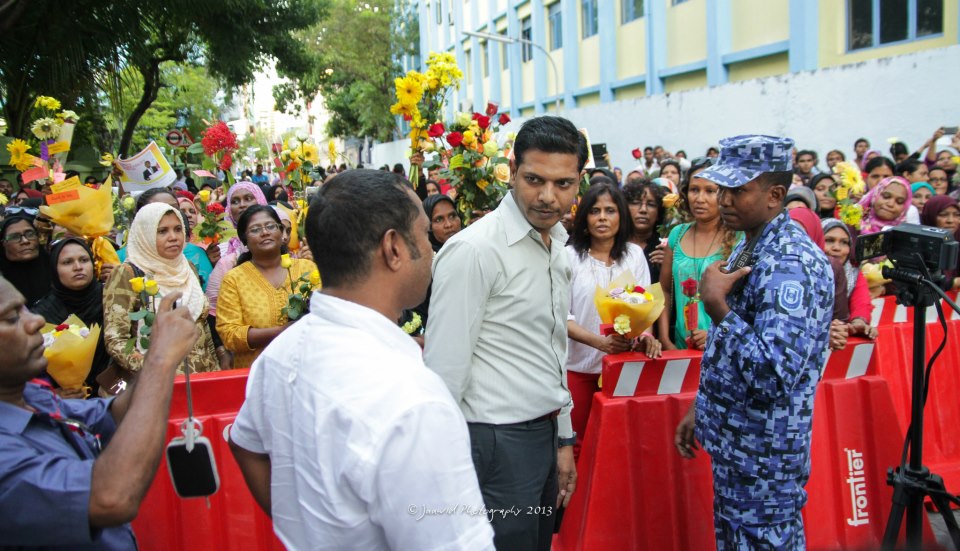
Since Nasheed sought refuge, several ‘delegations’ from various constituencies have presented him with bouquets, some wrapped in silk, almost on a daily basis. Yesterday they brought him bouquets, or at least tried to, until the police blocked their way with barricades.
Nasheed had been ‘the people’s president’, mingling with the young, the old, the rich and the poor with equal ease. When he takes to the streets, they follow him. Now, sensing he is in danger, they march on the streets of Male’ every evening, calling for his protection. Several have stated — with all seriousness — that Nasheed can only be taken into custody over their dead bodies. At an MDP press conference in Colombo, Sri Lanka, yesterday, former Foreign Minister Mohamed Naseem announced the party would boycott the elections if Nasheed is prevented from running under any pretext. That is close to 50,000 people, a large chunk of voters among the 350,000 population who would not participate in the election.
Mohamed Waheed Hassan Manik, the current president, along with a group of nameless men “all… of the same level” who now rule the country, meanwhile, are depicting Nasheed’s presence at the Indian High Commission as a ploy to avoid facing the charges against him. Waheed said he was “dismayed” Nasheed remained at the Indian High Commission, instigating “street violence”, his view of the nightly demonstrations by Nasheed’s supporters.
Waheed used to be Nasheed’s Vice President but, when offered the presidency by coup-makers in January, promptly betrayed Nasheed and hastened to take oath as President of the Maldives. A PhD graduate from Stanford University with a long career in the United Nations, he was seen by the international community as someone who would ‘stabilise’ the volatile atmosphere created by the coup.
He has since aligned himself closely with the ideologies of the Islamist Adhaalath Party, overseen curtailment of several fundamental civil and political rights, disregarded blatant human rights abuses by security forces, and partaken in the xenophobic and nationalistic campaign to oust India’s GMR. Waheed loves Twitter, has intimate personal chats in public with his family on various social media and, although seemingly composed and calm most of the time, can surprise with fist-pumping, rebel-rousing speeches when excited.
Unlike Nasheed, Waheed has very few supporters. His party has just over 3000 members with no representation in parliament. It is a common joke that his supporters consist of his wife Ilham, his children, and one loyal advisor (among two). He recently launched his presidential bid at his wife’s house, but is yet to reveal whether he will compete as an individual or form an alliance with someone else. With so few supporters, and lack of potential allies, he has very little hope of winning, especially with Nasheed in the race. Based on past and present behaviour, it is clear that he would gladly participate in any political prosecution of Nasheed.
Waheed is not the only one. All of the presidential candidates would like to see the back of Nasheed. Former President Maumoon Abdul Gayoom, who returned to the political centre-stage after the coup, has said he is “embarassed” by Nasheed’s decision to take refuge at the High Commission. He must also feel frustrated. Gayoom and his fellow authoritarians’ control over the Maldives’ judiciary is now well exposed and often discussed. If Nasheed can be brought to court, all three judges, hand-picked from among the worst on the bench, would arrive at a guilty verdict with ease. They would impose a hefty sentence.
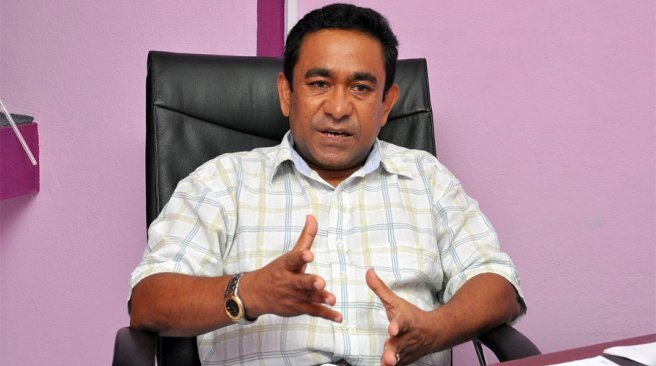
With Nasheed inside the Indian High Commission, international law has got in the way. Gayoom’s party, PPM, has not yet decided on their presidential candidate. Would it be Gayoom the septuagenarian? His politically active daughter, currently State Minister for Foreign Affairs, Dunya Maumoon? His brother Abdulla Yamin, against whom there are corruption charges amounting to US$800,000? One of Gayoom’s two sons? With Nasheed in the race, the times ahead will be tough for any member of the family. With him gone, the field is wide open.
Gasim Ibrahim and Ahmed Thasmeen Ali are also in the running. Gasim is one of the richest men in the country. He has shares in almost everything that makes money from five star hotels to the humble onion. He owns not just several resorts but a fleet of assorted vessels, an airport, and a hefty reputation for being a womaniser. Gasim never attended school (and is one of the country’s worst public speakers), but was recently awarded an honorary doctorate in entrepreneurship from the Open University of Malaysia in recognition of his mega-tycoon status.
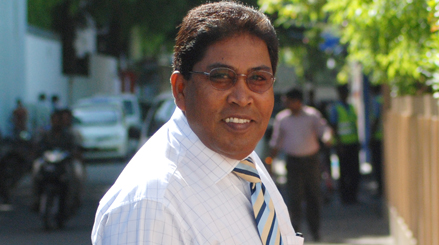
Gasim invests heavily in education, although his reasons for doing so are often far from altruistic. Attending one of his schools means towing his Jumhooree Party line – student and staff alike. He provides scholarships and loans for university education abroad for many, several of whom then enter into a life-long relationship of patronage with him. He recently described the power relations between him and the people as that of “master and servants.” Although without any training or experience in law or even a remotely related discipline, he now sits on the Judicial Service Commission (JSC), the chief overseer of the judiciary. Many of Nasheed’s supporters have asked: how can Nasheed have a fair trial when Gasim, his rival in the presidential race, sits in the JSC with its control over the judiciary?
Thasmeen’s party, the DRP, was Gayoom’s party before Gayoom split and formed PPM. While some maintain that DRP is ‘more democratic’ than PPM, with Thasmeen at the helm, the party participated in — and condoned — events of 7 February that ended democratic governance. Unlike his competitors – Nasheed, Gasim, Gayoom (or whoever Gayoom anoints from the shortlist) all of whom generate intense emotions among people – Thasmeen is mostly regarded with indifference. He rarely makes headlines, and is often discussed among rival supporters and democracy activists in relation to unpaid debts of millions owed by a family business.
DRP itself, however, still has a significant number of supporters. Last December Gayoom’s PPM overtook DRP in numbers to become the second largest party, but two days ago, DRP once again became the second largest party with 22,687 members. But, there is only a difference of 64 members between the two parties. The truth is, there is little that differentiates members of the two parties — some support PPM because it’s Gayoom’s, and others support DRP because it was Gayoom’s. Unlike Gayoom’s embarrassment and Waheed’s dismay, Thasmeen was “saddened” by Nasheed seeking refuge. Just like them, however, he sees Nasheed’s act as “unnecessary”, and a ploy to evade justice.
Apart from the candidates, there are also several petty chiefs who would like Nasheed behind bars. Several of them, frighteningly, work in law enforcement. The Defence Minister Mohamed Nazim, Police Commissioner Abdulla Riyaz, and Minister of Home Affairs Mohamed Jameel Ahmed, for example. All of them would love it if Nasheed simply disappeared.
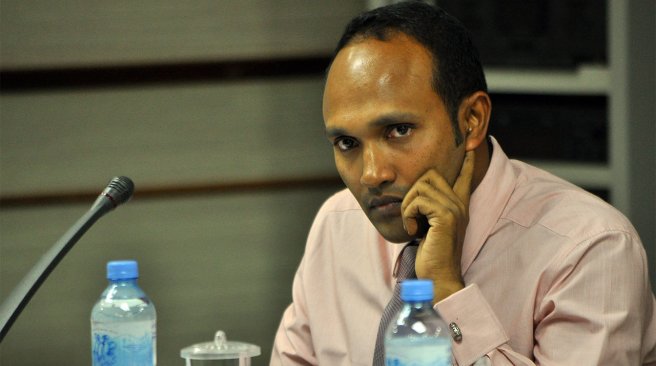
Jameel, the Home Minister (also present during the police mutiny on 7 February), is from the island of Fuammulah, an atoll unto itself, located furthest south of Male’. Jameel has a PhD in Law from London’s SOAS University, but has a shockingly tenuous grasp of the fundamentals of democracy, even rule of law. Jameel is known to have a vicious temper, having flown off the handle in public on several occasions, earning him the nickname Angry Bird. It would not be an exaggeration to say Jameel hates Nasheed.
In a pamphlet he co-authored with Hassan Saeed (with whom heads the Dhivehi Qaumee Party (DQP), another small party of little consequence) he accuses Nasheed of attempting to undermine and destroy the Islamic faith in the Maldives. Saeed is Jameel’s long-time friend (they live in the same apartment building) and he is also one of Waheed’s special advisors (the disloyal one). Nasheed had Jameel arrested for defamation after the ‘hate-pamphlet’ was published, but Criminal Court Chief Judge Abdulla Mohamed (the same judge for whose arrest Nasheed is currently being prosecuted for), released him.
For Jameel, it is payback time. Having Nasheed arrested and prosecuted before the elections is imperative, he has said. On Monday, Jameel told Times of India that “I would be the happiest person to see Nasheed contest and lose.” Jameel’s two fantasies are mutually exclusive, but will end with the same desired climax: Nasheed will not be President again.
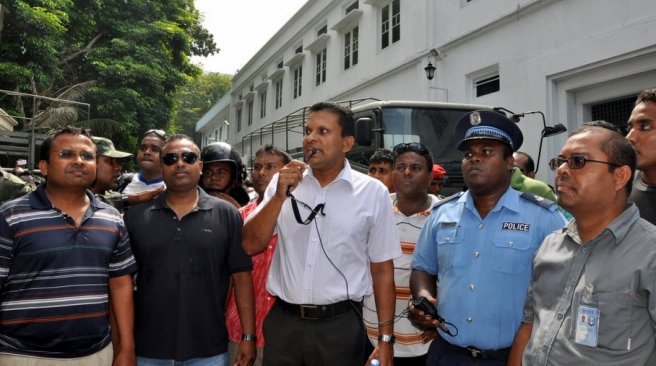
Nazim the Defence Minister and Abdulla Riyaz the Police Commissioner fear that should Nasheed be re-elected they, and not Nasheed, would be heading to Dhoonidhoo. Nasheed has called them traitors and openly declared his intention to prosecute them, if he is re-elected. They, with the current state minister for Home Affairs Mohamed Fayaz, commandeered the security forces during the police mutiny on 7 February 2012. To avoid jail time, they must imprison Nasheed. All three lost their positions during Nasheed’s government, and all bear personal grudges.
Is Nasheed’s life in danger?
Yes, says all Nasheed’s supporters. Last week, pro-MDP TV channel, Raajje TV, aired a video that was all the confirmation they needed. Nasheed, less then 24-hours after he resigned, was being brutally manhandled by a squad of about twenty policemen. They are all dressed in full riot gear. One of them has the former President, their Commander in Chief only a few hours previously, by the collar, hand across throat. In a move that supporters have likened to the movements of Neo, the protagonist in Hollywood hit movie The Matrix, Nasheed is seen sliding away from their grasp and fleeing for his life.
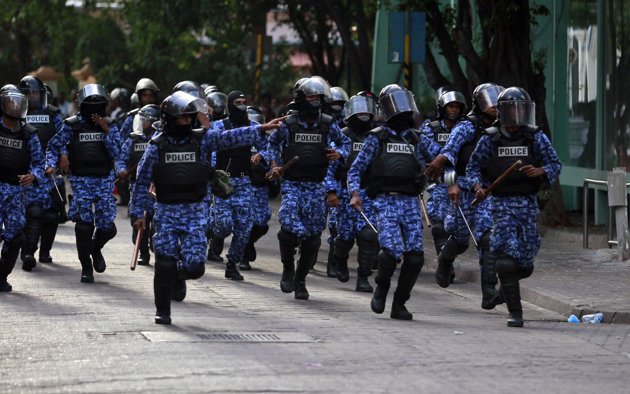
The policemen after Nasheed are members of an ‘elite’ squad named Special Operations or SOs. These are the same men who led the police mutiny on 7 February. According to the CoNI testimony of Nasheed’s police Commissioner, Ahmed Faseeh, the SOs’ origins explained their present: They were the ‘Star Force’, put together in a rush to control the uprisings in 2004 against Gayoom’s dictatorship.
To sum up his description of the squad, most SOs are men recruited into the police straight from the streets, given muscle enhancing substances (suspicions focus on steroids), made to pump iron, taken to intensive training in a foreign country, and brought back home for the sole purpose of ‘crowd control’. Then, as now, according to Fasyh, they were a tough squad to control. Back under Nazim and Riyaz, the SOs have happily reverted to form, taking up pre-democracy tactics of violence and brutality with ease and abandon. And, as seen in the video, they have no respect for Nasheed, or his life.
All things considered, is Nasheed’s prosecution politically motivated? Yes. Apart from all the reasons above, the current regime has failed to implement any steps recommended by the international community to reform the judiciary. Judge Abdulla Mohamed, whom Nasheed arrested citing national security, and against whom their are many allegations of misconduct and criminal activities, not just remains on the bench as the Chief Judge of the Criminal Court, but is also a part of the regime’s inner circle, attending government functions and officiating at various events.
Questions remain over the legality of the Hulhumale’ Court where he is to be tried, and all calls to redress Article 285 of the Constitution have been willfully ignored.
Justice appears to have very little to do with the impending prosecution.
Dr Azra Naseem has a PhD in International Relations
All comment pieces are the sole view of the author and do not reflect the editorial policy of Minivan News. If you would like to write an opinion piece, please send proposals to [email protected]
Likes (1)Dislikes
 (1)
(1)
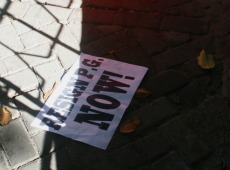 As the time of the hearing neared, around 200 MDP supporters gathered outside the party office on Sosun Magu before moving to the Prosecutor General (PG)’s Office demanding the PG withdraw the charges against former President Nasheed.