Preliminary PPM primary results roll in

The ruling Progressive Party of the Maldives (PPM) has announced preliminary results for eight constituencies in Malé in ongoing primaries to determine candidates for the People’s Majlis election.

The governing coalition had allocated 49 out of 85 seats for the PPM. Candidates in 13 constituencies won the party ticket by default, and an additional five candidates were awarded the ticket after their contenders failed to gain more than 75 percent in the vetting process.

The PPM is to hold primaries for the remaining six constituencies today.

In Malé, state owned Maldives Broadcasting Corporation’s (MBC) reporter that Aishath Liza won the ticker for the Medhuhenveiru constituency. Film producer and writer Fathimath Nahla defeated footballer Ali Umar to win the ticket for Machangoalhi Uthuru.

TV presenter Aminath Namza lost the Galholhu Uthuru constituency to Maheel Ali Jaleel.

Deputy Minister of Youth and Sports Ahmed Rifau ‘Bochey’ won the Maafannu Dhekunu ticket against footballer Shah Ismail.

Asma Rasheed won the Maafannu Medhu constituency against Deputy Home Minister Mohamed Hanim – Asma is the mother of Minister of Presidential Affairs Mohamed Hussein Shareef.

Former goalkeeper of VB Sports Club Mohamed Sinan won the Maafannu Hulhangu ticket, while Hassan Ziyath won the Hulhuhenveiru ticket. Abdulla Shinan won the Machangoalhi Dhekunu primary.

The PPM is yet to announce results for 17 constituencies, but results circulating on social media indicate incumbent MP for Thimarafushi constituency Mohamed Shareef successfully defended the party ticket.

However, MP Mohamed Rasheed (Matrix Mode) who recently defected from the opposition  to the PPM appears to have lost the Addu City Hithadhoomedhu ticket to former MP ‘Hiyalee’ Mohamed Rasheed.

In southern Addu city, Ali Ibrahim won the Hithadhoo Uthuru ticket and Mohamed Shahid won the Hulhudhoo ticket. Ali Ibrahim won the ticket for Hithadhoo Uthuru.

The Fuvahmulah Atoll Council President Ali Fazad won the Fuvahmulahmedhu ticket.

PPM lawyer Mohamed Waheed won the ticket for the Kaafu Atoll Thulusdhoo constituency against Deputy Minister of Youth and Sports Naif Shaukath.

Mohamed Latheef won the Gaaf Dhaal Atoll Faresmathoda constituency against Deputy Home Minister Ahmed Siddiq. Saud Hussein won the Gaaf Alif Atoll Villingili ticket and Abdulla Mohamed won the Gaaf Dhaal Madaveli primary.

Ahmed Thoriq won the Felidhoo ticket while Jameel Usman won the Gemanafushi ticket. Abdulla Nazim won the Hinnavaru ticket and Jaufar Dawood won the Raa Atoll Ungoofaaru ticket.

The JP has assigned candidates for all 28 seats without primaries. All eight incumbent MPs as well as former Commissioner of Police Abdulla Riyaz have received the party ticket.

The MDA held primaries in late January for two of the nine constituencies reserved for the party. The party ticket was awarded to two incumbent MPs and a further two candidates won the ticket by default.

The religious conservative Adhaalath Party has also announced it will field five candidates in constituencies reserved for the JP.

The AP has condemned the coalition’s decision to exclude the party from the constituency allocation.

Likes(1)Dislikes(0)

Voting ongoing in PPM primaries

The ruling Progressive Party of the Maldives (PPM) has begun primaries for 25 parliamentary constituencies today.

Voting is proceeding smoothly in Malé at Dharubaaruge, Thajuddeen School, Malé City Hall and the PPM’s ally Maldives Development Alliance (MDA) party offices, PPM Secretary General Mohamed Zuhair said.

Over 2,700 members had registered to vote in Malé, Zuhair said, adding that the only complaints the party had received so far related to registration.

Parties in the ruling coalition allocated 49 of the 85 People’s Majlis seats to the PPM, 28 seats to the Jumhooree Party (JP) and nine seats to the MDA.

The party ticket was initially awarded to 13 candidates due to a lack of contestants. The 13 included eight incumbent MPs.

Over 150 candidates applied to contest the remaining 36 constituencies. But only 92 candidates were chosen for the primaries.

Applicants were graded on a six point criteria that included the extent to which candidates uphold party ideology, the length and type of service to the party, experience in parliament and participation in the presidential campaign.

Only candidates who received over 75 points were allowed to contest.

Five candidates – including four incumbent MPs – were awarded the party ticket on Friday after their competitors failed to meet the 75 percent threshold.

The PPM said it will hold primaries for the remaining six constituencies tomorrow.

Vilimaafannu MP Ahmed Nihan who won the party ticket by default said some members had complained of the party leadership favoring one candidate over the other.

“Holding primaries is not easy. For any party. But I do not expect any major issues,” he said.

Meanwhile, local media have reported conflict has emerged between the PPM and MDA over the Gahdhoo constituency. The seat was initially allocated to the MDA, but the party decided not to field a candidate and to instead back incumbent MP Zahir Adam.

Zahir was recently suspended from opposition Maldivian Democratic Party (MDP) after he violated a three-line whip and voted for President Abdulla Yameen’s cabinet in December.

Following MDA’s decision not to contest the Gahdhoo constituency, PPM called for applicants for primaries. According to local media, the MDA has ordered the PPM to retract the announcement.

Polls will close at 10:00pm tonight.

Applications must be submitted to the Elections Commission by February 11. Parliamentary elections are set for March 22.

Likes(1)Dislikes(0)

Week in review: February 1 – 8

The last week’s headlines were dominated by the stabbing of Maldivian Democratic Party (MDP) MP Alhan Fahmy in a Malé cafe.

After flying to Sri Lanka for prolonged surgery to repair spinal damage, the Feydhoo constituency MP’s family revealed he will face a hard struggle if he is to regain the full use of his right leg.

The attack was swiftly condemned both internationally and domestically, with fellow MP’s pointing the finger at local gangs and their political paymasters.

Despite his attack, Fahmy remained determined to contest in the Majlis primaries, despite the MDP refusing to hold a re-vote in the Feydhoo party primary. After losing the poll, Alhan had questioned the fairness of proceedings and will now contest as an independent.

Controversy also accompanied a number of other MDP primaries, with  Kendhoo constituency candidate Mauroof Zakir considering a legal response to what he considered to have been irregularities stemming from the party’s abandoned polls in late January.

Kaashidhoo incumbent Abdulla Jabir, meanwhile, retained his place on the party ticket after the MDP’s disciplinary committee found party regulations did not permit his removal, despite his repeated defiance of the whip.

The MDP’s talismanic leader, Mohamed Nasheed, this week told Minivan News he was confident in the transparency of the polls. Discussing the two years since his removal from the presidency, he noted that the current governing coalition would struggle to provide political stability.

Following the completion of its primary races, Nasheed revealed that his party’s legislative agenda for the 18th Majlis would include strengthening local government, reforming the judiciary, and eliminating barriers to development.

Nasheed’s doubts over the unity of the current coalition appeared well-founded this week as the religious Adhaalath Party announced it would be openly competing with the Jumhooree Party (JP) in five parliamentary constituencies, while talks with the Progressive Party of Maldives (PPM) continue.

The PPM’s selection of candidates for the poll continued, after party members in Maavah constituency, Laamu Atoll, demonstrated against the apparent award of the ticket to the current member without a primary.

After assigning 13 of its 49 places on the ticket without contests, the PPM is holding primary polls for an additional 27 seats today (Saturday 8), with the method of allocation for the remaining 9 yet to be decided.

Progressive coalition partner the JP meanwhile concluded selections for its 28 allocated constituencies, which includes eight incumbent MPs and new member Abdulla Riyaz – former commissioner of police.

One person who is unlikely to be standing in the March 22 polls is Dhivehi Rayyithunge Party MP Dr Abdulla Mausoom. As Minivan News’ series of interviews with MPs continued, Mausoom described the occupation as no longer “savvy”.

Legal interpretations

The Majlis continued to hold special sessions this week to help the government raise revenue to meet its 2014 budget commitments, including the reintroduction of tourist bed tax and the raising of T-GST in November. Changes to current import duties were also passed.

Following the Criminal Court’s continued recalcitrance after the Majlis’s failure to approve a new prosecutor general, the Chief Justice this week suggested that parliament take some time during the current emergency sessions to resolve the issue.

PPM MP Ahmed Mahloof also suggested that he would submit a motion to the house, calling for a public referendum on the death penalty to be held alongside the parliamentary elections.

Asked about the practice of female circumcision this week, Figh Academy Dr Mohamed Iyaz Abdul Latheef endorsed the practice, citing several hadiths which he felt made clear the obligatory nature of this procedure.

Elsewhere, local heritage group REVIVE announced it would be considering legal action after a centuries old mosque in Malé was demolished to make way for a modern replacement.

Finally, as crime figures in the country revealed a huge spike in cases of theft and robbery, a local drug lord appeared to have evaded punishment, leaving for Sri Lanka part-way through an 18 year sentence.

Likes(3)Dislikes(0)

Lost diver found dead at 100 meters

A diver reported lost on February 4 has been sighted at 100 meters off the coast of Kaafu Atoll Villingili Island.

The Maldives National Defense Forces (MNDF) said it is currently holding discussions with expert foreign and local divers on retrieving Mohamed Jameel’s body.

Mohamed Waseem was among the last to see Jameel alive. Waseem told local newspaper Haveeru that he had noticed Waseem diving to an unsafe depth and had cautioned him not to do so.

Jameel, Waseem and a third man had been diving to catch live fish at the time.

Likes(1)Dislikes(0)

MDP and Adhaalath fined MVR 5000 over fraudulent membership forms

The Elections Commission has fined religious Adhaalath Party and opposition Maldivian Democratic Party MVR5000 (US$324) for submitting fraudulent membership forms.

According to the EC, the two parties had submitted membership forms where one individual had put fingerprints on different forms.

In January, the EC fined the ruling Progressive Party of the Maldives and its ally the Jumhooree Party for submitting membership forms on behalf of deceased people.

Likes(0)Dislikes(0)

MDP candidates submit applications for the parliament

Candidates contesting the People’s Majlis election on the opposition Maldivian Democratic Party (MDP) ticket have submitted their applications to the Elections Commission (EC) today.

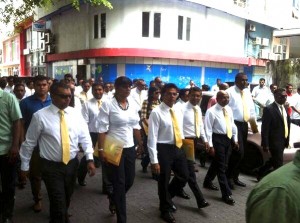
Candidates walked with former President Mohamed Nasheed from the party’s headquarters in Henveiru Ward to the EC offices in Maafannu Ward in Malé.

According to the MDP, 84 of the 85 candidates submitted their forms today.

Nasheed said he believed the MDP would win a majority in the parliamentary elections scheduled for March 22. He also said he believed candidates who had lost in the primaries held in late January were backing the winners.

Today, the MDP retracted the party ticket from Ubaidhulla Muaz who had gained the ticket for Haa Dhaal Atoll Nolhivaram constituency by default after he “refused to cooperate” with the MDP campaign.

The MDP has opened up a call for new applicants and awarded the ticket to the sole contender Ali Arif, who had previously contested and lost the party primary for Henveiru Dhekunu constituency.

The MDP held primaries to determine candidates for 56 constituencies in late January. The party ticket was awarded to 29 candidates by default due to a lack of contestants.

Likes(0)Dislikes(0)

President ratifies revisions to tourism and tax legislation

President Abdulla Yameen has ratified revisions to the Maldives Tourism Act and the Goods and Services Act today.

The amendments were passed at an extraordinary sitting of the People’s Majlis and will allow the government to hike Tourism Goods and Services Tax (T-GST) from 8 to 12 percent starting in November this year.

The US$8 bed tax will restart in February and will continue until November. The government will also be able to collect resort lease extension fees in a lump sum within two years.

The Finance Ministry had initially estimated that new revenue-raising measures would bring in MVR3.4 billion (US$224 million).

However, amendments were not passed as per the ministry’s proposals, and Finance Minister Abdulla Jihad has said “numbers will not match” in the budget.

Additional revenue raising measures include levying a 6 percent tax on telecommunications, increasing airport departure fees to US$25, leasing out 12 islands for resort development, and revising import duties.

Likes(0)Dislikes(0)

Q&A: Former President Mohamed Nasheed

With two years having passed since his controversial removal from power, Mohamed Nasheed – Maldivian Democratic Party (MDP) figurehead, and runner-up in November’s presidential election – speaks with Minivan News about past controversies, the present government, and the future of Maldivian democracy.

Daniel Bosley: Looking back, what do you feel are the long-term effects of February 7 – on yourself personally, as a politician, and on the MDP?

Mohamed Nasheed: It’s not so much on what I have personally experienced but I think if you look at what has happened to the country after  the forceful transfer. We had in 2008 amended the constitution after a very very long period of single party dictatorial rule. One of the main difficulties in Maldives politics has been transfer of power – the peaceful transfer of power. In the past, transfer of powers have been mostly violent. It’s always surrounded by an aura of illegitimacy, irregular or all kinds of conflict. In some instances, former presidents are murdered, and in others they are banished or send into exile, so the transfer of power has always been an issue for us, and one of the main reasons for the 2008 constitution was to provide for a transfer of power.

If you have a look at the first constitution of the Maldives in 1932, even then the main reason for that constitution was to see who would assume power after the sultan at that time – Shamsuddeen – would it be his son or someone else. So, while transfer of power has been so fundamental – so important – for our stability and for our development, and while the constitution aims at providing a mechanism for that transfer, in 2012 we saw the state being very violently challenged and the transfer being very forcefully done.

What therefore that leads to – especially when the international community legitimised that transfer – it looks like it is normal. Now, come mid-term, any other group of politicians or any other group of people can again attempt to transfer power because apparently this is legal. I think that because that transfer was legitimised, that this is going to crop up in our political life on and on and on again.

DB: As a historian yourself, how do you feel the last two years will be viewed by future generations in terms of the country’s history?

The two years of [Dr Mohamed] Waheed’s coup government and then the interference of the Supreme Court in the election process, and therefore the ability for them to consolidate power through the facade of the ballot box, has of course installed them in power. But I would still argue that this is fairly temporary. I wouldn’t see this as having achieved long-term stability. This is very early in the day and we can now already see the cracks. [President Abdulla] Yameen with 25 percent of consent would find it very difficult to rule – it’s not going to be possible. And the idea that an alliance of Yameen and Gasim and Adhaalath can be maintained is I think a myth, and you’re seeing this now.

We’ve always argued that this doesn’t work. Coalitions work in parliamentary systems where you can actually have ministers coming out from the parliament and therefore it’s possible to come to an arrangement. But when the cabinet is not in the parliament, an alliance doesn’t necessarily work. The shuffling or the portions given to different parties are given from the cabinet, and the cabinet is a very superficial layer on the government. The actual essence is the parliament where you make the laws.

As long as you don’t have a coalition or an understanding in the parliament then this doesn’t work. So when Yameen and Gasim and Adhaalath cannot decide on sharing all the seats they would share, I think they finds themselves in a lot of difficulties

DB: There have been reports that you ordered the withdrawal of police from the artificial beach area on February 6, as well as the removal of the MNDF cordon from Republic Square the next morning. Looking back, would you have handled things differently in the run up to the transfer?

I was getting reports of a coup from General Nilam, who was intelligence chief of the military, and he’d been reporting the coup since the end of the SAARC summit [November 2011]. Soon after the summit he wrote his first dispatch, his first intelligence reports, and he has sent a number of intelligence reports saying that this was brewing.

Now, the perpetrators of the coup, or those who were scheming it – the opposition and the judiciary were with them. We were not able to investigate General Nilam’s findings – or his intelligence reports – because the courts wouldn’t allow us to do that and therefore, although we knew that this was coming up, we found it very difficult to attend to it or suppress it without forceful means, which in the legislative framework it was almost impossible because the judiciary were hijacked by Gayoom-era judges.

Now, did I ask the police to withdraw the cordon at the artificial beach? First, in our government I don’t give detailed orders to the rank and file of the police. Neither do I do that to the military. Withdrawal of the police at that instance from there, if it was the proper thing or not? If the police hadn’t withdrawn at that instant I think – given the intransigence of the police, given that the police were scheming – the chief of police and a fair amount of us knew at the time that there were elements within the police who were in the coup scheme. So, I think that the police or anyone who was instructing the police there would know the risks of having a hostile police force trying to maintain peace between the MDP supporters and the present government supporters.

General Nilam was sending intelligence reports that were fed to the police and everyone else. The police themselves had a number of reports saying that trouble was brewing up and that this had spread into the police and the military. The extent that it had gone into military I didn’t know at that time – I didn’t think it was to that extent – but to the police, we knew it very well. Those who were in charge knew it very well and, while the police were in the scheme, to assume that they would maintain peace between MDP and the opposition – that was difficult to understand and I think they wanted the MNDF there.

DB: So, essentially, it’s diffcult to think of any way you could have handled things differently?

MN: Oh yeah, we could have shot everyone. It’s essentially very simple to suppress a public uprising, it’s fairly simple, but the question is always ‘would you want to do that’. We didn’t think this was a proper thing to do, We didn’t think there should have been a confrontation between the MDP and our opposition and it was very unfortunate that the police behaved so badly. I still believe that these people must be prosecuted, I still believe that [Mohamed] Nazim, the minister of defense, must be prosecuted.

DB: What lessons did you take from the presidential election loss – about yourself, about your party, about your country?

MN: We’d come from a very small idea – to become the leading political party in this country. When you ask me that question – let’s say this country had a very long history of democratic politics, and let’s say that those who had done the work to democratise the country had passed away and those who were facing the election at this instant didn’t have a knowledge of what happened before. Now because our changes were so recent, and it has been so substantial, it’s simply amazing how 105,000 people of this country decided that they want to change.

I would argue that the ancien regime – the Gayoom regime – lost it. With all the institutions, with everything, the vast majority of the people of this country wanted an MDP government, which would have been a more open government, which would have been more international, which would have been more tolerant, which would have departed from our normal things – far away from what any other presidential candidate would have done.

To have got that mandate – to depart from so feudal a system, I think is just very very amazing and I’m very happy about it. I think we’ve installed the MDP as a political force, as a political party that is here to stay. Gayoom’s PPM [Progressive Party of Maldives] changes – from DRP [Dhivehi Rayyithunge Party] to PPM – but here I think we have been able to maintain.

DB: The religious lobby has been another constant over the past two years’ events, and the slogans used by the now-ruling coalition played a prominent role in the election. How do you see these groups affecting Maldivian politics in the long term?

MN: Again, after all that rhetoric, 105,000 Maldivians simply decided it was rhetoric and there was nothing to it. They were loud but the fact is that they keep losing – Adhaalath party as an idea keeps losing. I think people understand their fabrications.

DB: Looking at the recent MDP primary elections, the leadership has been accused of manipulating certain primary elections to secure seats for more established members. How effect do you feel this affects the reputation of the party and the enthusiasm of its members?

MN: Elections have losers and winners, and very often losers find that they must get time to digest the defeat and therefore there’s always a tendency to blame the process. I think, given the circumstances and the facilities available to political parties such as the MDP, we did very well. We have an elections committee, which functions independently. We have a disciplinary committee and we also have an appeals committee within the party. I’ve seen these three organs functioning very well, and I think the elections were very transparent and there is nothing wrong with that – I’m very very sure of that.

We can’t do that – it’s just not possible. I can’t even tell [close associates] to do it, and then these elections are conducted by hundreds of volunteers. How in God’s name can I ring some fellow down in Maakurath and ask him to fix the ballot? It’s just not possible. It’s too decentralised and it’s too widespread for anyone to fix.

There was an issue for some candidates, with PPM members and Jumhooree Party members and Adhaalath members – previous members – being on our voter lists. Now, the party decided that anyone who joined the party before December 19 would be eligible to vote. Then, if candidates decide to bring in former members from PPM and so on, we increased our party by 16,000 people. Even if they are from other parties – we’ve found that 5000 of them are from other parties. Our experience is that more than 70 percent of them remain even if their candidate loses.

DB: Regarding relations with the new government, you have talked about the MDP acting as a responsible opposition, but also of working to impeach President Yameen. Do you consider this to be a legitimate government with which the MDP intends to cooperate?

MN: The MDP shouldn’t co-operate with any government, the MDP should only co-operate with an MDP government because we are a political party and our position is to contest the opposition – make it accountable. Making it accountable basically really means using the legal processes available to deal with the government. I think President Yameen would very much expect us to make the full use of whatever facilities and mediums are legally available for us. I am sure President Yameen wouldn’t have any other idea – it would be strange if he had any other ideas. [That] we would for instance support their cabinet, we would for instance support their policies – no, we wouldn’t do that. What we would do is we would not do anything illegal.

DB: What are your initial thoughts on the first 100 days of the Yameen presidency and his proposed policies?

MN: One [issue] was slicing the government – distributing government positions among Gayoom families and political parties. Not necesarilly so much political parties, but among their families. [Another is] the number of government positions they have come up with – how huge the government is. I think we are probably now bigger than the Kremlin. It is in fact looking more like a Mughal kingdom. A better comparison would be with Zafar – the last Mughal emperor. Zafar’s government and the number of ministers, the number of courtiers, the number of assistants, the number of everything that they had, and the number of everything that President Yameen is having to have. It’s comical. It’s not really a contentious political issue. It’s sad though because the drain is on the treasury.

We are also looking at how they have honoured sovereign contracts after the transfer of power. They said with the GMR issue, that contract was void ab initio and so on and so forth so we’ll be looking at that. We think that this government is very secretive. We were publishing government income and expenditure every week, they’ve stopped that. We were having a cabinet meeting every week, they’ve stopped that. We were having a press conference every week, they’ve stopped that. We were communicating with the public all the time, and they haven’t done that. We feel that this is a very secretive government.

How they are managing finances: it all looks like how much should we make available for businessman A, for businessmen B. Nothing for social security, nothing for the fishermen, nothing for any of the other people. Taxes keep on coming up but we think that their tax system is again taking the country back to the financial system prior to 2008. They are taking it back to Gayoom’s financial system.

They are not fulfilling any of their pledges. The projects that were ongoing through multinational finance and so on, they’ve all stopped. So we don’t think they are doing a very good job and the people have every right to get rid of them.

DB: What are your initial thoughts on the stabbing of Alhan Fahmy and the safety of politicians?

MN: It’s very dangerous and it’s very worrying. Dr Afrasheem’s murder and the police not being able to do a better job with that, and now Alhan – it’s so sad. So young and so vibrant, and with a bright political future in front of him and cut down in his prime – it’s not good.

DB: Is the MDP’s loss in the presidential election a set back for fight against climate change?

MN: We were doing a lot of international work on climate change and we don’t see that kind of commitment from the present government, and it’s unfortunate. We would like another vulnerable country to pick up the work – someone who is more concerned about these things. I’m speaking to like-minded leaders about this. I’ve just been to Abu-Dhabi for Sheikh Zayed’s future energy prize, which I have been on the jury for the last three years. I did meet a number of heads of state – like-minded people who wanted to do something about it.

DB: What does the future look like for Maldivian democracy? Will you be standing again in 2018?

I’ll be seeking election in 2018, and I think we have a bright future. But the immediate future is bleak, I would argue – it’s difficult.

Likes(0)Dislikes(0)

Chief Justice calls on Majlis to hasten PG appointment

Chief Justice Ahmed Faiz has called on the parliament to hasten the appointment of a new prosecutor general (PG).

Speaking at the inauguration ceremony of the Drug Court’s development structure, the Chief Justice noted that parliament had been conducting extra sittings to conclude unfinished work, and that it was possible to appoint a PG during one of those sittings.

The Criminal Court decided in January that it would not accept any cases submitted by the PG’s Office, and that it would halt all existing cases as the PG position had been vacant for over 30 days.

Deputy Prosecutor General Hussein Shameem today said that he was yet to receive any response from the apex court regarding an appeal for assistance in the matter, made over two weeks ago.

Faiz noted that each day that passed without a PG was a day on which he felt concern. He expressed regret that one half of the criminal justice procedure was now ineffective, and that the constitutional time frame to appoint the new PG had passed.

Furthermore, Faiz said that if the constitution mandates to do something during a specific duration of time it has to be done in that period. The constitution states that if the position of PG becomes vacant a new person must be appointed in 30 days.

Faiz presided over Supreme Court proceedings during the annulment of the 2013 presidential election first round – though the chief justice himself opposed the ruling. The delays resulting from the verdict’s guidelines subsequently led to the extension of the legally mandated presidential term of office, prompting fears of a constitutional crisis.

Speaking to Minivan News today Deputy Prosecutor General Hussein Shameem said that the Supreme Court had still not responded to a letter sent by his office complaining about the Criminal Court’s decision.

‘’We called the Supreme Court today also to ask about the response but we were unable to get a word from the Supreme Court regarding the issue,’’ he said.

He stated that it was not for him to make the Supreme Court and parliament accountable and there was nothing he could do about it.

‘’Next week we will decide what to do,’’ he added.

On November 25, former PG Ahmed Muiz submitted his resignation just as parliament was set to debate a no-confidence motion against him.

Last month, Shameem said that the laws did not prohibit the deputy from taking over the responsibilities of the PG should a new person not be appointed within the required 30 days.

He also expressed concern that there were people held in pre-trial detention who were to be kept there until their trials were concluded.

“So what do they do now, it would not be fair to keep them in there until the parliament comes back to work from recess after three months and appoints a new PG,’’ Shameem said.

On December 10, President Abdulla Yameen proposed his nephew Maumoon Hameed for the post, submitting the name to parliament for MPs’ approval.

The issue was sent to the Majlis independent commissions committee, with the group subsequently deciding to seek public opinion before sending Hameed’s name to the parliament floor. The Majlis is now on recess and will not re-commence work until March.

On January 9, the Supreme Court had ordered the Criminal Court to continue pending trials, saying that the criminal justice system must proceed in order to maintain constitutional rule.

The Criminal Court announced it would not reconsider its decision to stop accepting cases, but decided to continue with cases that were already filed at the court.

Likes(0)Dislikes(0)