WSPA, EPA raise concern over living conditions of 10-foot crocodile in children’s playground

The World Society for the Protection of Animals (WSPA) has stated that the cage used to house a crocodile in Male’ is “entirely inadequate” for an animal of its size.

Locally known as ‘Kinboo’, the crocodile was first captured back in 1998 and was subsequently caged inside a children’s play park for public entertainment.

For the last three years, the animal’s poor living conditions have caught the attention of the media, even sparking a campaign from a local school to save the animal, however nothing has yet been done to resolve the issue.

WSPA’s Wildlife Veterinary Programmes Manager, Dr Jan Schmidt-Burbach told Minivan News in a statement that the WSPA encouraged local efforts being made to relocate the crocodile to a more suitable facility.

“It is important to remember that good animal welfare is not only about the physical health of an animal, but also its mental health. As is the case with humans, the environment that an animal is living in can and does affect its mental health.”

“The ideal environment for a wild animal is its wild habitat. Based on the images I have seen, the enclosure [in Male’] is entirely inadequate to meet the needs of a wild crocodile,” Schmidt-Burbach stated.

According to captive crocodile husbandry guidelines, the wildlife expert stated that the enclosure needs to have both shaded and sunlit areas and should be a minimum of 36 square-metres.

“A majority of the enclosure should be covered in water deep enough for the animal to fully submerge itself. I estimate for this crocodile the pool should be at least one metre deep,” he added.

Cage is far too small: EPA

Director General of the Environmental Protection Agency Ibrahim Naeem made similar recommendations to the WSPA in regard to the crocodile, adding that it needs to be kept in an adequate space and is currently living in cage “far too small” for its size.

“We believe that the Maldives lacks in technical and financial capacity regarding the animals kept in captivity. Though the conditions are like that, we believe that these animals must be treated with care and killing is not an option in any case,” Naeem said.
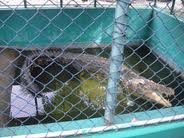
Last year, Minivan News reported that the crocodile was forced to curl its tail to fit inside its roofed cage.

Furthermore, the water within the enclosure barely covered the animal’s stomach – an apparent violation of both international and national laws forbidding animal cruelty.

“The 10-foot crocodile in Male’ is living in a far too small cage for it. We believe that the Maldives National Defence Force (MNDF) has conducted enlargements of the cage several times and hope they will continue to do so,” Naeem added.

The EPA’s comments follow news that a smaller crocodile had been captured by MNDF last month at Helengeli Resort.

MNDF Spokesperson Colonel Abdul Raheem told Minivan News on Thursday (March 14) that there had been “talks” to send the animal abroad, but as of yet nothing had happened.

“I don’t think the cage is big enough, but I have no idea if they are going to increase the size of the cage,” Raheem said.

When asked if the EPA believes the MNDF has adequate facilities and knowledge in keeping crocodiles, the agency’s Director General said that it was in “no position to comment on the capacity of MNDF regarding the crocodile issue.”

Mission to save Kinboo

In 2010, a group of children from Billabong High School in Male’ attempted to save Kinboo from captivity.
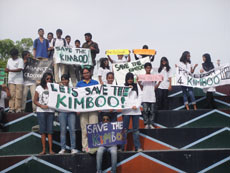
Roughly 30 students took part in the ‘mission’ after the crocodile’s living conditions were noticed by the school’s biology teacher, Kate Wilson.

Wilson told Minivan News at the time, that she had been “horrified” by the size of the enclosure and enlisted the help from her students to attempt to save the animal.

Despite getting in touch with an international agency in Australia and producing a video calling for support, the crocodile still remains in the cage three years later.

Last year, Defence Minister Mohamed Nazim claimed that the ministry had planned to send Kinboo abroad to a zoo, replacing the large animal with a “small Kinboo” to keep in the cage instead.

According to the minister, a smaller crocodile will be brought to replace the bigger one because a lot of children enjoy watching the creature in its cage.

“It is useful for educating the children. So we are planning to bring a small Kinboo.” he noted. “When it grows big we will send it off abroad again.”

Following the occasional public calls to have the crocodile released, former governments have made similar suggestions about sending the animal overseas, yet none of these plans have transformed into any action.

Regarding this matter, Naeem said that because the animal had grown so large, the expense of moving such a big animal to a nearby country is very high.

“We had discussions to move the crocodile to a zoo in a neighbouring country, but it was later recommended that since the animal is adjusted to such a condition [of the cage] it minimises its chance of survival in its natural habitat,” Naeem claimed.

Likes(3)Dislikes(0)

Ahmed Mohamed appointed acting minister of finance and treasury

Economic Development Minister Ahmed Mohamed has been appointed acting minister of finance and treasury in place of Abdulla Jihad, the President’s Office has announced.

No reason was given for the decision to appoint Ahmed Mohamed to the role.

Both Ahmed Mohamed and Abdulla Jihad were not responding to calls from Minivan News at time of press.

Likes(0)Dislikes(0)

Maldives National University establishes postgrad research centre

The Maldives National University (MNU) announced the establishment of its Postgraduate Research Centre and strategic plan for 2013-2017.

The centre was inaugurated by President Waheed Hassan Manik in the university’s auditorium.

During the ceremony, Waheed announced a plan to introduce a Presidential Postgraduate Research Fellowship, however due to the lack of funds, only one fellowship is currently being established, reports local media.

Waheed urged that the knowledge spread by the university “does not contradict the principles of our country, religion, nationhood and culture”.

Likes(0)Dislikes(0)

Two men deny forcing 14 year-old girl into child prostitution

Two men have denied charges of forcing a 14 year-old girl into child prostitution, the Criminal Court heard on Monday (March 11).

Ibrahim Manik of Heylhi, South Hulhudhoo and Hussain Manik of Hikiunimaage, S. Hulhudhoo in Addu Atoll, were accused of forcing the girl to “attend” to one Maldivian and four foreign men, local media reported.

The penalty for a person convicted of sexually abusing a child is 20 to 25 years imprisonment.

Likes(0)Dislikes(0)

Maldivian suspects released in rape case of Indian teacher

Two Maldivian suspects arrested in connection with rape, assault and robbery of a young Indian teacher on Dhangethi in Alif Dhaal Atoll in February have been released, while a Bangladeshi national remains in custody.

The Bangladeshi suspect was taken into police custody after the incident as he was about to board a boat departing for Male’.

A community member from Dhangethi claimed that a large number of people came to the harbour prior to the police’s departure with the suspect and called for the Bangladeshi man to “face due justice,” according to Sun Online.

“Some people tried to attack the Bangladeshi man at the time of his arrest, and the conflict was encouraged by the island council,” alleged the source.

The Dhangethi Island Council denied allegations of encouraging a violent confrontation, but confirmed some people at the harbour did attempt to harm the suspect before police brought the situation under control.

Head of the Police Serious and Organised Crime Department, Mohamed Dawood, told local media that it was believed the Bangladeshi man had committed the rape.

“We monitored all vessels leaving the island during the investigation. In that regard, we first took the two Maldivians into custody. But later we arrested the Bangladesh man who was living on the island as his behavior was suspicious,” Dawood explained to Haveeru.

The three men were accused not only of raping the 25 year-old computer teacher, but of stealing her mobile phone, an Acer laptop, and MVR 9000 (US$583) in cash, a source with knowledge of the investigation told Minivan News.

Police recovered the victim’s belongings, and a knife believed to have been used to threaten the woman, inside the home of the Bangladeshi national.

The three suspects were taken by police to the island of Mahibadhoo in Alifu Dhaalu Atoll. None of the men arrested were over the age of 23, the source said.

The attack

The young woman suffered serious sexual trauma, according to police.

Speaking to Minivan News on February 11, an informed source said the woman had been transferred to the atoll hospital’s intensive care unit and was “bleeding uncontrollably” following the attack.

“The victim was taken to Mahibadhoo Hospital where she is being treated for the injuries she suffered from the incident. There was blood all over her room when the police attended the scene,” the source told Minivan News.

According to local media, when police arrived at the scene the young woman was found slumped near her bed, which was covered in blood.

A source close to the victim told Minivan News February 23 that the woman was subsequently transferred to a hospital in India.

“She has still not recovered from the attack, I have been in contact with her, but now she is in India,” he added.

The incident occurred on Sunday (February 10) – some time between 2:30am and 2:45am, the source said.

Local media reported that the woman was teaching a private computer course on the island.

Island Council President Adam said the young woman had been working on the island for less than a month, and described her as a “very kind person who was very friendly towards the local islanders”.

Police Spokesperson Sub-Inspector Hassan Haneef told Minivan News he was checking whether the investigation is still ongoing or if a case has been filed with the Prosecutor General’s office.

The Prosecutor General’s office was not responding to calls at the time of press.

Likes(0)Dislikes(0)

Attempts will be made to “assassinate” my character: Umar Naseer

Progressive Party of the Maldives (PPM) presidential primary candidate Umar Naseer has claimed he has “received information” of an attempt to plant drugs in one of his offices.

A post made under Umar’s name on his Facebook and Twitter pages stated he had received “intel” that an attempt would be made to discredit his name by planting contraband in one of his offices.

Umar Naseer is the Managing Director of both Whale Submarine and and Alarms Pvt Limited. One of building in which the Whale Submarine office is located caught fire on Saturday (March 9).

Despite the posts on social media, a source familiar with the matter told Minivan News on Tuesday (March 13) that police had already searched through the Umar’s offices looking for contraband.

“After Home Minister [Dr Mohamed] Jameel [Ahmed] joined Umar’s competitor [Abdulla] Yameen in his campaign meeting, police turned up at Umar’s offices with a search warrant allegedly looking for alcohol,” the source claimed. “It is an intimidation tactic I think.”

Police Spokesperson Chief Inspector Hassan Haneef denied that police had searched the offices of the PPM presidential helpful.

Both Umar Naseer and Abdulla Yameen are currently campaigning to win the PPM’s presidential candidate slot for the upcoming presidential elections to be held in September this year.

Umar Naseer’s secretary, when contacted by Minivan News, said that Umar was unable to comment on the matter as he was away on a campaign trip.

Asked whether she was aware of any office searches by police, the secretary stated: “I am in no position to answer that. I will get back to you.”

Minivan News was awaiting a response at time of press.

On Saturday (March 9), local media reported that a fire had broken out at a Sakeena Manzil property in Male’ – a building also used by Umar Nazeer’s ‘Whale Submarine’ company.

Soon after the flames had been extinguished by Maldives National Defence Force (MNDF) firemen, local media reported that the MNDF equipped two well-known PPM activists with gas masks and oxygen tanks, who then entered the building.

According to a report in Sun Online, the two PPM activists went inside the building to retrieve some “very important objects”, but it had not been elaborated as to what these objects might have been.

MNDF Spokesperson Colonel Abdul Raheem denied reports made by local media, stating: “The fire chief told me they did not allow any civilian to enter the building or tamper with fire equipment.

“Once the area was deemed safe however, members of the public were allowed back into the building with the guidance of police,” Raheem told Minivan News.

Likes(0)Dislikes(0)

JSC acted unconstitutionally in assigning panel of judges to Hulhumale’ Court: Speaker Shahid

Speaker of Parliament Abdulla Shahid, who is also a member of the Judicial Services Commission (JSC), appeared before Parliament’s Independent Commissions Oversight Committee on Tuesday to answer questions regarding the the appointment of a panel of three magistrates to the Hulhumale’ Magistrate Court.

This panel of three judges were appointed to preside over the case against former President Mohamed Nasheed for his detention of Criminal Court Chief Judge Abdulla Mohamed, and cases against other officials from the former government involved in the detention.

Prior to Shahid’s appearance, JSC Vice Chair Criminal Court Judge Abdulla Didi and member appointed to JSC from among the public, Sheikh Shuaib Abdul Rahman, have attended the committee over the same matter.

Meanwhile, JSC Chair Supreme Court Judge Adam Mohamed has refused to attend the committee on the grounds the matter is related to an ‘ongoing case.’

JSC acted outside its mandate: Speaker Shahid

Speaking at the committee meeting, Shahid stated that he believed that the judicial watchdog had acted unconstitutionally in assigning magistrates to a particular case.

“In deciding upon the bench, the JSC did follow its rules of procedures. As in, it was voted upon in an official meeting and six of the seven members in attendance voted on the matter. The seventh member being the Chair, does not vote in matters,” Shahid explained.

“However, whether it is within the commission’s mandate to appoint a panel of judges in this manner is an issue which raised doubt in the minds of more than one of my fellow members.”

Shahid then referred to the existing legal framework, quoting articles to back his statement that he did not believe the matter was within the responsibilities of the commission.

He quoted Article 21 of the JSC Act, Articles 48 and 49 of the Judges Act, and from the Judicature Act.

Article 21 of the JSC Act outlines in detail the responsibilities and powers of the commission.

Article 48 of the Judges Act states “A judge can be temporarily appointed to another court in the instance that the court is unable to sufficiently complete assigned work, or if the court has difficulties providing services, or if the judges serving in the court has been suspended from their duties. or if other circumstances which may cause a delay in the completion of work assigned to the court occur.”

Article 49 of the same act states “It is the Judicial Services Commission, with the counsel of the Judicial Council, which will come to a decision on the transfer of judges to oversee cases in other courts.”

Article 55 (a) of the Judicature Act states “In addition to the responsibilities assigned by other laws, the responsibilities of the Senior Judge of a superior court are the following: (a) Determine the Judges who would adjudicate the cases of that court.”

“None of these articles say anything about assigning cases concerning a particular individual to a specific set of people. The JSC is mandated with the appointment and transfer of judges. But it does not say anywhere here that the JSC holds the powers to assign cases to specific judges,” Shahid said.

“Hence, I do not believe that the appointment of a panel of magistrates to the Hulhumale’ Magistrate falls into the mandate of the JSC,” Shahid stated.

“The reason why I need to state this here is because the constitution explicitly guarantees the right to a fair trial to all individuals. When things proceed as they are going now, this is being compromised. So I must speak out,” he said.

Responding to a question posed by Maldivian Democratic Party (MDP) MP Ahmed Abdulla, Shahid said he did not “feel it was the right course of action” to remove then Senior Magistrate of Hulhumale’ Magistrate Court Moosa Naseem from the case after he had assumed responsibility for the case.

“Moosa Naseem, who was then in charge of the Hulhumale’ Court sent in his recommendations for magistrates who are to sit on Nasheed’s case to the JSC for comments. This list included his own name. The JSC then replaced all three of these magistrates. Do you feel this was done in the rightful manner?” Abdulla asked.

“I do not think removing Naseem was the right course of action. There should be a good reason to remove a judge from a case from which the judge has not recused himself. I think that is a good issue for this committee to further investigate,” Shahid responded.

Asked about the formation of the Hulhumale’ Court, Shahid answered that his summons letter had detailed that he would be asked specifically about the assignment of the panel, adding that therefore he felt it “unnecessary to even extend [his] thoughts” to any other topic.

Political competitiveness

“As Speaker of Parliament, you have been working with us 77 MPs for years now, in a very politically volatile environment. You are also one of the most senior council members of Dhivehi Rayyithunge Party (DRP), and we belong to your political opponent, MDP,” MDP MP Ali Waheed addressed Shahid.

“In these past few years, there have been times when we have acted very harshly against you. We even initiated a no confidence motion against you. Now to come back, you have just told us that you don’t think the assignment of the Hulhumale’ Court panel is legitimate. This is the panel which will be ruling on the presidential candidate of your political opposition,” Ali Waheed continued.

“My question to you is, under these circumstances, can you tell us in what light you see the events that are unfolding? Do you think the trial that is being conducted by this panel we speak of can be free and impartial?”

Shahid promptly responded that he did not entertain any political thoughts while serving as a JSC member.

“You have pointed out that I come from a specific political party, and you are right. Nevertheless, I was voted in as Parliament Speaker through votes cast by MPs from various parties. When I sit as speaker, I do not see any political action, and instead work as per the regulations and the constitution,” Shahid answered.

“I sit in the JSC because of my role as speaker, and hence as a rule, I have no right to harbour any political thoughts or mindset in the work I do there, nor will I do so,”’he said.

“In casting my vote in JSC or advocating for different matters in the commission’s meetings, the only focus I keep is on doing what is constitutionally mandated. Hence, even at a politically turbulent time, on a very politically contentious matter, I am sitting here in this chair and telling you that in my personal capacity I believe the JSC acted wrongfully in having appointed that panel,” Shahid repeated.

Chair of the Independent Commissions Oversight Committee Independent MP Mohamed Nasheed did not attend Tuesday’s committee meeting. He was also not present at the last two meetings of the committee where JSC members Abdulla Didi and Sheikh Rahman were summoned.

Likes(0)Dislikes(0)

Human Rights Ministry sends orphans to mental disability centre without psychiatric evaluation

The Maldives’ Ministry of Gender, Family and Human Rights has admitted transferring two children from the Villlingili island orphanage ‘Kudakudhunge Hiya’ to the Centre for People with Mental Disability on the island of Guraidhoo, without determining if they were in fact special needs children.

The Ministry confessed to transferring the 18 year-olds – two of eight children sent to the Guraidhoo centre – without a doctor’s consultation, local media outlet Sun Online reported.

The Ministry was summoned to a parliament committee meeting in regard to an ongoing investigation initiated by the Human Rights Commission of the Maldives (HRCM). The investigation was launched in response to allegations of children being taken to the Guraidhoo facility and given psychiatric medication.

Speaking to the parliamentary committee, State Minister for Gender and Human Rights, Dr Aminath Rameela, admitted the children were transferred to the special needs centre without a proper doctor’s evaluation.

“[Regarding] the children who were taken there [to the Guraidhoo facility] without a psychiatric recommendation, keeping the children at Kudakudhinge Hiya at that time was viewed as a threat,” she said.

“They were powerless to control them,” Dr Rameela told the committee, according to local media.

Rameela denied the children were given psychiatric medication and that “the Ministry is currently in the process” of conducting a psychiatric evaluation of he two children, local media reports.

The HRCM Vice President Ahmed Tholal told Minivan News the matter is currently under investigation and procedure prevented them from divulging any information.

“We do not want to compromise the investigation process,” he stated.

Children victimised “over and over”

Tholal stressed that the number of incidents occurring at both the orphanage and the Guraidhoo centre for were greatly concerning.

“Incidents are occurring repeatedly. Children under the care of the state need a safe environment; it’s a concerning issue.

“The fact is there is no special shelter or place for girls in trouble with the law. HRCM has raised the issue several times – both the need for education as well as psycho-social support and counselling,” Tholal added.

He said the Maldivian government has a responsibility to protect children from being “systemically” victimised, and once the state has been notified, children should not be put back in a situation of neglect or abuse.

“Vulnerable children are often from difficult families or are abandoned and are victimised over and over again. Currently [government] support is haphazard, and we are not properly equipped. A safety net needs to be established,” stated Tholal.

He cited the recent incident where two underage females living in the Villingili orphanage were arrested and sent to Maafushi prison in January.

The parliamentary committee investigating their arrest learned that all concerning authorities had neglected their duties and responsibilities to protect the rights of children.

In March 2013, police returned seven underage girls who escaped from the ‘Kudakudhinge Hiya’ orphanage on Villingili, otherwise known as Villi-Male’. Local newspaper ‘Haveeru’ reported another two girls who escaped from the orphanage were found on a ‘bokkura’ – a small local vessel – in the lagoon near Villingili with two boys.

In 2011, police arrested a female staff member working at the Villingili children’s home, after she allegedly physically abused a boy living in the centre.

In October 2010, the Maldives Police Service and the Health Ministry commenced a joint investigation into “serious issues” concerning the mistreatment of children at Kudakudhinge Hiya, the only orphanage in the Maldives.

The Guraidhoo centre has also been the subject of scrutiny. In January 2013, four men were allegedly arrested in Kaafu Atoll over drug and sex offences related to their work at the Centre for People with Mental Disability on the island of Guraidhoo.

Several sources with knowledge of the matter have claimed the four suspects stood accused of giving hash oil cigarettes to women staying at the centre and then having sex with them. One of the four suspects was said to have been charged with filming the alleged crimes, according to the sources.

Minivan News understands that although the woman were staying at the Centre for People with Mental Disabilities, they were not thought at the time to suffer from any mental health issue or physical disorder.

“I have information that these girls were first kept at the orphanage in Villingili and when they were old enough to get out from the orphanage and had nowhere to go, the government sent them to the Centre,’’ a source familiar with the matter claimed.

Tholal explained that the only other institutions for children are for boys, the Maafushi island Education and Training Centre for Children (ETCC) and Feydhoo Finolhu, a Correctional Training Centre for Children run by the Juvenile Justice Unit (JJU) of the Ministry of Home Affairs and the Maldives Police Service’s Child Protection Unit.

Acute staffing and budget shortfalls combined with the lack of children’s rights education and the exclusion of children’s feedback have “deprived [residents] of their liberty”. Staff caring for the children are often excluded from important decisions impacting children’s quality of life at the facilities, a recent HRCM report stated.

The report, Child participation in the Maldives: An assessment of knowledge, highlights numerous participation and protection policy deficiencies putting Maldivian children at serious risk of harm.

Government support lacking

Tholal emphasised the lack of understanding regarding children’s and women’s victimisation is reflected in the national budget and lack of Gender Ministry support. Not enough funds are allocated, instead these “far reaching and cross cutting” issues are eclipsed by the need for generating state revenue.

“How can you sustain revenue if the social fabric of society is in such bad state?” Tholal asked.

“There must be a gender sensitive budget process to identify the gaps between problems and funding. Parliament and the Finance Ministry must demonstrate the need, want, and dedication during their budget preparations.

“Priority issue areas that need to be captured properly are children, gender, and related social aspects,” Tholal said.

The Maldivian constitution guarantees individuals’ human rights and state obligations to fulfill these rights, including ensuring children’s protection and education,Tholal explained. As a result, the HRCM has repeatedly recommended establishing children’s shelters.

“On the brighter side, the HRCM and Gender Ministry are engaging in more liaising to find solutions in the best interest of the children. We are working together to find a proper, systemic solution for the long term, not an ad hoc fix.

“Discussions between the Gender Ministry and HRCM have been significant and very positive. We are working together to ensure things are in place. Thing can improve, we don’t want to play the ‘blame game’,” said Tholal.

Government alternative care institutions intended to provide shelter, rehabilitation, or “restorative justice” suffer from the “large gaps between policy and reality,” the recent HRCM report stated.

The HRCM serves as the National Preventive Mechanism (NPM) with the responsibility to “ascertain that people detained under State care are in satisfactory condition and their basic human rights are respected and fulfilled and that no inhumane and degrading treatment has taken place against the person detained,” the HRCM website states.

This was established under the Optional Protocol to the Convention Against Torture and Other Cruel, Inhuman or Degrading Treatment (OPCAT), which the Maldives has ratified along with the Convention against Torture (CAT) .

The Ministry of Gender, Family and Human Rights was not responding to calls at the time of press.

Likes(0)Dislikes(0)

Police reject claims that assault of Raajje TV journalist was politically motivated

Police have dismissed claims that an attack last month on a senior reporter for private broadcaster Raajje TV was politically motivated.

Journalist Ibrahim Waheed (Aswad) was left requiring major surgery abroad after he was beaten unconscious with an iron bar while riding on a motorcycle near the artificial beach area of Male’ on February 23. He was reported at the time to be on his way to see two Maldives Broadcasting Corporation (MBC) journalists who were admitted to hospital after being attacked.

National media bodies have since raised concerns about a growing number of attacks on journalists. The same bodies have also claimed that reporters and other media figures needed to be more professional in order to ensure similar incidents and attacks can be better “contained and controlled” in future.

The police’s Head of Serious and Organised Crime Department Mohamed Daud declared at a press conference today that Aswad’s assault should not be viewed as a politically motivated attack, or an attempt to silence national media.

The claims were made as police announced that two suspects – an 18 year-old and 21 year-old – had been arrested in connection to what was believed to be a “planned” attack on Aswad.

Daud told local media that both suspects had criminal records and were believed to belong to “groups” based in the capital, though no further details were provided as police continue their investigations.

Speaking following the press conference, Police Spokesperson Sub-Inspector Hassan Haneef today told Minivan News that with investigations continuing into Aswad’s attack, no motive had so far been established.

Following the arrest yesterday (March 12) of a second suspect in connection to the attack, Haneef added that the police investigation had so far found no evidence to imply a political motivation or that Aswad had been assaulted due to his role as a senior reporter for Raajje TV.

Targeted attack

Addressing Daud’s claims today, Maldives Journalist Association (MJA) President Ahmed ‘Hiriga’ Zahir said he would not speak contrary to the police view on the case. However, he maintained that Aswad had been specifically targeted by his attackers.

“We cannot investigate the matter ourselves, so I cannot go against what the police have said. However, what I know is that Aswad is a journalist and he was attacked whilst out on a motorbike,” he said. “It was a targeted attack.”

The attack on Aswad was the most serious incident of violence against a journalist in the Maldives since July 2012, when a group of alleged Islamic radicals slashed the throat of blogger Hilath Rasheed. Rasheed, who had been campaigning for religious tolerance, narrowly survived and has since fled the country.

Aside from the attack on Aswad, Hiriga continued to express concern at what he believed were a growing number of attacks on journalists of late, notably following recent anti-government demonstrations in the capital.

Just last week, a journalist for private media group Sun and a cameraman from broadcaster Villa Television (VTV) were attacked near to the residence of former President Mohamed Nasheed during coverage of his arrest.

Two Television Maldives (TVM) journalists were also attacked with an irritant while covering protests on Sosun Magu in Male’ on the same night Aswad was assaulted.

“Too many opinions”

Following Aswad’s attack, National media bodies including the MJA last month called on journalists to act more professionally to prevent future confrontations between themselves and the public.

Senior figures from both Maldives Journalist Association (MJA) and Maldives Broadcasting Commission (MBC) said that journalists needed to act in a more professional manner in order to help prevent future confrontations between the public and reporters.

MBC Vice President Mohamed Shahyb told Minivan News that journalists have been targeted because “hatred has been building” towards them over a long period of time.

“Some journalists are not doing their work professionally in the Maldives.  The biggest problem is that they do not have much education or training [in journalism] and because of that they write anything,” Shahyb told Minivan News. “If the professional standard can be maintained, similar incidents can be contained and controlled.”

The MBC Vice President claimed that there are “too many opinions” leaking into news reports and that politicians need to start “pointing their fingers” at journalists who are not working in the correct manner.

“Social networking is also a big problem. Even if they work professionally, they then go onto social media sites and start expressing their own personal feelings, this is an issue,” Shahyb said.

MJA President, Ahmed ‘Hiriga’ Zahir, expressed similar concern, adding that journalists need to be more impartial with their reporting.

“We need to encourage media to be more objective. When we listen to the TV or radio we can’t tell the difference between an opinion piece or the actual news itself.”

Zahir has also requested the media to act more professionally and stop “spreading hatred”, while calling for police to give greater protection to journalists.

President Dr Mohamed Waheed Hassan Manik has also of late called on the media to “encourage stability, unity and harmony” in the country, adding that those responsible for the attacks will be brought to justice.

Likes(0)Dislikes(0)