Inequality and climate change threaten Maldives’ human development improvements

The UN’s 2013 global human development report has highlighted inequality and climate change vulnerabilities as major concerns for the Maldives, despite the country’s “significant economic growth” in recent years.

“Although the Maldives’ performance in human development in the South Asian region is quite commendable, the country continues to face a number of risks and vulnerabilities,” said UN Resident Coordinator Tony Lisle during the report’s launch on Sunday (May 12).

The 2013 UN human development report is entitled: “The Rise of the South: Human Progress in a Diverse World”.

The findings have positioned the Maldives in the medium human development category, where it was ranked 104 out of 186 countries and territories.  The ranking is based on the human development index – a composite measurement of life expectancy, education, and income.

According to Lisle, the country’s human development index value increased 30 percent between 1995 and 2012, an average annual increase of about 1.6 percent.

The Maldives graduated to the status of a middle income country in Jan 2011.

However, when inequalities are factored into the Maldives’ human development index ranking, the country’s “value falls to 25.2 percent indicating that addressing inequalities continues to warrant significant national attention in the years ahead,” he added.

“Risks and vulnerabilities faced by the Maldives include effects due to climate change and of course the financial global crisis, which is still with us,” said Lisle.

“The nation has also been maturing in its democratic processes, including the creation of independent bodies, the establishment of a multi-party political system, and rolling out of decentralised governance.”

The 2013’s human development report focused on issues such as increasing access to schools, improving access and quality of health services, promoting inclusive growth and putting an emphasis on improving conditions for women globally.

“These are also qualities espoused by the government of Maldives, which deserve our vigorous support,” said Lisle.

To ensure this support, he explained that the Maldivian government was currently collaborating with the UNDP and UN country team to formulate the second national human development report for the Maldives, which will focus on inequality and vulnerability.

“We must go beyond GDP to measure development. The UNDP defines development as a process of enlarging people’s choices to realise their potential and enjoy the freedom to lead lives they value. Some will do better than others with the choices they have, but the challenge is to ensure everyone has a fair and equal chance, equal opportunity to improve quality of life,” said Lisle.

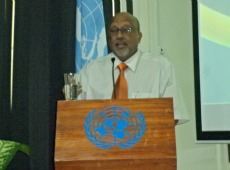
Meanwhile, Vice President Mohamed Waheed Deen, also speaking at the launch, criticised government policy failures for failing to correct numerous development challenges in the Maldives.

Deen therefore emphasised the need to learn from the UN’s latest human development report to address the sustainable development challenges posed by geographically isolated, small island populations.

Women and children suffer

Although Deen proposed “population consolidation” – relocating small island communities to larger landmasses – as a means to improve democratic practices, he also emphasised the benefits of sustainable development.
He also highlighted the need to listen to communities and young people, while providing them opportunities to express themselves in “forums and different platforms” to utilise their ideas for development and to prevent “wilder activities” from occurring.

“The best method is to let a person express himself or herself and not to hide the real problems of the country, domestic violence, child abuse, and many other issues related to gender. Unless we accept that we have these problems, we cannot bring changes,” Deen said.

“Quite unfortunately we pretended we did not have these problems. We pretended these things never existed in our society. ‘What a wonderful clean society we have’, but the truth is we have these problems and people suffered, children suffered, women suffered,” he lamented.

Deen explained that “sadly” many presidents and politicians have not directly addressed problems within island communities or Maldivian society generally to bring about change. As a result, the recent democratisation process, including the related constitutional changes, have led to protests protests regarding development and human rights issues.

“The only way for our country to progress is to listen to the people. We have learned that the voice of the people must be heard,” Deen stated.

The vice president also discussed the “very important need” to educate the populace about democracy. He stated that it was “almost impossible” to run a democratic nation with “changing constitutions and presidents”.

“The mindset the people must understand what democracy is and how we can sustain it. Unless we do that we won’t be able to sustain a democratic system,” said Deen. “Educating the people is extremely important, more than building harbours.”

Vice President Deen added that economic inequalities have been perpetuated by the lack of planning, job creation for youth, and and a proper tax system.

“We didn’t plan ahead. what has happened to us today, our situation, is not something that has happened overnight. It took time, many years,” he said.

He emphasised the need to establish a “proper tax system” to reduce economic inequalities and bridge the disparity between the wealthy and less fortunate.

“The huge level of discrepancy can create social unrest, misunderstandings, hatred, anger, and frustration and these are bad for any nation,” noted Deen.

“I’m not a believer of expecting donations and support all the time. These funds must be utilized in a context as a catalyst for sustainable development,” he added.

“Please understand the Maldives will never never go back, we will go forward,” Deen declared.

“I hope the presidential candidates seriously consider these [human development] reports when they are deciding their manifestos and bringing changes to our beautiful country,” he added.

UN human development recommendations

Giving her own summary on the 2013 human development report, UNDP Deputy Resident Representative Azusa Kubota said there were four key areas needing to be addressed by governments to facilitate sustainable human development.  She said these factors included enhancing equity; enabling voice and participation, managing demographic change and confronting environmental challenges.
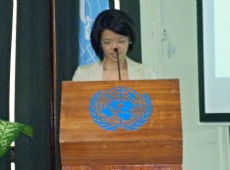
“We all know environmental threats such as climate change, air and water pollution, natural disasters, deforestation affect everyone globally, but they hurt poor countries the most,” Kubota added.

Sustaining human development gains is difficult in the face of “natural disasters which are increasing in frequency and intensity that cause enormous economic damage and loss of human capacities,” she said.

“International governance structures can be held to account, not only by member states but governance by global civil society which is on the rise.”

At the national level, Kuota explained that human development required support by a “developmental state” with an activist government and a political elite that sees record economic growth as their primary aim.  She added that job creation and investing in people’s capacities to sustain the gains of economic growth via health, education and other public services were also key elements. Additionally, governments need to actively nurture sectors that would not otherwise emerge to do global competitions and incomplete markets.

Kubota further emphasised that to sustain human development “substantial public investment, in [social services] not just infrastructure, as well as bold proactive, targeted social policies are required. It is not just economic growth alone.

“Human development doesn’t come without targeted policy interventions and carefully crafted national visions,” said Kubota.

The developed north and developing south are connected “more than ever”.

“The challenges faced by the multilateral system in response to the rise of the south [do not pose] a false choice between globalism, regionalism, and sovereignty. We all have to work together. Human development is not a zero sum game, we all benefit equally,” Kubota concluded.

Likes(2)Dislikes(0)

Storm surge floods large areas of Fuvahmulah island

A storm surge in the Maldives has caused a large area of Fuvahmulah Island to flood.

Three regions of the island have areas larger than 20 feet flooded, while farmland and some freshwater wells have been affected by salt water, according to the Maldives National Defence Force (MNDF) and local media.

The extent of the damage caused to farmlands flooded by salt water last night (May 12) is still being assessed, President of Fuvahmulah Atoll Council Ali Fazad told local media. He added that the flooded farmlands are located on the island’s eastern “bushy edge”.

MNDF officers will be on alert given that more flooding is expected in Fuvahmulah during high tide later tonight.

According to the Maldives Meteorological Service (MET Office), no island other than Fuvahmulah as reported flooding, however the southern atolls can expect more heavy rain and strong winds, with gusts up to 45 miles per hour.

Earlier this week (May 9), Fuvahmulah suffered the most storm damage nationwide due to severe storms, harsh wind and rain, blowing off roofs and felling trees, according to Minister of State for Defence and National Security and head of the National Disaster Management Center (NDMC), Ahmed Mohamed.

Likes(0)Dislikes(0)

Singaporean woman drowns at Embudu Village Resort

A Singaporean woman on vacation with her husband at Embudu Village Resort died while snorkeling, the second such incident at the resort in the past three years.

The 34 year-old Singaporean, Irene Soon, drowned last Saturday (May 4) in a snorkelling accident at Embudu Village resort, located eight kilometres from Male’ in Kaafu Atoll.

Soon was snorkeling near the main jetty area of the resort and is believed to have drowned, however the case is still under investigation a police media official told Minivan News today (May 12).

Soon, an insurance manager, was vacationing with her husband in the Maldives to celebrate her recent promotion. Soon and her 37 year-old husband Mike Lie were snorkeling for the first time and taking photos with a rented underwater camera when the incident occurred, reported Singaporean publication the New Paper.

The publication claims that a dive instructor ran over after Soon had been pulled from the water and asked Lie how long she had been underwater. Allegedly Lie responded that he was unsure, but “maybe 10 minutes”.

Lie then asked the “Aren’t you going to CPR (cardiopulmonary resuscitation) or something?” at which point the dive instructor said “there was no point”, claims the publication.

“She was snorkeling with her husband, taking photographs then somebody saw her motionless, lifeless, in the water,” Embudu Village General Manager Ramsay Perera told Minivan News today.

“The dive instructor did give emergency care and performed CPR. She was then taken to ADK hospital via speed boat,” he claimed.

Perera explained that the dive school staff is “well equipped” and trained in CPR, however there is no in house doctor at the resort.

“The dive school staff are very observant most of the time. It was calm weather and very shallow water. She was briefed [about snorkeling safety] when she arrived at the resort and was wearing a life-jacket, snorkel and fins [when the incident occurred],” Perera said.

Snorkel at your own risk

After approximately an hour of snorkeling Lie decided to take a break because saltwater was “getting into his mask and nose”. Lie was standing in shallow water next to the resort’s pier watching his wife continue to snorkel and diverted his gaze for five minutes to watch a group of guests learning to scuba dive. When Lie looked back for his wife, she was nowhere to be seen.

“That was when I realised, ‘Oh my goodness,’ the weather is bad, cloudy and drizzling. I decided to swim out,” Lie said. “I was worried, I wanted to get her out of the weather and say it was time to go back.”

While Lie hurried to put his snorkelling gear back on to swim out and look for Soon, she was being pulled from the water by a German uncle and nephew, with her body face down on the seabed.

The German tourists noticed that Soon’s snorkeling tube was underwater and swam out to where she was floating.

“I was shocked, I wondered what I could do to save her. Her fingernails and toenails were purple. I tried calling her name, she didn’t answer. I frantically felt for her pulse, but there was none,” said Lie.

Soon was snorkeling in water about one metre deep. “It would have taken effort for her to stand with flippers on her feet and corals below,” explained Lie.

Soon was not a strong swimmer and her husband recalled swimming together fewer than 10 times in the last 12 years they had known each other. “She wouldn’t do laps, just short distances,” Lie recalled.

Lie said there no lifeguards were present at the Embudu Village beach, however he and his wife had been briefed about water safety upon their arrival at the resort. During the briefing, entry points into the water and coral bed areas were discussed, as well as advice not to swim too far away from shore. They were also told that “activities were carried out at their own risk”.

Lie returned to Singapore May 6 and Soon’s body arrived the morning of May 9. During her wake, Lie told Singaporean media that he regrets “taking his eyes off my wife.. or else, this might not have happened.”

Second death

Soon’s drowning is the second such incident at Embudu Village Resort. In February 2010, a 69 year-old German tourist died while snorkelling at the resort.

A senior staff member at Embudu Village told Minivan News at the time that the man was snorkeling with his friend.

”His friend noticed that he had been floating in the water without movement for a while and went to help him,” the staff member said at the time. ”When he shook him he did not move, so he knew that something was wrong. The sea was calm and there was low tide at the time.”

There have been a string of tourist deaths while snorkeling in recent years.

A 51 year-old Italian tourist died in a boat propeller accident while snorkeling in January of this year near Elaa Island in Thaa Atoll.

During 2012, tourist deaths – usually while snorkelling – were disproportionately higher among Chinese visitors, who now account for a majority of Maldives tourist arrivals compared to the country’s traditional European market.

Mohamed Ibrahim ‘Sim’ from the Maldives Association of Tourism Industry (MATI) pointed out in a 2012 interview with Minivan News that Chinese guests in particular needed to be made more aware of the dangers of snorkeling in the Maldives, “because it is a totally different environment than what they are used to.”

Many resorts and Chinese tour operators have reacted to the higher incidence of casualties by issuing life-jackets to Chinese guests on arrival. However, despite efforts to adapt to a market which in 2011 brought over 100,000 visitors to resort beaches and house reefs, Sim observed that “things still have not changed” as Chinese fatalities remain higher compared to European market.

Two Chinese nationals vacationing on two different resorts in the Maldives were found dead within 48 hours in suspected snorkeling accidents in 2012.

A Chinese woman identified as Shuhui Li, aged 58, was pronounced dead after she was pulled out from the waters of Lily Beach resort on January 26, 2012, while a Chinese man identified as Ding Hai, aged 30, was found dead whilst snorkeling at the newly-opened Ayada resort the following afternoon.

In October 2012, a 26 year-old male from China staying at Alif Dhaal Atoll Vakafaru resort was suspected to have died in a snorkelling accident at the property.

In December 2012, a Chinese tourist was reported missing from the Bandos Island Resort and Spa property.

Earlier in 2012, a French tourist, identified as 49 year-old Alan Marshall, went missing during a late afternoon swim while vacationing on Club Med Kanifinolhu resort with his wife, daughter and son-in-law. A day later he was found dead near Paradise Island Resort.

A 36 year-old Chinese tourist was also found dead off the coast of Sun Island Resort and Spa in January 2011.

In August 2011, a decomposing female body was found on the shore of the Adhaaran Hudhuranfushi resort, a week after a 29 year-old Japanese tourist and her 37 year-old husband were reported missing from the property.

On March 14, 2010 police received a report that a Chinese national, Rui Dai, died while snorkeling at Holiday Inn Kandooma Resort, in Kaafu Atoll.

Earlier that same month another Chinese man died while snorkeling at Chaaya Lagoon Hakurahura Island Resort, less than a day after a German tourist died in a snorkeling accident at Embudu Village Island Resort.

In mid-August 2010 a Chinese couple vacationing in the Maldives disappeared from their resort after going for a swim. The 38 year-old woman and 40 year-old man were staying with their 13 year-old daughter on the Hilton Irufushi Beach and Spa Resort in Noonu Atoll.

In September 2010 a 48-year old Chinese woman died while snorkeling at Paradise Island Resort and Spa.

A top UK transplant surgeon died while snorkeling on holiday at the Adaaran Meedhupparu Resort in Raa Atoll in September 2010.

The following month, Sharon Duval, a 42 year-old British woman died while on honeymoon. Her body was found on the shore of Kuredhoo Island Resort.

Likes(0)Dislikes(0)

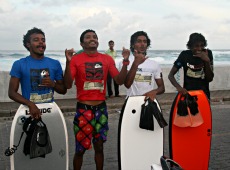
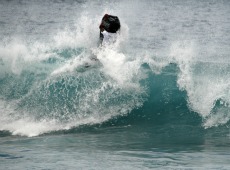
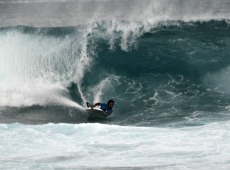
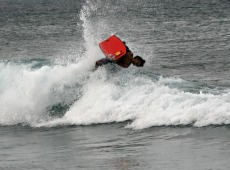
Big surf heats up bodyboarding competition final

The Burunu Shikaaru Bodyboarding Challenge, the first event of the Maldives Bodyboarding Association (MBBA), concluded in Male’ yesterday with big surf and competitors in high spirits.

The newly formed MBBA began this aptly named event – in Dhivehi, ‘burunu’ means a constellation that indicates the southwest monsoon and the best season for surfing, while ‘shikaaru’ is to hunt – on May 2.

What was originally planned to take three days stretched into nearly a week and a half of postponements and rescheduling with swells at Male’s surf area ‘Raalhugandu’ only reaching about a foot.

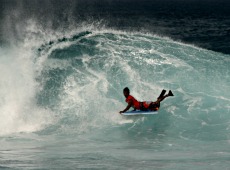
However, after a week of severe thunderstorms across the island-nation the five foot swells at yesterday’s (May 11) final provided competitors with the strong, hollow waves they were hunting for.

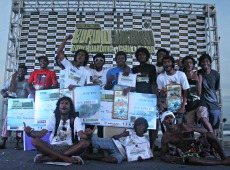
Ali ‘Kuda Ayya’ Khushruwan, founder of MBBA, won first place and MVR 10,000 (US$648). The competition’s youngest bodyboarder, 16 year-old Ali ‘Shaam’ Raafiu, finished a close second scoring only half a point less, and walked away with MVR 5,000 (US$324). Third place and MVR 2,500 (US$162) went to Ali ‘JD’ Javid, while Ijazulla ‘Ija’ Shareef took home the ‘rookie’ award.

“I didn’t know this would happen. I thought you know it’s really competitive, I didn’t expect this. Today it was really good, really strong and nice waves. Overall [my performance] was pretty good, but in the final I got really panicked because I didn’t get really good waves. I thought I’d place second. I’m really shocked,” MBBA founder and competition winner Ali ‘Kuda Ayya’ Khushruwan told Minivan News.

“I also didn’t know that my dad competed. The first day I told him don’t go, it’s going to be really big,” said Kuda Ayya. “It’s really nice, crazy, everyone came here to support me. I didn’t know that everyone would come, my friends and family, everyone was supporting [wearing ‘Kuda Ayya’ t-shirts],” he gushed.

Second and third place winners Shaam and JD were beaming after their performance in the final and craving the next competition.

“Waves today were really good. We didn’t think we’d get this size of waves. At the beginning [of the competition] it was good, but the waves were awesome for the final,” Shaam told Minivan News.

“It was very heavy and shallow, with a strong current and backwash. All the conditions are very difficult because this area is closed,” JD told Minivan News.

Both Sham and JD are “trying for first place the next time” and explained that competition is always a friendly amongst the Maldivian bodyboarders because “it’s a very close knit group”.

Kuda Ayya is also excited to compete in the for the next MBBA competition, planned to take place in June on Villingili Island, which neighbors Male’.

“It’s going to be good, really fun, it’s really hollow and really shallow. We have to be really careful, but it’s competition,” said Kuda Ayya.

Twenty-two bodyboarders faced off over 18 heats, with the best two from each heat automatically advancing to the next round, while the bottom two had a chance to participate in the requalifying rounds. Ultimately, eight bodyboarders advanced to the semi-final and four to the final yesterday.

Rough rides at Raalhugandu

Although regulars make carving the waves at raalhugandu look easy, the reef break is not for the faint of heart.

“If you can surf here, you can surf anywhere in the Maldives,” a local surfer explained.

Bodyboarders had to contend with a reef break plagued by strong currents, rip tides, backwash, a very shallow reef, all in an area less than a kilometer wide.

“You have to be very careful. It’s really hard to learn here [at raalhugandu], because it’s a reef break and really shallow – waist high where the waves break,” said Kuda Ayya.

“This break is pretty, it’s like when it’s big, it’s really good for bodyboarders, the waves are really strong and hollow. We need a critical, strong lip for maneuvers – like backflips which are my favorite,” Kuda Ayya explained. “But it’s a really small space.”

“In 2000 the artificial beach was made, that’s why it’s really small. Previously we had really long waves. It was really good spot in the 1980’s and 1990’s but what to do,” he lamented. “[Now] it’s really bad. I think the bodyboarding and surfing community is really small, that’s why they [the government] didn’t care and they did this.”

Although Raalhugandu can break big, after Kuda Ayya’s first round, first heat win earlier this week, he discussed having to compete on small waves.

“The heat went pretty good, the thing is the waves are pretty small [today], but I think it’s going to be fine,” Kuda Ayya said. “Actually it’s really hard to take the speed and doing the rolls and things, you have to paddle for the rolls and forward spins. It’s really difficult, but what to do,” Kuda Ayya told Minivan News the first day of competition.

Kuda Ayya is a Male’ local with 12 years of bodyboarding experience, including winning first place in international competitions held in Malaysia and New South Wales, Australia. He took first place in 2012’s Australia’s Senior Men’s Open, competing for the New South Wales team.

Raalhugandu regulars

“The MBBA plans to hold four or five contests yearly,” MBBA Media Coordinator Hassan ‘Rushh’ Rasheed told Minivan News.

“This is the first competition, so I think it’s pretty big. You can see lots of spectators,” he added.

Maldivian bodyboarders and surfers work together closely, especially raalhugandu regulars, and this was evident during the very well organised bodyboarding competition.

Five International Surf Association (ISA) certified judges – also local surfers – scored the competition.

“Although the maneuvers are different, the judging criteria is the same,” a competition judge told Minivan News.

“The Maldives Surfing Association (MSA) and MBBA we are together and work together. MSA is the governing body, but I think next year MBBA might change to a bodyboarding governing body,” explained Kuda Ayya.

The Burunu Shikaaru Bodyboarding Challenge was the first event held by the MBBA, which had its first round of elections February 10 and was registered February 11 with 40 new members. To compete in the competition bodyboarders had to be an member of MBBA.

The bodyboarding challenge was sponsored by Sonee Sports, the Tourism Employees Association of the Maldives (TEAM), and travel company, ‘I (heart) Maldives’.

The newly-formed MBBA’s mission is to help local bodyboarders of all ages get started and build a career in the sport. They aim to raise awareness, support, and promote bodyboarding throughout the Maldives.

Given the intimate relationship bodyboarders, and surfers, have with the ocean, the MBBA also plans to organise beach cleaning projects on islands throughout the country with local bodyboarders and surfers.

Joining MBBA only requires MVR 150 (US$10) and an application form, and membership has the bonus perks of a member identification card, event t-shirts, and “hopefully” surf shops and coffee shop discounts.

Likes(2)Dislikes(0)

US Embassy backs US$2.5 million election assistance program for the Maldives

The US Embassy in Colombo has announced a US$2.5 million election assistance program in the Maldives, to be implemented over the next 18 months.

According to a statement from the embassy, the program will “promote an open, democratic election by increasing civic participation… promote the integrity of the electoral process in the Maldives in advance of the September 2013 elections, and the subsequent local council and parliamentary elections.”

Speaking of the launch, US Ambassador Michele J Sison said the program would seek to ensure “that all Maldivians participate in credible, transparent and inclusive elections.”

According the statement, the program will be implemented by the International Foundation for Electoral Systems (IFES) with Maldivian partners Transparency Maldives and the Raajje Foundation.

“The program aims to support the election process through resolution of disputes and voter education. This assistance will provide national and regional forums for dialogue with policy makers and civic leaders as well as dispute resolution and mediation training for community leaders,” the US Embassy stated.

“For Maldivian citizens, the program will launch a public awareness campaign to promote political reconciliation and a free and fair election. In addition, civic and voter education programs will provide training and grants for community based organisations to increase citizen participation and improve voter education across the atolls,” the statement added.

The US election assistance comes on the back of an extensive pre-election assessment published by Transparency Maldives ahead of the September 7 elections, highlighting vote-buying, political polarisation, and credibility as key challenges.

The elections were set to unfold “against a context of uncertainty, crises of political legitimacy and unprecedented levels of political polarisation”, Transparency stated.

Political polarisation in the Maldives has grown in the wake of the failed all-party talks and events of February 7, leading to bitter mistrust between political factions and the pervading sense among parties that the loss of the upcoming elections “could amount to losing everything”.

“Political polarisation is characterised by mutual mistrust and radical negative categorisation of people, politicians, political parties and, sometimes, entire institutions,” Transparency noted.

“It’s characterised by the lack of self-reflective criticism, by the failures to hold one’s own self and party to account, and the inability to listen to and compromise for the callings of the other side. It’s also characterised by an apparent struggle for political power as a bitter zero-sum game.”

Particular challenges around polarisation include a “lack of cooperation and dialogue among major political parties, opening up space for intolerance and violence”, “a possibility of contestation of elections results, especially if the victory is through a narrow margin”, and the risk that even if the election results are respected, “a significant segment of the polity might reject the incoming president as the representative for all the people in the true democratic spirit required in defeat.”

Transparency called for restraint among parties, appealed for policy debates, and extensive and long term observation on behalf of the international community.

The country’s two largest parties have meanwhile turned their focus to campaigning, with the Progressive Party of the Maldives (PPM) annoucing Home Minister Dr Mohamed Jameel as running mate of presidential candidate Abdulla Yameen – half-brother of former autocratic leader of 30 years, Maumoon Abdul Gayoom.

The opposition Maldivian Democratic Party (MDP), headed by former President Mohamed Nasheed, has claimed it has  been pledged 125,000 votes during its door-to-door campaigning, a figure which if correct would translate to 61 percent of the vote assuming a 2008-levels of voter turnout (~85 percent).

Key factors affecting the September election will include widespread and heavily polarised sentiment surrounding the February 2012 transfer of power, and the preferences of 31,000 new young voters – a 15 percent increase on the number of eligible voters compared with the 2008 presidential election.

Likes(0)Dislikes(0)

Government has received 208 reports of child abuse so far for 2013: Human Rights Minister

The Ministry of Family, Gender and Human Rights has received 208 reports of child abuse so far this year, Minister Azima Shukoor has said.

In a statement marking Children’s Day, Shukoor said 83 percent of all reported child sexual abuse claims involved young girls. In addition, Shukoor said the ministry has also been informed of 43 cases of child neglect.

“The number of children facing abuse at one point in time in the Maldives is a number that is unreasonable for a country with such a small population,” she said, according to local media.

“The abuse of children is on the rise. Children being used as sex workers, where the children are sent to places as a means to pleasure people and to gain an income from such a trade. This is being practiced in the Maldives today. Both boys and girls are being used in this trade,” Shukoor said.

Likes(1)Dislikes(0)

Vote counting: MDP claims 125,000 votes pledged for 2013 elections

Former President Mohamed Nasheed has claimed the Maldivian Democratic Party (MDP) will receive at least 125,000 votes in the September 2013 election, an estimate based on the number of pledges received during its recent nationwide door-to-door campaign.

Nasheed’s contesting of the September elections appears increasingly likely after a criminal court case potentially disqualifying him from running became mired in allegations of politicisation – most notably from members of JSC, the same body responsible for both establishing the court hearing the case and appointing the panel of judges.

The Elections Commission (EC) will formally announce the various presidential candidates in mid-July.

Currently, contestants are likely to include Nasheed, as well as his former Vice President and incumbent Dr Mohamed Waheed in a possible coalition arrangement with other smaller parties.  Also expected to contest are Progressive Party of the Maldives (PPM) candidate Abdulla Yameen – the half-brother of the Maldives’ former autocratic leader Maumoon Abdul Gayoom – Dhivehi Rayithunge Party (DRP) Leader Ahmed Thasmeen Ali, and Jumhoree Party (JP) Leader Gasim Ibrahim, a resort tycoon, MP, media oligarch and member of the JSC.

To win government, a candidate must secure 50 percent of the vote ‘plus one’ in the first round. If this does not happen, the EC will hold a second round ‘run-off’ election several weeks after the first.

The MDP – currently the largest party in terms of membership – has declared it intends to secure a first round win.

Despite all other parties currently in government being allied against the MDP – albeit in an increasingly fractious coalition – the opposition party has dismissed the possibility of a power sharing agreement should the outcome rest on the anticipated chaotic last-minute deal-making of a second round.

“Listen to the radio on the evening of September 7, you will hear that the Maldivian Democratic Party had received 125,000 votes. Listen to the radio, listen to the radio and watch the TV,” declared the former president at a recent rally on Milandhoo in Shaviyani Atoll.

Asked to elaborate how the figure was reached, MP and former party chairperson Mariya Ahmed Didi said the party tallied the number of people who pledged to vote for Nasheed during the the MDP’s campaigning.

“We counted the amount of pledged votes so far and came to that figure. There are still some smaller islands where we have still not completed the door-to-door,” she told Minivan News.

According to the Elections Commission, 240,302 people will be eligible to vote in the presidential elections – a 15 percent increase (31,000 people) on 2008’s 209,294 eligible voters.

Bitter political and societal polarisation over February 2012’s controversial transfer of power is likely to swing fence sitters and make the results unpredictable, but the ‘high stakes’ are liable to ensure a relatively high voter turnout – as observed during the country’s first democratic multi-party election in 2008, which saw 85 percent for both rounds.

Assuming a similar voter turnout is witnessed during September’s elections as was seen in 2008, the MDP’s estimate of securing 125,000 votes is a prediction that amounts to 61 percent of the total electorate.

Outside of political division over the transfer of power on February 7, 2012, whether the MDP is able match its ambition to win the first round will hinge on the party’s appeal to young voters – particularly 31,000 18 year-olds – and whether it can match or exceed its performance in urban areas in the 2011 local council elections.

In February 2011, the then opposition DRP secured a clear seat majority across the islands and atolls in an election with a voter turnout of 70 percent and widely considered credible.

However, MDP secured an overwhelming majority of council seats in almost every major population centre, notably Male’, Addu City in the south and Kulhudhuffushi in the north – collectively accounting for approximately 50 percent of the total population.

The DRP was later split into two factions, leading former President Gayoom to eventually break away and form the PPM, which is now the second largest party in the Maldives after the MDP in terms of number of MPs.

The remnants of the DRP, together with other parties including Gasim’s JP, potentially the Maldives Development Alliance (MDA) of resort owner MP Ahmed Shiyam, and Waheed’s coalition – presently including the Dhivehi Qaumee Party (DQP) and the religious conservative Adhaalath Party (AP) – are likely to face an uphill battle in the first round.

As such, the best chance for smaller parties to leverage power may be in drawing away enough MDP votes to survive the first round and trigger power-sharing negotiations ahead of the second round.

Election challenges

Transparency Maldives has highlighted vote-buying, political polarisation, and election credibility as critical challenges for the 2013 elections, in its comprehensive pre-election assessment report released in March this year.

The NGO noted that political polarisation in the Maldives had grown in the wake of the failed all-party talks and events of February 7, 2012, leading to bitter mistrust between political factions and the pervading sense among parties that the loss of the upcoming elections “could amount to losing everything”.

“Political polarisation is characterised by mutual mistrust and radical negative categorisation of people, politicians, political parties and, sometimes, entire institutions,” Transparency noted.

“It’s characterised by the lack of self-reflective criticism, by the failures to hold one’s own self and party to account, and the inability to listen to and compromise for the callings of the other side. It’s also characterised by an apparent struggle for political power as a bitter zero-sum game.”

As a result of this polarisation, the limited space for public debate on urgently-required public policies and programs continue to be “colonised by demagogic appeals to religio-nationalist sentiments, empty motifs, and outlandish electoral promises never intended to be delivered,” Transparency stated.

“Similarly, as the polarisation is symbolised by political personalities, political debate is likely to center on personalities as opposed to issue-based discourse.”

Particular challenges around polarisation include a “lack of cooperation and dialogue among major political parties, opening up space for intolerance and violence”, “a possibility of contestation of elections results, especially if the victory is through a narrow margin”, and the risk that even if the election results are respected, “a significant segment of the polity might reject the incoming president as the representative for all the people in the true democratic spirit required in defeat.”

Transparency called in the findings for restraint among parties, appealed for policy debates, and extensive and long term observation on behalf of the international community.

Likes(0)Dislikes(0)

Man found dead after morning swim in Thaa Atoll

A man from Kinbidhoo Island in Thaa Atoll was found dead after he went for a morning swim today (May 9), reports local media.

The man was taken to the island’s health centre by the group of people who discovered his body.

He was identified as Abdul Kareem Dauood of Andhaasy Villa, Kinbidhoo Island.

The examining doctor determined Dauood was already deceased when he was brought to the centre, according to a police media official.

The police were notified of the incident at 12:49 and are looking into the cause of the incident, a police media official told local media.

Likes(0)Dislikes(0)

Police deny arresting 50 Addu City residents prior to president’s visit

The Maldives’ Police Service has denied arresting approximately 50 people – primarily Maldivian Democratic Party (MDP) supporters – the night prior to President Mohamed Waheed’s arrival in Addu City yesterday (May 8).

President Waheed visited Addu to inaugurated the Hulhumeedhoo road development project,  open the Hulhudhoo pharmacy and inaugurate higher secondary education at Seenu Atoll School, according to the President’s Office.

During the ceremony for the former Dr Waheed “highlighted the importance of developing roads on the bigger islands for the development of the atoll. In this regard, the President said the government’s aim was to complete such developmental endeavors without any interruptions.”

Addu City Mayor Abdulla Sodig told Minivan News the night before Waheed’s arrival close to 50 people were arrested, “and about 90 percent of those taken in were MDP supporters”.

“The police knew who had been actively engaged in [MDP] demonstrations and targeted those individuals. Those who were arrested were having coffee in restaurants, standing having a chat outside, others were stopped at vehicle checkpoints. They were arrested for allegedly being ‘a member of a gang’,” he added.

A few of the individuals arrested were released after one or two hours, according to Sodig.

“People know this game because it was the game [former President Maumoon] Gayoom played. They know they were arrested because of Waheed’s visit,” Sodig said.

“Police probably purposefully did this negative campaign. But Waheed’s game has backfired. Families of the arrested individuals are really angry and frustrated,” he added.

As part of an ongoing police operation in Addu to “keep the peace”, “lots of people were taken into custody and were released after their information was collected”, the Police Media Official who spoke with Minivan News today (May 9) initially stated.

The official then refuted the statement, claiming that only one person was arrested in Addu City on May 7.

The official confirmed that being “arrested” and “taken into custody” have the “same meaning”.

However, a police media official told local media outlet CNM that “people assembled in groups and other suspects were taken in for questioning last night. He said that they were all released except for one who is being held for issuing a death threat to a policeman.”

Mayor Sodig explained that the Addu City Council was not notified about this ‘special operation’.

“Normally the commander(s) visit and explain the details when a special operation is going to take place,” Sodig said. “During last week’s fortnightly meeting [with the council] the police did not mention such an operation was planned.”

“The [city] council is gravely concerned by these developments,” Sodig told local media.

Approximately 30 were arrested from Hithadhoo Island, more than 10 from Feydhoo Island and around 10 from Maradhoo Island, all part of Addu City’s administrative district, according to local media.

These arrests were made under the “’Our Peaceful Addu City” operation, which has been continued by the police services to make the atoll “crime free”.

Police ‘star force’ out of control

“Addu City has the largest population outside of Male’ [approximately 35,000 people], as well as a very large land area, and so much is happening now,” Sodig explained. “We have to have a police presence not only in namesake or to run the desks, but enough to oversee the whole area.”

“Usually there are 15 to 20 police officers in each of the three stations in the area, however this is not enough, so we requested the police provide extra strength to increase numbers to about 30 per station,” he continued.

“The special operations team [responded by] sending their ‘star force’, but they don’t have their commander here. He’s not in control of this group or operations. Instead they are directly overseen by Male’ command,” said Sodig.

“That’s the reason why we don’t want them to continue,” he declared.

The task force consisting of 50 special operations police was started in January 17, 2013 and was supposed to end April 17, according to Sodig. However, the entire special operations force has remained in Addu City, targeting those allegedly involved in drug and gang issues.

“Dream on Waheed”: Sodig

During Waheed’s visit to Addu City, he stated that the Maldives not only has two ideologies – Islamic and anti-Islamic – but a third “ideology of unity” which was evident in Addu City.

He made the remarks after seeing a “Unity Jagaha” (campaign office) on Hulhumeedhoo Island in Addu, according to local media.

Last month President of the Progressive Party of the Maldives (PPM) and former president, Maumoon Gayoom, claimed the Maldives was now dominated by people belonging to the “Islamic” ideology and those belonging to the “anti-Islamic” ideology.

Waheed also said that prior to his visit to Addu, “he had received information that a certain group was ‘very strong’ in Addu City, however, his team received greater support than he had expected.”

Waheed was informed that MDP support in Addu was very strong, but that’s not what he has seen, according to Mayor Sodig.

“Dream on Waheed,” Sodig declared. “He doesn’t have much support here, it is not close to [former President Mohamed] Nasheed, Maumoon, or [Abdulla] Yameen supporters.”

Sodig explained that paid government employees were ordered to receive Waheed at the airport, which is abnormal.

“This is the game Mamoon played during his [30 year] term,” said Sodig. “During Nasheed’s government this kind of thing never happened.”

“There were only 100 or 200 people to receive Waheed. There were some supporters from his united coalition with Adhaalath Party (AP) and Yameen supporters. However, people from all government agencies in the area, all paid staff, were told to receive him,” Sodig said.

“This includes senior government officials, senior civil servants – informed by the Civil Service Commission, all the schools’ senior management and non-teaching staff – issued a letter from the Education Ministry, southern utilities company staff, as well as airport and customs staff,” he claimed.

According to Sodig, currently 70 percent of Addu City’s electoral ‘dhaaira’ (constituency) are MDP supporters, and the party is close to reaching their goal of signing 80 percent of the population.

“At the moment, [we know] from door to door campaigning, MDP has more than a 60 to 70 percent support base, while 20 to 30 percent of the population is undecided,” said Sodig.

“In my area we only need 200 or 300 extra votes to reach that target [of 80 percent]. It’s achievable for sure,” he added.

Likes(0)Dislikes(0)