Government to review doctor salaries

The government is to review that salaries of doctors in the Maldives after reviewing a paper submitted to cabinet by the Ministry of Health.

According to the President’s Office the cabinet advised the president to amend the salary structure from 2014, to address some of the difficulties the country is facing in attracting foreign doctors.

Minivan News reported in September 2012 that expatriate medical professionals working in the Maldives regularly face intimidation, fraud and “substandard” treatment from patients, health authorities, local staff and the country’s courts.

One expatriate medical professional, who has worked in several posts across the country since 2009, revealed that along with widespread reneging on contracts and failing to deal with intimidation of expatriate medical staff, health officials had, in certain cases, not even checked whether foreign doctors were registered to practice medicine.

Likes(0)Dislikes(0)

President abolishes gender department

The Department of Gender and Family Protection Services has been abolished by President Mohamed Waheed Hassan Manik.

The department, formerly administered under the Ministry of Gender, Family and Human Rights asits activities related to children, women, people with special needs, and families, are now conducted by the Gender Ministry, according to the President’s Office.

The announcement of the department’s elimination (May 6) comes a day after Waheed met with the United Nation’s Special Representative of the Secretary-General on Violence against Children Marta Santos Pais.

During the meeting Waheed emphasised his commitment to promoting and protecting children’s rights as well as ending all forms of violence against children.

He said a special committee has been established to “reform and strengthen” the government’s framework for protecting and advancing the rights of women, children, special needs individuals, and senior citizens, as well as promoting gender equality.

Likes(0)Dislikes(0)

Nasheed contests JSC’s claim that Supreme Court ‘ruling’ and ‘counsel’ carry equal legal weight

The High Court has granted former President Mohamed Nasheed additional time to respond to procedural matters raised by the Judicial Services Commission (JSC) in the case submitted by his defense counsel, challenging the legitimacy of the three-member bench appointed by the JSC to his trial at the Hulhumale’ Magistrate Court.

The JSC, raising procedural issues, stated that the High Court does not have the jurisdiction to preside over the case submitted by the former president’s legal team.

Nasheed and his counsel stated several times during today’s hearing that the JSC’s procedural points were not completely clear.

The High Court judges panel gave Nasheed’s lawyers the opportunity to ask the JSC’s legal representation for clarifications, while posing additional questions regarding the same issue themselves.

They then stated that it was unclear why the JSC had asked for the counsel of the Supreme Court in deciding the composition of the bench, and the justification under which the JSC considered the Supreme Court’s counsel to be of the same legal weight as a ruling of the court.

In responding to the questions posed to them, the JSC revealed that the names of the magistrates they had sent to the Supreme Court for their counsel were not the names nominated by the Hulhumale Magistrate Court.

The High Court bench questioned JSC if there it is a procedure in place which allows the assignment of judges for specific cases.

The JSC responded that there were certain circumstances in which judges can be assigned for specific cases, adding that the commission had done so previously in certain cases.

The bench further asked the JSC several times as to whether they considered the Supreme Court’s ‘counsel’ a ‘ruling’. The JSC’s legal team confirmed that they did.

The JSC’s legal representation stated that the Hulhumale’ Court Bench had been established under the counsel of the Supreme Court, and that this held the weight of a Supreme Court ruling.

Nasheed’s legal team contested this, stating that ‘counsel’ and a ‘ruling’ of the Supreme Court cannot be considered to hold the same strength.

Upon receiving answers for some of the questions posed, Nasheed’s lawyers requested for more time to prepare a response, which the bench granted.

In concluding the hearing, the High Court judge’s bench stated that the next hearing of the case would be arranged in the near future, at which Nasheed’s legal team is expected to respond to the procedural matters raised by JSC.

The bench added that in an additional hearing which will be held closely following the next one, the High Court will reveal its ruling on the same matters.

JSC’s request to expedite case

In April, the JSC sent a letter to the High Court requesting that the case be expedited.

The letter was signed by JSC Vice Chair Criminal Court Judge Abdulla Didi, and it was later revealed that it had been sent without consultation with other members of the commission.

JSC member appointed from among the public, Sheikh Shuaib Abdul Rahman, told media that he believed the letter was sent under orders of JSC Chair Adam Mohamed, adding that the Chair did not have the authority to make such decisions without consulting the commission members.

“I believe that whoever advised for this letter to be sent has done so with the intention of influencing Nasheed’s case to be concluded in a particular way,” he had said at the time.

Shuaib’s contention was later backed by Speaker of Parliament Abdulla Shahid, who also sits on the commission.

However, JSC media official Hassan Zaheen stated that he did not believe that sending the letter would exert any undue influence or pressure, even though the JSC is currently looking into disciplinary matters concerning the Chief Judge of the High Court. He added that similar letters had been sent in the past at the discretion of the JSC Chair.

The case in question is one filed by the defense counsel of Nasheed, challenging the legitimacy of the panel of judges presiding over the case against him for the arbitrary detention during his administration of Criminal Court Chief Judge Abdulla Mohamed.

Nasheed and his party contend the case is a politically motivated attempt to convict and prevent him from contesting in the upcoming September 7 presidential elections.

Lawyers representing the JSC has even previously requested the High Court dismiss the case, contending the court did not have the jurisdiction to preside on the matter.

Upon accepting the case, the HIgh Court issued a stay order on Hulhumale’ Magistrate Court to suspend all criminal trials concerning the arrest of the judge until a ruling on the legitimacy of the bench is issued.

Likes(1)Dislikes(0)

Hospital infested with rats and cockroaches: IGMH staff

A rat and cockroach infestation are the latest in a series of problems faced by the state-run Indira Gandhi Memorial Hospital (IGMH), reports local media.

The hospital has become infested with rats, which are seen “scurrying about the wards”, a doctor working at IGMH told Haveeru on condition of anonymity.

“There are a lot of rats in the wards. We see them scurrying about. That has become a common sight, especially in the evening,” said the doctor.

“The pantry room is a rat nest, [but] it’s not only the rats. We’ve got a big cockroach problem too,” an IGMH nurse told local media.

“People come to tackle the plague of rats. But we don’t see the numbers receding,” she added.

A nurse recently found a live rat inside a plastic bag containing her breakfast, which was delivered from the hospital canteen. The incident was reported to the Health Protection Agency.

Despite numerous customer complaints about the canteen’s hygiene standards, a top official from the canteen denied any rats ever being present in the eatery, while speaking to Haveeru.

Due to severe budgetary constraints IGMH has faced numerous operational challenges. Major grievances have included overcrowding, as well as a lack of medicine, medical equipment, and maintenance.

IGMH Media Coordinator Zeenath Ali acknowledged the mounting complaints while speaking to local media and made assurances that the hospital was “on top of the problem”.

Likes(0)Dislikes(0)

Spray-painting “irreligious” on people’s homes risks sparking hate crimes: former police intelligence chief

Former Police Intelligence Chief Mohamed Hameed has expressed concern that a recent outbreak of graffiti, in which dozens of homes and public buildings have been spray-painted ‘laadheenee’ (‘irreligious’), could trigger hate crimes in the capital.

Hameed said the “highly provocative act”  required precautionary action from the police.

“The ‘laadheenee’ graffiti on many walls in Male’ is a serious issue, possibly leading to hate crimes. This has come up at a time when politicians are often speaking of religion, and [former President] Gayoom has himself just recently said that there are two ideologies in the country: religious and anti-religious,” Hameed stated, referring to a recent speech by the autocratic leader of 30 years.

“The graffiti came up shortly after that, and is mostly in yellow paint. It can be said it is targeting a specific group of people. This can lead to retaliatory acts from the target groups,” Hameed contended.

“With the looming elections, this might be an act deliberately orchestrated by a particular group of people to attempt to create chaos and delay elections, saying the country does not have a conducive environment in which a free and fair election can be carried out,” he said.

“It seems like the graffiti was put up late at night. Now, since there are no shops or cafe’s open 24/7, there are only a minimal amount of people out late. The police are out patrolling the streets at all hours so it should not be too much of a task for them to find out who is responsible for this. I think they probably already have an idea. I believe it’s very important the police investigate this matter and take precautionary measures,” Hameed stated.

The graffiti has since been altered to form a variety of other phrases ranging from “MullahDheen” (‘Mullah religion’) to “BinLaadheenTha?” (‘Is it Bin Laden?’).

“Political activism doesn’t strip me of religion”

Minivan News spoke to people living in some of the houses who woke up to see the label “Laadheenee” scrawled over their walls.

“We are not a high profile family, and usually just stay to ourselves, so I was very surprised to see this derogatory word on our wall. Perhaps it is because one of my sisters is very active in the anti-coup protests,” said the eldest son of one such house.

“None of us, even my sister, is intimidated by this. Why can’t people with opposing political views be like us? That’s what my Dad said too. We don’t run around vandalising the property of those sheikhs who preach hate, or their followers.”

A small street in Maafannu ward had the graffiti on a quarter of the houses along it.

“This street definitely has a lot of people living on it who support the MDP, but that doesn’t make us anti-religious in any sense,” said one resident, a 53 year-old housewife. “Political activism doesn’t strip me of my religion. This just displays their lack of maturity and political ineptitude.”

Another resident, a 24 year-old man, called the act ‘childish’, adding, “Seeing the graffiti, it was mostly anger I felt. This is obviously politically motivated. What right do they have to go around damaging the property of people they do not know at all?”

A 38 year-old man who lives alone in a house in Henveiru said he felt the graffiti was the start of something “larger and more menacing.”

“It’s like they have marked down the houses of people they mean to attack. The saddest thing is, although the word refers to religion, I doubt their intentions are anything but political. I hope the police look into this and ensure that none of us come to physical harm.”

“‘Laadheeneee’ is an old song, no one’s interested”: MDP MP

MDP Spokesperson Imthiyaz Fahmy described the painting of the graffiti as “a desperate political move” and “an old song that  people simply are no longer interested in listening to.”

“All this talk of religion and being anti-religious is a politically-motivated ploy used by a handful of politicians who have nothing else to come to the public with. They have no pledges, no manifesto, no policies: and because they have nothing to speak of, they resort to labelling those who do with derogatory terms,” Fahmy said.

“This particular instance is a crime according to both international law and the local law; I refer to the ICCPR (International Covenant on Civil and Political Rights) and the Religious Unity Act respectively. Because of the state our law enforcement system is in at the moment, we see no action being taken against crimes like this,” Fahmy said.

“It is this failure to act that led to the February 7 coup d’etat. The sad thing is that both the law enforcement forces and the judiciary are not working to deal with serious matters like this,” he continued.

“Religion does not belong to any man. It is between God and oneself. There is no justification for abusing religion in the competitiveness of politics,” he said.

Police Media Official Chief Inspector Hassan Haneef was not responding to calls at time of press.

Religion and politics

During an address given in Denmark, former President and MDP presidential candidate Mohamed Nasheed stated that the Maldivian people had largely rejected Islamic extremism, and, in a veiled reference to the Adhaalath Party – the only local political party which claims to be based on a religious ideology – noted that “the Islamists were never a credible electoral threat.”

“The Islamic extremists also didn’t like the Maldives’ new democracy because they were unpopular. They failed to win the presidential elections in 2008, they failed to win local government elections – in 2011 they won less than four percent of the vote. But now, after the coup, extremists have been rewarded with three cabinet positions in government, and in many ways set the tone of the government communications. They are busy trying to indoctrinate people with a misguided version of Islam,” Nasheed said.

“There is idea of wanting to return to Hejaz as it was in the 7th century. This is Wahhabism in principle. And it is difficult and worrying,” he had said at the time.

The religion based political party condemned Nasheed’s comments, alleging that “Nasheed misled them about the party he fears and envies most: the Adhaalath Party.”

The next night, the National Movement – comprising of Adhaalath Party and a number of NGOs – organised a several hundred strong march around Male’ calling on authorities to penalise Nasheed, with some calling for him to be hanged. They alleged that Nasheed had mocked Islam, the Sunnah of the Prophet and verses of the Quran.

Meanwhile, the MDP has released a statement condemning the use of “irresponsible and misleading” political rhetoric against Nasheed over his remarks on Islamic radicalism.

The party said “misleading” statements were made in the media by political parties and “those wearing the hats of sheikhs to use religion as a weapon.”

Likes(0)Dislikes(0)

India hosts Maldivian delegations to ensure “free, fair and credible” elections

India’s Elections Commission (ECI) and parliament are hosting respective delegations from the Maldives’ Elections Commission (ECM) and Majlis in an effort to ensure September’s presidential elections are conducted in a “free, fair and credible manner”.

A seven member delegation from the Elections Commission of the Maldives (ECM) is in India for six days as part of a cooperative program with the Elections Commission of India (ECI) to enhance the Maldives’ capacity to hold the upcoming presidential and local council elections.

While in India, the ECM has the opportunity to acquire first-hand experience during the Karnataka state assembly elections. The ECI is also organising a special election-related training module for the ECM in Mysore.

ECM President Fuad Taufeeq is leading the delegation, which includes other ECM senior officials. Prior to departing for India on May 4 the Maldives’ delegation met with the High Commissioner of India Rajeev Shahare to discuss the visit and other election related issues.

The ECM delegation is expected to return May 9.

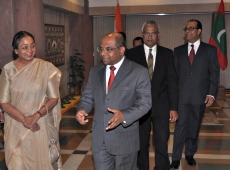
Meanwhile, a Maldivian parliamentary delegation led by Parliament Speaker MP Abdulla Shahid is also in India and met with Indian Parliamentary Speaker Lok Sabha Smt. Meira Kumar yesterday (May 6).

Kumar assured the visiting delegation that India would extend “all possible assistance” – in close coordination with the ECM – to ensure the September presidential elections are conducted smoothly and peacefully.

She expressed her hope that elections may be held in a free, fair and credible manner.

Kumar said that India and Maldives enjoy “special and time ­tested relations” and reiterated India’s continued commitment to further strengthen and diversify the bilateral relationship. Along those lines, she emphasised the collective task both nations have to create an atmosphere of “strong understanding and interdependencies” in the region to achieve collective progress and prosperity.

Kumar also stressed the need to further strengthen bilateral parliamentary linkages, with the first meeting of the India–Maldives Parliamentary Friendship Group being held during the Maldives delegation visit, acting as a “step in the right direction”.

The Maldivian government was urged to take measures for establishing investor confidence in the country as well as conduct structural reforms to prevent harassment and improve living conditions for the nearly 30,000 strong Indian expatriate workforce.

Shahid assured Kumar that the Maldives would work closely with India for the mutual benefit of both nations and extended an invitation for the India’s parliamentary speaker to visit the Maldives.

“Electoral background discouraging”: Transparency report

The 2013 presidential elections are set to unfold “against a context of uncertainty, crises of political legitimacy and unprecedented levels of political polarisation,” Transparency Maldives has stated, in an extensive pre-election assessment published on March 28.

The detailed report identifies key challenges in the lead up to the election, such as the candidacy of former President Mohamed Nasheed, lack of monitoring of campaign financing, an extensive and entrenched culture of vote buying, and a media establishment set on fueling personality politics and further polarisation.

The ECM said in mid-March it had noticed a surge of discrepancies on membership forms submitted by certain political parties including forged documents, forms with false information and even forms filed under the names of dead people.

“Buy-offs and civic education” challenges: ECI

The current ECM visit to India is part of a joint assistance project agreed upon in early-March during ECI’s eight day visit to the Maldives to study the electoral environment in an effort to enable free and fair elections.

During the ECI’s visit, they identified areas the ECM needs to develop and improve. These included: staff shortages, training needs, and the lack of information technology software. Vote buying is another important issue being addressed, the ECM’s President Fuad Thaufeeq previously explained to Minivan News.

Speaking to Minivan News at the time, India’s Deputy Election Commissioner Dr Alok Shukla said that preventing voter “buy-offs” and improving civic education were two “big” challenges about which the ECM was “extremely concerned”.

Likes(0)Dislikes(0)

Maldives included in United Nations’ US$2 million anti-piracy project

United Nations Trust Fund for the Fight against Piracy has approved a US$2 million package of projects for affected nations, including the Maldives.

The aim of the five projects, approved April 30, is to ensure ongoing piracy trials are conducted in a fair and efficient manner and that the human rights, health and safety of individuals suspected of piracy are protected. This includes facilitating the repatriation of detainees suspected of piracy from the Maldives to Somalia.

Other initiatives involve providing support to law enforcement authorities and prosecutors in “front-line States” to investigate illicit financial flows from piracy. Biometrics-based fishermen database systems will also be implemented to support monitoring and surveillance of fisheries resources, while also providing important information to counter-piracy forces. Projects have been approved for Somalia, Djibouti, Ethiopia, Kenya, the Seychelles, and the Maldives.

United Nations Assistant-Secretary-General for Political Affairs Tayé-Brook Zerihoun acknowledged the gains made in controlling piracy, but stressed that the international community “should not be under any illusion that piracy has been conclusively brought under control” during the announcement of the projects in New York.

“The dramatic decline in pirate attacks is clear evidence of years of hard work by United Nations Member States, international and regional organizations, and actors in the shipping industry,” said Zerihoun.

“The international community should continue to support the efforts of Somalia and States in the region to strengthen their maritime law enforcement capacities and their rule of law sector.

“With the Trust Fund’s resources largely spent, now is the time to replenish the Fund to bridge critical gaps in counter-piracy efforts,” he added.

The United Nations Trust Fund for the Fight against Piracy was established in 2010 and have received approximately US$17 million in contributions from member states and the maritime industry. The funds have been used for 31 projects, totalling approximately US$16 million, and “short-term needs related to unforeseen expenditures”.

The purpose of the trust fund is to “defray expenses” associated with prosecuting suspected pirates and undertaking other activities to fight piracy.

The trust fund’s Board is comprised of 10 voting member States – Germany, Italy, Kenya, Republic of Korea, Norway, Qatar, Seychelles, Somalia, Turkey, and the United Kingdom – and three non-voting entities, the International Maritime Organization (IMO), the United Nations Office on Drugs and Crime (UNODC), and the United Nations Political Office for Somalia (UNPOS).

Piracy threat

The Maldives is situated at a strategic intersection of sea trade routes, and a significant amount of global maritime traffic passes through or near the country’s northern atolls.

Due to increasing pirate attacks in the Indian Ocean and the frequent encounters with Somali castaways in Maldivian territory, maritime experts have speculated that the piracy threat is growing in Maldives.

“We are very concerned about piracy in the Maldives since we are located in the Indian Ocean, one of the major areas [at risk],” Foreign Ministry Spokesperson Ibrahim Muaz Ali told Minivan News today (May 6).

“The Maldives has already raised these issues with international organisations and international media,” he added.

Ali confirmed that although recent joint military exercises with neighboring SAARC countries, such as India and Pakistan, were not solely for anti-piracy purposes, that issue was included.

“We are seeking protection [from pirate attacks] from SAARC countries,” said Ali.

In an effort to address the growing threat of piracy and rising concerns over the security within Maldivian territorial waters and the wider Indian Ocean, the Government proposed an anti-Piracy bill in January 2013.

The stated purpose of the bill is to establish a legal framework to deal with piracy within the territorial waters of the Maldives amidst concerns at the growing risk of maritime crime in the Indian Ocean over the last few years.

The bill also seeks to outline legal procedures to deal with individuals suspected of committing acts of piracy within Maldivian territorial waters, give that such procedures do not presently exist in the country’s legal system.

Pirate attacks

The Maldives experienced the first confirmed case of piracy within its waters back in March 2012, when a Bolivian-flagged vessel headed for Iran was hijacked by Somali pirates. The vessel was released a few days later.

The Maldives’ government first expressed concern over the growing piracy threat in 2010 after small vessels containing Somali nationals began washing up on local islands.

In March 2012, 40 Somali castaways in the custody of Maldives authorities refused to return home despite arrangements that were made for their safe repatriation.

“Some of the Somali refugees are not in the Maldives. I can’t say exactly how many have been repatriated. The process has been ongoing. The Home Ministry and so many others are involved,” explained Ali.

In January 2012, an American luxury passenger line en route to the Seychelles was stranded in the Maldivian waters due to an alleged “piracy risk”, while the passengers departed to the Seychelles through airline flights.

Likes(0)Dislikes(0)

Coast Guard rescues five after fishing boat sinks due to bad weather

The Maldives National Defence Force (MNDF) Coast Guard have found and rescued the crew of a fishing boat that sank near Gaafaru Island in Male’ (Kaafu) Atoll.

The Coast Guard was notified at at approximately 5:00pm yesterday (May 5) that the Riveli fishing boat’s engine failed due to bad weather and the vessel was sinking, reported local media.

The Coast Guard located the 45 foot fishing boat this morning. It was “badly wrecked” and sunk on top of the reef, according to the MNDF.

MNDF Media Officer Abdulla Ali told local media today (May 6) that five people onboard the vessel were found floating with the aid of their life jackets inside the Gaafaru lagoon.

Four of the people are on route to Male’ and one is in need of medical attention, he added.

Likes(0)Dislikes(1)

Couple charged with murder after allegedly aborting, burying five-month old foetus

The Criminal Court has charged a couple from Seenu Atoll with murder after they allegedly aborted a pregnancy and buried the five month-old foetus on the beach of Maradhoo-Feydhoo.

Twenty-one year-old Aminath Shaahee Aalam was 20 weeks pregnant when she gave birth on December 12, 2012, according to local media. Shortly after she gave birth, her husband, 26 year-old Ibrahim Wisam, stands accused of placing the foetus in a plastic bag and burying it on the beach.

Police discovered the foetus buried on a Maradhoo-Feydhoo beach after local witnesses reported a motorist acting suspiciously in the area on the evening of December 14, according to local media. Abortion in the Maldives is illegal unless it is proved the conception is the result of rape, or that the pregnancy is a threat to the mother’s health.

The Prosecutor General’s Office forwarded the couple’s case to the Criminal Court on May 2, however a trial date has not yet been scheduled.

The young married couple from Maradhoo-Feydhoo – an administrative district of Addu City – are both being charged with murder, Criminal Court Spokesperson Ahmed Mohamed Manik confirmed to Minivan News today (May 5).

The prosecution accused Aalam of taking abortion pills, and alleged the couple did not seek medical care during the woman’s pregnancy, labour, or after giving birth to the five month-old foetus.

Police have stated that the buried foetus was found with its heart beating, but later died after being taken to the hospital, Manik explained.

Police said the couple had said they chose to bury the foetus because they did not want to have a child at that point in time, according to local media.

A medical authority in the Maldives informed Minivan News that a five month old foetus would be incapable of surviving outside the mother’s body.

In previous similar cases in the Maldives, a lack of post-mortem services and an absence of visible wounds on the body was observed as making it difficult to prove charges of infanticide without a confession from suspects.

In 2006, the Juvenile Court acquitted a woman from Dhabidhoo island, who police alleged had killed her newborn and disposed of the body in the lagoon, ruling that her three confessions contradicted each other. The woman gave birth out of wedlock in 2008.

Desperate measures

Cases of abortion, infanticide and discarded infants have been widely reported in local media over the past two years, particularly a spate of discoveries over several weeks in May 2011. One foetus was discovered in hidden in a milk tin, while the other was found at the bottom of Male’s municipal swimming pool area.

Later the same month, the corpse of a newborn infant was found discarded in some bushes with underwear tied around its neck.

A further two newborn children were discovered abandoned but alive the same year, and were placed under state care.

In December 2012, a newborn was found abandoned on a pavement in Male’, while in June the same year police recovered the body of a newborn infant buried in the outdoor shower of a house on Feydhoo in Shaviyani Atoll. The baby’s mother was identified as a 15-year old school student, who had allegedly been abused by her stepfather.  The girl’s stepfather was himself later charged with child sexual abuse and premeditated murder.

The 15 year-old meanwhile confessed to an unrelated instance of premarital sex during the police investigation and was sentenced by the Juvenile Court in February 2013 to 100 lashes and eight months of house arrest for the crime of fornication.  At present, the minor will be lashed once she has turned 18.

The girl’s case has garnered international attention and a petition by Avaaz for the government to appeal the sentence and issue a moritorium on the flogging of women for extramarital sex.  The petition has so far reached over two million signatures.

Social stigma

Birth out of wedlock remains heavily stigmatised in the Maldives. An unreleased 2007 study by the International Planned Parenthood Federation (IPPF) found that the stigma of having a child out of wedlock compels Maldivian women and girls to opt for abortions, and while a taboo subject, the practice was found to be widespread.

Some of those interviewed for the study said they knew of girls as young as 12 who had undergone abortions, and each knew at least one person who had terminated a pregnancy.

Abortion is illegal in the Maldives except to save a mother’s life, or if a child suffers from a congenital defect such as thalassemia. Many women unable to travel to Sri Lanka resort to illegal abortions performed by unskilled individuals in unhygienic settings, or even induce abdonminal trauma or insert objects into their uterus.

Other studies focusing on HIV have identified associated risk factors contributing to unplanned pregnancy including high levels of promiscuity and limited use of contraception.

The Centre for Community Health and Disease Control (CCHDC) has described these incidents, as well as the figures detailing an increase in the rate of sexually transmitted diseases, as evidence of a sexual health crisis in the Maldives.

Nazeera Najeeb, who leads the reproductive health unit of the CCHDC, told Minivan News in an 2012 interview that the centre was witnessing an “alarming” increase in cases of underage and unplanned pregnancies, where some girls are getting pregnant “without even knowing it”.

“These unwanted pregnancies are subsequently resulting in more unsafe abortions, baby dumping or infanticide,” she noted.

To curb these perceived problems, Najeeb stressed the need for implementing a comprehensive sex education curriculum in and outside educational institutions to create greater awareness on sexual and reproductive health subjects.

Though the concept of sex education is widely supported by health authorities, including Health Minister Dr Ahmed Jamsheed, efforts to implement such practices nationally have been limited.

Likes(2)Dislikes(0)