EC warns parliament over VTV’s attempt to “incite uprising” against commission

The Elections Commission (EC) has raised concerns in Parliament’s National Security Committee that there may not be a suitable environment for the presidential election’s second round should Villa TV (VTV), owned by Gasim Ibrahim and his Jumhooree Party (JP), continue to deliberately spread false information and incite people to rise up against the commission.

The National Security Committee unanimously approved the EC’s request to share their concerns about local media spreading JP’s “baseless and unfounded” claims last Friday (September 13).

The parliamentary committee then summoned the Elections Commission (EC), the Maldives Police Service (MPS), the Maldives National Defence Force (MNDF), and the Maldives Broadcasting Commission (MBC) to appear for questioning Saturday (September 14) in regard to its investigation into the EC case filed against the JP.

“For the past week, the media has been trying to spread a lot of untrue stories. There have been so many figures quoted with no truth in them,” EC Chair Fuwad Thowfeek told Minivan News yesterday (September 15).

“The problem isn’t local media in general, but VTV has been doing this deliberately,” said Thowfeek.

VTV had been continuously broadcasting the live program ‘Olhuvaalee Vote Ge Namugai’ (‘fraud in the name of the vote’) as well as reports against the EC and Maldivian Democratic Party (MDP), since the preliminary results from presidential election’s first round indicated Gasim placed third with 24.07 percent, a total of 50,422 votes.

“We went to Parliament’s National Security Committee and raised these concerns because VTV and JP [members] at their ‘jagaha’ (campaign meeting hub) are inciting people to uprise,” said Thowfeek.

“We are concerned that if they keep continuing that we may not find the opportunity for a peaceful, harmonious environment suitable for voting on the 28th,” he continued.

During the National Security Committee meeting these issues were brought to the attention of the Maldives National Defence Force (MNDF), Maldives Police Service (MPS), and Maldives Broadcasting Commission (MBC).

“These three institutions were present during the second round of the meeting Saturday – MBC because of VTV’s role in broadcasting these things all day and night,” noted Thowfeek.

“The MNDF and MPS [were notified] because the JP and VTV have continued to call on people to obstruct and oppose the second round of elections,” he explained.

“However, I noticed a change in VTV’s content after the National Security Committee meeting, because I didn’t see the ‘Olhuvaalee Vote Ge Namugai’ program broadcast Saturday night,” he added.

Minivan News observed this morning (September 16) that the ‘breaking news’ on VTV involved broadcasting as fact allegations that the EC was destroying election-related documents.

Police acted on the JP’s claim and barricaded the entrance to the EC secretariat early this morning, however by afternoon police had released a statement confirming that no documents potentially affecting the election results had been found among those disposed of by the commission.

“It’s really sad that one of the [presidential election] contestants – after he failed to get the votes required to compete in the second round – has behaved in such a very immature manner,” said Thowfeek.

“Gasim and [his running mate, Dr Hassan] Saeed both failed in the first round of the 2008 presidential election and without any fuss or problems they accepted their defeat,” he noted. “So I thought they’d be more mature this time and not raise problems, but this time they have failed to digest their loss.”

“It’s not a good example to set for the public and it’s not a good thing for the future,” he added.

Committee statements taken out of context: EC

Thowfeek also noted that statements he and EC Member Ali Mohamed Manik gave about the voter registry during the National Security Committee meeting had been taken out of context by local media.

“Saying these [11] people [who voted in the first round] were not registered voters is not true information,” said Thowfeek.

“These people were on the voter registry list. They were on the final gazetted list that was published publicly, they are not new names,” he continued. “The were also found on the voter registry that was sent to the ballot boxes.”
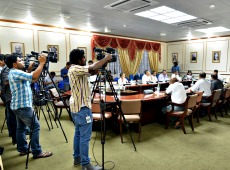
Thowfeek explained that an interim voter registry document was created after the voter list was published on the government gazette – and accessible for public review so the EC could be notified of needed corrections.

While the 11 voters in question were not included on interim document, their names were found on final voter registry list sent to polling stations, he emphasised.

“Due to a clerical error the EC was not able to find their names in the correct places [on the interim document],” said Thowfeek. “It was the fault of the EC administration. However, this was a case by case issue.”

“If anyone’s name is missed to the a fault of the EC then the commission is responsible for correcting the problem and giving the person a chance to vote,” he added.

Thowfeek emphasised that international observers from 17 commonwealth countries – including Australia, Malaysia, India and UK – as well as the US, EU, Japan and Thailand had all praised the smooth, calm, peaceful, transparent and open election process.

“During a gathering we had with the international observers the evening of September 8, they said this election is just like what anybody can see in a developed country because it was so open, transparent and organised,” he added.

Local media problems

Meanwhile, MBC has launched an investigation into VTV broadcasting unsubstantiated content to incite hatred against the EC in violation of the broadcasting code of practice. The commission stated that it was investigating the matter after a case was filed by a private individual.

“The investigation is ongoing, so I cannot comment [on the VTV case],” MBC President Mohamed Shahyb told Minivan News today.

“We have to watch real time video [from VTV] which takes time,” he explained. “If it is determined that VTV breached the [broadcasting] code of practice then we will give them an opportunity to respond.”

“The commission has to follow procedures to give them time to reply, only then we can adjudicate and reach a final conclusion,” he added.

Shahyb expects the investigation will “probably” be completed by late this week or early next week.

Although the VTV case also falls within the Maldives Media Council (MMC)’s mandate, no official complaints have yet been filed, the MMC told Minivan News today.

However, the MMC did receive an SMS expressing concern with VTV’s broadcasts, which was discussed by the council’s five member committee dedicated to election issues.

With the ongoing Supreme Court and High Court cases as well as MBC’s investigation, the MMC has not decided to take any official action as of yet, however the issue is “on the table”, it noted.

The MMC also noted it had not received any official complaints regarding the conflicting and inaccurate media reporting of first round voting figures during the counting process.

Confusion over the voting figures was created by local media reports not matching those of the EC during counting, with sluggish EC figures supplemented by differing poll results, depending on the outlet chosen. One local newspaper even had voted turnout at 102 percent for much of the counting process.

Prior to the release of the provisional results at 5:00am on Saturday 8, a small group of JP supporters demonstrated outside the Dharubaruge convention centre alleging a 10,000 vote discrepancy.

Likes(2)Dislikes(0)

Government paying Grant Thornton £4.6 million to halt STO oil trade investigation

The Maldivian government has reportedly been paying millions of dollars in penalty fees to forensic accountancy firm Grant Thornton, after last year terminating its contract to recover assets allegedly stolen during the 30 year regime of Maumoon Abdul Gayoom.

Under the terms of the contract, signed by the former Nasheed administration in July 2010, Grant Thornton would charge no fee for the investigation beyond costs such as flights and accommodation, instead taking a percentage of the assets recovered. At the same time, Grant Thornton was entitled to charge a penalty fee of up to US$10 million should the government terminate the investigation, such as in the event it arrived at a political deal.

One of the first acts of President Dr Mohamed Waheed’s government after 7 February 2012’s controversial transfer of power was to dissolve the Presidential Commission which had been overseeing Grant Thornton’s investigation, and terminate the agreement with the forensic accountants.

In August 2012, Attorney General Azima Shakoor issued a statement announcing that her office had received two invoices totalling US$358,000 and GBP£4.6 million from Grant Thorton, charges she claimed were for legal advice provided to Nasheed’s government.

Azima had not responded at time of press, but Finance Minister Abdulla Jihad confirmed to Minivan News last week that the government has been paying the charges, though he said he did not have the exact amounts to hand.

Minivan News understands from a source familiar with the matter that the government paid an initial GBP£1.5 million (US$2.4 million) on 24 April 2013, with the remaining amounts to be paid in monthly installments of GBP£300,000 (US$476,000) each.

According to the source, the Maldives Monetary Authority (MMA) remitted these monthly payments to Grant Thorton on May 22, June 27 and July 17.

STO and the Maldives-Burma oil trade

On 1 February 2012, a week before Nasheed’s government was toppled by opposition demonstrators and a mutinous section of the police, the Presidential Commission had forwarded a case for prosecution against Gayoom’s half-brother MP Abdulla Yameen over his alleged involvement in an oil trade of up to US$800 million with the Burmese military junta, during his time as chairman of the State Trading Organisation (STO).

“As of February 2012, Grant Thorton were ready with a criminal complaint, having obtained a number of documents relating to financial dealings from Singapore banks through court orders issued by Singapore courts,” stated Dr Ahmed Shaheed, former Foreign Minister and head of the Presidential Commission, shortly after the contract’s termination.

Yameen is contesting the presidential run-off against Nasheed on September 28. He has publicly dismissed the allegations on repeated occasions, distancing himself from the Singapore branch of the STO where the trade to Burma took place, as well as disputing any illegality in the trade.

The allegations first appeared in February 2011 in India’s The Week magazine, which described Yameen as “the kingpin” of a scheme to buy subsidised oil through STO’s branch in Singapore and sell it through a joint venture called ‘Mocom Trading’ to the Burmese military junta at a black market premium price.

That article drew heavily on a leaked draft of an investigation report by Grant Thorton, dissecting the contents of three hard drives containing financial information regarding transactions from 2002 to 2008. No digital data was available before 2002, and the paper trail was described as “hazy”.

Grilled by parliament’s National Security Committee over the matter in November 2011, Yameen denied any involvement in “micro-management” of STO subsidiary companies during his time as chairman until 2005.

Jumhooree Party vows to reopen investigation

In the lead up to the first round of the presidential election – in which the Jumhoree Party (JP) narrowly missed second place in the run-off to Yameen – JP vice presidential candidate Dr Hassan Saeed vowed to “reopen” the investigation into the STO oil case “as an issue of the highest priority.”

Dr Saeed was President Waheed’s Special Advisor at the time the Presidential Commission was dissolved, and the Grant Thornton contract terminated.

“Abdulla Yameen’s case was started under the previous government. While it was being investigated this government came into office, canceled the contract [with Grant Thornton] and paid 4.6 million pounds on the condition that it not proceed with the investigation, of which a large portion has now been paid,” Dr Saeed declared, during a press conference on August 31.

Saeed claimed that Grant Thornton attempted to communicate with Dr Waheed’s administration regarding the investigation but had received no reply. The accounting firm therefore decided that the contract was at an end and hired a debt collection agency, he revealed.

Asked by media if he had any role in terminating the contract as Waheed’s special advisor, Saeed claimed the contract was already cancelled when he became aware of it.

He further claimed that Dr Waheed was forced to reappoint STO Maldives Singapore Pvt Ltd and Maldives National Oil Company (MNOC) Managing Director Ahmed Muneez because of “pressure from Yameen.”

“Dr Waheed said he had to do it because of extreme pressure from Yameen,” Saeed said.

President Waheed, who polled 5.13 percent in the vote, has since declared he will back Yameen in the second round of the presidential election.

“I say this because in my opinion, the best path for this country cannot be the weakening of the constitutional framework, breaking the law, arson, or the creation of conflict,” Waheed said, explaining his decision to back Yameen in a statement published on the President’s Office website.

Likes(2)Dislikes(0)

Elections Commission announces final first round election results

The Elections Commission (EC) has announced the final results from the first round of the presidential election held September 7.

The EC announced the results yesterday (September 14) after the High Court rejected the Jumhooree Party’s (JP) request for an injunction to halt the announcement.

Maldivian Democratic Party (MDP) presidential candidate and former President Mohamed Nasheed placed first, winning 95,224 votes, or 45.45 percent.

Progressive Party of the Maldives (PPM) candidate Abdulla Yameen – an MP and half-brother of former autocratic President Maumoon Abdul Gayoom – received 25.35 percent,or 53,099 votes, to place second.

While the EC’s final results page showed these figures – identical to those released preliminarily on September 8 – local media outlet Sun Online reported that Yameen had received 54,099 votes – a discrepancy of 1,000 votes.

Gasim Ibrahim – resort tycoon, owner of Villa TV (VTV), MP, and JP leader – placed a close third at 24.07 percent, with 50,422 votes.

Gasim and his Jumhooree ‘Gulhun’ (coalition) – consisting of the Islamist Adhaalath Party (AP), the Dhivehi Qaumee Party (DQP), as well as former PPM Vice President Umar Naseer – have contested the election results and are seeking a recount through the High Court and Supreme Court, in addition to staging protests accusing the EC of negligence and vote rigging.

Incumbent President Dr Mohamed Waheed suffered a resounding defeat, securing 5.13 percent or 10,750 votes. Waheed contested the election as an independent candidate, following controversy over whether his Gaumee Ithihaad Party (GIP) had the minimum 10,000 members required under new political party regulation.

Yesterday Waheed announced GIP will support the PPM in the presidential election run-off, although he will be stepping down as head of the party.

The announcement of the GIP backing the PPM comes days after the Dhivehi Rayyithunge Party (DRP) announced its support for Nasheed and the MDP during the second round of voting. The DRP had backed Waheed in the first round vote, with party leader Ahmed Thasmeen Ali standing as the incumbent’s running mate.

Since no candidate received more than 50 percent of the total turnout, a second round run-off election between the top two candidates – Nasheed and Yameen – will be held on September 28.

Dead voters found alive

The EC also announced that eight deceased individuals the JP had claimed to be on the electoral register had been found alive.

The JP had submitted the alleged list of deceased individuals to court, according to local media.

The commission has determined that the eight people did cast ballots and have confirmed that five are living, EC Vice Chair Ahmed Fayaz told local media.  The commission has received information that the other three individuals are also alive, but the EC has not yet been able to meet them.

Fayaz told local media last week that the EC had previously rejected a voter list provided by the Department of National Registration prior to polling because it listed people who are still alive as deceased.

“They give us a list, [stating that] these 1,200 people are dead. If we deduct these 1,200 people [from the voter registry] without reviewing, an extra 400 people will come to vote,” said Fayaz.

However, the Jumhooree Party has now accused the EC Vice Chair of “outright lies”, claiming that the coalition did not submit a list of eight supposedly deceased individuals included in the electoral register to the EC.

“We call on Fayaz not to engage in such lies. We ask the EC to work independently,” said Ibraim Khaleel, Gasim’s spokesperson and former Villa TV chief executive officer.

No grounds for recount

Meanwhile, in response to representatives from the JP, the PPM, and President Waheed calling for a recount of all ballot boxes during an Elections National Advisory Committee meeting held Thursday (September 12), the EC stated that the alleged vote discrepancy was not enough to call for a recount of all 470 ballot boxes.

The law states there are two instances where ballot boxes may be recounted: 1) If the EC decides the voting process was compromised and decides to conduct a recount to address a complaint(s); 2) If there is a court order issued for a recount, EC Vice Chair Fayaz explained to local media.

MDP’s representative on the National Advisory Committee insisted there were no grounds to warrant a vote recount and argued that the JP noted no issues during polling.

President Waheed has said he is “very concerned” about “some very serious allegations regarding the election” and urged these issues be resolved “by the respective legal and judicial venues”.

However, EC Chair Fuwad Thowfeek has emphatically dismissed the JP’s allegations of rampant vote-rigging, pointing to the commission’s transparency, ongoing complaints investigations, and the praise from a broad spectrum of election observers who noted peaceful voting throughout the day and the preparedness of the EC.

Local NGO Transparency Maldives – which ran the most comprehensive observation operation on the day – also announced prior to the release of the provisional results that none of the incidents reported on election day would have a “material impact on the outcome of the election”.

The UK and the EU have both issued statements praising the conduct of Saturday’s presidential election, describing them as “transparent and competitive”.

Likes(1)Dislikes(0)

National Security Committee investigating local media spreading JP’s claims against Elections Commission

Parliament’s National Security Committee summoned the Elections Commission (EC), the Maldives Police Service (MPS), the Maldives National Defence Force (MNDF), and the Maldives Broadcasting Commission (MBC) to appear for questioning today in regard to its investigation into an EC case filed against the Jumhoree Party (JP).

An EC letter requesting the National Security Committee provide the commission an opportunity to share their concerns about local media spreading JP’s “baseless and unfounded” claims, was presented yesterday (September 13) by committee chairperson MP ‘Reeko’ Moosa Manik and unanimously approved, according to local media.

“The National Security Committee is concerned that the [presidential] contestants unfounded claims of corruption against the EC are a threat to national security,” Maldivian Democratic Party (MDP) MP and Spokesperson Hamid Abdul Ghafoor told Minivan News today.

MBC has been summoned to the parliamentary committee for allegations that Villa TV (VTV) – owned by resort tycoon and JP presidential candidate Gasim Ibrahim – was spreading information to incite hatred against the EC, while the MPS and MNDF will be questioned to determine whether current events pose a threat to national security, according to Sun Online.

Meanwhile, MBC has launched an investigation into VTV broadcasting unsubstantiated content in violation of the broadcasting code of practice. The commission stated that it was investigating the matter after a case was filed by a private individual, according to local media.

VTV has been continuously broadcasting the live program ‘Olhuvaalee Vote Ge Namugai’ (‘fraud in the name of the vote’) as well as reports against the EC and MDP ever since Gasim placed third in the first round of the presidential election with 24.07 percent, a total of 50,422 votes, reports CNM.

Asked about the confusion over the voting figures in the media not matching those of the EC during counting, Elections Commission Vice Chair Ahmed Fayaz criticised local media’s role in the matter.

“Politicians and newspapers have reported this [10,000 votes issue]”, he said, singling out the online publication Times.mv for particular criticism.

Meanwhile, during an elections National Advisory Committee meeting held Thursday (September 12), the JP, along with representatives of the PPM and President Mohamed Waheed, agreed they all want a vote recount of all ballot boxes conducted.

However, the MDP’s representative on the Advisory Committee insisted there were no grounds to warrant a vote recount and accused JP of not noting any issues during polling.

“It’s a matter of principle – this was a democratic election held under a democratic system. All parties were given an opportunity to send observers and monitors, and their observations [of the voting and counting process] were done in front of the people, as per the law,” said Ghafoor.

“This was an elaborate, laborious process with each count confirmed and then exhibited at each voting centre,” he continued.

“A recount would set a bad precedent that is not in the national interest. It would create a loss of faith in the system,” he emphasised.

Ghafoor noted that international observers have praised the transparency of the election process, including four former Election Commissioners hailing from India and the Commonwealth.

“The EC is one of the [only] effective, independent commissions we have. It has a very clean track record, which everyone knows,” declared Ghafoor. “An elaborately developed legal process [for elections] has been in place since 2008, there have been at least 11 by-elections conducted to date and none of them have been contested.”

He noted that the election results are being contested “by people like Gasim Ibrahim, who are from a culture that has rigged votes all their lives.”

Meanwhile, Elections Commission Vice Chair Ahmed Fayaz told local media the JP had requested a recount without any legal basis. He noted that if all the ballot box seals were broken for a recount, this could create election confidence issues and set a dangerous precedent for future elections. He proposed recounting boxes randomly as an alternative.

Likes(1)Dislikes(0)

Jumhooree Party to call on Supreme Court to annul first round results

The Jumhoree Party (JP) has declared that it intends to ask the Supreme Court to annul the results of last week’s presidential election, in which it narrowly missing placing in the run-off vote scheduled for September 28.

The JP’s presidential candidate Gasim Ibrahim, who placed third 24.07 percent of the vote, last week announced that he believed he “should have placed first“, and disputed the credibility of the results.

The Elections Commission (EC) has dismissed the allegations, pointing to near unanimous agreement among local and international election observers that the elections were free, fair and credible, and that the minor issues noted would not have had an impact on the final results.

However JP Policy Secretary Mohamed Ajmal told Minivan News the party would attempt to prove via the courts that the first round had been “rigged”.

As part of these efforts, he said that the JP would be submitting a “motion” to the Supreme Court on Sunday September 15 seeking to annul the vote, alleging discrepancies and irregularities during polling.

The party has already filed a case at the High Court – on the second attempt, after the first case was rejected – demanding the release of the ballot papers.

“We believe the High Court is delaying this process, and this is something we do not want to see,” Ajmal said, alleging this was in violation of “national regulations”.

Ajmal said the motion would give a “high priority” to its grievances, with the second round of voting just two weeks away.

Gasim and the Supreme Court

Until July 2013 and his official acceptance as a presidential candidate, Gasim was a member of the Judicial Services Commission (JSC) – the watchdog body tasked with appointing and disciplining the judiciary, including the Supreme Court.

Earlier that same month he declared that a leaked video depicting Supreme Court Judge Ali Hameed fornicating with an unidentified foreign woman in a Colombo hotel room was “a fake”.

Days later, two more videos of the judge engaging in sexual relations with foreign women were leaked on social media.

According to Maldivian law, the crime of fornication is subject to 100 lashes and banishment or house arrest for a period of eight months, a sentence regularly and overwhelmingly given to women found guilty of extramarital sex.

A fourth video showed the judge in conversation with a local businessman discussing the politicisation of the judiciary.

Gasim however voted against the recommendation of the JSC’s own subcommittee that Hameed be suspended pending further investigation. The judge remains on the bench.

He claims feuds between politicians were being settled through the court even though these did not involve the law or any legal issues.

Reactions

The Maldivian Democracy Network (MDN) has expressed concern at the way the results of the September 7 elections have been received by “some parties”, urging them “to act in the spirit of democracy and fair play by seeking solutions to grievances through due process and recourse to lawful means.”

“The principles of democracy prohibit threats, intimidation and harassment of each other and such behaviour has no place in a civilised society. MDN further expects that the judiciary will attend to elections-related petitions independently, efficiently and without discrimination,” the NGO stated.

President Mohamed Waheed, who received 5.13 percent of the vote in the first round and today announced that he would be supporting PPM candidate Abdulla Yameen in the run-off, declared that some allegations regarding the election were “worryingly serious”.

“I think it is paramount that these allegations be addressed within the designated legal framework, and justice be served,” President Waheed said in a statement reported by local media.

Maldivian Democratic Party (MDP) Spokesperson MP Hamid Abdul Ghafoor noted the irony that the country’s prior “culture of corruption, vote rigging, and coup d’etat” had been led by the same individuals who were now contesting the legitimacy of the election results.

“These are the same people who lobbied the Supreme Court to get more direct powers for the police and security forces, and thereby a controlling stake in the elections process,” he said.

“It would be unimaginable for the courts to rule against something that the international observers have endorsed. If they agree to a recount that would be going against the international community,” Ghafoor said.

Elections Commission Fuwad Thowfeek has emphatically dismissed the JP’s allegations of rampant vote-rigging, pointing to the commission’s transparency, ongoing complaints investigations, and praise from a broad spectrum of election observers.

“The allegations by the Jumhoree Party are wasting our time actually. They don’t understand democracy or how to accept defeat, it’s a very unfortunate thing,” EC Chair Fuwad Thowfeek told Minivan News last week.

“People who cannot accept defeat should not face an election,” he continued. “It’s a contest so there’s a chance they will win or lose. In this case there were four contestants and only two could advance to the second round. Gasim Ibrahim doesn’t understand [this] and his followers are making a fool out of him,” he contended.

Likes(1)Dislikes(0)

“We will do everything possible to help MDP win the election”: DRP leader Thasmeen Ali

The Maldivian Democratic Party (MDP) held a rally on Friday night to celebrate the Dhivehi Rayyithunge Party’s (DRP) support in the second round of the presidential election.

Jumhooree Party (JP) founding member Ahmed ‘ADK’ Nashid and Maldives Reform Movement leader Dr Mohamed Munavvar – also the former MDP chairperson – also announced their support for the party at the rally, attended by several thousand supporters.

DRP leader Thasmeen Ali, MPs Abdulla Mausoom, Visam Ali, Mohamed Nashiz, Rozaina Adam and other members of the party attended the rally held in the Alimas Carnival area of Male’.

Making the opening statement, MDP Chairperson ‘Reeko’ Moosa Manik asserted that, despite rumours allegedly being spread by political competitors, the two parties had not formed a coalition, and that the DRP had merely decided to back the MDP and to provide assistance in winning the upcoming second round of the election.

The DRP had gone into the first round in coalition with incumbent President Mohamed Waheed.

Speaking at the rally, DRP leader Ahmed Thasmeen Ali said that the party had made the decision based on the overwhelming support that the MDP had received in the September 7 election.

“I assure you that I stand here today with sincerity to ensure MDP succeeds in the coming election, God willing I will stay dedicated to achieving this,” Thasmeen began, prompting a standing ovation from the gathered supporters.

“This country is changing at a very fast pace. This country is going forward, swiftly forward,” he continued, borrowing MDP’s campaign slogan for the second round.

“I don’t believe that anyone can inhibit these tides of change. We have clearly seen the results of the first round of elections. President Nasheed and MDP got 95,000 votes. This is a huge achievement, and incredible success, and I congratulate you all for it.”

“We fully accept the results of the first round. There is no indication that any foul play was involved. I believe that if one fails, one must accept it and learn to digest the loss. In my opinion, it will be irresponsible for any politician or party to not back one of the candidates who are to contest in the final round of this election,” Thasmeen said.

“I want to see the democratic system strengthened and maintained”

“We must think deeply about the two candidates. I thought about which candidate would prioritize national interest, about which candidate would least entertain thoughts of revenge. There is no question in my mind about who that is, it is doubtless MDP’s candidate Mohamed Nasheed,” he stated.

“After taking office in 2008, Nasheed did not act towards his opponents with any intentions of taking revenge. On a single occasion, President Maumoon [Progressive Party of Maldives leader Maumoon Abdul Gayoom] was summoned to the police office, but even then he was taken with all due official respect. Nasheed did not treat either Maumoon or his family with any vindictiveness,” he said.

“The democratic system that came in 2008 with the new constitution is a system that we want to maintain, both then and now,” said Thasmeen – who had contested in the 2008 presidential elections as Gayoom’s running mate.

“A president elected by the people’s vote will take oath. The people will ensure this. The people will not let anyone do this in any other way,” he said, criticizing PPM running mate Dr. Mohamed Jameel Ahmed’s statement in a rally held last week that Nasheed will not be allowed to take office even if he wins the second round of elections.

“I also worked with Gayoom during the reform process which began in 2005. I did so believing that he will stop ruling with autonomy and will step aside and hand over the reigns of the country to a new generation. However, in light of his actions since losing the 2008 elections to date, we have realized that all along his intentions had been to prolong his 30 years of rule. That is not something that will benefit this country, and that is not what the people want today, or even then. We must not give him space to do so,” Thasmeen explained.

“I am standing at this podium tonight and supporting Nasheed because I want to see peace in this country after these elections, because I want to see the democratic system strengthened and maintained. Because the country will not see development unless democracy is upheld. For these reasons, Nasheed must be elected in these elections,” Thasmeen said.

“I believe that it would be an irresponsible and cowardly act to back away from doing what must be done to ensure that democracy is upheld in this country due to some words I might have said in the past. And therefore, tonight I assure all of you that DRP will do everything we possibly can to help Nasheed win these elections. I will stand firm in actively doing whatever is needed of me to reach this goal. We will join campaign activities, and you will see us participate in all campaign events,” he continued.

“God willing, Candidate number one, MDP’s Mohamed Nasheed will take the oath of presidency on Monday, November 11, 2013,” said Thasmeen, concluding his speech to loud applause.

Thasmeen’s speech was followed by similar pledges of support for democracy and the MDP from the other new faces, including MP Rozaina Adam, Dr. Mohamed Munavvar and former Ahmed Nashid.

The last speaker at Friday’s rally was Mohamed Nasheed, who thanked all those who are now extending support to the party, before echoing the pledges and plans included in the party’s manifesto.

Aerial footage of MDP’s rally on Friday:

Likes(0)Dislikes(0)

Comment: The man behind the sneer

One thing that has always struck me about Abdulla Yameen is that he never smiles. I can hardly remember him ever smiling. I think he smiled once, after being acquitted in some court case, but that was the only time. Sure, on his official campaign posters he sports a fake smile – a sort of upside-down scowl. But he never looks happy.

His eyes betray an angry glint, a contemptuousness of the ordinary man. If he has a trademark look, it is surely that sneer, which he seems to wear at almost every interaction with the general public.

If his second round campaign could be summed up in a facial expression, it too would be a sneer, or perhaps a snarl. Since last Saturday, Yameen has launched a vicious and full scale attack against Nasheed, accusing him of being irreligious and a threat to national sovereignty. Apart from trying to bribe the police and military with free housing and healthcare, Yameen hasn’t had a single positive word to say about what he would do if elected president.

Is Nasheed really that bad? Or is Yameen trying to draw everyone’s attention to Anni because he doesn’t want people focusing too closely on himself? Because when you dig a little into Yameen’s past, and the nature of his character, you tend to end up in a very dark place.

Some of the most shocking revelations come from the people Yameen is now desperately trying to woo onto his side: the Jumhoree Party.

According to JP official Ahmed “Maaz” Saleem, such was the rampant corruption that existed under Yameen’s watch when Trade Minister that major foreign investors quit the country, including Shell Oil and German investors who wanted to build ‘Maldives Media City’.

Gasim’s running mate, Hassan Saeed, said if he came to power he would put Yameen on trial over his involvement in the alleged theft of $800 million dollars worth of oil, money that should have gone into building schools, hospitals and harbours.

The scale of this alleged theft is staggering: the entire annual government budget is only US $1 billion. Yameen is accused of stealing 80 percent of it!

Nasheed’s government hired international experts Grant Thornton to investigate the chares and recover the money. What they uncovered is shocking.

When he was head of STO, responsible for the country’s oil shipments, Yameen allegedly set up a shell company in Singapore called Mocom Trading. Shady characters were involved, such as the former head of Malaysian military intelligence. Mocom would buy oil using STO’s money but instead of bringing it to Maldives, they sold it to the military junta in Burma, which was then under international sanctions because of its human rights abuses.

The huge profits generated from this illegal trade were stashed in secret bank accounts in Singapore. According to revelations published in the Indian media, Yameen was the “kingpin” of this vast criminal operation.

Most concerning, the oil was sold to people in Burma who were involved in the heroin trade. One such person was Tun Myint Naing, otherwise known as Steven Law. The United States calls Law’s father, Lo Hsing Han, the “Golden Triangle Heroin Baron”. Both Law and his dad are banned from traveling to America because of their links to drug dealing.

Yameen’s STO oil racket happened in the mid 1990s – the exact time when Maldives was flooded with ‘brown sugar’ heroin. This raises the question: did Yameen sell the Maldives’ oil to Steven Law for dollars, or did the son of the “Golden Triangle Heroin Baron” give something else in exchange for the oil? And was that something else shipped to Maldives, sold on Male’s streets, and did it end up harming so many of our young people?

Certainly, Yameen’s rival in the PPM primary race, Umar Naseer, seems to think so. Umar – who claims Yameen rigged the contest to become PPM’s presidential candidate – says Yameen “is involved in drug trafficking and commissioning gangs to cut down political opponents.”

The alleged links to Male’s violent street gangs hangs around Yameen like a bad and persistent smell. Along with the allegations of corruption and drug dealing, they point to a dark and sinister man: more of a mafiosi than a politician; a don rather than a democrat.

And then we have Yameen’s role in the abuse of the Sheikhs. Religious conservatives were brutally suppressed under Gayoom’s rule. Many were jailed, beaten and tortured. Gayoom’s security forces would forcibly shave off people’s beards and rub chili powder into their faces. Yameen served in his brother’s cabinet for years. But he never once lifted a finger to stop the abuse or utter a single word of condemnation. His current attack on Nasheed’s Islamic credentials has the distinct ring of hypocrisy.

Perhaps I am being unfair. Perhaps all these rumours and allegations are just that: rumours. Perhaps Yameen is as gentle as a doting grandpa. On 28 September, the people will give their verdict. We will find out if we are willing to place our families’ future in the hands of the man behind the sneer.

All comment pieces are the sole view of the author and do not reflect the editorial policy of Minivan News. If you would like to write an opinion piece, please send proposals to [email protected]

Likes(0)Dislikes(0)

Week in review: August 31-September 12

The past two weeks were dominated by the build-up to, and the fall-out from, the first round of the presidential elections. Last minute campaigning saw Maldivian Democratic Party (MDP) candidate Mohamed Nasheed try his hand at both rapping and speed-dating in order to bolster his support.

Nasheed also took time from the campaign to talk with Minivan News about post-election justice, and lessons learned over the last 18 months. The party estimated 10,000 of its supporters gathered for the final pre-election rally, where Nasheed pledged his commitment to developing the country.

Other parties continued to express their concerns over the upcoming poll, with both the Progressive Party of Maldives (PPM) and the Jumhooree Party (JP) citing the potential use of disappearing ink to alter the result. Responding to an elections related case filed by a PPM member the week before, the Supreme Court urged the Elections Commission to ensure the freedom and fairness of proceedings.

The EC responded to the non-specific ruling by saying that it would not be making any late changes to the voting registry. The PPM’s manifesto arrived with just days to spare, revealing plans to slash the state budget by MVR 4 billion ($259.9 million) as well as the introduction of extensive youth and sports programmes.

Final preparations for polling day saw the details of both international and domestic observer missions finalised, while activists of all colours (and motivations) decorated the streets of Male’ as a carnival atmosphere took hold. Incumbent President Mohamed Waheed spoke with Minivan News just hours before the election, declaring his confidence that the following day’s vote would be the best in the nation’s history.

Waheed had been joined by his three opponents earlier in the week for a live presidential debate. His singling out of the Blackstone seaplane takeover – as an example of his government’s success in attracting foreign investors –  appeared ill-advised, however, as numerous tourist industry stakeholders later revealed the detrimental impact the deal was having on business.

Meanwhile, it was the impact of the election in the atolls which attracted international headlines, with two separate instances of cursed coconuts, as well as a black magic doll and possessed children – all allegedly linked to party politics. Up to three people were also arrested on Kulhudhufushi on suspicion of illegally printing ballot papers, although island council sources stated that these were oversize laminated versions produced by the MDP to demonstrate the voting process.

Post-election

Despite a peaceful and much-praised polling operation, the EC’s critics were demonstrating against the outcome before the commission had been able to announce the provisional results. After initially claiming 10,000 additional votes had been cast, leader of the third-placed Jumhooree Party Gasim Ibrahim soon declared that he ought to have come in first, despite finishing over 40,000 votes behind the first-placed Mohamed Nasheed.

After JP supporters held protests outside of the EC Commissioner’s residence, Fuwad Thowfeek hit back, dismissing the party’s unconvincing allegations as something a ‘small child would not believe’. The High Court was quick to reject the JP’s requests to see the first round results sheets and to postpone their official announcement. The EC also took aim at the JP’s coalition partner, the Adhaalath Party, warning them that they faced dissolution if they continued to use Islam as a political weapon.

The MDP resumed campaigning optimistic of securing  the “few thousand additional votes” that would see their candidate secure a return to the presidency. “The people have again said a resounding ‘no’ to Gayoom, as they did in 2008,” a triumphant Nasheed told supporters at their first post-election rally. The party’s optimism will have been enhanced by the new that the Dhivehi Rayyithunge Party – aligned with President Waheed in the first round – would support Nasheed in the second, though it will be wary of the PPM’s apparent determination to prevent Nasheed taking office, regardless of the election’s outcome.

Other news

Despite the past weeks being dominated by the choosing of the next president, the issue of how the incumbent took office was not off the agenda. The appearance of a supposed ‘coup agreement’ on social media – apparently outlining a planned overthrow of the Nasheed government – was dismissed as a fake by those implicated in the document.

This did not prevent the MDP requesting the Prosecutor General look into the issue, despite its leader’s prior suggestion that the PG is unable to act impartially in the current system. The MDP continued to argue that cases against its MPs are being fast-tracked, in particular charges against Abdulla Jabir and Hamed Abdul Ghafoor in relation to alcohol possession.

The police commissioner’s appointment shortly after the February 7 transfer of power was deemed legal by the Police Integrity Commission, although Abdulla Riyaz’s poltical tweets were not  – the watchdog has recommended the Home Ministry take action. Riyaz defended the police against renewed allegations of partisanship as well as rewarding his force with 300 apartments in the same week.

This week also saw the conclusion of the Criminal Court trial into the deaths of British honeymooners Emma and Jonathon Gray. Swedish national Filip Eugen Petre was acquitted of all charges related to the quad-biking accident on Kuredu Island Resort in August 2011.

Away from politics, the Maldives national football team began the South Asian Football Federation Championship in high-scoring form, scoring 18 goals in their first two group games, including a record-breaking 10-0 win over Sri Lanka. The team’s prowess in front of goal would prove their undoing, however, as a healthy goal difference saw them top the group and draw champions India in the second round. In an ill-tempered game, the Indian’s sneaked a one-nil victory, going on to lose to Afghanistan in the final.

Four Seasons Kuda Huraa hosted its third consecutive annual surfing competition with domestic and international surfers competing in multiple events. The site of the competition’s – at Thamburudhoo Island – ensured that politics were never far away from this event, however, with three Australian surfers questioned for five hours by police. The surfers – wearing ‘Save Thamburudhoo’ t-shirts – were questioned regarding their involvement in the local campaign against the privatisation of the surf break. Politics was even discussed with the Maldives premier musical export Nothnegal, who revealed details of their new EP to Minivan News this week.

Likes(0)Dislikes(0)

Comment: Maafushi a shining example of guest-house tourism

President Nasheed’s references to guesthouse tourism on the local inhabited island of Maafushi in the recent televised presidential candidates’ debate has drawn comment from many in the tourism industry (not to mention the opposition parties and the various political affiliates whose only job seems to criticise Nasheed at every available opportunity).

Those references by Nasheed were made for a very good reason. Because Maafushi is a shining example of how successfully guesthouse tourism has been implemented on an inhabited island, and  illustrates how every employable person, every man or woman seeking a job on the island, has the opportunity to seek gainful employment.

Not only that, all the service-provision on the island has thrived on the commercial viability and need of the visitors coming to the island’s shores.

Cafés, restaurants, and water-sports businesses are thriving, as is the home gardening of local vegetables and fruits which can be sold to readily available buyers. All of these of course are what the guest-house policy is designed to achieve.

Occupancy of guest houses on the island is impressive with an average occupancy rate of over 70 percent – further demonstrating that demand is steady enough to support this newly emerging segment of the Maldives tourism product. In short, Maafushi demonstrates that guest-house tourism can indeed be successfully replicated across all the atolls of the Maldives.

MDP’s guest-house policy, like all of its policies, has been designed after extensive research, public consultation and with assistance and guidance of experts from the economic sector. During our public policy consultation process, which took the form workshops and repeated visits to local islands over several months, local entrepreneurs and concerned citizens alike consistently expressed their desire for an MDP policy “to bring tourism to our atoll”.

Without a doubt tourism, as it should, has remained the cornerstone of MDP’s vision for regenerating growth in the economy. The guest-house policy especially is aimed to kick-start local economies and more importantly to utilise the natural resources endowed on our beautiful islands. The competitive advantage of the Maldives as a tourist destination is the unique formation of the small islands, ringed as atolls, surrounded by reefs and ensconcing a breathtaking undersea marine life.

MDP’s policy team has asked all the right questions. What exactly is the Maldives tourism product? What are its components? At what point of maturity in the destination’s image should new components be introduced? Can occupancy rates be met if we introduced a different segment of tourism? What will guest-house tourism do to the existing resort tourism and safari-boats and dive-tours? Will budget tourism dilute the ability to market the destination successfully as a romantic island getaway on which exclusivity to guests is guaranteed?

These questions have been thoroughly discussed and scenarios considered before the policy was included in the MDP’s manifesto. The policy debates have produced many encouraging answers.

I believe the Maldives tourism industry and indeed local entrepreneurs in the country have reached a point in maturity in which new initiatives could be boldly introduced. The concern of the resort industry is that the current cache of 5 to 7 star island resorts built exclusively on uninhabited islands is emblematic of the destination’s image, with the view that any form of tourism on inhabited islands will create confusion and sully that image.

Looking at destination maturity across many other countries in the world, the timing is appropriate now to showcase what the rest of the country is about. Is there a single destination in the world without a network of guest-houses, youth hostels and locally based homestay arrangements? The existence of these facilities do not detract from the image portrayed by the destination marketing organisations, in fact they are seen as a necessary addition complementing the primary tourism product.

I am convinced such will be the case for the Maldives too. Forty years of tourism has created a specific image of the islands in the marketplace. And that is all about the islands’ natural beauty – such unique beauty not found in any other part of the world.

The guiding post for this policy is the answer to the question: Why do tourists come to the Maldives? The answer: to experience the spectacular natural beauty of its isles. Being on a resort or an inhabited island does not deprive a visitor or indeed any tourist of accessing such beauty.

To walk on a pristine white beach, snorkel in the azure seas or experience the breathtaking underwater world is entirely possible whether tourist facilities are provided on an inhabited island, or exclusive purpose built resort island.

Dr Mariyam Zulfa was former President Nasheed’s Tourism Minister at the time of the overthrow of his administration on 7 February 2012.

All comment pieces are the sole view of the author and do not reflect the editorial policy of Minivan News. If you would like to write an opinion piece, please send proposals to [email protected]

Likes(0)Dislikes(0)