Finance Ministry causes “crisis situation” for Care Society NGO

Lack of government support has caused a “crisis situation” for Care Society, the only institution providing schooling for a diversity of special needs individuals of any age and type of disability.

The Care Society was given a government-owned building in Male’s Heniveru neighborhood with a five-year lease agreement under former President Mohamed Nasheed’s government. The NGO has said it has been seeking a 20-year lease extension from President Waheed Hassan Manik’s government, to no avail.

The lease extension is necessary to secure private funds to rebuild the structure and expand services, but the Care Society has not received a definitive response from the Ministry of Finance and Treasury, despite the Ministry of Housing and Environment granting their approval, Care Society Director Shidhatha Shareef told Minivan News.

“Currently the Care Society works from a private residence donated by a Saudi Prince, but our lease is up at the end of May and we might have to shut down because we have no place to go. It will be a real loss for the children,” stated Shidhatha.

“We have not received any response from the government. The Housing Ministry approved the 20-year lease extension for the new building in writing, but the Finance Ministry has final approval and they still have not provided a definite response. We just want a yes or no answer.”

Shidhatha explained the Care Society has been seeking a “sustainable long term premises” since 2006 and has spent the last four years continually talking to and meeting with government officials. In addition to the Housing and Finance Ministries, they have been in contact with the President’s Office, Vice President Mohamed Waheed Deen, the Human Rights Commission of the Maldives (HRCM), and the National Disability Council.

“When we spoke to Finance Minister Abdulla Jihad about approving the lease extension he said he would ‘work on it’. Additionally, the Vice President Waheed Deen visited the premises and ‘expressed concern’ because the building is so old.

“Meanwhile, the engineers we’ve spoken to said the structure will have to be rebuilt, even the walls are not worth reusing. Care Society has a number of private investors interested in developing the building, however they are not willing to invest if the lease term expires in 2015.

“Ultimately, the government has an obligation to facilitate the process. They are mandated by the constitution and Disability Act to provide educational services to the disabled,” said Shidhatha.

Care Society has been working for the rights of the disabled for 14 years and established the Care Development Centre in 2001, a ‘special school’ for special needs individuals with all sorts of disabilities, including down syndrome, autism, cerebral palsy, physical disabilities, as well as the hearing and vision impaired.

This school provides services for any age, ranging from early intervention programs for one year-olds all the way to elderly individuals.

“Care Society runs the only school that caters to a diversity of special needs disorders and any age group,” Shidhatha explained.

“We work with 600 children and people with disabilities regularly, our school currently has 43 students and another 20 children on the waiting list, however we lack the space to accommodate them at this time,” she added.

Currently there are two government schools, Jamaluddin which only caters to the hearing impaired and Imaduddin which offers classes for the intellectually impaired. The problem is their age limitations, as once students exceed age 18 they are sent out of the school, Shidhatha said.

Additionally, the handful of other NGOs working with the disabled persons in the Maldives only address one type of disability or limit their target group age, Shidhatha added.

Care Society’s objectives include promoting rights of disabled people, rights of children and women, capacity building of CBOs and NGOs and assisting victims of natural disasters.

“Responsibility for ensuring disabled rights first falls on government”: Waheed

The Human Rights Commission of the Maldives (HRCM) began a “National Inquiry on Access to Education for Children with Disabilities” in January 2013.

The study was launched in November 2012 to “look into the practices, policies and laws related to the education for children with disabilities. HRCM will also inquire into the States role in providing for people with disabilities in a non-discriminatory manner, with a special focus on the educational needs of children with disabilities”.

According to the most recent study on the disabled conducted by the HRCM in 2010, there are 2250 children with disabilities in the Maldives that are registered with the government, while only 230 of these children attend school. Overall, 14,100 persons, about 4.7 percent of the population, were found to have permanent disabilities.

In July 2012, the Ministry of Gender, Family and Human Rights and the national Disability Council conferred the Disability Award 2012 to “individuals and organizations working for the rights of the disabled”.

Care Society received an award, which was presented by President Waheed.

Waheed “noted that the responsibility of ensuring the rights of the disabled first falls on the government, and assured that the government was always carrying out that responsibility as best as possible.”

Recent studies by the HRCM – primarily a women’s rights study and children’s participation study – found that lack of access to services were the primary issues discussed by the disabled.

Inadequate special needs schools for children and facilities within existing schools for them, as well as education and mental health service opportunities are of particular concern.

The Finance Ministry, President’s Office, and Housing Ministry were not responding to calls at the time of press.

Likes(0)Dislikes(0)

Criminal Court sentences Shahum to life imprisonment for terrorism

The Criminal Court has sentenced 22 year-old Ibrahim Shahum Adam to 25 years imprisonment after the court found him guilty of terrorism.

The Prosecutor General pressed terrorism charges against Shahum after he murdered Mohamed Hussain, 17 of Beauty Flower House in Male’ in 2010 July.

Criminal Court’s verdict stated that according to witnesses, on July 30, 2010 at 4:45pm Shahum used a knife to attack Mohamed Hussain and other people who were watching a football tournament held in Maafannu stadium.

The Criminal Court said that Mohamed Hussain died from the injuries he received at 6:00am on July 31 and sentenced Shahum under article 6[a] of Terrorism Act, Act number 10/90.

Judge Abdulla Didi was the presiding judge in the case.

In August 2010 police arrested Shahum in connection with the murder of Mohamed Hussain. After extending his detention for six months, the Chief Judge of the Criminal Court Abdulla Mohamed released him citing a lack of cooperation from the then Nasheed government.

In June 2011, the Criminal Court sentenced Shahum to one year imprisonment after the court found him guilty of assault and battery.

The victim told the court that Shahum attacked him with a wooden plank after he refused to have tea with him.

Shahim is also charged with murder for his alleged involvement in the stabbing of 21 year-old Ahusan Basheer in 2011 near NC Park in the Galolhu district of Male’.

The trial continues in the Criminal Court.

Likes(0)Dislikes(0)

Male’ immigration shelter opened as Maldives pressured over migrant rights

An immigration shelter intended to temporarily house unregistered and illegal immigrants is now up and running in Male’ as part of the government’s efforts to provide a more “humane” means of tackling immigration problems in the country.

Authorities have so far declined to provide exact details to media on the capacity or amenities available at the site, which the Maldives government has claimed will help to alleviate problems arising from the number of unregistered workers in the country at present.

With civil society, industry bodies and international experts continuing to raise concerns about the treatment and number of unregistered foreign workers in the Maldives in recent years, the country has come under increasing pressure to safeguard rights of migrants and curb people trafficking.

The Maldives has appeared on the US State Department’s Tier Two Watch List for Human Trafficking for three years in a row. Should it drop to tier three – the worst category- then the country is expected to face significant reductions in aid and potential travel restrictions on its citizens.

According to President’s Office Media Secretary Masood Imad, the immigration shelter, which was opened last month on Orchid Magu in Male’, forms part of a strategy to try and clear up the problems associated with illegal immigrants in the Maldives.

Masood contended that illegal or unregistered migrant workers were proving to be a significant drain on the national economy, with the shelter providing temporary accommodation before they can be repatriated.

The President’s Office recommended specific questions on the shelter be forwarded to the Department of Immigration and Emigration.

Immigration Controller Dr Mohamed Ali has confirmed to Minivan News that the site was now operational, but did not divulge any more information at time of press on how it would function or the facilities available.

“We will bring out a statement later,” he said. Minivan News is presently awaiting a response from immigration officials to a request to visit the shelter.

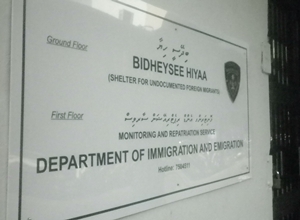
Shelter for undocumented foreign migrants, Orchid Magu, Male'

The government has in recent months launched a special campaign intended to raising awareness of the rights of foreign workers, while also last month ratifying eight “fundamental” International Labour Organisation (ILO) conventions intended to bring legislation on employee rights and trade unions in line with international standards.

However, independent institutions in the Maldives have maintained that the country is yet to ratify a core convention on protecting migrant worker rights, while no legislation is in place to punish those involved in smuggling workers though the country’s borders.

The Prosecutor General (PG’s) Office has also confirmed that a lack of legislation has meant no cases have been prosecuted against human traffickers in the Maldives at present.

“Corrupt immigration practices”

Just last month, a Maldivian trade union alleged that corrupt immigration practices and the use of unregulated employment agencies by private and state employers was limiting efforts to curb abuse of migrant workers and prevent illegal practices such as retaining their passports.

The Tourism Employees Association of Maldives (TEAM) claimed that while companies are not permitted to retain the passports of foreign workers, some hospitality operators – as well as unregulated third party agencies and government ministries – are still keeping employee travel documents without consent.

At the same time, a source with knowledge of the current immigration system told Minivan News that the practice of retaining passports – a long-standing habit of Maldivian employers – was a key contributor to human trafficking in the country.

“This is a common practice seen all over the world. But it creates major problems. If a foreigner wishes to go to law enforcement agencies for assistance, they will be asked to identify themselves with a passport,” the source said.

Third party agencies appeared to want to keep the passports to be able to “manipulate” foreign workers for their own financial advantage, the source explained.

Consistency

Meanwhile, the Human Rights Commission of Maldives (HRCM) has accused state and private sector employers in the country of lacking consistency in their efforts to address human trafficking, preventing “real” change in controlling illegal migration.

Speaking back in February 2013, HRCM member Jeehan Mahmoud told Minivan News that despite attempts under the present government to try and introduce new legislation, the Maldives had made little progress towards improving the treatment and rights of foreign workers over the last four years.

Addressing the current scope of unregistered foreign labour, Maldives Association of Construction Industry (MACI) President Mohamed Ali Janah said an estimated 40 percent of the foreign employees in the sector were thought not to be legally registered.

Considering these numbers, Janah said he could not rule out the involvement of organised crime in certain employment agencies, which supply a large amount of foreign labour to building sites in the Maldives.

Likes(0)Dislikes(0)

“So horrific that it’s hard to believe”: Amnesty International launches petition to overturn “disgraceful” flogging sentence

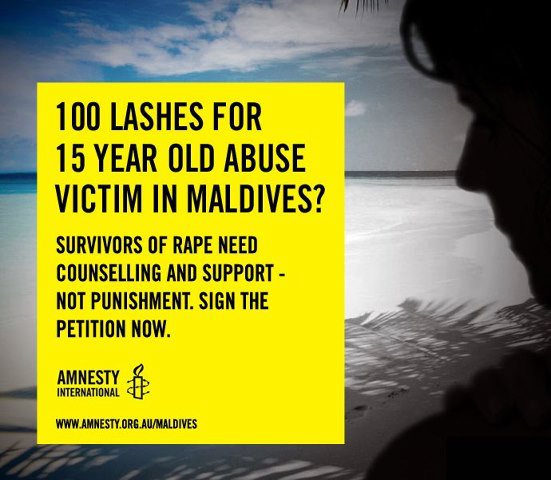
Amnesty International has launched a petition calling on the Maldivian government to overturn a court ruling sentencing a 15 year-old rape victim to 100 lashes for an unrelated fornication offence.

The story of the girl from Feydhoo in Shaviyani Atoll, who was convicted of premarital sex in the Juvenile Court February 26 and sentenced to 100 lashes and eight months of house arrest, has been reported by media around the world and been widely condemned by international NGOs and embassies.

“It’s so horrific that it’s hard to believe it’s true: a 15 year old rape survivor has been sentenced to 100 lashes for ‘fornication’ in the Maldives,” stated Amnesty International, which has followed the case since January.

“The traumatised girl was allegedly sexually abused by her step-father for many years. He has since been charged with sexually assaulting a minor. During the investigation however, authorities came across evidence to support separate charges of fornication against the girl for pre-marital sex,” Amnesty stated, demanding the government overturn the “disgraceful” sentence.

The Maldivian government – which is currently vying for re-election to the UN Human Rights Council, launched its campaign in Geneva on February 28 on a platform of “women and children’s rights and the rights of persons with disability” – expressed “deep concern” at the decision to prosecute the girl.

“Though the flogging will be deferred until the girl turns 18, the government believes she is the victim of sexual abuse and should be treated as such by the state and the society and therefore, her rights should be fully protected,” said the President’s Office in a statement.

“The government is of the view that the case merits appeal. The girl is under state care and the government will facilitate and supervise her appeal of the case, via the girl’s lawyer, to ensure that justice is done and her rights are protected,” the statement added.

Amnesty International welcomed the government’s stated commitment, but noted that “at this stage she is still facing flogging. We need to keep the pressure up to remove flogging as a form of punishment in her case and all cases in the Maldives.”

Foreign Minister Dr Abdul Samad Abdulla meanwhile announced on state broadcaster Television Maldives (TVM) that the girl had post traumatic stress disorder and certain medical issues, according to local media.

“The girl was abused since she was 12 until she turned 15, so multiple times for three years. She was abused by her stepfather. She has said that her baby was murdered. You can imagine the mental status of a child in this situation. She suffers from this condition,” local media reported Dr Samad as saying.

According to Sun Online, Dr Samad said the international community was not fully informed about the reason for the girl’s sentence, which was not due to her abuse by her stepfather, but her confessed fornication with another man.

He also warned that a failure to unite as a country during times of such international criticism would provide opportunities for “groups that want to harm the country,” Sun reported.

The government’s denouncement of the sentence is meanwhile at odds with its endorsement by the Adaathath Party, members of which make up the majority of the Ministry of Islamic Affairs.

“The purpose of penalties like these in Islamic Sharia is to maintain order in society and to save it from sinful acts. It is not at all an act of violence. We must turn a deaf ear to the international organisations which are calling to abolish these penalties, labeling them degrading and inhumane acts or torture,” the party said in a statement.

“Furthermore, Allah has decreed that expressing disapproval of issues such as this contradicts with faith in Islam,” the statement continued, quoting verses from the Quran.

“Allah has also commanded that we show no kindness when implementing these penalties,” the party added.

Flogging and politics

UN Human Rights Commissioner Navi Pillay in an address to the Maldivian parliament in November 2011 urged the government to issue a moratorium on sentencing women to flogging for extra-marital sex.

“This practice constitutes one of the most inhumane and degrading forms of violence against women, and should have no place in the legal framework of a democratic country,” Pillay stated.

Her comments were condemned by religious groups in the Maldives, with protesters urging authorities to arrest the UN High Commissioner and gathering outside the United Nations carrying signboards with slogans such as “Islam is not a toy,” “Ban UN” and “Flog Pillay”.

A presidential state apology for allowing Pillay to speak to parliament was one of the five demands of the December 23 coalition [of 2011], a mass gathering in the capital Male’ that saw the fractured opposition unite against President Nasheed on the pretext of protecting Islam.

Following the fall of Nasheed’s government on February 7 2012, government-aligned Progressive Party of the Maldives (PPM) MP Abdul Azeez Jamal Abu Bakr withdrew the Pillay apology petition in parliament.

Amnesty International’s petition:

Likes(0)Dislikes(0)

Nutrition awareness a “huge challenge” for Maldivian authorities: Children’s NGO

Informing parents and educators in the Maldives of the importance of healthy nutrition and exercise remains a “huge challenge” to child development in the country, a local charity has said.

The Advocating the Rights of Children (ARC) NGO has told Minivan News that parents in the country are still not well-informed on the best ways to promote and ensure their children are engaging in more active lifestyles and enjoying a balanced diet.

The comments were made on the second and final day of a festival launched to celebrate ARC’s Healthy Eating and Active Lifestyle (HEAL) initiative held at Iskandhar School in Male’.

Festival launch

The event began Friday (March 1) with the launch of the first in a new series of books aimed at children to try and promote the five key health objectives at the heart of the HEAL campaign, ARC has said.

According to the NGO, these focuses include: ensuring a daily intake of fruits and vegetables by emphasising colour,  encouraging drinking water as an alternative to carbonated beverages and energy drinks, and cutting down on processed foods.

ARC is also calling for a greater availability of healthy snacks for children’s diets, while encouraging physical activity over watching television and playing video games.

Despite the challenges of promoting nutrition in the country, Juna Latheef, Project Manager for the 2013 HEAL Festival, claimed that schools had shown more awareness about teaching the importance of diet and healthy activity even over last 12 months. However, she added that efforts to introduce healthy eating campaigns and other similar programm through the school curriculum were limited by budgetary restrictions.

As part of its own efforts to focus on nutrition in the country, ARC said it is using its HEAL festival to launch the first in a series of children’s books that could be used by both parents or teachers to encourage healthier lifestyles.

Each book will focuses on a child-friendly character, and will detail the key aims of the HEAL strategy, while also playing up the benefits of specific fruits and vegetables to a child’s diet, according to the NGO.  The book was made available at the festival for MVR 30 (US$2).

“Adverse dietary pattern”

In May 2012, Maldives Planning Department statistics detailing household food expenditure in the country charted a shift towards an “adverse dietary pattern”, with increased intakes of high-fat and sugary products.

Health experts in the country at the time blamed the unhealthy diet of Maldivians for the high prevalence of cardiovascular diseases and metabolic disorders such as diabetes in the country. These health factors were found to account for almost 50 percent of all deaths in the country. The comparative figure for the US was then 25 percent.

According to the Household Income and Expenditure Survey, the structure of the Maldivian diet was found to have shifted towards a “higher energy density diet with a greater role for fat and added sugars in foods, greater saturated fat intake, reduced intakes of complex carbohydrates and dietary fiber, and reduced fruit, vegetable and fish intakes.”

During World Health Day in April 2012, authorities told Minivan News that the level of malnutrition experienced in the Maldives was “quite alarming” considering other national advances in the fields of health and medicine.

Public Health Programme Coordinator for the Center for Community Health and Disease Control (CCHDC) Dr Fathmath Nazla said she was specifically concerned over the national promotion of healthy diets.  She claimed that the issue of vitamin deficiency in expectant mothers and children were among her key concerns.

The consumption of high-calorie junk food and energy drinks by young people was also raised as a serious issue for local health experts to address.

Likes(0)Dislikes(0)

Education Ministry withholding preliminary O’level result figures for 2012

Preliminary results for the 2012’s Cambridge O’Level examination have not been released due to “difficulties” in analysis, the Ministry of Education has said, despite claiming “one of the highest pass rates to date”.

O’Level exam results from 2012 show “the most progress to date”, Minister of Education Dr Asim Ahmed told local media during his speech at the University Education Fair opening ceremony on February 19.

“These are preliminary results right now. It could take a little while to get the final results, we are in the process of verifying, which could change the findings,” Asim told Minivan News.

“However, this should encourage a good increase in A’level enrollments, because more students will be eligible,” he added.

The claims were upheld by Ibrahim Shakeeb from the Education Ministry’s Department of Examinations (DPE), who told Minivan News that the results from 2012 had not yet been finalised.

“This year has one of the highest pass rates. We already know it’s one of the best results this year. Students will be celebrating.

“The preliminary results are out, however the recheck process is still ongoing and will not be completed until late March. However, there won’t be a major change in the findings. The final results will probably show a slight improvement, following the recheck process,” Shakeeb stated, but was unable to provide the preliminary figures.

Shakeeb explained that the DPE acts as a mediator by providing exams to students and sends them back-and-forth to Cambridge International Examinations. Thus, DPE receives the ‘raw’ data, while the Education Ministry’s Planning and Research section conducts the analysis and disaggregates the information.

“The Planning and Research Section may be having difficulties because Ahmed Shafeeu previously handled the analysis, however he became the Minister of Fisheries and Agriculture under President Waheed’s government,” said Shakeeb.

Former Education Minister Shifa Mohamed said it was a change in Ministry of Education practice for preliminary O’Level results not to be publicly disclosed.

Preliminary Cambridge exam results arrive in January or February, with little difference between these and the final results, she explained. Additionally, information from the provinces and islands should also be available.

“By now they should have the real results. Analysis of these findings should only require three days,” Shifa stated.

“I’m waiting to receive the statistics as per my request. I can’t understand why they are holding the [result] information or why it’s taking such a long time to analyse.

“I do not think they have done the analysis. It seems the government is dragging on it because they’re scared to show the results, because they’re not sure if they’ve achieved the marked improvement they’re aiming for,” Shifa added.

Shifa said exam results should show some improvement this year given the previously implemented programs and reforms, but said this would have depended on whether these programs were continued by President Waheed’s new government in 2012.

“Under former President Mohamed Nasheed’s government, we made it very transparent. We believe people ought to know how the budget is being spent and what kind of results the government is producing.

“I don’t think the public really knows the results these kids are producing. I think that [a current government] should actually make the people quite aware of major issues within the country,” Shifa stated.

Minivan News contacted Cambridge International Examinations, however they refused to provide statistics as well.

“This is the Education Ministry’s education policy. It is not for us to comment on the Ministry’s policy on their behalf,” a spokesperson said.

A source in the Ministry of Education told Minivan News that internally, the pass rate figure being passed around was 46 percent in 2012.

“I find very difficult to believe because that is a huge increase from 37 percent in 2011. It is very unlikely,” the source said.

“The pass rate was 35 percent in 2010 and 27 percent in 2009. Even with the numerous educational reforms implemented after [former President Mamuoon] Gayoom’s 30-year authoritarian rule ended, the Maldivian Democratic Party (MDP) government was unable to reach the nine percent increase per year needed to achieve their goal of 60 percent of students passing within five years,” the source said.

Meanwhile, students are reported to have received their O’Level exam results at the end of January.

Minivan News contacted numerous people within the Ministry of Education, who either would not release the O’Level pass rate statistics, or would otherwise not respond.

Likes(0)Dislikes(0)

Will form large coalition to “shock” Nasheed if elected: PPM Umar Naseer

Progressive Party of Maldives (PPM) presidential primary candidate Umar Naseer has revealed he intends to form a multi-party coalition should he win the PPM presidential election.

Speaking at artificial beach on Friday night (March 1) as part of his campaign rally, Naseer announced that a “wide coalition” must be formed in order to defeat the Maldivian Democratic Party (MDP) in the elections scheduled for later this year, local media reported.

Latest figures from the political party registry of the Elections Commission (EC) show that PPM currently has 22,765 members signed to its party – 23,769 members less than the MDP’s 46,533 total membership.

“It is not the way these days to do things on your own. If you give me the PPM leadership, I will form a wide coalition, God willing.

“I will attain this country’s power through a coalition that will shock Mohamed Nasheed,” Naseer was quoted as saying by Sun Online.

When Minivan News attempted to contact Umar Naseer today (February 2), his secretary stated: “Umar said we are not sharing any information with Minivan News”.

Speaking at the rally, Naseer claimed that Dhivehi Rayyithunge Party’s (DRP) refusal to form a coalition during the second round of the 2008 presidential elections had been a mistake, further claiming that should DRP decided otherwise, the MDP may not have achieved power in 2008.

“It is possible that Mohamed Nasheed could not have been able to get the last three years if the DRP had reached to other parties and formed a coalition.

“It was a strategic mistake we made that day, to not work with parties. PPM shall not make such a mistake,” Naseer said.

The PPM presidential primary candidate claimed there is now a need for leaders to work against the MDP from coming to power, assuring that he will make the effort if he wins the PPM ticket, local media reported.

Last month, the Progressive Party of Maldives (PPM) called on the Elections Commission (EC) to dissolve the Maldivian Democratic Party (MDP), calling it a “terrorism party”.

“There is the fear that MDP might come to power again. They are planning it very well. They even have the money. They are still a threat.

“This country needs strong leaders. Because this country is still not rid of MDP’s threat. I would like to tell you that if you give me the votes and elect me, I will achieve this for you,” local media reported Naseer as saying.

Likes(0)Dislikes(0)

MDP ‘Hoara’ Ibbe’s sexual assault trial scheduled next month

The trial against senior Maldivian Democratic Party (MDP) activist and former Undersecretary of the President’s Office, Ibrahim Rasheed ‘Hoara Ibbe’, has been scheduled for next month.

Rasheed stands accused of sexually abusing a 17 year-old girl in December 2012.

The Criminal Court stated that the Prosecutor General had filed the case in the court on February 19.

The Criminal Court told the media that Rasheed was charged under article [c] of the Special Measure for Perpetrators of Child Sex Abuse Act of 2009, which states that perpetrators of child sex abuse can be sentenced up to 14 years.

Ibrahim Rasheed is a well-known politician and a senior figure within the opposition MDP who  also served in the President’s Office under the former government of Mohamed Nasheed.

Rasheed was arrested on December 6, 2012, after being discovered in a house in Galolhu Ward of Male’ with a seventeen year-old girl.

The local media at the time quoted police as saying that when officers entered the room containing Rasheed, he was naked with the girl.

However, police later declined to confirm these reports.

In January 6, 2013, the Criminal Court placed Rasheed under house arrest, after keeping him in pretrial detention for a month.

According to Maldivian law, any person under 18 years of age is considered a minor.

Likes(0)Dislikes(0)

Criminal Court extends detention of suspect arrested for attack on Raajje TV journalist

The Criminal Court has extended the detention period of the suspect arrested in connection with the attack on Raajje TV senior journalist Ibrahim Waheed ‘Aswad’.

Police have not officially identified the suspect, however local media reported that the suspect was 21 year-old Ahmed Vishan.

The suspect was arrested on Tuesday while he was at his house and was summoned before the court, which extended his detention by 15 days.

The arrest was initially reported by Commissioner of Police Abdulla Riyaz, who informed the public in a tweet that a person had been arrested in what he described as a “murder attempt”.

Waheed, a senior reporter for the Maldivian Democratic Party (MDP)-aligned television station, was attacked with an iron bar while riding on a motorcycle near the artificial beach area early on Saturday morning.

The attack left him unconscious, and he was transferred to a hospital in Sri Lanka for treatment. Doctors have since said his condition is stable, and that he is recovering.

Maldivian journalists took to the streets of Male’ to protests against the recent attacks, joining international organisations who have also condemned the violence.

In July 2012, July 2012, a group of alleged Islamic radicals slashed the throat of blogger Hilath Rasheed. Rasheed, who had been campaigning for religious tolerance, narrowly survived and has since fled the country.

However, no arrests were made in connection to the case.

Likes(0)Dislikes(0)